Study of Floating and Non-Floating Columns
with and Without Earthquake
Prof. Rupali Goud
Assistant Professor Department of Civil Engineering
Shri Vaishnav Vidyapeeth Vishwavidyalaya, Indore
Abstract
This paper presents comparative study of loading and non-floating columns with and without seismic behaviour. There are numerous observations of damages caused by irregularity in buildings such as vertical irregularity is predominant to structure while earthquake excitation, the earthquake forces developed at different floor levels in building need to be brought down along the height to the ground by the shortest path, any deviation or discontinuity such as floating columns results in poor performance of building. The aim of this work is to compare the response of RC frame buildings with and without floating columns under earthquake loading and under normal loading. The effect of earthquake forces on various building models for various parameters is proposed to be carried out with the help of response spectrum analysis. The idea is to reach a definite conclusion regarding the superiority of the two structures over one another. Finally, analysis results in the building such as storey drifts, storey displacement, and amount of steel required were compared in this study.
Keywords: Floating Columns, Earthquake, Storey Drift, Story Displacements, Time history method
________________________________________________________________________________________________________
I. INTRODUCTION
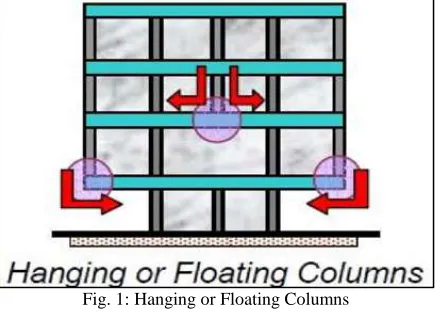
A column is supposed to be a vertical member starting from foundation level and transferring the load to the ground. The term floating column is also a vertical element which at its lower level rests on a beam which is a horizontal member. Buildings with columns that hang or float on beams at an intermediate storey and do not go all the way to the foundation and have discontinuities in the load transfer path. The beams in turn transfer the load to other columns below it. Such columns the load was considered as a point load. The previous Earthquake data provides enough evidence for behaviour of different types of structures under different seismic conditions and foundation aspects has become stuff for Engineers and Scientists. This has given various types of innovative techniques to save structures from seismic effects. Among those, Base Isolation is one of the recent techniques. The main aim of base isolation is to provide flexibility and dissipation of energy by incorporating the isolated devices so called isolators, which is provided between the foundation and the super structure. Thus, base isolation essentially dissociates the building from the ground during seismic excitation. The use of flexible layer by base isolation systems at the base of the structure will allow relative displacements between the foundation and the superstructure. Addition of isolation layer elongates the fundamental time period of the structure.
Fig. 1: Hanging or Floating Columns
II. OBJECTIVE OF STUDY
The aim of this work is to compare the response of RC frame buildings with and without floating columns under earthquake loading and under normal loading. The major objectives of this work are as follows:
The primary aim of this work is the comparative study of floating columns and non-floating columns with and without seismic behaviour.
Determination of seismic response of both the models by using response spectrum analysis in Staad Pro. Software. Finding out effects on various parameters of RC building under seismic events due to presence of floating columns. To determine which structure is superior to another in higher earthquake zones.
III. METHODOLOGY
These analysis methods, both elastic and inelastic, are available to predict the seismic behavior of the structures. A Response Spectrum Analysis (RSA) will be carried out using StaadPro. Software.Staad Pro.is a fully integrated program that allows model creation, modification, execution of analysis, design optimization, and results review from within a single interface. Staad Pro.is a standalone finite element based structural program for the analysis and design of civil structures. It offers an intuitive, yet powerful user interface with many tools to aid in quick and accurate construction of the models, along with sophisticated technique needed to do more complex projects. A total 2 number of problems will be taken for, with and without floating columns and for with and without seismic behaviour. The problems will include comparative study of seismic analysis of building without floating columns, seismic analysis of a building with floating columns. The output results will be expressed in terms of story displacements, inner-storey drift, and comparison of amount of steel and concrete required in different cases.
Fig. 2: Period shift effect of fixed base and base isolated building
Modelling & Analysis:
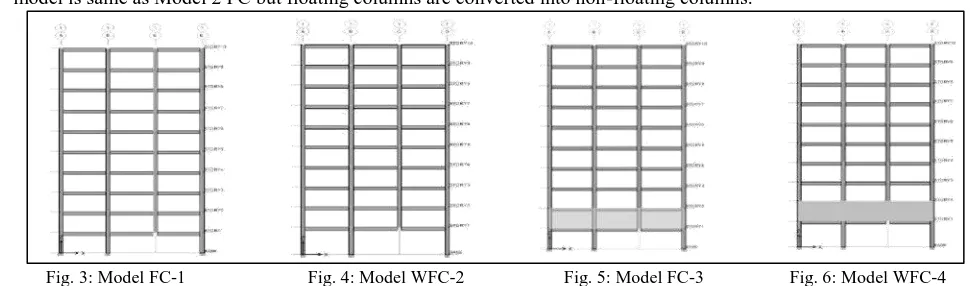
Two buildings with floating columns and without floating columns were analysed for seismic loading. The building chosen was 16m high buildings. To study the effect of seismic loading the buildings were modified in four different ways so that total number of cases is four namely:
1) Model 1 FC: Where 8 floating columns are provided. Height of per story is 3m.
2) Model 2 WFC: This model is same as Model 1 FC but floating columns are converted into non-floating columns.
3) Model 3 FC: This is another building where 4 floating columns are provided. Height of per story is 3m. Model 4 WFC: This model is same as Model 2 FC but floating columns are converted into non-floating columns.
Fig. 3: Model FC-1 Fig. 4: Model WFC-2 Fig. 5: Model FC-3 Fig. 6: Model WFC-4
Loadings Considered:
3) Exterior Wall Load = 16 kN / m Interior Wall Load = 10 kN / m2 4) Earthquake Load – As per IS 1893 (Part-I):2002
For analysis of structure, 13 load combinations were considered
Load Combinations:
Load Combinations considered for static analysis are as follows: 1) 1.5(DL+LL)
2) 1.2(DL+LL+EQX) 3) 1.2(DL+LL-EQX) 4) 1.2(DL+LL+EQY) 5) 1.2(DL+LL-EQY) 6) 1.5(DL+EQX) 7) 1.5(DL-EQX) 8) 1.5(DL+EQY) 9) 1.5(DL-EQY) 10) 0.9DL+1.5EQX 11) 0.9DL-1.5EQX 12) 0.9DL+1.5EQY 13) 0.9DL-1.5EQY
Parameters and Different Aspects of Study:
Section Displacement:
Net displacement of each floor with respect to fixed point at ground is studied.
Storey Drift:
Controlling storey sway or inter storey drift of a building is an important aspect because: 1) It prevents pounding of adjacent buildings in urban areas.
2) It prevents shear (brittle) failure.
3) It restricts damage to fragile non-structural elements, which can be costlier than the building. 4) Drift limitation provides stability to individual column as well as the structure as a whole. 5) Limited drift also provides comfort to occupants of such buildings.
As per clause 7.11.1 of IS 1893 (Part I):2002, the storey drift in any storey due to specified design lateral force with partial load factor of 1 shall not exceed 0.004 times the storey height.
Drift Reduction Factor:
Use of shear walls with frame changes in the drift values. Therefore drift reduction is one parameter to be studied. It is equal to ratio of difference of Storey drift without shear wall and with shear wall to storey drift without shear wall.
IV. RESULT AND DISCUSSION
Analysis was carried out by using Extended Three Dimensional Analysis of Building Systems Staad Pro Vi8 software and following results were obtained:
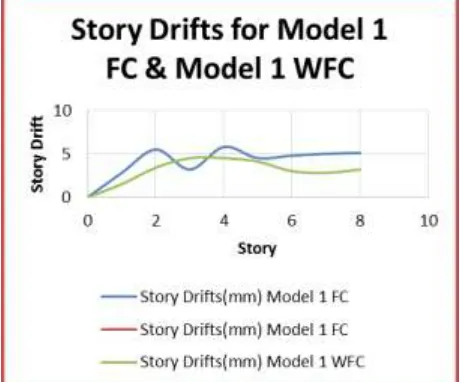
Table – 1 Story Story Drifts(mm)
Mode1 FC Model 1 WFC
0 0 0
1 2.8 1.5
2 5.5 3.4
3 3.2 4.5
4 5.8 4.5
5 4.5 4.1
6 4.8 3
7 5 2.8
8 5.1 3.2
Fig. 8: Displacements for Model 1 FC & Model 1 WFC
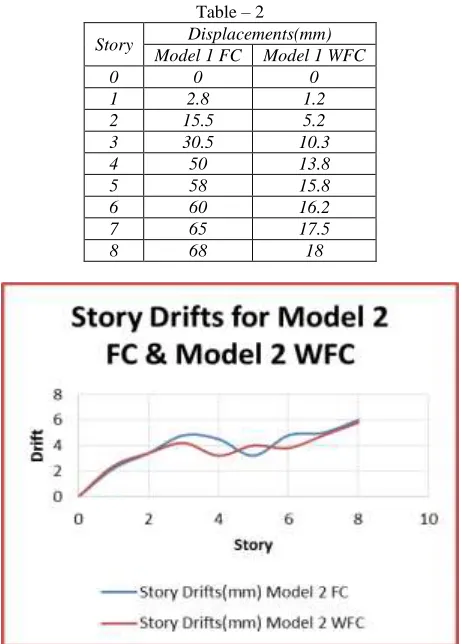
Table – 2
Story Displacements(mm) Model 1 FC Model 1 WFC
0 0 0
1 2.8 1.2
2 15.5 5.2
3 30.5 10.3
4 50 13.8
5 58 15.8
6 60 16.2
7 65 17.5
8 68 18
Table – 3
Story Story Drifts(mm) Model 2 FC Model 2 WFC
0 0 0
1 2.2 2.4
2 3.4 3.4
3 4.8 4.2
4 4.5 3.2
5 3.2 4
6 4.8 3.8
7 5 4.8
8 6 5.8
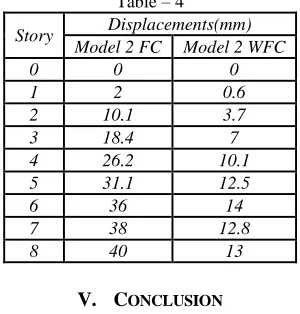
Fig. 10: Displacements for Model 2 FC & Model 2 WFC
Table – 4
Story Displacements(mm) Model 2 FC Model 2 WFC
0 0 0
1 2 0.6
2 10.1 3.7
3 18.4 7
4 26.2 10.1
5 31.1 12.5
6 36 14
7 38 12.8
8 40 13
V. CONCLUSION
This study presents the study of comparison without floating column and with floating column structures and design of seismic isolation systems and influence of base isolation on the response of structure under seismic loading. Based on analysis results and graphs following conclusions are made.
1) Structures with short natural period will suffer higher accelerations. Thus the increase in period of the structure with isolated base makes sure that the structure is completely safe from the resonance range of the earthquake.
2) The building with floating columns experienced more storey shear than that of the normal building. This will increase the structural member sizes. So the floating column building is uneconomical to that of a normal building.
3) Lateral displacements are more in time history analysis compared with other two method of analysis.
4) Maximum displacement is increased in floating column model when compared with without floating column model. 5) The decrease in the base shear in base isolated model compared to fixed base models is due to the decrease in spectral
6) The inter storey drift is maximum at 3rd level in without floating column model and 1st level in with floating column model in three cases of analysis.
7) Inter storey drift are more in time history case as compared with other two methods.
8) Inter storey drift at each floor for the building it is seen that building with floating column will experience extreme inter storey drift than the normal building.
VI. FUTURE SCOPE OF STUDY
1) Different types of dampers can be adopted for analysis of structures.
2) Comparison can be made between the performances of different base isolators using floating column structures. 3) Pushover analysis for floating column and base isolated structures can also be performed.
REFERENCES
[1] Ms. Minal Ashok Somwanshi and Mrs. Rina N. Pantawane (2015), “Seismic analysis of fixed based and base isolated building structures”. International Journal of Multidisciplinary and Current Research, volume 3, pp: 747-757.
[2] Sarita singal Er. Ashfi Rahman (2015) “Effect of floating columns on seismic response of multi-storeyed rc framed buildings”. International Journal of Research in Engineering and Technology, Volume 4 Issue: 6 pp: 1131-1136.
[3] Swathirani.K.S,Muralidhara.G.B, Santoshkumar.N.B (2015), “Eatrhquake response of reinforced cocrete multi storey building with base isolation”. Volume 4, Issue 10, pp: 158-167.
[4] Nikhil Bandwal, Anant Pande, Vaishali Mendhe, Amruta Yadav(2014), “To study seismic behaviour of rc building with floating columns”. International journal of research in engineering, science and technologies, volume 3, issue 8, pp: 1592-1596.
[5] Srikanth.M.K, Yogeendra.R.Holebagilu (2014), “seismic response of complex buildings with floating column for zone ii and zone v”. Volume 2, issue 4, pp. 2321-7758.
[6] Md.Arman Chowdhury, Wahid Hassan (2013), “Comparative study of the dynamic analysis of multi-storey irregular building with or without base isolator”. International Journal of Scientific Engineering and Technology Volume 2, Issue 9, pp: 909-912.
[7] Shrikhande M. and Agrawal P., “Earthquake Resistant Design structure”, Tata McGra Hill Publication, 10th Edition 2004. [8] Duggle S.K., “Earthquake Resistant Design Structure”, Tata McGra Hill Publication, 10th Edition 2004.
[9] K.V. Sudheer Dr. E. Arunakanthi (2015), “Design and analysis of a high-rise building with and without floating columns”. International Journal for Scientific Research & Development, Volume 3, Issue 10, pp: 760-65.
[10] Duggle S.K., “Earthquake Resistant Design Structure”, Tata McGra Hill Publication, 10th Edition 2004. [12]Indian Standard Criteria for Earthquake Resistant Design Structure 1839-2002.
[11] V. Harshitha, E. Arunakanthi (2015), “Seismic control of symmetric and asymmetric framed structures by base isolation method”. International research journal of engineering and technology, Volume 2, Issue 5, pp: 887-890.