A New Energy-Efficient Cluster based VANETS
through AODV Protocol
Miss. Thasneem. D Mrs. Suganthi. B
M.E Student Associate Professor
Department of Computer Science and Engineering Department of Computer Science and Engineering RVS College of Engineering & Technology, Coimbatore India RVS College of Engineering & Technology, Coimbatore India
Abstract
Vehicular ad hoc Network (VANET) could be a part of Mobile ad hoc Networks (MANET). Wireless communication among vehicles and static road facet infrastructure is provided by VANET. The communication among vehicles is vital for comfort, safety and for entertainment purpose likewise. The reason for this paper display a technique in view of a settled key framework for discovery pantomime attack, as such, Sybil attack, in the vehicular specially appointed system. This attack puts an awesome effect on execution of the system. The proposed technique, utilizing a cryptography system to identification Sybil attack. The communication performance depends on the routing protocols that area unit being used in network. during this paper, we've improved the performance of Ad-hoc on Demand Distance Vector (AODV) routing protocol by using some parameters i.e. Active route time outs and hello interval to decide on the simplest path for routing and compared the proposed AODV protocol performance with traditional AODV in terms of various performance metrics i.e. average throughput, average delay and average network load. We’ve used a simulation tool “NS2” for performance analysis. Results show that proposed AODV routing protocol has higher performance as compared to traditional AODV.
Keywords: VANET, MANET, Ad-hoc, AODV
________________________________________________________________________________________________________
I. INTRODUCTION
An ad hoc network is a network that is composed of individual devices communicating with each other directly. The term implies spontaneous or impromptu construction because these networks often bypass the gate keeping hardware or central access point such as a router. Many ad hoc networks are local area networks where computers or other devices are enabled to send data directly to one another rather than going through a centralized access point.
The growth of the increased number of vehicles are equipped with wireless transceivers to communicate with other vehicles to form a special class of wireless networks, known as vehicular ad hoc networks or VANETs. To enhance the safety of drivers and provide the comfortable driving environment, messages for different purposes need to be sent to vehicles through the inter-vehicle communications. Unicast routing is a fundamental operation for vehicle to construct a source-to-destination routing in a VANET. Multicast is defined by delivering multicast packets from a single source vehicle to all multicast members by multi-hop communication. Geocast routing is to deliver a geocast packet to a specific geographic region. Vehicles located in this specific geographic region should receive and forward the geocast packet; otherwise, the packet is dropped. Broadcast protocol is utilized for a source vehicle sends broadcast message to all other vehicles in the network.
VANETs inherit some of the characteristics such as mobile nodes and self-organizing behavior from MANETs. However, VANETs possess certain unique characteristics such as high mobility of nodes, time varying density of nodes, frequent disconnections, highly partitioned network and dynamically changing topology, which makes them more challenging. It is a challenge to construct networks between vehicles and ensure reliable, continuous and secure communication among the vehicles in motion. Routing in VANETs is a key issue. This paper focuses on the issues related to routing in VANET environment and presents a detailed review of various routing protocols for vehicular ad hoc networks.
There are various types of possible attacks on VANETs. It is imperative that VANET security should be capable of handling every type of attack. VANET security is different from that of wireless and wired networks because of its unique characteristics of mobility constraints, infrastructure-less framework, and short duration of link between nodes. In a wired network, infrastructure has components for specific functions, for example, routers decide the route to destination while network hosts send and receive messages. Security implementation is relatively easy as networks need to be physically tampered for eavesdropping. Wireless networks use infrared or radio frequency signals to communicate among devices. These networks can be either (a) infrastructure based or (b) infrastructure-less. Infrastructure-based wireless networks are based on Public Switched Telephone Network (PSTN) switches, MSCs, base stations, and mobile hosts. In ad-hoc networks, a type of infrastructure-less wireless networks, nodes perform all operations such as routing, packet forwarding, and network management, and so on. The existing security solutions use traditional digital signature and certificates using Public Key Infrastructure (PKI).
efficient in VANETs as node misbehavior can be detected through collaboration between the number of nodes by assuming that majority of nodes are honest.
In vehicular ad-hoc network (VANET), vehicles are exchanged information such as their status, accidental, potentially dangerous situations and in the form of messages between each other. With interpreting and processing these messages, drivers become aware of the situation and appropriate decisions are taken to prevent accidents. Obviously, the publication of false information in addition to reduce network performance lead to financial and even physical damage. Sybil attack is a serious threat as it impairs the functionality of VANETs. In this attack, an attacker node sends messages with multiple identities to other nodes in the network. The attacker simulates several nodes in the network. The node spoofing the identities of other nodes is called malicious node/Sybil attacker, and the nodes whose identities are spoofed are called Sybil nodes. Almost every other attack can be launched in a network in the presence of Sybil attack. One possibility could be an illusion of a traffic jam or accident so that other vehicles change their routing path or leave the road for the benefit of the attacker.
AODV Routing Protocol
AODV is an on routing protocol. This protocol finds routes for an only when it has data packet for transmission. The Ad-hoc On-Demand Distance Vector (AODV) routing protocol is designed for use in ad-hoc mobile networks. AODV is a reactive protocol: the routes are created only when they are needed. It uses traditional routing tables, one entry per destination, and sequence numbers to determine whether routing information is up to-date and to prevent routing loops An important feature of AODV is the maintenance of time-based states in each node: a routing-entry not recently used is expired. In case of a route is broken the neighbors can be notified. AODV is for networks containing numerous nodes.
II. LITERATURE SURVEY
A New Energy-Efficient Cluster-Based Routing Protocol Using a Representative Path in WSN Wireless sensor networks (WSNs) have been broadly studied in ubiquitous computing environment because of its widespread utilization. The application area of WSNs includes environmental management, health-care services, and military monitoring. WSNs are composed of many sensor nodes equipped with processors, memory, and short-range wireless communication. In real applications, the sensor nodes are distributed in the areas of interest, and they sense data from surrounding environments. The sensor nodes cooperate with each other to transmit the sensed data to the central base station, called sink node. A routing protocol is a way of determining a path between a source node and a destination (i.e., sink node) for sensed data transmission. The efficiency of WSNs is highly dependent on routing protocols that directly affect the network lifetime. The main objective of routing protocols is to enhance both reliability and lifetime of WSNs by considering the capability of a sensor node with resource constraints, such as limited power, slow processor, and low communication bandwidth. Hence, the challenging issue of routing protocols is to reduce the communication overhead for data transmission by determining an optimal path.
Hyunjo Lee, Miyoung Jang, Jae-Woo Chang propose an energy-efficient cluster-based routing protocol using a representative path. To generate a representative path, we adopt a centralized clustering approach by using the message success rate of a sensor node. By using a representative path, a sink node selects cluster headers and generates clusters in a distributed manner. Therefore, the burden of network configuration and routing from sensor nodes can be greatly reduced. Ideally, nodes with high connectivity should become a cluster header to increase the lifetime of network. Our energy-efficient routing protocol consists of four phases: network information table generation, representative paths construction, cluster generation, and cluster management.
Simulation of New AODV-FH Routing Protocol Based On AODV in VANET
The wealth of information that could be obtained from vehicular networks is quite large, ranging from location and speed of alerts and request for roadside assistance. Particularly many envisioned safety related applications require that the vehicles continuously broadcast their current position and speed in so called heart beat messages. This messaging increases the awareness of vehicles about their neighbors’ where about sand warns drivers off dangerous situations. But the very exorbitant information also threatens to cause deployment to come to a grinding halt if there is adverse consumer reaction to technology. In this paper we start the discussion with the introduction of vehicular adhoc networks. Next we specify various unique characteristics of VANET that differentiate it from MANET. We then examine AODV routing techniques for VANET and make a improvement in it. Then we describe AODV-FH routing technique in detail and give simulation results of AODV-FH onNS2. Important VANET applications are for traffic safety to avoid road accidents; potentially including safety of-life. These applications have high requirements with respect to real time and reliability. The end-to end delay of seconds can result a safety information meaningless.
A Noble routing protocol for vehicular ad hoc networks (VANETs) with less routing overheads
A Novel Wireless Fire Alert System Using Harmony Search Algorithm
A wireless sensor network consists of a large number of small size sensor nodes which form an adhoc distributed network and able to communicate unlethered within a short distance. The sensor nodes have stringent power limitation and replenishment of power is impossible in some application. Due to the strict energy constraint, the energy resource of sensor networks should be managed wisely to extend the lifetime of sensors in order to attain high energy efficiently and increase the network scalability, sensor nodes can be structured into clusters. Clustering can obviously reduce energy consumption and thus save power.
The network lifetime of a sensor and the lifetime of a network which directly determines the duration of sensing task, is limited by the amount of energy each sensor has. Therefore, when we examine these networks, the efficient use of energy is a primary concern. The main issue of our interest is to maximize the lifetime of a sensor network for a given amount of energy.
Relay Node Selection of Opportunistic Routing Algorithm with Sleep Mode in WSN
Multipath routing can reduce the need for route updates, balance the traffic load and increase the data transfer rate in a wireless sensor network, improving the utilization of the limited energy of sensor nodes. However, previous multiple path routing methods use flooding for route discovery and transmit data with maximum power regardless of need, which results in waste of energy. In the existing works on sleep mode in WSNs there exist a pair of targets: purpose coverage and node coverage. The Awake nodes in each epoch square measure chosen to cover every purpose of the deployed field in purpose coverage. Existing purpose coverage oriented algorithms dissent in their sleep designing goals: minimizing energy consumption or minimizing average event detection latency. For the purpose of node coverage, awake nodes square measure to construct a globally connected network such each asleep node may be a quickly neighbor of a minimum of 1 awake node.
III. RELATED WORK
In recent years, there are several studies on routing-related parameters, like connectivity-related parameters and density of the distributed nodes, in 1-D queue networks. Previous works studied the connectivity probability of two certain nodes versus the entire network. Other work investigated on uniformly and independently distribution under the assumption that the transmissio n range is fixed among sensor nodes. Some energy-efficient approaches have been explored in the literature. As transmitting data consumes much more energy than other tasks of sensor nodes, energy savings optimization is realized by finding the minimum energy path between the source and sink in WSNs. In the theoretical analysis about the optimal power control and optimal forwarding distance of each single hop was discussed. There is a tradeoff between using high power and long hop lengths and using low power and shorter hop lengths. With this in mind, minimum energy consumption can be achieved when each sensor node locates with the optimal transmission distance away from others in dense multihop wireless network. The most forward within range (MFR) routing approach has also been considered in 1-D queue networks, which chooses the farthest away neighboring node as the next forwarder, and eventually results in less multihop delay, less power consumption. Another approach proposed in reduces the total consumed energy based on two optimization objectives, i.e., path selection and bit allocation. Packets with the optimum size are relayed to the fusion node from sensor nodes in the best intermediate hops. Surprisingly, the benefit of optimal bit allocation among the sensor node has not been investigated in 1-D queue networks.
The unreliable wireless links makes routing in wireless networks a challenging problem. In order to overcome this problem, the concept of opportunistic routing was proposed. Compared with traditional best path routing, opportunistic routings, such as extremely opportunistic routing (ExOR), geographic random forwarding (GeRaF), and efficient QoS-aware geographic opportunistic routing (EQGOR), take advantage of the broadcast nature of the wireless medium, and allow multiple neighbors that can overhear the transmission to participate in forwarding packets. However, these routing protocols did not address exploiting OR for selecting the appropriate forwarding list to minimize the energy consumption, and optimize the design of an energy-efficient
OR protocol for wireless networks. Mao et al. introduced an energy efficient opportunistic routing strategy called energy efficient
opportunistic routing (EEOR), which selects a forwarder set and prioritizes them using energy savings optimization solution of forwarding data to the sink node in WSNs. While all of these routing methods to improve the energy.
IV. EXISTING WORK
V. PROPOSED WORK
In Proposed Methodology we use LB-VANET which will be joining Location based system that can address vehicle traveler inclinations and deliver content of their advantage. The client server engineering incorporates a server in the back-end which stores the content and can recover the content based on inclination and area data. A Roadside unit (RSU) RSU is a middle person for communication among Server what's more, client and the vehicles as clients (hubs).
In view of the characterized mobility parameters (distance and energy) for proposed procedure, it will be chosen whether to pick direct communication between two vehicles or through Road side Unit. Distance Threshold is characterized as a standard incentive for examination. Euclidean Distance strategy is utilized for ascertaining the distance between source and destination.
Euclidean distance = Dsd=√(x1 − x2)2 (y1 − y2)2
Where s(x1, y1) and d(x2, y2).
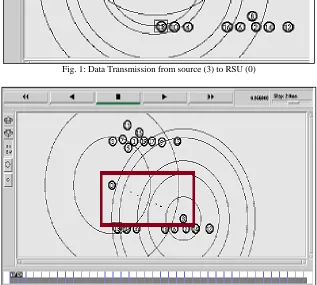
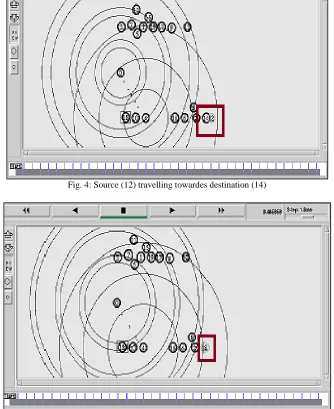
Calculated value is then compared and resulting value will then choose which mode of transmission should be picked. Following figures shows the snapshot of network topology wherein data delivery is initiated, vehicle 3 is sending a data packet to vehicle 8 via channel as Road side unit (Transmission - by means of channel) and vehicle 12 is sending an data packet to vehicle 14 by specifically experiencing vehicle (Transmission – specifically through vehicle).Fig.1 and Fig.2 demonstrates the transmission by means of channel from node 3 to node 8 following a way from (source (3)- RSU destination).
Fig. 1: Data Transmission from source (3) to RSU (0)
Fig. 2: Data Transmission from RSU (0) to destination (8)
Fig. 3: Data Transmission from source (12) to destination (14)by directly moving towards it
Fig. 4: Source (12) travelling towardes destination (14)
VI. SYBIL ATTACK
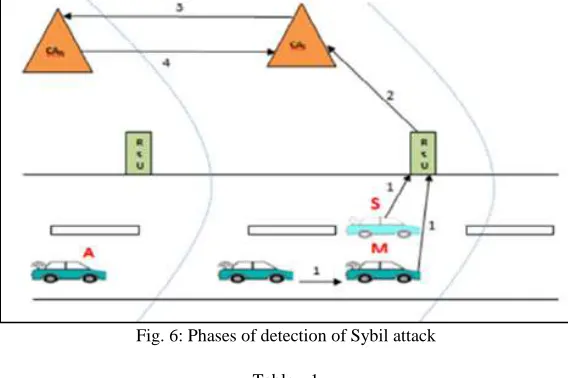
Sybil attack detection phases is shown in Figure 1 in this figure malicious node with M, Sybil node with S and The Node that is the identity of his spoofing with A is labeled.
In phase1, each vehicle should be registered in a group and receive its public authentication key (AK) before any message transmission. For signing a message, the vehicle uses group authentication key and encryption function and sends it along with original message to other vehicle and RSU. Therefore it is not obligatory for each member to have other members’ private information such as their identity and public key for authenticating them. Receivers verify a member’s authenticity by signature verification. It’s attained by reconfirmation of encryption function with authentication key to the received message and comparing the result to the signature. Also, receivers can make sure of transmitted data integrity.
{M, HAK(M), CAh, OBUID } OBUID, is as follows:
OBUID = {IDA, HSKA (IDA | H AK (M))}CA
In phase2, Because RSU don’t have a private key of CAl, so RSU cannot decrypt the message. It sending a request to CAl to decrypted of the OBUID, in this phase decrypted only IDA.
In phase3, because CAl don’t have private key of vehicle A, so CAl cannot decrypted HSK(IDA |HAK(M)), therefore send a request private key of vehicle A to the CAh.
In phase4, CAh reply private key of vehicle A to CAl and CAl attained by reconfirmation of encryption function with key of vehicle A to the (IDA|HAK(M)) and comparing the result to the HAK (IDA|HAK(M)). Also, CAl can detect the Sybil attack, if result of this comparison is different. The Notations used during a Message transmission in 4 phase are shown below. EH(PUAK(M)) from source node S
EH(SKA(IDA| HAK(M))) from source node S E(PUCA(IDA, HSKA(IDA| HAK(M)))) from node S
SEND(RQST(M,HAK(M),CAh,OBUId) from source node S to local RSU other vehicle in local region) EH(PUAK(M)) in RSU and IF(HAK(M)==HAK(M)) THEN go to step 7 else go to step 6
6- REPORT to CAl “the message is fault” D(SKCl(IDA, HSKA(IdA| HAK(M))) in CAl REQST(PUA) to CAh
RPLY(PUA) to CAl
EH(SKA(IDA|HAK(M))) and IF(HSKA(IDA|HAK(M))==HSKA(IDA|HAK(M))) THEN Sybil attack detect.
Fig. 6: Phases of detection of Sybil attack
Table - 1 Notation
Notation Means
RQST Request from source node RPLY Reply from VANET server SEND Send key from VANET server to destination E (…) Encryption of Message
EH(…) Encryption of Message with hashing function D (…) Decryption of Message
M Original message
AK Shared key between all nodes is located in a area HAK(M) Encryption message with Key AK
CAh Home CA or initial CA
CAl Local CA
IDA Identifier of vehicle
VII.CONCLUSION
We will propose an increased AODV protocol which will improve the performance problems on common AODV protocol mistreatment location primarily based cluster mechanism thus on improve the route discovery part and can conjointly contribute to minimize the energy consumption needed throughout the data transmission part by incorporating 2 tier mechanisms. Sybil attack depends on the number of messages not to number of vehicles. In our future work we would like to discover location of malicious node, because this nodes is important problem in this type of attacks, prevents of other attacks if malicious nodes is identify. This proposed schema have a problem, that, if nodes move to other rejoins, detection of Sybil attack does not work properly, so in future work we would like to improve this method to detection of Sybil attack execute properly and completely.
REFERENCES
[1] Bhattacharje, P. K. and Roy, U. (2010), A Novel Approach for Authentication Techniques in Vehicular Ad Hoc Network.
[2] U.S. Department of Transportation, “Intelligent Transportation Systems (ITS) Home”, http://www.its.dot.gov/index.htm, February 2012.
[3] A.K. Saha and D.B. Johnson. “Modeling Mobility for Vehicular Ad Hoc Networks”, Deparment of Computer Science, Rice University, Houston, USA. [4] Car-to-Car Communication Consortium, http://www.car-tocar.org., February 2012.
[5] Z. Li, Z. Wang and C. Chigan, “Security of Vehicular Ad Hoc Networks for Intelligent Transportation Systems in Wireless Technologies”, Nova Science Publishers, 2009.
[6] Dedicated Short Range Communications (DSRC) Home. http://www.leearmstrong.com/DSRC/DSRCHomeset.htm, 22 September 2005. [7] Y. Qian and N. Moayeri, “Design Secure and Application Oriented VANET”, National Institute of Standards and Technology,
http://www.antd.nist.gov/pubs/Yi-Paper7.pdf S
[8] Alshear, H. and Horlait, E. (2005), an optimized Adaptive Broadcast Scheme for Inter-Vehicle Communications, IEEE Vehicular Technology Conference, Stockholm, Sweden.