ISSN (Online): 2320-9364, ISSN (Print): 2320-9356
www.ijres.org Volume 7 Issue 4 Ser. I ǁ 2019 ǁ PP. 12-22
Obtaining Hydrocarbon Rich Bio-Oil Via Catalytic Co-Pyrolysis
of Plastic Wastes And Spirulina Sp. Microalgae
Gamze Özçakır
a,*, Ali Karaduman
ba Bilecik Şeyh Edebali University, Faculty of Engineering, Department of Chemical Engineering, Gülümbe Campus, 11230, Bilecik, Turkey
b Ankara University, Faculty of Engineering, Department of Chemical Engineering, Dögol Street, 06100, Tandoğan, Ankara, Turkey
*Corresponding Author. Gamze Özçakıra
Abstract: Synergic effect of microalgae, polystyrene and low density polyethylene on the co-pyrolytic bio-oil
product yield and composition were investigated. Spirulina in powder form was used as microalgae source, while the mixture of polystyrene and low density polyethylene were used as the source of plastic wastes. All experiments were done with 25 mL/dk carrier gas flowrate, 10 °C/min heating rate and 60 min duration in semi-batch reactor.In the thermal co-pyrolysisexperiments, it was studied under different algae to plastic wastes feedstock ratio (1/1, 1/2, 2/1) at 570 °C. Catalytic co-pyrolysis was carried out with 1/30, 1/15, 1/10 catalyst to feedstock ratio and 10 % wt./wt. metal doped ZSM-5. BET, SEM and XRF analysis were done for the catalysts. Product yield were calculated and bio-oil product were characterized by GC-MS.Keywords:
Microalgae, co-pyrolysis, plastic solid waste, bio-oil, zeolite catalyst--- --- Date of Submission: 27-11-2019 Date of Acceptance:12-12-2019 --- ---
Graphical abstract
Statement of Novelty
Plastic waste and zeolite catalyst were used together in the first time to upgrade bio-oil directly for Spirulina under the slow pyrolysis conditions. Catalyst characteristic were determined clearly.
I.
INTRODUCTION
Nowadays, studies on alternative energy sources have became crucial. Decrease in the amounts of fossil fuels, which occured naturally in the earth like carbon-rich petroleum, natural gas and coal, constitute one reason of this case.Additionally, using fossil fuels have caused environmental problems like increase in carbon dioxide emissions which is one of the greenhouse gases.This also constitutes another reason why researchers have put emphases on alternative energy sources [1, 2].
Microalgaeas a feedstock, which can be used to produce renewable energy,have several advantages. They can be cultivated in sewage or barren fields. Their growth period is quite short. Besides these, they are carbon-neutral. That is, when their energy use as fuel, it doesn’t occur any increase in carbon dioxide emission in the atmosphere [3].But, bio-oil, that is the organic phase of algal pyrolytic liquid product, is not suitable to become fuel directly because of its low hydrocarbon content and other several disadvantages, like its high viscosity and low volatility. However these feedstock mainly composes of valuable compounds which have nitrogen or oxygen functionality [4].
Plastic solid wasteindicatesrecyclable thermoplastic polymer mainly [5]. They behave like the fluids when temperature increases over specified value with pyrolysis [6]. Hence, obtaining gas or liquid product from
570 °C 33 % Spirulina+ 67 % Plastic Wastes
1/10 HZSM-5/Feedstock 1/15 HZSM-5/Feedstock 1/30 HZSM-5/Feedstock
1/30 NiZSM-5/Feedstock
1/30 CoZSM-5/Feedstock
LDPE PS Spirulina
themis possible. Because the liquid is rich of hydrocarbons, like fossil fuels, the liquid has importance as an energy source[7].
It had been estimated that co-pyrolysis of plastic wastes with microalgae can provide various advantages. Fuel quality of the bio-oil can be increased by virtue of hydrogen joining in bio-oil from plastic wastes [8]. This way may be alternative tothe process of hydrogenation under high pressure condition,which was applied to heal bio-oil fuel quality,after bio-oil from pyrolysis was obtained [9]. Addition to this, it was expected to increase in bio-oil yield with this way since it has been known that pyrolytic liquid yield of plastic wastes have almost been higher than biomass’ [10].
Catalyst using in pyrolysis has been known as another way to increase bio-oil quality. Zeolite catalysts has been widely used in biomass pyrolysis. Because zeolite catalysts crak compounds which have nitrogen or oxygen in microalgal bio-oil and by releasing nitrogen and oxygen to gas product they convert them to aromatic hydrocarbons[11].Due to that reason, the main disadvantage of this way have seemed as decrease in bio-oil yield.
There have been plenty of studies about thermal [12, 13, 14] and catalytic [15, 16, 17, 18] co-pyrolysis of plastic wastes and biomass. However, it was found a few study about thermal co-pyrolysis microalgae and plastic wastes [19, 20]. In addition, it was not found any research about the catalytic co-pyrolysis of microalgae and plastic wastes currently.
Within the scope of the study, it was investigated that chemical recovery from microalgae and plastic wastes with co-pyrolysis. Accordingly, effects of algae to plastic wastes ratio in the feedstock, catalyst to feedstock ratio and the effect of metal doping to catalyst on the pyrolytic liquid amount and chemical composition were examined. All pyrolytic product yield were calculated. Chemical composition of the bio-oil was characterized with GC-MS. Besides that, BET, SEM and XRF analysis to the catalyst and elemental analysis to the microalgae were done. After the experiments, coke deposition on the catalysts were computed with coke analysis.
II.
MATERIALS AND METHODS
2.1 FeedstockPolystyrene (PS) and Low Density Polyethylene (LDPE) were used as plastic waste. In the experiments, source of PS waste was white foam trays which had been used for putting blood collection tubes in hospitals. LDPE as F2-12 type was supplied from Petkim Petrokimya Holding A.Ş. Any pre-treatment was not practiced for LDPE. However sliced PS foam was dried in oven at 125 °C throughout 120 min before pyrolysis.
Spirulina in powder form was bought from a local herbalist. Particle size measurement of the Spirulina was made by using Malvern Mastersizer 2000 Particle Size Analyzer. According to the analysis results, average particle size of the sample was detected 37 µm by volume. Elemental (Ultimate) analysis of Spirulina was performed by utilizing Leco brand and CHN628 model with Sulfur add-on module equipment. Result of the analysis was shown in Table 1.
Table 1. Elemental composition of microalgae (wt. %, ash free and dry basis)
C H N S O*
46.69 6.22 10.76 1.55 34.78
*by difference
2.2 Catayst Preparation
ZSM-5 zeolyt in hydrogen form (HZSM5) was used as support of catalyst in the catalytic pyrolysis experiments. ZSM-5 powderin ammonium form was supplied from Zeolyst International. 10 % (wt./wt.) Nickel (Ni) or Cobalt (Co) metals whose water soluble salts were supplied from Acros Organics and Surechem Products respectively was doped in catalyst as active component. Besides metal doped ones, effect of HZSM5 on liquid product composition was also investigated.
1.3 Characterization of Catalyst
Brunauer–Emmett–Teller (BET) surface areas of the catalysts were determined by using a surface area and particle size analyzer whose brand and model are Quantachrome and Nova 2200 respectively. Pure Nitrogen was used as adsorptive gas in the equipment. Degas procedure before the analysis was made through 18 hours at 100 °C under vacuum. Hence, physical properties of the catalysts which were found with the analysis were shown in Table 2.In this table, non-doped ZSM-5, %10 (wt./wt.) Ni-doped ZSM-5 and %10 (wt./wt.) Co-doped ZSM-5 were represented as HZSM5, NiZSM5 and CoZSM5 respectively. Regarding analysis results, it was seemed that impregnating metals to the catalyst was decreased surface area and total pore volume compared to the non-doped one. Besides that, all catalysts possess mesopore class with respect to average particle size. This results overlap the results of the study which belongs to Dewajani et al. (2016) [21]. Adsorption isoterms based on the data which was obtained from BET analysis were given in Figure 1. Considering these figure, it can be told that adsorption isoterms are in the class of Type 4 which is observed in the solids with mesopores. In addition that, it was seemed that hysteresis curves in the isoterms are in the class of H2 which occurs due to the pores like ink bottle.
Table 2. Physical properties of the catalysts
Property (unit) HZSM5 NiZSM5 CoZSM5
BET Surface Area (m2g-1) 280.698 237.485 239.134
Total Pore Volume (cm3g-1) 0.263 0.240 0.238
Average Pore Size (Å) 18.7 20.2 19.9
Figure 1. Adsorption isoterms for HZSM5 (a), NiZSM5 (b) and CoZSM5 (c)
Figure 2.SEM images of for HZSM5 (a), NiZSM5 (b) and CoZSM5 (c)
X-ray fluorescence (XRF) analysis of the catalysts also was done. For the analysis, after nearly 4 g sample and 0.9 g binding material were mixed, the mixture was granulated in agate mortar. Then occured powder was compressed with hydraulic press. Lastly, the pellet form of the catalysts were analyzed with an equipment whose brand and model were Spectro and X–LAB 2000 respectively. Considering the results which were shown in Table 3, it was computed that Si/Al molar ratio of whole catalysts was in the range between 60 and 70. Also it was confirmed that the desired metal doping ratio of the catalysts was reached. Theoretical and real values were overlapped, i.e.
Table 3. Determining the percentage by mass of main elements of the catalysts with XRF
Catalyst Si Al Ni Co
HZSM5 53.06 0.72 nd* nd
NiZSM5 38.15 0.49 8.80 nd
CoZSM5 33.50 0.44 nd 7.80
* not detected
2.4 Method
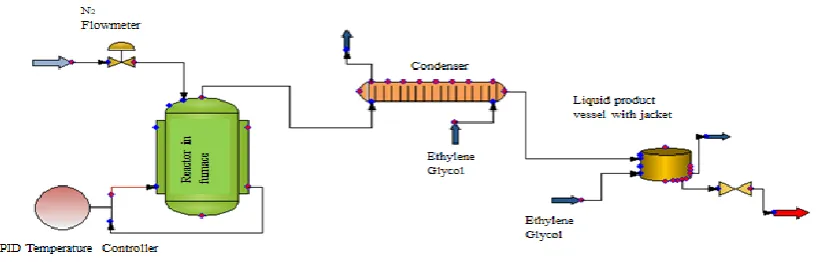
Thermal and catalytic co-pyrolysisexperiments of plastic wastes and algae were carried out within the scope of the study. Before the catalytic experiments, thermal experiments were made as the following. It was used that tubular pyrex glass reactor has 4 cm diameter and 33 cm length. Reactor which had fulled of 15 g feedstock was settled vertically in handmade ceramic furnace. Feedstock composed of 0, 33, 50, 67, 100 % wt./wt. plastic wasteswhich included same amount LDPE and PS. Furnace temperature and heating rate were controlled by Protherm brand PID controller. Inner temperature of the reactor was measured by Elimko brand 2000 M model digital display device linkes NiCr-Ni thermocouple.
Reactor was used in experiments was operated at temperature which is 570°C during 60 min. Its heating rate was choosen as 10 °C/min. Throughout the experiments nitrogen gas had 25 mL/min flowrate was passed through glass setup which has an gap is open to the atmosphere. Products moved away the reactor in gas form gattered after they had passed a condenser. Non-collecting ones were released to atmosphere. Condensing liquid was mono ethylene gliycol and it holded 0 °C by PolyScience brand circulator.
Figure 3. Chemcad drawing of the experimental setup
Catalyst amount that was putted in the reactor was changed as 0.5, 1 and 1.5 g.After the experiments, catalysts were heated in the muffle furnace controlledly up to 600 °C.Hence, coke amount of the catalysts was determined by taking the difference between the amount of the non-heated and heated ones.
Pyrolytic products were gas, liquid contains bio-oil (or bio-crude) and aqueous phase and bio-char. Difference between initial and final weight of the reactor whose inside was full of feedstock and bio-char respectively was divided by feedstock amount. Then this value was multplied by 100. Obtaining value after this calculation was taken as total conversion. It was assumed sum of the liquid and gas product yields. In the same way it was reached bio-oil, aqueous phase, liquid and char yields. Gas product yield was found the difference between total conversion and liquid yield.
2.5 Analysis of the pyrolytic liquid
Bio-oil and aqueous phase in liquid products were analyzed individually by GC-MS whose brand and model are Thermo Finnigan and DSQ 250 respectively. Zebron brand capillary column (ZB-1MS) which is 60 m length, 0.25 mm inner diameter and MS detector were assembled in the GC-MS. This column can be operated in the range of 60 and 370 °C. Analyzer was programmed as following. Injection volume of sample was 0.5 μL. Ion source temperature was 220 °C. Initially column was operated at 45 °C during 4 min. After its temperature reached 280 °C with 3 °C/min heating rate, it was holded at this temperature for 20 min. Total analysis time was nearly 100 min.
III. Results and Discussion
3.1 Yields of pyrolysis productsBefore algae and plastic wastes co-pyrolysis experiments were begun, it was necessary to determine the temperature at which they reached to maximum liquid product percentage. Chen et al. (2017) and Chaiwong et al. (2013) carried out Spirulina’s pyrolysis in fixed bed reactors at from 400 to 800 ˚C and from 450 to 600 ˚C respectively [23, 24]. Koo et al. (1991) studied on the co-pyrolysis of polyethylene and polystyrene waste [25]. The researchersreached the maximum liquid yield at 600 °C in the result of the co-pyrolysis experiments. In the light of these studies, temperature was choosen as 570 °C for whole feedstock materials.
Since, there are a few studies about co-pyrolysis of LDPE and PS wastes, several feedstock ratios were tested at 570 °C. Hence, maximum liquid product yield was found as 83.5% for the feedstock which composed of equal amount of the materials.The research, which belongs to Koo et al. in 1991, supported to our result. It was also detected that adding more PS material did not change this value.
Figure 4.Product yields for algae and plastic wastes: (a) for solid, liquid and gaseous, (b) for bio-oil and aqueous phase in the liquids
Afterwards, catalytic studies for this feedstock were carried out. It was known that HZSM5 was caused cracking, and it was strong enough to change the pyrolytic liquid product chemical composition. Because of that, it was tested how HZSM5 catalyst affected product yield firstly. As shown in Figure 5, there was not important change in the yield values when the catalyst amount was increased from 0.5 to 1.5 g. But, the most suitable catalyst to feedstock ratio was found as 1/30 to maximize liquid product yield. At this ratio, the liquid and bio-oil yield was computed as 64.1% and 53.8% respectively. As a result, it was deduced that the maximum liquid yield was decreased from 66.6% to 64.1% when it was used HZSM5 as catalyst.It was thought that there was an unimportant change.
Figure 5.Effect of HZSM5 using on the product yields for algae and plastic wastes: (a) for solid, liquid and gaseous, (b) for bio-oil and aqueous phase in the liquids
Figure 6. Effect of metal doping in HZSM5 on the product yields for algae and plastic wastes: (a) for solid, liquid and gaseous, (b) for bio-oil and aqueous phase in the liquids
As a consequence, the most suitable catalyst was determined as HZSM5to maximize liquid and bio-oil product yield. This result coincided with the study which was done by Campanella and Harold in 2012 [26].
3.2 Chemical Compositions of co-pyrolytic liquids
Previous researches have shown that LDPE’s pyrolysis liquid composed of aliphatic and cyclic hydrocarbons mainly. However, pyrolytic liquid of PS included high incidence of aromatic hydrocarbons.
Pyrolytic liquid of Spirulina formed from hydrocarbons, oxygenated and nitrogenous compounds.It was known that chemical composition of Spirulina’s pyrolytic bio-oil composed of alkanes and aromatic hydrocarbons like benzene, toluene, xylene, ethylbenzene, naphtalane, styrene by differing from its aqueous phase composition. Therefore, peak identifications were done by regarding co-pyrolytic bio-oil solely.
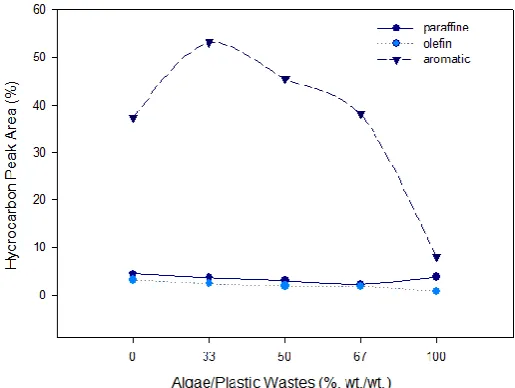
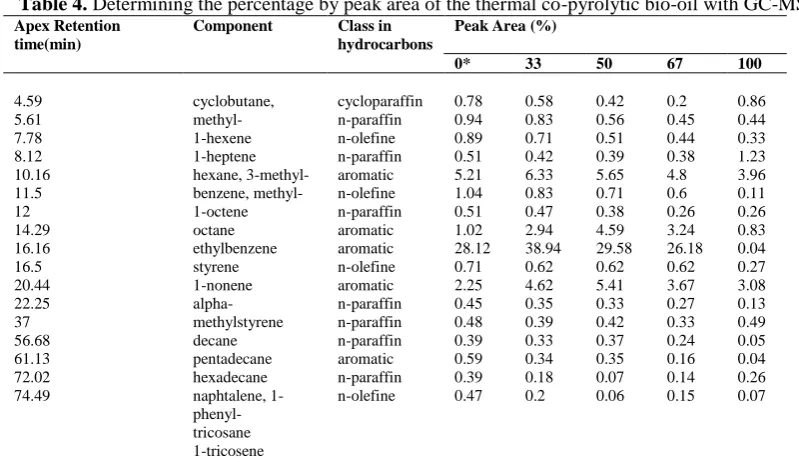
Thermal co-pyrolytic experiments gave interesting results which derived from a synergic effect between microalgae and plastic wastes. For example little amount of Spirulina, which was put the reactor around 30-50 % of the feedstock, increased aromatic component percentage in the bio-oil with respect to the bio-oil of the plastic wastes. But, aromatic components amount in Spirulina pyrolysis was found modest. As shown in Fig. 7, when amount of the plastic wastes, that was added in the co-pyrolytic feedstock, was increased, aromatic hydrocarbon amount in the bio-oil was increased also. However, peak areas of olefin and paraffine components which were found in the co-pyrolytic bio-oil as another hydrocarbon type, did not affect feedstock composition. In Table 4, it was given that hydrocarbons were recycled by co-pyrolysis in detail. Styrene, alpha-methyl styrene and ethylbenzene were seemed as key components in the aromatic hydrocarbons.
Table 4. Determining the percentage by peak area of the thermal co-pyrolytic bio-oil with GC-MS
Apex Retention time(min)
Component Class in hydrocarbons
Peak Area (%)
0* 33 50 67 100
4.59 5.61 7.78 8.12 10.16 11.5 12 14.29 16.16 16.5 20.44 22.25 37 56.68 61.13 72.02 74.49 cyclobutane, methyl- 1-hexene 1-heptene hexane, 3-methyl- benzene, methyl- 1-octene octane ethylbenzene styrene 1-nonene alpha-methylstyrene decane pentadecane hexadecane naphtalene, 1-phenyl- tricosane 1-tricosene cycloparaffin n-paraffin n-olefine n-paraffin aromatic n-olefine n-paraffin aromatic aromatic n-olefine aromatic n-paraffin n-paraffin n-paraffin aromatic n-paraffin n-olefine 0.78 0.94 0.89 0.51 5.21 1.04 0.51 1.02 28.12 0.71 2.25 0.45 0.48 0.39 0.59 0.39 0.47 0.58 0.83 0.71 0.42 6.33 0.83 0.47 2.94 38.94 0.62 4.62 0.35 0.39 0.33 0.34 0.18 0.2 0.42 0.56 0.51 0.39 5.65 0.71 0.38 4.59 29.58 0.62 5.41 0.33 0.42 0.37 0.35 0.07 0.06 0.2 0.45 0.44 0.38 4.8 0.6 0.26 3.24 26.18 0.62 3.67 0.27 0.33 0.24 0.16 0.14 0.15 0.86 0.44 0.33 1.23 3.96 0.11 0.26 0.83 0.04 0.27 3.08 0.13 0.49 0.05 0.04 0.26 0.07
* Since bio-oil did not occur in plastic wastes co-pyrolysis, liquid composition of plastic wastes was based on as bio-oil in the table.
It was expected that HZSM5 catalyst was promoted to occur aromatic compounds. While it was considering that the feedstock which composed of 33 % algae and 67 % plastic wastes, it can be shownthat the amount of aromatic components in the bio-oil increased with HZSM5 apart from styrene (Table 4,5).Besides that, olefin and paraffines tended to the same trend. But, in that time, olefin outdid paraffine curve (Fig 7, 8). It was also shown that maximum amount of the aromatic compounds in the bio-oil was obtained with just 0.5 g of the catalyst.
Figure 8. Change in the peak area of hydrocarbons with catalyst amount for the co-pyrolysis with HZSM5
Table 5. Effect of using catalyst amount on the co-pyrolytic bio-oil composition
Apex Retention time(min) Component Peak Area (%)
1/30 1/15 1/10
4.59 5.61 7.78 8.12 10.16 11.5 12 cyclobutane, methyl- 1-hexene 1-heptene hexane, 3-methyl- benzene, methyl- 1-octene octane
0.55 0.35 0.66 0.68
0.7 0.63
0.49 0.53 8.24 6.77
0.9 0.84
0.68 0.66
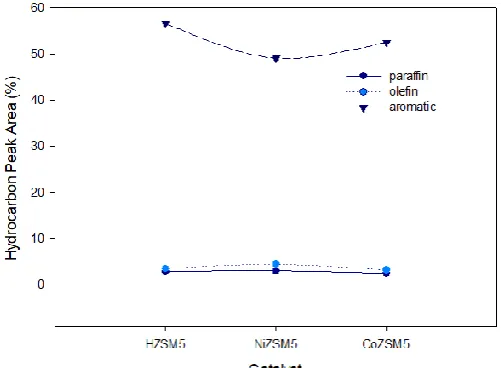
Metal impregnation to the catalyst was not influential to increase aromatic content in the bio-oil (Fig. 9).However, Ni doping to the zeolyt caused that increase in the difference between the amount of olefin and paraffine clearly. Besides that, when the retention time of the component in the bio-oil was examined, it was observed that the molecules such as pentadecane, hexadecane and 1-tricosene which had high boiling point and retention time affected in terms of amount positively with metal doping (Table 6).
Figure 9. Change in the peak area of hydrocarbons with the catalyst type for the co-pyrolysis
Table 6. Effect of metal loading in catalyst on the co-pyrolytic bio-oil composition
3.3 Coke amount of catalysts
In the catalytic co-pyrolysis experiments, it was observed that coke deposition in metal doped catalysts was higher than the non-doped one. This result was expected since maximum liquid amount was obtained with the HZSM5. Besides that, as shown in Table 7, Co metal caused more coke deposition than Ni metal.
16.16 16.5 20.44 22.25 37 56.68 61.13 72.02 74.49 styrene 1-nonene alpha-methylstyrene decane pentadecane hexadecane naphtalene, 1-phenyl- tricosane 1-tricosene
35.01 30.31 0.86 0.81 6.83 6.13 0.49 0.5 0.29 0.55 0.29 0.42 0.43 0.61 0.04 0.1 0.31 0.61
32.95 0.67 6.24 0.49 0.49 0.35 0.59 0.1 0.85
Apex Retention time(min) Component Peak Area (%)
HZSM5 NiZSM5 CoZSM5
Table 7. The amount of coke depositions of the catalysts
Catalyst m1 (g) m2 (g) Coke amount
(%, wt./wt.)
HZSM5 0.551 0.479 13.067
NiZSM5 0.471 0.387 17.834
CoZSM5 0.507 0.408 19.527
IV. Conclusions
In thermal co-pyrolysis of plastic wastes and Spirulina, maximum liquid product and bio-oil were obtained as 67and 57.9 % wt./wt. for the feedstock which was composed of 67 % plastic wastes and 33 % algae. Bio-oil, which was the organic phase of the liquid product, included hydrocarbons which was aromatic, parafine and olefin highly.
For catalytic co-pyrolysis, maximum amount of liquid and bio-oil were found as 65.5 and 55.8 % wt./wt. with 1/30 catalyst to feedstock ratio Using HZSM5 as catalyst decreased the yields of liquid and bio-oil product in small quantities, i.e. At that ratio, NiZSM5 and CoZSM5 decreased liquid product yield to 63.4 and 61.4 respectively. HZSM5 catalyst rose the peak area or composition in the bio-oil, while metal impregnation did not affect aromatics.
Consequently, obtained bio-oil, which was composed of parafine and aromatic compounds highly,can be used as green hydrocarbon source. Or, it can be used as green diesel with less greenhouse gas emmission after it was improved.
Acknowledgement
This work was supported financially by Ankara University Coordinatorship of Scientific Research Projects (Project Number: 17L0443014).
References
[1] X. Wu, Y. Wu, K. Wu, Y. Chen, H. Hu, M. Yang, Study on pyrolytic kinetics and behavior: The co-pyrolysis of microalgae and polypropylene, Bioresource technology 192 (2015) 522-528. https://doi.org/10.1016/j.biortech.2015.06.029.
[2] Isa, Yusuf Makarfi, and Elvis Tinashe Ganda. "Bio-oil as a potential source of petroleum range fuels." Renewable and Sustainable Energy Reviews 81 (2018): 69-75.https://doi.org/10.1016/j.rser.2017.07.036.
[3] Y. Li, M. Horsman, N. Wu, C.Q. Lan, N. Dubois-Calero, Biofuels from Microalgae, Biotechnology Progress 24 (2008) 815-820. https://doi.org/10.1021/bp070371k.
[4] Cordero-Lanzac, Tomás, et al. "Stability of an acid activated carbon based bifunctional catalyst for the raw bio-oil hydrodeoxygenation." Applied Catalysis B: Environmental 203 (2017): 389-399.https://doi.org/10.1016/j.apcatb.2016.10.018 [5] Singh, Narinder, et al. "Recycling of plastic solid waste: A state of art review and future applications." Composites Part B:
Engineering 115 (2017): 409-422.https://doi.org/10.1016/j.compositesb.2016.09.013
[6] Callister W.D., Rethwisch D.G. (2007), Materials Science and Engineering an Introduction, John Wiley & Sons, Inc.
[7] Al-Salem, S. M. "Thermal pyrolysis of high density polyethylene (HDPE) in a novel fixed bed reactor system for the production of high value gasoline range hydrocarbons (HC)." Process Safety and Environmental Protection 127 (2019): 171-179. https://doi.org/10.1016/j.psep.2019.05.008
[8] Tang, Ziyue, et al. "Co-pyrolysis of microalgae and plastic: Characteristics and interaction effects." Bioresource technology 274 (2019): 145-152. https://doi.org/10.1016/j.biortech.2018.11.083.
[9] de Miguel Mercader, F., et al. "Pyrolysis oil upgrading by high pressure thermal treatment." Fuel 89.10 (2010): 2829-2837. https://doi.org/10.1016/j.fuel.2010.01.026.
[10] Yang, Jingxuan, et al. "Fast co-pyrolysis of low density polyethylene and biomass residue for oil production." Energy conversion and management 120 (2016): 422-429. https://doi.org/10.1016/j.enconman.2016.05.008
[11] Widayatno, Wahyu Bambang, et al. "Upgrading of bio-oil from biomass pyrolysis over Cu-modified β-zeolite catalyst with high selectivity and stability." Applied Catalysis B: Environmental 186 (2016): 166-172.https://doi.org/10.1016/j.apcatb.2016.01.006 [12] Burra, K.G. and Gupta, A.K. 2018. Kinetics of synergistic effects in co-pyrolysis of biomass with plastic wastes. Applied Energy,
220, 408-418.https://doi.org/10.1016/j.apenergy.2018.03.117.
[13] Johansson, Ann-Christine, et al. "Co-pyrolysis of woody biomass and plastic waste in both analytical and pilot scale." Journal of analytical and applied pyrolysis 134 (2018): 102-113.https://doi.org/10.1016/j.jaap.2018.05.015.
[14] Zheng, Yunwu, et al. "Study of the thermal behavior, kinetics, and product characterization of biomass and low-density polyethylene co-pyrolysis by thermogravimetric analysis and pyrolysis-GC/MS." Journal of Analytical and Applied Pyrolysis 133 (2018): 185-197.https://doi.org/10.1016/j.jaap.2018.04.001.
[15] Zhang H. , Nie J. , Xiao R. , Jin B. , Dong C. , Xiao G. , 2014. Catalytic co-pyrolysis of biomass and different plastics (polyethylene, polypropylene, and polystyrene) to improve hydrocarbon yield in a fluidized-bed reactor. Energy Fuels 28, 1940-1947.https://doi.org/10.1021/ef4019299.
[16] Xiang, Z., Liang, J., Morgan Jr, H. M., Liu, Y., Mao, H., Bu, Q. 2018.. Thermal behavior and kinetic study for co-pyrolysis of lignocellulosic biomass with polyethylene over Cobalt modified ZSM-5 catalyst by thermogravimetric analysis. Bioresource Technology, 247, 804-811.https://doi.org/10.1016/j.biortech.2017.09.178.
[17] Ding, Kuan, et al. "Improving hydrocarbon yield via catalytic fast co-pyrolysis of biomass and plastic over ceria and HZSM-5: An analytical pyrolyzer analysis." Bioresource technology 268 (2018): 1-8.https://doi.org/10.1016/j.biortech.2018.07.108.
www.ijres.org 22 | Page
]
[19] Azizi, K., Moraveji, M. K. and Najafabadi, H. A. 2017. Characteristics and kinetics study of simultaneous pyrolysis of microalgae Chlorella vulgaris, wood and polypropylene through TGA. Bioresource technology, 243, 481-491.https://doi.org/10.1016/j.biortech.2017.06.155.[20] Dai, Minquan, et al. "Microwave-assisted fast co-pyrolysis behaviors and products between microalgae and polyvinyl chloride." Applied Thermal Engineering 136 (2018): 9-15.https://doi.org/10.1016/j.applthermaleng.2018.02.102.
[21] Dewajani, H., Rochmadi, S. P. and Budiman, A. 2016. Kinetic Study of Catalytic Cracking of Indonesian Nyamplung Oils (Calophyllum inophyllum) over ZSM-5 Catalyst. ARPN J. Eng. Appl. Sci, 11, 1-5.
[22] Shirazi, L.,Jamshidi, E., & Ghasemi, M. R. 2008. The effect of Si/Al ratio of ZSM-5 zeolite on its morphology, acidity and crystal size. Crystal Research and Technology: Journal of Experimental and Industrial Crystallography, 43, 1300-1306.https://doi.org/10.1002/crat.200800149.
[23] Chen, W., Yang, H., Chen, Y., Xia, M., Yang, Z., Wang, X. and Chen, H. 2017. Algae pyrolytic poly-generation: Influence of component difference and temperature on products characteristics. Energy, 131, 1-12.https://doi.org/10.1016/j.energy.2017.05.019. [24] Chaiwong K., Kiatsiriroat T., Vorayos N. and Thararax C., 2013. Study of bio-oil and bio-char production from algae by slow
pyrolysis. Biomass and Bioenergy 56, 600-606.https://doi.org/10.1016/j.biombioe.2013.05.035.
[25] Koo, J.K., Kim, S.W. and Seo, Y.H. 1991. Characterization of aromatic hydrocarbon formation from pyrolysis of polyethylene-polystyrene mixtures. Resources, conservation and recycling, 5(4), 365-382.https://doi.org/10.1016/0921-3449(91)90013-E. [26] Campanella, A., Harold, M. P. 2012. Fast pyrolysis of microalgae in a falling solids reactor: effects of process variables and zeolite
catalysts. Biomass and bioenergy, 46, 218-232.https://doi.org/10.1016/j.biombioe.2012.08.023.