1
International Journal of Business and Applied Social Science Vol.1, No.1, December/2015
Counselling in Malaysia: Trends and Practice with the Malays
Azizah Othman, Doctor of Pscyhology (Clinical)
Department of Pediatric,
School of Medical Sciences, Campus Health Universiti Sains Malaysia,
Email: [email protected]
Siti Salina Abdullah, Doctor of Counsellng
Department of Psychology and Counselling, Faculty of Social Development
University Malaysia Terengganu Terengganu Darul Iman
Terengganu, Malaysia Email: [email protected]
Abstract:
Counselling in Malaysia has developed impressively since the last four decades. This paper briefly outlines the trends and development of counselling as a formal academic training programme and a recognised helping profession in Malaysia. It appears that the majority of the training programmes are based on Western approaches with limited attention given to the application of counselling on the locals. This paper discusses the group counselling practice on Malays, as the major ethnic race. Six factors that may influence the practice are religion, general emotions, customary traits, help seeking behaviors, language, and family influences. It also provides suggestions to group leaders who deal with this particular race.
Keywords: Group Counselling, Counselling in Malaysia, Malays
1. Introduction
In general, counselling deals with psychological stresses, that is when a person experiences problems in their personal functioning and social interactions, as opposed to physical stresses (Everts & Mohd Noor, 1993). In the process of counselling, a trusted relationship is established between the counsellor and the client whereby both parties explore the nature of the client’s problems, resources, and goals or solutions to be achieved. Counsellor assists clients to move into a better life that may require them to learn, acquire and practice new skills, behaviours or thinking patterns.
2
ISSN: 2469:6501(Online) ©Center for Promoting Education and Research (CPER) USA, www.ijbassnet.com
economic growing countries in the South East Asian region with diverse cultures and religions. To date, with a total population of 27.2 million, it consists of 59% Malays and other indigenous groups, 32% and 9% of Chinese, Indians and others respectively. Most Malays are Muslims, whereas Chinese and Indians are Buddhists, Christians or Hindus. The official language is Malay (Bahasa Melayu) with English being the second language which is widely used especially in the urban areas (Saw, 2007). Counselling has the potential to be a reactive agent of help in responding to many social, economical, political, technological changes and challenges which promote psychological stresses. As far as the cultural values and collectivistic nature of Malaysian are concerned, counselling is compatible and relevant to some aspects of the Malaysian life system. However, there are some problems in practicing counselling within this context. Professionally trained counsellors who are mostly Western educated; differ from the traditional helpers in several aspects of counselling. For example, the former emphasizes on personal autonomy, responsibility and expression of feelings (Jensen & Bergin, 1988) while the latter values collective allegiance and religious convergence (Everts & Mohd Noor, 1993).
This paper focuses on two major issues of counselling in Malaysia. First, it presents the trends and development of counselling as a formal helping-profession. The trends involve history counselling services, formal academic training for counsellors, and counselling organizations in the country. Second, the paper discusses factors that influence the practice of counselling (i.e. group counselling) with the Malays. It also suggests some recommendations to group leaders who intend to conduct group counselling for the Malays. The counselling practice in Malaysia has been well developed in terms of upgrading the academic trainings and establishing its professional standard. However, counsellors need to be aware and alert of several factors that may affect the counselling practice with the specific population that is the Malays.
2. Trends and Development of Counselling in Malaysia
The trends and development of counselling in Malaysia are reviewed based on the history of counselling as a vocational guidance services for students, formal academic training for counsellors, and specific bodies that govern the counselling profession in Malaysia.
2.1. History
Counselling is considered as a new field in helping profession in Malaysia. The counselling services formally began in a form of vocational guidance service for the secondary school students in the 1960s. It started in schools in 1969 when the Ministry of Education called for a guidance teacher as stated in the Service Circular, KP5209/35/4(4). Starting from 1983, every secondary school is required to have a career guidance teacher (Quek, 2008). By 1985, every secondary school has a counselling room with a career guidance teacher. The career guidance teacher does not only manage the vocational problems per se but also other related problems such as educational, social, psychological, and family problems (Chew, Lee & Quek, 1995).On top of that, they were also required to teach subjects and conduct off-school hour’s guidance services. Due to these heavy responsibilities faced by the counsellors, the Ministry of Education had published a book entitled “Panduan Pelaksanaan Bimbingan dan Kaunseling di Sekolah-sekolah Menengah” (A guide for practicing guidance and counselling in secondary schools) in 1993. The book served as a guideline for counsellor teachers to implement guidance and counselling programmes in schools. Later in 1996, the Ministry of Education had allocated full time counsellors in secondary schools to meet the arising demands and needs of counselling services. Since then, there were rapid and drastic changes in counselling movements in Malaysia. The Malaysian government had shown support in giving formal training for future counsellors as the demand of counsellor education programmes have increased.
2.2. Academic Training
3
International Journal of Business and Applied Social Science Vol.1, No.1, December/2015
Malaysian guidance services as there were lack of proper facilities and a shortage of trained counsellors (Amir Awang & Latiff Mirasa 1984). Due to these urgent needs, in early 1990s specific measures such as formal trainings have been taken to train future counsellors.
Most of the earlier counsellor education programmes were conducted at tertiary level at Malaysian public universities. For example, the University of Malaya (UM) offered its first counselling course through its Master of Education (Guidance and Counselling) programme in 1976, under the Department of Educational Psychology and Pedagogy (currently known as Department of Educational Psychology and Counselling) (Salim & Jaladin (2005). At that time, it was a research oriented programme. However, with the current needs and demands, the programme has been changed to a mixed programme consisting coursework and research. Currently, UM offers the Executive Diploma in Counselling (EDIC), Bachelor of Counselling, Master of Counselling and PhD (Counselling).
Another pioneer university that offers counselling courses is the University Kebangsaan Malaysia (UKM). UKM first introduced its counsellor education programme in November 1980 (Salim & Jaladin, 2005). The programmes offered different levels ranging from Diploma to Doctoral levels. The Ministry of Education through its counsellor education programmes has selected teachers to undergo a one year specialized counselling programme and has sponsored graduate teachers for counsellor education programme at UKM with a Diploma in Counselling (Quek, 2008). The aforementioned degree is reported as a comprehensive counselling programme developed in UKM (Scorzeli (cited in Salim & Jaladin, 2005). The programme consists of a one year of academic coursework, supervised research and, a three monthof counselling placement that occurs beyond the academic year. To date, there are three counselling programmes offered by the University Kebangsaan Malaysia, namely the Diploma in Psychology (Counselling), Master of Social Science (Counselling Psychology) and PhD.
In 1981, the University Putra Malaysia (UPM) through its Faculty of Educational Studies has started the first degree of counselling programme, i.e. Bachelor of Education Guidance and Counselling. The main objective in this four-year programme is to prepare skilled guidance teachers for secondary schools. These guidance teachers are those who have obtained Certificate of Education and attended courses in guidance and counselling at the Teachers Training Institutes or other similar courses conducted by the Ministry of Education. Later in 1987, UPM offered its Master of Science (Guidance and Counselling) and also at PhD level. The master programme has specialization in five areas of interest, namely schools counselling, career counselling, mental health and community counselling, organizational and industry counselling, and family counselling.
In 1983, the University Technology of Malaysia (UTM) has started to offer Master of Education (Guidance & Counselling) under Department Social Science and Humanities (currently known as Faculty of Education). The programme has two modes coursework and research. Students who choose to do the coursework programme must complete a minimum of 32 credits, which consist of one university compulsory subjects (2 credits), 2 faculty compulsory subjects (3 credits each), 4 course core subjects (3 credits each), 3 elective subjects (3 credits each) and a Masters project (3-4 credits).
4
ISSN: 2469:6501(Online) ©Center for Promoting Education and Research (CPER) USA, www.ijbassnet.com
Terengganu (UMT) offers an undergraduate programme in the Bachelor of Counselling and Master of Psychology Counselling in graduate level. In the near future, the UMT aim to offer another one or two more programmes specifically designed to meet the evolving market demand. Other universities that offer counselling programmes at undergraduate and post graduate levels are University Utara Malaysia; (Bachelor of Education (Guidance and Counselling) with Honours and (Master of Science Counselling), (Coursework & Thesis), University Pendidikan Sultan Idris; Bachelor of Education (Guidance & Counseling) with Honours and Master of Education (Guidance & Counselling). University Science Islam Malaysia currently offers Bachelor of Counselling with Honours and Graduate Diploma Studies specialized in Drug and Alcohol Abuse meanwhile International Islamic University of Malaysia (IIUM) offers Diploma in Guidance and Counselling. University Malaysia Sarawak through Department of Counselling did offer the Bachelor of Counseling. However, the enrolment of this programme is temporarily suspended.
In short, Malaysian public universities offer counselling education programmes in various levels at certificate, diploma, undergraduate and postgraduate levels, in order to fulfil the needs of formal counsellor training. It is observed that these programmes were largely related to the general areas of guidance and counselling. Most of these programmes include internship as a partial requirement. Some of these universities conducted interviews upon recruiting new students.
Despite the rapid-growing of counsellor education programmes in Malaysia, it appears that major issues confronting counselling and counselling education in the country, are the much the same as faced by other societies heavy reliance on the foreign counselling theories and experiences (Halim & Aboo Bakar, 1993) which may be incompatible or insufficient if one were to practice counselling with the locals. This condition is apparent due to several factors. First, most of senior lecturers were graduated from counsellor education programmes in United States (Scorzelli, 1987). Thus, there are likely that the programme that they outline in the training the future counsellors may have adopted the Western approaches as is was their educational training background. As a result, the counselling courses offered in most of public Malaysian universities are based on the counsellor education programme at the United States. In respond to this situation, recently, in July 2006, the University Darul Iman (formerly known as KUSZA) has introduced the Bachelor of Usuludin and Counselling programme, which is the first counselling programme in Malaysia that combines counselling and religious perspective. The programme is offered for six semesters.
Second, Malaysian counselling practice is subjected to the Council for Accreditation of Counselling and Related Educational Programme (CACREP) guidelines. Counsellors in Malaysia are bonded with the Malaysian Board of Counsellor. The board links with the CACREP which acts as a body for counselling accreditation programmes in the United States (Salim & Jaladin, 2005). As such, majority of the counselling guidelines and principles applicable in Malaysian context reflect those in the CACREP which again may not be fully matched with the local counselling needs.
The other problems related to counselling and counsellor education programme in Malaysia is the lack of locally published references and textbooks. As a result, textbooks published from the United States are usually referred (Scorzelli, 1987). The obvious limitations of this condition would be the absence of discussion on local cultures and values, incompatibility of Western to local cases examples, and language and interpretation problems.
5
International Journal of Business and Applied Social Science Vol.1, No.1, December/2015
Vocational Interest Inventory (IMKS) and Sidek Vocational Value Inventory (INPS), and Colour Personality Inventory (IPW) (UPM, 2008).The next section will describe the development of Counselling Act and Association in Malaysia.
2.3. Development of Counselling Acts and Association
The Counsellor’s Act and the Malaysian Counselling Association are the two main bodies that exist to monitor the practice of counselling services in Malaysia as well as to establish the counselling profession.
2.4. The Counsellor’s Act (580)
The Malaysian government has endorsed the Counsellor’s Act (580) in March 1998 to act as a registrar for the licensure and certification of new counsellors. In respond the Malaysian Board of Counsellor is established to supervise the practice of counselling services in Malaysia. The Malaysia Board of Counsellor consists of a President who is nominated from the registered counsellors and other 13 other members are selected from the registered counsellors and other Malaysia organizations such as from the Ministry of Health, police department and Ministry of Higher Learning Education. According to this Act, any person or organizations that practiced counselling services in Malaysia must be registered with the Malaysia Board of Counsellor. However, practicing professional health experts are exempted to register as stated in the Counsellor’s Act 1998. Within this Act, any person or organization are not allowed to declare or work as a counsellor, or used the Registered Counsellor title or advertised any board, sign or others to inform that he/she is a Registered Counsellor unless he/she is registered under this Act. Those who failed to do so will be charged for not more than RM 30,000 or will be put in prison for not more than three years or both. To register, a person must be a Malaysian citizen or a Malaysian permanent resident, age 21 years and above, entitled and suitable to be registered as a counsellor and hold any qualification listed in Table Two of the Counsellor’s Act 580. According to the Table, only graduates from these six Malaysian public universities, University of Malaya, University Kebangsaan Malaysia, University Putra Malaysia, University Technology Malaysia, International Islam University of Malaysia and University Science Malaysia, are entitled to register. Additionally, a temporary registration is allowed under Part IV Section 27. (1) (2) (3) (a) (b) (c) to those who are not a Malaysian citizen and not apermanent resident to be registered as a counsellor in Malaysia.
Through this Act, counselling in Malaysia has gained its status as an accredited profession. With this recognition, one can practice counselling as a profession in Malaysia. At present, there are 1364 registered counsellors in Malaysia.
2.5. The Association of Counselling Malaysia
6
ISSN: 2469:6501(Online) ©Center for Promoting Education and Research (CPER) USA, www.ijbassnet.com
that most of counselling programmes and training in Malaysia are based on Westernised approach. Therefore, in order to put counselling into practice in the Malaysian context, a special circumstances and factors need to be considered.
3. Group Counselling for Malays: Factors to be considered
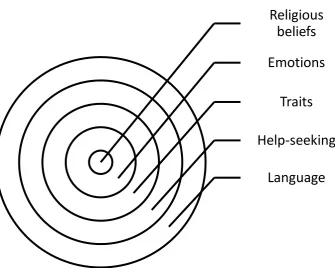
Counselling, when practiced. is constantly challenged by the questions of relevance (Everts & Mohd Noor, 1993), compatibility, or challenges because people of different socio-demographic backgrounds may hold different views and respond differently to the conventional (e.g. Westernised) counselling principles. Similarly, when it is practiced in a particular group such as the Malays, several factors need to be considered as they may influence the practice of counselling especially related to this group of people. The factors include religious beliefs; emotional regulation, customary traits, help seeking behaviours, language, and familial influence (see Figure 1). These factors are further elaborated below, and there are also some suggestions for the counsellors.
Figure 1: Factors that influence counselling practice with the Malays.
3.1. Religious beliefs
One of the factors that may influence the practice of counselling in Malaysia among the Malays is their religious beliefs in Islam. For a Muslim (i.e. a person who believes in Islam), religion is a way of life that guides them through life in this world. In a Muslim community, a religious man who has vast knowledge in religion is called a Ustaz. Ustaz is an influential figure in the community, whom people would traditionally go and seek advice regarding all aspects of living, especially those related to the teaching of Islam. Ustaz’s
Religious
beliefs
Emotions
Traits
Help-seeking
7
International Journal of Business and Applied Social Science Vol.1, No.1, December/2015
opinions and advice are respected and followed for his knowledge about religion, and that puts him in an advanced stage than others. In addition, the Islamic teaching infuses in most aspects of a Malay Muslim’s life, especially in the values and behaviours aspect. The values in the Malay society are based on the two primary sources of references Al Qur’an and the practice of Prophet Muhammad (S.A.W). Some values are absolute and unchangeable. For example, Islam propagates that alcohol drinking and pre-marital sexual relationships are forbidden and taken as unlawful acts. Most religious Malays would conform to these values and would not easily influence or change their views When group counselling is applied in the Malay Muslim group in a positive sense, group members, who belong to same religious beliefs would share the same values in life. This common value facilitates the group cohesiveness. On the other hand, they can become inflexible and rigid as they hold similar values of life, and believe that all should behaved appropriately and accordingly to their beliefs system. For example, if some members fail to conform to Islamic teachings, initially they may be perceived negatively or their acts or wrongdoings are simply not accepted. Given this, group counsellors need to be aware and respect these religious values. Assuming that in general the group members conform to their religious values; any suggestions or any contradictory values which are against the religious teaching in the group should not happen and any recommendations should be communicated with extra cautious and sensitivity.
3.2. Regulation of Emotions
In addition to the religious beliefs, general perceptions on regulation of emotions assumed on the Malays may affect the counselling process. Like other Asian community, Malays emphasize on moderation and control of one’s emotions (Ball, Mustafa, & Moselle, 1994). Therefore, the art of disclosure and sharing of inner thoughts and feelings, which is one of the main components in the group counselling; can be an intimidating and challenging activity to the group members. This is especially true during the initial stage of the group. The idea of discussing personal problems with someone perceived as a stranger, even a professional, or a group of strangers, is an anxiety-provoking situation that results in discomfort. For instance, when examining the burden of Malay families in taking care of patients with schizophrenia, Salleh (1994) found that the families tended to suppress negative emotions and did not report their stress. This was despite the fact that nearly half of the participants were found to have had neurotic depression (Salleh, 1994). For this reason, in practicing group counselling with the Malay group, it is suggested that the group can be started off by talking about issues that are easier to be expressed and shared such as somatic complaints or practical day-to-day problems like financial or academic problems (Williams, Graham & Foo, 2004).
3.3. Customary Traits
8
ISSN: 2469:6501(Online) ©Center for Promoting Education and Research (CPER) USA, www.ijbassnet.com
consistent with the social and religious norms and not against them. Given that, one must think before one speaks as not to not hurt others or rise any issues conflicting his norms or beliefs. Similarly, most of them hold an attitude of ‘saving face’ where criticism or opposing opinions are seldom expressed publicly in order to protect one’s dignity. The Malays therefore tend to be very careful about commenting and opposing others’ views. They tend to avoid as much as possible any conflict by being silence rather than initiating or prolonging continuous arguments. These typical stereotyped Malay traits are not parallel with the principles of providing effective feedback in group counselling. Nevertheless, as the positive impact of effective feedback in a group process is obvious, group leaders then will have to play a vital role in promoting, modelling, and providing a safer forum for the group members to learn new behavioural skills in human relationships.
3.4. Help seeking behaviour
Another factor that may hinder the practice of group counselling in Malaysia is the Malays’ beliefs in illness and behavioural patterns in seeking help. Amongst indigenous Malay, illness is attributed to either physical or supernatural causes (Razali & Najib, 2000). The illnesses rooted in supernatural causes involve the activities of a wide variety of spirits, black magic, or witchcraft that occur with the wills of God. These factors are generally assumed as common causes of mental illness in the Malay society (Razali et al., 1996). A traditional healer called bomoh or the witchdoctor ‘seemed’ to know about the origin of these diseases origin, and tries to cure by taking preventive measures. In Malaysia, bomoh is more often consulted than the mental health specialists especially for emotional and psychological problems. The consultation is basically due to several reasons such as a belief that modern treatment is not as effective in treating black magic or supernatural agents, which are assumed to be the cause for mental problems. Other reasons for not consulting mental health specialists are attached stigma that one is considered insane if one were to seek consultation from a mental health expert and also there is a tendency to refuse paying a high amount of registration fees in mental health specialist consultation (Razali & Najib, 2000). More often than not, a mental health specialist’s help is sought late after a long delay since the first onset of the illness, or and when the condition has worsen. This help seeking behavioural pattern amongst the Malays is probably the first barrier and challenge for counsellors in practicing group counselling in this particular society. Razali (1995) recommended that there is a need for mental health practitioners to establish relationships with the
bomoh so that patients and their families would be exposed to various treatment options and that they are able to make wiser choices.
3.5. Malay Language
9
International Journal of Business and Applied Social Science Vol.1, No.1, December/2015
3.6. Family
Similar to other Asian cultures, family is a basic unit in a Malay society from which the members identify their social identity. In order to practice group counselling with the Malays, a group leader needs to consider the strong influence of extended family in the system,,The Malays emphasize on the roles and positions of each member in the family. Specifically, the elders are given a higher authority and men are considered to be the leader who is primarily responsible to protect and sustain the family (Hsu, Davies, & Hansen, 2004). Children are obliged to respect and obey their parents and that their actions are within the consent of the parents. Parents, siblings, close relatives and friends are the important sources of social support, where one could always seek counselling or advice from. Whenever a problem arises, the head of the family usually discusses with other family members (Razali & Najib, 2000). Their opinions are often well regarded and thus may directly or indirectly affect a person’s views of life, expectations, and attitudes, in general. For some group leaders, the close extended family unit may seem to be seen as an overly enmeshed condition. The significant effects of family and its impact on the individual’s behaviours and thinking can sometimes be difficult for others to understand. Thus, counsellors have to learn, understand and appreciate these values and regard those as resources or strengths in a person. If necessary, counsellors could enhance the efficacy of the existing resources that a person has, by teaching relationships skills such as communication, conflict management, and problem-solving skills.
4. Conclusion
Counselling is acknowledged as a recognised helping profession which has evolved rapidly since the last four decades in Malaysia. It started as a guidance vocational service in school settings and currently has become an accredited profession through the endorsement of the Counsellor Act 580 and the establishment of Malaysian Counselling Association (PERKAMA). The fast development and enormous interest in the area are evident from the growing number of postgraduate counselling programmes especially in the public universities. Yet, these programmes are mostly derived from the Western perspectives of counselling, which in turn may not be compatible when it is practiced on locals, such as the Malays. Six factors were identified as to have influence the practice of counselling with the Malays. They are religion, customary traits, help seeking attitude, language, regulation of emotions and, family system. Based on these factors, further suggestions were provided for the counsellors working with the particular group.
References
Abdullah, A. (1996). Going GLOCAL: Cultural dimensions in Malaysian management. Kuala Lumpur, Malaysia: Malaysian Institute of Development.
Amir Awang & Latiff Mirasa (1984). Guidance and counselling in Malaysian schools: A review and critique. Paper presented at Third Asian Workshop on Child and Adolescent Development, University of Malaya, Kuala Lumpur.
Ball, J., Mustafa, S.M., & Moselle, K. (1992). Phenomenology and prevalence of self-reported stress among Malay college students. In Proceedings of the First Asian Conference in Psychology (pp. 29-30). Singapore: Singapore Psychological Society.
Ball, J., Mustafa, S.M., & Moselle, K. (1994). Cultural influences on help-seeking for emotional problems: A study of Malay young adults. In G. Davidson (Ed.)., Applying psychology: Lessons from Asia-Oceania (pp. 97-112). Brisbane Australia: Australian University Press.
10
ISSN: 2469:6501(Online) ©Center for Promoting Education and Research (CPER) USA, www.ijbassnet.com
Everts, J & Mohd Noor, M.Y. (1993). Testing the cultural relevance of counselling: A Malaysian case in point. Asian Journal of Counselling, 11, 79-86.
Goddard, C. (1997). Cultural values and ‘cultural scripts’ of Malay (Bahasa Melayu), Journal of Pragmatics, 27, 183-201.
Hsu, E., Davies, & Hansen, D. J. (2004). Understanding mental health needs of Southeast Asian refugees: Historical, cultural, and contextual challenges. Clinical Psychology Review, 24, 193-213.
Jensen, J.P. & Bergin, A.E. (1988). Mental health values of professional therapists: A national inter-disciplinary study. Professional Psychology: Research and Practice, 19, 290-297.
Mastor, K. A., Jin, P., & Cooper, M. (2000). Malay culture and personality. American Behavioural Scientist, 44, 95-111.
Othman, A.H. & Aboo Bakar, S.B. (1993). Guidance, counselling, and counsellor education in A.H. Othman & A. Awang (eds.). Counselling in the Asia Pacific Region. London: Greenwood Press.
Quek, A.H. Career guidance and counselling in Malaysia: Development and trends. Retrieved May, 29, 2008 from
http://www.spc.org.sg/9thARACD/CAREER%20GUIDANCE%20AND%20COUNSELLING%20IN%20 MALAYSIA.doc
Razali, S.M. & Najib, M.A.A. (2000). Help-seeking pathways among Malay psychiatric patients. International Journal of Social Psychiatry, 46, 281-289.
Razali, S.M. (1995). Psychiatrists and folk healers in Malaysia. World Health Forum. 16, 56-58.
Salim, S. & Jaladin, R.A.M., (2005). Development of Counselling Services in Malaysia. In Zafar Afaq Ansari, Noraini M. Noor and Amber Haque (ed.), Contemporary Issues in Malaysian Psychology (p. 237-264). Singapore: Thomson.
Salleh, M.R. (1994). The burden of care of schizophrenia in Malay families. Acta Psychiatrica Scandinavica, 89, 180-185.
Saw, S.H. (2007). The population of Malaysia. Singapore: Institute of Southeast Asian Studies.
Scorzelli, J. F. (1987). Counselling in Malaysia: An emerging profession. Journal of Counselling and Development, 65, 238-240.
University Darul Iman Malaysia. Retrieved June, 7 2008 from www.udm.edu.mu
Universiti Islam Antarabangsa Malaysia, Retrieved June, 7 2008 from www.iium.edu.my
University Kebangsaan Malaysia. Retrieved June, 7 2008 from www.ukm.edu.my
University Malaysia Sabah.Retrieved June, 7 2008 from www.ums.edu.my
University Malaysia Sarawak. Retrieved June, 7 2008 from www,unimas.edu.my
University Malaysia Terengganu. Retrieved June, 7 2008 from www.umt.edu.my
University Science of Malaysia. Retrieved June, 7 2008 www.usim.edu.my