Adaptive Order Morphology Edge Detection
Yuanni Wang
School of Computer, China University of Geosciences, Wuhan, China Email: [email protected]
Fei Ge
Department of Computer Science and Technology, Center China Normal University, Wuhan, China Email: [email protected]
Abstract—In this paper, we present an edge detection model by combining order morphology transformation and anti-noise morphology transformation. In the model, we construct three kinds of edge detection operators and apply them in edge detection of some gray images and some urban satellite images with different levels of salt and pepper noise, gaussian noise and mixed noise. The experiment results show that less than 30% noise the edge detection effect by our model is better than that by canny operator and the general order morphology transformation. The conclusion is that our model is feasible for edge detection of the gray image and the satellite remote sensing images.
Index Terms—edge detection, order morphology, anti-noise performance
I. INTRODUCTION
Classical edge detection operators such as Roberts, Sobel, Canny operator are all space-based operations, corresponding to the gradient of the first derivative and second derivative, although each operator for a specific situation, but sensitive for the noise, so the edge extraction is not effective for the noisy image[1].
An ideal edge detector should have high precision, good edge response and full of the details characteristics, not sensitive to noise, and little influence by the edge direction features[2]. However, these are not usually taken into account for a specfic detector, but the morphological transformation provides an effective way to solve this problem. Through morphological basic operations it can be constructed out of many effective methods of image processing.
Order morphology transformation theory introduced the statistical methods based on the morphology and the edge detection based on order morphology transformation has obvious advantages for noisy image[3]. People can acquire the optimum image effect through choosing the appropriate morphology arithmetic parameters according to actual background, which are mainly the form and dimension of the structure element, the value of the percentile and its compound form shift. Based on order morphology transformation and anti-noise morphology transformation, it has established a new edge detection model applied to the gray images including gaussian noise and salt and pepper noises within 30% and can be extended to the city of satellite remote sensing images.
II. ORDER MORPHOLOGY TRANSFORMATIONS
For the discrete form of order morphology transformations, there are several define as follows [4, 5]:
Definition 1 If
f ( x )
is the discrete function defined in ( n )Z (
n
-dimension discrete data space) ,1 2 n
B={ x , x ,..., x }is the structure element, moreover,
0<μ( B )= < +∞N , and the estimate μ β( )is count counting. Based on B, the value with count N of f ( x )
arranging in a proper order from small to large is
1 2 N
f ( x ')≤ f ( x ')≤ ≤... f ( x ') , then, based on B, the d-step order measures of
f ( x )
is defined as follows:d
ord{ d , f | B }=Δ f ( x '),d=1,2,...,N.
Definition 2 The order morphology transformation of discrete function f ( x ) related to structure element B
called
f
○pB
is defined as follows:( f
○px
B )( x )=ord{ d , f | B∨}
x
ord{( N 1 ) p 1; f | B∨}
= − +
p= 0, 1/(N- 1) , …, 1.
x
B ∨={ x b : b− ∈B },d =( N−1 ) p 1+ ,
Among it, p is the percentile value of the order morphology transformation.
For
f
○pB
, d 1 pN 1
− =
− , specially, when p is 0, 0.5 and
1,
f
○pB
is erosion operation, median operation, and dilation operation respectively.III. ADAPTIVE ORDER MORPHOLOGY EDGE DETECTORS
A. Model
The paper according to the morphology transformation of anti-noise dilation type, anti-noise erosion type, and anti-noise dilation and erosion type, combining order morphology transformation, constructs a new morphology transformation form for edge detection. Give the formula as follows:
anti-noise dilation type:
=f ( n )
○pB
1−
f ( n )
○pB
1 ○q 2B
(3.1)anti-noise erosion type:
f '
=
f(n)( q, p )B
−
f ( n )
○qB
f ( n )
=
○q1
B
○p2
B
−
f ( n )
○q1
B
(3.2)anti-noise dilation and erosion type:
f '
=
f ( n )( q, p )B
○pB
−
f ( n )( p,q )B
○qB
f ( n )
=
○qB
1○p 2B
○p3
B
−
f ( n )
○p 1B
○qB
2○qB
3(3.3) It will increase their computing flexibility that changing the solution of maximum and minimum of dilation erosion operation into the solution of the percentile value of p of the order morphology. It operators the original image by controlling the value of p, which also including the erosion operation and dilation operation.
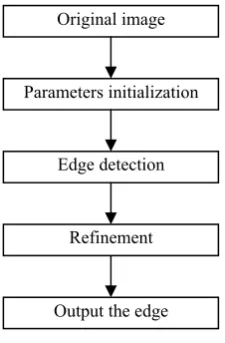
Combing the thinking of complex order morphology transformation and morphology edge detection based on anti-noise, it constructs a novel gray-scale image edge detection method. It controls the edge detection effect by the percentile value of order morphology and introduces the elements structure of different orientations to match the diversity of the edge direction, improving the traditional mathematical morphology edge detection, thereby enhancing the positioning accuracy, at the same time suppressing noise well. For the edge detection result, if it is not the single-pixel edge, then refine it. The implementation steps are as follows:
STEP1 : Initialize the parameters, mainly the percentile value of p, q, and the structural elements B.
STEP2:Use the edge detection operator constructed by the formula 3.1, 3.2 and 3.3 to extract the edge.
STEP3:Refine the edge. STEP4:Output the result.
The algorithm flow chart is shown in Figure 1.
Figure 1. edge detection flow chart
B. Parameters setting (1) design the value of
p
If p+ =q 1, the output variance of
f
○pB
andf
○qB
is equal. For minimum mean square error (MSE) and minimum mean absolute error ( MAE ) , theconvergence of minimum mean square error is faster, proved by Zhao Chunhui et al. Here, use the principle of minimum mean square error as the principle in the evolution of
p
. Iff ( x )
represents the input imagesignal,
d( x )
represents the image signal desired,n( x )
represents the noise image signal, andf '( x )
represents the output filter image signal, then there are the situation as follows: f ( x )=d( x ) n( x )+ , f '( x )= f ( p, B ), In the principle of minimum mean
square error, p '= +p 2a( d(x)-f'(x) )*(N-1) ,
p
is thecurrent percentile value,
a
is the parameter of controlling the convergence, p' is the next percentile value according to the principle of minimum mean square error. Based on it calculates the appropriate percentile value for the initial parameter of edge detection.(2) design the structural elements
It mainly takes account to the directionality of the edge, so it mainly considers both level direction, diagonal line direction and perpendicularity direction of the structure element chosen. For the edge detection of anti-noise dilation order morphology and the edge detection of anti-noise erosion order morphology, the structural elements are as follows: B1= [1 0 1 0 1 0 1 1 1], B2 = [1 1 1 0 1 1 1 1 1]. For the edge detection of anti-noise dilation erosion order morphology, the structural elements are as follows: B1 =[1 1 1 1 1 1 1 1 1], B2 =[0 0 1 0 0 0 0 1 0 0 1 1 1 1 1 0 0 1 0 0 0 0 1 0 0], B3 =[1 0 0 0 1 0 1 0 1 0 0 0 1 0 0 0 1 0 1 0 1 0 0 0 1].
IV. EXPERIMENTS
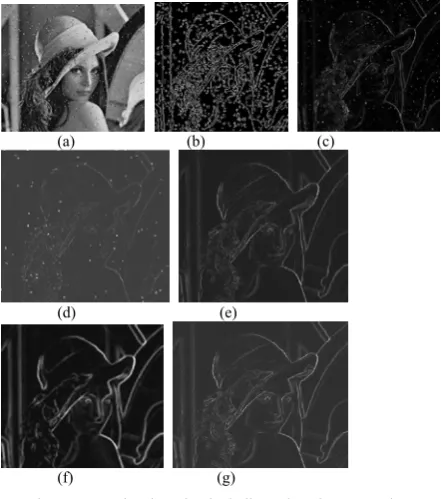
Here, it chooses the lenna image of 256 colors and satellite remote sense image of SPOT5. It compares the edge detection effect of different methods with different parameters. First, we carry out an experiment on the lenna image of 256 colors, and add salt and pepper noise, gauss noise and their commixture noise to extract the image edge.
(1) edge extraction for the salt and pepper noise image First, add the salt and pepper noise with mean value 0 and variance 0.02. Use the proposed operators as 3.1, 3.2 and 3.3 to extract the image edge. The value of
p
in theimage is 0.25 obtained by the principle of minimum mean square error and
q
is 0.75. The effect is compared withthe effect obtained by canny operator and traditional order morphology. It is showed as the figure 2.
Original image
Parameters initialization
Edge detection
Refinement
(a) (b) (c)
(d) (e)
(f) (g)
Figure 2. edge detection including salt and pepper noise 0.02
(a) image including salt and pepper noise 0.02 (b) canny operator detection
(c) traditional order morphology detection (d) anti-noise dilation order morphology detection (e) anti-noise erosion order morphology detection (f) anti-noise dilation erosion order morphology detection (g) refine(f)
In above experiment the structure elements is initial fixed, then, we change them to experiment. For the anti-noise dilation order morphology edge detection and the anti-noise erosion order morphology edge detection, the structure elements are changed into nine points crossed direction and nine points diagonal line direction. They are as follows:
B1
= [0 1 0 1 1 1 0 1 0], B2 = [1 0 1 0 1 0 1 0 1]. For the anti-noise dilation erosion order morphology edge detection, the structure elements are changed as follows: B1 = [0 0 0 1 1 1 0 0 0], B2 = [0 0 1 0 0 0 0 1 0 0 1 1 1 1 1 0 0 1 0 1 0 0 1 0 0], B3 = [1 0 0 0 1 0 1 0 1 0 0 0 1 0 0 0 1 0 1 0 1 0 0 0 1]. The effect is showed in the figure 3.(a) (b) (c)
Figure 3. edge detection including salt and pepper noise 0.02 after structure elements changed
(a) anti-noise dilation order morphology detection (b) anti-noise erosion order morphology detection (c) anti-noise dilation erosion order morphology detection
It can be seen, the effect is changed not big, which showed the proposed model is affected small by the structure element changed and its change will not arise the big difference of the edge extracting result.
Second, strengthen the salt and pepper noise to 0.1. The parameters setting are the same as in front. The edge extracted effect is showed in the figure 4.
(a) (b) (c)
(d) (e) (f)
Figure 4. anti-noise order morphology edge detection including salt and pepper noise 0.1
(a) image including salt and pepper noise 0.1 (b) canny detection
(c) traditional order morphology detection (d) anti-noise dilation order morphology (e) anti-noise erosion order morphology detection (f) anti-noise dilation erosion order morphology detection
Third, strengthen the salt and pepper noise to 0.3. The parameters setting are the same as in front. The edge extracted effect is showed in the figure 5.
(a) (b) (c)
(d) (e) (f)
Figure 5. anti-noise order morphology edge detection including salt and pepper noise 0.3
(a) image including salt and pepper noise 0.3 (b) canny detection
(c) traditional order morphology detection (d) anti-noise dilation order morphology detection (e) anti-noise erosion order morphology detection (f) anti-noise dilation erosion order morphology detection
As can be seen from Figure 3-5, with the increased noise, edge detection is in terms of part disconnection compared with the figures 2, 3, and 4, but the overall profile can also be detected. If the noise continues to increase, the image edge detected needed to be connected according to the near points to ensure the continuity of the edge. Here it is just focusing on the changes of edge detection with noise increase continually, not to consider how to connection when a large number of discontinuous edges.
0.1. For the traditional order morphology transformation, it can see a little edge with noise increased to 0.1, but can no longer detect the edge when the noise reached 0.3. However, for the order morphology transformation established by this paper, it can also detect the edges when the noise researched 30% while the canny operator and traditional order morphology transformation can not do anything. It shows that the model is feasible to some extent for gray images with the salt and pepper noise.
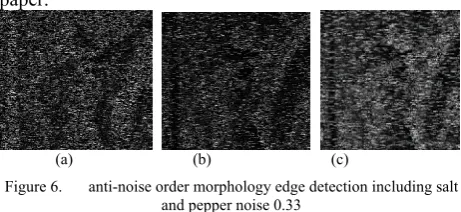
Along with the further strengthening of salt and pepper noise, for the anti-noise order morphology edge detection operator established in this paper, the anti-noise performance also decreased. The following are the detection effect figures when the salt and pepper noise increases to 33%. Compared to the Figure5, the effect decreases significantly, with many noise points, and the contour begins to blur. Therefore, when the salt and pepper noise more than 30%, the anti-noise detection performance has degraded of the three operators in this paper.
(a) (b) (c)
Figure 6. anti-noise order morphology edge detection including salt and pepper noise 0.33
(a) anti-noise dilation order morphology detection (b) anti-noise erosion order morphology detection (c) anti-noise dilation erosion order morphology detection
(2) edge extraction for the gaussian noise image
Respectively, detect the image edge with the gaussian noise when mean 0, variance 0.02, 0.1, 0.3. Here, it gives the edge detection effect of the anti-noise dilation and erosion order morphology transformation in the figures below.
(a) (b) (c)
Figure 7. anti-noise dilation and erosion order morphology edge detection with the gaussian noise
(a) under the gaussian noise 0.02 (b) under the gaussian noise 0.1 (c) under the gaussian noise 0.3
For the order morphology transformation proposed by this paper, the edge detection effect is not impact with the increase of gaussian noise, from the experiment results can be seen, the model is feasible for the image with gaussian noise less than 0.3.
Along with the Gauss noise increases substantially, the anti-noise performance also will be weakened. Below it gives the detection effect figure with Gauss noise 33%. Compared to the figure 7, the detection effect is greatly reduced.
(a) (b) (c)
Figure 8. anti-noise order morphology edge detection including gaussian noise 0.33
(a) anti-noise dilation order morphology detection (b) anti-noise erosion order morphology detection (c) anti-noise dilation erosion order morphology detection
From the above two cases can be seen, for the anti-noise order morphology edge detection operators, it can be more clear image edge detection when the salt-and-pepper noise or Gauss less than 30%, and the noise is small. But beyond this range, the anti-noise performance dramatically drops, edge detection begins to blur, and the effect is bigger contrast with the case of less than 30%. Therefore, this model is effective only for salt and pepper or Gauss noise less than 30%.
(3) edge extraction for the image with the mixture noise of salt and pepper noise and gaussian noise
Respectively, detect the image edge with the mixture noise of salt and pepper noise and gaussian noise when mean 0, variance 0.02, 0.1, 0.3. Here, it gives the edge detection effect of the anti-noise dilation and erosion order morphology transformation in the figures below.
(a) (b) (c)
(d) ( e) (f) Figure 9. edge detection with mixture noise less than 0.3
(a) image with mixture noise 0.02
(b) detection by anti-noise dilation erosion order morphology (c) image with mixture noise 0.1
(d) detection by anti-noise dilation erosion order morphology (e) image with mixture noise 0.3
(f) detection by anti-noise dilation erosion order morphology
From the above figure, it can be seen, for the mixture noise reached to 0.1, the operator proposed can also detect the image edge, but when the mixed noise reached 0.3 at this time, it can detect the edge, but the quality is starting to decline. If the mixed noise continues to increase, how to ensure that the edge detection correct should be improved, this is the content needed for the further research.
image with 2.5 m resolution of SPOT5 and satellite images of Harbin Institute of Technology Area. Here, it gives the edge effect detected by anti-noise erosion order morphology operator with the salt and pepper noise 0.1 and gaussian noise 0.1.
(a) (b)
(c) (d)
Figure 10. edge detection of Bengbuzha
(a) Bengbuzha with salt and pepper noise 0.1
(b) edge detection of anti-noise erosion order morphology (c) Bengbuzha with guassian noise 0.1
(d) edge detection of anti-noise erosion order morphology
(a) (b)
(c) (d)
Figure 11. edge detection of Harbin Institute of Technology Area
(a) Harbin Institute of Technology Area with salt and pepper noise 0.1
(b) edge detection of anti-noise erosion order morphology (c) Harbin Institute of Technology Area with guassian noise 0.1 (d) edge detection of anti-noise erosion order morphology
Figure 10-b, figure 10-d, figure 11-b and figure 11-d are two cases of edge detection results. Through the actual edge detection of the remote sensing images above, it can be seen, for the anti-noise order morphology operators proposed by this paper, it is valid for the edge detection of remote sensing images with the salt and pepper and gaussian noise less than 0.3.
V. CONCLUSIONS
In this paper, it has proposed a novel edge detection model, constructed three kinds of anti-noise edge detection operators which can correctly detect the noise images with the salt and pepper noise, gaussian noise and mixed noise less than 0.3 and can be extended to SPOT5 satellite remote sensing images. The next work is to solve
the problem of how to ensure the correct image edge detection when the noise continually increasing and how to properly connect disconnected.
ACKNOWLEDGMENT
The authors would like to thank the Fundamental Research Funds for the Central Universities, China University of Geosciences(Wuhan) (No.CUG100707) , the China Postdoctoral Science Foundation (No.20110491235) , the self-determined research funds of CCNU (CCNU10A01011) and the National Natural Science Foundation of China (No.40972206) for financially supporting this research.
REFERENCES
[1] X Jiang, H Bunke. Edge detection in range images based on scan line approximation. Computer Vision and Image Understanding, vol.73, No.2, Feb 1999, pp.183-199 [2] Xu Tao, et al. A novel image edge detection method based
on coordinate logic of multi-structure elements. Data collection and processing, 2002, 9 (7) : 252-255
[3] Yan Xueqiang. Application of Order Morphology to Image, Signal snd Processing, vol.13, No.4, 1997, pp.357-362.
[4] Arce G R, Foster R E. Detail preserving ranked-order based filters for image processing, IEEE Transaction on ASSP, vol.237, No.1, 1989, pp. 83-98.
[5] Zhao Chunhui, Hui Junying. A class of adaptive ranked-order morphological filters, Journal of Image and Graphics, vol.8, No.5, May 2000, pp. 674-677.
[6] Chi Jiannan, etc. order morphology transformation Edge Detection Based on multi-structuring elements. Image and Graphics. Vol.11, No.1, 2006, pp.41-44
[7] Liu Yanyu, Li Deliang, A Novel Algorithm of Image Edge Detection based on the Order Morphology. 2009 International Forum on Computer Science-Technology and Applications.pp:458-461
[8] J.-A. Jiang, C.-L. Chuang, Y.-L. Lu and C.-S. Fahn. Mathematical-morphology-based edge detectors for detection of thin edges in low-contrast regions. IET Image Process., vol.1, No.3, 2007, pp.269–277
[9] Serra, J. Image analysis and mathematical morphology. Academic, New York, 1982
[10]Hou Z J, Wei G W. A new approach to edge detection. Pattern recognition. Vol, 35, No.7, 2002, pp.1559-1570
Yuanni Wang is a Ph.D graduated from Wuhan University, China, and a lecturer of China University of Geosciences. Her research interests are image processing and spatial data mining. She is the corresponding author of this article.