Train Coordinated Optimization Operation with
Regenerative Braking
Peng Zhou
State Key Laboratory of Rail Traffic Control Safety, Beijing Jiaotong University, Beijing, China
Centre for Industrial and Applied Mathematics, University of South Australia, Mawson Lakes, Adelaide, SA, Australia School of Mathematics and Statistics, University of South Australia, Mawson Lakes, Adelaide, SA, Australia
Email: [email protected]
Hongze Xu
State Key Laboratory of Rail Traffic Control Safety, Beijing Jiaotong University, Beijing, China Email: [email protected]
Abstract—Reducing the traction energy consumption plays
an important role in railway energy saving. The traditional train optimization operation theories, taking the coasting as the means of energy saving, can’t fit complicated lines and is suitable for the single train only. Meanwhile, the highly complicated line will cause the risk of train collision. On the background of the “11th Five-Year” State Science and Technology Support project, a multi-train coordinated optimization operation method based on regenerative braking and safety constraint is studied, and then its application is researched relied on the experimental line. Firstly, a multi-train and multi-object dispatch method for energy saving with safety constraints is researched, and the flexible time constraint model is established. Secondly, on this basis, the multi-train coordinated optimization operation algorithm with the constraints of flexible time and safety is got. At last, the application research is done with the experimental line as the background. The results show that the multi-train coordinated optimization operation method based on regenerative braking, with flexible time and safety constraints, can decrease the energy consumption greatly and improve the traffic volume dramatically in the condition of complicated lines.
Index Terms—train optimization operation, multi-train
coordination, safety constraints, regenerative braking, the steep ramp with gradient 100‰
I. INTRODUCTION
Railway traction energy consumption accounts for 60%-70% of the railway energy consumption in all the railway departments. Reducing the railway traction energy consumption plays an important role in railway energy saving. The key factors in the railway traction energy consumption: 1, Energy consumption as a result of the train running against the resistance; 2, Kinetic energy loss caused by the train braking.
In the coal mine areas in northwest China, the coal transport lines, from the mine to the railway station or pithead power plant, are very complicated. Thus, the traditional railway can’t be used, and the road transportation has severe disadvantages of high cost and heavy pollution. So, a major project of “11th Five-Year” State Science and Technology Support Plan was set up by the Ministry of Science and Technology to research the innovative rail transportation system fitted to such complicated lines, and with the characteristics of energy saving and environment- friendliness.
The traditional train optimization operation theories, taking the coasting as the means of energy saving, can’t fit such complicated lines and is suitable for the single train only. Meanwhile, the highly complicated line will cause the risk of train collision.
Therefore, to research the train optimization operation theories, which take the regenerative braking and multi-train coordination as the major technical means of energy saving and meet safety constraints, has theoretical significance and application value.
II. RELATED WORK
The train optimization operation research can be divided into three classes:
The first class is from the standpoint of train control strategy for energy saving-optimized control strategy based on the fixed train structure and fixed operation environment. The research object is the train without energy-feedback. From the standpoint of different constrains, the first class can be divided into two classes: 1, the train optimized control strategy without energy-feedback on the condition of no-safety constraints. 2, the train optimized control strategy without energy-feedback on the condition of safety constraints. At present the method of the research class 1 is comprised of optimal control method [1,2] and intelligent control method [3,4]. In order to ensure the train running safety, the train should limit the speed in the curve and steep gradient section. The method of the research class 1 can’t adapt This work is supported by National Key Technology R&D Program
(2008BAG11B01) and partially supported by the National High Technology Research and Development Program (863 Program) under Grant 2004AA505540.
such complicated line, so the method of the research class 2 becomes an important research field [5,6].
The second class is from the standpoint of train dispatch for energy saving-the influence of train formation for energy saving in train operation. The research object is the train group. From the standpoint of different constrains, the second class can be divided into three classes: 1, the train optimized dispatch without energy-feedback on the condition of no-safety constraints [7,8]. 2, the train optimized dispatch without energy-feedback on the condition of safety constraints [9,10]. 3, the train optimized dispatch with energy-feedback on the condition of safety constraints [11,12].
The third class is from the standpoint of train dynamics system, such as energy storage equipment. The research on the train operation for energy saving which takes the train dynamics system as the research object starts on the 60's of 20th century, so far some technology is relatively mature and abundant[13,14].
The problems of the research on the train optimization operation research are as follows in conclusion:
The traditional train optimization operation theories, taking the coasting as the means of energy saving can only fit general ramp (the gradient is below 15‰), the train optimization operation theories fitted the complicated lines (the gradient is above 100‰) are in the beginning stage.
Energy-feedback is not taken into consideration in the traditional train dispatch for energy saving, so the train dispatch for energy saving with energy-feedback is in the beginning stage.
The traditional train optimization operation theory research is in the view of separated train, and the safety constraint contains only line speed limit, the train tracking is not taken into consideration. The traditional theory research on the train
operation for energy saving doesn’t combine the train optimization operation with the train dispatch for energy saving.
According to the present research situation above, on the background of the “11th Five-Year” State Science and Technology Support project, a multi-train coordinated optimization operation method based on regenerative braking and safety constraint is studied, and then its application is researched relied on the experimental line. Firstly, a multi-train and multi-object dispatch method for energy saving with safety constraints is researched, and the flexible time constraint model is established. Secondly, on this basis, the multi-train coordinated optimization operation algorithm with the constraints of flexible time and safety is got. At last, the application research is done with the experimental line as the background.
III. TRAIN DISPATCH FOR ENERGY SAVING WITH REGENERATIVE BRAKING
The train dispatch method for energy saving with regenerative braking is researched, so that the model of the train dispatch is got.
Firstly, the object function for the model of train dispatch method for energy saving is researched. Secondly, the constraint condition is studied.
A. Object function
The object function for the model of train dispatch method for energy saving is based on two objects: 1, the minimum energy consumed in a unit time
t
. 2, the maximum traffic volume in a unit timet
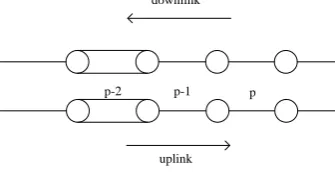
. However, the two objects are contradictory: in a limiting case, if the trains are not moved in a unit time, the energy consumed is zero, but the traffic volume is zero too; if the traffic volume is large, the energy consumed is high too. So we have to balance the two objects to optimize the train dispatch method for energy saving.Firstly, the model of train dispatch for energy saving is established. One section is cut from the whole line, as is shown in figure 1, section p2 is a double section, and section
p
is a single section. Suppose Pis the set of the track sections, P1Pis a single section. P2P is a double section. SoP1P2P,1 2
P P ,dpis the length of the sectionp, Iis the set of the up trains, Jis the set of the down trains, iIis the train going up, jJ is the train going down.
p-2 p-1
uplink downlink
p
Figure 1. Sketch map of track sections
The factors that influence the energy consumption in the train operation: 1, the energy consumption for the train overcome the resistance; 2, the energy consumption for the accelerating or braking [8,15].
Aiming at the first factor, according to the Davis formula [16], the unit energy consumption for the train
iIrunning at the average speed of i p
v on section pP Ripipp pi iv ip(vip)2 (1)
Where
( 0.8 ) i
a G r W
p p p i
i bW
p i
i cA
p i
i p
: the average resistance due to the train
going on the ramp or the curve
, ,
a b c: the adjusted parameter G p: the gradient of the section pP
rp: the curvature of the section pP
i p
: the average friction force when the train
iIrunning on the section pP i
p
: the average air resistance force when the
train iIrunning on the section pP Ai: the cross sectional area of the train iI Suppose x pi is the moment that the trainiI enters the section pP , so the average speed that the
train iI on the section pP is
1
d p i
v p i i
xp x p
,
according to formula (1), the energy consumption for the train iIrunning on section pP:
2
1 1
dp dp
i i i i
Vp dp p p i i p i i
xp xp xp xp
(2) Aiming at the second factor that influences the energy consumption in the train operation, the energy consumption due to the trainiIaccelerating or braking on the section pPisU pi .
Ifvip vip1, that is
1
1 1
d
d p p
i i i i
xp xp xp xp
0
i
U p . So,
2 2
1 1
2 1 1
l
l p p
i
Up Wi i i i i
xp xp xp xp
(3)
Ifvip vip1, that is
1
1 1
d
d p p
i i i i
xp xp xp xp
0
i
U p . So,
2 2
1 1
(1 )
2 1 1
l
l p p
i
Up Wi i i i i
xp xp xp xp
(4)
At the moment the train brakes and produces the renewable energy.
According to formula (1)-(4), the energy consumption due to the trainiIrunning on the sectionpis
piVpiU pi (5) Similarly, the energy consumption due to the train jJrunning on the sectionpis
jp V pjUpj (6)
Suppose m pf
x is the moment that the train going up arrives at the destination,
f
m p
x and
f
m p
x are the lower bound and the upper bound. Suppose
f m p
y is the moment that the train going down arrives at the destination,
f
m p
y and
f
m p
y are the lower bound and the upper bound.
[0,1]
e m
is the weight of energy consumption and
operation time of the train going up.mw[0,1] is the weight of energy consumption and operation time of the train going down.
Suppose fie( ),x fjw( )y are the energy consumption of the single train going up and the single train going down, so the total energy consumption of the trains going up is fie( )x
i I (7) The total energy consumption of the trains going down is fjw( )y
j J (8) According to (5),
fie( )x ip p P
(9) According to (6),
fjw( )y jp p P
(10) According to (7)-(10), the general objective function is
( , ) ( ) (1 )
( ) (1 )
(1 )
(1 )
e e e m
f x y m fi x m xp
f i I
w w w m
f y y
mj J j m pf
e i e m
x
m p m pf
i I p P j
w w m
y
m p m p
f j J p P
(11)
B. Constraint Conditions
In order to ensure the safety, the speed limits of the different lines are distinct. P1P is a single section.
2
P P is a double section, P2Pcan be divided into the main line and the branch line. Suppose
i
v p: the average speed of the train iIon sectionP1P,
where
v
pi is the lower bound andv
pi is the upper bound.j
w p : the average speed of the train jJ on
sectionP1P, where w pj is the lower bound and j
w p is the upper bound. i
v pm : the average speed of the train iI on the main line of section P2P , where vpmi is the lower
i
v ps: the average speed of the train iIon the branch line of sectionP2P, where vpsi is the lower bound
and v psi is the upper bound. j
w pm: the average speed of the train jJon the main line of section P2P , where w pmj is the lower
bound and w pmj is the upper bound. j
w ps: the average speed of the train jJon the branch line of section P2P , where w psj is the lower
bound and w psj is the upper bound. So,
( 1)
i i i
vp vp vp pP
( 1)
j j j
wpwp wp pP
( 2)
i i i
vp vp vp p P
m m m
( 2)
j j j
wp wp wp p P
m m m
( 2)
i i i
vp vp vp p P
s s s
( 2)
j j j
wp wp wp p P
s s s
Constraint Condition 1: the upper bound of the operation time of the train running on the sectionpP
The speed limits on different lines are distinct, so the operation time of the train running on the different sections are distinct. As is shown in figure 1, the operation time of the train iI running on the section pPis xip1x pi , the operation time of the
train jJ running on the sectionpPisypj1y pj. If
the trainiIruns on the main line of sectionpP2,
1
dp i i dp
x x p
i p i
vp vp
m m
(12)
Suppose
2
2
1( sec
0 sec
e ip
the train i I enters the branch of the tion p P D
the train i I enters the main of the tion p P
)
( )
2
2
1( sec )
0 sec
w jp
the train j I enters the branch of the tion p P D
the train j I enters the main of the tion p P
( )
M: a positive number that is infinitely great, according to (12),
1
dp dp
e i i e
MDip i xp xp i MDip
vp vp
m m
(13)
(13) is the constraint condition 1.
Constraint Condition 2: the safety constraint on the no switch section
Suppose
s
is the safety buffer time of the no switch section. In order to ensure the safety, the time between the successive two trains which enter the same section iss
. As is shown in figure 1,k l, I,pP1, if the train kenters the sectionpP1earlier than the trainl, the trainlcan’t enter the sectionpP1until the time
s
after the train kenters the sectionpP1, that issxkp xlp (14) Suppose
1
1
1, sec
0, ( sec
) e
klp
the train k I enters the tion
p P earlier than the train l I B
the train l I enters the tion
p P earlier than the train k I
(
)
1
1
1, sec
0, ( sec
) w
klp
the train k J enters the tion
p P earlier than the train l J B
the train l J enters the tion
p P earlier than the train k J
(
)
According to (14),
sxkp xlpM(1Bklpe )(k l, I p, P1) (15)
(15) is the constraint condition 2.
Constraint Condition 3: the safety constraint on the switch section
Suppose
s
2is the safety buffer time of the switch section. In order to ensure the safety, the other train can’t enter the switch section until the train going ahead leave, and the buffer time iss
2.2
2
1( sec ,
sec )
0 klp
after the train k I J leaves the tion p P
C the train l I J enter the tion p P
(其它)
So,
(1Cklp)(1Clkp) 0( k l, I J p, P2) (16)
As is shown in figure 1, if the train ldoesn’t enter the section pP2 until the train k leaves the
sectionpP2and the time
s
2passes,s2xkp1xlpM(1Cklp)(k l, I p, P2) (1)
(17) is the constraint condition 3.
Constraint Condition 4: the traffic volume in a unit time Suppose the whole traffic volume is at least mq (m is the train number, q is the single train volume), so the time that the mth train arrives the last section pf can’t be more than T, that is
xmpf T (18)
Now we get the object function and the constraint conditions of the model of the train dispatch method for energy saving, then the solution which is the flexible time can be easily got by branch and bound algorithm.
IV. TRAIN COORDINATED OPTIMIZATION OPERATION WITH THE CONSTRAINTS OF FLEXIBLE TIME AND SAFETY
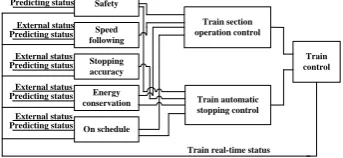
The automatic train operation (ATO) does the traction calculation on the basis of train group real-time status and the train group predicting operation condition, and then the train group predicting status was got. According to the train group predicting status, train group real-time status and external status, ATO gets the fuzzy object evaluation and then does fuzzy reasoning, and gets the satisfactory optimization, then does reinforcement learning, and gets the most energy efficient, the safest train coordinated optimization operation through coordinating the relationship among trains for energy saving, as is shown in figure 2.
The function of the on schedule evaluation is applied to connect the flexible time in the section III with the model of train coordinated optimization operation, so that the flexible time is considered as the constraint condition of the method of the train coordinated optimization operation.
Fuzzy Object Evaluation
Fuzzy
Reasoning Train
Traction Calculation
Reinforcement Learning
Train Group Real-time Status Train Group Predicting Operation Condition Train group Predicting Status
External Status
Train Group Real-time Status
Figure 2. The model of train coordinated optimization operation
A. Traction calculation
Based on the traction calculation theory, we can get the predicting current I , the predicting speed v , the predicting acceleration a , the predicting maximum overrunning distancesmax, and the predicting running distances, and the predicting running timet.
B. Predicting fuzzy control
Some rules should be followed to make the train run safely and energy-efficiently [17]: 1, certain rules should be followed when the train operation condition changes, as is shown in table 1. For example, when the train is in traction status, it can’t change to decelerating brake status or stopping brake status immediately.
TABLE I.
RULES FOR THE CHANGE OF OPERATION CONDITION
Status Priority Status to be changed
Starting 1 Traction Traction 1 Coasting
Coasting
1 Traction
2 Stopping brake 3 Decelerating brake Restraining speed 1 Coasting
Status Priority Status to be changed 2 Stopping brake 3 Decelerating brake
Decelerating brake
1 Coasting 2 Stopping brake Stopping brake 1 Stopping brake 2, the operation condition of the train should be changed smoothly from one status to another. For example, when the train operation condition changes from coasting to traction, the traction force can’t be too big at once, and should be increased gradually.
1) Fuzzy object evaluation
The procedure for energy-efficient train operation: 1, train starting.2, uniform velocity. 3, accelerating or decelerating brake before entering the speed limit section. 4, decelerating brake. 5, stopping brake. According to the process, we evaluate safety, speed following, stopping accuracy, energy conservation, on schedule of the train operation.
Safety evaluation
a. Evaluation function of the acceleration safety The acceleration safety depends on the acceleration value and the rate of acceleration changing. If the acceleration is too big or the rate of acceleration changing is too fast, it may lead to the damage of the vehicle structure. So the acceleration value and the rate of acceleration changing should be controlled to make sure that the train running steady.
Suppose amax : maximum acceleration for safe operation. a t( ) : predicting acceleration. So the evaluation function of the acceleration safety is
0, ( ) max
( ( )) ( )
1 , 0 ( ) max
max
a t a
a t a t
q
a t a
a
(19)Suppose amax : maximum rate of acceleration changing for safe train operation. a: predicting rate of acceleration changing. q( a) [0,1] : the rate of acceleration changing safety evaluation function. In formula (19) we replacea t( ), amax witha t( ),amax
then we can getq(a).
b. Evaluation function of the stopping position safety
The stopping position safety displays when the train stops. Supposesmax( )t : maximum overrunning distance.
( )
smb t : target stopping position. So the evaluation function of the stopping position safety is
0, ( ) max( ) ( ) ( ) max
( ( )) , ( ) ( ) max( ) ( ) ( )
max
1, 0 ( ) ( ) s t s t
s t s t
s t s t s t s t
t mb
s t smb t
s t smb t
c. Evaluation function of the speed safety
The train speed should be less than the speed limit when the train is running. Supposey( ( ))x t : evaluation
function of the speed safety. vmax( ( ))x t : limiting speed.
( ( ))
vmb x t : target speed. We define vmb( ( ))x t
0.9vmax( ( ))x t
. In formula (20) we replaces t( ),smax( )t
( )
s t
mb withv x t( ( )),vmax( ( ))x t , vmb( ( ))x t , then we can gety( ( ))x t .
Speed following evaluation
Speed following evaluation depends on the consistency between the predicting speed v x t( ( )) and the target speed vmb( ( ))x t . Suppose v x t( ( )) v x t( ( )) v ( ( ))x t
mb
,
the evaluation function of the speed following is 0, ( ( )) 10
10 ( ( ))
, 10 ( ( )) 1.5 8.5
( ( ( ))) 1, 1.5 ( ( )) 0 1
( ( ))
1 , 0 ( ( )) 3 3
0, ( ( )) 3 v x t
v x t
v x t
v x t v x t
s
v x t
v x t
v x t
(21)Stopping accuracy evaluation
Stopping accuracy function depends on the deviation of the predicting stopping position s t( ) and the target stopping positionsmb( )t . Supposes t( )s t( )smb( )t , the evaluation function of the stopping accuracy is
( ( ) ) , ( )
( ( )) 1, ( ) 1
( ( ) ) , ( )
k s t A
e s t A
s t A s t A
t
k s t A
e s t A
(22)Energy conservation evaluation
SupposeI t( ): predicting current consumed. In( )t : the regenerative current from the power-supply network. IfI t( )In( )t , the regenerative current will be consumed
by the train. If 0I t( )In( )t , only a part of the regenerative current will be consumed by the train. IfI t( )0, the train produces regenerative current. The energy conservation evaluation depends on the deviation of I t( )andIn( )t .
1, ( ) ( )
( )
( ( )) , 0 ( ) ( ) ( )
0, ( ) 0
I t In t
I t
I t I t I t
e n
In t
I t
(23)On schedule evaluation
On schedule evaluation depends on the deviation of the predicting running time t and specified running timetmb.
Suppose t t tmb. The degree of the flexibilitytm: the maximumt. The evaluation function of the schedule is
0,
1 , 0
( )
1 , 0
0,
t tm
t
tm t tm t z t t tm tm t tm
(24)2) Fuzzy reasoning
1
m ,m2,m3,m4,m5 respectively stand for safety, speed following, stopping accuracy, energy conservation, on schedule. m1 includes acceleration safety m11, speed safety m12 , position safety m13 . The factors that influence the train section operation are m1,m2,m4,m5. The factors that influence the train automatic stopping arem1,m3,m4,m5. Supposem n1 ( )u : the nth safety
satisfactory optimization value. wm is the weight of the fuzzy object. Under the prerequisite of safety (m n1 ( )u 0,nZ,1 n 3), the weights of the train section operation from high to low arew1,w4,w5,w2, and w1w2w4w51 . The weights of the train automatic stopping from high to low arew1,w4,w5,w3, and w1w3w4w51.
SupposeK t( ): the train operation condition in timet. According to table 1, If K t( )0 , K t( 1)0
orK t( 1)0. IfK t( )0, K t( 1) 0 orK t( 1)0, so the satisfactory optimization function of the train section operation control:
11 12 13
( ) ( 11( )) ( 12( )) ( 13( ))
2 4 5
( 2( )) ( 4( )) ( 5( ))
( ) 0, ,1 3
1
1 2 4 5 1
: ( ) 0, : ( 1) 0 ( 1) 0
: ( ) 0, : ( 1) 0 ( 1) 0
w w w
u m u m u m u
w w w
u u m u
m m
u n Z n
m n
w w w w
if K t then K t orK t
if K t then K t orK t
(25) We can get the satisfactory optimization function ofthe train automatic stopping control in a similar way. As is shown in figure 3, we get the satisfactory optimization value of the train operation, and the forward p optimal values of the traction operation mode are the optimum operation value. Train automatic stopping control Train section operation control Train control Safety Speed following Stopping accuracy Energy conservation On schedule External status Predicting status
Train real-time status External status Predicting status External status Predicting status External status Predicting status External status Predicting status
3) Reinforcement learning
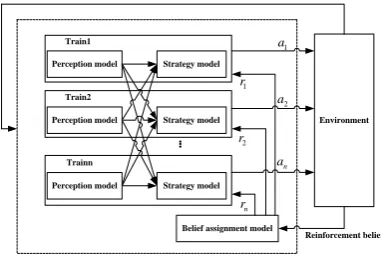
If the relationship of the trains is well coordinated, the energy will be adequately used. We make use of the reinforcement learning to get the most energy efficient control strategy from the p recommended traction operating mode.
Every train is regarded as an intelligent agent, whose state s contains the velocity and location of the train. SettingS( , )v s , where v stands for the set of all the possible speed of the train, s stands for the set of all the possible positions of the train. Therefore, the state of the kth train isS S
k ; the action set A is made up of p recommended traction working conditions from predictive fuzzy controlling, the action of the kth train isakA; the reward of the kth train is determined by the value of regenerative energy which is gained by the kth train. For example, if the value of regenerative energy gained by the kth train is 1 kW.h, then r 1
k . If regenerative energy generated by the kth train is 1 kW.h, therk 1.
Determination of action depends on both its own state and the state and action of other trains in the process of the trains’ study. Usually, the reinforcement learning of multi-agent system is distributed, concurrent and fault-tolerant [18], as shown in figure 4.
Perception model Strategy model Train1
...
Environment
Belief assignment model Environment status
1
a
2
a
n a
1
r
2
r
n r
Reinforcement belief Train2
Trainn Perception model
Perception model
Strategy model
Strategy model
Figure 4. Train group reinforcement learning system We replace the action of a single train with combined motions of all trains when the single train system is expanded to multi-train system, then
1 1
( , , ..., ) (1 ) ( , , ..., ) [ ( )]
1 1
k n k n k k
Qt st at at t Qt st at at t tr Vt st
But there is still one question that is updating state-value functionVtk(st1). We adopt the Friend-or-Foe Q learning. At time t, the relationship among the trains which use regeneration energy each other is called Friend, Then
1( ) max 1( , 1, 2) 1 1 2, 2
NashQt st Qt s at a a A a A
The trains which generate regeneration energy are their Foe, and the algorithm degenerates to Minmax-Q algorithm. Then there is:
1 1 1 1 2
( ) max min ( ) ( , , ) 2 2
1 1 1
( )
NashQ st t a Q s at t a
a A
PD A a A
n
trains need to be divided into two parts. Variables fromx
1 tox
marem
friends, while ones fromY
1toY
larel
Foes. Then the definition of values function is: 1( ) max min
1 1 1
( ... ) ... ...
1 1 1 1
( )... ( ) ( , , ..., , , ..., ) 1 ... 1...
NashQt st
m l l
X X y y Y Y
m m l
x x Qt st x x y y
m m
x x X X
The size of the n trainsQtable is
| | | | | | | | | | | |
1 1 1
n i n i n i n n
n S A n S A n S A
i i i (26) According to (26), the space size is the exponential function of the number of the trains. If
n
is too big, it will influence the convergence rate. In order to increase the convergence rate, we use the predicting action method. The probability predicting function updating rules:( , ) ( , ),
{ } ( , )
1
(1 ) ( , ),
i i i i i i
It s at k It s at l al ak
i i
i i a A a
It s at k l k
i i
It s at k
otherwise
(27)
1 { , ..., n}
s st st
t .
i
ak: trainiuses the kth action in action collectionA.: learning rate of the predicting learning model, which decays from 1 to 0. Formula (27) is a stochastic learning automaton. The Q function updating rules of the train kis
( , ) (1 ) 1( , ) 1
[ ( )... ( ) 1( 1)]
1 1
k k k k
Qt st a t Qt st a
t t
k n k k
r s s Q s
t t t t t t
(28)
According to (27) and (28), we can see that the storing space becomes n|S||A|n n |S|n|A|, which is far less thann|S|n|A|n, so we can use the predicting action method to decrease the learning space, and increase the learning speed. The predicting action method can easily realize action choice of the train group learning algorithm.
1
( , , 2 3, ,..., )/ 1
( ) 1
( , , 2 3, ,..., )/ 1 1
Q s a a at l an T e
prob ai Q s a a a a T n t k
e ak A
(29)
According to Boltzmann machine (29), we get the probability that the train 1, 2… n chooseain. The method of train coordinated optimization operation is got through balancing exploitation and exploration.
V. EXPERIMENTS & RESULTS
Section1
70 60
Section2
265.62 230.38 24
Section 3、4 Section5 Section6
24 126.26 180 42
Section1 Section2 Section3 Section4
Coaling point Full train line
Light train line Unloading point 1
Unloading point 2 Garage
30 60 70
235.62
Section1 Section2 Section3
2
3
0
.3
8
42 180
1
2
6
.2
6
2
4
2
4
Full train line Section4
S
ec
ti
o
n
5
S
ec
ti
o
n
6
Section1 Section2
S
ec
ti
o
n
3
S
ec
ti
o
n
4
Light train line Coaling point
Unloading point 1
Unloading point 2
Figure 5. The line sketch map
The actual maps of the curve and the uphill grade are shown in figure 6. The curvature of the line reaches 1/150, and the gradient is greater than 100‰.
Figure 6. The actual maps of the curve and the uphill grade As is shown in figure 7, the regional control system and the vehicle control system were developed, which respectively used to running the program of the train dispatch method for energy saving and the program of the train coordinated optimization operation.
Figure 7. The actual maps of the regional control system and the vehicle control system
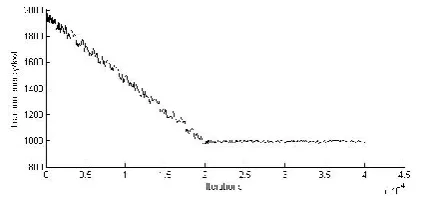
As is shown in figure 8, we applied the model of train coordinated optimization operation to the line, and did 40000 iterations.
Figure 8. Relationship between the iterations and the traction energy
From figure 8, we got that: 1, when the number of iterations is 20042, the traction energy converges to 993.297 kW.h. 2, the traction energy shakes slighter as the number of iterations increases after 20042. It is the phenomenon that the trains lingered between exploitation and exploration. After the convergence, the probability that the trains choose the return r
k is higher than before, because the trains have found the optimal strategy. In the figure 8, the result is much better than the method without train dispatch for energy saving in which traction energy converges to 1173.844 kW.h in [19].
Figure 9. Relationship between the energy consumed by the brake resistor and the regenerated energy
Figure 10. Relationship between the traction energy and the time After the convergence, we get the optimal strategy, and then we compare the optimal strategy with the strategy that is not optimal.
As is shown in figure 9, we got that: the regenerative energy is 594.258 kW.h before optimization, in which the brake resistor consumes 526.701 kW.h; the utilization factor of the regenerative energy is 11.37%. The regenerative energy is 357.718 kW.h after optimization, in which the brake resistor consumes 20.692 kW.h, the utilization factor of the regenerative energy is 94.22%, so the result is better than the method without train dispatch for energy saving in which the utilization factor of the regenerative energy is 89.02% in [19].
According to the experimental data, if it works for 5 hours, the traffic volume of the coal is 996.483 tons before optimization, and the traffic volume of the coal is 1244.831 tons after optimization, which is almost the same as the result in [19].
VI. CONCLUSION
The experiment results demonstrate that the train group energy control strategy based on the complete security constraints not only decreases the traction energy consumption heavily, but also improves the traffic volume largely in unit time, and the results are much better than that in [19].
REFERENCES
[1] ZHU Jinling,“Optimization analysis on the energy saving control for trains,” China Railway Science, vol. 29, pp. 104-108, 2008.
[2] P.G. Howlett, P.J. Pudney, “Local energy minimization in optimal train control,” Automatica, vol. 45, pp.2692-2698, 2009.
[3] Wong K K,Ho T K. K, “Dwell-time and run-time control for DC mass rapid transit railways,”Electric Power Applications, vol.1, pp. 956-966,2007.
[4] YU Jin, QIAN Qing-quan, HE Zheng-you, “Research on application of two-degree fuzzy neural network in ATO of high speed train,” China railway Society, vol. 30, pp. 2-12, 2006.
[5] Liu R F, Golovitcher I M, “Energy-efficient operation of rail vehicles,”Transportation Research Part A, vol.37, pp.917-932, 2003.
[6] Khmelnitsky E, “On an optimal control problem of train operation,” Automatic Control, vol. 45, pp. 1257-1266, 2000.
[7] Goossens J,Van Hoesel S,Kloon L, “A branch-and-cut approach for solving railway line-planning problems,”Transportation Science, vol. 80, pp. 193-210, 2004.
[8] Chang, Y.H., Yeh, C.H., S, “A multiobjective model for passenger train services planning: application to Taiwan’s high-speed rail line,”Transportation Research Part B, vol. 34, pp. 91-106, 2000.
[9] Mu S, Dessouky M, “Scheduling freight trains traveling on complex networks,” Transportation Research Part B, vol. 45, pp. 1103-1123, 2011.
[10]Ghoseiri, K., Szidarovszky, F., Asgharpour, M.J, “A multi-objective train scheduling model and solution,”Transportation Research Part B, vol. 38, pp. 927-952, 2004.
[11]Zhou Jianbin, “Utilization of train’s regenerative energy in metro system, ” Urban Mass Transit, vol. 7, pp. 33-35, 2004.
[12]ZHANG Wen-li ,LI Qun-zhan ,LIU Wei, “Simulation research on energy saving scheme of metro vehicle regenerative braking,” Converter Technology & Electric Traction, vol. 3, pp. 41-44,2008.
[13]M. Ogasa,“Energy saving and environmental measures in railway technologies: example with hybrid electric railway vehicles,”Electrical and Electronic Engineering, vol. 3, pp. 15-20,2008.
[14]Y. Sekijima, S. Toda, “Test run of onboard energy storage system using EDLC,”Industry Applications Society, pp. 201-202,2008.
[15]Ke BR, Lin CL, Lai CW, “Optimization of train-speed trajectory and control for mass rapid transit systems,”
Control Engineering Practice, vol. 19, pp. 675-687, 2011. [16]Dingier Mark H, Lai Yung-Cheng, Barkan Christopher P.
L, “Effects of communications-based train control and electronically controlled pneumatic brakes on railroad capacity,” Transportation Research Record, vol. 2159, pp. 77-84, 2010.
[17]FENG Xiao-yun, ZHAO Dong-mei, LI Zhi, “A new algorithm for fuzzy multi-objective prediction control based on satisfactory optimization,” Journal of Southwest Jiaotong University, vol. 37, pp. 99-102,2002.
[18]ZHANG Ru-bo, ZHONG Yu, “A new accelerating algorithm for multi-agent reinforcement learning,” Harbin Institute of Technology, vol. 12, pp. 48-51,2005.
[19]Peng Zhou, Hongze Xu, Mengnan Zhang, “Train group energy control strategy with security constraint,” 2011 International Conference on Computer Control and Automation, pp 10-14, 2011.
ACKNOWLEDGMENT
This work is supported by National Key Technology R&D Program “Key Technology Research and the Core Equipment Developing of the innovative linear electric motors transport system” and partially supported by the National High Technology Research and Development Program (863 Program) “Key Technology Research and the Core Equipment Developing of the High-Speed Maglev Train Decentralized Operation Control System”.
Peng Zhou Ph.D. student at school of Electronics and
Information Engineering, Beijing Jiaotong University. He received the bachelor’s degree from Beijing Jiaotong University in 2005.His research interest covers the control of the train operation.
Hongze Xu Professor at school of Electronics and Information