PERFORMANCE AND EMISSION CHARACTERISTICS OF CI ENGINE
USING SIMAROUBA BIODIESEL WITH SC5D ADDITIVE
E Surendra*1, G Madhu Babu2, V. V. S. H. Prasad3
Assistant Professor, Department of Mechanical Engineering t, IARE (autonomous), Hyderabad, Telangana, India1. Assistant Professor, Department of Mechanical Engineering, BIE&T College, Hyderabad, Telangana, India2 Professor, Department of Mechanical Engineering, IARE College (autonomous), Hyderabad, Telangana, India
Abstract:
The world’s fossil fuel reserves are depleting at higher pace due to exponential growth of population and increased usage of technology. Developing countries like India, invests heavily on imports of petroleum fuels and simultaneously better fuel economy and higher power with lower maintenance cost has increased the popularity of diesel engine vehicles. Diesel engines are used for bulk movement of goods, powering stationary/mobile equipment, and to generate electricity more economically than any other device in this size range. Diesel engines are the major contributors of various types of air polluting gases like CO, HC, NOx, Smoke etc., and Improvement of fuel properties are essential for suppression of diesel pollutant emissions. Vegetable oils are also a very hopeful alternate fuel for diesel engines because they are renewable, clean burning and have properties analogous to that of diesel. Experimental investigation has been carried out on the performance and emission characteristics of CI engine using Simarouba oil and its blends with SC5D Additive. Tests are conducted on single cylinder four stroke water cooled compression ignition engine to evaluate the feasibility of blends of Simarouba oil with SC5D Additive. It is evident from the experiment that additive will improve the thermal efficiency of the engine and also it influence on emission characteristics.Keywords: Biodiesel, Simarouba, SC5D Additive, 4 stroke diesel engine, Engine performance and emissions.
1. INTRODUCTION
Diesel engines are widely used for transportation, industrial and agricultural sectors due to their reliability, durability and high thermal efficiency. However, there are two major challenges facing the use of diesel engines. One is related with fossil fuel sustainability and other is related with environmental concern on engine emissions. So far, diesel engines have adopted many technical break through for reducing both fuel consumption and pollutant emissions.
Diesel engines are being used as one of the vital prime movers for generating power and electricity in many industrial and agricultural applications. Reports emanating from research studies on alternate or renewable fuels unanimously predict an unprecedented demand for petroleum fuels by 2030 and the repercussions of this have been already felt by the sudden surge in petroleum prices. In addition to this petroleum fuel demand, its use is also associated with increased environmental problems.
Considering the future energy security, sustainability and environmental damage, the study on various alternate, clean and renewable sources of fuel has grabbed the interest and attention of many researchers. Among which, biodiesel is one of the most commonly used alternative fuel for diesel engine. In this work, we have adopted Simarouba glauca oil. Simarouba glauca belongs to family Simarubaceae Quasia. By adding SC5D Additive to the bio-diesel the performance will improved and emissions will be reduced more than plain bio-diesel.
Simarouba oil:
Simarouba belongs to the family Simarubaceae Quasia. It had also been known as paradise tree, Laxmitaru, Acetuno, a multipurpose tree that can grow well under a wide range of hostile ecological condition. Its origin is native to North America, now found in different regions of India. It was a medium sized tree generally attains a height about 20 m and trunk diameter approximately 50 – 80 cm and life about 70 years. It is an evergreen multiutility tree that grows up to 15m height with tap root system and cylindrical stem. It grown well in the wastelands of Orissa, Karnataka and Gujarat Besides, Andhra Pradesh, Bihar, Chhattisgarh, Maharashtra and Tamil Nadu are potential states where it can be grown successfully. Simarouba tree can grow well in tropical climate with the temperature ranges from 10˚C-40˚C. The rainfall of 700-1000 mm is suitable for its normal growth. All types of well drained soil having pH range 5.5 to 8.0 are suitable for simarouba plantation. It could grow under a wide range of agro climatic conditions like warm, humid and tropical regions. Its cultivation depends upon rainfall distribution (around 400 mm), water holding capacity of the soil and sub-soil moisture. It was suited for temperature range 10 – 40oC, pH of the soil should be 5.5 – 8. It produces bright green leaves 20-50c length, yellow flowers and oval elongated purple colored Fresh fruits. Its seeds contain about 40 % kernel and kernels content 55 -65% oil. The amount of oil would be 1000 – 2000 kg/ha/year for a plant spacing of 5m x5m. It was used for industrial purposes in the manufacture of soaps, detergents and lubricants etc.
Fig:1 Simarouba Seeds
The oil cake being rich in nitrogen (7.7 to 8.1%), phosphorus (1.07%) and potash (1.24%) could be used as valuable organic manure. Simarouba was a rich source of fat having melting point of about 29oC. The major green energy components and their sources from Simarouba were biodiesel from seeds, ethanol from fruit pulps, biogas from fruit pulp, oil cake, leaf litter and thermal power from leaf litters, shell, unwanted branches etc.
SC5D Additive:
It is a polymer based additive and Radish yellow colour liquid. It is soluble in hydrocarbons. SC5D Additive compare to other additives cost wise very cheap as well as quality like mileage, performance, power, reliability and going to turn your simple diesel to SUPER DIESEL.
2. Materials and Methods:
2.1 Production of Simarouba biodiesel
Raw oil extracted from the dry seed of Simarouba Glauca has higher viscosity and poor combustion quality due to the presence of free fatty acid. Simarouba oil undergone trans-esterification process for reducing the viscosity and make it has combustible. The process for the production of the biodiesel is based on the presence of the FFA. Since the FFA value of Simarouba oil was found to be 2.57% single stage (alkaline catalyzed trans-esterification) process was used. 1 liter of Simarouba oil is taken and transferred into a3-neck flask. This 3-neck flask is placed on a magnetic stirrer which has a magnetic pellet inside it.
Now the reflux condenser is fixed to the central neck of 3-neck flask. Water pipeline is connected to the condenser and checked for water circulation from tap to condenser and outlet. The magnetic stirrer is then switched on, the heating control is set to 600oC and the speed of the stirrer is adjusted between 600-800 rpm to get a homogeneous heating of the oil. Now add some oil into the thermo-well and insert it into the side neck of the 3-neck flask. Place the thermometer into the thermo-well and check the temperature. Now take 300ml methanol per liter of oil in a 500ml capacity beaker. Weigh the 6 grams of NaOH (based on the FFA% determined earlier for
the raw oil) and add to methanol. Stir well and this mixture is called Methoxide mixture.
When the temperature reaches 630oC, the Methoxide mixture slowly added to the hot oil inside the 3-neck flask through the loading opening neck and the speed is maintained at 600rpm. Now the opening neck is closed with a stopper. The temperature is maintained at 600oC to 630oC using condenser and the process is run for 2hours. It is observed that the color of the mixture turns to transparent chilly red. Switch off the power and remove the reflux condenser. Transfer the mixture into a separating funnel and allow settling for 2-hours. After 2 hours the glycerin is settled down at the bottom and the biodiesel separates as top layer. Glycerin is drained from the bottom of the separating funnel carefully and stored.
2.2 Recovery of methanol from biodiesel
Transfer the biodiesel into the reaction vessel, make the necessary arrangement for the distillation setup like heating, stirring and fixing the double wall condenser along with the recovery flask, maintain the rpm speed at 1000 RPM and the temperature at 700oC, methanol starts evaporating. Collect the methanol condensate, measure the quantity and record it. Switch off the system when the methanol condensation stops.
Fig2. The flow chart for biodiesel production
2.3 Washing of biodiesel
Transfer the biodiesel after methanol recovery into the plastic washing funnel specially assembled for this purpose, spray 300ml of warm water slowly into the biodiesel without
any agitation. Allow to settle for 15 minutes. A bottom layer of soap water will slowly start to form, drain the bottom layer carefully. Repeat the above procedure (300mlwater) for third time and shake vigorously and allow it to settle for 1 hour and drain the soap water. Check up the pH value of the third drained soap water using the pH paper. Continue washing with the warm water till the biodiesel reaches 7pH.
2.4 Drying of biodiesel
Transfer the washed biodiesel from the washing funnel to the 1 liter beaker, add the magnetic pellet and adjust rpm to suitable speed. Heat the biodiesel to a temperature of1000C, allow the biodiesel to cool gradually, measure the final finished biodiesel. Record the quantity and store it in a clean, dry container.
3. PREPARATION AND PROPERTIES OF DIESEL AND BLENDS:
3.1 Preparation of blends
The blends are done with the help of clean measuring jars. Based on the blend percentage the required quantity of Simarouba biodiesel and diesel are calculated and taken. It is then mixed together to form the blend.
TABLE 1
FUELS PROPERTIES
Properties Diesel Simarouba
Bio-Diesel SC5D Density (kg/m3) 835 875 795 Calorific value (kJ/kg) 42500 37933 28500 Flash point (0C) 54 165 29 Kinematic viscosity (cSt) 2.54 5.6 2.1 TABLE 2
PROPERTIES OF SIMAROUBA BIO DIESEL BLENDS
properties B10 B20 B30 B40 Density 839 843 847 851 Kinematic viscosity 2.68 3.104 3.344 3.891 Flash point 60 67 73 78 Fire point 67 74 82 110 Calorific value 42043 41586 41130 40673 4. EXPERIMENTAL PROCEDURE
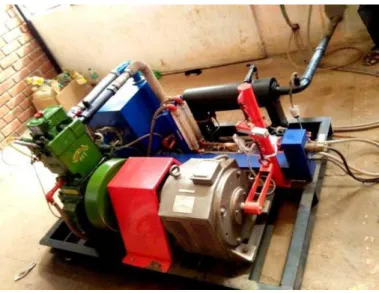
The engine tests were conducted on a computerized single cylinder, 4-stroke water cooled CI engine test rig. It was directly coupled to an Eddy current dynamometer that permitted the engine motoring either fully or partially loaded. The engine and Dynamometer were interfaced to a control panel which is connected to a digital computer used for recording the test parameters such as fuel flow rate, temperature, air flow rate, load etc, and calculating the engine performance characteristics such as Brake Power, BSFC and Brake Thermal efficiency. The calorific value and density of the particular fuel was fed to the software for calculating the above said performance parameters for different pressures. At the same time the exhaust gas analyzer is used to measure the emission parameters such as HC, CO and NOx.
PHOTO GRAPH OF ENGINE SETUP
TABLE 3 ENGINE SPECIFICATIONS
PARAMETERS SPECIFICATIONS
ENGINE TYPE FOURSTROKE
SPEED 1500RPM
ASPIRATION TYPE NATURAL
BORE 80mm
STROKE 110mm
NUMBER OF CYLINDERS
5. RESULTS AND DISCUSSION
This paper compares specific fuel consumption, brake thermal efficiency and exhaust emissions of blends of SOME and SC5D Additive with those of diesel.
5.1 Performance characteristics:
Engine performance characteristics are the major criterion that governs the suitability of a fuel. This study is concerned with the evaluation of Brake Specific fuel Consumption (BSFC) and Brake Thermal Efficiency (BTE) of the blends of SOME and SC5D Additive with diesel and also emission characteristics are studied.
5.1.1 Brake specific fuel consumption
Fig 3: Load vs. brake specific fuel consumption
Fig 3 shows breake specific fuel consumption (BSFC) variation with respect to load. Specific fuel consumption decreases by 8.62%when compared to pure diesel with addition of additives up to B30+4Aat rated load then increases further addition of additives, then increases the BSFC further addition of diesel blend with additive.
5.1.2 Brake thermal efficiency
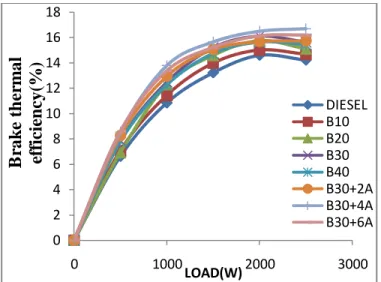
Fig 4: Load vs. brake thermal efficiency
Fig 4 shows the brake thermal efficiency (BTE) variation with respect to load. Brake thermal efficiency of engine increases by 1.9% when compared to pure diesel with addition of additives up to B30+4Aat rated load then decreases further addition of additive.
5.2Emission characteristics: 5.2.1 Hydro carbon
Fig 5: Load vs. Hydro Carbon
Fig 5 shows the variation of the HC emission with respect to load. Hydro carbon emissions decreases by 11.76%when compared to pure diesel with addition of additives up to B30+4Aat rated load then increases further addition of additives. 0 0.2 0.4 0.6 0.8 1 1.2 1.4 0 500 1000 1500 2000 2500 3000 B S F C ( k g/ k Wh r) LOAD(W) DIESEL B10 B20 B30 B40 B30+2A B30+4A B30+6A 0 2 4 6 8 10 12 14 16 18 0 1000 2000 3000
B
rak
e
th
er
m
al
ef
ficie
n
cy(
%
)
LOAD(W) DIESEL B10 B20 B30 B40 B30+2A B30+4A B30+6A 0 5 10 15 20 25 30 35 40 45 0 1000 2000 3000 H C (p p m ) LOAD(W) DIESEL B10 B20 B30 B40 B30+2A B30+4A B30+6A5.2.2 Carbon monoxide
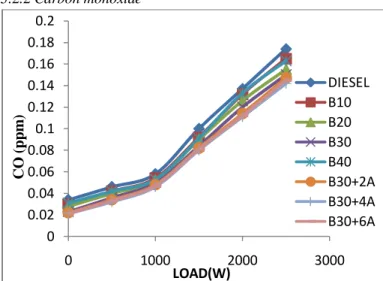
Fig 6: Load vs. Carbon monoxide
Fig 6 shows the variation of carbon monoxide (CO) emissions with respect to load Carbon monoxide emissions decreases by 18.97% when compared to pure diesel with addition of additives up to B30+4Aat rated load then increases further addition of additives.
5.2.3 Nitrogen oxide
Fig 7 shows the variation of oxides of nitrogen (NOx) in the exhaust with respect to load. NOx emission is found to be increases by 14.09% when compared to pure diesel with addition of additives up to B30+4A at rated load then decreases further addition of additives.
Fig 7: Load vs. Oxide of Nitrogen 6. CONCLUSION
From the experimental results, the following conclusions are drawn:
1) Brake thermal efficiency of engine increases by 1.9% when compared to pure diesel with addition of additives
up to B30+4Aat rated load then decreases further addition of additive.
2) Specific fuel consumption decreases by 8.62%when compared to pure diesel with addition of additives up to B30+4Aat rated load then increases further addition of additives.
3) Hydro carbon emissions decreases by 11.76%when compared to pure diesel with addition of additives up to B30+4Aat rated load then increases further addition of additives.
4) Carbon monoxide emissions decreases by 18.97%when compared to pure diesel with addition of additives up to B30+4Aat rated load then increases further addition of additives.
5) NOx emission is found to be increases by 14.09% when compared to pure diesel with addition of additives up to B30+4Aat rated load then decreases further addition of additives.
7. REFERENCES
1) Mishra S. R., Mohanty M. K., Das S. P., and Pattanaik A. K., “Production of Bio-diesel (Methyl Ester) from Simarouba Glauca
Oil”, ResearchJournal of Chemical Sciences, Vol.2(5), pp.66-71,
2012.
2) Vishwanath Kasturi, and M. C. Navindgi, “An Experimental
Analysis of Performance, Combustion and Emission Characteristics of Simarouba Biodiesel and Its Blends on CI Engine”, International
Journal Of Modern Engineering Research (IJMER), Vol.4, pp.79 -86, 2014.
3) Shailesh Golabhanvi, Harish Astagi, and Omprakash Hebbal, “Performance, Emission and Combustion characteristics of a single
cylinder diesel engine operating on simarouba biodiesel and diesel fuel”, International Journal of Emerging Trends in Engineering and
Development,Vol.3, pp.201-213, May 2014.
4) Vishwanath Kasturi, and M. C. Navindgi, “Experimental
Investigation of Performance and Emission Characteristics of Simarouba Biodiesel and Its Blends on LHR Engine”, International
Journal Of Modern Engineering Research (IJMER), Vol.4, pp.63 -69, 2014.
5) Sharun Mendonca, and John Paul Vas, “Influence of Injection
Timing on Performance and Emission Characteristics of Simarouba Biodiesel Engine”, International Journal of Scientific and Research
Publications, Vol.3, Issue 4, 2013.
6) DilipSutraway, Y. U. Biradar, and V. V. Katti, “Effect of Fuel
Injection Time on Performance of CI Engine Using (Simarouba) Biodiesel asFuel”, Journal of Mechanical Engineering Research
and Technology, Vol.2, pp.556-572, 2014.
7) Lava K. R., C. R. Rajashekhar, and Vilas Watwe, “Using
simarouba as a bio-diesel studies the effect of modified (threaded) piston onperformance, combustion and emission characteristics of diesel engine”, International Journal of Innovation and Scientific
Research, Vol.8, pp.64-72, 2014. 0 0.02 0.04 0.06 0.08 0.1 0.12 0.14 0.16 0.18 0.2 0 1000 2000 3000 C O (p p m ) LOAD(W) DIESEL B10 B20 B30 B40 B30+2A B30+4A B30+6A 0 100 200 300 400 500 600 700 800 900 0 1000 2000 3000 N O x(p p m ) LOAD(W) DIESEL B10 B20 B30 B40 B30+2A B30+4A B30+6A
AUTHOR PROFILE
E Surendra M.Tech
He is working as a assistant Professor in the Department of Mechanical of Engineering, Institute of Aeronautical Engineering (Autonomous), Hyderabad. He is interested in Thermal Engineering.
G MADHU BABU M.Tech
He is working as a assistant Professor in the Department of Mechanical of Engineering, Bharat institute of engineering & Technology, Hyderabad. He is interested in Thermal Engineering.
Prof. V. V. S. H. Prasad M.Tech.,Ph.D.
Working as A Professor and Head in the Department of Mechanical Engineering, Institute of Aeronautical Engineering (Autonomous), Hyderabad. He has 34 years of experience in various domains.