Volume 5, Issue 7, July 2016
ABSTRACT
In this paper, the essential issues of HetNets in LTE-A platform have been covered and current solutions are implied by utilizing self-organizing network (SON) management methods, which allows the cooperative cellular systems to experience decide and enhance their ongoing operation reling on network situations. The current SON algorithms are replicated and modeled in OPNET simulator simulation software for the three phenomenon’s of resource allocation, interference coordination and mobility administration in multi-tier macro-femto networks. Many channel assignment processes relied on frequency reuse, cooperative transmission and dynamic spectrum approach are enquired and a current SON sub-channel assignment process is recommended depending on hybrid fractional frequency reuse (HFFR) method to give dynamic resource assignment between femtocells and microcells, while rejecting cross-tier and co-tier interference. The sufficient research to think of a restricted no. of processes for handover optimization i.e. call admission control (CAC) and signal ability to avoid unimportant handovers, while our current SON handover management scheme strengthen a comprehensive algorithm that does sensing process, as well as resource occurring and user residence checks to begin the handover phenomenon at the optimal time. Also the current femto over macro priority (FoMP) check in this process also provides the femtocell target nodes priority over the overcrowded microcells in order to enhance the QoS at both the network tiers. Inter-cell interference, as the crucial challenge of HetNets, is also inquired by research on the reality time-domain, frequency-domain and power control methods.
I. INTRODUCTION
SON works in 3GPP has been inspired by sufficient by SON studies and the set of requirements explained by the operators’ bond, Next Generation Mobile Network [3]. As a technique which satisfies above specified conditions, LTE -Advanced is in the significance now [1-3]. As indicated in Fig 1, 3G LTE uses backbone relied on ALL-IP, interworking with different networks continuously. The service stipulate from 3GPP LTE-Advanced is always joined with data rate of over greater 100Mbps and lower delay; it is
feasible to continuously interwork with sufficient facilities in HSDPA and WCDMA networks. In case of choosing 3GPP LTE-Advanced, it is possible to link obtainable 4G and 3G networks, so all of transmission services could be used with only one mobile terminal. The most unusual process for this is service continuity technique by seamless link [4-8]. LTE-Advanced should provide high-speed data transmission primarily in hot-spot space, and gives service continuity during session movement and movement terminal with only a mobile terminal. Since, in LTE-Advanced where many networks usable, it is actually complex to give service continuity essentially [9-11]. And due to every resource in LTE-Advanced system and the network state i.e. bandwidth, error rate replace variably, it is assumed that it is not possible to manage service continuity with artificial, procedural, and static management method employed to the usable voice service. As a solution for this, we suggest a self-organizing network (SON) concept in LTE-Advanced. it is targeted at constructing heterogeneous networks spread more stably and efficiently through employing self-organization concept that different networks unite and act each other for better impact, so that it has got a lot of care as core technology to hire commercial system of future mobile communication networks after 4G as well as LTE-Advanced [11-13]. As of yet, it generally concentrates on growth of physical aspect i.e. performance enhancement, establishing base stations and ability expansion, but it is seen that if a mechanism which assures service continuity relied on self-monitoring process is developed, it will play a important role in market expansion of LTE-Advanced; self-monitoring is a technique for performing traffic management and improving resource ability by examining some surrounding information about neighboring terminals and cells, which is the central technology of SON [14-15]. We recommend a service self-organization technique to sustain the service continuity effectively depending on SON, in which a mobile terminal collects some news about its current state of every cell and a base station, depending on the news collected by maintaining inner or neighbouring cells, managing service continuity on its own and distributes related data and converges.
A Novel Self-Organizing Network Algorithm for
Modeled HetNets LTE-Advanced Through Hybrid
Fractional Frequency Reuse (HFFR) Scheme
Mona Lamba 1, M. S. Dagar2,
M-Tech Student1,Assit. Prof. 2 & Department of CSE & Shri Ram College of Engg. & Mgmt Palwal, Haryana, India
Volume 5, Issue 7, July 2016
Figure 1. 3G LTE network structure
In other words, related news of cells and mobile terminals changes, the operation of context functions i.e. cell selection, ISHO, load management, source assignment and QoS mapping is followed; every function is appropriate into the change, exchanges the phenomenon of reorganization, and interacts; these activities go toward to satisfy service continuity.
II. SON CHARACTERISTICS
A .Self-Configuration: The starting configuration of
network elements in a mobile network is complexed by a greater no. of parameters supporting configuration manually is complex and time consuming. This is an seen candidate for automation because network nodes usually have common values for greater portions of the form settings. Self-configuration network elements may be connected with an starting set of site-specific features in an optional planning step. This assembling of features may be combined via the 3GPP automatic radio configuration data-handling function (ARCF), and may include pre-configured neighbor relations, cell identities, transmit power levels, antenna configurations, operational carrier, etc. The ARCF, along with any software upgrades, are sent to the eNB in the self-configuration installation mechanism once the development of connectivity is done. The eNB is operational after self-testing and prepared to support mobile terminals.
B. Automatic Neighbor Relations (ANR): Ordinarily, a big
optimization/configuration cost for operators has been the handed creation of neighbor relations among cells. This is based on the LTE ANR function placed in the eNB. It aids in administration of neighbor cell relations within E-UTRAN, between UTRAN and EUTRAN and from E-UTRAN to GERAN and CDMA2000 cells. An RNC or an eNB can demand a UE to decode neighboring cell system news and apprise the decoded news back depending on the UE ANR characteristic. Relied on this news, the eNB can search a unique cell identifier for the neighboring cell. This show that the supporting eNB has sufficient information to begin a handover to the founded cell. Alternatively, the eNB may further utilize the unmatched cell identifier to get connectivity news from the neighboring base station through S1 eNB/MME optimization-transfer mechanisms and begins
development of an X2 interface. The evident advantage of ANR is that by using UEs to create and update neighbor relations the whole procedure can be comlpeted automatically. Giving the no. of UEs in a network, this process is faster, more flexible and cost effective in comparaion of manual optimization or drive tests.
C. Automatic Cell Identity management: Mobility in 3GPP
networks relied on UE guided reporting of physical cell identifiers (PCIs) that rather should be temporary unmatched. Matched PCIs can cause to confusion (a cell has two or more neighboring cells with the identical cell identifier) or collision (neighboring cells have the identifier cell identifier). PCI collision/confusion can be examined through the UE ANR mechanism. The OAM system, observed of the examined PCI collision/confusion, can begin a centralized PCI re-assignment procedure. This acquinted a new PCI to the cell relied on the neighbor-relation news in the OAM system. Optionally, the OAM system may give the eNB with a set of existed PCIs to select from, and authenticate the eNB to select an optional PCI, in consideration of provided PCIs in environment eNBs.
D. Random Access Optimization: The primary goal of the
random access mechanism is for UEs to notice their existence to the network and establish uplink time synchronization with it. In the mechanism, the UE will select an access slot, a preamble waveform and a transmission power. These features are subjected to optimization to satisfy requirements in terms of:
• Access probability, which is the possibility of a UE having completed access after a certain no. of random access trys, or • Access delay (AD) probability, where access delay is explained as the time duration for a random access mechanism to complete once it is began by a UE.
To support RACH achievement estimation and optimization, the UE can be assisted to give a RACH report to the eNB after a completed access attempt. This solution depends on UE reports because the UE can control radio-related problems which the network may not be known of. Hence, identical as the ANR function, this characteristic makes utilize
III. SIMULATION PARAMETERS
To completely illustrate the effects of the new comprehensive handover technique inside a multi-tier LTE-A network, a LTE-Advanced platform with the closest features to a real-life network is modeled in OPNET. The parameters of simulation and values for all the scenarios are represented in Table 1. In the simulated network, the maximum abilities of a LTE-A system is used, for example: LTE bandwidth and maximum physical profile, for more visual implementation of the results. the LTE packet data convergence protocol (PDCP) functions. PDCP sub layer is responsible for header compression of IP data flows and transfer of data in user plane or control plane.
At the next stage, the IP packets become classified into the evolved packet system (EPS) bearers, and the radio link control (RLC) is then operated to perform the required functions for the link control, e.g. retransmissions and status reports. The scheduler decisions determine the dynamic protocol data unit (PDU), which contain address information and user data, and MAC service data unit (SDU).
Volume 5, Issue 7, July 2016 Table 1 Configured simulation parameters and
characteristics Entire Parameter Simulation Value Number of Cells 4 HeNodeB Max.Transmission Power 21 dBm eNodeB Max.Transmission Power 41 dBm
Terrain Model and Type Urban, Terrain Type A Carrier Bandwidth 20 MHz Building Percentage 31.6 % Propagation Model HATA Duplex FDD
IP Routing ID Auto Assigned Bandwidt
h
20MHz
Downlink Frequency 2110 MHz Uplink Frequency 1920 MHz
For the packet transmission values of noise power (Pb), interference power (Pi) and the obtained power (Pr), the value of signal to noise ratio (SINR) is computed by Equation (4-5).
IV. SIMULATION SCENARIOS
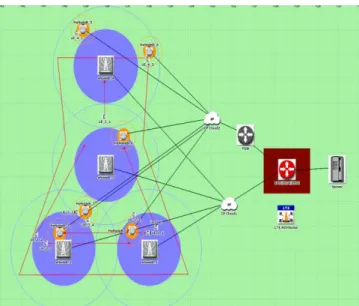
In the simulation section, four different scenarios have been modeled, examined and compared by utilizing of OPNET network modeler. Fig 2 illustrates the presented LTE-A platform for all the simulation scenarios in OPNET simulator version 17.1 (64-bit). The first scenario has a heterogeneous macro-femto LTE-Advanced network with the conventional handover sensing and decision making procedures in the system. In conventional handover management, the moving mobile subscribers with a described or random trajectory are handed over to the closest existed base station based upon their movement activities. The handover procedure in this scenario is not started depending on the new QoS situations, e.g. new signal strength and resource existence, but only depending on the source and destination nodes location. In this mode, the cell selection attribute of the network modeler is set to “First Available Node” in the settings. In the second scenario, the same LTE-Advanced network platform is shown, but with the handover management only based on resource existence. In this handover plan, the radio resources or wireless
bandwidth existence is examined in the destination node, and the handover is started only in case of sufficient resource existence.
Figure 2: The LTE-A platform in OPNET network simulator
V. SIMULATION RESULTS AND ANALYSIS
As was defined in chapter 3 for the results implementation and analysis in simulation scenarios, the results of simulation for the required scenarios are exploited by 5-time simulation run (5 random seeds) in confidence interval (CI) of 95%, and the standard error, standard deviation and upper and lower distribution restrictions are computed accordingly to represent the error bars for every complete value.
The following OPNET statistics are examined through the simulations to compare the impacts of the introduced comprehensive handover mechanism in LTE-A networks:
Traffic End-to-End Delay: Average end-to-end delay
observed by the transferred information, while moving among the nodes, in seconds (sec).
Throughput: Total traffic delivered from LTE to the higher
layers, gathered by all BSs, in bits per second (bits/sec).
Total Number of Admitted GBR Bearers: Total no. of
admitted guaranteed bit rate (GBR) bearers existed in access stratum (lte_as) unit of macrocells BSs.
Fig 3 illustrates the packet transmission procedure from the eNodeB and HeNodeB base stations to the subscribers with and without pre-specified trajectories.
The annotations in this fig represent a particular mobile subscriber (UE 1_1) with a pre-specified handover trajectory towards northwest, as well as its supporting and target nodes in the handover procedure. The destination node will be chosen according to the updated location information of the moving subscriber, while the macro link is consistent from the supporting eNodeBs during the UE traverse. The four configured scenarios are modeled in OPNET and several statistics are measured to present the enhancements in transmission delay, admission control and packet delivery when we use the new handover algorithm. For every evaluated statistics, the total of 100 simulation runs have been built to cover 5 simulation seeds for 4 handover
Volume 5, Issue 7, July 2016
scenarios in 5 different conditions of connection time or no. of femtocell subscribers (5×4×5=100).
Figure 3: Handover process in OPNET simulation
The comparison in traffic end-to-end delay is illustrated in Fig 4 with the error bars for 95% confidence interval. The average handover latency for the subscribers included in the handover procedure is directly based on the end-to-end delay value in the transferred information. The introduced mobility management uses the comprehensive handover algorithm in LTE-A macro-femto integration, which speeds up the handover latency in the subscriber roaming procedure, and finally results in notable reduction in traffic delay. The fig represents that although there are enhancements in traffic delay when call admission control (CAC) and resource availability (RA) is used in the system, but the best value relates to the introduced comprehensive handover mechanism to maintain the subscriber’s mobility. However the extra FoMP procedure in this scenario builds priority for the HeNodeBs over the existed eNodeBs, part of the user congestion becomes offloaded from the main macrocell eNodeBs towards the closest HeNodeB, which will also result in enhanced entire network capacity.
Figure 4: Traffic end-to-end delay with 95% confidence interval
In our simulation, assuming the steady state values of the end-to-end delays in seconds for 600 s link time, the values of traffic delay in the second and third scenarios are enhanced as about 6.9% and 14.8% respectively, while the enhancement for the comprehensive handover (HO) method
is about 29.9%, as compared with the conventional handover scenario. For network throughput analysis, extra UEs are introduced into the network to measure the network performance when a bigger part of available subscribers are supported by the closest HeNodeBs instead of the available eNodeBs. Fig 5 illustrates the comparison of average throughput among our handover scenarios in 95% confidence interval. The comparison has been built for different no of subscribers assigned to the HeNodeB base stations. In comparison of the conventional scenario for 50 femtocell subscribers as an example, the enhancements for the second and third scenarios are about 50% and 58%, while the enhancement for the scenario with the introduced HO mechanism is about 67% in comparison of the conventional HO scenario.
Figure 5. Network throughput with 95% confidence interval
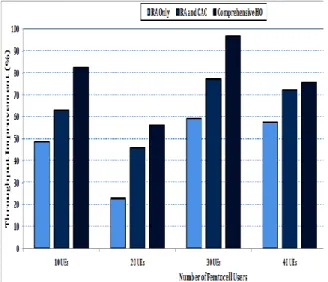
For more detailed comparison, Fig 6 represents the throughput enhancement for all the scena.3rios, in comparison of the conventional HO scenario as the reference. In this fig, the percentage of enhancements in this fig is not essentially a function of femtocell subscribers.
Figure 6: The throughput improvements from the Traditional HO scenario
It can just ensure that the value of enhancement in throughput for the scenario with comprehensive handover algorithm remains greater than the other scenarios, either in
Volume 5, Issue 7, July 2016
a network with higher or lower no. of the subscribers assigned to femtocells. In either of the scenarios with more macrocell subscribers or more femtocell subscribers, applying a flexible handover technique with bandwidth optimization, admission control and femtocell services lead to achieve higher network throughput, which results in enhanced network capacity, as well as QoS, not dependent to the no. of subscribers in every network layer. This comparison proves that the introduced handover mechanism is the nearest technique to the state of the art in HetNet mobility management, regardless to the subscribers conditions in the network.
The minimum bit rate required to be existed in networks with packet transmissions is described with guaranteed bit rate (GBR) value in macrocells. In this context, a particular amount of the total bandwidth is always reserved for the data packet transmission, even if there is no traffic in an instant. The total number of admitted macrocell GBR bearers can thus reflect the subscribers dependency to the macrocell as a significant consideration in LTE admission control, which immunise the macrocell subscribers from packet loss, while decreasing the bandwidth optimization in heterogeneous networks. In LTE-A heterogeneous networks, the lower value of accepted macrocell GBR bearers in macrocells can happen if the subscribers are maintained to be linked to the small cells, such as HeNodeBs, which is a network dynamism sign.
REFERENCES
[1] NGMN, “Recommendation on SON and O&M Requirements,” Requirement Specification, www.ngmn.org, version 1.23, 2008.
[2] Aliu, O.G.; Imran, A.; Imran, M.A.; Evans, B., “A Survey of Self Organization in Future Cellular Networks,” Communications Surveys & Tutorials, IEEE , vol.15, no.1, pp.336,361, First Quarter 2013
[3] M. Peng, D. Liang, Y. Wei, J. Li, and H. H. Chen, “Self-Configuration and Self-Optimization in LTE-Advanced Heterogeneous Networks,” IEEE Communications Magazine, vol. 51, no. 5, pp. 36-45, 2013.
[4] 3GPP “Telecommunication Management; Self-Organizing Networks (SON); Concepts and Requirements (Release 11),” 3GPP TS 32.500, v. 11.1.0, 2011-12.
[5] T. Jansen, I. Balan, J. Turk, I. Moerman, and T. Kurner, "Handover Parameter Optimization in LTE Self-Organizing Networks", In Proceedings of IEEE Vehicular Technology
Conference (VTC Fall 2010), pp. 1 –5, 2010.
[6] T. Jansen, M. Amirijoo, U. Turke, L. Jorguseski, K. Zetterberg, R. Nascimento, L.C. Schmelz, J. Turk, and I. Balan, “Embedding multiple self organization functionalities in future radio access networks,” In
Proceedings of IEEE Vehicular Technology Conference (VTC Spring 2009), pp. 1 –5, 2009.
[7] www.fp7-socrates.eu.
[8] S. Hamalainen, C. Sartori, Henning Sanneck, “LTE Self-Organising Networks (SON): Network Management Automation for Operational Efficiency,” WILEY, 2011.
[9] L.C. Schmelz, M. Amirijoo, A. Eisenblaetter, R. Litjens, M. Neuland, and J. Turk,”A Coordination Framework for Self- Organisation in LTE Networks,” In Proceedings of
IEEE Integrated Network Management (IM' 2011), pp. 193
–200, 2011.
[10] H. Y. Lateef, A. Imran, A. Abu-Dayya, “A Framework for Classification of Self-Organising Network Conflicts and Coordination Algorithms,” In Proceedings of IEEE Personal
Indoor and Mobile Radio Communications (PIMRC' 2013),
pp. 2913-2920
[11] Chen, Yan, et al. "Fundamental Trade-offs on Green Wireless Networks”, IEEE Communications Magazine, vol. 49, no. 6, pp. 30-37, 2011.
[12] O. Oluwakayode, F. Heliot, and M. A. Imran, “On the Energy Efficiency-Spectral Efficiency Trade-off in the Uplink of Comp System." IEEE Transactions on Wireless
Communications, vol. 11, no. 2, pp. 556-561, 2012
[13] 3GPP Tech. Spec. Group, E-UTRA, “LTE; Evolved Universal Terrestrial Radio Access (E-UTRA); Radio Resource Control (RRC); Protocol specification,” 3GPP TS 36.331, v. 11.3.0, 2013-04. http://www.3gpp.org/ftp/Specs/html-info/36331.htm [14] L. Yun, L. Man, C. Bin, W. Yong, and L. Wenjing, “Dynamic Optimization of Handover Parameters Adjustment for Conflict Avoidance in Long Term Evolution,” Communications, China, vol. 10, no. 1, pp. 56–71, 2013.
[15] L. Yun, L. Man, C. Bin, W. Yong, and L. Wenjing, “A conflict avoid method between load balancing and Mobility Robustness Optimization in LTE,” In Proceedings of IEEE
Communications in China (ICCC' 2012), pp. 143 –148, 2012
[16] Ali, A.N.A. Comparison study between IPV4 & IPV6. International Journal of Computer Science Issues, 2012. 9(3): p. 314-317.
[17] Dutta, C. and Singh, R. Sustainable IPv4 to IPv6 Transition. International Journal of Advanced Research in Computer Science and Software Engineering, 2012. 2 (10): p. 298-305.
[18] Reddy, P.V.P., Ali, K.M.I., Sandeep, B. and Ravi, T. Importance and Benefits of IPV6 over IPV4: A Study. International Journal of Scientific and Research Publications, 2012. 2 (12): p. 1-2.
[19] Dey, S and Shilpa, N. Issues in IPv4 to IPv6 Migration. International Journal of Computer Applications in Engineering Sciences, 2011. 1(1): p. 9-13.
[20] Karim, A. VoIP Performance Over different service Classes under Various Scheduling Techniques. Australian Journal of Basic and Applied Sciences, 2011. 5(11): p. 1416-1422.
[21] Ayokunle, O.O. Integrating Voice over Internet Protocol (VoIP) Technology as a Communication Tool on a Converged Network in Nigeria. International Journal of Information and Communication Technology Research, 2012. 2 (11): p. 829-837.
[22] Al-Ani, M.S. and Haddad, R.A.A. IPv4/IPv6 Transition. International Journal of Engineering Science and Technology, 2012. 4 (12): p. 4815-4822.
[23] Abusin, A.A., Alam, M.D.J. and Abdullah, J. Testing and Analysis of VoIPv6 (Voice over Internet Protocol V6) Performance Using FreeBSD. International Journal of
Volume 5, Issue 7, July 2016
Communications, Network and System Sciences, 2012. 5: p. 298-302.
[24] Anouari, T. and Haqiq, A. Performance Analysis of VoIP Traffic in WiMAX using various Service Classes. International Journal of Computer Applications, 2012. 52 (20): p. 29-34.
[25] Chen, W., Wu, Q., Lin, Y. and Lo, Y. Design of SIP Application Level Gateway for IPv6 Translation. Journal of Internet Technology, 2004. 5 (2): p. 147-154.
[26] Kundu, A., Misra, I.S., Sanyal, S.K. and Bhunia, S. VoIP Performance over Broadband Wireless Networks under Static and Mobile Environments. International Journal of Wireless & Mobile Networks, 2010. 2 (4): p. 82-93.