Cynthia C. Pierce. A Public Library Learning Organization: A Case Study. A Master’s Paper for the M.S. in L.S degree. August, 2005. 131 pages. Advisor: Barbara B. Moran.
This study examined the practices of one public library system operating as a learning organization. The library bases its practices on the five disciplines described by Peter Senge: personal mastery, mental models, team learning, shared vision, and systems thinking. Eight managers participated in detailed interviews, and 94 employees completed questionnaires designed to elicit information about their experiences and perceptions of working in a learning organization. A strong commitment to staff development and learning is a hallmark of the library’s operation. It reflects managers’ understanding that an organization’s ability to serve its users and to thrive in an ever-changing environment is based on its ability to learn, and that learning begins with every individual employee. While respondents offered unique perspectives on the details of the library’s functioning, there was a general agreement that it was successfully working as a learning organization.
Headings:
In-service education Personnel--Administration Public libraries--Administration Public libraries--Case studies Public libraries--Staff
by
Cynthia C. Pierce
A Master’s paper submitted to the faculty of the School of Information and Library Science of the University of North Carolina at Chapel Hill
in partial fulfillment of the requirements for the degree of Master of Science in
Library Science.
Chapel Hill, North Carolina August 2005
Approved by
Acknowledgement
The employees of the “Wencatoma County Public Library” deserve much credit for their enthusiasm about this project. The generosity and willingness they have shown in sharing their perspectives about the work of their library has provided invaluable insight that will surely benefit the readers of this study. I thank them all.
Cynthia Pierce August 2005
Table of Contents
Page
Tables . . . 4
Figures . . . 6
Introduction . . . 7
Literature Review . . . 15
Method . . . 20
Interview findings . . . 26
Setting . . . 26
Historical background . . . 27
Catalysts for change . . . 29
Introduction of teamwork . . . 30
Advent of the learning organization . . . 32
Teamwork in a learning organization . . . 33
Human resources . . . 37
Learning philosophy and staff development . . . 40
Library and community . . . 42
Learning organization disciplines in action . . . 45
Working in a library learning organization . . . 50
Managing in a library learning organization . . . 51
Page
Questionnaire findings . . . 56
Personal mastery . . . 58
Mental models . . . 65
Team learning . . . 72
Shared vision . . . 78
Systems thinking . . . 85
Discussion . . . 99
References . . . .104
Appendix A: Interview Questions . . . .106
Appendix B: Questionnaire . . . .107
Appendix C: Sample Team Activities at WCPL . . . . .113
Tables
Figures
The challenges faced by America’s public libraries have been widely reported in recent years in the professional literature, in the news, in web logs, at conferences, and by word of mouth. In 2003, OCLC reported the findings of its inquiry into issues and trends affecting member agencies. Data collected through interviews and focus groups created a provocative, thoughtful, and somewhat familiar picture of working in today’s information world. The 15-page Library Landscape section of The 2003 OCLC Environmental Scan: Pattern Recognition: A Report to the OCLC Membership organizes the findings into two
subsets: Social and Technology (OCLC, 2003).
Indeed, social and technological challenges abound. And almost all those challenges, coming from both external and internal environments, can be most
History
In looking forward, it can be useful to consider how public library management got to where it is. Richard Daft offers a useful framework for understanding the history of management in his book Management (2000). While many people look at different management efforts as fads that come and go, there is a sort of evolution and
amalgamation of theories that takes place over time within a changing world context. Daft describes three main perspectives on management that have been influential in the last century: classical, humanistic, and management science (Daft, 45). What follows is a brief description of each perspective and an attempt to show how each has been
interpreted in the practice of library management.
The classical perspective focuses on tasks and jobs and includes scientific management and bureaucratic organizational approaches (Daft, 45). These influences could be seen in public libraries beginning in the early 20th century, when managers began turning away from their rather authoritarian positions regarding philosophical and social order concerns, and became increasingly focused on technical and economic efficiency (Nauratil, 42). This scientific management approach focused mainly on tasks: carefully examining them to determine how best to perform them, and standardizing their performance for greatest efficiency.
As public libraries grew in size, managers began incorporating ideas from
today continues to incorporate some of the more enduring aspects of these approaches. The most obvious areas neglected in the classical perspective, however, are the context in which work takes place and the workers themselves, their knowledge, individuality, and higher needs (Daft, 47).
The humanistic perspective is a sort of complement to the classical perspective in that it addresses the needs, attitudes, and interactions of the people who do the work. It has as long a history as the classical, but it features human relations, human resources, and behavioral science approaches (Daft, 50). Abraham Maslow’s needs hierarchy theory and Douglas McGregor’s Theory Y are part of the underpinnings of an evolving
humanistic perspective. Human resource departments, employee assistance plans, staff development, union representation, flexible work schedules, and participative
management are all part of the landscape from a humanistic perspective.
The management science perspective applies more mathematical approaches to solving management problems (Daft, 53). Consider the amount of counting done in modern public libraries: reference questions answered, attendance at programming, books circulated in a year’s time, interlibrary loan requests, and requests to use special
collections, for example. These numbers are used to create schedules, devise budgets, apply for grants, support operating decisions, and sometimes even justify the library’s existence.
Systems theory, contingency theory, and total quality management grew out of the humanistic perspective and offer more ways to consider increasingly complex
Systems theory is a sort of cause and effect theory. Put simply, an organization can comprise several subsystems which are interdependent. A change in one part causes a response in another part. The manager’s goal is to be able to understand operating
patterns within a system and to understand how to create desired outcomes.
Contingency theory holds that what works for one does not work for all. An effective manager will evaluate the organization and figure out which factors need to be acted upon in order to attain desired outcomes.
Total quality management (TQM) is a process geared toward continual renewal and improvement. “Hallmarks of TQM include employee involvement at all levels; commitment to employee training and development; the use of problem-solving teams, quality control standards and statistical methods; long-term (instead of short-term) goals and thinking; and recognition that the system (not employees) is responsible for most inefficiencies” (Barnard, 1). Total quality management incorporates the use of numbers and statistics to get feedback from customers in order to know what their needs are. Some contemporary libraries managers have tried and committed to many of these practices. From helping employees become more effective to conducting user surveys and focus groups, many managers know that the internal customers and external customers are equally critical to customer service success.
The Problem
placed upon them? Has the evolution of management theories and practices presented library managers with a next logical step?
In 1990, MIT professor Peter Senge first published The Fifth Discipline: The Art and Practice of the Learning Organization. The ideas in the book were based on years of
work at MIT and other universities, as well as work being done at Innovation Associates, a firm committed to helping corporations and other organizations become learning organizations. The general proposition of The Fifth Discipline is that “our organizations work the way they work, ultimately, because of how we think and how we interact” (Senge, xiv). It is through the process of actively learning that we build the capacity to meet the challenges our organizations face.
Senge’s model for working as learning organizations is based on five disciplines or practices: systems thinking, personal mastery, mental models, shared vision, and team learning. Each is described briefly below.
Systems thinking, or the fifth discipline of the book’s title, is the conceptual foundation upon which all the other disciplines are built. The idea behind it is that we need to understand how to see the whole picture instead of just the parts. For example, we do not always get to see direct cause and effect relationships, because the result of one action might happen far away in time and space from that action. If we understand the system in which we operate, we are more likely to understand where to direct change in order to achieve the desired outcome.
objectively. As such, it is an essential cornerstone of the learning organization--the learning organization’s spiritual foundation. (Senge, 7).
Mental models are our pictures of how the world works. They are generalizations and assumptions we might not even realize we hold. Working on our mental models involves learning to be honest about the stories we tell ourselves, to learn how to scrutinize our own beliefs and thinking, and to expose our thinking to others.
When people in a group share a vision, they share an idea of the future they are working toward. The discipline of building a shared vision involves discovering a picture of the future that everyone is committed to, not just one everyone will comply with.
The practice of team learning involves learning through dialogue. The idea is that a group can gain insights through thinking and learning together that an individual cannot achieve alone. Since so many modern organizations are organized into team units, it is crucial that the team learn so the organization can learn.
This cursory description of the practice of the learning organization incorporates several management elements discussed earlier. Systems theory, total quality, and other elements of the humanistic perspective are clearly evident here. But even organizations that operate under more classical or scientific management systems might very sensibly and practically incorporate learning organization practices into their operations; they need not be antithetical.
The basic human needs, as described by Maslow, are physiological, safety, love, esteem, and self-actualization. He wrote that at any given time, most people have all the basic needs partially satisfied and partially unsatisfied. He proposed that once
physiological needs--hunger, thirst, and need for safety--are met, the “higher” social needs become dominant. Higher needs include affection and belongingness, achievement and respect from others, “feelings of self-confidence, worth, strength, capability, and adequacy of being useful and necessary in the world” (Maslow, 1973, p. 162). The highest of the basic needs, self-actualization, can be described by the following imperative to fulfillment: “What a man can be, he must be” (Maslow, 1973, p. 162).
The preconditions for satisfying basic needs, according to Maslow, are “freedom to speak, freedom to do what one wishes so long as no harm is done to others, freedom to express one’s self, freedom to investigate and seek for information, freedom to defend one’s self, justice, fairness, honesty, orderliness in the group” (Maslow, 1973, p. 163). Any deprivation of our cognitive capacity to satisfy curiosity; search for knowledge, truth, and wisdom; or to try to understand the world’s mysteries is thwarting our ability to satisfy basic needs.
Len Tischler (1999) applies Maslow’s hierarchy of needs theory at a social level to describe the trend in the 1990s toward spirituality in the workplace. His contention is that workers in economically evolved societies consider themselves satisfied in terms of physiological and safety needs, and are demanding more opportunities for satisfying esteem and self-actualization needs in their workplaces.
If the ability to learn is a fundamental prerequisite for being able to satisfy higher human needs of esteem and self-actualization, would working in a learning organization provide an opportunity for workers to practice the kinds of activities that would lead not only to the growth and fulfillment of their organization’s potential, but also to their own growth? Do human goals for satisfying higher needs intersect with organizational goals in a learning organization to create a dynamic synergy that results in growth for both
employees and in their organizations?
It is generally accepted that libraries lag several years behind the public sector in adopting innovations. In the 15 years since The Fifth Discipline was first published, businesses, schools, private associations, and government agencies have begun learning organization practices. It would seem that the practice of organizational learning as described by Senge might offer approaches to meeting many of the challenges faced in public libraries today by helping them become more flexible and responsive to
Literature Review
One of the challenges of studying library learning organizations is that little in the way of formal study has been conducted to describe them. Most of the library literature on learning organizations can be classified into two discussions: summaries of The Fifth Discipline, along with attempts to define learning organizations and to relate those
definitions to a library setting; and descriptions, often first person, of libraries in the process of adopting learning organization practices.
Describing and Defining Learning Organizations
Shelley E. Phipps (1993), of the University of Arizona Library, provides an explication of the five disciplines of the learning organization process, as written about by Peter Senge, and suggests how each could be applied in an academic library
environment. She believes that academic library management is often marred by linear thinking, controlling leadership, negative mental models, and lack of vision, and that libraries are operating in times that demand change. Phipps states that organizations in transformation can best achieve their purpose through learning from the environment in which they operate. She encourages academic library managers to pursue learning organization practices in order to model learning to the greater educational environment in which they operate.
of a learning organization. Interested in the potential of learning organization practices in academic libraries, Rapple is concerned about the shifting definitions and paucity of metrics, and questions how various organizations actualize learning organization principles. He writes that learning, vision, flexibility, leadership, and communication should be the primary considerations in any efforts toward becoming a learning
organization. He also states that the learning organization might be an excellent model for libraries.
Libraries Practicing as Learning Organizations
Rena Fowler (1998) used qualitative and quantitative methods to explore how organizational learning facilitates organizational change and technological innovation. In this study, the adoption of Internet use in a university library setting was examined. Interview data yielded 14 methods of organizational learning, which range from formal and informal training to team learning, professional involvement, and reading . Fowler found that learning organizations drive innovation mainly by creating an environment in which the organization is primed and empowered for innovation, and that innovation and learning seem to fuel one another. Results suggested that technology and economic conditions were the real drivers for innovation, and that commitment to change might be related to technology, anticipating change, and fear of the library’s becoming irrelevant. Other findings were that team learning precedes and contributes to shared vision, and that shared vision is significantly related to “age, professional reading, and committee
service” (p. 229).
System (NSLS) in Chicago employed thirty people in its headquarters, which served more than 600 academic, school, public, and special libraries. Because of rapid
technological changes taking place in the library environment, NSLS realized the typical four-year plans they were accustomed to creating were no longer practicable. So they began a conversion toward a practice which was intended to result in better
responsiveness and service to member libraries. Staff educated themselves on learning organization disciplines, as described by Peter Senge; got help from experts; and developed their own training programs and personal learning plans. Results of the changes included developing a shared vision, more risk-taking, better communication, more effective customer service, more local decision-making, broader knowledge, more flexibility, and a general transformation into a more positive workplace. Goals for the future included flattening out the organization’s hierarchy, having managers take on roles as coaches and facilitators, and helping member libraries begin their journey toward becoming learning organizations.
adult learning theory, and described the importance of interpersonal relationships in a learning environment. The authors further described in detail some of the particulars of training that reference staff engaged in, and how those activities related to learning theory. Results of the experience were reduction of fear and inhibitions, recognition of expertise among coworkers, and a realization that team learning was more effective than if each person had tried to learn everything in isolation from coworkers.
Joan Giesecke and Beth McNeil (2004) defined learning organizations according to Senge’s framework and presented a description of the University of Nebraska-Lincoln libraries’ conversion into a learning organization, a process which began in 1996. They described training and learning that have taken place on individual, group, and
organizational levels within the libraries. Reviews of staff development program evaluations, reviews of training effects, and results of a recent campus-wide poll indicated that the University of Nebraska-Lincoln libraries had indeed made progress practicing as a learning organization.
Eleven years after publication of her persuasive recommendation that academic libraries consider becoming learning organizations, a summary of which began this section, Shelley E. Phipps (2004) wrote of the continuing organizational development work being done at the University of Arizona Library. Phipps used systems theories of W. Edwards Deming, Peter Senge, and Peter Scholtes as the foundation on which her discussion was based. She provided a detailed description of how the systems focused on at the university’s library are managed in order that the work of the library achieve the desired results. The systems she detailed include leadership, team, planning,
recruitment and hiring, among others. Included in the discussion were methods for designing the systems and the challenges to sustaining them. This article is a substantial contribution to the literature of library learning organizations, and would be of significant value to library managers and organization developers.
Beyond Academic Libraries
The above articles are a representative of the state of library learning organization literature. Not one of them discusses public libraries. If working as a learning
Method
The literature search on the topic of library learning organizations yielded a few anecdotal stories, but little in the way of formal investigation. This case study of one public library system was designed to contribute to our understanding of work in library learning organizations. Interviews and questionnaires were used to collect both
qualitative and quantitative data from managers and other employees that would provide information about their practices, observations, and experiences at work.
Identifying a Library and Interview Participants
In order to identify a library system for study, I turned to the Internet. In that search I discovered a few public libraries describing themselves as learning
organizations. After reading about some of them, I discovered one state agency which promotes learning organization practices in all its public libraries. I contacted the agency and found its deputy librarian to be a committed proponent of public library learning organizations. She referred me to one representative at each of two public library systems in her state who might be interested in sharing their stories with the greater library
Once a subject for the study was available, I submitted a research proposal to my university’s Academic Affairs Internal Review Board (IRB) for approval. The proposal included all documents required for conducting research with human participants. It also described the two steps for data collection. The first would be to interview managers of the library, in person at their offices; the second step would be to elicit information from all willing employees, including managers, by providing them with questionnaires to fill out. Consent forms assured potential participants that their identities, as well as the name of their library system, would remain anonymous. For the purpose of this paper, the library is called Wencatoma County Public Library (WCPL).
After receiving IRB approval, I requested from the deputy director at WCPL contact information for any managers she thought would be interested in participating in the study. Using that contact information, I sent e-mails, with consent forms attached, to eight managers and soon received positive responses from six. Of the two managers who did not respond right away, one never did; and one, who had been on temporary leave, offered at a later date to be interviewed by telephone. Eight female managers, including the deputy director, participated in interviews.
Interview Apparatus
Interview Procedure
I traveled to WCPL and spent five days visiting managers at their departments and branches, and exploring the communities the library serves. Approximately 16 hours of interviews with seven managers (the six who responded to my request, as well as the deputy director) were recorded using a hand-held tape player. Recorded conversations were transcribed, and notes from the telephone interview with an eighth manager were typed up. In total, 157 pages of interview material provided data for this study.
I analyzed interview transcripts for content and coded them according to
chronology, topic and theme. Each piece of information was marked by a Post-it® note on which additional reference was made to respondent name and page number of the transcript where the topic was discussed. After all transcripts were thoroughly
considered, the Post-it® notes were then sorted into an order that provided chronological and thematic structure.
Questionnaire Participants
Questionnaire Apparatus
Manager interviews yielded information that would enhance the design of the original questionnaire, so I modified it and re-submitted it to the IRB for approval. Appendix B is the revised document as it was presented to participants. The document contains 50 Likert-type scale statements designed to draw out employee experiences practicing the five disciplines of the learning organization. The questionnaire also contains two opportunities for open-ended responses, as well as four questions about management or non-management status, job title, length of time worked at WCPL, and number of hours worked weekly at WCPL.
Procedure
I e-mailed all the eight interview participants, as well as the manager who did not respond to my earlier request, and asked permission to visit their branches and
departments in order to distribute questionnaires to staff, and to answer any questions potential respondents might have about the study. Consent forms and a promotional flyer were attached to the e-mail request. Again, every manager I interviewed responded affirmatively. The manager who did not reply to my request for an interview did not answer the request to distribute questionnaires to staff in her branch either.
On the second trip to WCPL, I distributed questionnaires in person to all
any other participants wanted to return questionnaires to me at a later date. Within two weeks, every envelope was returned to me with additional completed questionnaires. Ultimately, 94 questionnaires were completed and returned for use in this study, a 59 percent response rate. Managers who participated in the interviews were also welcome to fill out questionnaires.
Data from the questionnaires were recorded in an Excel spreadsheet for
preliminary examination and basic analysis. Responses to the two open-ended questions were recorded, organized, and analyzed there.
The numeric analysis was performed using SPSS, Statistical Package for the Social Sciences. I began by recording all variables and responses into an SPSS data file. Then I reversed the coding for 18 negatively-worded statements so that total scores and means could be meaningfully compared.
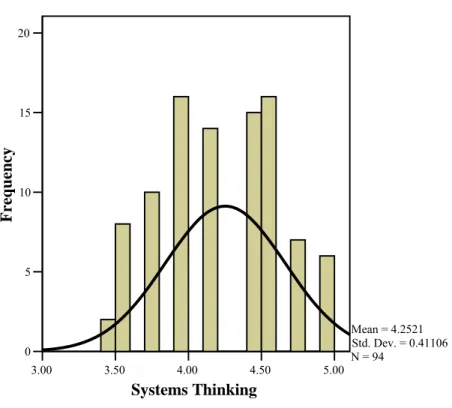
The next step was to organize the 50 Likert scale statements into categories according to the discipline with which they were most readily associated: personal mastery, mental models, team learning, shared vision, and systems thinking. Four statements were included in more than one category or discipline. Then each category was tested for reliability using Cronbach’s alpha. All were found to be reliable at .70 or higher except systems thinking, which rated at .62. Three statements--30, 39, and 50--were found not to be reliable for their categories, so they 50--were analyzed individually.
employees. One-way analyses of variance (ANOVAs) compared means according to number of years worked at the library and across job titles.
Interview Findings
Interviews with eight WCPL managers provided a richly detailed picture of the library system’s history, organization, and operation. The first part of this Interview Findings section describes the context in which the library operates and the users it serves. Then follows a chronological overview of the library’s recent history, the events that catalyzed change, the library’s adoption of teamwork, its subsequent introduction of learning organization principles and practices, and how teamwork and team learning processes have evolved over time. A more thematic arrangement continues the section, providing information on human resources practices, staff development, the library’s learning philosophy, and a description of the library’s service to its community. Then a description of learning disciplines in actual practice, managers’ views on what it is like to work and manage in a learning organization, and a discussion of whether any library can become a learning organization conclude this section.
Setting
Wencatoma County is historically an agricultural county that lies near two large cities. Hilly terrain, rivers, creeks, woods, and farmland mark the rural landscape in this scenic area. Its natural attractions, its proximity to jobs in larger cities, and a relatively lower cost of housing have resulted in significant growth pressures on the county.
suburban one. With a population of 166,000, the county is home to the second highest number of commuters in its state. Wencatoma County has little industrial development, no interstate highways traversing it, and no significant public transportation.
The population of the county is 96 percent Caucasian; it is described as middle class, Christian, and conservative. At least 75 percent of households in the county have Internet connections. About 25 languages other than English are spoken by students in the county’s single school district; and a growing number of Hispanic migrant workers are establishing permanent residency, slowly and significantly changing the
demographics of the county. Women (and some stay-at-home dads), their young children, students, and seniors constitute the largest segment of users in the library’s five branches. WCPL serves not only its own county’s citizens, but also residents of contiguous
counties.
Historical Background
Public library service in the Wencatoma County began in the mid-19th century, but a county-wide system was not formally established until the late 1950s. By the late 1970s, libraries nationwide were beginning to automate some of their functions. WCPL had little in the way of financial resources, but it did have a forward-looking director who established a collaboration with an equally entrepreneurial director of a larger
In that same year, thanks to construction money having come available earlier, the library’s one full-service branch was able to move out of the church building it occupied and into a new library building. During the succeeding 14 years, the remaining four branches moved from their storefronts into proper new library buildings. Also during that time, a new administrative office was established, new staff were hired, and the
outsourced work was brought back in-house. Additionally, an automation department was created.
The growth years also saw increases in the number of employees and in the number of services being provided. Those increases created a need for someone to
oversee the development of the organization. The assistant director, who had started as an outreach librarian in the late 1970s, was ready for a new professional challenge. With the support of the library and the director, she took a master’s degree in organization
development. It was during that time, the early 1990s, that The Fifth Discipline was published and the ideas in it were gaining such traction among organizational leaders.
The assistant director knew there were characteristics about WCPL that would make it a good candidate for working as a learning organization, as described in The Fifth Discipline. First of all, the library director had already established a culture that promoted
organizations have life cycles, and that as they grow, they need different things from their leaders and staff. The other idea was that the solutions to today’s problems carry the seeds for tomorrow’s problems.
Catalysts for Change
After more than a decade of library expansion came a period of economic
contraction. In the early 1990s, WCPL faced a budgetary shock. The county government, source of 85 percent of the library’s funding, announced it would have to reduce its financial contribution by 14 percent. In spite of a modest tax increase intended to soften the blow, a significant cut to the library’s already lean budget still resulted. Even though no library jobs were lost at the time, managers did not believe the budget woes were over; and there was a sense that the track of the pendulum swing was changing. The library’s understanding of what it could expect from the local county government in the future had been significantly altered during the budget talks. Furthermore, there was a broader sense of environmental change afoot: The Internet was becoming a growing presence in
society, surely foretelling not-yet-imagined changes in how the library would work. Meanwhile, WCPL’s patrons continued eagerly to use and support the library’s services, making it the state leader in per capita circulation year after year.
When a new library director was hired to succeed the retiring director, she had a vision for WCPL: It would become a premier library system, but it would have to do it with little money. A consulting group was hired to conduct, simultaneously, an
library staff would no longer be offered; and a merit pay system was established. The confusion caused by conducting two studies at the same time, the changes wrought as a result of the studies, and some negative publicity resulted in significant unhappiness among staff. In what two managers referred to as the long hot summer, WCPL struggled through the most extended bad period it had ever experienced, while still working hard for a positive outcome. Ultimately, managers believed that their best hope for getting the organization through this difficulty intact would be to put more control in the hands of employees, in other words, to move to teamwork. That option did not suddenly present itself; strategic plans had been orienting the library in that direction already, and other systems in the state were having significant success using teamwork in their operations. Plus, there was one manager who was already introducing WCPL staff to teamwork practices.
Introduction of Teamwork
That manager had been hired by the library in 1996 to run one of its branches. She was convinced of the value of teamwork due to her experience in another public library system. At her WCPL branch, she saw how cooperative team practices could help employees overcome departmental segmentation and gain a sense of the larger
done at their branch. Not long after teamwork practices were introduced at a single branch, the decision was made to begin teamwork training throughout the system. Staff from the branch most experienced at teamwork were happy about the learning
opportunities afforded by working on teams, and they were able to reassure people in the rest of the system that the changes would not be as bad as they predicted.
During the transition to a more team-oriented workplace, some of the unhappiest employees left the library, and every vacant position was reevaluated in terms of its usefulness and position within the organization. People interested in taking on new responsibilities were hired.
The early days of system-wide teamwork were problematic because teams were created to be very hierarchical and bureaucratic. Every team addressing a system-wide issue had to have representation from each branch. Teams typically had 10 to 12 members each. Team charters (tasks, problems, assignments) could take a long time to accomplish, sometimes requiring people to rotate into and out of team membership. Branches found it difficult to support that amount of commitment.
Advent of the Learning Organization
The state in which WCPL is located has a division of library development and services within its education department. That division supports school library and public library development and administers federal and state programs. The deputy state
librarian, who is also referred to as a futurist, is an advocate for helping public libraries acquire the tools they need in order to be responsive to change. In the late 1990s, she became interested in introducing the concept of the learning organization to library administrators, knowing that learning organization practices diffuse throughout any organization from the top down. She hired two leadership consultants to present the ideas at an administrators’ meeting. Response from participants was inexplicably tepid at best.
In a second attempt, a different consultant was found and an advisory group was formed, made up of people who either were familiar with learning organizations, were interested in learning, or were in organizations that might be supportive. This advisory group decided they would teach teams of people from different library systems to identify and solve problems. The group developed a curriculum; and in 2001, teams of employees from public library systems throughout the state participated in a learning libraries
workshop. They discussed trends affecting the state’s public libraries; learned about the five disciplines of learning organizations as described by Senge; practiced team building, team learning, and problem-solving; and developed change models for their systems. In the following year, learning libraries teams met again to learn more about group
learning organization--testing and transforming experience into knowledge that is accessible to the organization and relevant to its purpose--and on the five learning disciplines described in The Fifth Discipline. Teams who had used what they learned in the first year’s workshop brought back success stories in the second year. Teams all across the state were beginning to use learning organization vocabulary, and library systems were finding they had a common language for discussing their change activities. Teams were also reporting improved customer service.
Teamwork in a Learning Organization
To understand how WCPL came to its practice as a learning organization, it should be emphasized that WCPL employees had already incorporated teamwork and team learning--one of the learning organization disciplines-- into their operation before the learning organization workshops were held. Several of the managers interviewed indicated that team learning and teamwork were really the beginning of the library’s subsequent work as a learning organization.
The learning libraries workshops not only introduced the other four disciplines of learning organizations, but they also gave WCPL more tools for understanding, working in, and managing teams. As previously noted, original teams were challenged by too much bureaucracy and by rigid hierarchies. Time, training, and tenacity, however, brought significant changes and created more effective teams. Because teamwork and team learning are so integral to the library’s function as a learning organization, it is worth noting some of the significant changes that helped teams improve their processes.
unnecessary directions. The language was made more understandable, less theoretical, and more practical.
The size of teams was reduced also, which helped them work more quickly. Teams at WCPL today are typically made up of between three and eight members who represent a range of job titles. Participation is voluntary. Employees choose to be on teams investigating topics that appeal to them; interest, not expertise, in a subject is the only prerequisite. Anyone can suggest creating a team, and some people never volunteer to be on a team. There are in-house branch teams and system-wide teams.
Team hierarchies were flattened out. A director’s staff of five managers act as administrative liaisons to the teams. One of the five managers, the deputy director (the assistant director mentioned previously) oversees the team charters, making sure they get articulated. She assures that teams report on a quarterly basis, that recruitment gets done for new teams, and that team leaders get the training they need. The other four members of the director’s staff act as advocates or sponsors of teams. They do not lead teams; their role is to take away barriers that prevent the teams from being successful. Interest and workload determine which teams a manager acts as advocate for. The director’s staff meet weekly to share information about teams they are sponsoring and answer questions for one another about teams.
Employees have had training in team activities such as generating ideas,
brainstorming methodologies, decision-making, and dealing with conflict. They have also learned about the behaviors expected of team members. Considerable work has been done to educate staff on the different roles--facilitator, process observer, timekeeper, recorder--they might assume in team meetings. The information is posted on the library’s intranet for easy reference. Understanding and maintaining those roles is critical in making meetings productive. Several teams use plus-delta to evaluate team meetings in order to learn how to improve them. Plus-delta is simply a process of describing what went well in the meeting and what needs improving. Is one person monopolizing the meeting time? Was the agenda sufficient? Questions such as these help the group to manage itself. The result is more efficient, effective, productive meetings. Also, in the process of describing what went well in the meeting and what needs to be changed about the way the team works, more safety is created, and people are willing to think more deeply about the work of the team.
One manager indicated that the people who learn most are the ones who work on really substantial team projects. She believes those team members become more tolerant as they work to get people signed on to new ideas and new ways of doing things. Another manager thinks that the best team learning occurs in the process of solving problems.
teams, people discover and develop talents and skills they were not aware they possessed. One manager declares that teams are wonderful and integral to the way the library works, while another describes moving to teamwork as one of the biggest changes the system has ever made, and the best. She also believes working in teams has helped people be more flexible; they are more willing to consider ideas or suggestions, for example, rather than reject them outright. Another manager states that the advent of teamwork has opened up staff, and that people are talking to one another across departments and branches with tremendously positive results.
After a team accomplishes the objectives of its charter, there is a sunset process of evaluation. Team members evaluate the team leader and they collect data for their own performance reviews. The evaluation also provides a final opportunity for team learning as members reflect back on their team’s activities.
Appendix C provides a brief description of the work of some WCPL teams both currently and in recent years. From it, one can get an idea of the scope of topics explored and responsibilities borne by teams at WCPL.
Have there been any down sides to working in a team-based environment? Managers provided the following examples.
tendency to tune out the theoretical; they just want to know how it all works in practical terms.
Another negative was occasional resentment from people who believed they were being asked to do work that was not their job. This reaction was more or less alleviated when participation on teams was made voluntary, and when people began to see that opportunities and rewards were coming available to them because of their work on teams.
One manager stated that some people, including some managers, are not
comfortable working on teams. She said the people who prefer to have more traditional control and say-so are less enthusiastic about teamwork.
In the early days, a team was given an undoable job, or perhaps simply a job that should have or could have been done by one person. The lesson learned was that if a team’s charter is inadequate, the result will be off target.
Another negative was experienced by a team that invested much effort into meeting its charter’s objectives, only to find that the resulting recommendations would not be approved by the governing board. Such an experience can result in intense disappointment.
Finally, when a team has members who are not up to speed on working in teams or who are out of their depth, teammates might end up doing more than their share of the team’s work.
Human Resources
its activities promoting training and staff development. A closer look at some of its activities and interests--compensation, hiring, evaluation, staff development--provides beneficial insight.
Employees of WCPL are not attracted to the library by financial incentives. As stated earlier, organization and salary studies conducted in the early 1990s resulted in significant changes at the library. Two of those changes were that staff would go on a merit pay system, and that there would no longer be longevity increases for people who had reached the top of their pay scale. At the time of these interviews, even the merit pay increases had ceased. The deputy director and the human resources director deplore the lack of funding for competitive compensation, and they expressed hope that the
opportunities and challenges available to people working in a stimulating learning environment are helping mitigate that deficiency.
Employees at WCPL are not union members. There is a fairly active staff association that serves as an employee voice on various issues. Managers and the association communicate openly and discuss any concerns that need addressing. The organization arranges fund-raisers and donates the proceeds to charities. It also coordinates staff social activities.
When managers are interviewing to hire new staff, they are looking for caring attitudes, people skills, and compatibility with the library’s learning culture. The
those in a learning organization. In spite of WCPL’s inability to pay top wages, managers said that the library is fortunate to be able to hire and retain excellent employees.
The performance evaluation tool at WCPL was designed by a team. It is a thorough, detailed document that outlines behaviors associated with individual jobs. Employees either meet or exceed standards associated with those behaviors. Staff are encouraged to take part in filling out their own evaluations, to be proud of their accomplishments, and to celebrate their successes.
One section of the evaluation document is a development plan. The development plan serves as a sort of map to indicate the road a person is on in the organization. Staff are asked to state what they want to accomplish, what they need in order to reach their goals, and how they plan to reach their goals. Both employees and their supervisors contribute to the plan, which is described as fluid and ever-changing. Target dates can be changed, and items can be added and taken away.
It is in the area of evaluation and development planning that the human resources manager sees employees actively working on changing their mental models. As for evaluations, some employees, particularly female, tend to be dismissive of their accomplishments, thinking that their successes are just part of doing their job. Getting them to shift their ideas and beliefs about acknowledging their own achievements is a challenge. In regard to development planning, employees begin to realize they are responsible--not their supervisors--for their own goals. That shift in understanding can create a richer experience working in a learning organization.
special according to one manager. The deputy director and the director were praised by all managers interviewed for adamantly protecting the development budget. Staff development is seen as both good for the organization and good for the individual. Particulars of staff development are covered in more depth below.
Learning Philosophy and Staff Development
Several years ago a team was established at WCPL with a charter to develop the library’s learning philosophy which, in practical terms and in a broad sense,
institutionalized the discipline of personal mastery. That philosophy describes the role of employees, the environment in which they can expect to work and learn, what constitutes a learning activity, how learning will be documented in development plans and
recognized in performance reviews, and how staff can take advantage of learning
opportunities. Employees are expected to seek out challenges and intellectual stimulation, follow their curiosity, innovate, create, and take risks. Worthwhile learning activities prepare employees for current and future work assignments, help employees help others achieve their goals, enhance their people and leadership skills, help them be at the forefront of their profession, and help staff adapt to the library’s and the profession’s changing needs.
Staff are personally responsible for taking advantage of learning opportunities; supervisors act as facilitators to learning by providing encouragement, time away from work, and financial support. Additionally, peer and system support can be expected.
individual level: At least three branch managers have recently begun to learn Spanish in order to provide better service to a growing population of Spanish-speaking patrons; and a number of paraprofessional staff have taken advantage of the library’s policy of paying for one course per semester for staff working on MLS degrees.
Training on a branch level occurs also. Children’s and young adult programs have particularly benefited from the fact that employees are encouraged to cross-train outside of their own departments. Stepping outside of comfort zones is applauded. To aid in understanding more about learning organization disciplines, one branch manager created workshops and exercises to help her staff do more in-depth work on mental models, shared vision, and systems thinking. When she went to a creativity workshop in another library system, she brought back some of the ideas she learned there and provided creativity training at her branch. Sometimes training will start in a branch, but another library system will learn about it join in. In fact, sharing training with neighboring systems is becoming a statewide trend.
In the past couple of years, training the trainer has become a model used more frequently system-wide. People who are interested in developing skills as trainers get training on a particular topic--either by going outside the system or having someone come in--and then they take what they have learned and train other staff. This practice of sharing of training has been very successful at WCPL.
Statewide initiatives also play a part in WCPL learning. From the learning libraries programs of the early 2000s that helped get systems on the track to becoming learning organizations, to leadership programs, to mandatory training for library associates, employees have a range of learning opportunities through the state library. Because the employees at WCPL like to be in on new library innovations and initiatives--after all, their vision is “Leading the way in lifelong learning and enjoyment”--they are often funded by the state library to be the system to try new things first. As one librarian put it, WCPL often gets the money to try new things, but they also do it well, getting the “most bang for the buck.”
Library and Community
Until now, this narrative has described the library’s setting, its evolution, the shift to team and learning organization practices, human resource activities, and staff
development opportunities. This would be an appropriate juncture for introducing more information about the library’s current activities and the services it provides to its community. Technology, outreach, and programming are featured.
search out and use technology to help provide better service to its community. The library is an Internet service provider to the county government and to individual citizens.
Patrons can use the library’s interactive Web site to search the catalog, view their records, request titles from any library in the state, suggest titles for purchase, check the library board’s meeting minutes, reserve a meeting room, get homework help, get reference assistance, use online databases, register to attend programs, search the community services directory, get library news, download audiobooks, receive reader’s advisory newsletters, and more.
There are approximately 115,000 registered users of the library. Year after year, patrons make WCPL the system with the highest circulation statistics in the state. WCPL is also one of the busiest systems in the state in terms of programming, and it is widely regarded for the quality of its programs. In the 2004 fiscal year alone, WCPL presented 105 programs per week, with a total annual attendance of approximately 35,000 people.
The outreach department of WCPL plays a vital role in community learning. One method of fulfilling that role is by taking services to people who might not otherwise visit the library. The department serves seniors in nursing homes and assisted living centers; it services the library at the detention center and supports computer training for inmates; and it has three bookmobiles that travel to childcare providers in order to reach the county’s youngest population. Outreach staff are responsible for 45 of the 105 programs offered weekly by the library. In the 2004 fiscal year, they presented 110 puppet shows at library branches and community locations.
organizations. She has worked at facilitating partnerships by introducing into meetings simple team processes that she uses at the library. Establishing a mission, a purpose, and an action plan helps focus groups and make them more effective. On a recent occasion, the manager gathered together a panel of experts on immigration issues and invited representatives from various community organizations who serve immigrant families. The purpose was to learn from the panel and to support a learning network of people with similar aims. The department plans a more in-depth workshop a year later, as a follow-up, to continue the interagency dialogue.
Branches are also involved in outreach and partnerships. Leadership programs with the Chamber of Commerce, an initiative with the health department directed at expectant mothers, service on the board of a local psychiatric hospital, and work with local agencies to help a growing Hispanic community are examples of outreach activities originating in branches. Branches and the outreach department collaborate at times, but usually branches work independently in their communities. The outreach department can be a source of funding for some projects, and it can serve as a liaison which introduces branches and the community organizations to one another as potential partners.
Branch managers as well as the outreach department actively seek out grant monies that will help support programming and reader services activities. Recent applications have sought to purchase Spanish-language children’s books; to provide literacy training for childcare providers; to purchase training videos for helping dyslexic readers; to serve at-risk families, particularly Spanish-speaking ones; and to provide science and math programming for youth. Three branches within the system have
received repeated awards to fund Library Discovery Zones, which promote library use to at-risk families.
Having now described the library’s evolution toward learning organization practices and its service to the community, this account will now turn to the specific details of learning organization activities at WCPL.
Learning Organization Disciplines in Action
In actuality, the five disciplines of the learning organization can result in a variety of activities and outcomes, and none of the activities is enhanced by one discipline to the exclusion of all others. The disciplines are related and work together. Because team learning and personal mastery have been covered in-depth up to this point, this section will focus more on how managers and employees work on systems thinking, mental models, and shared vision, and how those affect other critical learning activities such as communicating; making decisions; experiencing autonomy, empowerment, and change; solving problems; taking risks; and making mistakes.
organization for people to ask themselves the who, what, when, where, why, and how questions in anticipation of initiating change or making decisions. That awareness and orientation is an integral part of their operation.
In day-to-day activities, systems thinking can particularly affect communication. Staff strive to make sure news and information is conveyed to people who need to have it. In one branch, departmental notebooks, e-mail, and even the physical layout of the workspaces is all geared toward keeping communication flowing. When one manager realized that one of the services provided in her department was not familiar to everyone working at the library, she and staff conducted an analysis of the system to try to figure out where the communication had faltered and how they would successfully market their services internally so that all staff would be familiar with them.
Working in teams also helps maintain communication and system awareness within branches and across the system. The fact that teams are composed of members from different departments and from different branches results in communication links being created.
While communication between departments and branches is an important part of systems thinking at WCPL, interpersonal communication skills are critical. Practicing the discipline of recognizing and understanding one’s own and others’ mental models is crucial to productive communication. One manager said that in her branch, staff feel very comfortable in expressing themselves freely, yet she sometimes feels some reticence herself when speaking her opinions with other managers. The reason for this is her belief that her management style is different from others’. Another manager made a distinction between being able to express her opinion and knowing it is being heard. Although the feeling of not being heard is not a regular occurrence, she thinks she lacks skill to express dissenting opinions. She does believe, however, that WCPL is a place where there is freedom of expression. Other managers spoke of the value they place on openly
communicating in their branches; one demonstrated her technique of eliciting opinions, suggestions, and information from staff.
When managers were asked whether they think one explanation for
communication failures is that people sometimes just do not know how to say what they want to say, their responses were affirmative. In fact, this had already been seen as an opportunity for skill-building and learning. Participants in the Leadership Academy, as well as their branch manager mentors, were scheduled to work on dialogue skills during their training. It is likely that dialogue training at WCPL will continue beyond the Leadership Academy.
branch shortly after the library started working in teams. The impetus was the branch manager’s overhearing staff, over a period of days, saying no to patrons. Something about hearing repeated negative answers to public requests and questions made her want to examine customer service in her branch. The No Logs project involved getting staff to mark in a log every time they said no to a patron, and to indicate the reason for saying no. Upon reflection, they realized that saying no was a habit that could be changed. The result was a complete turnaround in the way the branch conducts its business. Front-line staff became empowered to provide positive solutions to patrons’ needs.
In another instance, a single honest question about whether the library was really the “door to learning” for preschoolers, as it had always believed it was, was a catalyst for completely altering the way the library provided service to young users. A realistic look at the statistics showed that the library, at the time the question was posed, was actually not reaching as many of the county’s preschoolers as it had thought. The
outreach and children’s departments began working together to try to increase the number of children who were able to attend programming. Changes in registration policies for story times and summer reading programs resulted in large growth in attendance.
Significant efforts went into problem-solving and changing the library culture in order to make the changes, but the result was that the library’s mental model of itself and its role came more aligned with reality.
service decisions as needed. Having a common goal and a spirit of cooperation tends to alleviate power struggles. Additionally, having a shared vision helps to solve problems; when everyone understands what the goal is, everyone can contribute to finding a solution that will help meet that goal.
While shared vision might seem to be one of the easier disciplines to practice in a library, one manager indicated that “the vision thing” is the most difficult of the
disciplines for her. She said that her branch’s vision is customer service, but she relates the difficulty she has with shared vision to the fact that so much is out of their control every day. In her opinion, a vision is related to setting and meeting goals. But combine frequent interruptions with a spontaneous management style, and the result is a difficulty maintaining that vision.
The learning philosophy of WCPL states that one of the roles of all staff at the library is to be risk-takers. As one manager laughingly said, “What’s the worst that can happen?” is practically a corporate ethic at WCPL. Indeed, the phrase turned up
repeatedly in conversations with managers. Risk-taking is supported by the practice of any or all of the five disciplines in the learning organization framework.
Managers at WCPL support risk-taking by expressing an open attitude toward mistakes. They start by admitting their own. As one manager said, it is important for managers to own their mistakes so staff know it is okay to for them to make mistakes, too. Mistakes are looked at as learning opportunities. And since one never knows what the outcome of a risk will be, the value is in experimenting, learning, and moving on.
the state’s learning organization training. The team called on staff to think about their best effort at risk-taking, to write a two-minute sketch about it, and to videotape the sketch. The videos were then posted on the intranet, and staff could vote for the best risk. Prizes were awarded at the annual staff day. The risk-takers’ network competition
continues. One manager noted a marked difference in staff willingness to take risks after this competition was established. She sees less fear--of reprisals, of looking silly, and of failing--in staff than she did in earlier years.
More willingness to take risks can even be seen in programming changes. For example, efforts to build a stronger relationship with the community’s middle school age users resulted in popular late-night and overnight lock-in activities. Cultural
programming for adults has also expanded due to a commitment to take more risks. What, then, must it be like to work in an organization where risk-taking, independent decision-making, effectively communicating, problem-solving, mistake-making, change, and learning are not only supported, but are goals and objectives? Working in a Library Learning Organization
Managers described working in a learning organization as a very positive
experience. WCPL was portrayed as a busy library system where a lot gets done, partially due to the fact that every task and objective need not go through a long chain of
command in order to be completed. Two managers humorously described WCPL staff as having a low tolerance for boredom, one indicating that a little bit of chaos is normal. Work was described as stimulating, challenging, exciting, exhausting, fun, and
attached to a position or procedure. Two managers, speaking for their co-workers, said people enjoy what they are doing, and they enjoy working for the organization. Working at WCPL is said to be more than just a job. One manager declared that the positive attitudes and attempts to bring out the best in people are remarkable values in the organization. She also indicated that working in this learning organization allows her to align her personal goals with her work goals.
One manager compared working at WCPL in 1994 and in 2004, and declared that over a decade’s time, it became a much improved place to work. She asserted that anyone being honest would agree. A second manager who witnessed the changes taking place over time noted that there is now less blame, more trust, more permission to make mistakes, as well as different ways of communicating and making decisions. Another manager spoke of listening to friend and family descriptions of their business workplaces, and comparing them to working at WCPL. She indicated that WCPL has more of an atmosphere of cooperation, of people wanting to provide good customer service, of wanting to work together toward a common goal. The near absence of “complaining gossip” is a notable trait of the library’s culture, according to one departmental manager. Managing in a Library Learning Organization
Managers were adamant in their conviction that the learning organization
approach to running a library must come from the highest ranks of the agency. It matters who are in key positions. Furthermore, working as a learning organization is a
perspective, another manager stated that the library had already been working toward becoming a learning organization before, but that going through formal learning organization training gave terminology to some of their practices, thus providing a
common vocabulary. Applying learning organization principles also validated the already recognized need to evaluate and learn from team processes. Evaluation procedures were strengthened, resulting in teams’ improved abilities to work and learn.
Department and branch managers at WCPL have taken on learning organization practices according to their own management styles and temperaments. Some use the jargon associated with practicing learning organization disciplines--systems thinking, mental models, team learning, shared vision, personal mastery--others do not. The main reason for not actively using the terminology is that to some it can seem too theoretical, not practical enough. However, those same managers do practice the disciplines at work, and they model or talk about them with staff.
Details of manager practices shed light on individual perspectives and approaches to managing in a library learning organization. Highlights are described briefly below.
and failures together as a team; no one fails or succeeds alone in this supportive environment.
A second manager described a participatory management environment in the branch she manages. She supports a cooperative effort in building solutions. There is little nay-saying in her branch; instead, there is more of an experimental, try-it-and-see culture.
A third branch manager described working in a collegial family atmosphere where value is placed on flexibility, sharing opinions, and communicating. She models learning organization behaviors instead of talking about them, and prefers the practical and nitty-gritty to the theoretical. In her perspective, this learning organization welcomes risk-taking and encourages creativity. She also noted the sense of pride that results from the value placed on forward thinking in the organization.
Another branch manager spoke of her role encouraging staff development. When new teams are being created or new initiatives are being developed, she tries to nurture an interest in staff who might not initially consider themselves to be appropriate candidates for the topic or activity.
A departmental manager talked about the importance of creativity in her work. An important stimulation for that creativity comes from interactions with colleagues outside the library. Attending national conferences and regional meetings helps her stay in touch with practices in different agencies. Learning from others inspires her to create new practices also. Likewise, staff in her department are encouraged to learn from the
library. Reciprocally, this manager and her staff act as sources of learning for associates outside.
Finally, the manager of another department emphasized the importance of orientating new staff into the library’s learning culture. She spoke about meeting with individuals or small groups in her department semiannually in order to have a formalized learning experience. Once a year there is a day-long retreat for all staff in her department. On those occasions there is a further opportunity for group learning, particularly through team-building. An issue that has been a particular challenge to this department is learning to prioritize and to say no. As this manager becomes more of a master in this area, she is able to model her learning with staff.
One of the main roles of managers in this learning organization is that of facilitator. Since the implementation of teamwork, a lot of the traditional work of the managers has been taken over by teams. That is not to say managers do not have
authority, but teams do formulate the answers to a lot of the issues the library works on. Managers help the teams get to where they need to go.
Can any Organization Become a Learning Organization?
organizations that have unions can become learning organizations. The key is to show the practicality, the job satisfaction potential, and the new skills that can be developed in staff. She stated that people who are not allowed to learn new skills because their job descriptions are strictly enforced by union rules are losing out on opportunities for learning and job satisfaction. In her view, the size of an organization affects its flexibility and its ability to make the changes necessary to becoming a learning organization. Another manager spoke to that same point: Any library can become a learning
organization, but the larger the system, the harder it is to do. She emphasized that it is absolutely doable, but not without an openness and commitment at the top levels of the organization.