Relationship as a moderator for the association between perceived parental disapproval and willingness to self-disclose about alcohol exposure in adolescence
Corey Miller
University of North Carolina, Chapel Hill Spring 2013
A thesis presented to the faculty of The University of North Carolina at Chapel Hill in partial fulfillment of the requirements for the Bachelor of Arts degree with Honors in
Psychology
Committee Chair: Andrea Hussong, Ph.D. Committee Member: Don Baucom, Ph.D.
Table of Contents
List of Tables and Figures……… 3
Acknowledgments……… 4
Abstract……… 5
Introduction……….. 6
Perceived Parental Disapproval of Adolescent Alcohol Use………... 8
Balancing Disapproval & Self Disclosure……… 12
The Current Study……… 15
Method………. 16
Results……….. 20
Discussion……… 23
Limitations and Future Directions……… 26
List of Tables and Figures
Table 1 Tests of covariates, perceived caregiver disapproval, and interaction between perceived caregiver disapproval and perceived relationship quality as explanations of adolescent alcohol exposure
Table 2 Tests of covariates and adolescents’ willingness to self-disclose about alcohol exposure as explanations of adolescent alcohol exposure
Table 3 Tests of covariates, perceived caregiver disapproval, and the interaction between perceived caregiver disapproval and perceived relationship qualities as
explanations of adolescents’ willingness to self-disclose about alcohol exposure Figure 1 The Interaction of Perceived Caregiver Disapproval and Perceived Relationship
Acknowledgments
This thesis would not be possible without the continuous support from my thesis advisor, Dr. Andrea Hussong. She was extremely patient with me and provided me with simple
frameworks for my mind to wrap itself around when it was cluttered by big research ideas. I would like to thank her for putting up with me when I was simply unbearable when less kind individuals would have given up on me or thrown in the towel. Dr. Hussong represents how truly great the faculty here at UNC is and I will never forget our talks, both about my research and life.
I must state my many thanks to both of my other defense committee members, Dr. Don Baucom and Alison Reimuller-Burns, for agreeing to evaluate my research. Dr. Baucom’s lively sense of humor made his class enjoyable and interesting in a way that made it easy to ascertain the information he was providing us. This study would not exist if not for Alison. Partially, this is because my study is an extension of a study that she is currently conducting. But more
importantly, this project exists because of her willingness to work with me so closely, something that many people with a schedule as busy as hers would simply not want to do or find extremely inconvenient.
Abstract
Relationship as a moderator for the association between perceived parental disapproval and willingness to self-disclose about alcohol exposure in adolescence
Adolescent alcohol use has been considered a public health concern for the United States and other parts of the world for decades (Caetano, Tam, Greenfield, Cherpitel, & Midanik, 1997; Hingson, Heeren, Jamanka, & Howland, 2000; Zeigler et al., 2005). Alcohol use on some level has been seen in children as young as 8 (Donovan & Molina, 2008). By late adolescence, alcohol use is prevalent, with 28 percent of 10th graders and 40 percent of 12th graders reporting that they have consumed alcohol in the past 30 days, respectively (Monitoring the Future, 2011). These behaviors are also seen in young adolescents, varying in age from 11-14. By 8th grade, 16 percent of adolescents already report consuming alcohol in the past 30 days. These trends indicate that prevention efforts aimed at reducing adolescent drinking must occur very early in adolescence to catch these early initiating youth.
frequency that these 8th graders are exposed to peer alcohol use was not collected in the
Monitoring the Future study.
For those interested in prevention, these early experiences of alcohol exposure, either through an adolescent’s own early initiation of drinking or through early exposure to peer drinking, may be a more useful target for intervention than the more circumscribed target of early alcohol use initiation. Alcohol exposure is especially important at younger ages of adolescence in which alcohol use is still less common. However, alcohol becomes more and more available as adolescents age.
Adolescents who begin to drink during early adolescence are at risk of abusing alcohol, in terms of quantity and frequency, later in life (Caetano, Tam, Greenfield, Cherpitel, &
Midanik, 1997; Dawson et al., 2008; Grant & Hartford, 1990; Polluck & Martin, 1999). This includes middle school drinkers who continue to drink into high school, which is especially alarming because many teenage drinkers may experience alcohol dependence symptoms without ever getting an alcohol abuse or alcohol dependence diagnosis (Chung, Martin, Armstrong, & Laborvie, 2002; Hartford, Grant, Yi, & Chen; Nelson & Wittchen, 1998; Polluck & Martin, 1999). Alcohol dependence symptoms also tend to emerge sooner and progress at a faster pace for adolescents than adults (Chung, Martin, & Winter, 2005; Deas, Riggs, Langen-bucher, Goldman, & Brown, 2000) and excessive alcohol consumption in adolescents can cause neurocognitive deficits (Zeigler et al. 2005).
It is clear that adolescents who consume alcohol can run into health and legal
onset of alcohol use. Adolescents who engage in drinking before reaching legal age are significantly more likely to injure themselves or someone else than those who do not consume alcohol (Hingson, Heeren, Jamanka, & Howland, 2000; Hingson & Zha, 2009; Knight, Sherritt, Shrier, Harris, & Chang, 2002). Therefore, measures that both stop adolescents who are already using alcohol and prevent those who are not using but are exposed are necessary.
Perceived Parental Disapproval of Adolescent Alcohol Use
Parental disapproval seems to be a critical tool in lowering adolescent alcohol
consumption (Eddy et al., 2012). Increased parental disapproval has been found to be associated with decreases in binge drinking (i.e., the intention to get drunk by heavy intoxication over a short period of time) among adolescents (Eddy et al., 2012). Greater parental disapproval of alcohol use was also associated with less involvement with friends and peers who use alcohol, greater self-resilience for avoiding alcohol consumption, and less peer influence to use alcohol (Nash, McQueen, & Bray, 2005).
Parents can converse with their adolescents about alcohol through alcohol-specific communication. Classically, these conversations were a way for parents to monitor their adolescent’s activities as well as a way for adolescents to receive information about what is acceptable and unacceptable behavior according to the parent. In this case, the first key function may be to communicate parent disapproval. The second key function of these conversations is parental monitoring.
should supervise alcohol use for 15-17 year olds (Donaldson, 2009; National Health Medical Research Council, 2009). This advice reinforces that parents showed both disapproval of alcohol use but supervise adolescent alcohol consumption if it occurs. This is a difficult message to balance. Despite parents’ intentions to monitor their teen’s behavior, adolescents may choose to conceal information related to personal alcohol exposure to avoid parental disapproval. This avoidance is a barrier to effective parent-adolescent communication aiming to prevent the escalation of alcohol use or alcohol-related injury. Thus, providing direct messages of disapproval may directly work against parents’ efforts to monitor their adolescents’ alcohol-related exposure effectively by decreasing an adolescent’s willingness to disclose about alcohol exposure.
Given this tension, how parents should then best monitor their adolescent’s risk behaviors has been a focus of significant study. Parents may not be able to supervise their children at all times. For that reason, parents must combine information they gather from directly watching over their children with what they gain by other means. Parental monitoring is then a set of parenting behaviors or deliberate actions involving the tracking of a child’s whereabouts,
activities, and adaptations with the express goal of better understanding or gaining knowledge of their adolescent’s activities (Dishion & McMahon, 1998).
Studies of parental monitoring initially indicated strong associations between greater monitoring and lower risk for adolescent alcohol use (Flannery, Vazsonyi, Torquati, & Fridrich, 1994). However, some studies indicate that this association may be more complex. Cohen and Rice (1995) investigated the effect of providing parents, through controlled intervention sessions, the ability to get to know their adolescents’ friends and thus could limit adolescents from
subjects including the ways adolescents manipulate their parents, how parents could prevent such manipulation, and other helpful child-rearing practices. Parents also met with the parents of their children’s friends to better get to know them and discuss a number of alcohol-related topics. Cohen and Rice (1995) hypothesized that since parents that attended the intervention sessions knew their children’s friends, the friends’ parents, and knew how to deal with alcohol issues, parents could limit their children’s associations with substance-using peers. However, Cohen and Rice (1995) found that interventions in which parents were instructed on how to control access to alcohol and substance-using peers directly were ineffective as a means for parents obtaining knowledge about their children. Similarly, other researchers have suggested that perhaps parental monitoring is not the most effective tool in preventing adolescent alcohol use that occurs within alcohol-specific communication. Adolescent self-disclosure, considered to be a way parents gain knowledge about their children, occurs when adolescents tell parents
information without the need for prompting (Stattin & Kerr, 2000). Parents can obtain
knowledge by means other than adolescent disclosure, such as parental solicitation and parental control, but research has found that parental knowledge comes mostly from child disclosure (Kerr & Stattin, 2000; Stattin & Kerr, 2000).
Stattin and Kerr (2000) concluded that parental monitoring was not a parental activity; it was primarily a child’s activity. They found that when children talked to their parents about their personal activities of their own free will (child disclosure), it was a better indicator of parental knowledge than when parents controlled their children’s freedom (parental control) or when they pressed their children to talk about their personal lives (parental solicitation).
In a study conducted by Stattin and Kerr (2000), which included 704 14-year-old
parent’s knowledge of adolescent’s whereabouts, activities, and associations), child disclosure (i.e., children choosing to tell parents about child’s activities), parental control (i.e., parents controlling child’s freedom), and parental solicitation (i.e., parents asking children or their friends for information about child’s activities). Of the adolescents and parents who completed surveys about potential information sources pertaining to children’s activities, child disclosure accounted for 44 percent of the variance for the child report and 38 percent of the variance for the parent report, showing that child disclosure was significantly related to parental knowledge. Parental solicitation and parental control once added to the regression analysis only contributed to 3 percent and 5 percent of the variance in parental knowledge, respectively. Therefore, child disclosure is the driving force behind what is considered parental monitoring or, more broadly, parental knowledge about adolescents’ alcohol exposure.
Adolescent self-disclosure predicts rates of norm-breaking behavior (Stattin & Kerr, 2000). Higher levels of adolescent self-disclosure are associated with lower levels of norm-breaking behaviors when compared to both parental solicitation and control (Stattin & Kerr, 2000). Adolescents who voluntarily tell their parents about their personal lives end up breaking rules less often. Therefore, with higher rates of adolescent self-disclosure come lower rates of adolescent alcohol use. If adolescent self-disclosure predicts less alcohol consumption in adolescents, it seems that adolescent self-disclosure should be promoted.
However, adolescents may feel uncomfortable disclosing to their parents about certain aspects of their personal lives in certain situations. Situations in which parents strongly voice disapproval for alcohol exposure may be one instance where self-disclosure is less likely. Indeed, rates of child disclosure decrease as perceived parental disapproval increases (Smetana,
parent-child conversations about alcohol exposure, conveying disapproval and parental
monitoring through prompting child self-disclosure, may sometimes be at odds. This may create a challenge for parents and prevention scientists seeking to use these conversations as a
prevention tool.
Balancing Disapproval & Self Disclosure
Conversation has already been seen to be a prevention tool parents can use with regards to reducing the risk of drinking for their adolescents. Frequent conversation between parents and their adolescents concerning alcohol predicts rates of safer drinking practices among adolescents (Booth-Butterfield & Sidelinger, 1998), and when parents rarely caution their adolescents about alcohol use, their adolescents are more likely to begin drinking within one year (Andrews, Hops, Ary, Tildesley, & Harris, 1993). However, the literature surrounding frequency of alcohol communication acting as a prevention tool is mixed (Ennett et al., 2001). Another aspect of alcohol-specific communication is content, or what the conversations are about. Jaccard, Dittus and Gordan (1988) brought to light the possibility of there being more than two qualities that exist within parent-adolescent communication. Process, or the manner in which a message is communicated, is also an important quality within parent-adolescent communication because messages that are frequent and based on certain content do not necessarily get picked up by the adolescent if they are delivered in a poor fashion. By being warm and positive, parents are able to communicate messages via positive processes. Disapproval and disclosure, although
One way of thinking about how these messages are conveyed is by considering the larger parenting context in which these conversations occur. Baumrind (1966), and then later Maccoby and Martin (1983), classically defined the parenting context as the combination of two
According to Steinberg (2001), authoritative parenting is effective because children of authoritative parents are particularly receptive to parental guidance. Authoritative parents tend to communicate in a specific way to their children. They use reasoned arguments and promote verbal compromise with their children, siding with their child if the child makes a reasonable argument (Baumrind, 1967). Although they communicate messages of give-and-take between parent and child, authoritative parents still enforce family rules while remaining centered on the needs of their children (Baumrind, 1967). With this understanding, authoritative parents provide a warm environment for their children to self-disclose. Children of authoritative parents display many positive outcomes including high levels of self-esteem, behavioral self-control, academic achievement, and social maturity (Field et al., 2002; Fitzpatrick, 1997; Kann, 2001; Kodjo & Klein, 2002; Paterson et al., 1995; Piko, 2000). Piko and Kovacs (2010) found that parental protective factors were not significant in preventing alcohol use in adolescents and found that talking about problems with parents was positively correlated, although not significant, with drinking in adolescents. When such conversations take place without a sense of parental control or disapproval, this permissive parenting style may actually not protect children against risk for alcohol exposure. Thus the goals of providing a warm environment for child self-disclosure must be balanced with those of conveying parental disapproval.
parenting styles that are characterized by warmth and demandingness but without excessive conflict may be most likely to support the types of parent-adolescent communication conducive to meeting the sometimes competing goals of promoting child self-disclosure and conveying parent disapproval for early alcohol exposure.
The Current Study
Parental disapproval remains a preventative tool that parents can use to try to keep their adolescents from using alcohol. However, if adolescents do not feel comfortable or simply do not want to share information about their alcohol exposure because their parents are
disapproving, parental disapproval has not done its job. If parents use a parenting style, such as authoritative parenting, in which they communicate effectively with their adolescents,
adolescents may disclose, providing parents with knowledge about their adolescent. The current study examines the possible moderating effects of the parent-child dyadic relationship on the association between perceived parental disapproval and adolescents’ willingness to self-disclose about alcohol exposure. By obtaining adolescent reports of perceived parental disapproval and perceived relationship quality, we are able to take the adolescents’ perspective in these
relationships. Because adolescent disclosure is the driving force behind parental knowledge, it is vital that we know what the adolescent perceives because their perception is what guides their willingness to disclose.
I tested the following five hypotheses:
(1) Adolescents who perceive greater parental disapproval of adolescent alcohol use will have lower alcohol exposure;
(3) The more the parent is thought to disapprove of alcohol use, the less likely the adolescent will be willing to self-disclose about their alcohol exposure;
(4) Adolescents who perceive greater parental disapproval will be more willing to self-disclose about alcohol exposure if adolescents perceive their relationship with their parent as positive.
(5) Adolescents who perceived parental disapproval will be less exposed to alcohol if adolescents perceived their relationship with their parent as positive.
Method Participants
Participants (n= 27, 64% female) were recruited through the middle school system of Chapel Hill/Carrboro School District. In order to participate in the study, participants had to be in middle school within the specific school district (stated above). These adolescents ranged from 6th to 8th grade and 11 to 13 years old. Of the participants, 49% reported having consumed some amount of alcohol in their lifetime while 70% reported knowing a peer who had consumed some amount of alcohol during their lifetime. Due to small proportions of individuals
identifying as African American (22%), Asian (4%), or Multiracial (4%), ethnicity was coded as white vs. ‘ethnic minority.’
perceptions, data obtained directly from caregivers was not used in the current analyses, with the exception of demographic information.
Procedure
Caregiver-adolescent dyads were recruited by sending flyers home with adolescents’ report cards. Interested dyads contacted researchers directly by the phone number provided within the advertising of the study and were then scheduled for assessment. Visits occurred at the Center for Developmental Science. The space included a one-way window in which observational tasks could be viewed and taped in a way that would not interfere with the conversations. The lab space was set up to look similar to a home environment (i.e. including art, comfortable seating, a table, etc). The lab space could only be accessed with a key card, providing extra privacy to the dyads.
Consent was obtained before starting assessment. Caregivers consented to their
participation in the study and the participation of the adolescent. Assent was also obtained from the adolescents. Caregivers and adolescents then completed computerized questionnaires in separate rooms to ensure privacy. Caregivers and adolescents were allowed to opt out of answering any question they did not wish to answer.
Caregivers and adolescents were then reunited to participate in a series of three
adolescents were separated again to complete post questionnaires regarding the observational tasks. At the end of each session, adolescents and caregivers were given $20 for participating in the study and were also entered into a raffle for a Kindle Fire. The only data used from
participants in this specific study was from the pre-test questionnaires. Measures
Demographic characteristics. Caregivers provided the demographic information for their adolescents. Information of interest included adolescent’s gender (female=0, male=1), adolescent’s grade level (6th
, 7th, or 8th), adolescent’s race (white or minority), parent’s gender (female=0, male=1), parent’s education (ranging from less than high school diploma to graduate degree), and family’ household income ($4,999 or less – $90,000 or more).
Alcohol Exposure. A nine item battery was composed to assess the level of alcohol exposure in participants. Alcohol exposure is defined as the personal use of alcohol or association with peers who use alcohol. Each question was scored as no exposure (0) vs.
exposure (1), with 5 items assessing personal use (M= 1.07, SD= 1.47) and 4 peer use (M= 1.31,
SD= 1.26). The alcohol exposure scale was a sum of the 9 items thus the maximum score that any participant could have was 9. Participants ranged in total alcohol exposure from 0 to 7 (M= 2.42, SD= 2.00).
willingness to self-disclose about alcohol exposure was as follows: 1= ‘no’, 2= ‘most likely not’, 3= ‘maybe’, 4= ‘most likely’, and 5= yes. A mean was taken from all eight of the questions for each adolescent. This was considered an individual’s ‘willingness to self-disclose about alcohol exposure’ score (M= 3.97, SD= 1.05).
Perceived Caregiver Disapproval. Six items assessing perceived parental disapproval were adapted from Monitoring the Future (Johnston, O’Malley, Bachman, & Schulenberg, 2005). Adolescents were asked how disapproving they thought their caregiver would be if they engaged in behavior that exposed them to alcohol (for example, ‘how do you think your
caregiver would feel if you were to drink alcohol?’). The response scale ranged from 0-4, with 0= ‘strongly disapprove’, 1= ‘disapprove’, 2= ‘neither approve nor disapprove’, 3= ‘approve’, and 4= ‘strongly approve’. A mean of these six items represented the level of disapproval adolescents felt their caregiver had for their alcohol exposure (M= 3.65, SD= 0.49).
and your caregiver argue with each other?). The response scale ranged from 1-5: 1= ‘never’, 2= ‘once in a while’, 3= ‘sometimes’, 4= ‘frequently’, and 5= ‘all the time’. Means for both
affection (M= 4.51, SD= 0.63) and conflict (M= 2.56, SD= 0.95) items were calculated. A median split was done at 4.75 to divide affection into a binary scale; scores above the median indicated that the adolescent felt that their caregivers were affectionate, while scores below the median indicated that the adolescents felt that their caregivers were not affectionate. Moderate amounts of conflict indicate a healthy amount of limit setting by the caregivers. Because of this, an amount of conflict will occur that is beneficial to the relationship if an adolescent reports an amount of conflict in between the first (1.92) and third (3.19) quantiles. Quantiles were used because high levels of conflict may indicate that it is difficult for caregivers and adolescents to have productive conversations, a sign of poor relationship quality. Values under Q1 (1.92) were low and indicated low amounts of limit setting or control by the caregiver (low in
demandingness). Adolescents with high affection and moderate conflict subscale scores are defined as having a positive relationship quality, or an Authoritative style. All other adolescents were coded as having parents with a Non-Authoritative style.
Results
Table 1). Perceived caregiver disapproval was then entered in model 2. A significant negative relationship was found between family’s household income and adolescent alcohol exposure (b=-.27, t=-2.22, p<.05). Perceived caregiver disapproval was also negatively related to alcohol exposure (b=-3.65, t=-5.91, p<.0001). Lastly, in the final model, the interaction between
perceived caregiver disapproval and perceived relationship quality was added. A significant negative relationship persisted between family’s household income and adolescent alcohol exposure (b=-.25, t=-2.24, p<.05). A significant negative relationship persisted between
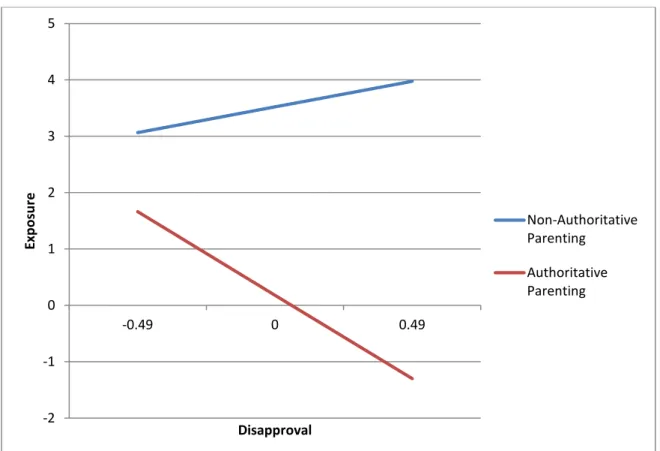
perceived caregiver disapproval and adolescent alcohol exposure (b=-3.34, t=-5.50, p<.0001). A significant negative relationship was found between the interaction of perceived caregiver disapproval and perceived relationship quality on adolescent alcohol exposure (b=-3.95, t=-2.43, p<.05). As perceived disapproval increases, adolescents with authoritative parents were found to be less exposed whereas those with non-authoritative parents were found to be at greater risk of exposure (see Figure 1).
The second analysis examined the relation between adolescent’s willingness to self-disclose about alcohol exposure and adolescent alcohol exposure. During the first step, the same control variables that were entered during model 1 of the first analysis were entered during model 1 of the current analysis (see Table 2). In model 2, the adolescent’s willingness to self-disclose about alcohol exposure was entered. No significant relationship was found between adolescent’s willingness to self-disclose about alcohol exposure and adolescent alcohol exposure (b=-0.73, t=-1.64, p=.12).
of adolescent alcohol exposure and perceived relationship quality predicting adolescent’s
willingness to self-disclose about alcohol exposure was examined. In model 1, control variables were entered (see Table 3). The same control variables that were entered in the first and second regression were entered in the third regression with the addition of caregiver’s gender. A significant negative relationship was found between adolescent’s education and willingness to self-disclose about alcohol exposure (b=-0.65, t=-2.25, p<.05). During the second step of the analysis, perceived caregiver disapproval of alcohol exposure was entered. A significant negative relationship persisted between adolescent’s education and adolescent’s willingness to self-disclose about alcohol exposure (b=-0.85, t=-3.01, p<.01). A significant positive
relationship was found between caregiver’s gender and willingness to self-disclose about alcohol exposure (b=1.57, t=2.36, p<.05). A significant positive relationship was found between
perceived caregiver disapproval and willingness to self-disclose about alcohol exposure (b=0.93, t=2.13, p<.05).
Discussion
The first hypothesis was supported; adolescents who perceived greater parental
disapproval of adolescent alcohol exposure had lower alcohol exposure. Caregiver disapproval has been found to be a strong predictor of less personal alcohol use in adolescents and less association with peers among other studies (Eddy et al., 2012; Nash, McQueen, & Bray, 2005). Adolescent alcohol exposure has been considered a public health concern because of the
negative consequences associated with it (Caetano et al., 1997; Hingson et al., 2000; Zeigler et al., 2005). This study provides further evidence for the effectiveness of caregiver disapproval in lowering adolescent alcohol exposure. Researchers seeking to create a preventative strategy for this population should consider caregiver disapproval a helpful tool in deterring the harmful consequences that come from early-age onset of alcohol exposure.
The second hypothesis in this study was partially supported. Although willingness to self-disclose about alcohol exposure was not significantly related to alcohol exposure, they are negatively correlated as hypothesized. If there was a larger sample size, thus more power, the association might have reached statistical significance. Previous research has indicated that adolescents self-disclose more to their caregivers about their alcohol exposure when they are less exposed to alcohol (Smetana et al., 2009). This illuminates the crux of the conundrum. By being disapproving, caregivers are faced with the possibility that their adolescent will not self-disclose about alcohol exposure.
associating with peers that drink, meaning that the adolescent is less willing to self-disclose since it is more likely that there is something to disclose at this point in development that a
disapproving caregiver would not be happy about (Monitoring the Future, 2011).
The third hypothesis was not supported. The more disapproving adolescents thought their caregivers were of alcohol exposure, the more adolescents reported that they were willing to self-disclose about their exposure to alcohol. Literature has previously examined the
relationship between caregiver disapproval and adolescent self-disclose, indicating that these two constructs are negatively related (Smetana et al., 2009). However, a willingness to self-disclose is different from disclosure itself. Adolescents that report that they are more willing to self-disclose to their caregiver about their alcohol exposure may not necessarily self-self-disclose to their caregiver about their alcohol exposure.
Adolescent’s education continued to predict an adolescent’s willingness to self-disclose about alcohol exposure above and beyond perceived caregiver disapproval. Adolescents in higher grade levels were less willing to share information with their caregiver about their alcohol exposure regardless of how disapproving the caregiver was. Caregiver gender was also
significantly related to adolescent’s willingness to self-disclose about alcohol exposure. Adolescents were more willing to self-disclose about their alcohol exposure if their caregiver was male. However, there were only 3 male caregivers in the 27 caregivers who participated in the study so findings should be considered preliminary.
Initially, it was thought that if adolescents considered their relationship to be positive with their caregiver they would be more willing to self-disclose to their caregiver about their alcohol exposure even if they thought their caregiver was disapproving of alcohol exposure. Self-disclosing alcohol exposure to a caregiver who is disapproving of alcohol exposure may put a strain on the adolescent-caregiver relationship. Adolescents who endorse this view may not be willing to self-disclose their alcohol exposure to a disapproving caregiver if they care about the relationship shared by them and their caregiver. Adolescents may feel shame if they self-disclose alcohol exposure to a disapproving caregiver. To avoid caregivers being disappointed with them, adolescents may choose not to disclose their alcohol exposure.
The fifth hypothesis was supported. The relation between adolescents’ perceptions of caregiver disapproval and adolescents’ alcohol exposure depends upon the relationship that they share with their caregiver. Adolescents’ perceived relationship quality is preventative with regards to adolescent alcohol exposure. Adolescents who perceived their caregiver as
disapproving of adolescent alcohol exposure were less exposed to alcohol if they perceived a positive relationship with their caregiver. This demonstrates the preventative effect that
adolescents that view their relationship with their caregiver as positive are less likely to be exposed to alcohol.
In summary, perceived parental disapproval predicts both adolescents’ alcohol exposure and an adolescent’s willingness to self-disclose about alcohol exposure. Also, an adolescent’s willingness to self-disclose about alcohol exposure was marginally related to adolescent alcohol exposure. Relationships deemed positive by adolescents between themselves and their
caregivers affected the relationship between perceived parental disapproval and adolescent alcohol exposure, but did not affect the relationship between perceived parental disapproval and willingness to self-disclose about alcohol exposure in adolescents. This may be because
adolescents who think of their relationship with their caregiver as positive are less likely to be exposed to alcohol as they value their caregiver and communicate effectively with their caregiver about the negative consequences of alcohol exposure. However, adolescents may not want to self-disclose information about their alcohol exposure to their caregiver when their caregiver is disapproving in fear that it will negatively impact their relationship with their caregiver, causing shame and the feeling that their caregiver is disappointed in them.
Limitations and Future Directions
Another limitation of this study is that it cannot be discerned to what effect the nature of the relationship between caregiver and adolescent had on adolescent alcohol exposure. To clarify, a caregiver who is a brother or sister to the adolescent in their care may have a very different relationship than an adolescent whose caregiver is their biological parent. There may be some noticeable differences between types of caregivers that vary the caregiver-adolescent dynamic and should be examined in the replication of this study.
Future studies should examine more relationship qualities that are found within the caregiver-adolescent dyad. In this study, only the level of affection and conflict were examined. However, caregiver-adolescent relationships are based on other variables as well, making the process of examining this relationship much more complex.
Because an adolescent’s educational level was significantly related to an adolescent’s willingness to self-disclose about their alcohol exposure, studies should also compare middle school populations, as such was done in this study, with populations of adolescents in higher grade levels. A longitudinal methodology could also be implemented at varying grade levels to see how an adolescent’s willingness to self-disclose about alcohol exposure varies from year to year. Effective prevention may look very different at different ages. The role the caregiver plays may vary from age to age. It is vital to examine adolescent alcohol exposure within the
appropriate context. Because this context may change as an adolescent ages, seeing how it changes over time would be beneficial.
greatly improved by incorporating several predictive measures (e.g. peer alcohol use and individual alcohol use) that could point out even more indications of potential or future alcohol use among middle school populations and older adolescent populations alike.
Although alcohol based research has been conducted within the middle school population for years, it must continue so that we can better develop prevention and treatment methodologies that would be deemed useful in most areas. This study could help direct future studies down the paths of trying to better understand early-age predictors of alcohol exposure, better understand the relationship that disapproval and self-disclosure share, or develop ways to measure
relationship qualities within dyads. It is important to understand the limitations of the caregiver-adolescent relationship. It is preventative, when positive, with regards to caregiver-adolescent alcohol exposure. However, we cannot assume that because an adolescent and caregiver share a positive relationship, adolescents are going to want to talk about their exposure to alcohol. The
References
Baumrind, D. (1966). Effects of Authoritative Parental Control on Child Behavior, Child Development, 37(4), 887-907.
Baumrind, D. (1967). Child care practices anteceding three patterns of preschool behavior. Genetic Psychology Monographs, 75(1), 43-88.
Caetano, R., Tam, T., Greenfield, T., Cherpitel, C., & Midanik, L. (1997). DSM-IV alcohol dependence and drinking in the U.S. population: A risk analysis. AEP, 7(8), 542–549. Chung, T., Martin, C. S., Armstrong, T. D., & Labouvie, E. W. (2002). Prevalence of DSM-IV
alcohol diagnoses and symptoms in adolescent community and clinical samples. Journal of the American Academy of Child and Adolescent Psychiatry, 41(5), 546.
doi:10.1097/00004583
Chung, T., Martin, C. S., & Winters, K. (2005). Diagnosis, course, and assessment of alcohol abuse and dependence in adolescents. Recent developments in alcoholism, 17, 5-27. Cohen, D. A., & Rice, J. C. (1995). A parent-targeted intervention for adolescent substance use
prevention: Lessons learned. Evaluation Review, 19(2), 159-180. doi:10.1177/0193841X9501900203
Darling, N., & Steinberg, L. (1993). Parenting style as context: An integrative model. Psychological Bulletin, 113(3), 487-496. doi:10.1037/0033-2909.113.3.487
Dawson, D. A., Goldstein, R. B., Chou, S. P., Ruan, W. J., & Grant, B. F. (2008). Age at first drink and the first incidence of adult-onset DSM-IV alcohol use disorders.
D'Amico, E. J., & McCarthy, D. M. (2006). Escalation and Initiation of Younger Adolescents' Substance Use: The Impact of Perceived Peer Use. Journal Of Adolescent Health, 39(4), 481-487. doi:10.1016/j.jadohealth.2006.02.010
Deas, D., Riggs, P., Langenbucher, J., Goldman, M. and Brown, S. (2000), Adolescents Are Not Adults: Developmental Considerations in Alcohol Users. Alcoholism: Clinical and Experimental Research, 24: 232–237. doi: 10.1111/j.1530-0277.2000.tb04596.x Dishion, T.J., & McMahon, R.J. (1998). Parental monitoring and the prevention of child and
adolescent problem behavior: A conceptual and empirical formulation. Clinical Child And Family Psychology Review, 1(1), 61-75. doi:10.1023/A:10211800432380
Donaldson L. (2009) Guidance on the consumption of Alcohol by children and young people.
Donovan, J. E., & Molina, B. G. (2008). Children's introduction to alcohol use: Sips and tastes. Alcoholism: Clinical And Experimental Research, 32(1), 108-119. doi:10.1111/j.1530-0277.2007.00565.x
Eddy, J. J., Giddeonsen, M. D., McClaflin, R. R., O’Halloran, P., Peardon, F. A., Radcliffe, P. L., & Masters, L. A. (2012). Reducing alcohol use in youth aged 12-17 years using the strategic prevention framework. Journal Of Community Psychology, 40(5), 607-620. doi:10.1002/jcop.21485
Field, T., Diego, M., & Sanders, C. (2002). Adolescents' parent and peer relationships. Adolescence, 37(145), 121-130.
Fitzpatrick, K. M. (1997). Fighting among America's youth: A risk and protective factors
approach. Journal Of Health And Social Behavior, 38(2), 131-148. doi:10.2307/2955421 Flannery, D. J., Vazsonyi, A. T., Torquati, J., & Fridrich, A. (1994). Ethnic and gender
differences in risk for early adolescent substance use. Journal Of Youth And Adolescence, 23(2), 195-213. doi:10.1007/BF01537445
Grant, B. F., & Harford, T. C. (1990). The relationship between ethanol intake and DSM-III alcohol dependence. Journal of Studies on Alcohol, 51(5), 448–456
Hartford, T. C., Grant, B. F., Yi, H. -y., & Chen, C. M. (2005). Patterns of DSM-IV alcohol abuse and dependence criteria among adolescents and adults: Results from the 2001 National Household Survey on drug abuse. Alcoholism, Clinical and
Experimental Research, 29(5), 810–828.
Hawk, S. T., Keijsers, L., Hale, W., & Meeus, W. (2009). Mind your own business! Longitudinal relations between perceived privacy invasion and adolescent-parent conflict. Journal Of Family Psychology, 23(4), 511-520. doi:10.1037/a0015426
Hingson, R. W., Heeren, T., Jamanka, A., & Howland, J. (2000). Age of drinking onset and unintentional injury involvement after drinking. JAMA: Journal Of The American Medical Association, 284(12), 1527-1533. doi: 10.1001/jama.284.12.1527
Johnston, L. D., O'Malley, P. M., Bachman, J. G., & Schulenberg, J. E. (2012). Monitoring the Future national survey results on drug use, 1975-2011. Volume I: Secondary school students. Ann Arbor: Institute for Social Research, The University of Michigan, 760 pp. Kann, L. (2001). The youth risk behavior surveillance system: Measuring health-risk behaviors.
American Journal Of Health Behavior, 25(3), 272-277. doi:10.5993/AJHB.25.3.14 Kerr, M., & Stattin, H. (2000). What parents know, how they know it, and several forms of
adolescent adjustment: Further support for a reinterpretation of monitoring.
Developmental Psychology, 36(3), 266-380. doi:10.1037/0012-1649.36.3.366 Knight, J., Sherritt, L., Shrier, L., Harris, S., & Chang, G. (2002). Validity of the CRAFFT
substance abuse screening test among adolescent clinic patients. Archives of Pediatric & Adolescent Medicine, 156, 607-614.
Kodjo C.M., Klein J.D. Prevention and risk of adolescent substance abuse. The role of
adolescents, families, and communities. Pediatric clinics of North America. 2002 Apr 0; 49(2):257-68.
Lamborn, S. D., Mounts, N. S., Steinberg, L., & Dornbusch, S. M. (1991). Patterns of competence and adjustment among adolescents from authoritative, authoritarian, indulgent, and neglectful families. Child Development, 62(5), 1049-1065. doi:10.2307/1131151
Maccoby, E. E., & Martin, J. A. (1983). Socialization in the context of the family: Parent-child interaction. In P. H. Mussen (Ed.), Handbook of child psychology. Vol. 4: Socialization, personality, and social development (pp. 1–101). New York: Wiley.
Nash, S., McQueen, A., & Bray, J. (2005). Pathways to adolescent alcohol use: family
environment, peer influence, and parental expectations. Journal of adolescent health, 37(1), 19-28.doi:10.1016/j.jadohealth.2004.06.004
National Health Medical Research Council. (2009).Australian guidelines to reduce health risks from drinking alcohol.
Nelson, C. B., & Wittchen, H. U. (1998). DSM-IV alcohol disorders in a general
population sample of adolescents and young adults. Addiction, 93(7), 1065–1077. Ohlson, M.M. (1979). Marriage counseling in groups. Champaign, IL: Research Press.
Paterson, J., Pryor, J., & Field, J. (1995). Adolescent attachment to parents and friends in relation to aspects of self-esteem. Journal Of Youth And Adolescence, 24(3), 365-376.
doi:10.1007/BF01537602
Piko, B. (2000). Perceived social support from parents and peers: Which is the stronger predictors of adolescent substance use?. Substance Use & Misuse, 35(4), 617-630. doi:10.3109/10826080009147475
Piko, B. F., & Kovács, E. (2010). Do parents and school matter? Protective factors for adolescent substance use. Addictive Behaviors, 35(1), 53-56. doi:10.1016/j.addbeh.2009.08.004 Smetana, J. G., Villalobos, M., Tasopoulos-Chan, M., Gettman, D. C., & Campione-Barr, N.
(2009). Early and middle adolescents’ disclosure to parents about activities in different domains. Journal Of Adolescence, 32(3), 693-713.
doi:10.1016/j.adolescence.2008.06.010
Zamboanga, B. L., Schwartz, S. J., Ham, L. S., Hernandez Jarvis, L., & Olthuis, J. V. (2009). Do alcohol expectancy outcomes and valuations mediate peer influences and lifetime alcohol use among early adolescents?. The Journal Of Genetic Psychology: Research And Theory On Human Development, 170(4), 359-376. doi:10.1080/00221320903218380
Zeigler, D., Wang C., Yoast R., Dickinson B., McCaffree M., Robinowitz C., & Sterling M., (2005). The neurocognitive effects of alcohol on adolescents and college students.
Table 1
Tests of covariates, perceived caregiver disapproval, and the interaction between perceived caregiver disapproval and perceived relationship quality as explanations of adolescent alcohol exposure
Model 1 β (SE)
Model 2 β (SE)
Model 3 β (SE)
Adolescent’s Gender 0.71 (0.89) 0.18 (0.55) 0.34 (0.50)
Adolescent’s
Education -0.67 (0.63) 0.07 (0.40) 0.23 (0.38)
Adolescent’s Race 0.57 (1.11) -0.48 (0.70) -0.30 (0.65)
Caregiver’s Education 0.30 (0.55) 0.39 (0.34) 0.31 (0.31)
Family’s Household
Income 0.01 (0.18) -0.27 (0.12)* -0.25 (0.11)*
Perceived Caregiver
Disapproval -3.65 (0.62)*** -3.34 (0.61)***
Perceived
Relationship Quality 0.93 (0.61)*
Perceived Caregiver Disapproval
X
Perceived
Relationship Quality
-3.95 (1.62)*
R2 0.11 0.69 0.77
Table 2
Tests of covariates and adolescents’ willingness to self-disclose about alcohol exposure as explanations of adolescent alcohol exposure
+= p<.01;*=p<.05; **=p<.01; ***=p<.001
Model 1 β (SE)
Model 2 β (SE)
Adolescent’s Gender 0.71 (0.89) 0.65 (0.86)
Adolescent’s Education -0.67 (0.63) -1.05 (0.65)
Adolescent’s Race 0.57 (1.11) 0.16 (1.09)
Caregiver’s Education 0.30 (0.55) 0.32 (0.53)
Family’s Household Income 0.01 (0.18) 0.04 (0.18)
Willingness to Self-Disclose
about Alcohol Exposure -0.73 (0.44)
Table 3
Tests of covariates, perceived caregiver disapproval, and the interaction between perceived caregiver disapproval and perceived relationship qualities as explanations of adolescents’ willingness to self-disclose about alcohol exposure
+= p<.01;*=p<.05; **=p<.01; ***=p<.001 Model 1
β (SE)
Model 2 β (SE)
Model 3 β (SE) Adolescent’s Gender -0.24 (0.41) -0.26 (0.38) -0.18 (0.38) Adolescent’s
Education -0.65 (0.29)* -0.85 (0.28)** -0.80 (0.29)*
Adolescent’s Race -0.68 (0.51) -0.43 (0.48) -0.30 (0.49) Caregiver’s Education 0.16 (0.27) 0.20 (0.25) 0.19 (0.25) Caregiver’s Gender 1.05 (0.67) 1.57 (0.67)* 1.67 (0.67)* Family’s Household
Income -0.01 (0.09) 0.03 (0.09) 0.03 (0.09)
Perceived Caregiver
Disapproval 0.94 (0.44)* 0.91 (0.47)
Perceived
Relationship Quality 0.64 (0.46)
Perceived Caregiver Disapproval
X
Perceived
Relationship Quality
-0.76 (1.24)
Figure 1. The Interaction of Perceived Caregiver Disapproval and Perceived Relationship Qualities on Alcohol Exposure
-2 -1 0 1 2 3 4 5
-0.49 0 0.49
Exp
o
su
re
Disapproval
Non-Authoritative Parenting