Changing
Institutional
Structures
to
Improve
the
Coordination
of
Land
Use
and
Transportation
in
the
Research
Triangle
Robert
J.Schneider
Introduction
When
Sandy Ogburn.
AssistanttotheGeneral
Manager
atTriangleTransitAuthority(TTA).
firstarrivedin theNorth
CarolinaResearch
Triangleregionfrom
Philadelphia,sheplanned
tostayonlytwo
years.However,
because
of
"theslowerpaceof
life, all theamenities intheregion,
and
the beautifulbluecolor
of
the sky." sheand
her familyhave
made
theTriangle
home
forover25
years.During
thattime.
Ms.
Ogburn
hasbeen
an activemember
of
theTriangle
community,
servingas amember
of
the
Durham
CityCouncil,aschairoftheDurham-Chapel
Hill-CarrboroMetropolitanPlanning Organization
(DCHC MPO)
Transportation
Advisory
Committee, and
aschairofthe
TTA
Board
ofDirectors.Unfortunately, recenttrends
may
threatenthehighquality
of
lifethathasattracted people,like
Ogburn. and
businessestotheTriangle inthepast. Trafficcongestion
and
airpollutionproblems
thathave
plagued other fast-growingmetropolitanareas
have
come
tothe Triangle.According
totheNorth
CarolinaDepartment
of
Environment and
NaturalResources
(NC
DENR).
the Research Triangle regionexperiencedeight
Code Red
("unhealthy")and
twenty-three
Code
Orange
("unhealthy forsensitivegroups")
ozone days
in 1999
(NC
DENR
2000).Automobile
emissionsareamajor
source
of
thispollution,and
an inefficientregional transportationsystemcontributestothe
emissions
problem
by exacerbatingtrafficcongestion. Traffic
volumes on
Interstate40
atthe
Wake-Durham
county
line increasedfrom
about 71.000vehiclesper
day
in 1990
toover1 1,000 vehiclesper
day
by
1995
(Eisenstadtand
Hoar
1995).Commuters
oftenspend anhour
traversing the 10-milestretch ofInterstate
40
between Research
Triangle Parkand
Raleigh.The
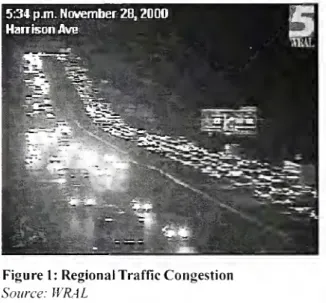
region'scongestionproblem
has increasinglydrawn
press coverage, with helicoptertrafficreports
and
liveviews from
trafficcameras
broadcast each night
on
the local news.Ms.
Ogburn
attributesmuch
of
theblame
fortheTriangle's
worsening
congestion toalackof
coordination
between
theregion's land useand
transportationdecision-makers.
She
stated inarecent interview,
"We
[intheTriangleregion] arequickly
going
theway
ofmany
largemetropolitanareasbynotacting regionally. Airpollutiondoes
notstopatthe county line. It's not a
Durham
problem. It's not a Raleigh problem. It's
our
problem
as a region."She
suggestsalso thattheeconomic
viabilityoftheTriangle,which
isdependent on
theregion's qualityoflife,will bedamaged
when
agenciesand
municipalitiesactindividually.
Over
thepastfew
years,businesseshave begun
toquestionmoving
toandstayingintheTriangle becausetheir
employees
arefrustratedwithairpollution
and
trafficcongestionproblems.
Ogburn
warns."Ultimately,withoutregional coordination,ourqualityoflifewillbe
diminished,
and
theTrianglewillbecome
a lessdesirableplace tolive.
People
will search forgreener pastures
—
literally"(Ogburn
2000).Airpollution
and
trafficcongestionareone
resultoflanduseandtransportationdecisions
thatare
made
by
individual municipalities,suchasRaleigh,
Durham.
Chapel
Hill,and
Cary,without consideration
of
theireffectson theregion as awhole.
These
fourcitiesand nearbyemployment
centerofthe region. ResearchTrianglePark,
and
theRaleigh-Durham
InternationalAirportare located inthecenter
of
the"triangle." Malls, sporting events
and
most
jobsarewithinan hour's driveof almost
any
household
in the region.Because
Triangleresidentstravel
between
allcommunities
intheregiontotake
advantage of
social, cultural,employment, and
otherresources, itmakes
sensetouse regional
approaches
toplanningand
sharethe costs
and
benefits ofdevelopment.
Figure1: RegionalTrafficCongestion
Source:
WML
Purpose
and Methodology
This paper arguesthatthe lack
of
coordination
between
localitieswith landusedecision-makingauthority
and
regionalagencieswithtransportationdecision-making
power
causestheTriangleregionto
develop
unsustainable landuse patterns
and
transportation systems.
The
purposeof
thispaper
isto:suggest general keysto success for
cooperativeregional
governance
structures;
evaluate the effectiveness
and
feasibilityofalternativeinstitutional
frameworks
forregionalcoordinationin
comparison
tothecurrent landuse
and
transportationdecision-makingstructuresinthe
Triangle;
and
recommend
five institutionalchanges
thatcould beadopted separately or in
combinationto
improve
regionalcoordinationintheTriangleregion.
Two
sourcesof
opinion,responsestoa briefquestionnaire
from
fiveregionalagencies locatedindifferent parts
of
thecountry(Alabama,
California,Illinois/Iowa.
North
Carolina,and
Oregon) and academic
literatureoninter-jurisdictionalcooperation,suggestkeysto
success
and
guidetheevaluationand
recommendations.
Taking
aRegional
View
Proponents
of
regionalcoordinationof
landuse
and
transportationdevelopment
citenumerous
planningissues that aretheresultof
thebalkanization
of
localgovernments
withinaregion
and
a lackof concern
aboutthe impactsof
development
and
regulation policieson
otherjurisdictions
(MSRC
1993;Chapralis 1994;Pincetl 1994; Baldassare, etal. 1996; Leo, etal.
1998;
Rusk
2000).Research
hasidentifiedseveral
problems
that relatespecificallytocoordinating land use
and
transportationbetween
jurisdictions:
Inefficient regional
development
patterns
determined
by
land usechoicesmade
atthelocal leveltendnot tosupporthigherdensitiesin locationsthat will
optimizethe efficiencyofregional
transportationsystems(Porter 1997:
Rusk
2000).Inefficient transportation
system
leadingto
poor
connectivitybetween
roads
and
transit systems acrossjurisdictionalboundaries. Lessdirect
transit routesresult in fewer
transportation
mode
choicesfor residents.and
awkward
road connections result inmore
airpollutionand
time spentintraffic(Porter 1994; Baldassare. etal. 1996).
Individual local
development
choicesresultingreaterdispersionofjobs
throughoutaregion. Low-skilledjobs
become
less accessibletoworkers
withlittle
money
tospend
on
transportationInterstates
and
otherfreeways
make
"greenfield"sitesat the
edge of
metropolitan areas accessible
and
attractive fordevelopment.
As
aresult,centralcity lots
and
buildingsthatareserved
by
roads, sewer, utilities,schools,and
other services areabandoned
forthese
new
sites that arenot servedby
infrastructure
and
publicservicesand
may
be sensitive environmental areasorproductive farmland(Porter 1997).
Critics
of
regionalcooperationstatethatthere isa lack
of
concrete evidence linkingpoliticalfragmentationtospecificproblems.
Detractorsalsopoint outthat larger
governments
areinefficient,
and
thatsmall localgovernments
providecitizenswithincreased choice,
more
responsiveness
and
a greaterchance
forpublicinputin landuse
and
transportationdecisions(Pincetl 1994; Baldassare. etal. 1996; Porter
1997).
Movement
Towards
Regional
Strategies in theTriangle
Recent
initiativesshow
thatthere isreceptiveness
towards
usingregional strategiestocoordinateland use
and
transportationdecisionsin theTriangle. In 1972. theTriangleJ
Council
of
Governments
(TriangleJCOG),
one
of 18
North
CarolinaCOGs.
was
formed
as avoluntary organization of municipal
and
countygovernments from
thesixcountiesof
the region(Figure2).
The
Greater Triangle RegionalCouncil
(GTRC),
a coalitionof
developers,environmentalists, fanners,
neighborhood
activists,business owners,university
representatives,
and
chamber
ofcommerce
members
from
the region,was
formed
in 1993toprovidea privateperspective
on
theregion'sproblems
(Warrick 1993).GTRC
helpedtodevelopa series
of
"smartgrowth"
principlesfortheTriangle region
(Leavenworth
1999).The
principlesinclude:
Design
new
and
preserveexistingneighborhoods
andcommunities
tofosterwalkability. safety
and
asenseof
place;Promote
differentmixed-use
centersof
various scales foreach citv,
town and
crossroads in the Triangletoserve as
centers
of
civic,social, cultural,and
economic
life,and
astransportationhubs;Createaseamless,regional,multi-modal
transportation
system
which
interlinksnew
and
existingresidential,employment,
commercial,
and
recreational areas;Promote development
patternsand
designs that take
advantage
ofand
supportregional
and neighborhood
transportationsystems;
Preserve
more
natural areasand open
space
and
provide fortheirinterconnectionatlocal
and
regionallevels;
and
Coordinate
landusedevelopment and
transportation infrastructure
and
servicesto helpachieve
each of
these principles.There
hasalsobeen
statesupportfor linkingland use
and
transportationattheregional level.The
North
CarolinaCommission
toAddress
Smart Growth.
Growth Management,
and
Development
Issues("Smart
Growth
Commission")
isdevelopingrecommendations
that itwill presenttothestatelegislaturein
January
2001
(Godschalk
2000).One
oftherecommendations
theSmart
Growth Commission
isconsideringisforthestatetoallow localitiesto
voluntarily
form
regionalgovernments.
Under
thisarrangement,thevoluntaryregional
governments
will adoptregional smartgrowth
plans,
and
ifmembers
adoptlocal smartgrowth
plansconsistentwiththeregional plan, the
localities in theregioncould
have
accesstoa"smart
growth
toolbox"(Stradling2000). Thiswould
allow Trianglecommunities
touseaseriesof
state supported smartgrowth
policies, suchastransfer
of development
rightsor impactfeeson
new
development,
withouta formal actfrom
thestate legislature.
Regions
thatrequireconsistency witha regionalsmart
growth
planwould
alsobeeligiblefor statefunded incentivesto
implement
regionalplanningefforts. Thistypeof
initiativecouldresultina regionalforum
touniteland use
and
transportationdevelopment
Keys
toSuccess
forRegional
Coordination
of
Land
Use and
Transportation
Modeling
regional strategiesaftersuccessfulregional initiativesin other parts
of
thecountrycould help ensurethesuccessofregional
initiativesinthe Triangle.
Responses from
thefive regional agencies
and
otheracademic
research suggestthere are several critical
elementstocreating a regionalinstitutional
structurethatfosters integrative
decision-making
(Table 1).
These
elements fallunder
two
main
evaluativecriteria,feasibility
and
effectiveness.A
regional structure's effectiveness isthe extentto
which
theorganizationisabletoget resultsby
implementing
landuseand
transportationdevelopment
toolsand
decisions.A
regionalstructure's feasibility is the degree
of
difficultyinmaintainingthenecessary institutional
arrangements
from
political, legaland
technicalperspectives. Equity,ortheability
of
agenciestoincludeallregional stakeholdersin landuse
and
transportation decisions, isanimportant
component
withinthiscategory. Regionalinstitutions
must
beequitable inordertomaintainthe support
of
grassrootsand
otherpublicinterest groups.
The
literatureshows
thatregionalgovernments
aremost
effectivewhen
agencies:Integrate a
number
oftools to create acomprehensive
regionaldevelopment
program
(Lassar 1991: Leo. etah
1998):Establish concrete,understandable,
common
goalsforcommunities
withintheregion(Porter 1997):
^S^s-^WZ
TriangleJCouncilofGovernments
(Chatham. Durham.Johnston. Lee.
Orange and
Wake
Counties)Figure2:North CarolinaCouncils of
Government
Source:
Land
of Sky RegionalCouncil, S'CCouncilsof
Government
* Establish jointadvisory
committees
toaddress land use
and
transportationissues:
Promote
activecommunication and
collaboration
between
jurisdictions:and
Emphasize
implementationof
plansand
programs.
Italso
shows
that regionalinitiativesaremost
feasiblewhen
agencies:Solicitpublicinvolvementinthe landuse
and
transportation process(Carlsonand
King
1998):Take
abottom-up approach
todevelopingregional plans,
work
w
ithlocaljurisdictions as
much
as possible,and
allow localimplementation ofregional
strategies (Baldassare. et al. 1996):
Understand
traditional institutionalbarrierstoregional coordination,suchas
local
home
ruleauthority (Porter 1997):Obtain
state supportforregionalcooperation (Porter 1997: Carlson
and
King
1998):and
Define a clear objective(such as
reductionofregionalairpollution,
reductionin regionaltrafficcongestion,or
better
management
of
regionalinfrastructure) that requires regional
coordinationtobe achieved (Chapralis
1994: Porter 1997).
Current
InstitutionalArrangements
The
Triangle'scurrentinstitutionalstructurehas
many
of
the attributesthat should leadtosuccessful regionalcoordinationas
mentioned
above. Yet.analternativeinstitutional
arrangement
may
be able to achieve greatereffectivenesswhile maintainingfeasibility.
Established
InstitutionalArrangements
The
initiativesof
theGTRC
and
otherproponentsofregionalcooperation
have
promoted
thisconcept withinthe Triangle'sestablishedinstitutional
framework. However.
current
power
structure for land use andtransportationdecisions
remains
inplace.Currently, four
government
agenciesinfluence regional transportation
and
landuseplanningin the Triangle.TriangleJ
COG
playsaroleinfacilitating
agreements between
localities,providingdata
and
suggestingprinciplesforlanduse
and
transportationdevelopment.
The
regionhas
two
separateMetropolitan PlanningOrganizations,theCapital
Area
MPO
(CAMPO),
which
represents areasaround
Raleigh,
and
theDurham-Chapel
Hill-CarrboroMPO
(DCHC
MPO).
Both
MPOs
have thepower
todevelop
transportationimplementationprograms and
todistribute stateand
federaltransportation funds. Finally,theTriangleTransit
Authority has
been
giventhe responsibilityof
planning
and
operatinga regionaltransitsystem.Despite theexistence
of
these regionalgovernments,currentinstitutionalarrangements
dictatethatlanduse planning
and
development
decisionsremainfirmlywithintheadministrative
purview of
municipaland
countygovernment.
Local
governments have
thepower
to:Develop comprehensive
land use plans;Enact zoningordinances/establish zoning
districts:
Raisetaxes
and
acquire land;and
Create subdivision
and
transit-orienteddevelopment
guidelines.Incontrast, regional
governments
playmore
of an advisoryorclearinghouserole withouta
greatdeal of decision-making power. For
example.
TTA
has limitedpower
toacquire landwithin
and around
theright-of-wayofitsfutureregional railcorridor.
TTA
hasencouraged
localmunicipalitiestozoneahigh-density
mix
oflanduses inareasnear future rail stationsin its
Station
Area
Development
Guidelines(TTA
1998),yetitcan
do
littleifmunicipalitiessuchasCary
orChapel
Hilldecidetozone
areas nearfuture stationsaslow-densityresidential.
Hence,
local landusedecisionswill
have
a significantimpact
on
the efficiencyof
thefuturerail systemas a whole.
TriangleJ
COG
providesdatatomunicipalitiesthat
may
have
smallstaffsorbudgetssothatall parts
of
the regioncanachieve a basic level
of
land useand
transportationplanning. Yet,
membership
inTriangleJ isnotmandatory,
and
localities suchasSilerCity
and
Wilson
Millsare not represented.Under
itsvoluntarystructure.TriangleJCOG
can:
Mediate
landuseand
transportationdisputes
between
localities:Provideland use
and
transportation datatoallmunicipalitiesinthe region:
Develop
model
ordinancesfor localities;and
Establish regional land use
and
transportation principles.
Finally,while
COGs
likeTriangleJmay
develop
regional principles,theyhaveno
power
to
implement
theirrecommendations
(MunicipalCooperation
Guide
1993). Therefore,theirplansare often"ignored almostatwill by
member
localgovernments"
(Porter 1997). Fora regionalagency
tohave
true land useand
transportationpower, it
must
be givenstatutoryhome
rulepowers, there
must
be an express grantofpowers
totheagency
through a stateconstitutionalprovisionforregionalgovernments,
orthere
must
be specific stateor federallegislation thatallowsthe consolidationoflocal
municipalitiesto
form
regionalgovernments
(Richardson 2000).
Alternative Institutional
Arrangements
The
Research Triangle couldimprove
regionalcoordination
of
landuseandtransportation
development by
adoptingadifferent structure
of
regionalgovernance.Experiences
from
otherregionsin the UnitedStatesprovide
examples of
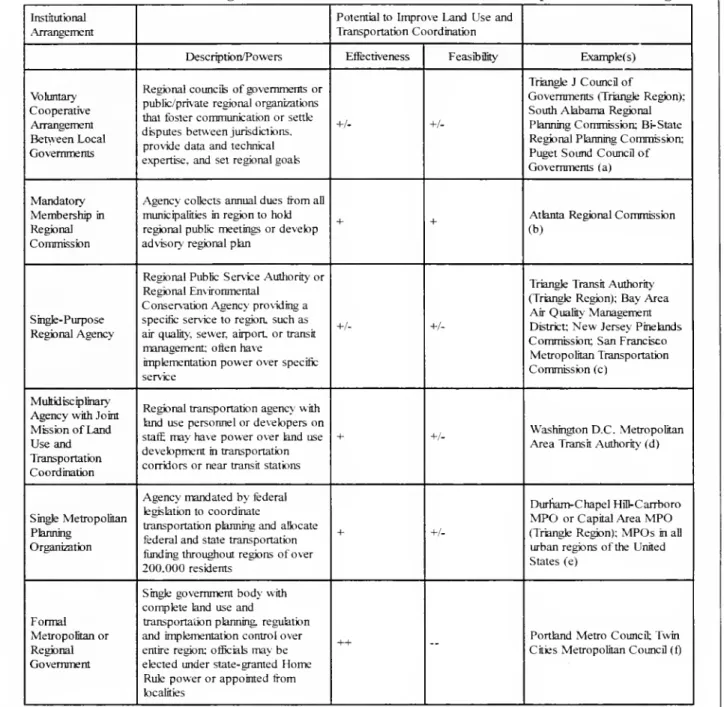
successfulinter-jurisdictionalarrangements. Table 1
shows
how
theeffectiveness
and
feasibilityofregionalinitiativescouldbeaffectedor
improved
underalternative
arrangements
tothe present regionalgovernment
structurein the Triangle.Table 1 describessix regional
governance
structuresthatare currently used in regions
of
Table
1: InstitutionalArrangements
toCoordinate
Land
Use
and
Transportation Planning
Institutional
Arrangement
Potential to Improve LandUseand
TransportationCoordination
Description/Powers Effectiveness Feasibility Example!s)
Voluntary
Cooperative
Arrangement
BetweenLocal
Governments
Regionalcouncilsof governmentsor
public/privateregionalorganizations
thatfostercommunicationorsettle
disputesbetweenjurisdictions,
provide dataandtechnical expertise,andsetregionalgoals
+/-
+/-TriangleJCouncilof Governments(TriangleRegion);
SouthAlabamaRegional PlanningCommission; Bi-State Regional PlanningCommission; PugetSoundCouncilof Governments(a)
Mandatory
Membershipin
Regional
Commission
Agencycollectsannualduesfromall
municipalitiesinregiontohold
regional publicmeetings ordevebp
advisoryregionalplan
+ + AtlantaRegionalCommission
(b)
Single-Purpose
RegionalAgency
RegionalPublic Service Authorityor Regional Environmental
ConservationAgencyprovidinga
specific service toregion,such as
airquality,sewer,airport,ortransit
managementoften have
implementationpoweroverspecific service
+/-
+/-Triangle TransitAuthority
(TriangleRegion);BayArea
AirQuality Management
District;
New
Jersey PinelandsCommission;SanFrancisco Metropolitan Transportation
Commission(c)
Multidisciplinary
AgencywithJoint
MissionofLand
Useand
Transportation Coordination
Regional transportationagency with
landusepersonnel ordeveloperson
stafEmay havepoweroverlanduse
developmentintransportation corridorsorneartransitstations
+ +/- Washington D.C.Metropolitan
AreaTransitAuthority(d)
SingleMetropolitan Planning
Organization
Agency mandated byfederal legislationtocoordinate
transportationplanningandallocate federalandstatetransportation fundingthroughout regionsofover
200.000residents
+
+/-Durham-ChapelHiD-Carrboro
MPO
or CapitalAreaMPO
(Triangle Region):
MPOs
in allurbanregionsoftheUnited States(e)
Formal
Metropolitan or Regional
Government
Single governmentbodywith
complete landuseand
transportationplanning,regulation
and implementation control over
entireregion; officialsmaybe
electedunderstate-grantedHome
Rulepowerorappointed from
localities
++
-
PortlandMetroCouncil;TwinCities MetropolitanCouncil(f)
Status
Quo
InstitutionalArrangement=landuseauthorityatlocallevel;voluntaryregionalcouncilofgovernments; transportation authoritysplitbetweentwo
MPOs;
one single-purpose transitagencyKEY:
=majorpositivechangefromstatusquoforgivencriterion;~=minor
positivechange fromstatusquoforgivencriterion; +/-
=no
improvementormixedevaluationforgivencriterion;-=minor
negativechangefromstatusquo forgivencriterion;
—
=majornegativechange fromstatusquoforgivencriterionSOURCES:
(a)Porter 1992:Atkins 1993;
MRSC
1993:Pincetl 1994:Porter1994:GTRC
1997:Porter 1997;Rusk2000(b)
GTRC
1997(c)Lassar 1991; Easley 1992;Porter 1992:Atkins 1993: Chapralis 1994;Pincetl 1994; Baldassare,etal. 1996;Porter1997
(d)TCRP
1998(e)Atkins 1993;Pincetl 1994;Rusk2000
theUnitedStates.
The
institutionalarrangements
arenotmutuallyexclusive.For
example, theTriangleregionhasavoluntary
cooperative
agreement between
localgovernments,asingle-purposeregionalagency,
and
two
metropolitanplanningorganizations.The
ratingof
a regional institution'seffectivenessrepresents the positive ornegativechange, in
comparison
totheTriangle's current structureof
governance, with respecttothe extentto
which
theregionisabletoachieve coordination
of
landuse
and
transportationby
usingregionaldevelopment
tools.The
ratingofa regionalinstitution's feasibility represents the positiveor
negative change, in
comparison
totheTriangle'scurrent structure
of
governance, with respect tothedegree
of
difficulty thattheinstitutionwillhave
implementing
landuseand
transportationdecisions
from
apolitical, legaland
technicalperspective.
The
institutionalarrangement
ratings are nottaken
from
the perspectiveof
any
oftheTriangle'sregional organizations,local
governments
orbusinessorenvironmentalinterests; they are based on evidence that is
presented throughout thepaper
on
the successorfailureoftheseinstitutionsinother regions
of
theUnited States.
Evaluation
of
InstitutionalArrangements
Currently,theTriangle
Region
hasavoluntarycooperative
arrangement
between
local
governments
(TriangleJCOG),
asingle-purposeregional
agency (TTA). and
two
separate
MPOs.
CAMPO
and
DCHC
MPO.
The
effectivenessand
feasibilityofregionalcoordinationoflanduse andtransportation
may
be
improved
ifone
orseveralof
the alternativeinstitutional
arrangements
areadopted.Implementing
amore
comprehensive
regionalstrategy
may
bethe bestway
tocoordinate landuse
and
transportationdevelopment
intheTriangle.
Effectiveness
and
FeasibilityAs
stated earlier, the effectivenessof
aninstitutional
arrangement
isbased onthedegreeto
which
theregion's governingpowers
can beusedtocoordinateland use
and
transportationdevelopment. Several agenciesin theTriangle
have
statedmissionstocoordinate land use.transportationorboth acrosstheregion;
however,
landuseplanningpower
iscurrentlyheldbyindividual local
and
countyjurisdictionswithin theTriangleregion. Therefore,an
alternativeinstitutional structurecouldbe
more
effective forcoordinating landuse
and
transportation systems.
Based
solelyon
effectiveness, creating agovernment agency
thatwould
covera largegeographic area
would
appear
tobe an easysolutionto
improve
coordinationoflanduse andtransportation
development
intheTriangleregion. Empirically,
however,
thefeasibilityofinter-governmental
arrangements
tendstodecreaseas the size
of
theirjurisdictionsincreases.
Land
use control isa "'ferociouslyjealously
guarded
localpower"
(Pincetl 1994).Resistancetoregional
government
comes
bothfrom
publicpolicyand
public sentiment.There
tendstobepolitical support intheTriangleforthestatus
quo
regionalinstitutions.Moreover,
councilsofgovernments
likeTriangleJ are
found
inevery stateand
areeven
needed
toqualifyfor
some
stateand
federal funds,many
regional agencies like
TTA
arecreated toprovidepublic transitservice,
and
MPOs
aremandated
federally. Therefore,adopting anew
landuse
and
transportation policy-settingstructureintheTriangle
would
alterinstitutionsthat areboth familiartoresidents
of
the regionand
usedcommonly
throughoutthe nation.Two
main
legal obstaclesaffect thefeasibilityofregional
governance
tocoordinatelanduse
and
transportationplanning: 1)most
stateenablinglegislationcauses landuse
planningtobe executedatthe local
government
level,whileitsimpactontransportation corridors
and
infrastructureextend across localboundaries;
and
2) federallegislation(i.e.Transportation Equity
Act
forthe21
il
Century
-TEA-2
1)mandates
thattransportationplanningbe executedattheregional
government
level, yetregional Metropolitan Planning Organizations
do
not
have
the legalpower
to control land use.Recommendations
Though
eachof
the followingrecommendations
couldbeadopted separately,acomprehensive
regional strategymay
bethemost
beneficial fortheTriangleregion. Forexample,
a regional sales taxmay
bemost
effective
and
feasible ifit isadministeredby
acouncilof
governments
thatall localgovernments
participate inand which
hasthepower
torequire that local landuseand
transportationdecisionsareconsistentwitha
regionalplan.
1.
Require
Mandatory Membership
in theTriangle
J Council
ofGovernments.
The
North
CarolinaGeneralAssembly
couldenactabillrequiringthatall localities
become
members
oftheirCOGs.
Each
municipalitywould
be charged an annual feebasedon
itsnumber
of
residents. Thiswould
providemore
resourcestoTriangleJ
and
alsoensure localrepresentation
on
thecounciland
givealllocalitiesand countiesintheTrianglea greater
stake in theplans
and
recommendations of
theregional agency.
The
AtlantaRegionalCommission
(ARC)
utilizedmandatory
membership
and
a percapitaannual fee tosuccessfully
develop
an advisoryregional plan(GTRC
1997).ARC
used theannual $0.80 percapita feetohold publicmeetings
and
gatherinput
from
citizenstodevelopthe plan. Localplannerscredited
ARC
withimprov
ingcommunication
among
localitiesand
discouragingdevelopment
with adverseregional impacts(GTRC
1997). Inthe Triangle, feerevenue
could beused tohire
more
staff,collectand
provideadditionaldata,
and
facilitatedisputesbetween
municipalities.Though
mandatory
membership
and
an annual feestillwould
notallowthecooperative
agency
toimplement and
enforce landuse
and
transportation decisions, itmay
provideagreater incentive forlocalities topay
attentiontothe land useand
transportationguidelinesprovided
by
TriangleJ. Also,because
mandator}
participationand
annualfeerequirements
must
bemandated by
statelegislation, thisact
would
sendapowerfulmessage
to localgovernments
abouttheimportance ofregional coordination.
2. Establish a
Land
Use
Division in theTriangle
TransitAuthority
thathas
power
over land
use decisions in transit corridorsand
station areas.InanticipationofitsRegional RailInitiative.
TTA
could follow themodel
oftheWashington
D.C. Metropolitan
Area
TransitAuthority(
WAMTA)
by
establishing aland usedivisionw
ithinthe agency.Under
thisarrangement,TTA
could ensurethatlanduses withintransit
corridors
and
neartransit stationsaretransit-supportive. Specifically,
by working
withlocalofficials,the
agency
couldencourage
higherdensity
and
a bettermix
ofland usesto supportridership
on
theregionalsystem. Further,officialcorridor
and
station landuse planscouldbecreated
by
TTA.
orlocalitiescould be requiredtocomply
withTTA
landuse guidelines.These
changes
would
improve
the overall successof
transitintheTriangleregion.
WAMTAs
landusedivisiondevelopsadvisory landuse plansfor transitcorridors
and
areas neartransit stations.
Although
WAMTA
couldnot establishzoningregulations,itsjoint
land
use-development
divisionworked
closely with localjurisdictionstofosterappropriaterailstation area
development
patternswhen
planningthe
Washington
regionalrailsystem
(TCRP
1
998
).A
similararrangement
couldwork
intheTriangle region. Ideally,individuallocalities
would
giveup
some
localcontrol overland usearound
rail stationssothatTTA
couldestablishmixed
usezoning
intransitstationareasand
corridors
and
mandate
localconsistency withstationarea
development
guidelines.However,
even
ifTTA's
land usepower
was
limited,orifanotherregional
governmental
agency
was
grantedland useauthority,alandusedivision
could advocate for a
mix
of
land usesand
moderate
tohighresidentialand
commercial
densities
developed
nearstationsinDurham.
RTP.
Morrisville.Cary.and
Raleigh.These
landuses
would
helpsupport highridership levelswhen
trainsbegintorunin 2007. Unfortunately,there
would
most
likelybe strongpoliticalresistanceto
TTA
havingalltransitcorridorand
3.
Merge
theRaleigh
and
Durham MPOs.
With
thesupportof
localmunicipalities, thetwo
MPOs
could be consolidated intoone
agency
thatwould
coordinatetransportationplanning
and
programming
forthe entire region.Under
aconsolidatedMPO.
allmunicipalitieswithin theTriangle
would
be abletowork
withasingleorganization
towards
a single regionalvision. Ideally, this
would
result inthefundingofprojectsthatextend
beyond
current jurisdictionalboundaries tothe region asa whole, suchas
transitconnections
between
Raleighand
Durham.
The
Bi-StateRegionalPlanningCommission
operating inthe
Quad
Citiesregion hasjurisdictionoverfourdistinctcities,Davenport,
IA.Bettendorf, IA,
Rock
Island. IL,and
Moline.IL.
The
commission
transcends municipal,federal
and
geographic boundariestoservecommunities
on
bothsidesoftheMississippiRiver. Likethese residents
of
Iowa
and
Illinois,who
make
a largenumber
of
tripsamong
theQuad
Cities,residentsof
Chapel
Hilland
Durham
make
alargenumber
of
commuting
and
social tripsto
Cary and
Raleighand
vice versa.Therefore, a single
MPO
arrangement might
alsobeeffective in theTriangle.
Combining
thetwo
MPOs
is legallyfeasiblebecausethe state legislature has alreadypassed
a
law
toallowtheDurham
and
Raleigh planningorganizations tomerge.
CAMPO.
however,
opposed
themerger
(The
Chapel
HillNews,
II12/00).possiblyout
of concern
that localinterests
would
not be representedby
a largeragency. For
example.
Chapel
Hillmay
have
lesspower
toreceive fundingforsidewalkimprovements and
itssystem
of
bikeways
iftheMPO
must
alsoaddress theneeds
of
towns
likeCary and
Smithfield.4.
Give
the TriangleJ Council of
Governments
authorityover land
useand
transportation
development.
Ifthe state legislature
and
thegovernor
arepersuaded
by
theNorth
CarolinaSmart
Growth
Commission
toenactlegislation thatwould
require orallowtheformation
of
regionalagencies.TriangleJ
COG
couldobtain authorityover landuse
and
transportationdevelopment.The
agency
would
be able tocreate a smartgrowth
planand
requirethat localitiescomply
withits landuse
and
transportationdevelopment
provisions or
develop
anegotiated processof
cross-acceptance
(Godschalk
2000).With
thisstructure inplace.TriangleJ
would
receiveincentives for creating plans,
and
localitiesintheregioncould levy impactfees
on
new
developments,
setup
taxincrement financingdistricts,orestablish transfer
of
development
rightsprograms.
Modeled
afterthe PortlandMetro
Counciland
Twin
Cities(Minneapolis-St. Paul)Metropolitan Council,thistypeofregional
body
(withsupportingstatelegislation)could
coordinateitsregional landuse plans withthe
regionaltransportation system
and
ineffectoverseethe
Durham
and
RaleighMPOs
and
TTA. The
agency
would
not onlybe abletoachievethe land use
and
transportationcoordination goals lobbiedforbytheGreater
TriangleRegional Council, itcouldalso:
Establish a regional taxor
mandate
regional cost-sharing;
Adopt
regionalzoning ordinancestoestablish
minimum
andmaximum
development
density,mixed
land uses,and
transit-orientedortraditionalneighborhoods;
Write subdivision
and
transit-orienteddevelopment
regulationstorequirefacilitiesfor
walking and
bicycling;Acquire
landforpublic buildingsand
public right-of-way;
Review
developments of
regional impactand
planand
siteregionalpublicfacilities;Establishan urban
growth
boundary;and
Levy
bonds
toprovide infrastructureintransitcorridors orprovidetaxincentives
for businesses tolocate neartransit
corridors orhubs.
The Twin
CitiesMetro
Councilmandated
thattheplansofall 189 cities
and towns
in theregionbeconsistentwith itsregionalsystems
plans(Lassar 1991 ).
As
a result, it hasbeen
credited withguiding93 percent
of development
intheregion
between
1980 and
1990
toareasdesignatedinits
comprehensive
plan,saving$1billion ininfrastructurecosts
(GTRC
1997).Portlandused itsregional
zoning
authority tosetminimum
densitytargetsof
four to tendwelling unitsperacre forall27 of
itsmunicipalities(Porter 1997). Similarly,
King
County,WA
proposed
ameasure
thatwould
require aminimum
of
15.000jobstobe contained withinone-half mile of14high-density urbancenters in
ordertosupportitstransitsystem. Opposition
surfaced,
however,
when
projectionsshowed
thatthetransit
system
would
reducetrafficby
only
two
percent(Porter 1994).Regionalauthorityoverlanduse decisions
would
most
likelycome
from
thestatelegislature.
As shown
by
the successof
theagenciesinPortland
and
theTwin
Cities, regionalcooperation
mandated by
state statutemay
bethe
most
legallyand
politicallyfeasibleway
tocreate an effective
growth
management
program
(Porter 1997;
Rusk
2000).Though
municipalities
may
resentthistop-down
approach, astatutory
mandate
could help counteropposition
from
localproponentsof
home
ruleauthority. Thirteenstates,includingFlorida,
Georgia
and
Tennessee,have
statewidegrowth
management
lawsthat integrate transportationandlanduseplanning
and development
(Godschalk
2000).Recommendations
oftheSmart
Growth Commission
may
persuadeRaleigh
lawmakers
toenactlegislation thatwould
allowa regionalcoordinatingbody
withsimilar
powers
tobe createdin the Triangle.InCalifornia,the JointExercise of
Powers
Act
(CaliforniaGovernment
Code
Section6500-6599.1)allows
two
ormore
public agenciesto"jointlyexercise
any
power
common
tothecontractingparties."
The
legislationpermitsthecreation
of
new
government
entitiesand
can giveregional agencies
powers
such asthe authority toissue
revenue bonds
topay
for streets, roads,bridges,or
mass
transit facilitiesand
vehicles(Carlson
and
King
1998).A
similaractoftheNorth
CarolinaGeneralAssembly
could providethese
development
management
toolstoaregional
government
inthe Triangle.Formal
regionalgovernance
powers
aremore
difficult toestablish. Localofficialsmay
notbewillingto
cede
aregionalgroup
controlover decisionsthatcould
keep
them
from
implementing
some
oftheirown
plans.For
example,
though
thereviewof developments of
regional impact
(DRI)
isrequired intheTwin
Cities
and
Atlanta,localgovernments
resistedDRI
review inPalm
Beach
County.FL,
leadingtothe
demise of
thePalm
Beach Countywide
Regional
Council
(Porter 1997).When
regionalgovernance
was
proposed
inSan
Francisco,some
anti-growthgroups perceivedthatregionalauthority
w
ouldundermine
theirgrassrootssupport.
At
thesame
time, proponentsof growth
thoughtthattaking
power
away
from
localgovernments
would
reducethenumber
of
sitesopen
fordevelopment
withintheregion(Porter1997).
Even
withinthe areacovered
by
thesuccessful
Twin
CitiesMetro
Council.90
percentoflocalities
were opposed
tothe ideaof
regionalgovernance
when
itwas
firstproposed.Other
politicalobstaclestoestablishinggovernments
thatcoverwide
geographic areasinclude thefactthat
suburban
voters traditionallyoppose
regionalgovernments,
aswellas federalfundingcutstoregionalagencies inthe early
1980s. Regional
governments"
power
touselanduse
and
transportationmanagement
toolsmay
alsobe
impeded
by
thepoliticalclimate.For
example,municipalitiesinthe
Twin
Citiesregionmay
begintolobbyagainsttax-sharingiftheysee excessive
revenue
losses.And
althoughPortlandMetro's
home
rulepowers
includetaxingauthority, the
agency
has notused
thepower
to datebecause
of
the negative publicattitude
toward
taxes(Steele2000). Oppositiontoregional authorityis
found
intheTriangleaswell. Steve Ford, staffwriter for
The
RaleighNews and
Observer,commented. "Our
counties,and
insome
casestowns
within thosecounties,arestilltoo competitive
and
jealousof
localprerogativesto agreeto cede real
power
toaregional
body"
(Ford 1999). Regional bodiesareperceived
by
residentsand
localitiestohave
amore
difficulttime providing informationto.and
addressingtheconcernsof.individual citizens
thanlocal
governments
(Pincetl 1994; Porter1997).
crisis,regional
governance
becomes
more
politicallyfeasible. Environmentalprotection
and
local
growth
regulation arenow
high-profileissues in metropolitan areas.
Because of
trafficcongestion,automobilepollution,
and
aprojected$10
billionfundingshortfallfornew
freeways,secondaryroads,
mass
transit, highoccupancy
vehiclelanes,
and
pedestrianand
bicyclefacilitiesoverthenext25 to
50
years(Stradling2000).
many
Triangleresidentsand
businessleaders, aswell as the
mayors of
Cary.Chapel
Hill
and
Durham,
supportaregional tax fortransportation
improvements.
Though
amajorityofthe
members
of
the RaleighChamber
of
Commerce
do
notsupport increased taxes, theleadersofthe
Chamber
would
supportnew
localtaxesthatcould help relievetraffic (Stradling
2000). Precedentforregional taxation in the
Triangle
was
setwhen
TTA
established afivepercent tax
on
car rentals inDurham, Orange
and
Wake
Counties in 1997
thatgenerates$6
million peryear.
A
regional sales taxwould
allowgreaterfunding ofacoordinated,
region-wide
transportationsystem(Hyman
2000).Several other
programs have
overcome
business
and
citizen concerns. In theNew
Jersey Pinelands. a transferof
development
rights
program
administeredby
aregionalgovernment
hasbeen
successful in protectingenvironmentallysensitive landswhile focusing
higher-density
development
inareas withhightransportation accessibility(Porter 1997).
The
AtlantaRegional
Commission
and
Twin
CitiesMetropolitanPlanning
Commission
usetheirpower
to reviewDRIs
toensure that localprojects
do
nothave
an adverse impacton
theregion as a
whole
(GTRC
1997).Though
thepublic
and
developers intheseregions worriedthatthe
development
processwould
be hinderedbyadditionalreviews,the
new
Commission's
existence
seems
to be an effective incentive fordeveloperstothink regionally.
To
date,no
projects
have been
delayed in theTwin
Cities(Lassar 1991).
Portland has successfully
adopted
subdivisionguidelines requiring pedestrian
and
bicycle facilities
and
theestablishmentof
minimum
standards fortransportationperformance
throughout theregion (Porter1997). Finally, the
New
Jersey Pinelandsand
Twin
Citieshave
bothbeen
abletocreate taxincentives forbusinessesto locate neartransit
hubs
(GTRC
1997; Porter 1997).These
aresome
of
the toolsthatwould
bepossibleunder
aregional
framework
in the Triangle.5.
Levy
Regional
SalesTax
to beAdministered by Triangle
JCouncil of
Governments.
If
TTA
and
thetwo
MPOs
were
containedwithinTriangleJ.the
agency
could be given theauthority toadministera regional salestax.
The
Regional TransportationAlliance, a
group
of
business
and government
leadersorganized bytheGreater Raleigh
Chamber
of
Commerce,
and
the
mayors
of
Cary,Chapel
Hilland
Durham
willlobbythestatelegislaturein January
2001
toallowthe regiontovote
on
thistypeoftax.A
regional sales taxcould helpfundtransitplanning
and improvements,
such asTTA*s
Regional RailInitiative,stationarea plans, busshelters,
and
land acquisition intransitcorridors. Itcouldalso
providefundingforhighway, sidewalk
and
bicycle
system
constructionand maintenance
throughouttheTriangleregion.
The
RTA
hasalsogiven itssupporttoGTRC*s
effortstoestablish a regional land usestrategy
and
transportationinitiatives. Policiesbacked by
theRTA
includemerging
theDurham
and
RaleighMPOs.
implementing
TTVs
RegionalRail Initiative,
and encouraging
thestatetoallowthe region
and
localities to increasetransitfunding through aregional 5-centgastax
orlocal salestax.
According
tothe Institute forTransportation Research
and
Education atNorth
Carolina State University, sales taxescouldraise
$65millionannuallyfortheregion(Paik 1999).
The
local sales taxinitiativefollowsthemodel of Charlotte/Mecklenburg
County,where
legislationallowedtheregion's votersto
approve
a salestaxthat raises $1 million per
week
formass
transit(Hyman
2000).A
regionalbody
with taxingauthorityintheTriangle
would
providetheregionwith
more
transitfundingthaniscurrently available forthe entire state(the
legislature has
capped
NC DOT
statewidetransitfundingat$5 million annually).
The
taxwould
alsoallowresidentsof Chapel
Hilland
Cary
tohelppay
forroadsthatthey usewhen
visiting
Durham
and
Raleigh.Yet.thefeasibility oftaxation
remains
inquestion.
While
leaders oftheRaleighChamber
of
Commerce
support the 0.5 percenttax. theyhave
stoppedpromoting
itaggressivelybecauseonly
37
percentof
theChamber's
5000 members
supportthetax(Stradling2000).
The
regionmay
looktothe
Twin
Cities foranexample
of
aregional tax-sharingprogram.
As
a resultofthisMetro
Council initiative.40
percentof
thecommercial
and
industrial taxbaseof
eachmunicipality
goes
toaregionalpoolof
funds,which
helps subsidizeinfrastructurecosts forpoorermunicipalities. Withoutthetax-sharing
program,thepercapita tax disparity
would
have
been
50:1;withtax-sharing, itwas
only 12:1(GTRC
1997).The mayors
of
Can.
Chapel
Hilland
Durham
alsosupportaregion-wide,multi-modaltransportation plan.
According
toThe Chapel
Hill
News,
"currentplanningactivityisfocusedeither
on
asingle partoftheTriangle,theseparateCapitol
and
Durham-Chapel
Hillplanningorganizations,or
on
distinctmodes
oftransportation...
Nowhere
isthere in place aregion-wide,multi-modaltransportationplan.
That's
what
themayors want"
(The
Chapel
HillNews,
7/12/00).Further Support for Regional
SolutionsPublic supportforregional
governments
isoften easierto
come
by
iftheorganizationcreated focuses
on
aconcrete,narrow
regionalgoal,suchas
water
quality protection,transitprovision,orpark system
management
(Belldassare.etal. 1996: Porter 1997). For
instance,
many
Triangleresidentsperceivethattrafficcongestion
and
airpollution reducethequality
of
lifeand
viabilityof
businesses intheregion(Hicks 1995: Ford 1999:
Dyer
and
Feagans
2000). In 1993.columnistNeal
Pricecited"longer
commuting
times,pocketsof
uglyand
mounting
trafficcongestion,and
airpollution highenough
totriggerozone
alertdays"
asnegativeresults
of
theTriangle'sfragmented
leadership
(Warrick
1993).These problems
have
helped buildsupportfortherecent regionaldevelopment
management
strategyproposalsof
the
GTRC.
RTA.
and
themayors of
Cary.Chapel
Hilland
Durham.
Yet. furthersupportforregional cooperation
may
notbe generatedifplanners
and
policy-makersatTriangleJCOG
TTA,
theDurham
and
RaleighMPOs,
and localand county
governments do
notconnectwhat
Triangleresidentsconsidercritical issuestothe
inefficient results
of
local landuseauthorityand
regional transportation control.
Between
1950
and
1990.the urbanizedpopulation
of
theTrianglegrew
lessthan300
percent, while thetotal urbanized area
grew by
900
percent(Whisnant
2000).Connecting
thelocal land use decisionsthat
have
fosteredthislower-density,non-contiguous
growth
totheregional
problems
oftrafficcongestionand
automobilepollutioncanhelprallypublicsupport
forcooperativeregional solutions.
For
example,planners can present concrete data, suchas the
number
of
extraautomobile
tripsthat areneeded
forresidentsof
Apex
orHillsboroughlivinginneighborhoods
thatarenotservedby
publictransitorarenotwithin
walking
distanceofcommercial
centers. In addition,plannerscanprovide informationabout
how
much
work
and
familytime islostto
commuting
when
aresidence is located five,tenor
twenty
milesfrom
anemployment
center.They
can alsoexplain
how
much
additionalcarbonmonoxide.
h\
drocarbon
orozone
pollutioniscreatedbythesetrips.
Summing
emissionsincreases,additional
commuting
expenses, decreasesintransitridership. losses
of
exercise,and
timelostoverthe entire regioncan be used as apowerful
example of
thepublic costs generatedby
uncoordinatedtransportation decisions.
Between
1990 and
2020.thepopulationoftheTriangle isprojectedtoincrease 76percent,
from
700.000
to 1.230.000(Eisenstadtand
Hoar
1995). This
growth
willbeaccommodated more
efficientlyifland use
and
transportationsystemsarecoordinatedoverthe entire region. Ifa
regional
body
isdedicatedspecificallytoaddressissues
of
trafficcongestionand automobile
pollutioninthe Triangle,it
may
buildcredibilitythrough smallsuccesses.
With
this credibility,itmay
beable toobtainbroaderpowers
tocoordinateland use
and
transportationSummary
Evidence from
otherpartsofthecountryreveals the strengths
and weaknesses of
multi-jurisdictionalcooperation
and
suggestskeystosuccess forregionalcoordination oflanduse
and
transportation
development.
Evaluatingtheeffectiveness
and
feasibilityofalternativeinstitutional
frameworks
intheTriangleregiondemonstratesthat land use
and
transportationcoordinationcouldbe
improved
by adoptingalternative
government
arrangements. Thispaper
recommends
fivespecificinstitutionalchanges
inordertoachieve regional gains: 1)
merge
the Raleighand
Durham MPOs;
2)require
mandatory
membership
intheTriangleJCouncil
of Governments;
3) establish aLand
Use
Division withintheTriangleTransitAuthority with
power
overlanduse decisionsneartransitcorridors
and
stations;4) give theTriangleJCouncil
of
Governments
authorityoverlanduse
and
transportation development;and
5)levy a regional sales taxtobe administered
by
TriangleJ
COG.
Sandy
Ogburn
suggeststhattheTriangle hasmade
progresstoward
takingthiskindofregionalview.
The
TrianglehostedaWorld
ClassRegion
Conference
in 1987.which
eventually inspiredthecreation of
TTA
and
GTRC.
Within the pastfiveyears, therehas
been
renewed
interest inregionalplanningstrategies. "Right
now
themayors
are interestedand
the businesscommunity
is interested."saysOgburn.
But
significantshiftsinattitudesstill
must
bemade:
"Although
the restoftheworld views
us asaregion,individually
we
do
notview
ourselvesasaregion.
Not
working
asaregionimpedes
sittingatthe table
and working
throughproblems
together."
Adopting
aninstitutional structurethatfosterscoordinated landuse
and
transportationsystemsat the regional level can ensurethatthe
quality
of
life intheTriangleregionremainsashighas it
was
when
Sandy
Ogburn
firstmoved
here 25 years
ago.©
References
Atkins. PatriciaS. 1993.
"From
theMaulingtotheMailingofRegionalism," Public Administration
Review,53(6),November/December.
Baldassare.Mark.JoshuaHassol,WilliamHoffman,
and
Abby
Kanarek. 1996. "Possible PlanningRolesforRegionalGovernment:
A
Survey ofCityPlanningDirectorsinCalifornia,"Journal ofthe
American PlanningAssociation.62(1),Winter.
Carlson,Danieland StephenKing. 1998. Linking
Transportationand
Land
Use by FosteringInter-jurisdictionalCooperation:EnablingLegislation
inEightStates. InstituteforPublicPolicyand
Management. DanielJ. EvansSchoolofPublic
Affairs,University ofWashington, May.
TheChapelHillNews. 2000. "Regional Plan
Needed
forTransportation," July 12, p.A4.
Chapralis,Sally. 1994.
"On
theAgenda
for21st-century Chicago: Regionalism,"UrbanLand,
November.
CityofDurham,
NC.
2000.Durham
ZoningOrdinance. Online, Available
December
3at:http://www.ci.durham.nc.us/planning/zoneord/
section5/index.html.
CityofRaleigh,
NC.
2000. RaleighZoning Code, Online,AvailableDecembers
at: http://www.raleigh-nc.org/planning'planzs.htm
Diaz,David. 2000. TransportationPlanner,South
Alabama
RegionalPlanningCommission, Interview,October18.D'Ignazio.Janet. 2000.
"Growing
SmartAboutTransportation," Popular Government.Fall,
66(I),pp.52-56.
Dyer.Eric. 2000. "Growth'sEffectsChallenge
StewardsofNaturalResources," TheRaleigh
News and
Observer,March
29.p.A
I .Easley,V.Gail. 1992. StayingInside theLines:Urban
GrowthBoundaries,
PAS
#440, Chicago,American Planning Association.
Eisenstadt.StevenandSteven Hoar. 1995.
"A
New
Line," TheRaleigh
News
and
Observer.January 8,p.Al.Ford. Steve. 1999.
"What
itTakesfor CitiestoSlow
the"Dozers," TheRaleigh
News and
Observer.July l8.p.A24.
GreaterTriangleRegional Council(GTRC). 1997.
"RegionalCase StudySeries: Minneapolis-St.
Paul.
MN;
Atlanta,GA;
SanDiego.CA;
Portland,OR,"
RegionalDevelopmentChoicesProject. September.Godschalk. DavidR. 2000. "SmartGrowth
Around
theNation."Popular Government.Fall.66(1),pp.
12-20.
Hicks.Sally. 1995. "Triangle
Dream
Homes
CreateSprawlingNightmare." The Raleigh
News
and
Observer,July3, p.
A
1.
Hitchings.BenjaminG. 1998.
"A
TypologyofRegional
Growth Management
Systems." TheRegionalist,3(\,2),Fa\\.
Hitchings,BenjaminG. 2000. SeniorPlanner.Triangle
JCouncilofGovernments,Questionnaire
response,October 16.
Hyman,
Vicki. 2000. "Mayors want TaxforTransit,"TheRaleigh
News and
Observer,July7, p.B
1.
Lassar.TerryJ. 1991. "SharingtheBenefitsand
Costs of
Growth
Management
inMinneapolis."Urban
Land, February.Leavenworth.Stuart. 1996.
"More
Roadswillmean
More
Pollution.EnvironmentalistsSay,"TheRaleigh
News
and
Observer.October3I.p.A
16.Leavenworth.Stuart. 1999. ""Developers, Activists
Craft PrinciplesforGrowth." TheRaleigh
News
and
Observer,June5.Leo,Christopher,Mary
Ann
Beavis,Andrew
Carver,and
Robyne
Turner. 1998. "IsUrban Sprawl BackonthePoliticalAgenda?"Urban
AffairsReview,34(2),November.
McLaughlin. Mike. 2000. DirectorofLand Use and
PublicFacilitiesandPlanning,SanDiego
Association ofGovernments. Questionnaire
response.
November
2.Municipal ResearchServicesCenterofWashington
(MRSC).
1993. Municipal Cooperation Guide.ReportNo.27,September.
NorthCarolinaDepartment of Environment and
NaturalResources, DivisionofAirQuality. 2000.
Ozone
ForecastCenter. Online.AvailableNovember
1,2000: www.daq.state.nc.us.Ogburn.Sandy. 2000. AssociateDirector.Triangle
TransitAuthority. Interview.
December
12, 10a.m. Paik.Angela. 1998. "The ThreatofSprawl." TheRaleigh
News
and
Observer.September 10, p.B
1.
Paik.Angela. 1999.
"A
Fix-itPlanforTriangle,"TheRaleigh
News
andObserver,March
16,p.Al.Pincetl.Stephanie. 1994. "TheRegional
Management
of
Growth
inCalifornia:A
HistoryofFailure,"Cambridge,
MA,
BlackwellPublishing, pp.256-274.
Porter. DouglasR. 1992. "ToughChoices: Regional
GovernanceforSanFrancisco,"
Urban
Land,March.
Porter,DouglasR. 1994.
"No
EasyAnswers
inKingCounty, Washington,"
Urban
Land, July.Porter.DouglasR. 1997.
Managing Growth
inAmerica'sCommunities. Washington D.C.. Island
Press.
TheRaleigh
News
and
Observer. 2000. ""LeadersTack$10
BilliontoTransit Costs."November
16.Available
November
16.2000:www.newsandobserver.com.
Richardson,Craig. 2000. LegalIssuesRelevantto
Development Management. Presentationtothe
UniversityofNorth CarolinaatChapelHill.
Department ofCityandRegional Planning,
Development
Management
Class(PLAN
244).November
2.Rusk. David. 2000. "Growth Management:
The
CoreRegional Issue." ReflectionsonRegionalism,
Editedby BruceKatz.Washington, D.C..
Brookings Institution.
Steele.BethAnne. 2000. Outreach Coordinator.
PortlandMetroCouncil.Surveyresponse,
October12.
Stradling,Richard. 2000.
"Chamber
PutsOff PushingTax,onlygets37PercentSupport."TheRaleigh
News and
Observer,December
8. AvailableDecember
8.2000: www.newsandobserver.com.Town
ofChapelHill,NC.
ChapelHillComprehensivePlan,Online,Available
December
3 at:http://www.ci.chapel-hill.nc.us/planning
.
TransitCooperative Research Program. 1998. Transit
andUrban Form. Vol.2.Chapter3,"Role of
TransitinRegional Planning," Parsons
Brinckerhoff
Quade
andDouglas.TriangleTransitAuthority. 1997. StationArea
DevelopmentGuidelinesfortheRegionalTransit
Stations.December.
Vallem.Gary. 2000. ExecutiveDirector,Bi-State
(IllinoisIowa) RegionalCommission,
QuestionnaireResponse.October24.
Warrick,Joby. 1993. "Regional CouncilSeekinga
Voice." TheRaleigh
News and
Observer,OctoberlO.p.Al.
Whisnant. Richard. 2000. ""GrowingPains: