Image from:
http://gillinghampri.dorset.sch.uk/blog/wp-‐content/uploads/2011/01/animals-‐and-‐
plants31701s.jpg
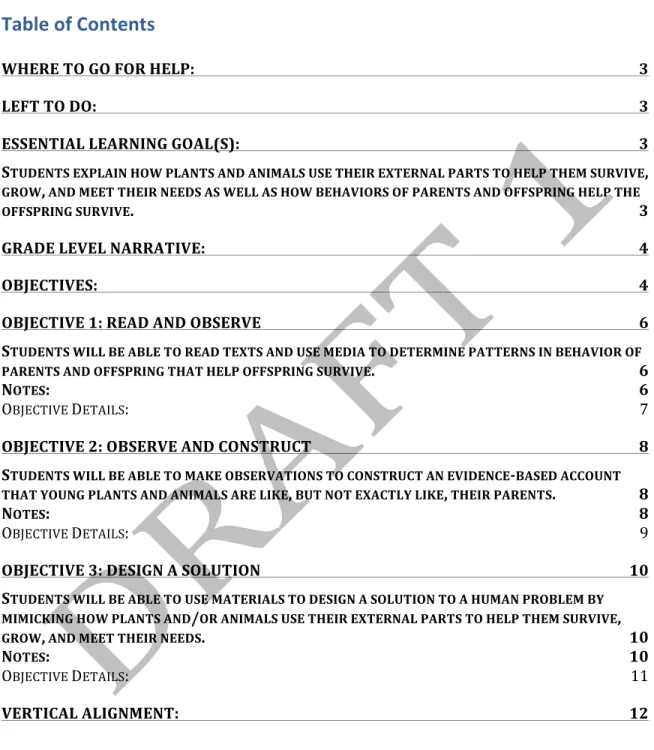
Table of Contents
WHERE TO GO FOR HELP: 3
LEFT TO DO: 3
ESSENTIAL LEARNING GOAL(S): 3
STUDENTS EXPLAIN HOW PLANTS AND ANIMALS USE THEIR EXTERNAL PARTS TO HELP THEM SURVIVE, GROW, AND MEET THEIR NEEDS AS WELL AS HOW BEHAVIORS OF PARENTS AND OFFSPRING HELP THE
OFFSPRING SURVIVE. 3
GRADE LEVEL NARRATIVE: 4
OBJECTIVES: 4
OBJECTIVE 1: READ AND OBSERVE 6
STUDENTS WILL BE ABLE TO READ TEXTS AND USE MEDIA TO DETERMINE PATTERNS IN BEHAVIOR OF PARENTS AND OFFSPRING THAT HELP OFFSPRING SURVIVE. 6
NOTES: 6
OBJECTIVE DETAILS: 7
OBJECTIVE 2: OBSERVE AND CONSTRUCT 8
STUDENTS WILL BE ABLE TO MAKE OBSERVATIONS TO CONSTRUCT AN EVIDENCE-‐BASED ACCOUNT THAT YOUNG PLANTS AND ANIMALS ARE LIKE, BUT NOT EXACTLY LIKE, THEIR PARENTS. 8
NOTES: 8
OBJECTIVE DETAILS: 9
OBJECTIVE 3: DESIGN A SOLUTION 10
STUDENTS WILL BE ABLE TO USE MATERIALS TO DESIGN A SOLUTION TO A HUMAN PROBLEM BY MIMICKING HOW PLANTS AND/OR ANIMALS USE THEIR EXTERNAL PARTS TO HELP THEM SURVIVE, GROW, AND MEET THEIR NEEDS. 10
NOTES: 10
OBJECTIVE DETAILS: 11
VERTICAL ALIGNMENT: 12
Where to go for help:
Chris McGee – Science Coordinator Marie Masterson – Avery
Terri Hennrich – Clark Daleyne Griggs -‐Edgar Road
Bridget Ewing -‐ Hudson
LEFT TO DO:
¨ Assessment¨ Link to Common Core
¨ Experiences
¨ Pacing guide
¨ Materials List
¨ Trade books/Resources
¨ Key Vocab list
Essential Learning Goal(s):
Students explain how plants and animals use their external parts to help them survive, grow, and meet their needs as well as how behaviors of parents and offspring help the offspring survive.
S
4 In addition to a Level 3, students:
• Create innovative solutions to unique threats facing plants/animals. 3 Students explain how plants and animals use their external parts to help them survive, grow, and meet their needs as well as how behaviors of
parents and offspring help the offspring survive.
D 2 Students communicate partial mastery of how plants or animals survive, grow, and meet their needs OR how behaviors help them to survive B 1 Students are beginning to communicate how plants and animals survive.
The performance expectations in first grade help students formulate answers to questions such as:
What happens when materials vibrate? What happens when there is no light?
What are some ways plants and animals meet their needs so that they can survive and grow?
How are parents and their children similar and different? What objects are in the sky and how do they seem to move?
First grade performance expectations include PS4, LS1, LS3, and ESS1 Disciplinary Core Ideas from the NRC Framework. Students are expected to develop
understanding of the relationship between sound and vibrating materials as well as between the availability of light and ability to see objects. The idea that light travels from place to place can be understood by students at this level through determining the effect of placing objects made with different materials in the path of a beam of light. Students are also expected to develop understanding of how plants and
animals use their external parts to help them survive, grow, and meet their needs as well as how behaviors of parents and offspring help the offspring survive. The understanding is developed that young plants and animals are like, but not exactly the same as, their parents.
Students are able to observe, describe, and predict some patterns of the movement of objects in the sky. The crosscutting concepts of patterns; cause and effect;
structure and function; and influence of engineering, technology, and science on society and the natural world are called out as organizing concepts for these disciplinary core ideas. In the first grade performance expectations, students are expected to demonstrate grade-‐appropriate proficiency in planning and carrying out investigations, analyzing and interpreting data, constructing explanations and designing solutions, and obtaining, evaluating, and communicating information. Students are expected to use these practices to demonstrate understanding of the core ideas.
Objectives:
1. Read texts and use media to determine patterns in behavior of parents and offspring that help offspring survive.
2. Make observations to construct an evidence-‐based account that young plants and animals are like, but not exactly like, their parents.
3. Use materials to design a solution to a human problem by mimicking how plants and/or animals use their external parts to help them survive, grow, and meet their needs.
Students explain how
plants and animals use their external parts to help them survive, grow,
and meet their needs as well as how behaviors of parents and offspring
help the offspring survive.
Use materials to design a solution to a human problem by mimicking how plants and/or animals
use their external parts to help them survive, grow,
and meet their needs
Read texts and use media to determine patterns in behavior of parents and
offspring that help offspring survive
Make observations to construct an evidence-‐ based account that young plants and animals are like,
but not exactly like, their parents.
Students will be able to read texts and use media to determine patterns in behavior of parents and offspring that help offspring survive.
S
4 In addition to a level 3, Students: • Search and find relevant supporting artifacts to increase their understanding of parents and offspring survival
3 Students independently read texts and use media to determine patterns in behavior of parents and offspring that help off spring survive. D 2 With teacher guidance OR assistance students are able to read texts and use media to determine patterns in behavior of parents and offspring
that help off spring survive
B 1 With teacher guidance AND assistance students are read texts and shown media and require assistance recognizing patterns in behavior of parents and offspring that help off spring survive.
Notes:
Clarification:
• Examples of patterns of behaviors could include the signals that offspring make (such as crying, cheeping, and other vocalizations) and the responses of the parents (such as feeding, comforting, and protecting the offspring).
• Start with students’ own personal accounts then work to animals.
• For a 4, that Search must be independently and can include examples such as:
selecting a book from the library or searching the internet during class,
Science and Engineering Practices:
• Obtaining, evaluating, and communicating information in K– 2 builds on
prior experiences and uses observations and texts to communicate new information.
• Read grade-‐appropriate texts and use media to obtain scientific information to determine patterns in the natural world.
• Scientists look for patterns and order when making observations about the
world.
Disciplinary Core Idea(s)
• Adult plants and animals can have young. In many kinds of animals, parents
and the offspring themselves engage in behaviors that help the offspring to survive.
Cross Cutting Concept(s)
• Patterns: Patterns in the natural world can be observed, used to describe
Link to Common Core •
Objective Details:
Assessment item(s):
• Book selection
• Additions to science journal
• Recording comments from conversations Resource(s): •
Website(s): • Trade
Book(s): •
Students will be able to make observations to construct an evidence-‐based account that young plants and animals are like, but not exactly like, their parents.
S
4 In addition to a level 3, students: • Are able to attribute features found in hybrids and designer species to their parents.
3 Students independently make observations to construct an evidence-‐based account that young plants and animals are like, but not exactly like, their parents.
D 2 Students require assistance constructing and evidence based account of how offspring are like and not like their parents B 1 Students struggle to use evidence to determine likeness.
Notes:
Clarification:
• Examples of patterns could include features plants or animals share. • Examples of observations could include leaves from the same kind of plant
are the same shape but can differ in size; and, a particular breed of dog looks like its parents but is not exactly the same.
• Assessment does not include inheritance or animals that undergo metamorphosis or hybrids.
• Keep within the same species. For example it is above grade level
expectations for students to understand features such as crossing a Labrador with a poodle to get the offspring “Labradoodle”, etc.
Science and Engineering Practices:
• Constructing explanations and designing solutions in K–2 builds on prior
experiences and progresses to the use of evidence and ideas in constructing evidence-‐based accounts of natural phenomena and designing solutions.
• Make observations (firsthand or from media) to construct an evidence-‐based
account for natural phenomena.
Disciplinary Core Idea(s)
• Inheritance of Traits
o Young animals are very much, but not exactly, like their parents. Plants also are very much, but not exactly, like their parents.
• Variation of Traits
o Individuals of the same kind of plant or animal are recognizable as similar but can also vary in many ways.
Cross Cutting Concept(s)
• Patterns: Patterns in the natural world can be observed, used to describe
phenomena, and used as evidence.
Link to Common Core •
Objective Details:
Assessment
item(s): •
Resource(s): • http://en.wikipedia.org/wiki/Hybrid_(biology) •
Website(s): • Trade
Book(s): •
Students will be able to use materials to design a solution to a human problem by mimicking how plants and/or animals use their external parts to help them survive, grow, and meet their needs.
S
4 In addition to a level 3, Students: • thoughtful design is shared with an authentic audience and student redesigns product based on feedback.
3 Students use materials to design a solution to a human problem by mimicking how plants and/or animals use their external parts to help them survive, grow, and meet their needs.
D 2 Students need help designing a solution to a human problem connection is unclear/inconsistent as to how plants and/or animals use OR the their external parts to help them survive, grow, and meet their needs.
B 1 Students are beginning to explain how plants and/or animals use their external parts to help them survive, grow, and meet their needs.
Notes:
Clarification:
• Obvious statement: Reproduction is not discussed
• Examples of human problems that can be solved by mimicking plant or animal solutions could include:
o Designing clothing or equipment to protect bicyclists by mimicking turtle shells, acorn shells, and animal scales
o Stabilizing structures by mimicking animal tails and roots on plants
o Keeping out intruders by mimicking thorns on branches and animal quills
o Detecting intruders by mimicking eyes and ears.
Science and Engineering Practices:
• Use materials to design a device that solves a specific problem or a solution
to a specific problem.
Disciplinary Core Idea(s)
• Structure and Function
o All organisms have external parts.
o Different animals use their body parts in different ways to see, hear, grasp objects, protect themselves, move from place to place, and seek, find, and take in food, water and air.
o Plants also have different parts (roots, stems, leaves, flowers, fruits) that help them survive and grow.
• Information Processing
o Animals have body parts that capture and convey different kinds of information needed for growth and survival.
o Animals respond to these inputs with behaviors that help them survive.
o Plants also respond to some external inputs.
Cross Cutting Concept(s)
• The shape and stability of structures of natural and designed objects are
related to their function(s).
• Every human-‐made product is designed by applying some knowledge of the natural world and is built by using natural materials.
Link to Common Core •
Objective Details:
Assessment
item(s): • Resource(s):
• http://www.ted.com/talks/scott_summit_beautiful_artificial
_limbs.html
• http://science.howstuffworks.com/prosthetic-‐limb3.htm •
Website(s): • Trade
Book(s): •
PreK ???
4
Structure, Function, and Information Processing
Students who demonstrate understanding can:
• Develop a model to describe that light reflecting from objects and
entering the eye allows objects to be seen.
• Construct an argument that plants and animals have internal and
external structures that function to support survival, growth, behavior, and reproduction.
• Use a model to describe that animals’ receive different types of information through their senses, process the information in their brain, and respond to the information in different ways.
MS
Structure, Function, and Information Processing
Students who demonstrate understanding can:
• Conduct an investigation to provide evidence that living things are
made of cells, either one cell or many different numbers and types of cells.
• Develop and use a model to describe the function of a cell as a whole
and ways parts of cells contribute to the function.
• Use argument supported by evidence for how the body is a system of
interacting subsystems composed of groups of cells.
• Gather and synthesize information that sensory receptors respond to
stimuli by sending messages to the brain for immediate behavior or storage as memories.
Growth, Development, and Reproduction of Organisms
Students who demonstrate understanding can:
• Use argument based on empirical evidence and scientific reasoning to
support an explanation for how characteristic animal behaviors and specialized plant structures affect the probability of successful reproduction of animals and plants respectively.
• Construct a scientific explanation based on evidence for how
environmental and genetic factors influence the growth of organisms.
• Develop and use a model to describe why structural changes to genes
(mutations) located on chromosomes may affect proteins and may result in harmful, beneficial, or neutral effects to the structure and function of the organism.
• Develop and use a model to describe why asexual reproduction
results in offspring with identical genetic information and sexual reproduction results in offspring with genetic variation.
• Gather and synthesize information about the technologies that have
organisms.
HS
Structure and Function
Students who demonstrate understanding can:
• Construct an explanation based on evidence for how the structure of DNA determines the structure of proteins, which carry out the essential functions of life through systems of specialized cells.
• Develop and use a model to illustrate the hierarchical organization of
interacting systems that provide specific functions within multicellular organisms.
• Plan and conduct an investigation to provide evidence that feedback
mechanisms maintain homeostasis.
Inheritance and Variation of Traits
Students who demonstrate understanding can:
• Use a model to illustrate the role of cellular division (mitosis) and differentiation in producing and maintaining complex organisms.
• Ask questions to clarify relationships about the role of DNA and
chromosomes in coding the instructions for characteristic traits passed from parents to offspring.
• Make and defend a claim based on evidence that inheritable genetic
variations may result from: (1) new genetic combinations through meiosis, (2) viable errors occurring during replication, and/or (3) mutations caused by environmental factors.
• Apply concepts of statistics and probability to explain the variation and distribution of expressed traits in a population.