A Comparison of Coping Strategies Used
By
Urban and Rural
Women
in
Violent Relationships
By Sarah Wood
A Master's Paper submitted to the faculty of the University of North Carolina at Chapel Hill In Partial Fulfillment of the requirements for the degree of Master of
Public Health in The Public Health Leadership Program
A Comparison of Coping Strategies Used By Urban and Rural Women in Violent Relationships
Introduction
Intimate partner violence (IPV) is a significant public health problem, affecting a large proportion of women in the United States and leading to significant physical and emotional health consequences. Women experiencing intimate partner violence use a wide array of mechanisms to cope with violent relationships. A better understanding of the coping strategies and their helpfulness to victims of domestic violence is important for health care providers and other agencies in order to provide adequate and useful assistance. Goodman and her colleagues developed the IPV Strategies Index, to assess coping mechanisms of women in violent relationships. They used the instrument to assess coping strategies of women living in an urban environment in a large mid-Atlantic seaboard city in the United States. Because previous studies indicated that the experience, resources, and needs of IPV victims in mral areas were different from those living in urban areas, we assessed coping strategies of women experiencing domestic violence in rural North Carolina. We believe that our study is the first to use the IPV Strategies Index with rural women. The purpose of our study was to assess the strategies used by rural women in violent relationships and to determine the most frequently used categories of strategies, as subdivided in the IPV Strategies Index. Additionally, we wanted to compare the use patterns and helpfulness ratings of the coping strategies of the women in our study to women in an urban sample of women.
Methods
We interviewed sixty-six victims of intimate partner violence, all of whom lived in three distinct mral areas of North Carolina. The women were asked about their history of violence as well as their use of coping strategies and the helpfulness of these strategies. Additionally, we determined the most frequently used categories of strategies used. The results were calculated and compared to the previous study findings reported by
Goodman et al. for women in an urban setting. Results
Overall, when compared to Goodman et al. 's urban sample, both groups of women used similar patterns of coping. Both groups reported the most frequently used category to be ending the relationship, which was used by 92% of the rural women and 87% of the urban women. A higher proportion of mral women reported helpfulness of the strategies, in general, than the urban women. With the exception of the legal category, which was used more frequently by the women in the urban sample, both groups used placating and resistance categories more frequently than formal, safety plarming, and informal
categories of strategies. Interestingly, even though these categories were found to be the most frequently used by the women in the samples, the strategies in the placating and resistance categories were found to be the least helpful by both groups, with both groups reporting the informal strategies to be the most helpful.
Discussion
The main differences in the findings of our study in comparison with Goodman et al. may be, at least in part, attributable to the sampling differences between the two studies. Goodman recmited women primarily through the court system, and we recruited women primarily through domestic violence shelters. Further study is necessary to understand the coping strategies among women in violent relationships, including women at earlier stages of help seeking. Women in both studies were already "in the system."
Additionally, further qualitative studies may be helpful in understanding how women decide to use certain strategies, and the characteristics of those strategies that women consider helpful.
Wood2
Background
Background on Intimate Partner Violence
Intimate partner violence is a widespread problem throughout the United
States. Nationally representative telephone surveys have found that the
phenomenon of physical or sexual abuse annually affects an estimated 1.5 to 4.4
million women, or 1.5 to 8.4 percent of women in the United States (Tjaden and
Thoennes, 2000; Leiman eta!. 1998). These same surveys indicate that lifetime
prevalence of intimate partner violence ranges from 25 to 4 3. 7 percent of women
(Tjaden and Thoennes, 2000; Leiman et a!. 1998).
Prevalence measurements of intimate partner violence vary for multiple
reasons, including variations in the definition of intimate partner violence, the
sample of women surveyed, and the setting ofthe survey. For example, the
definition of intimate partner violence often differs depending on the context of
the term's use, contributing to difficulties in the measurement. The legal
definition of intimate partner violence may include only physical assaults, or acts
intended to cause pain or injury, threats to cause injury, or actions against
personal property (Stark and Flitcraft 1991; Leiman eta!. 1998). On the other
hand, research definitions often extend to encompass acts that not only involve
physical injury, but also are intended to cause fear or psychosocial problems
(Stark and Flitcraft, 1991; Golding 1999; Walker 1984). Despite the lack of a gold
standard of measurement, nationwide surveys and other studies have
demonstrated that this problem is common and widespread.
Wood3
Intimate partner violence is associated with innumerable negative health
outcomes, including immediate physical injury, long-term negative health
consequences, negative psychological outcomes, and disability (Plichta and Falik
2001; Leiman et al. 1998; Coker eta!. 2000; Campbell2002). Researchers
describe the most common sites of injury among battered women as the face,
neck, upper torso, breast, or abdomen (Mullerman et al.1996; Grisso et al. 1999;
Campbell 2002). Additionally, in a large case-control study Campbell et al.
(2002), consistent with other research, found symptoms of chronic stress,
gynecological problems, chronic pain, and central nervous system impairments
related to intimate partner violence (Coker et al. 2000; Lesserman et al. 1997).
Besides the immediate injuries and long-term negative physical health
outcomes, researchers also have associated considerable negative emotional and
psychological outcomes with intimate partner violence, including higher rates of
depression, anxiety, low self-esteem, posttraumatic stress disorder and suicidal
ideation, and subsequent suicide attempts (Clements, Sabourin, and Spiby 2004;
Golding, 1999; Campbell 2002). Golding (1999) conducted a meta-analysis of
eighteen studies of victims of intimate partner violence. They were recruited
from various settings, including the community, domestic violence agencies, and
hospitals and clinics. She found victimization by an intimate partner was
consistently associated with mental disorders, including depression, posttraumatic
stress disorder, substance abuse, and suicidality. In addition, a national,
cross-sectional survey found that women with a history of abuse were more likely to
have been diagnosed with depression or anxiety than women without a history of
abuse (Plichta and Falik, 200 I). In the 1993 Commonwealth Fund Survey, higher
rates oflow self-esteem, depressive symptoms, and rates of suicidal
contemplation were found in victims of intimate partner violence (Plichta 1996,
Leiman et al. 1998). Additionally, women involved in violent relationships have
been found more likely to smoke and to drink alcohol, and they are almost twice
as likely to use or to have used illegal drugs (Plichta 1996, Leiman et al. 1998).
Background on Coping and Intimate Partner Violence
Domestic violence research during the 1970's focused on patterns of
violence and the abuse process within families. It did not emphasize victim's
inner resources used to cope with their situation (Clements and Sawhney, 2000;
Davis 2002; Nurius et al. 1992; Hotaling et al. 1988). However, recent research
has begun to investigate women's psychological reactions to violence and
mechanisms used to cope with the violence, finding that some abused women use
coping mechanisms effectively (Davis, 2002). Throughout this evolution of
research on victims of domestic violence, researchers' views have changed from
characterizing women in violent relationships as passive victims to viewing them
t
as survivors, focusing on the decisions and actions that they make to keep
themselves physically or emotionally safe from the violence (Johnson and
Ferraro, 2000).
Involved in this progression of research has been the introduction of
evidence and subsequent development of theories regarding women in violent
relationships and their reactions to intimate partner violence. Two theories have
coexisted for several years that attempt to explain women's responses to intimate
partner violence (Goodman et aL 2003). The first of these two theories is Lenore
Walker's application of Seligman's theory of"leamed helplessness." "Learned
helplessness" in this context is based on findings from interviews with victims of
domestic violence, where women perceived that they were unable to do anything
to change the perpetrator's behavior (Walker 1984). Walker posited that the
women felt helpless in the violent situation and further applied this feeling of
helplessness to other life situations. Moreover, negative psychological outcomes
resulted in what practitioners refer to as the "battered woman syndrome"
(Goodman et aL 2003, Walker 1984).
Many researchers have since argued that the learned helplessness theory
results in a view of battered women as passive victims of violence, when in reality
many are attempting to change their situation and improve their safety (Bowker
1993; Goodman et aL 2003; Campbell 1990).
A decade after Walker's invocation of the learned helplessness theory,
Gondolf and Fisher introduced a second theory, the survivor theory, based on
extensive data demonstrating that, as the violence worsened, women sought
increasing amounts and widely varied forms of assistance ( Gondolf and Fisher,
1988; Goodman et aL 2003; Lerner and Kennedy 2000). Not only researchers, but
also the public have begun to shift their focus to the strength of victims and the
decisions they make to end the violence or to cope with it in other ways (Johnson
and Ferraro, 2000).
Moreover, some survivors of domestic violence suffer fewer
psychological effects than others, a phenomenon that has been related to varying
Wood6
histories of abuse, including duration, severity, and types of violence.
Differentiating the effect of each of these factors is difficult (Carlson et. a!. 2002).
Some abused women may have been exposed to multiple types of severe violence
over a long period, but continue to function well, suffering few long-term mental
health sequelae. Researchers have described these women as "resilient" (Carlson
et a!, 2002; Davis 2002; Christopher 2000). Davis defines resilience as an inner
resource that reflects the ability of an individual to succeed in the face of
adversity, resulting from the ability to find meaning in stressful life events and to
activate her internal resources to solve issues (Christopher, 2000; Davis, 2002). In
an attempt to understand the contributors to resilience of some women in abusive
relationships, researchers have studied various coping mechanisms used by
victims.
Further, the researchers have associated various protective factors that
contribute to resilience. Some of the important contributors to resilience include
social support, self-esteem, overall good health status, managing affect, cognitive
appraisal strategies, perception of control, maintaining a positive outlook,
self-efficacy, hope, spirituality, and positive coping strategies (Nurius 1992, Davis
2002). For example, Carlson eta!. demonstrated similar protective factors to be
related to lower rates of depression and anxiety among domestic violence victims
(Carlson et a!, 2002).
L
Some researchers have reported that problem-focused coping is more
effective at mediating negative emotional outcomes, while others have suggested
that this is not entirely correct and that this depends on the individual's level of
control over the situation (Clements and Sawhney, 2000; Valenier et al 1994;
Shaw 1999; Perrez 1992).
In studying survivors' coping strategies, researchers often apply Lazarus'
transactional reaction to stress model to understand coping mechanisms enacted
by people facing stressful life events, including stressful and dangerous events
experienced in violent relationships (Davis, 2002; Gottleib 1985; Lazarus and
Folkman 1984). Stemming from Lazarus' theory of stress and coping, coping
strategies are subdivided into two broad categories: emotion-focused or
self-directed coping; and problem-focused or environment-self-directed coping (Shaw
1999; Y oshihama 2002; Nurius et al. 1992). Emotion-focused coping consists of
internal alteration and regulation of the emotional response to the stressful
situation, without outward action directed at changing the objective situation,
while problem-focused coping is action aimed at managing or altering the source
of stress (Lazarus 1966; Lazarus and Folkman 1984; Shaw 1999). Lazarus defines
four fundamental types of problem-focused coping tendencies, including 1)
actions aimed at strengthening the individual's resources against harm, 2)
avoidance of the harmful situation, 3) preventing the harmful situation, and 4)
inaction. In contrast, people in stressful situations where the situation is assessed
as uncontrollable, often enact more passive, emotion-focused coping, including
denial and reappraisal of the situation (Lazarus, 1966).
Thus, within the framework of this theory, women in abusive relationships
use problem-focused coping strategies to deal with or change the source of the
stress, while they use emotion-focused coping strategies to regulate their
WoodS
i
L
L
emotional response to the stress (Lazarus and Folkman, 1984; Shaw, 1999,
Lazarus et al. 1985). The dichotomy between these two categories is often not
precise; coping is a dynamic, rather than static response that changes over time,
and with the situation (Goodman et al 2003, Y oshihama 2002; Lazarus and
Folkman 1984). Nonetheless, Lazarus' framework is useful to researchers to
understand the range of ways that women in violent relationships attempt to cope
with their situation.
In an attempt to better understand intimate partner violence and ways to
help survivors of domestic violence, further understanding of coping mechanisms
enacted by victims of intimate partner violence is important (Nurius, 1992).
Researchers have identified a number of coping mechanisms used by women in
violent relationships, both problem-focused and emotion-focused, including
information seeking, redefining the situation, seeking assistance from other
people (including family and friends or legal and/or social services), and leaving
the relationship (Horton and Johnson, 1993; Nurius, Furrey, and Berliner, 1992;
Mitchell and Hodson, 1983, Yoshihama, 2002).
Goodman et al. (2003) developed an instrument to examine the use and
effectiveness of these coping strategies. These strategies, along with others
identified in their literature review, experienced in their clinical or forensic work,
or developed from multiple focus groups, were divided into six categories:
placating, resistance, safety planning, legal, and formal and informal network,
thus creating the Intimate Partner Violence Strategies Index (IPV Strategies
Index). As defined by Goodman et al. (2003), the placating category includes
items that are intended to change the behavior of the perpetrator, without
challenging the balance of power within the relationship. The items in the
resistance category are also intended to change batterer' s behavior; however,
these items are intended to challenge the perpetrator's sense of control. The legal
category strategies are also meant to change batterer behavior, with the help of the
legal system as an outside regulator. The strategies within the formal network
category are intended to change behavior or increase resource or improve options
for escape through use of non-legal public agencies. The informal network
strategies, similar to increasing resources or options for escaping or protection,
make use of external sources of support that are non-public agencies. The items
within the safety-planning category are meant to increase resources and allow for
protection or escape from a future violent incident. Chart 1 delineates strategies
in each of the six categories.
Wood 10
;
f
i
l
Chart 1. IPV Strategies Index*
~ ~
No. Cate o Strate ~
~
1 Formal Network Tried to get help from clergy
Tried to get help from her employer or coworker Talked to a doctor or nurse about abuse
Called a mental health counselor about abuse Tried to get him counseling for violence Stayed in shelter
Talked to someone at a Domestic Violence Program, Shelter, or Hotline Tried to get help for yourselffor alcohol or substance abuse
Tried to get him help for alcohol or substance abuse**
2 Legal Filed petition for protective order
Filed or tried to file criminal charges Sought help from legal aide
Called police
3 Safety Plarming Hid car or house keys
Kept money or other valuables hidden
Developed code so others would know I was in danger Worked out escape plan
Removed or hid weapons
Kept important phone nmnbers I could use to get help Kept an extra supply of basic necessities for myself/children Hid important papers from him
Put a knife, gun, or other weapon where I could get it
Changed locks or somehow improved security**
4 Informal Network Talked to family or friends about what to do to protect myself/children
Stayed with family or friends
Sent kids to stay with friends or relatives Made sure there were other people around**
5 Resistance Fought back physically
Slept separately
Refused to do what he said
Used/threatened to use a weapon against him Left home to get away from him
Ended (or tried to end) relationship**
6 Placatiog Tried to keep things quiet for him
Did whatever he wanted to stop violence Tried not to ery during the violence Tried to avoid him**
Tried to avoid an argument with hiln**
*IPV Strategies Index developed by Goodman eta!~ and presented m ln11mate Partner Violence
Strategies Index: Development and Application~ Violence Against Women~ 2003; 9:163-186~
**Items added by Goodman eta!~ (Violence Against Women, 2003) to original 33-item Index to
create 39-item revised IPV Strategies Index after their time 1 data collection in initial study
The IPV Strategies Index allowed for investigation of patterns and factors
in the choice of strategies victims used and their perceived usefulness ofthe
enacted strategies (Goodman eta!~ 2003)~ Using the newly developed IPV
Wood 11
t
L
Strategies Index, Goodman et a!. studied 406 women who were survivors of
intimate partner violence and who lived in an urban, mid-Atlantic seaboard city;
they were mostly African-American victims recruited from the court system.
Research previously demonstrated that the experience of domestic
violence varied between urban and rural settings, however, because of the
difference in available resources, regional norms and attitudes surrounding the
violence, and the increased isolation experienced by women in rural areas (Murty
eta!. 2003, Goekerman, et al, 1994; Clifford 2003). Further, others have
hypothesized and demonstrated that cultural characteristics and demographic
variables influence and determine the use of various coping strategies (Pre low,
Tein, Roosa and Wood, 2000; Slavin eta!. 1991; Yoshihama 2002).
Understanding the coping strategies and the related patterns and
helpfulness of these strategies used by women in violent relationships is important
to develop effective interventions and services for victims of domestic violence
(Goodman et al. 2003; Yoshihama 2002, Shaw 1999). Moreover, resources and
social support networks may vary between different areas of the country.
Research is needed to understand how community and cultural factors influence
choice of strategies, so that adequate resources to help victims of intimate partner
violence can be developed, building on women's strengths and assessed strategies
of coping.
l
Our intent was to utilize Goodman et al. 's IPV Strategies Index to
determine whether it was useful in a rural setting with cultural and demographic
variables that differ from an urban mid-Atlantic city with primarily
American women as study participants. We used the IPV Strategies Index to
determine which coping strategies were used by women victims ofiPV in a rural
southeastern state. Further, we examined whether these strategies varied from the
findings in the urban sample offered by Goodman et al (2003). Finally, we
compared southern rural women's perception of the helpfulness of these strategies
with the perception of the helpfulness of these strategies by urban women from
the mid-Atlantic seaboard.
Methods
Participants in this study consisted of a convenience sample of sixty-six
women who had previously sought services from domestic violence agencies in
three counties in rural North Carolina: one in the eastern (coastal) area, one in the
western (mountain) area, and one in the central or piedmont area. A representative
from each domestic violence agency contacted women clients and asked them to
participate in an interview about women's responses to intimate partner violence.
The agency representative informed the women that their decision to participate
would, in no way, affect their ability to receive services from the agency.
Participants in the study were eighteen years old or older and were current
or former victims of violence committed by a heterosexual, intimate partner, and
spoke English as their primary language. The University of North Carolina School
of Medicine Human Subjects Review Board specified that only women who were
deemed safe by the domestic violence agency could be contacted and recruited to
participate and that only agency representatives were authorized to contact the
victims. At the time of recruitment, each woman was informed that she would
receive, for her participation, a $25 gift certificate for use at a local grocery store.
Representatives from the agency then scheduled interviews with women.
Interviews were conducted in these three rural counties between June 2001 and
July 2002.
After informed consent was obtained from participants, a trained
interviewer conducted a personal interview in a private area at the domestic
violence agency. With the participants' consent, the interviews were
tape-recorded. The interviewer also recorded responses by pencil and paper. The
interview required approximately one and one-half hours to complete.
The interviewer obtained demographic information from each participant,
I
j Measures
including the participant's age, country of origin, highest education level, racial
and ethnic background, relationship status, number of children and household
income. Additionally, interviewers sought demographic information about the
I
J f perpetrator, including education level, racial and ethnic background, age andcountry of origin.
To assess women's coping strategies in order to deal with their partners'
violence, we asked about their use of each of the items in the IPV Strategies
Index. The original IPV Strategies Index consisted of 33 items and assessed a
wide array of coping strategies in six categories: placating, resistance, informal,
formal, safety planning, and legal. Besides the strategies from the original IPV
Strategies Index, Goodman et a!. added six additional strategies, generating a
L
revised IPV Strategies Index with 39 items. In addition, we asked women about
thirteen additional coping strategies previously identified by one of the
researchers through counseling, small group discussions, and interviews with
survivors. Our additional coping strategies were put forward to assess
psychological mechanisms that women can use to cope with intimate partner
violence, while others were assumed to fall into previously established categories
of the revised IPV Strategies Index.
In this paper, we compare only the frequency of use of the strategies in the
revised 39-item IPV Strategies Index. As well, following the Goodman et al.
urban study we asked the rural women to rate the helpfulness of each of these
strategies, with 1 =not at all helpful to 5= extremely helpful.
To understand the severity of physical and sexual violence experienced by
the study participants, the interviewer solicited an open-ended response from the
participant regarding the worst incidence of physical or sexual assault. Following
the qualitative description of the participant's experience of violence, the
interviewer then elicited information, based on the Revised Conflict Tactics Scale
and Leserman' s measure of Sexual and Physical Violence Experience Scale
regarding the injuries sustained in order to rate the severity of the injury (Straus,
Hamby, Boney-McCoy 1996; Leserman et al. 1997). Drawing upon previous
research, we defined severe injury as lacerations, deep cuts or wounds, broken
teeth or bones, burns, or genital injuries as a result of physical or sexual abuse
(Straus, Hamby, Boney-McCoy 1996; Goodman et al. 2003).
Analvsis
We performed analysis of data using SAS® to summarize the
demographic characteristics, including age, race, income, education level,
relationship status, and employment status. Additionally, we categorized the
severity of injury experienced by the participants.
We then calculated the proportion of women who used each of the coping
strategies and the corresponding percentage of women who found the strategy
helpful (1 =not at all helpful to 5= extremely helpful). Rankings for 3=helpful,
4=very helpful, and 5= extremely helpful were then recoded to "helpfuT' in order
to assess helpfulness of a specific strategy within one of the six categories and to
compare responses to Goodman et a!. study findings. Next, we clustered the
strategies into the six categories used by Goodman et al (2003): formal network,
informal network, legal, safety planning, resistance, and placating. In order to
compare the frequency of use and helpfulness of strategies within the categories
of the IPV Strategies Index, we averaged the percentage of women endorsing use
and helpfulness of all of the strategies within the categories to calculate the group
mean of use and helpfulness of each of the categories. This enabled comparison of
each of the categories within our sample of women. We then compared the rural
women's use of strategies and helpfulness of those strategies with the Goodman et
a!. study population.
Results
Sample Description
The age of participants ranged from 20 to 63, with a mean age of35.9
years (SD=10.8). Fifty-three percent of the women reported less than $10,000 for
their yearly household income, while 24% reported between $10,000 and $20,000
and only 24% reported a household income greater than $20,000 annually (Table
1 ). Fifty-eight percent reported a high school education or less. More than half
(72%) were employed. Slightly over half(51%)considered themselves Caucasian,
while 28% were African American, 9% were Latina, 6% were Native American,
and 6% reported "other."
Most of the women (57%) reported that they were married to the
perpetrator at the time that the incident occurred, which prompted them to seek
help from the domestic violence agency. Only 15% considered their relationship
with the perpetrator to be intact at the time of the interview.
Fifty-eight (88%) of the women had experienced injury as a result of
physical abuse perpetrated by an intimate heterosexual partner. Of those reporting
injury, 25 (43%) reported severe physical injury and approximately 10 (17%)
reported severe sexual injury.
L
Table 1: Demographic Characteristics of Rural North Carolina Women
~ariab!e ~
' IT 'Jfo eli;"
' ' ' ' 8ample '
Age (N=65)
Less than 40 years 45 69
40-49 years 11 17
Greater than 49 years 9 14
Race (N=65)
Caucasian 33 51
African American 18 28
Latina 6 9
Native American 4 6
Other 4 6
Children (N=66)
At least one child 48 28
Children living with participant 47 72
Employed (N-65)
Employed 47 72
Unemployed 18 28
Income (N=55)
Less than $5,000 18 33
$5,000-10,000 11 20
$10,000-20,000 13 24
Greater than $20,000 13 24
Education (N=65)
Less than high school 10 15
Completed high school 28 43
Technical or trade school 2 3
Some college 14 22
2 year College degree 1 2
4 year College degree 9 14
Graduate school I 2
Relationship status at Time of the Interview (n=65)
Intact 55 15
Estranged 10 85
Marital Status with Abuser at Time of Incident (N=65)
Married or living together 37 57
Other 28 43
Physical Injury from IPV (N=66) 58 88
Severe physical injury 25 43
Severe sexual injury 10 17
Distributions of Coping Strategies
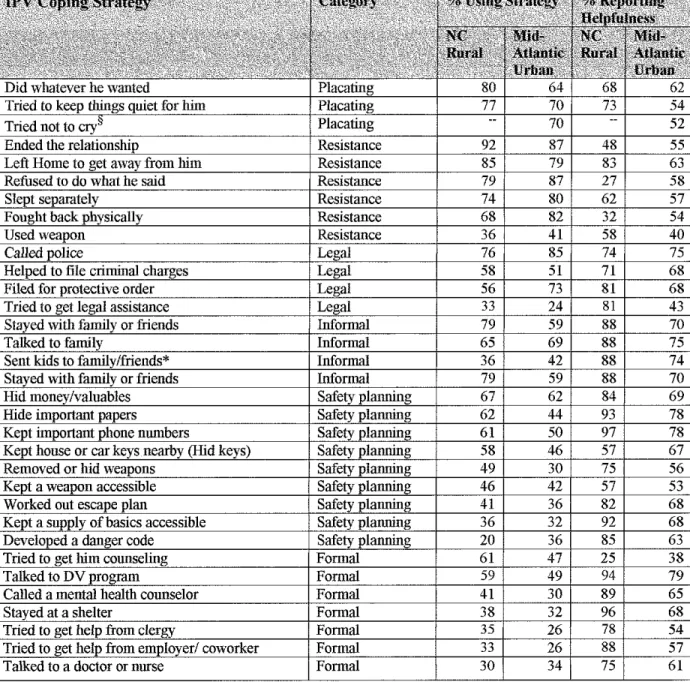
Table 2 compares the percentage of women in our study and Goodman's
study reporting use of each strategy and of the women who rated the strategy as
helpful on a scale of 1 =not at all helpfit! to 5=extremely helpfitl. A strategy was
deemed as helpfid if the participant endorsed 3=helpful, 4=quite helpfid, or
5=extremely helpfid. Over half of the rural participants endorsed use of
twenty-one or more of the thirty-nine strategies.§ Ending the relationship was the most
commonly used strategy in both our study and the Goodman et al. study.
Additionally, three of the six strategies that Goodman eta!. added to their original
Index were used by over 80% of the rural women interviewed. These strategies
were: 1) trying to avoid an argument with the abuser; 2) trying to avoid the abuse;
and 3) fighting back verbally. These strategies were also ranked among the top
five strategies used by rural North Carolina women.
Overall, the percentage of women endorsing use of the strategies was
similar between the two studies. However, in comparing rural to urban women,
more than a 10% difference was found for twelve of the original 33 strategies.
Overall, the two groups agreed within 1 0 percentage points 63% of the time.
Rural women were more likely to report doing whatever he wanted (80%
v. 64% ), staying with family or friends (79% v. 59%), hiding important papers
(62% v. 44%), trying to get him counseling (61% v. 47%), hiding keys (58% v.
46%), removing or hiding weapons (49% v. 30%), keeping important phone
numbers accessible (60% v 50%), and calling a mental health counselor (41% v.
§ only 38 of 39 strategies were used in the study of rural women; one strategy, "tried not to cry"
was inadvertently omitted from the questionnaire
Wood 19
I
t30%). However, use of the following strategies was more prevalent for the urban
women: fighting back physically (82% v 68%), filing for a protective order (73%
v. 56%), seeking substance abuse assistance for the participant (25% v. 5%), and
developing a danger code (36% v. 20% ).
There was a greater variation between the two groups when comparing
some of the helpfulness ratings. Although ending the relationship was the most
widely used strategy in both groups, only about half of each group endorsed it as
helpful. Three-fourths of rural women called the police for assistance, while about
85% of Goodman et al' s urban sample called the police. Moreover, about
three-quarters of women in both groups reported that calling the police was a helpful
coping strategy. However, when compared to rural women, a much larger
I
proportion (87%) of the urban group reported that refusing to do what the
perpetrator said, and that fighting back (82%) was helpful. On the other hand, a
larger proportion of the rural women (92% v. 68%) found that keeping a supply of
necessities accessible was helpful. A larger proportion of rural women (85% v.
63%) also believed that developing a danger code was helpful.
Additionally, more rural women found some formal strategies to be
much more helpful than urban women, including calling a mental health
counselor (85% v. 65%), obtaining help for substance abuse (100% v. 49%),
and soliciting help from clergy (78% v. 54%) and from their employers (88% v
I
L57%). In summary, only six strategies were found to be useful by 70% or
greater of the urban women. In contrast, twenty-three strategies were found to
be helpful by 70% or more of the rural women.
Table 2: A Comparison Between Rural and Urban Victims§§ Regarding Prevalence of Use and Perceived Helpfulness of Strategies to Deal with Intimate Partner Violence By Category and Order of Percent of Use By Rural Women
1 only 38 of39 strategies were used in the study of rural women; one strategy, "tried not to cry"
was inadvertently omitted from the questionnaire for rural women
§§Data from Mid-Atlantic Urban Sample of Women is from Goodman et al. Intimate Partner
Violence Strategies Index: Development and Application. Violence Against Women. 2003;
9:163-186.
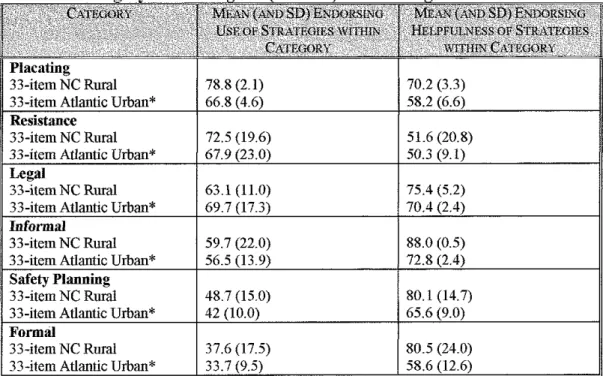
The mean and standard deviation of percentage of participants reporting
use and helpfulness of each of the strategies within each of the six categories,
defined by the IPV Strategies index, are presented in Table 3. We report the
results for strategies included in the original IPV Strategies Index (33-item), and
compare the group means and standard deviations for urban and rural women.
Additionally, we present the results of the following table graphically in Figure I.
Table 3: Mean Percent ofltems Used and Found to be Helpful in Each
Qti~lll)' ofthe IPV Index
78.8 (2.1) 70.2 (3.3)
Urban* 66.8 58.2
Resistance
33-item NC Rural 72.5 (19.6) 51.6 (20.8)
33-item Atlantic Urban* 67.9 50.3
33-item NC Rural 63.1 (11.0) 75.4 (5.2)
33-item Atlantic Urban* 69.7
Informal
33-item NC Rural 59.7 (22.0) 88.0 (0.5)
56.5 72.8
Planning
33-item NC Rural 48.7 (15.0) 80.1 (14.7)
33-item Atlantic Urban* 42
Formal
33-item NC Rural 37.6 (17.5) 80.5 (24.0)
33-item Atlantic Urban* 33.7 58.6
*Data from Urban Sample of Women is from Goodman et al. Intimate Partner
Violence Strategies Index: Development and Application. Violence Against Women. 2003; 9:163-186.
Wood22
L
t
Figure 1: Graphical Representation of the Average Percentage of Women Using Items and Finding Helpful in Each Category of the Original (33-item) IPV Strategies Index
C' 80
~
11 75 u
.s
70-=
....
~ 65 ~
]'
E
60"'
55~
~
~
"'
50...
e~ 45
~
~ 40
!'. 35
E
~
~ 30
95.
"
"OlJ 90
.s
"
..
~ 85
....
0 :1; 80~
::=.
Q. 75
~
70....
0t
65!l 60
..
~
"
OJ] 55"
..
""
50~
45
Awrage Percentage of Women Using Items mthin Categories of
the IPV Strategies ln..,x (33-item)
Placating(_,;)---"~---Resistance~--- ---
-~--- -.. _ .. ,,Legal
~Resistance
- __ , Placating
Legal
Inform am ---· ---
--
---..-..• Informal
Safety Planning),\(-...
·-
--
-·-.
---..
---.. ~,~-~--:.;,k' Safety Plannina
A~ o
Formal&
""""Formal
Rural Women Urban Women
A\erage Percentage of Women Reporting Helpfulness ofltems
mthin Categories of the IPV Strategies lnoox (33-item)
lnfonnal
Placating"
Infonnal Legal
OK Safety Planning Fonnal
- lacating
Resistance !l!---~lll n ·
1 I'\.eSIS ance
Rural Women Urban Women
Wood23
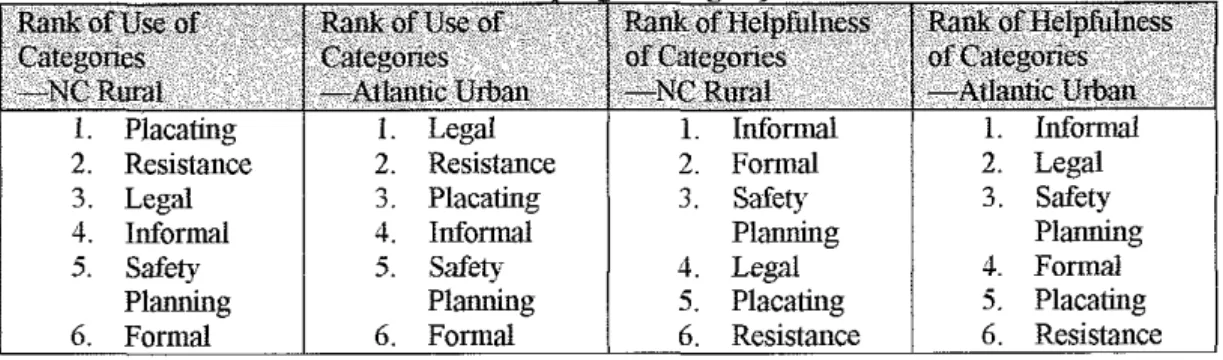
As displayed in Table 4, both urban and rural women used strategies in the
same three top categories (e.g. placating, resistance, and legal) most frequently.
We found that strategies within the placating category were the most frequently
used by the rural women, on average, followed by the resistance and legal
categories. On the other hand, Goodman et a!' s urban women reported the highest
use oflegal strategies, followed by resistance and placating categories.
Interestingly, the placating and resisting strategies, though frequently used by
both group of women were the two categories of strategies that women reported
to be the least helpful.
Table 4: Rank Order* of Categories of Use and Helpfulness [Mean% of Women Using And Endorsing Helpfulness of Strategies within Each Category of
IPV Copin1 Strategies]
1. Placating 1. Legal 1. Infonnal 1. Infonnal 2. Resistance 2. Resistance 2. Formal 2. Legal 3. Legal 3. Placating 3. Safety 3. Safety
4. Informal 4. Infonnal Planning Planning
5. Safety 5. Safety 4. Legal 4. Formal
Planning Planning 5. Placating 5. Placating 6. Formal 6. Formal 6. Resistance 6. Resistance *Rank order denved from origmal33-item IPV Strategies Index
Additionally, we considered how the inclusion of the items added by
Goodman et a!. to the IPV Strategies Index to create the revised IPV Strategies
Index affected the rank order of use. The additional items, as shown in chart one,
increased the use of placating category from 79% to 85%, while it decreased the
use of the legal category strategies from the 70% to 64% for the rural women.
However, with the addition of these strategies, the other strategy categories did
not change by more than 3 percentage points. Thus, when including these six
Wood24
~-items, the rank order of the categories used and found helpful by rural women did
not change.
Discussion
Using the IPV Strategies Index developed by Goodman eta!. (2003), this
study examined the use of coping strategies by an ethnically diverse sample of
women in rural North Carolina who had experienced violence perpetrated by an
intimate male partner. Previous research has demonstrated that, available
resources and cultural attitudes and norms purportedly differed between urban and
rural environments (Murty et al. 2003, Goekerman, eta!, 1994; Clifford 2003).
In general, the proportion of participants using and reporting helpfulness
of the strategies was similar between the urban and rural women. However, some
strategies were strikingly different in use and helpfulness. Women in the urban
sample, on average, used strategies within the legal category more often and
found legal mechanisms to be more useful than rural women. This difference
possibly may be attributable to different recruitment techniques used in the
respective studies. Goodman et a!. recruited participants from women who were
seeking legal assistance at an urban courthouse. We recruited our study
participants from domestic violence agencies. This finding also may be
attributable, in part, to differences in rural and urban women's' experience and
access to the legal system and its resources.
Private strategies, including the placating and resistance categories, were
more widely used by women in both studies, but found to be less helpful overall
than the public strategies (formal, informal, and legal). This is an interesting
Wood25
'
'
\finding, suggesting the strategies most often used by women in violent
relationships are often not the most helpful strategies. However, the most helpful
strategies, used by fewer women, may be considered more advanced strategies of
copmg.
Limitations
This study consisted of a convenience sample of women, identified by the
domestic violence agencies, who had already sought help and were deemed safe
to participate in the study. The Institutional Review Board would not approve
recruitment of women other than through a domestic violence agency, believing
that such measures would increase the likelihood of safety for victims. Because
interviewers were blinded to the recruitment process, researchers do not know the
I
actual number of women who were identified and approached. Further, by using
this sample, women who may have been in later or more advanced stages of
coping strategies may have biased our findings, as these women had already
sought formal assistance from the domestic violence agency. Therefore, it is
possible that they may have used, on average, more coping strategies than women
in violent relationships not yet seeking outside help for their situation.
Additionally, we neglected to measure one item from the IPV Strategies
Index, namely the placating strategy of "tried not to cry in front of him". Though
each researcher involved in our study reviewed the interview several times, this
L
item was inadvertently omitted.
Our sample, though ethnically and racially diverse, consisted primarily of
women of lower socioeconomic status living in one southeastern state.
Additionally, the inclusion of a method to quantify the severity of abuse
experienced by the women rather than the severity of injury may have
strengthened our study. Although Goodman et a!. did not find a correlation
between strategies utilized and severity of abuse, it may have been important to
test for a correlation in our sample.
Future Research
The additional strategies that we tested were used frequently by the
women in our sample, though the helpfulness of these strategies was not strongly
endorsed. Because of the prevalence of use of these strategies, further analysis
may be important. Some of the additional strategies might actually belong in the
broader categories of the IPV Strategies Index, while some of the items,
especially those testing internal and emotional coping strategies, might merit
creation of an additional category in the Index. Factor analysis of these items is
the next step in the process. Testing these additional factors with the IPV
Strategies Index would be useful to analyze clustering of strategies, both among
themselves and compared to the other strategies in the Index. To test the
appropriateness of assigning these new strategies to existing categories or to
consider creation of new categories, a factor analysis strategy could be performed
on the data.
To further our understanding of the process of coping, interviewing
women in different stages of coping with the violence in their lives would be
useful. Goodman eta!. interviewed a sample of women who were seeking an
Wood27
L
t
i
L
initial restraining order, and we interviewed women who had previously sought
help from domestic violence agencies. If their safety can be confirmed, and the
Human Subjects Review Board would allow public recruitment of women,
interviewing a random sample of women using the IPV Strategies Index would be
useful, in order to understand coping of women who had not yet sought outside
formal assistance for their violent situation.
Moreover, obtaining additional qualitative information to understand why
certain items within the scale were used or found helpful would be useful to
further our understanding of coping and might possibly improve resources
available to victims of intimate partner violence.
In conclusion, this study, like others before it, found that women involved
in violent relationships use a variety of mechanisms in an attempt to cope with
violent relationships. There are differences, as mentioned above, between the
coping mechanisms that women in rural areas use to cope with domestic violence,
when compared to urban women. However, overall, the similarities in coping
mechanisms used and found helpful were notably consistent between the two
study groups. The IPV Strategies Index is a useful tool to assess coping and
helpfulness of a variety of coping mechanisms enacted by victims of domestic
violence, both in urban and rural areas. The understanding of these strategies, as
reported and rated by women, the experts in their situation, will continue to be
useful to develop public health measures to assist women in violent relationships.
References
l. Bowker, LH. "The Effect of Methodology on Subjective Estimates of the Differential Effectiveness of Personal Strategies and Help Sources Used by Battered Women. In Hotaling T, Finkelhor D, Kirkpatrick JT, Straus MA, eds. Coping with Family Violence: Research and Policy Perspectives. Newbury Park: Sage Publications; 1988.
2. Bowker, LH. Does the Battered Woman Syndrome Exist?. In Gelles, RJ and Loseke DR, eds. Current Controversies on Family. Newbury Park: Sage Publications; 1993.
3. Campbell J. Battered Woman Syndrome: A Critical Review. Violence Update. 1990; 1: 1-11
4. Campbell, J. Health Consequences oflntimate Partner Violence. The Lancet. 2002; 359: 1331-1336.
5. Campbell J, Jones A, Dienemann J, et al. Intimate Partner Violence and Physical Health Consequences. Archives oflnternal Medicine. 2002; 162:1152-1163. 6. Carlson VE, McNutt L, Choi D, Rose IM. Intimate Partner Abuse and Mental
Health: The Role of Social Support and Other Protective Factors. Violence Against Women. 2002; 8:720-745.
7. Christopher K Determinants of psychological well-being in Irish immigrants. Western Journal of Nursing Research. 2000; 22:123-144.
8. Clements C, Sabourin C, Spiby L. Dysphoria and Hopelessness Following Battering: The Role of Perceived Control, Coping, and Self-Esteem. Journal of Family Violence. 2004; 19: 25-36.
9. Clements C, Sawhney D. Coping with Domestic Violence: Control Attributions, Dysphoria, and Hopelessness. Journal of Traumatic Stress. 2000; 13:219-240. 10. Clifford A. "Intimate Partner Violence in Rural Women. Kentucky Nurse. 2003;
51:9.
11. Coker AL, Smith PH, Bethea L, King MR, McKeown RE. Physical Health Consequences of Physical and Psychological Intimate Partner Violence. Archives of Family Medicine.2000; 9:451-457.
12. Davis RE. 'The Strongest Women': Exploration of the Inner Resources of Abused Women. Qualitative Health Research. 2002; 12:1248-1263.
13. Goeckermann CR, Hamberger LK, Barber K Issues of domestic violence unique to rnral areas. Wisconsin Medical JournaL 1994; 93:473-479.
14. Golding JM. Intimate Partner Violence as a Risk Factor for Mental Disorders: A Meta-analysis. Journal of Family Violence. I999; 14:99-132.
15. GondolfE, Fisher E. Battered Women as Survivors: An Alternative to Treating Learned Helplessness. Lexington: Lexington Books; 1988.
16. Goodman L, Dutton M, Weinfurt K, CookS. The Intimate Partner Violence Strategies Index: Development and Application. Violence Against Women. 2003; 9:163-186.
17. Gottlieb BH. Social Networks and Social Support: An Overview of Research, Practice, and Policy Implication. Health Education Quarterly. 1985; 12:5-22. 18. Grisso JA, Schwarz DF, Hirschinger E, eta!. Violent Injuries Among Women in
Urban Areas. New England Journal of Medicine. 1999; 341: 1899-1905. 19. Horton A, Johnson B. Profile and Strategies of Women who have Ended Abuse.
Families in Society. 1993; 74:481-492.
Wood29
l
I
20. Hotaling T, Finkelhor D, Kirkpatrick JT, Straus MA, eds. Coping with Family Violence: Research and Policy Perspectives. Newbury Park: Sage Publications; 1988.
21. Johnson MP, Ferraro KJ. Research on Domestic Violence in the 1990s: Making Distinctions. Journal of Marriage and the Family. 2000; 62:948-963.
22. Kocot T, Goodman L. The Roles of Coping and Social Support in Battered Women's Mental Health. Violence Against Women. 1998; 9:323-246. 23. Lazarus RS, De Longis A, Folkman S, Gruen R. Stress and Adaptation
Outcomes. American Psychologist. 1985; 40:770-779.
24. Lazarus RS, Folkman S. Stress, Appraisal, and Coping. New York: Springer. 1984.
25. Lazarus, RS. Psychological Stress and Coping Process. New York: McGraw-Hill Book Company; 1966.
26. Leiman JM, Rothschild, N, Meyer, JE, Kott A. Addressing Domestic Violence and Its Consequences: Policy Report of the Commonwealth Fund Commission on Women's Health. New York: The Commonwealth Fund. 1998.
27. Lerner CF, Kennedy LT. Stay-Leave Decision Making in Battered Women: Trauma, Coping, and Self-Efficacy. Cognitive Theory and Research. 2000; 24:215-232.
28. Leserman, J, Li Z, Drossman D, et a!. Impact of Sexual and Physical Abuse Dimensions on Health Status: Development of an Abuse Severity Measure. Psychosomatic Medicine. 1997; 59: 152-160.
29. Mitchell R, Hodson C. Coping with Domestic Violence: Social Support and Psychological Health among Battered Women. American Journal of Community Psychology. 1983; 11:629-654.
30. Mullerman R, Lenagan P, Pakieser R. Battered Women: Injury Locations and Types. Annals of Emergency Medicine. 1994; 28; 486-492.
31. Murty, SA, Peek-Asa C, Zwerling C, eta!. Physical and Emotional Partner Abuse Reported by Men and Women in a Rural Community. American Journal of Public Health. 2003; 93: 1073-1075.
32. Nurius P, Furry J, and Berliner L. Coping capacity among women with abusive partners. Violence and Victims. 1992; 7:229-243.
33. Perrez M. Mental Health and Coping with Everyday Stressors. In Perrez M, Reicherts M eds. Stress, Coping and Health: A Situation-Behavior Approach. Theory, Methods, Applications. Seattle: Hogrefe and Huber Publishers; 1992. 34. Plichta S, Falik M. Prevalence of Violence and Its Implications for Women's
Health. Women's Health Issues. 2001; 11:244-258.
35. Plichta S. Violence and Abuse: Implication for Women's Health. In Women's Health: The Commonwealth Fund Survey. Baltimore, Md: Johns Hopkins University Press; 1996; 237-270.
36. Prelow HM, Tein JY, Roosa MW, and Wood J. Do Coping Styles Differ Across Sociocultural Groups? The Role of Measurement Equivalence in Making This Judgment. American Journal of Community Psychology. 2000; 28: 225-244. 37. Shaw, C. A Framework of the Study of Coping, Illness Behaviour and
Outcomes". Journal of Advanced Nursing. 1999; 29:1246-1255.
38. Slavin LA, Rainer KL, McCreary ML, Gowda KK. Toward a multicultural model of stress process. Journal of Counseling and Development. 1991; 4 7:
1363-1385.
39. Stark ED, Flitcraft AH. Spouse abuse. In: Rosenberg ML, Fenley MA, eds. Violence in America: A Public Health Approach. New York: Oxford University Pr; 1991.
40. Straus MA, Hamby SL, Boney-McCay S. The Revised Conflict Tactics Scales (CTS2): Development and Preliminary Psychometric Data. Journal of Family Issues. 1996; 17:283-316.
41. Strube, MJ. Decision to Leave an Abusive Relationship. In Hotaling T, Finkelhor D, Kirkpatrick JT, Straus MA, eds. Coping with Family Violence: Research and Policy Perspectives. Newbury Park: Sage Publications; 1988.
42. Tjaden P, Thoennes N. Extent, Nature, and Consequences of Violence Against Women: Findings from National Violence Against Women Survey, July 2000. National Institute for Justice, Centers for Disease Control and Prevention. http://www.ncjrs.org/pdffilesl/nij/181867.pdf Accessed March 2, 2004. 43. Va1entiner DP, Holalnm CJ, Moos RH. Social Support, Appraisals of Event
Controllability, and Coping: An Integrative Model. Journal of Personality and Social Psychology. 1994; 66:1094-1102.
44. Walker LEA. The Battered Women Syndrome 2nct Edition. New York: Springer Publishing; 2000.
45. Yoshihama M. Battered Women's Coping Strategies and Psychological Distress: Differences by Innnigration Status. American Journal of Community
Psychology. 2002; 30:429-452.
Wood 31
t
L
l J