Analysis the Effects of Internet of Things
Technology in Managing Supply Chain
Amir Houshang Tajfar
Payam Noor University Faculty of Engineering,Tehran, Iran [email protected]
Mohammad Gheysari
IT Specialist, Focus Middle EastTehran, Iran
Received: January 11, 2016- Accepted: June 14, 2016
Abstract - Internet of Things Technology forms an information network of Smart things which are interrelated in the
physical world. Using information tools such as smart equipment (Radio Frequency Identification, wireless Sensor Network), Middleware, Web platforms, and reliance on could computing, have led to practical and strategic progress in coordinating business activities and expansion of job opportunities in different fields. One of the advantages of new technology is facilitation of information exchange between things in commercial networks and business processes. In this article attempts were made to analyze the effects of cloud centric Internet of Things technologies on supply chain. For this purpose. Supply chain management and Internet of Things processes are considered as dependent and independent variable respectively. A questioner was designed and completed by selected number experts. The result shows that Cloud Computing with covering the Internet of Things have positive influence on supply change process and will facilitate prediction, planning, procurement and supporting activities. In addition, this technology will reduce the time that businesses spend on procurement and buying of good and service, and in general will change the buying habits of companies.
Keywords: Internet of Things, Smart Business, Cloud Computing, Smart Things, Wireless Sensor Networks
1-INTRODUCTION
Investment on research and development and advances in technology are the most important factors for economic growth. According to new theory of international trading and economic growth, investment in external research and development will result in new knowledge transfer (Shahabadi and Sajadi 2011).
The ultimate goals for using Information Technology (IT) are fulfillment of strategies and reaching business objectives. Accordingly
organizations should utilize appropriate different ways and options in IT to accomplish this business objectives. Utilizations and effective IT option as well as having proper and respective processes, are essential for this purpose (Rezain et al, 2011).
Internet is now considered as an essential part of the word economy, and more than one billion people are using internet for work and social interactions and access to internet is expanding very fast. Combination of wireless technology and internet, makes it possible to connect all the items or things in the physical word. One of the latest technology in this field is called Internet of Things (IoT). Many experts
believed that Internet of Things is an important discovery with potential capabilities which can have significant impact on businesses and society (Gonzalez, 2011). Internet of Things technology not only is used in industrial areas, such as production, logistics, retail, service management, public safety, Insurance and utilities, but also can have considerable impact on the daily life of ordinary people (Haller and Magerkurth, 2011).
Internet of Things combines the concepts ‘‘Internet’’ and ‘‘Thing’’ and can therefore semantically be defined as ‘‘a world-wide network of interconnected objects uniquely addressable, based on standard communication protocols’’. The interaction between real/ physical and
digital/virtual things is an essential concept behind this vision. In Internet of Things, physical entities have digital counterparts and virtual representation; things become context aware and they can sense, communicate, act, interact, exchange data, information and knowledge. (Verdouw and others, 2013) Supply change management which
is considered as critical areas of smart business, contains a huge and complex information flow, and proper management of information and sharing them among different section within the chain, can lead to precise and real time monitoring in the entire supply chain. Internet of Things can deploy and use a wide range of smart technologies (such as
Radio Frequency Identification (RFID), and Global Positioning System (GPS)). In addition, networks based on internet will increase the corporate intelligence and improve competitive
advantage in business environment. Furthermore, deployment of service oriented architecture or web based software, can offer verity of services to different end users (Liu and Sun, 2011).
The main aims of implementing this technology in the field of supply chain management, are promoting the prediction level and planning and also proper aiming in supplying organization resources and move towards smart trading. In addition, improving production status, based on intelligence that is generated by this technology, will improve quality of products that are delivered to customer and also facilitate management of return goods.
2- THEORIES AND LITERATURE REVIEW 2-1 Smart Businesses
Organizations are pursuing new technologies in their business activities for different reasons, which include facilitating execution of activities, reduction of human errors, cost reduction, and increase the speed of service and product delivery. One of the newest computer related technologies that is also referred to as an evolution in the field of information technology, is Internet of Things, which is generating values for both businesses and customers. This technology is generating values in business processes by connecting physical things (Fleisch, 2010). Internet of Things by implementation enabling technologies and transforming product and other artifacts to intelligent things in all part of the value
chain (suppliers, producers and retailers), can improve performance in value chain management and smart trade, which in turn lead to more flexibilities, high reliabilities, and proper information monitoring, throughout the supply chain (Gonzales, 2011).
Management of supply chain and customers (by providing product, manufacturing and distribution information) is considered the most effective part of smart trade and will receive special attention in this article.
2-2 Managing Supply Chain
Supply chain management is defined as a strategic way, which by means of integration the intermediates of supply chain and coordinating cooperation of all parties involved in exchange of information, materials and money, maximizes benefits and performance of entire supply chain (Shin et al, 2011).
Supply chain management integrates supply and demand processes in the entire organization (Kumar, 2009). Eight key process that form supply chain managements are as follows: 1) customer relationship management, 2) management of customer services, 3) demand management, 4) Making orders, 5) production management, 6) Provision, 7) commercialization, 8) management of return goods (Croxton, 2001).
As an industrial system theory, supply-chain management claims to offer solutions to help industrial practitioners to better manage the whole supply chain from suppliers to end customers. Supply chain management theories mainly focus on production efficiency, information flow and financial flow, but do not consider the uncertainties in information, cash or logistics. Thus, previous supply chain theories seem to have failed to explain the emerging process of a supply chain. Internet of Things technology could help the industrial system to manage these uncertainties very well and improve the productivity of the supply chain (Ke Rong and others 2015).
2-3 Internet of Things 2-3-1 Concepts
Internet of Things refers to a wide network of things which are connected to each other by different smart tools within that network. The objective of making network of smart things is to form an integrated and flexible information system which can perform services such as identification, control, and tracking, receive and make available online information about the things. Internet of Things technology provides the means for information exchange between the objects and with creating synergies can lead to quality of life in different aspects (Atzori et al, 2010).
After communication network of computers, internet and mobile phones, Internet of Things technology is considered as the third wave in information industry. With spread of this technology,
traditional thinking about infrastructure will no longer apply. In traditional thinking, physical infrastructure, such as airports, roads, buildings, are considered as separate from information infrastructure are such as data center, personal computers. However, with Internet of Things approach, all these infrastructure are considered as integrated for delivering different services to customers (Shen and Liu, 2010).
2-3-2 Element of Internet of Things
The main components of Internet of Things that provide the possibility of implementing business intelligence are as follows:
Radio Frequency Identification (RFID) RFID Technology is an important achievement in the field of systems that provide microchips design
for wireless communications. This technology helps automatic identification of everything that is connected to it. RFID can be an information platform for storing information, commodity, and also provide means for identifying them in all stage of business process.
Wireless Sensor Network
Advances in electronic circuits technology with low power in integrated wireless communications, have resulted in invention of so many small and powerful equipments. These equipment are produced with relatively low costs with generally high capabilities and can be used in different locations. A combination of these factors will improve productivity of a sensor network which contain huge numbers of smart sensors. In addition, processing, analysis and distribution of valuable information can
be collected by business processes (Gubbi et al, 2012).
Analysis and storing data
One of the outputs of Internet of Things is generation of huge amount of data. Storage, ownership and expiration of data are getting more important every day. Internet is currently consume about 5% of the world energy, and with implementation of Internet of Things it will grow considerably. Therefore, forming concentrated data centers such as information clouds will assure energy efficiency and also reliability.
Visualization
Visualization is very critical for Internet of things functionalities. This will make collaboration between different users possible. Visualization and ease of understanding for ordinary people is very important factor in Internet of Things (Gubbi et al, 2012).
Internet of Things Functionality
Internet of Things has influence on many functional areas such as: availability, coverage, scale, dissimilarities, repeatability, participation of workers and their effectiveness. In this article functionalities are divided into four different practical areas: 1) personal and domestic, 2) business enterprise (organizational), 3) tools, 4) mobile. Figure 1 illustrate schematics of applications of this technology. as it can be seen, this technology is currently used in smart buildings. In these building it is possible to have full surveillance on house installation. One of major usage areas of this technology is making use of information that are gathered from sensors. These information are made Fig 1 – General view of end users and functionalities of
Internet of Things (Gheysari, 2013)
available for service companies, police, city council, so that comprehensive and precise services can be provided (Gluhak et al, 2011).
2-4 Cloud Computing
Cloud computing model is based on big computer networks such as internet, which is a new pattern or method for supply, consumption and delivery of IT services (including hardware, software, information and computer resources). This means that access to IT resources will be provided on demand and based on the required amount and in a flexible way through the internet. The word “Cloud” is an expression that refers to internet and in computer network diagram is shown as cloud to show the internet network. The reason of showing internet as cloud is that similar to cloud, internet is hiding details from users and forms an abstraction layer between technical details and user. For example, a cloud computing software service provider, provides commercial online applications, which is given to users through web browsers and other software (Armbrust et al, 2010).
2-5 Many studies acknowledge that electronic
supply chain management systems have empowered by making use of internet, and this has led to increase in performance and productivity in supply chain. As part of internet, could computing technology has extended benefits for supply chain. The benefits of electronic supply chain management (that more often are mentioned) include: operational and strategic progress in communicators, cooperation and coordination to deal with organization barriers (Casey et al, 2012). Applying the concept of supply chain management in the field of cloud computing is an innovation and has led to some new research in this area. Cloud centric supply chain are formed from two or more parts that are connected through could centric services, related information and financial support (Aivazidou et al, 2012).
Advances that have been made in Internet of Things technology and also improvements in the cloud centric technology, have created opportunities for organizations to show more flexibility in their infrastructure technology, and at the same time have reduced costs for system ownership. Cloud computing is used to facilitate supply chain stages, and has generated cloud centric supply chain. These stages of cloud centric supply chain are as follows:
Prediction and planning Procurement and sourcing Support
Service Management (Schramm et al, 2011)
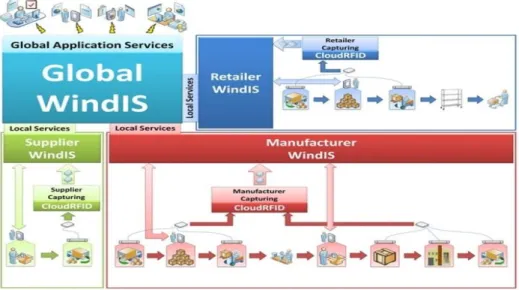
Figure 2 shows one example of smart business, based on cloud centric Internet of Things technology.
2-6 Previous Researches
In the march 2014 Stefan Willutzky presented a paper that concentrated on RFID technology next to the Internet of Things concept and their potential impact on increasing inter-organizational supply chain performance. He concluded that RFID technology is a value adding technology in specialized supply chain applications.
Verdouv and his collogues in 2013 worked on the benefits of using Internet of Things on the supply chain. They worked on diversity and dynamics of virtualizations in a supply chain context, in particular on the possibility that when objects travel through supply chains they may change ownership. Their work was concentrated on assessing how the IoT concept can enhance virtualization of supply chains in the floricultural sector. They emphasized on the importance of how to manage multiple representations of the same object for different organizations and different purposes of usage, and how to ensure the data integrity of these heterogeneous object representations and how to Fig 2 - Example of smart business, based on
cloud centric IoT technology (Gheysari, 2013)
provide an overarching view of an object stream given situational access and usage rights.
In 2015 Irene Ng presented a paper with subject of Contextual variety, Internet-of-Things and the choice of tailoring over platform: Mass customization (MC) strategy in supply chain management. They identified a broad visionary approach to MC Development that focused on the role of customer value, and provide some insights into how organizations can approach the challenge of both scalability and customization. They identified two possible MC approaches (a tailoring strategy and a platform strategy) and specify conditions under which each of them benefit providers of goods and/or services, placing a particular emphasis on the importance of contextual variety of use and its impact on customization.
In the 2014 Mr. Aikaterini Micheli worked on his the mpact of IoT Enabled Service Solutions in the Downstream Automotive Supply Chain. He investigated the extent that connected services could be applied to the downstream automotive supply chain as a viable long-term business solution. A door-to-door perspective was applied in order to identify the challenges and opportunities towards different stakeholders within this supply chain.
Mr. Gnimpieba and their partners presented an article with subject “Using Internet of Things technologies for a collaborative supply chain: Application to tracking of pallets and containers” in International Workshop on Mobile Spatial
Information Systems (2015).
They proposed to provide the architecture of a collaborative platform based on advanced technologies related to IoT, CC, GPS/GPRS and RFID for positioning, identification, communication,
tracking and data sharing.
3-DEVELOPING HYPOTHESES AND CONCEPTUAL MODEL
3-1 Hypotheses
For analyzing application of supply chain in smart business, a number of previous research studies were reviewed. After full analysis and consulting with panel of experts in the field of supply chain, we use the process that was introduced by Duanhong. This model covers the entire stages of smart business and provides the possibility of separation and analysis of each process. Table 1 illustrates all five processes and their sub-processes.
Num
b
er
Main Process Sub-Process Description of Main Process
1
Planning (Duanhong 2007) (Kumar, 2009) (Farsijani, 2012) (Croxton, 2001)
Demand Forecast
Planning consists of processes that improve the balance between demand and supply. This facilitates developing procurement, manufacturing and distribution processes related requirements.
Supply Forecast
2
Procurement (Duanhong 2007) (Kumar, 2009) (Poon, 2009) (Farsijani, 2012) (Croxton, 2001)
Access to Raw Material This covers processes that provide goods and services to meet the real or planned demands. In this process, goods and raw materials are obtained from the companies that have contract with firm and evaluation is done based on what is planned.
Accessing Materials
Choosing Supplier
3
Manufacturing (Duanhong 2007) (Kumar, 2009) (Poon, 2009) (Farsijani, 2012) (Croxton, 2001)
Inventory Management
This consist of processes that put the products in ready state so that real and planned demands are met. For this process full information about stoke should be available, so that excess production or less than demand be avoided. In stage goods are made from available resources.
Manufacturing Warehousing Clearance
4
Distribution (Duanhong 2007) (Kumar, 2009) (Poon, 2009) (Poirier, 2000) (Farsijani, 2012)
Order Management This transportation process consists management of order and management, distribution management. In this process, customers are ordering, follow up order state, and monitor the information related to transportation and distribution.
Transportation Distribution 5
Managing Return (Duanhong 2007) (Croxton, 2001)
Send Returned Goods to Supplier
In this process the goods that are returned (for whatever reason) are managed and some of these goods are sent back to suppliers.
TABLE .1
Describing the Main Processes of the Supply Chain Management Based on the References
Supply Chain
Management Produce
Resource Providing
Planning
Distribution Services
Returns Management
(Cost, Quality, Flexibility, Delivery, Resource Accessibility)
(Cost, Quality, Flexibility, Delivery, Resource Accessibility)
(Cost, Quality, Flexibility, Delivery, Resource Accessibility)
(Cost, Quality, Flexibility, Delivery, Resource Accessibility)
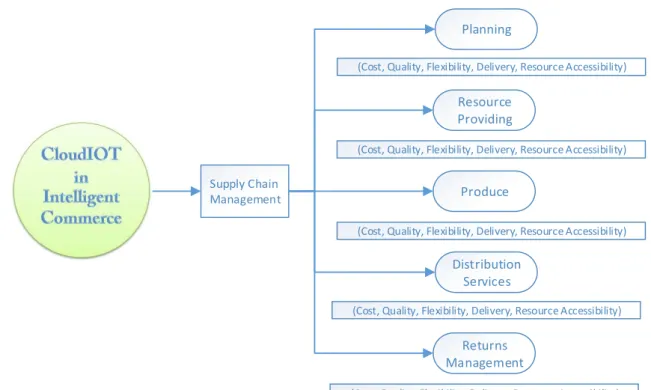
(Cost, Quality, Flexibility, Delivery, Resource Accessibility) Fig .3 - Conceptual Model
By consideration of the above table the research Hypotheses are developed as follows:
Main Hypotheses: Internet of Things based on cloud computing lead to improved performance in supply chain processes.
1-1 Cloud Centric Internet of Things improves planning in supply chain
1-2 Cloud Centric Internet of Things has positive impact on procurement process in supply chain
1-3 Cloud Centric Internet of Things improves manufacturing process in supply chain.
1-4 Cloud Centric Internet of Things resolves distribution problems in supply chain
1-5 Cloud Centric Internet of Things facilitates management of return goods in supply chain
3-2 Conceptual Model
Conceptual model of this research is based on "Meta Model", which is designed based on conceptual models of service-oriented architecture. Figure 3 shows conceptual model of this research. 3-3 Specification Criteria for Measuring Performance Improvements
For specification of measurement criteria for supply chain management, different resources were analyzed and summary of that is shown in table 2.
For testing the Hypotheses of this research Delphi method (panel of experts) was used. For this purpose a questioner was designed based on conceptual model and main variables of research. For selecting the sample, provisioning or judgment sampling was used, and questioner was distributed to 52 experts in the field of Information technology and value chain management systems.
4-RESEARCH METHODOLOGY
Cloud Centric Internet of Things is considered as independent variable and value chain process and customer service in smart business is considered as dependent variable. Therefore, T-Student and linear regression statistical tests for analysis of received responses were used. For correlation test, we used Pearson test. Data analysis were done with SPSS software. Questioner stability was 0.093% which indicate that that questioner is in good state. In this research Likert scale was used for scoring response. Responder expresses agreement or disagreement with each item which is scaled between 1 to 5. In the questioner scale of 1-Very Disagree, 2- Disagree, 3-No Opinion, 4-Agree, 5- Strongly Agree were used.
TABLE .2
Measurements of Performance Improvement
Performance measurement References
Cost (Spring and Boaden 1997)
(Schroeder et al. 2002) (Vereecke and Muylle, 2006)
(Bond 1999), (stalk 1998) (Ghazi Noori; TavasoliZade
2008)
(voos 1995), (Hill 1994) (Sharma and Bhagwat 2007)
(Kaplan and Norton 1992)
Flexibility (voos,1995)
(Spring and Boaden 1997) (stalk 1998) (Vereecke and Muylle, 2006)
Delivery services (Ghazi Noori; TavasoliZade
2008)
(Sharma and Bhagwat 2007), (voos 1995), (Hill 1994) (Spring and Boaden, 1997)
(Vereecke and Muylle 2006), (Bond 1999), (stalk
1998)
Quality(facility, adoptability,
speed, accuracy) (voos 1995), (Hill 1994)
(Vereecke and Muylle 2006), (Bond 1999) (Ghazi Noori; TavasoliZade
2008) (stalk, 1998) (Sharma and Bhagwat 2007)
Material accessibility (Vereecke and Muylle 2006),
(Spring and Boaden 1997) (Vereecke and Muylle 2006)
(Schroeder et al 2002) (stalk 1998), (Sharma and
Bhagwat 2007) (Ghazi Noori; TavasoliZade
2008)
5-RESEARCH FINDINGS Demographic Information
TABLE 3
Demography of the respondents
Tot
al N
u
m
b
er
Gender
Educational
Level
Field of Activity
Me n W o m en Ph D
MSC BSC Priv
ate G o ve rn m en tal Le ctu rer St u de n t 5
2 43 9 11 17 24 19 14 12 7
TABLE 4
Testing Independent and Dependent Variables
Normality
Te st R esu lt Sig ni fic an t l ev el t e st Kol m o go ro v– Sm irno v te st Normal distributionParameter Sam
pl e Si ze Var iab le St an da rd de viat io n A ve rag e N o rm al 0.85 2 0.60 9 1.00 … 52 P lan ni ng N o rm al 0.48 1 0.84 0
1.00 … 52
P ro cur em ent N o rm al 0.97 5 0.48 0 1.00 … 52 M an uf ac tur ing N o rm al 0.25 8 1.01 2
1.00 … 52
D ist ribu tio n N o rm al 0.95 8 0.50 8
1.00 … 52 Cont
ro l R et ur ne d G o o ds N o rm al 0.22 6 1.04 4
1.00 … 52
C us to m er s
Examining Normality of Variables
In this research Kolmogorov–Smirnov test was used for examining the normality of data. This test is applied to approve using Pearson correlation Coefficient on dependent variables.
H0: Data distribution is normal H1: Data distribution is not normal
For judging data normality in Kolmogorov– Smirnov test, if significant level for all independent and dependent variables are greater that test level (0.05), data distribution are normal. Based on table 4, normality will be analyzed.
As it can be seen the significant level of Kolmogorov–Smirnov test for all variables are greater than 0.05, which indicate that data are normal. For ensuring that data are appropriate and that correlation matrix (which is the base forfactor analysis), is not zero for the statistical society, Bartlett test are used.
By considering table 5, the amount of KMO is 0.801 (bigger that 0.6), thus number of sample for analysis is enough. In addition, the amount of sig in Bartlett test is less than 0.05, which indicates that factor analysis to identify the structure factor model
is appropriate and Hypotheses of “correlation matrix is known”, is rejected.
TABLE 5 Bartlett's Test
KMO Test
0.801
Bartlett
Test
X
22574.497
Freedom
Level
561
Sig
0.000
Main Hypotheses Test
Internet of Things based on cloud computing lead to improved performance in supply chain processes
H0: Internet of Things based on cloud computing lead to improved performance in supply chain
processes
H1: Internet of Things based on cloud computing does not lead to improved performance in supply
chain processes
For testing this Hypotheses, T-Student and linear correlation analysis were used and the results are shown in table 6.
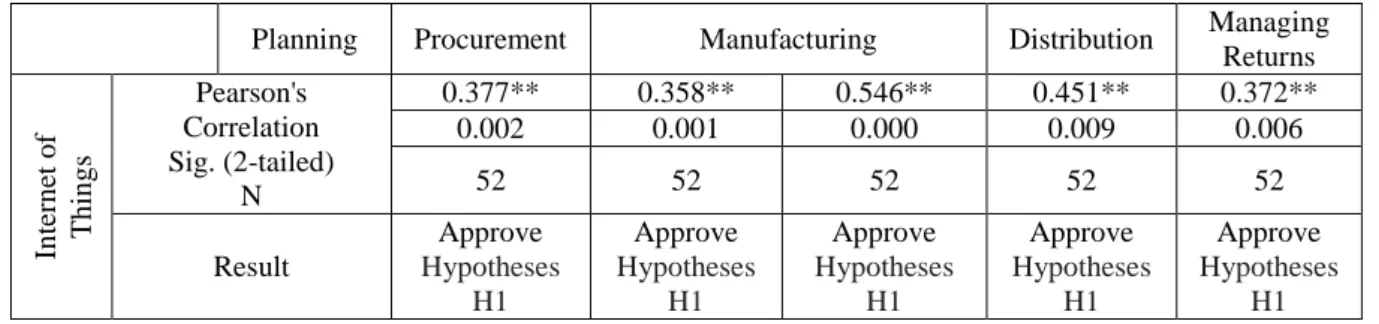
By considering the above table, it can be concluded that because Fisher meaningful level in dependent variable (planning, procurement, manufacturing, delivery, of goods and managing returns) are all equal to zero and this is less than 0.05, linearity of the model is confirmed. Therefore, Internet of Things technology have effects in all processes of supply chain.By using Pearson correlation coefficient, each minor Hypotheses are analyzed to determine correlation amount between Internet of Things with each supply chain process.
H0: There is not meaningful relationship between Internet of Things and supply chain management
processes
H1: There is meaningful relationship between Internet of Things and supply chain management
processes
As it can be seen from the test result, Sig is less than 0.05 for all variables, which indicates that there is correlation between Internet of Things Technology and value chain process. In addition the mark (**) at the top of correlation coefficient numbers refers to meaningful relation up to 99%.
Testing performance improvement criteria
In this section effects of applying Internet of things technology on performance improvement criteria of supply chain, by using Pearson correlation coefficient will be examined.
H0: There is not a meaningful relation between performance improvement criteria of Internet of
Things and supply chain processes H1: There is a meaningful relation between performance improvement criteria of Internet of
Things and supply chain processes
Hypotheses Variables coefficients Variable Deviation Standard Statistic t Meaningful level with 0.05 Compare the Model Result in
1-1 Planning 0.546 0.044 12.375 0.0 0.05> It has
effects
1-2 Procurement 0.358 0.044 8.107 0.0 0.05> It has
effects 1-3 Manufacturing 0.451 0.044 10.203 0.0 0.05> It has
effects
1-4 Good
Distribution 0.377 0.044 8.535 0.0 0.05>
It has effects 1-5 Managing
Returns 0.372 0.044 8.431 0.0 0.05>
It has effects Watson Statistic 1.937 Errors are not in Correlated Model
Coefficient of Model Specification 0.910 91% of changes in smart business value chain process are expressed by independent variable IoT model
Significant level of Model 0.0 Linear relationship of Model Hyposis Result : Internet of Things based on cloud computing lead
to improved performance in supply chain processes TABLE 6
Result of Correlation between IoT and Supply Chain Processes
Planning Procurement Manufacturing Distribution Managing Returns In ter n et o f T h in g s Pearson's Correlation Sig. (2-tailed) N
0.377** 0.358** 0.546** 0.451** 0.372**
0.002 0.001 0.000 0.009 0.006
52 52 52 52 52
Result Approve Hypotheses H1 Approve Hypotheses H1 Approve Hypotheses H1 Approve Hypotheses H1 Approve Hypotheses H1 Performance Improvement
Criteria Planning Procurement Manufacturing Distribution
Managing Return Expense Pearson's Correlation Sig. (2-tailed) 0.374** 0.04 0.495** 0.00 0.550** 0.00 0.451** 0.00 0.282** 0.01 Facilitating Access Pearson's Correlation Sig. (2-tailed) 0.022 0.012 0.384** 0.00 0.315** 0.02 0.650** 0.00 0.460** 0.00 Quality Pearson's Correlation Sig. (2-tailed) 0.416** 0.00 0.484** 0.00 0.475** 0.00 0.503** 0.00 0.284** 0.00 Flexibility Pearson's Correlation Sig. (2-tailed) 0.022 0.012 0.572** 0.00 0.427** 0.00 0.571** 0.00 0.240 0.008 Delivery Service Pearson's Correlation Sig. (2-tailed)
0.014 0.426**
0.00 0.669** 0.00 0.346** 0.01 0.375** 0.01
As it can be seen from the above table, all significant levels are less than 0.05, which indicate a relation between all performance improvement criteria and supply chain processes. The highest correlation coefficient between expense criteria and performance is 0.55, which belongs to manufacturing process. This means that implementing Internet of Things technology in supply chain, will have the best improvement in expense (cost reduction). This coefficient, between accessibility criteria and supply chain process, is 0.65, which indicate significant improvement in accessibility by using Internet of Things. Coefficient correlation between quality criteria and supply chain process is 0.503. This indicates that implementation of Internet of Things results in quality improvement of company resources. The highest correlation coefficient
between flexibility criteria and supply chain belong to distribution process which is 0.572. This coefficient shows improvement in flexibility level in supply chain after implementation of Internet of Things. Finally coefficient of delivery service criteria is highest for manufacturing process, which indicate improvement effect in that area after implementation of Internet of Things.
6- Conclusion
Rapid technological progress has effects in our lives from different angles. Business areas are not exempted from this and with use of innovation and new technologies, they have moved towards modernization. In this regard, use of Internet of Things technology, which covers the latest TABLE .7
Result of Correlation between IoT and Supply Chain Processes
TABLE 8 Results
automatic identification, tracking and also smart things, have created new approach in business environments.
In this research the effects and meaningful relationship between different part of supply chain and Internet of Things technology were analyzed. The result of this research showed direct and significant effects of Internet of Things on supply chain process and customer services. This technology with making use of information cloud services and creating a precise, related and integrated information source, will lead to improve access to different resources and improves quality at resource levels. By making use of this technology, information related to each source can be analyzed in real time and the most appropriate option for supplying raw materials may be selected. This has direct effect on managing returned goods. Identification and automatic tracking systems of this technology, provides the possibility of intelligent communication for ordering and manufacturing process, and will lead to reduction of expenses in these areas. In addition, existence of such communications, provide the background for accurate prediction and planning, and will enable companies to predict customer purchasing pattern and provide strategic planning accordingly.
Based on the obtained results, after implementation of Internet of Things technology, considerable flexibility in distribution of good will be observed. Consequently supply chain can use different ways to deliver services and products and use internet capabilities for tracking products.
Finally, by considering the results, it can be concluded that share of services received by customers will have the highest ranking and have the most benefits from Internet of Things implementations.
REFERENCES:
[1] Aivazidou, E., Antoniou, A., Toka, A., Arvanitopoulos, K. (2012). Using Cloud Computing in Supply Chain Management: Third-Party Logistics οn the Cloud. 2nd International Conference on Supply Chain in Greece, Oct 05, 2012.
[2] Armbrust, M., Fox, A., Griffith, R., Joseph, A.D., Katz, R., Konwinski, A., Lee, G., Patterson, D., Rabkin, A., Stoica, I. and Zaharia, M. (2010). A view of Cloud computing. Communications of the ACM, Vol. 53 No. 4.
[3] Atzori,L., Iera,A., Morabito,G. (2010). The Internet of things: A survey, Computer Networks28 (Volume 54, Issue 15), p 2787- 2805.
[4] Casey, G., Cegielski, L., Yun, Wu,. and Benjamin T. H. (2012 ). Adoption of cloud computing technologies in supply chains, The International Journal of Logistics Management Vol. 23 No. 2, p 184-211. [5] Croxton, K.L., García-Dastugue, S.J., Lambert.
D.M. (2001). the Supply Chain Management Processes, the International Journal of Logistics Management, Volume 12, Number 2, p 13-36. [6] Duanhong,L. (2007). A Supply Chain Management
Framework Based on SOA, Hunan Provincial Laboratory of Logistics Information and Simulation Technology, p243-248.
[7] Farsijani, hassan, Fallah hosseini, ali, (2012), Identifying and prioritizing factors to achieve world-class supply chain management and provide appropriate solutions, Journal of Industrial management perspective, No. 6.
[8] Fleisch,E. (2010). What is the internet of things? An Economic Perspective, Business Process and Applications, ETH Zurich / University of St. Gallen. [9] Gheysari, Mohammad, (2013) “ A service- oriented
architecture from internet of thing to use in warehouse management system.”, Master of Thesis, Payam-e-noor, Tehran.
[10] Gluhak, A., S, Krco., M, Nati., D, Pfisterer., N, Mitton., T, Razafindralambo. (2011). A Survey on Facilities for Experimental Internet of Things Research, IEEE Commun Mag 49 , p 58–67. [11] Gonzalez, J. (2011). 4 the impact of the internet of
things on Business and Society, Foundation de la Innovation Bankinter, p44- 50.
[12] Gubbi, J., Buyya, R., Marusic, S., Palaniwani, M., (2012). Internet Of Things: A vision, Architectural elements, and Future direction, Sciencedirect, Future Generation Computer Systems 29, p 1645-1660.
[13] Haller,s., Magerkurth,G.,(2011), The Real- time Enterprise: IoT-enabled Business Processes, IETF IAB Workshop on Interconnecting Smart Objects with the Internet, March 2011.
[14] IBM , The benefits of cloud computing, available at: ftp://public.dhe.ibm.com/common/ssi/ecm/d iw03004usen/DIW03004USEN. (accessed February 5, 2012).
[15] Kalantari, Khalil, (2011), Processing and data analysis on socio-economic research,Book, Tehran, Saba culture publications.
[16] Ke Rong, Guangyu Hu, Yong Lin, Yongjiang Shi, Liang Guo,. (2015), Understanding business ecosystem using a 6C framework in Internet-of-Things-based sectors, International Journal of Production Economics, Volume 159, Pages 41–55. [17] Kumar, M. (2009), Warehouse in theory and practice,
University of Boras, Master Thesis of Technology. [18] Liu, X., Sun, Y. (2011), Information Flow
Management of Vendor Managed Inventory System in Automobile Parts Inbound Logistics Based on Internet of Things, Journal of Software,vol.6, No.7. [19] Mirzaei, Khalil, (2008), Research, Researcher
and Research Writing, Book, Tehran, Jameeshenasan publications.
[20] Poirier, C,. Bauer, M. (2000). E-supply chain: Using the internet to revolutionize your business. San Francisco: Berrett- Koehler.
[21] Poon, T.C., Choy, K.L., Chow, H. K.H., Lau, H.C.W., Chan, F.T.S., Ho, K.C. (2009). A RFID case-based logistics resource management system for managing order- picking operations in warehouses, Expert Systems with Applications, NO 36, p 8277– 8301.
[22] Rezaeian, ali. Ghelichli, behrouz, Darvishi, fateme, (2012), The effect of the maturity of IT processes to achieve business requirements with the approach of qubits, Journal of Humanities lecturer. No. 78, Pages 63-78.
[23] Shahabadi, abolfazl, Sajadi, Hassan, (2011), Resources of technology transfer and economic growth, Journal of Research and Economic Policies, No. 59, Pages 33-52
[24] Schramm, T., S, Nogueira., and D, Jones. (2011). Cloud computing and supply chain: A natural fit for the future, Logistics Management,
[25] Shen, G., Liu, B., (2010). Research on Application of Internet of Things in Electronic Commerce, third
international symposium on electronic commerce and security, computer society, July 29, 2010, Guangzhou, China.
[26] Shin, T., Chin, S., Yoon, S., W, Kwon., S, w. (2011). A service-oriented integrated information framework for RFID/WSN- based intelligent construction supply chain management, Automation in construction, p 706-715.
[27] Verdouw C.N, Beulens A.J.M., van der Vorst J.G.A.J. (2013), Virtualisation of floricultural supply chains: A review from an Internet of Things perspective, Computers and Electronics in Agriculture 99 160–175.
Amir Houshang Tajfar is
faculty member of Payam Noor University and he has over 20 years experience in the IT field and working with many organizations in the field of Information Technology Holding key positions such as the head of IT of University of Farhangian, coordinator of research section of six development plan in the field of ICT. Auditor of many national projects in the field of Information Technology. Working as an international consultant for more than 10 years and work for more than 2 years in NHS UK project (the biggest IT project). Giving IT related consultancy to some of the main organization, such as IT department of President office, ITRC, Iran Aerospace organization, ISIran, MCI , ... He is the author of 12 books (three published in US), which most of them are used as reference in different Universities, and published over 40 articles in different journals and conferences.
Mohammad Gheysari has Over
8 years experience in Information Technology and teaching at Universities. Working in the field of Information Technology and work in different organization in the field of Information Technology such as Focus Middle East and IoT Center, as well as teaching in the Payam Noor University. The author of one book and over 30 article in the field of IoT in both Persian and English languages.