• No results found

Thesis

N/A
N/A
Protected

Academic year: 2020

Share "Thesis"

Copied!
15
0
0

Loading.... (view fulltext now)

Full text

(1)

ABSTRACT  

Glioblastoma  (GBM),  the  most  common  and  malignant  primary  brain  tumor,  is  currently  

incurable  and  the  most  recent  advance  in  treatment  yields  a  median  survival  of  only  12-­‐15  

months.

1-­‐3

 To  account  for  GBM’s  heterogeneity,  molecular  diagnostics  may  be  used  to  enable  

mutation  specific  treatment  and  improve  patient  outcomes.

4

 Mutations  in  PIK3CA,  the  

p110α  subunit  of  phosphatidylinositide  3-­‐kinase  (PI3K),  are  important  in  pathogenesis  of  other  

cancers,  and  drugs  targeting  PI3K  are  in  clinical  development.

5-­‐8

 In  12%  of  GBM,  PIK3CA  is  

mutated  and  recurrent  mutations  are  distributed  across  three  functional  domains  (adaptor-­‐

binding,  helical,  and  kinase).

6

 As  their  role  in  GBM  tumorigenesis  is  unknown,  we  examined  six  

mutations  known  to  occur  in  GBM,  two  per  mutated  domain,  for  activation  of  biochemical  

signaling  through  phosphorylation  of  downstream  targets  ATK  and  S6.  These  mutations  were  

introduced  into  immortalized  human  astrocytes,  with  and  without  oncogenic  RAS.

9

 We  

determined  that  the  downstream  signaling  molecule  AKT  is  activated  by  all  of  the  mutations  in  

human  astrocytes,  with  the  greatest  increase  caused  by  mutations  in  the  helical  and  kinase  

domains.  The  presence  of  oncogenic  RAS  cooperated  with  the  helical  and  kinase  domain  

mutations  to  activate  signaling.  Mutations  in  the  adaptor-­‐binding  domain  appear  to  increase  

signaling  independently  of  oncogenic  RAS.  Mutations  in  PIK3CA  therefore  differentially  increase  

signaling,  leading  to  differing  phenotypes  and  possible  differential  response  to  PI3K  inhibitors.  

By  understanding  the  consequences  of  differing  mutations,  GBM  diagnosis  and  treatment  can  

be  improved.  

(2)

INTRODUCTION  

Class  I  phosphatidylinositide  3-­‐kinases  (PI3K)  are  activated  by  receptor  tyrosine  kinases  

(RTK)  and  have  an  established  role  in  cancer  biology,  making  them  an  important  target  for  

research  and  drug  development.

10

 In  general,  phosphatidylinositide  3-­‐kinase  proteins  form  a  

diverse  family  of  related  enzymes,  whose  members  are  divided  into  three  classes  based  on  

their  structural  features  and  lipid  substrates.

8,  11

 Class  II  and  III  members  do  not  have  a  well-­‐

established  role  in  cancer,  however  signaling  by  Class  I  members  has  been  shown  to  promote  

cellular  survival,  proliferation,  and  migration,  along  with  other  hallmarks  of  cancer.

5,  8,  11,  12


These  proteins  are  heterodimeric,  with  our  focus  being  on  the  catalytic  subunit  encoded  by  

PIK3CA  and  the  regulatory  subunit  encoded  by  PIK3R1  due  to  their  frequent  mutation  in  

cancer.

6

 The  catalytic  subunit  produces  a  phosphatidylinositol-­‐3,4,5-­‐triphosphate  (PIP

3

)  

secondary  messenger  from  membrane  bound  phosphatidylinositol-­‐4,5-­‐bisphosphate  (PIP

2

)  and  

the  regulatory  subunit  inhibits  this  activity.  There  are  many  upstream  signals  interacting  

specifically  with  each  subunit,  and  the  ability  of  these  signals  to  activate  signaling  depends  on  

the  catalytic  isoform  present  in  the  heterodimer.

8,  11,  13


In  GBM,  three  PI3K  pathway  genes  are  frequently  mutated:  PIK3CA  (12%)  (Fig.  1A),  

PIK3R1  (12%),  and  PTEN  (41%).

5,  14,  15

 These  mutations  are  mutually  exclusive,  suggesting  that  

they  all  activate  PI3K  signaling  and  that  a  mutation  in  one  is  sufficient  to  promote  

tumorigenesis.  Mutations  in  PIK3R1  and  PTEN  have  been  shown  to  be  transformative  in  brain  

tissue,  and  although  PIK3CA  mutations  are  presumed  to  drive  gliomagenesis  based  on  

(3)

the  oncogene  RAS  from  the  mitogen-­‐activated  protein  kinase  (MAPK)  arm  of  the  RTK  pathway  

(Fig.  1B).  PIK3CA  mutations  in  GBM  are  spread  across  the  protein,  with  recurring  mutations  in  

the  helical,  kinase,  and  adaptor  binding  (ABD)  domains  (Fig.  1C,  1D).

7

 The  helical  (E542K  and  

E545K)  and  kinase  (H1047R)  domain  mutations  have  been  shown  to  initiate  tumorigenesis  and  

promote  progression  in  non-­‐brain  tissues,  such  as  breast.

16-­‐18

 Structural  analysis  has  been  used  

to  predict  the  mechanisms  of  mutations  in  these  three  domains.

13,  19-­‐23

 Helical  domain  

mutations  are  predicted  to  disrupt  inhibitory  interactions  between  PIK3R1  and  PIK3CA,  leading  

to  signaling  activation.  Kinase  domain  mutations  are  predicted  to  alter  the  conformation  of  the  

PIK3CA  protein’s  activation  loop,  resulting  in  increased  binding  to  the  cellular  membrane  and  

therefore  increased  catalytic  efficiency.  ABD  mutations  are  predicted  to  alter  the  conformation  

of  the  kinase  domain,  leading  to  an  increase  in  the  protein’s  enzymatic  activity.  Helical  domain  

mutations  have  been  found  to  require  RAS  for  signaling  activation  but  not  PIK3R1  in  non-­‐brain  

models,  whereas  the  opposite  is  true  for  kinase  domain  mutations.

24

 The  role  of  RAS  and  

PIK3R1  is  unclear  for  ABD  mutations.  

To  determine  if  PIK3CA  mutations  differentially  activate  PI3K  signaling  based  on  the  

mutated  domain,  we  selected  six  specific  mutations  known  to  occur  in  GBM  (R88Q,  C90Y,  

E542K,  E545K,  M1043V,  and  H1047R)  (Fig.  1D)  and  introduced  them  into  immortalized  

astrocytes  with  and  without  oncogenic  RAS.  The  use  of  cultured  genetically  engineered  cells  has  

important  advantages  over  other  preclinical  models,  as  they  allow  direct  genotype  to  

phenotype  conclusions.

9,  25  

These  cells  are  also  more  experimentally  manageable,  and  can  be  

(4)

expressing  the  HPV  oncogenes  E6  and  E7  to  inhibit  the  TP53  and  RB  pathways  and  expression  of  

hTERT  for  telomere  maintenance.

9

 These  genetic  modifications  are  required  for  culture  of  

astrocytes,  but  do  not  transform  the  cells  or  make  them  tumorigenic.

9

 The  mutations  were  also  

introduced  into  astrocytes  that  express  oncogenic  HRAS  (NHARAS),  as  a  way  to  examine  effects  

between  the  PI3K  and  MAPK  effector  arms  of  the  RTK  pathway.

9

 Both  of  these  effector  arms  

are  frequently  mutated  and  activated  in  GBM.

6

 We  propose  that  signaling  activation  is  

dependent  not  only  on  the  specific  gene  that  is  mutated  but  also  on  the  precise  location  within  

the  mutated  protein.  Even  though  mutations  in  all  three  functional  domains  of  PIK3CA  are  

assumed  to  activate  signaling,  drive  tumor  growth,  and  predict  PI3K  inhibitor  activity,  none  of  

these  assumptions  has  yet  been  successfully  experimentally  tested.  The  validity  of  these  

mechanisms  must  be  proven  to  provide  a  rational  basis  for  developing  individualized  therapy.  

MATERIALS  AND  METHODS  

Tissue  Culture  

Immortalized  normal  human  astrocytes  (NHA)  with  and  without  oncogenic  H-­‐RAS  were  a  gift  

from  Dr.  Russell  O.  Pieper.

9


All  cell  lines  were  maintained  in  Dulbecco’s  Modified  Eagle’s  

Medium  supplemented  with  10%  FBS  and  1%  Penn/Strep  (complete  DMEM)  at  37ºC  and  5%  

CO

2

.


PIK3CA  Mutagenesis  

HA-­‐tagged  wildtype  PIK3CA  (PIK3CA

wt

,  pBABE-­‐puro-­‐HAPIK3CA),  HA-­‐tagged  GFP  (GFP,  pDEST-­‐

Flag-­‐HA-­‐GFP),  pENTR4  vector  (pENTR4-­‐no-­‐ccDB),  and  third  generation  lentiviral  Gateway  

destination  vector  (pLenti-­‐PGK-­‐Hygro-­‐DEST)  plasmids  were  purchased  from  Addgene  

(5)

via  ligation  into  the  pENTR4  vector.  Point  mutagenesis  of  PIK3CA  was  performed  in  the  pENTR4  

vector  using  the  Q5  Site-­‐Directed  Mutagenesis  Kit  (New  England  Biolabs,  Ipswich,  MA)  

according  to  manufacturer’s  instructions  generating  the  six  PIK3CA  mutants  (PIK3CA

mut

:  R88Q,  

C90Y,  E542K,  E545K,  M1043V,  H1047R).  The  sequence  of  each  mutated  gene  was  confirmed  

with  Sanger  sequencing  (Genewiz,  South  Plainfield,  NJ).  Each  gene  (GFP,  PIK3CA

wt

,  and  six  

PIK3CA

mut

)  was  transferred  from  the  pENTR4  vector  to  the  pLenti-­‐PGK-­‐Hygro-­‐DEST  vector  by  

recombination  as  previously  described.

26


Lentivirus  Production  

Lentiviral  particles  containing  GFP,  PIK3CA

wt

,  or  individual  PIK3CA

mut

 were  generated  using  

293FT  cells  (Invitrogen,  Grand  Island,  NY).  Briefly,  5  x  10

5

 cells  were  plated  on  10  cm  plates  in  

complete  DMEM  supplemented  with  2  mM  GlutaMAX  (Invitrogen),  0.1  mM  MEM  Non-­‐Essential  

Amino  Acids  (Invitrogen),  and  1  mM  sodium  pyruvate  (Invitrogen)  (293FT  medium).  The  next  

day  medium  was  replaced  with  fresh  293FT  medium  without  Penn/Strep,  and  with  9  μg  GFP,  

PIK3CA

wt

,  or  PIK3CA

mut

 pDEST  vector  plasmids,  9  μg  pLP1,  3.6  μg  pLP,  and  1.89  μg  pMD2.G  

transfected  into  these  cells  using  Lipofectamine  2000  (Invitrogen)  according  to  the  

manufacturer’s  instructions.  After  24  hours,  medium  was  exchanged  for  new  293FT  medium  

supplemented  with  1  M  HEPES  (Invitrogen).  At  48  and  72  hours  post-­‐transfection,  viral  

supernatants  were  collected  and  fresh  293FT  medium  supplemented  with  1M  HEPES  was  

added.  Viral  supernatants  from  each  time  point  were  filtered  through  a  45  μm  PES  filter,  and  

stored  at  4ºC  until  all  time  points  could  be  pooled,  aliquoted,  and  stored  at  -­‐80ºC.    


(6)

Creation  of  Stable  Cell  Lines  

NHA  and  NHARAS  cells  were  plated  at  135,000  and  120,000  cells  per  plate  on  6  cm  plates  and  

infected  with  lentiviral  particles  after  two  days.  Viral  particles  and  cells  were  incubated  

overnight  in  complete  DMEM  containing  8  μg/ml  polybrene  (Sigma-­‐Aldrich,  St.  Louis,  MO)  at  

37ºC  and  5%  CO

2

.  Two  days  post-­‐infection,  transduced  cells  were  selected  by  culture  in  

complete  DMEM  with  300  μg/ml  hygromycin  B  for  14  days.  Stable  gene  expression  was  

confirmed  by  immunoblot  for  the  HA  tag  on  GFP,  PIK3CA

wt

 and  PIK3CA

mut

.  

Immunoblot


NHA  and  NHARAS  cells  were  serum  starved  in  0.5%  FBS  for  24  hours,  harvested,  lysed,  and  

quantified  by  BCA  (Pierce  BCA  Protein  Assay  Kit,  Thermo  Scientific,  Waltham,  MA).  Protein  

samples  (20  μg)  were  separated  by  gradient  (8-­‐16%)  SDS-­‐PAGE  (Bio-­‐Rad,  Hercules,  CA)  and  

transferred  to  PDVF  membranes  (EMD  Millipore  Corp,  Billerica,  MA).  The  membranes  were  

probed  with  primary  antibodies  against  GAPDH  (EMD  Millipore  Corp,  Billerica,  MA,  MAB374)  at  

1:7000,  AKT  (Cell  Signaling  Technology,  Danvers,  MA,  CST2920S)  at  1:3000,  phospho  AKT  

(Ser473)  (Cell  Signaling  Technology,  Danvers,  MA,  CST4060)  at  1:3000,  phospho  S6  

(Ser240/244)  (Cell  Signaling  Technology,  Danvers,  MA,  CST2215)  at  1:3000,  ERK  (Cell  Signaling  

Technology,  Danvers,  MA,  CST4696)  at  1:3000,  and  phospho  ERK  (Thr202/Tyr204)  (Cell  

(7)

Western  ECL  Substrate,  Bio-­‐Rad)  on  an  Image  Quant  LAS  4000  (GE  Healthcare).  Immunoblot  

images  were  analyzed  using  ImageJ  (NIH,  Bethesda,  MD),  normalized  to  GAPDH,  normalized  to  

an  external  standard,  and  expression  levels  were  set  relative  to  parental,  uninfected  cells.  

Immunoblots  were  performed  with  1  (NHA)  and  3  –  4  (NHARAS)  experimental  replicates.  

Differences  between  cell  lines  were  determined  by  one-­‐way  ANOVA  tests  using  Tukey’s  post-­‐

tests  for  multiple  comparisons  in  GraphPad  Prism  5  (La  Jolla,  CA).  For  statistical  analysis  P  values  

<  0.05  were  considered  to  be  significant.  

RESULTS  


Figure  1:  PIK3CA  mutations  in  GBM.  (A)  Occurrence  of  PIK3CA  mutations  in  a  sampling  of  273  GBM  patients,  courtesy  of   cBioPortal.14  (B)  Abbreviated  figure  of  the  MAPK  and  PI3K  arms  of  the  RTK  pathway,  proteins  examined  in  this  paper  are  red,   and  dashed  lines  indicate  multiple  steps.  (C)  PyMOL  (Schrödinger,  New  York  City,  NY)  generated  protein  model  with  mutation   locations  marked.  (D)  Simplified  protein  diagram  showing  mutation  locations  within  protein  domains,  R88Q  and  M1043V  are   rare  mutations,  C90Y  is  unique  to  GBM,  and  E542K,  E545K  and  H1047R  are  “hot-­‐spot”  mutations  seen  in  other  cancers.  


RAS PIP2 PTEN PIP3 AKT PIK3CA RTK ERK S6 PIK3R1 PI3K%Arm% MAPK%Arm%

A"

B"

C"

D"

N

H1047R M1 04 3V E5 42 K E5 45 K

R88Q C90Y

C

ABD RBD C2 HELICAL KINASE

PIK3CA 12%

genetic alteration Amplification Missense Mutation Truncating Mutation Inframe Mutation

PIK3CA 12%

genetic alteration Amplification Missense Mutation Truncating Mutation Inframe Mutation

PIK3CA 12%

genetic alteration Amplification Missense Mutation Truncating Mutation Inframe Mutation

PIK3CA 12%

genetic alteration Amplification Missense Mutation Truncating Mutation Inframe Mutation

PIK3CA 12%

genetic alteration Amplification Missense Mutation Truncating Mutation Inframe Mutation

PIK3CA 12%

genetic alteration Amplification Missense Mutation Truncating Mutation Inframe Mutation

PIK3CA 12%

(8)


Figure  2:  PI3K  signaling  in  PIK3CA  mutant  NHA  (A)  Immunoblot  of  cell  lysates  probed  for  the  HA  tagged  PIK3CA,  phosphorylated   AKT,  total  AKT,  GAPDH  (loading  control),  and  phosphorylated  S6  (B)  Plot  of  HA  levels  relative  to  PIK3CAwt.  (C)  Plot  of  pAKT  levels   relative  to  parental  NHAs.  (D)  Plot  of  pS6  levels  relative  to  parental  NHAs.  


Figure  3:  PI3K  signaling  in  PIK3CA  mutant  NHARAS.  (A)  Immunoblot  of  cell  lysates  probed  for  HA  tag,  phosphorylated  AKT,  total   AKT,  phosphorylated  ERK,  total  ERK,  GAPDH  (loading  control),  and  phosphorylated  S6.  (B)  Plot  of  HA  levels  relative  to  PIK3CAwt.   (C)  Plot  of  pAKT  levels  relative  to  parental.  (D)  Plot  of  pS6  levels  relative  to  parental.  (*)  dictates  significant  difference  from   parental  and  (**)  dictates  significant  difference  from  PIK3CAwt.  

A"

B"

C"

D"

A"

(9)


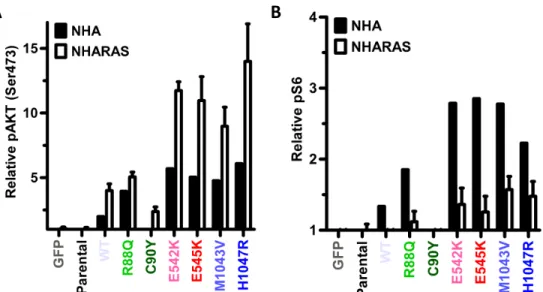
Figure  4:  Comparison  of  phosphorylated  AKT  and  phosphorylated  S6  between  NHA  and  NHARAS  cells.  (A)  Plot  of  pAKT  in  NHA   and  NHARAS  relative  to  parental  cells.  (B)  Plot  of  pS6  in  NHA  and  NHARAS  relative  to  parental  cells.  
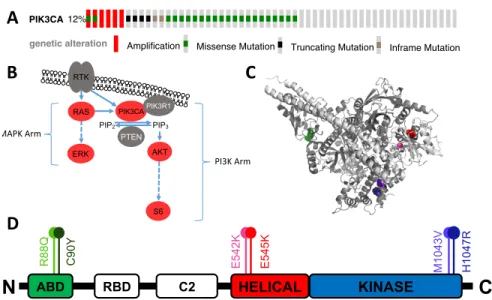
 

As  PIK3CA  mutations  are  seen  in  12%  of  GBM  (Fig.  1A),  we  introduced  six  mutations  into  

genetically  engineered  human  astrocytes  in  the  presence  and  absence  of  oncogenic  RAS  to  

determine  their  impact  on  PI3K  signaling  (Fig.  1B)  and  gliomagenesis.  These  mutations  were  

distributed  across  three  functionally  distinct  domains,  with  two  mutations  per  domain  and  

including  several  “hot-­‐spot  mutations”  that  commonly  occur  and  are  transformative  in  other  

cancers  (Fig.  1C,  1D).

16-­‐18


PIK3CA  mutations  affected  signaling  to  different  degrees,  based  the  specific  amino  acid  

that  is  mutated.  We  confirmed  expression  of  the  PIK3CA  mutations  in  NHA  by  immunoblotting  

for  HA  (Fig.  2A,  2B).  HA  levels  were  approximately  equal  across  PIK3CA

wt

 and  PIK3CA

mut


indicating  that  any  observed  signaling  differences  were  due  to  the  mutation,  not  differences  in  

engineered  protein  levels.  PI3K  signaling  activation  was  measured  through  phosphorylation  of  

AKT  and  the  more  downstream  target  S6.  Expression  of  the  PIK3CA  plasmids  did  not  alter  total  

AKT  levels  (Fig.  2A).  Cells  with  GFP  insertion  do  not  show  a  pAKT  increase  compared  to  parental,  

(10)

confirming  that  viral  transduction  did  not  alter  PI3K  signaling.  PIK3CA

wt

 increased  pAKT  

signaling  two  fold  compared  to  parental,  showing  a  slight  increase  due  to  increased  levels  of  

PIK3CA  protein  (Fig.  2C).  The  ABD  mutation,  R88Q,  increased  pAKT  four  times  as  much  as  

parental  and  twice  as  much  as  PIK3CA

wt

,  but  helical  and  kinase  domain  mutations  produced  a  

greater  increase  in  signaling  (Fig.  2C).  E542K  and  H1047R  show  a  six-­‐fold  increase  compared  to  

parental  and  about  a  three-­‐fold  increase  compared  to  PIK3CA

wt  

(Fig.  2C).  E545K  and  M1043V  

show  about  a  five-­‐fold  increase  compared  to  parental  and  more  than  double  levels  seen  in  

PIK3CA

wt

 (Fig.  2C).  The  more  distal  signaling  molecule  pS6  shows  a  similar  trend  but  with  more  

minor  increases  (Fig.  2D).  PIK3CA

wt

 only  increased  signaling  by  25%  relative  to  parental,  while  

R88Q  has  about  a  two-­‐fold  increase  and  E542K,  E545K,  and  M1043V  show  about  a  three-­‐fold  

increase  in  pS6  (Fig.  2D).  GFP  has  an  increase  similar  to  that  of  PIK3CA

wt

,  however  this  could  

also  be  due  to  experimental  error,  and  more  biological  replicates  are  needed  to  confirm  these  

results.    

Because  RAS  has  been  shown  to  differentially  influence  the  effects  of  PIK3CA  mutations  

in  non-­‐neural  tissues,  we  wanted  to  determine  whether  the  presence  of  oncogenic  RAS  

(11)

two-­‐fold  compared  to  parental,  suggesting  that  it  is  a  less  potent  activator  of  PI3K  signaling  

than  PIK3CA

wt

 (Fig.  3C).  The  helical  and  kinase  domain  mutations  had  more  dramatic  increases,  

with  E542K  and  E545K  showing  a  12-­‐fold  increase  from  parental  and  a  significant  two-­‐fold  

increase  over  PIK3CA

wt

 (Fig.  3C).  Kinase  mutant  M1043V  shows  about  an  eight-­‐fold  increase  

with  statistical  difference  from  parental,  and  around  a  two-­‐fold  increase  from  PIK3CA

wt

 (Fig.  

3C).  H1047R  shows  the  greatest  increase  at  about  13  times  that  of  parental  and  shows  over  a  

three-­‐fold  increase  and  statistical  difference  from  PIK3CA

wt

 (Fig.  3C).  Changes  in  levels  of  pS6  

were  less  dramatic,  with  R88Q  and  C90Y  showing  levels  similar  to  parental  and  PIK3CA

wt

 (Fig.  

3D).  The  helical  and  kinase  domain  mutants  show  a  slightly  greater  increase,  but  only  reach  

about  1.5  times  parental  levels  (Fig.  3D).    


To  determine  the  effects  of  oncogenic  RAS  in  PI3KCA  mutant  astrocytes  by  we  

compared  PI3K  signaling  in  its  presence  and  absence.  In  the  absence  of  oncogenic  RAS,  pAKT  

increases  are  apparent  but  pS6  increases  are  less  pronounced  (Fig  4A,  4B).  The  presence  of  

oncogenic  RAS  yields  much  greater  increases  in  proximal  signaling  through  pAKT  seen  by  the  

over  10-­‐fold  increases  compared  to  parental  from  helical  and  kinase  mutants  (Fig.  4A).  In  

contrast,  more  distal  signaling  through  pS6  shows  a  less  dramatic  result  compared  to  parental  

(Fig.  4B).  

DISCUSSION  


By  understanding  how  PIK3CA  mutations  activate  signaling  and  promote  tumorigenesis,  

we  may  better  comprehend  the  genetic  drivers  of  GBM  and  how  to  combat  them  with  

(12)

The  ability  to  interpret  the  function  and  variation  between  these  mutations  is  fundamental  to  

the  goal  of  improving  treatment  and  increasing  patient  survival.  

PIK3CA  mutations  differentially  influence  signaling,  and  responses  are  influenced  by  the  

presence  of  oncogenic  RAS.  As  all  mutants  tested  except  for  C90Y  increase  signaling  beyond  

levels  seen  from  overexpression  of  PIK3CA

wt

,  they  are  activating;  however  the  location  of  the  

mutation  within  the  protein  is  important  for  the  extent  of  activation.  The  helical  and  kinase  

domain  mutations  are  the  most  activating,  though  R88Q  is  also  activating  in  NHAs.  This  

activation  continues  down  the  pathway  as  it  is  still  seen  in  increased  levels  of  pS6,  but  increases  

are  less  dramatic  likely  due  to  translation  downstream.  This  suggests  that  R88Q,  and  the  helical  

and  kinase  domain  mutations  promote  tumorigenesis  by  increasing  signaling  down  the  PI3K  

pathway.  In  the  presence  of  oncogenic  RAS,  helical  and  kinase  domain  mutations  dramatically  

increase  pAKT  signaling,  suggesting  that  oncogenic  RAS  cooperates  with  the  helical  mutations  

to  promote  AKT  activation.  This  increase  also  suggests  that  H1047R  activity  is  influenced  by  

oncogenic  RAS  despite  previous  evidence  that  it  functions  independently  of  RAS  binding.

20,  24


The  adaptor  binding  domain  mutation  R88Q  shows  only  a  slight  increase  compared  to  PIK3CA

wt

,  

and  C90Y  shows  a  decrease  in  signaling  suggesting  that  this  mutation  leads  to  decreased  

activity  of  PIK3CA.  The  similar  levels  of  pAKT  in  R88Q  mutants  in  the  presence  and  absence  of  

RAS  suggests  that  the  presence  of  oncogenic  RAS  does  not  influence  its  ability  to  activate  PI3K  

signaling.  Increases  in  pS6  are  much  less  dramatic,  however  this  could  be  due  to  the  already  

higher  baseline  levels  of  pS6  in  the  presence  of  oncogenic  RAS.  

(13)

promising  therapeutic  option.  Increases  in  signaling  seen  by  phosphorylation  of  AKT  and  S6  

would  be  predicted  to  lead  to  increases  in  proliferation  and  migration.  We  have  seen  that  this  is  

indeed  the  case,  as  increased  signaling  caused  by  these  mutations  translates  into  phenotypic  

consequences  such  as  proliferation,  migration,  and  tumorigenesis  in  vivo  (data  not  shown).  This  

suggests  that  PI3KCA  mutations  in  the  helical  and  kinase  domains  are  transformative,  and  

promote  gliomagenesis.  Understanding  differences  between  mutations  is  critical  to  predicting  

the  biology  of  patient  tumors.  Mutations  that  promote  tumorigenesis  may  not  respond  well  to  

PI3K  inhibitors,  therefore  understanding  the  responses  of  various  mutations  is  necessary  for  

directed  patient  treatment.  Future  studies  investigating  the  response  of  these  mutations  to  

PI3K  inhibitors  will  make  progress  towards  mutation  based  diagnosis  and  increased  efficacy  in  

treatment.    

ACKNOWLDGEMENTS  

Thanks  to  Robbie  McNeill,  Demi  Canoutas,  Ralf  Schmid,  Ryan  Bash,  and  Dr.  C.  Ryan  Miller.  

This  research  was  funded  in  part  by  a  Summer  Undergraduate  Research  Fellowship  from  the  

Office  for  Undergraduate  Research  at  the  University  of  North  Carolina  at  Chapel  Hill.  

This  research  was  funded  by  a  NC  TraCS  grant.  


LITERATURE  CITED  

1)

Stupp,  R.;  Mason,  W.  P.;  Van  Den  Bent,  M.  J.;  Weller,  M.;  Fisher,  B.;  Taphoorn,  M.  J.;  

Belanger,  K.;  Brandes,  A.  A.;  Marosi,  C.;  Bogdahn,  U.;  Curschmann,  J.;  Janzer,  R.  C.;  

Ludwin,  S.  K.;  Gorlia,  T.;  Allgeier,  A.;  Lacombe,  D.;  Cairncross,  J.  G.;  Eisenhauer,  E.;  

Mirimanoff,  R.  O.;  European  Organisation  for  R.;  Treatment  of  Cancer  Brain  T.;  

Radiotherapy  G.;  National  Cancer  Institute  of  Canada  Clinical  Trials  G.  Radiotherapy  plus  

concomitant  and  adjuvant  temozolomide  for  glioblastoma.  N.  Engl.  J.  Med.  

2005

,  352,  

987-­‐96.  

(14)

3)

Stupp,  R.;  Hegi,  M.  E.;  Mason,  W.  P.;  Van  Den  Bent,  M.  J.;  Taphoorn,  M.  J.;  Janzer,  R.  C.;  

Ludwin,  S.  K.;  Allgeier,  A.;  Fisher,  B.;  Belanger,  K.;  Hau,  P.;  Brandes,  A.  A.;  Gijtenbeek,  J.;  

Marosi,  C.;  Vecht,  C.  J.;  Mokhtari,  K.;  Wesseling,  P.;  Villa,  S.;  Eisenhauer,  E.;  Gorlia,  T.;  

Weller,  M.;  Lacombe,  D.;  Cairncross,  J.  G.;  Mirimanoff,  R.  O.;  European  Organisation  for  

R.;  Treatment  of  Cancer  Brain  T.;  Radiation  Oncology  G.;  National  Cancer  Institute  of  

Canada  Clinical  Trials  G.  Effects  of  radiotherapy  with  concomitant  and  adjuvant  

temozolomide  versus  radiotherapy  alone  on  survival  in  glioblastoma  in  a  randomised  

phase  III  study:  5-­‐year  analysis  of  the  EORTC-­‐NCIC  trial.  Lancet.  Oncol.  

2009

,  10,  459-­‐66.  

4)

Mendelsohn,  J.  Personalizing  oncology:  perspectives  and  prospects.  J.  Clin.  Oncol.  

2013

,  

31,  1904-­‐11.  

5)

Fruman,  D.  A.;  Rommel,  C.  PI3K  and  cancer:  lessons,  challenges  and  opportunities.  Nat.  

Rev.  Drug.  Discov.  

2014

,  13,  140-­‐56.  

6)

Brennan,  C.  W.;  Verhaak,  R.  G.;  McKenna,  A.;  Campos,  B.;  Noushmehr,  H.;  Salama,  S.  R.;  

Zheng,  S.;  Chakravarty,  D.;  Sanborn,  J.  Z.;  Berman,  S.  H.;  Beroukhim,  R.;  Bernard,  B.;  Wu,  

C.  J.;  Genovese,  G.;  Shmulevich,  I.;  Barnholtz-­‐Sloan,  J.;  Zou,  L.;  Vegesna,  R.;  Shukla,  S.  A.;  

Ciriello,  G.;  Yung,  W.  K.;  Zhang,  W.;  Sougnez,  C.;  Mikkelsen,  T.;  Aldape,  K.;  Bigner,  D.  D.;  

Van  Meir,  E.  G.;  Prados,  M.;  Sloan,  A.;  Black,  K.  L.;  Eschbacher,  J.;  Finocchiaro,  G.;  

Friedman,  W.;  Andrews,  D.  W.;  Guha,  A.;  Iacocca,  M.;  O'Neill,  B.  P.;  Foltz,  G.;  Myers,  J.;  

Weisenberger,  D.  J.;  Penny,  R.;  Kucherlapati,  R.;  Perou,  C.  M.;  Hayes,  D.  N.;  Gibbs,  R.;  

Marra,  M.;  Mills,  G.  B.;  Lander,  E.;  Spellman,  P.;  Wilson,  R.;  Sander,  C.;  Weinstein,  J.;  

Meyerson,  M.;  Gabriel,  S.;  Laird,  P.  W.;  Haussler,  D.;  Getz,  G.;  Chin,  L.;  Network,  T.  R.  The  

somatic  genomic  landscape  of  glioblastoma.  Cell.  

2013

,  155,  462-­‐77.  

7)

Cloughesy,  T.  F.;  Cavenee,  W.  K.;  Mischel,  P.  S.  Glioblastoma:  from  molecular  pathology  

to  targeted  treatment.  Annu.  Rev.  Pathol.  

2014

,  9,  1-­‐25.  

8)

Thorpe,  L.  M.;  Yuzugullu,  H.;  Zhao,  J.  J.  PI3K  in  cancer:  divergent  roles  of  isoforms,  

modes  of  activation  and  therapeutic  targeting.  Nat.  Rev.  Cancer.  

2014

,  15,  7-­‐24.  

9)

Sonoda,  Y.;  Ozawa,  T.;  Hirose,  Y.;  Aldape,  K.  D.;  McMahon,  M.;  Berger,  M.  S.;  Pieper,  R.  

O.  Formation  of  intracranial  tumors  by  genetically  modified  human  astrocytes  defines  

four  pathways  critical  in  the  development  of  human  anaplastic  astrocytoma.  Cancer  Res.  

2001

,  61,  4956-­‐60.  

10)

Wen,  P.  Y.;  Lee,  E.  Q.;  Reardon,  D.  A.;  Ligon,  K.  L.;  Alfred;  Yung,  W.  K.  Current  clinical  

development  of  PI3K  pathway  inhibitors  in  glioblastoma.  Neuro.  Oncol.  

2012

,  14,  819-­‐

29.  

11)

Vanhaesebroeck,  B.;  Guillermet-­‐Guibert,  J.;  Graupera,  M.;  Bilanges,  B.  The  emerging  

mechanisms  of  isoform-­‐specific  PI3K  signaling.  Nat.  Rev.  Mol.  Cell  Biol.  

2010

,  11,  329-­‐41.  

12)

Hanahan,  D.;  Weinberg,  R.  A.  Hallmarks  of  cancer:  the  next  generation.  Cell.  

2011

,  144,  

646-­‐74.  

13)

Vadas,  O.;  Burke,  J.  E.;  Zhang,  X.;  Berndt,  A.;  Williams,  R.  L.  Structural  basis  for  activation  

and  inhibition  of  class  I  phosphoinositide  3-­‐kinases.  Sci.  Signal.  

2011

,  4,  re2.  

14)

Gao,  J.;  Aksoy,  B.  A.;  Dogrusoz,  U.;  Dresdner,  G.;  Gross,  B.;  Sumer,  S.  O.;  Sun,  Y.;  

Jacobsen,  A.;  Sinha,  R.;  Larsson,  E.;  Cerami,  E.;  Sander,  C.;  Schultz,  N.  Integrative  Analysis  

of  Complex  Cancer  Genomics  and  Clinical  Profiles  Using  the  cBioPortal.  

2013

.  

(15)

Schultz,  N.  The  cBio  cancer  genomics  portal:  an  open  platform  for  exploring  

multidimensional  cancer  genomics  data.  Cancer  Discov.  

2012

,  2,  401-­‐4.  

16)

Koren,  S.;  Bentires-­‐Alj,  M.  Mouse  models  of  PIK3CA  mutations:  one  mutation  initiates  

heterogeneous  mammary  tumors.  FEBS.  J.  

2013

,  280,  2758-­‐65.  

17)

Hanker,  A.  B.;  Pfefferle,  A.  D.;  Balko,  J.  M.;  Kuba,  M.  G.;  Young,  C.  D.;  Sanchez,  V.;  Sutton,  

C.  R.;  Cheng,  H.;  Perou,  C.  M.;  Zhao,  J.  J.;  Cook,  R.  S.;  Arteaga,  C.  L.  Mutant  PIK3CA  

accelerates  HER2-­‐driven  transgenic  mammary  tumors  and  induces  resistance  to  

combinations  of  anti-­‐HER2  therapies.  Proc.  Natl.  Acad.  Sci.  

2013

,  110,  14372-­‐77.  

18)

Bader,  A.  G.;  Kang,  S.;  Vogt,  P.  K.  Cancer-­‐specific  mutations  in  PIK3CA  are  oncogenic  in  

vivo.  Proc.  Natl.  Acad.  Sci.  

2006

,  103,  1475-­‐79.  

19)

Zhao,  L.;  Vogt,  P.  K.  Class  I  PI3K  in  oncogenic  cellular  transformation.  Oncogene.  

2008

,  

27,  5486-­‐96.  

20)

Huang,  C.  H.;  Mandelker,  D.;  Schmidt-­‐Kittler,  O.;  Samuels,  Y.;  Velculescu,  V.  E.;  Kinzler,  K.  

W.;  Vogelstein,  B.;  Gabelli,  S.  B.;  Amzel,  L.  M.  The  structure  of  a  human  

p110alpha/p85alpha  complex  elucidates  the  effects  of  oncogenic  PI3Kalpha  mutations.  

Science.  

2007

,  318,  1744-­‐48.  

21)

Carson,  J.  D.;  Van  Aller,  G.;  Lehr,  R.;  Sinnamon,  R.  H.;  Kirkpatrick,  R.  B.;  Auger,  K.  R.;  

Dhanak,  D.;  Copeland,  R.  A.;  Gontarek,  R.  R.;  Tummino,  P.  J.;  Luo,  L.  Effects  of  oncogenic  

p110alpha  subunit  mutations  on  the  lipid  kinase  activity  of  phosphoinositide  3-­‐kinase.  

Biochem.  J.  

2008

,  409,  519-­‐24.  

22)

Hon,  W.  C.;  Berndt,  A.;  Williams,  R.  L.  Regulation  of  lipid  binding  underlies  the  activation  

mechanism  of  class  IA  PI3-­‐kinases.  Oncogene.  

2012

,  31,  3655-­‐66.  

23)

Gkeka,  P.;  Evangelidis,  T.;  Pavlaki,  M.;  Lazani,  V.;  Christoforidis,  S.;  Agianian,  B.;  Cournia,  

Z.  Investigating  the  structure  and  dynamics  of  the  PIK3CA  wild-­‐type  and  H1047R  

oncogenic  mutant.  PLoS  Comput.  Biol.  

2014

,  10,  e1003895.  

24)

Zhao,  L.;  Vogt,  P.  K.  Helical  domain  and  kinase  domain  mutations  in  p110alpha  of  

phosphatidylinositol  3-­‐  kinase  induce  gain  of  function  by  different  mechanisms.  Proc.  

Natl.  Acad.  Sci.  

2008

,  105,  2652-­‐57.  

25)

Rich,  J.  N.;  Guo,  C.;  McLendon,  R.  E.;  Bigner,  D.  D.;  Wang,  X.  F.;  Counter,  C.  M.  A  

genetically  tractable  model  of  human  glioma  formation.  Cancer  Res.  

2001

,  61,  3556-­‐60.  

26)

Campeau,  E.;  Ruhl,  V.  E.;  Rodier,  F.;  Smith,  C.  L.;  Rahmberg,  B.  L.  et  al.  A  Versatile  Viral  

Figure

Figure	
  1:	
  PIK3CA	
  mutations	
  in	
  GBM.	
  (A)	
  Occurrence	
  of	
  PIK3CA	
  mutations	
  in	
  a	
  sampling	
  of	
  273	
  GBM	
  patients,	
  courtesy	
  of	
   	
  
Figure	
  3:	
  PI3K	
  signaling	
  in	
  PIK3CA	
  mutant	
  NHARAS.	
  (A)	
  Immunoblot	
  of	
  cell	
  lysates	
  probed	
  for	
  HA	
  tag,	
  phosphorylated	
  AKT,	
  total	
   	
  
Figure	
  4:	
  Comparison	
  of	
  phosphorylated	
  AKT	
  and	
  phosphorylated	
  S6	
  between	
  NHA	
  and	
  NHARAS	
  cells.	
  (A)	
  Plot	
  of	
  pAKT	
  in	
  NHA	


References

Related documents

[r]

[r]

[r]

university reform claims that strategic manage- ment has been strengthened in the universities, while the role of university per- sonnel has remained weak. Two major strategy

The output characteristic (Fig. 6-1) for a water-gated PBTTT film is close to ideal, with very little hysteresis and a low threshold between 0V and 0.1V. The responses of PBTTT

[r]

In this review, the research carried out using various ion-exchange resin-like adsorbents including modified clays, lignocellulosic biomasses, chitosan and its derivatives, microbial

While in Table 3 we present a pooled specification, to increase the chances for the added variables to exert a significant impact, in unreported regressions we repeat the