UNC Eshelman School of Pharmacy Honors Program
Figure 1: Chemical Structure of Metformin
ABSTRACT
Metformin is the most widely prescribed anti-hyperglycemic agent for Type 2 Diabetes Mellitus (T2DM). Despite its frequent use, the intestinal absorption mechanism of this orally administered drug is still under investigation, and it is not known why up to 36% of diabetics on metformin therapy are nonresponsive. Previous studies in the Thakker laboratory have demonstrated that organic cation transporters (Octs) mediate metformin intestinal absorption and influence its pharmacokinetics in mice. Using a diabetic mouse model of T2DM, this study aims to demonstrate that Octs enhance the contribution of the intestine to the overall glucose-lowering effects of metformin. Mice were administered metformin orally in the presence and absence of the cation-selective transporter inhibitor, pentamidine, and blood glucose levels were measured using an OneTouch Ultra glucometer. Our data suggest that intestinal cation-selective transporters facilitate the glucose-lowering effect of oral metformin, and that inhibition of these transporters by pentamidine diminishes the glucose-lowering efficacy of this drug. Thus, the intestine may play a role in the pharmacodynamic effects of metformin and contribute to the glucose-lowering response.
INTRODUCTION
Metformin and Type 2 Diabetes Mellitus
Metformin is an anti-diabetic drug widely used to treat T2DM. It is currently the most prescribed anti-hyperglycemic medication for diabetes in the United States.1 T2DM is a chronic disease characterized by hyperglycemia and insulin resistance. Metformin has effects on multiple parts of the body including the liver, intestine, and skeletal muscles. Studies show that metformin decreases gluconeogenesis in the liver and reduces glucose transport into the intestine while increasing glucose consumption. It also increases insulin sensitivity in skeletal muscle, which improves glucose utilization. All these actions help to reduce blood glucose levels in the body.2
Metformin Pharmacokinetics
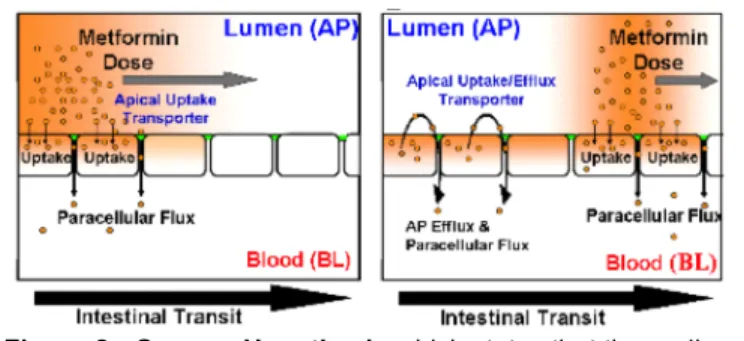
Figure 2: Sponge Hypothesis which states that the cycling of metformin between the gut lumen and enterocytes as metformin dose travels distally through the intestine leads to efficient absorption by increasing opportunities to access the paracellular space.
However, due to the restrictive nature of tight junctions and the limited surface area they provide in intestinal epithelial cells, paracellular diffusion would lead to a low bioavailability. However, metformin has a bioavailability ranging from 40-60%, which is higher than molecules with similar characteristics. Mannitol, which is also a hydrophilic and charged molecule in the intestine with a similar molecular weight as metformin, undergoes paracellular diffusion to enter the systemic circulation. However, unlike metformin, mannitol only has an oral bioavailability of 16%.3-4 This discrepancy in
bioavailability led to the idea that metformin may have a different mechanism of absorption than paracellular diffusion. The Thakker Laboratory has done extensive work over the last several years to uncover the pharmacokinetic properties of metformin and how it is absorbed into the body. A former student of the Thakker laboratory elucidated the transport kinetics of metformin using the Caco-2 transwell intestinal cell model, and uncovered that metformin is efficiently transported across the apical membrane of the Caco-2 cell monolayer in either direction, while basolateral efflux is poor.5 This lack of
basolateral efflux led to the hypothesis that metformin accumulates in the Caco-2 cells, and 3-compartmental modeling of these data suggested that metformin transport primarily occurs (>90%) via paracellular diffusion. This study led to the development of the “Sponge Hypothesis” which states that as metformin travels along the gastrointestinal tract, some will be absorbed via paracellular diffusion through tight junctions and some will be taken up via cation-selective transporters into the epithelial cells of the small intestine. Since there is poor basolateral efflux of metformin, the drug will accumulate in the intestinal cells, and then efflux back into the lumen of the small intestine. While in the lumen of the small intestine, metformin can then undergo further absorption via paracellular
UNC Eshelman School of Pharmacy Honors Program
Figure 3: Chemical Structure of Pentamidine
Figure 4: Area Under the Curve of Metformin Plasma Concentrations in the Presence and Absence of the Transporter Inhibitor Pentamidine. After oral administration of metformin with and without pentamidine, metformin plasma concentrations were significantly lower in the presence of pentamidine (p<0.01).
diffusion, which is enhanced by the ability of metformin to efflux out of the intestinal cells and re-enter the intestinal lumen (Figure 2).5 The individual cation-selective transporters
that facilitate metformin uptake in Caco-2 cells were recently identified by the Thakker group, and include the plasma membrane monoamine transporter, organic cation transporter 1, serotonin transporter, and choline transporter.6
In addition to unveiling the transporters involved in the uptake of metformin, recent studies in the Thakker
laboratory have also shown that chemical inhibition of these transporters reduces systemic absorption of metformin in vitro and in
vivo.7 Pentamidine, which is a positively charged molecule at physiological pH, has the
ability to inhibit all four transporters involved in metformin uptake by Caco-2 cells (Figure 3). A study by a former graduate student of the Thakker laboratory on wild type mice showed that the plasma concentrations of metformin were significantly reduced when metformin was administered in the presence of the pan transporter inhibitor, pentamidine (Figure 4). Based on these data, this study aims to determine if intestinal cation-selective transporters play a role in the pharmacological effects of metformin in addition to influencing its pharmacokinetics.
Hypothesis: Intestinal apical transporters of metformin enhance its glucose-lowering effect.
Specific Aim: Establish that transporters increase the intestinal absorption of metformin and contribute to its glucose-lowering effect in diabetic mice.
B6.BKS(D)-Leprdb/J Mice
B6.BKS(D)-Leprdb/J (Db/Db) mice are a strain of mouse which is homozygous for
a defective Lepr gene. The Lepr gene codes for the leptin receptor, which is necessary for the feeling of satiety and fullness. This defect leads to the development of diabetes mellitus and it has been shown that Db/Db mice are a good model for T2DM seen in humans. Db/Db mice become obese near 3-4 weeks of age. Whereas a non-diabetic mouse will have a fasting plasma glucose (FPG) around 150 mg/dL, a Db/Db mouse will have an average FPG level anywhere between 300-500 mg/dL.8 All mice were fasted for a total of four hours prior to receiving experimental procedures. Fasting was continued throughout the duration of each experiment and the mice only had access to water. Oral Gavage Studies
Twelve Db/Db mice were divided into 3 groups (n=4/group). Group 1 (control group) received distilled water at time 0 followed by distilled water 15 min later. Group 2 received distilled water at time 0 and metformin (450 mg/kg) 15 min later, and Group 3 received pentamidine (3.4 mg/kg) at time 0 followed by metformin (450mg/kg) plus pentamidine (3.4 mg/kg) 15 min later. All treatments were administered via oral gavage at 5 µL/g. Blood samples were collected via the tail vein before the treatment (time 0) and then at 0.25, 0.5, 1, 2, 3, 4, 5, and 6 hours post treatment. Blood glucose levels were measured with an OneTouch Ultra glucometer.
Statistical Analysis
Blood glucose levels at each time point were compared among all three groups using a two-way ANOVA. A one-way ANOVA was used to compare total blood glucose concentrations between Groups 2 and 3 (i.e., area under the metformin effect curve).
Results
UNC Eshelman School of Pharmacy Honors Program
Figure 6: Area Under Effect Curve of Blood Glucose Over 6 Hours in Db/Db Mice. Orally administered metformin significantly reduced total blood glucose concentrations over 6 hours in db/db mice compared to the control (distilled water, p<0.05). Co-administered pentamidine attenuated metformin effect on blood glucose levels.
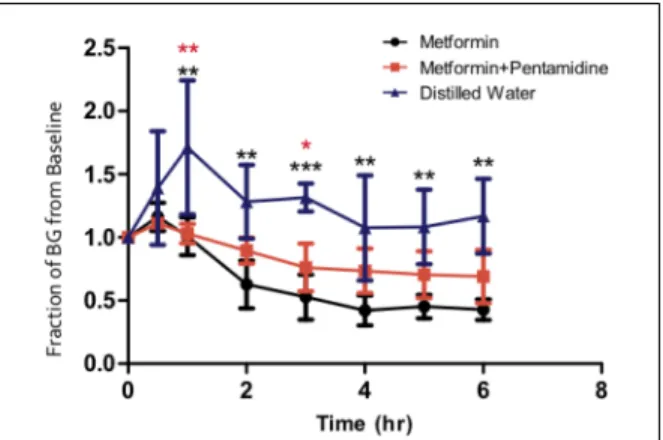
Figure 5: Fraction of Blood Glucose vs Time in Db/Db Mice. Orally administered metformin significantly decreased blood glucose levels over 1 to 6 hours compared to the control (distilled water). Co-administered pentamidine attenuated metformin effect on glucose levels, which was significant at 1 and 3 hours post treatment (p<0.05).
* p<0.05, **p<0.01, ***p<0.001
In mice which received distilled water at time 0 and metformin (450 mg/kg) 15 min later (i.e., Group 2), orally administered metformin significantly decreased blood glucose levels over 1 to 6 hours compared to control mice (Group 1) (p<0.01 at 1, 2, 4, 5 and 6 hr; p<0.001 at 3 hr); no significant difference
in blood glucose levels was observed at 30 min post treatment (Figure 5). In the presence of orally co-administered pentamidine (Group 3), metformin-mediated decrease in circulating glucose levels was attenuated at 1 and 3 hours post treatment compared to the control group (p<0.05). The average decrease in blood glucose levels was 50% in Group 2 and 33% in Group 3 versus Group 1. These data correspond with a 49% decrease in area under the effect (AUE) of metformin in Group 2 compared to Group 1 (p<0.05), and a 33% decrease in AUE in Group 3 versus Group 1 which was not statistically significant (Figure 6).
Discussion
compared to metformin being given alone.7 Even though the plasma concentration of
metformin is significantly reduced with co-administration of pentamidine, the reduction is not enough to cause a statistically difference in the pharmacological effect of metformin. Several limitations in the experiment could have contributed to the lack of statistical significance between metformin glucose-lowering efficacy in presence and absence of pentamidine. The first limitation was the glucometer used in the study. The OneTouch Ultra glucometer was only capable of reading blood glucose levels up to 600 mg/dL. If a mouse had a blood glucose level greater than 600 mg/dL, the exact level could not be determined. Over the course of the study this error occurred infrequently, but it might have made the difference between significant and non-significant results.
A second limitation of the study was the wide variability in blood glucose levels of the mice. One factor that effected blood glucose levels was induced stress the mice experienced. Stress could have occurred during different aspects of handling the mice. While administering the treatments, if oral gavage had to be attempted multiple times on the same mouse, there could have been an increase in stress levels which could have led to increased glucose release. The same issue might have occurred when sampling blood via tail nicks. Some mice had difficulties with bloodletting, which may have led to more stress. The induced stress resulted in elevated blood glucose levels, which can be seen by the spikes in blood glucose within the first 30 minutes of each mouse. There was inter-variability in blood glucose elevation between mice and could not be controlled for. The amount of variability in blood glucose levels was not taken into consideration when determining the number of mice per treatment arm. If the sample size was increased, it could help minimize the influence the variability of blood glucose had on the results and may be able to show that the intestinal transporters do in fact play a significant role in the glucose-lowering effect of metformin.
UNC Eshelman School of Pharmacy Honors Program
REFERENCES
1. IMS Institute for Healthcare Informatics. The Use of Medicines in the United States: Review of 2011. 2012:1-42.
2. Hundal RS, Krssak M, Dufour S, Laurent D, Lebon V, Chandramouli V, Inzucchi SE, Schumann WC, Petersen KF, Landau BR, and Shulman GI. Mechanism by Which Metformin Reduces Glucose Production in Type 2 Diabetes. Diabetes. 2000: 49;2063–2069.
3. Artursson P, Karlsson J. Correlation between oral drug absorption in humans and apparent drug permeability coefficients in human intestinal epithelial (Caco-2) cells. Biochem Biophys Res Commun. 1991;175(3):880-5.
4. Tucker GT, Casey C, Phillips PJ, Connor H, Ward JD, Woods HF. Metformin kinetics in healthy subjects and in patients with diabetes mellitus. Br J Clin Pharmacol. 1981;12(2):235-46.
5. Proctor WR, Bourdet DL, Thakker DR. Mechanisms underlying saturable intestinal absorption of metformin. Drug Metab Dispos. 2008;36(8):1650-8.
6. Han T, Proctor W R, Costales C L, Everett R S, and Thakker D R. (2014) Four Cation-selective Transporters Contribute to Apical Uptake and Accumulation of Metformin in Caco-2 Cell Monolayers, J Pharmacol Exp Ther., in review.
7. Costales C, Alluri R, and Thakker D. Apical Uptake and Efflux Transporters Enhance the Intestinal Absorption of Metformin in Mouse. 2013 AAPS Workshop on Drug Transporters in ADME: From the Bench to the Bedside.