Rebel Cooperation
Tegan George
The University of North Carolina at Chapel Hill Curriculum in Peace, War, and Defense
May 2015
Abstract: Intuitively, rebel groups should ally, as this allows them to maximize their power and fighting efficiency against their target. Yet, groups do not always form alliances, and instead sometimes engage in inter-factional conflict. This raises the question: when and why does cooperation fail to materialize between rebel groups? Using micro-level studies of terrorism, I argue that the strength of groups is typically a function of resources or
I. Introduction
In 2010, the al Qaeda offshoot known as the Islamic State in Iraq (ISI) appeared to be in
disarray. The group lost considerable support throughout the Sunni dominated al Anbar province
and was facing mass defections. Iraq also vastly improved its armed forces and border security.1
The U.S. began withdrawing troops from Iraq that year because the fighting appeared to be
coming to an end. However, in 2011, at the start of the Syrian Civil War, ISI and al-Qaeda cells
started to spring up inside Syria to fight the al-Assad regime, and despite their weakened power,
continued to coordinate sporadic attacks across Iraq.2 Soon after, the two groups coalesced to
form a new group separate to al-Qaeda, that would in time represent a major source of
competition. This group became known as ISIS— the Islamic State in Iraq and Syria— and
began reconstituting alliances with former Ba’athist insurgents, the old supporters of Saddam
Hussein. As of this writing, ISIS has taken control of Iraqi cities such as Mosul, captured oil
refineries, and wreaked havoc on noncombatants.3This case identifies an interesting pattern:
while both the Iraqi and Syrian al-Qaeda cells appeared insignificant when operating alone, the
alliance morphed these two groups into a more powerful fighting force, particularly when the
alliance expanded to include the former Ba’athist insurgents. It is puzzling that these militant
groups did not form an alliance sooner, and instead often seemed unwilling to cooperate with
each other. This raises the question: when and why are militant groups willing to form alliances,
and when do they refuse to cooperate with each other?
Since 9/11, terrorism scholarship has focused on the two extremes of the spectrum:
terrorist action as a result of macro-level conditions, such as poverty or foreign intervention, and
1 Office of the Coordinator for Counterterrorism, “Country Reports: Middle East and North Africa Overview,”
Country Reports on Terrorism 2010, 18 August 2011, http://www.state.gov/j/ct/rls/crt/2010/170257.htm.
2 Office of the Coordinator for Counterterrorism, “Country Reports: Middle East and North Africa Overview,”
Country Reports on Terrorism 2011, 31 July 2012, http://www.state.gov/j/ct/rls/crt/2011/195544.htm.
3 Martin Chulov, “ISIS Insurgents Seize Control of Iraqi City of Mosul,” The Guardian, 10 June 2014,
in-depth profiles of terrorist groups in isolation. However, these two approaches present an
incomplete explanation for why some terrorists become cooperative allies while others become
competitive rivals, as seen in the case of ISIS. The former does not give sufficient weight to the
significance of independent agency necessary for these groups to survive, and the latter addresses
agency, but neglects the importance of interaction and systemic factors. If alliances make groups
like ISIS so much stronger, it is puzzling that more groups do not take advantage of the benefits
of cooperation. Indeed, the survival of ISIS and rebel groups in general depends critically on
their ability to form and sustain alliances with other militant groups. It is therefore important to
both explain how terrorists form and sustain alliances, and identify the conditions under which
these alliances contribute to the survival of terrorist groups. If alliances make groups as strong as
they do, it is critical to investigate why some groups do not form them.
II. What produces cooperation?
Economics tells us that pooling comparative advantages makes groups stronger than they
would be alone.4 In this way, it makes intuitive sense that rebel groups should ally in order to
maximize their power and fighting efficiency. Studies suggest that that over ninety percent of
groups do not survive their first year,5 and only five percent survive their first decade, so it would
make intuitive sense to form inter-factional alliances.6 However, it is necessary to take into
account the fact that these groups are distinct entities, with distinct ideologies and visions for the
future.Different groups may share a conflict of interest with the current government, but will
often disagree about what will happen after this conflict is resolved.For example, ISIS and the
Ba’athists agreed that they were against the “sectarian” al-Maliki government, but ultimately,
4 Lauren F. Landsburg, “Comparative Advantages,” Library of Economics and Liberty, n.d.
http://www.econlib.org/library/Topics/Details/comparativeadvantage.html.
5 Daniel Byman, Deadly Connections (Cambridge: Cambridge University Press, 2005), 63.
6 Blake William Mobley, “Terrorist Group Counterintelligence,” Georgetown University, 20 October 2008,
ISIS wants a religious state and the Ba’athists want a secular one.7Thus, while it is true that
pooling comparative advantages makes groups stronger and increases their capacity to fight,
cooperation comes at a cost, in that both sides must dilute their long term agendas.
The existing scholarship on rebel alliances identifies several general patterns that predict
the formation and persistence of cooperative agreements. Despite the fact that militants should
prefer to maximize their power against governments by forming alliances, their poor reputations, low prospects for future interaction and lack of transparent structures lead to an inability to
demonstrate trustworthiness or trust others.8 Bapat and Bond (2012) find that militants have been
able to overcome their commitment problems in the past by creating specific security
arrangements depending on the situations they find themselves in.9 Their results indicated that, if
the state is weak and has a low repressive capacity, militants form bilateral alliances based upon
a long shadow of the future, or high prospects for future iterations.10 On the other hand, if the
state is strong and has a high repressive capacity, militants form asymmetric alliances, typically
relying on an outside enforcement mechanism to punish defection and establish credibility. In
this case, sponsors provide material goods and serve as a guarantor of cooperation, as they can
often force unity among “otherwise fractious” groups.11 Sponsors often serve as institutions, but
the sponsor may also be predatory and seek to sell out the groups it sponsors, in order to advance
its own interests.12
III. State Sponsorship
7Tim Arango and Suadad al-Salhy, “Iraq Militants, Pushing South, Aim at Capital,” The New York Times, 11 June 2014,
http://www.nytimes.com/2014/06/12/world/middleeast/iraq.html?
_r=0&module=ArrowsNav&contentCollection=Middle%20East&action=keypress®ion=FixedLeft&pgtype=article. 8 Navin A. Bapat and Kanisha D. Bond, “Alliances between Militant Groups,” British Journal of Political Science 42
no. 4 (2012): 796.
9 Ibid. 10 Ibid. 795
State sponsorship of rebel groups is seen when a state offers support as part of a broader
effort to bolster an insurgent movement. This is typically seen for three reasons: to advance their
international position; to promote their ideology; and to reinforce their domestic position.13
Diasporas, political parties, and wealthy merchants usually play a huge role, often through the
use of charities that act as fronts.14 These three motivations are complementary by nature.
Primarily, states want to advance their security and power— core concerns for any state— and
supporting a terrorist group can enable a state to weaken or destabilize a neighbor, project its
own power outwards, change a regime, or shape an opposition movement.15 States lacking
military forces or disposable income to invest in defense spending often use terrorist groups to
project power beyond their region or get more attention from more advanced military powers, as
is often seen with Middle Eastern regimes, such as Libya or Iraq, against Western targets.16
Ideological regimes, such as Ayatollah Khomeini’s Iran, often use terrorist groups as proxies or
revolutionary vanguards in an attempt to export their political system abroad and gain
international prestige.17
In rare instances, states have used terrorist groups to topple regimes seen as threats or
impediments to aggrandizement aims– such as Libya’s training of Charles Taylor in the 1980s,
who would go on to seize control of Liberia and nearly seize control of Sierra Leone in 1989.18
Domestic politics can lead to state support of terrorism even if it is not in the best strategic
interests of the state, or does not line up with the state’s ideology. Domestic populations are often
interested in aiding kin (whether ethnic or religious)that are perceived to be oppressed, and if the
state cooperates, it will bolster its popularity domestically. This is a two-way street, as terrorists
13 Daniel Byman, Deadly Connections, 23. 14 Ibid. 221
can be very useful for eliminating dissidents abroad as well, and domestic politics often “blend
neatly” with ideological motivations.19 Terrorist groups that are associated with a more
widespread insurgent movement can even become unofficial arms of their sponsor’s military,
increasing its reach or helping it target critics of the regime in neighboring countries or regions.20
State sponsorship manifests itself in a variety of ways, such as training and operational
support, financial or diplomatic backing, and sanctuary. Training and operational support is the
most common type of state assistance, but sanctuary is arguably the most important. Often,
insurgent groups form from “impoverished peasants, frustrated students, or alienated workers,”
members of society that do not necessarily know how to use explosives or fire guns, 21 despite the
fact that terrorists are usually above average in terms of education and socioeconomic status.22
Additionally, states often provide intelligence to terrorist groups, and sometimes even work
jointly with them.23 The emergence of today’s international arms market has led to a shift in what
groups use state money for. Before, most state money went towards arms acquisition, but today
the money often goes towards recruitment purposes: propaganda, member pay, and even social
welfare.24 Perhaps the most crucial form of state assistance is diplomatic backing and sanctuary
provision, as sanctuary “facilitates all other forms of assistance.”25 Sanctuary provision turns the
tables: by allowing the terrorist groups to dictate the pace of initiatives against their targets, the
terrorists become much more intractable and difficult to defeat. Giving terrorists safe haven,
19 Ibid. 33 20 Ibid. 50 21 Ibid. 59
22 David R. Francis, “Poverty and Low Education Don’t Cause Terrorism,” The National Bureau of Economic
Research, n.d. http://www.nber.org/digest/sep02/w9074.html
right of transit, or ignoring that they are present within a country’s borders renders the target
government unable to act against them without a violation of the state sponsor’s sovereignty.26
Modern states are “fundamentally limited”27 by national boundaries, the
“politico-military institutions” that have demarcated the post-war international order.28 Territoriality norms
show that even the sovereignty of the “most inept” of states is usually respected, and despite the
fact that states are the most powerful actors in international politics, they are nonetheless most
heavily constrained by borders.29 In this way, the role the sponsor plays in preventing the target
government from conducting successful counterinsurgency often allows groups to survive, as
states only have monopolies over use of force within their borders, and have no power to
“suppress armed challenges to their rule” externally.30 Sanctuary and diplomatic backing make it
very difficult for the target state to deliver a “knockout blow,”31 attack the group’s logistics, or
delegitimize the group and its tactics effectively without angering the sponsor or provoking
retaliation.32 In the past, intelligence and judicial barriers imposed by the sponsor have proved to
be very effective “red tape,” as terrorist groups rely on keeping their names and locations secret
in order to make up for being “outgunned and outmanned” by their target government.33 In turn,
target states are very constrained in their ability to monitor these rebel group activities, creating
information asymmetries that benefit rebel groups at the expense of counterinsurgency measures
undertaken by the target state.34
26 Ibid. 66
27 Idean Salehyan, Rebels without Borders, (Ithaca: Cornell University Press, 2009), 19 28 Ibid. 27
29 Ibid. 29 30 Ibid. 27
31 Daniel Byman, Deadly Connections, 67 32 Ibid. 69
33 Ibid. 70
Despite the benefits state sponsorship provides, it is not always an absolute good for rebel
groups. Regimes have national interests that by definition will supersede and often contravene
terrorist agendas, and terrorists lose a significant amount of decision power, freedom of action,
and autonomy when they choose to rely on a state sponsor.35 Important implications on
legitimacy also arise. Often, terrorist groups are fighting to “liberate” the group they claim to
represent, and domination by an external power, notably a state, diminishes their credibility.36
State support also at times weakens groups, as sanctuary provision leads to diminished threat
perception and inability to “evade and weather counterterrorism responses.”37
I argue that the benefits of state sponsorship ultimately outweigh the detriments, as state
sponsorship often allows groups to survive in the uncertain early years, and gives groups access
to technology, intelligence information, and operational aid that they would not have on their
own. Most integral to survival in many cases is sanctuary provision, which allows groups in
formative stages to avoid confrontations with the target state that could destroy them early on.
Indeed, research suggests that sanctuary provision sometimes even encourages groups to emerge
in the first place, as conditions that reduce the state’s ability to “repress challengers effectively”
provide “strategic opportunities” for rebel groups to form.38 Intuitively, rational actors do not
rebel if their chances of victory are low, and when state repressive ability is robust, the costs of
rebellion are too high for rational actors to act on them. Limitations on the state’s coercive
ability, such as the inability to cross sovereign borders, are in this way a “necessary precondition
for violence” that terrorist groups often find unparalleled in usefulness, especially in neighboring
territories.39 Extraterritorial bases allow for recruitment and training in early stages, supply
35 Ibid. 75 36 Ibid. 76 37Ibid. 77
acquisition during the “mobilization phase”, and somewhere to flee during the “combat phase.”40
Groups taking advantage of the benefits state sponsorship provides are also more likely to iterate
alliances because a sponsor can act as an enforcement mechanism to ensure iteration of the
alliance, as opposed to one group exploiting another and the alliance failing. A common reason
for alliance collapse is lack of trust between groups, as the incentives to defect are often too high
for groups to choose not to exploit each other.41 Pervasive commitment problems make it
difficult for groups to know if their ally is going to defect or not, and a state sponsor can often
become an “institution to govern inter-group cooperation.”42 While this type of cooperation can
be costly in terms of the group’s autonomy, state sponsorship can also cause alliances to have
higher degrees of iteration over time because they force groups to remain honest, at risk of losing
sponsorship or being punished by the sponsor.43 Overall, the combination of sanctuary,
third-party enforcement, and the other types of support offered by state sponsors make the benefits of
state sponsorship outweigh the detriments, and state sponsorship as a whole causes alliances to
last longer.
IV. Hypotheses
While existing literature is a valuable starting point, these studies assume that the power
of rebel group is an exogenous factor. I argue instead that, in order to truly understand alliances,
it is necessary to identify the micro-foundations that determine rebel group strength and power.
The power of these groups is often a product of their own choices and decisions, including
recruitment strategies, decisions to provide positive selective incentives, and military strategies. 40 Ibid.
41 Navin Bapat and Kanisha Bond, “Alliances Between Militants,” 802 42 Ibid. 803
Micro-level work further identifies that the strength of groups seems to typically be a function of
access to resources or commodities (such as oil, minerals, or diamonds)44 andtheir ability to
attract state sponsorship. However, resources can often act as a contaminant, in that they increase
violence against civilians and weaken the groups in the long run.45 I argue that the relationship
between those two factors— state sponsorship and access to natural resources— ultimately
determines the success or failure of rebel alliances, and exploring them will enable us to better
unpack group strength.
I hypothesize that a group’s access to natural resources and the type of state sponsorship
it receives appear to play a direct role on the probability that an alliance with another group will
be successful. Groups have incentives to cooperate because cooperation is popular, and groups
that do not cooperate may be vulnerable to sudden collapse. Reliance on resources, sponsors, or
both lead to different behaviors and propensities to cooperate. Engaged state sponsors often unify
groups, but natural resource access tends to have the opposite effect and increase intra-rebel
violence. Groups with no sponsor and access to natural resources are not likely to cooperate
because they will act opportunistically and compete with each other for the resources. Groups
with a sponsor and access to natural resources are likely to cooperate briefly, but the alliance will
be unstable and is unlikely to endure. Groups with no access to resources and no sponsor are
unlikely to cooperate because of the commitment problems mentioned above. If they cannot trust
each other and there is no enforcing mechanism (such as a sponsor) to force them to trust each
other, they are not likely to ally. Groups with no access to resources and an engaged sponsor are
likely to cooperate for the same reason— if the sponsor is engaged, there are less incentives to
defect, and the presence of an outside enforcement mechanism will lead them to cooperate.
44 Jeremy M. Weinstein, Inside Rebellion: the Politics of Insurgent Violence (New York: Cambridge University Press,
2007), 11.
Hypothesis 1: Rebel groups with access to natural resources are more likely to ally.
Hypothesis 2: Rebel groups with access to state sponsors are more likely to ally.
V. Quantitative Research Design
To systematically test the hypotheses, I combine data from Bapat and Bond (2012) on
militant alliances and information on energy resources from British Petroleum. The Bapat and
Bond data was constructed by using the 2009 Uppsala Conflict Data Project/Peace Research
Institute of Oslo (UCDP/PRIO) Armed Conflicts Dataset, which identifies the conflicts using
two or more non-state actors that are fighting against a government. They organized the data into
yearly dyads, and then examined each dyad for instances of alliance. For this analysis, I focus
exclusively on the Middle East and North Africa region (MENA.) This allows me to focus only
on oil as a natural resource to avoid the potentially confounding effects of different resources.46 I
merge alliance data with BP data on oil reserves within each of the MENA states. I then merge
other demographic and state level indicators into the data, including population, literacy, and
birthrate, as well as others that could affect the observations. The data run from 1975 to 2003 and
observes various annual observations of pairs of rebel groups and possible alliance partners.
There are seven countries represented in the data for the Middle East and North Africa: Algeria,
Sudan, Iraq, Lebanon, Israel, Oman, and Afghanistan. Examples of rebel group pairings include
Hamas and Hezbollah in Israel, the People’s Democratic Party of Afghanistan (PDPA) and
Jama’at al-Islamiyya in Afghanistan, and the al-Mahdi Army and the Tanzim Qa’idat al-Jihad
Bilad al-Rafidayn (TQJBR) in Iraq.
a. Dependent Variable
The dependent variable for the analysis is a binary indicator for whether two groups in a
dyad formed an alliance. In the spreadsheet, this is coded as “0” for non-alliance and “1” for
alliance. Some examples of non-alliances in this data are seen between military factions and
Hezb-i-Islami in Afghanistan, the Lebanese Army and Lebanese Forces in Lebanon, and Hamas
and the Palestine Liberation Organization (PLO) Some examples of alliances in this data are seen
between the Armed Islamic Group (GIA) and al-Qaeda in the Islamic Maghreb (GSPC) in
Algeria, the Popular Front for the Liberation of Palestine (PFLP) and PLO in Israel, and the
Hezb-i-Islami and the Jama’at al-Islamiyya in Afghanistan. The data shows that some groups
were able to overcome barriers to alliance, such as the Kurdistan Democratic Party (KDP) and
Patriotic Union of Kurdistan (PUK) in Iraq, who did not ally between 1975 and 1985, but did
from 1985 to 1988. The same phenomenon was seen between the PLO and the Palestinian
Islamic Jihad (PIJ) in Israel, who did not ally in the early 1970s, but did after the mid-1970s. The
breakdown of data is shown in Figure I below.
Figure I. Rebel Group Alliance Formation Results
No Alliance (0) Alliance (1) Totals
449 cases (82.7%) 94 cases (17.3%) 543
b. Key Explanatory Variables
a. Sponsorship
Similarly to alliances, state sponsorship was tested as a dichotomous variable. In the
state sponsors are present in 91 cases. State sponsorship is most notable in the Lebanese cases,
where there is a state sponsor present for every year of data, which is available from 1975 to
1990. There is no state sponsorship recorded for Afghanistan until 1996, but state sponsorship
was present every year after that (until the data ends in 2003.) To the contrary, state sponsorship
in Israel was heavy during the 1970s and 1980s, but came to a complete halt in 1996, with no
sponsorship present from 1996 to 2003. Some well-known active state sponsors include Pakistan
in Afghanistan, sponsoring the Taliban, and Iran in Lebanon, sponsoring Hezbollah. Predictably,
Afghanistan and Lebanon had the highest number of “1’s” recorded in the data. There was no
state sponsorship recorded whatsoever for any year in Algeria, Sudan, Oman, or Iraq. The
breakdown of data is shown in Figure II below.
Figure II. Sponsorship Results
No State Sponsor (0) State Sponsor (1) Totals
452 cases (83.2%) 91 cases (16.8%) 543
b. Oil Reserves
In contrast to the alliance and sponsorship variables, oil reserves were tested as a ratio
variable. Oil reserves are best classified as a ratio variable because, while they can be measured
along a continuum like other interval variables, a measurement of zero means that there are no
reserves. Instead of classifying oil reserves dichotomously, meaning “0” (no reserves) or “1”
(reserves present), I utilized British Petroleum’s energy resource data in order to use specific
Figure III. Oil Reserve Results
Mean Standard Deviation Minimum Maximum
3.198 16.936 0 115
Figure IV. Distribution of Oil Results
c. Control Variables
Variables included in the spreadsheet that acted as controls included factors such as
population, literacy rates, and birthrates. I included these as control variables because
detracting from the observations about alliance behavior. Below are the measures of central
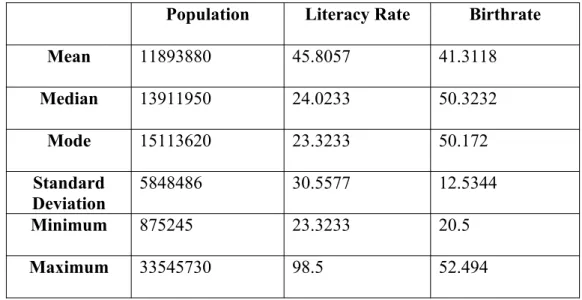
tendency and spread for the controls coded as continuous ratio variables. The lowest population
was found in Oman, and the highest population was found in Sudan. The highest literacy rate and
lowest birthrate were found in Israel, and the lowest literacy rate and highest birthrate were
found in Afghanistan.
Figure V. Measures of Central Tendency and Spread, Control Variables
Population Literacy Rate Birthrate
Mean 11893880 45.8057 41.3118
Median 13911950 24.0233 50.3232
Mode 15113620 23.3233 50.172
Standard
Deviation 5848486 30.5577 12.5344
Minimum 875245 23.3233 20.5
Maximum 33545730 98.5 52.494
c) Method
Since my dependent variable is binary, I ran tests on my hypotheses using probit
regression models in Stata. Probit models are appropriate because they are specifically designed
for dichotomous or binary outcomes, and the normal distribution for the data is modeled
linearly.47 My outcome is a “success/failure” model, because the only options are for groups to
ally (“1”) or not ally (“0.”) Due to the fact that probit models cannot directly interpret
coefficients, I also utilized the statistical software Clarify, which estimates what the substantive
47 “Stata Data Analysis Examples: Probit Regression”, Institute for Digital Research and Education, UCLA,
effect of each variable is.48 I found that if I hold sponsorship at 0 and increase oil, alliances with
low levels of oil (0 or mean level) stay somewhat low, but if I increase oil to the +1 standard
deviation level, then the probability of alliance increases. In this way, having more oil in the
ground increases probability of alliance. Ultimately, I discovered from Stata and Clarify that
alliances are more likely with high levels of oil as well as high levels of state sponsorship.
d) Results
Figure V. Access to Oil Reserves; Access to State Sponsorship
No oil Mean oil Mean oil + 1 standard deviation 0
0.1 0.2 0.3 0.4 0.5 0.6 0.7 0.8
State Sponsor No State Sponsor
No State Sponsor State Sponsor
Oil = 0 0.097 0.552
Oil = 3.2 0.107 0.582
Oil = 20.14 0.l86 0.727
48 Gary King, “Clarify: Software for Interpreting and Presenting Statistical Results,” Harvard University, 1 June 2001,
The results are consistent with both of the hypotheses, and interestingly reveal several
nuances that the case studies do not. We see that both the sponsorship and the oil variables are
statistically significant at the p < .013 level and in the anticipated direction. To substantively
interpret the results, I estimate the effect of the explanatory variables on the predicted
probabilities of an alliance while holding the other variables constant. First, let us consider the
effect of lootable resources, or the level of oil reserves in a given state. I estimated the
probability of an alliance at three different levels of oil reserves: no oil (0), mean oil (3.2), and
max oil (20.14, found by increasing the mean oil by one standard deviation.) As access to oil
increases from zero to mean the level, chances of alliance increase by 10.3%. When increased
from the mean level to the max level, they increase by 73.83%. However, we see that the results
are more powerful when a sponsor is active in the dyad. When a sponsor is added to groups with
access to maximum levels of oil, the chances of alliance increase by 291.9%. For groups with no
access to oil, the addition of a state sponsor increases their probability of alliance by 469%.
Ultimately, I found that the lowest probability of alliance occurs when there is no oil and
no sponsor (9.7% chance of alliance), and the highest probability of alliance occurs where the
maximum amount of oil is present, as well as a sponsor (72% chance of alliance.) That being
said, results show that access to a state sponsor is a more powerful indicator of rebel alliance
than access to oil, although both are statistically significant and contribute to alliance formation.
The coefficients for sponsorship and oil reserves are positive and significant at the 0.05 level
(more specifically, at the 0.013 level.)
VI. Case Study Analysis
I have selected four case studies to study intensively in order to demonstrate support for
sponsorship of the Taliban, who had access to opium. Where there is no sponsor and access to
resources, I plan to use ISIS, who has access to oil. Where there is a state sponsor and no
resources, I plan to use Iran’s sponsorship of Hezbollah. Lastly, where there is no state sponsor
and no access to resources, I plan to use the Palestinian groups Hamas and Fatah.
a. Pakistan and the Taliban
Pakistan has long been suspected of actively sponsoring the Taliban, a group that mainly
operates within and targets Afghanistan. While Pakistan denies that they currently sponsor the
Taliban, substantial evidence, outlined below, exists to the contrary. I argue that the presence of
this sponsorship, coupled with easy access to opium and a monopoly over Afghan opium
markets, makes it difficult for the three factions of the Taliban— the Quetta Shura, Haqqani
Network, and Hezb-i-Islami— to foster enduring alliances with other groups. The Taliban has
sometimes allied with other groups in the past, but these alliances proved to be unstable and
difficult to iterate over time. Instead, the Taliban tended to form temporary alliances with groups
such as al-Qaeda or the IMU (Islamic Movement of Uzbekistan) that would help them regain
their strength when they were weak.49
The Taliban emerged in the early 1990s after the withdrawal of Soviet troops from
Afghanistan. Pakistan supported them from the beginning, as they did not want the mujahedeen
to consolidate too much power after the withdrawal of the Soviet Union and move Afghanistan
away from Pakistan’s orbit. Predominantly Pashtun, the Taliban initially promised to restore
peace and enforce sharia law, and by 1998 they had gained control over almost 90% of
49Abubakar Siddique, “In Afghanistan IMU-Taliban Alliance Chips Away at the Stone,” The Pashtun Question, 9 June
Afghanistan.50 Afghans generally looked upon the Taliban favorably when they first emerged,
seeing them as a departure from the excesses of the mujahideen that fought against the Soviet
Union. Indeed, the Taliban paved roads, increased commerce, and lowered corruption while they
were in control,51 but their puritanical views led to unpopularity domestically and abroad, and
they were overthrown by a U.S.-led military coalition in October of 2001.52 After the invasion,
the Taliban regrouped remarkably quickly by drawing on “tribesmen alienated by civilian
casualties and government abuse to reconstitute their command structure, recruitment and
funding networks.” However, most important here was the reconstitution of their logistical bases
in Pakistan.53 The state of Afghanistan was still tremendously weakened, as it had to figure out
how to be a functional state in the new millennium, as well as how to cooperate with its
neighboring regions and maintain its sovereignty. In order to do this, it was necessary to form a
legitimate government that could secure its territory with a “geopolitical identity”54 unthreatening
to Pakistan, who was accustomed to meddling in Afghanistan’s affairs often.55 Indeed, Pakistan
had a reputation in the region of taking advantage of wars in and around Afghanistan to further
its security aims, and often tried to neutralize Afghan nationalism by supporting Islamist rebel
groups that relied on street violence and asymmetrical warfare, such as the Taliban.56
Pakistan has repeatedly denied current involvement with the Taliban, but this claim is
regarded with suspicion around the region and the world. Many Afghan members of the Taliban
were educated in religious schools, or madrasas, in Pakistan, and Pakistan was one of only three
countries (the other two being Saudi Arabia and the United Arab Emirates) that recognized the
50 John Simpson, “Who are the Taliban?” BBC, 1 November 2013,
http://www.bbc.com/news/world-south-asia-11451718.
51 Ibid. 52 Ibid.
53 Barnett R. Rubin, “Saving Afghanistan,” Foreign Affairs 86 no. 1 (2007): 58 54 Ibid. 66
Taliban when they were in power in Afghanistan. Pakistan was also the last country to break
diplomatic ties.57 With Pakistan’s help, those opposed to the Taliban— called the "Northern
Alliance" and mainly consisting of perpetually quarreling, non-Pashtun former mujahideen—
were pushed back to a few pockets of territory in the northeast, and the Taliban was able to rule
almost unopposed in Afghanistan due to Pakistan’s help.58 It has been argued that Pakistan is the
epicenter of “terrorism of global reach,”59 and that it was only with Pakistan’s help that the
Taliban was able to take such widespread control of Afghanistan in 1998. The safe haven
provided by Pakistan’s active sponsorship has not only allowed the Taliban to survive, but to
“broaden and deepen their presence” across the border regions and in Afghanistan. Despite
repeated victories by the Afghan military and international forces against the insurgency, the
extreme weakness of the Afghan government and the continued sanctuary enjoyed by the
Taliban in Pakistan has allowed the group to survive.60 Studies suggest that few insurgencies
with safe havens in other countries are defeated, and the persistence of “coordinated
antigovernment violence” and cross-border insurgency points directly to state sponsorship.61
In 2006, leaked ISI papers confirmed that Pakistan knew the location of many of the
Taliban’s top leaders, and that it had been intimately involved in the success of the group over
time.62 Though this was suspected, the leaked papers proved it definitively. Allegedly, Pakistan
has had a direct hand in: soliciting funding and bankrolling Taliban operations; providing
diplomatic support to the Taliban abroad; using its own security forces to train and recruit
Taliban fighters; and donating shipments of ammunition, fuel, and direct combat support in
57 Simpson, “Who are the Taliban?” http://www.bbc.com/news/world-south-asia-11451718. 58 Rubin, “Saving Afghanistan,” 65.
59 Ibid. 58 60 Ibid. 70 61 Ibid. 71
62 Quentin Sommerville, “Pakistan Helping Afghan Taliban—NATO,” BBC, 1 February 2012,
battle.63 For example, Pakistani aircraft conducted troop rotations for the Taliban in late 2000,
and throughout the 1990s, the Taliban would often arbitrarily show new military prowess and
innovation. Between 1995 and 1999, the Taliban's military skills often improved abruptly
immediately preceding pivotal battles. For example, after Taliban offensives in Kabul were
decisively routed by the Afghan military in 1995, Taliban troops reemerged a few months later
displaying remarkable increases in speed and technical capability, as well as a move away from
mujahideen “hit-and-run style raiding and skirmishing” that seemed to be a direct product of
formal training.64 Indeed, Afghan sources reported that in 2001, as many as thirty trucks were
crossing the “notoriously porous” border each day carrying artillery shells, tank rounds, and
rocket-propelled grenades. Additionally, Pakistani-made anti-personnel and anti-vehicle
landmines have been found in Afghanistan.65
One very important part of this cross-border insurgency has been the enormous
smuggling network running parallel to it. Drugs form a huge part of this network, and provide
the livelihoods of the peoples living on the border, as well as warlords and corrupt soldiers and
officials. However, the people who benefit most are the Taliban operatives.66 This illicit
economy has slowed the licit economy to the point of devastation, and the total export value of
Afghan opium has been estimated to be thirty to fifty percent of the total economy.67 Per U.S.
State Department data, Afghanistan continued its streak as the world's largest opium producer
into the new millennium, and accounted for 72 percent of the world's supply of opium in the year
2000.68 Despite pervasive drought conditions throughout the country, estimates indicate that
63 Human Rights Watch, “Crisis of Impunity,” Human Rights Watch, July 2001,
http://www.hrw.org/reports/2001/afghan2/Afghan0701-02.htm
64 Ibid. 65 Ibid. 66 Ibid. 69
67 Rubin, “Saving Afghanistan,” 77
68 “Narcotics Control Reports: 2000 INCSR, Southwest Asia,” State.gov, 1 March 2001,
cultivation increased by 25 percent and potential production reached 3,656 metric tons that
year.69 The Taliban controlled 96% of the territory used by cultivators, refiners and traffickers,
and promoted poppy cultivation as a way to finance arms purchases as well as its military
operations. Opium trading in Afghanistan is a highly profitable endeavor, as it is non-perishable
and has a very stable market value. After it is processed, Taliban authorities often facilitate the
transit and export of drugs.70 Taken together, Pakistan’s state sponsorship and the Taliban’s
unlimited access to opium have influenced the Taliban’s ability to form lasting alliances with
other groups. Since they have access to funds from Pakistan and cash flows from Afghan opium,
their alliances with other groups are unstable because they are able to get lootable resources or
disposable income elsewhere. While the Taliban itself is an alliance between the Haqqani, Quetta
Shura, and Hezb-i-Islami networks, this alliance may be tested by resource conflicts and ensuing
infighting later, as was seen with the mujahideen after the withdrawal of the Soviet Union in the
1980s. Additionally, the Taliban alliance only tends to reach out to and ally with other groups
outside of the current three when they are at their weakest.71
b. ISIS
ISIS has existed in some form since early 2004, but has really risen to prominence as of
the writing of this research project. An acronym for Islamic State in Iraq and Syria (alternatively
al-Sham or the Levant), ISIS is a primarily Sunni group seeking to overthrow the Iraqi
government and replace it with a self-styled Islamic caliphate, or a transnational state based on
sharia law. ISIS is somewhat of an umbrella organization, as it has incorporated many smaller
69 Ibid. 70 Ibid.
71 Abubakar Siddique, “In Afghanistan IMU-Taliban Alliance Chips Away at the Stone,”
groups into itself,72 but its formal alliances with more powerful groups never seem to last very
long. In the summer of 2014, ISIS notably allied with the remaining Ba`athists, or those loyal to
Saddam Hussein. They are often called the “deep state,” or Men of the Army of the Naqshbandia
Order (J.R.T.N.)73 The Ba`athists’ deep social and cultural ties to the community helped ISIS
take over these regions, and many analysts do not believe that ISIS would have enjoyed a
fraction of the success that it did without the help from the Ba`athists or other Sunni groups.74
However, these two groups are diametrically opposed ideologically, and ultimately, the alliance
failed. ISIS is a mostly foreign group, boasting membership from a variety of places, while the
Naqshbandia is “homegrown,” and attractive to many Sunnis because of their religious
moderation, Sunni nationalism, and perceived willingness to cooperate with the people.75 ISIS
has access to oil, from which it draws most of its disposable income, and no state sponsor. As of
November 2014, ISIS gains up to 6 million dollars a day in revenue.76 Since there is no guarantor
to mitigate incentives to defect, and ISIS can draw so much money from oil, alliances with any
group would be difficult to sustain. Factoring in the ideological differences between the two
groups makes iteration of the alliance even less likely.
ISIS first emerged in 2004 as Jama'at al-Tawhid wa'al-Jihad (The Monotheism and Jihad
Group.)77 By October 2004, it was usually referred to as al-Qaeda in Iraq, or AQI, since Abu
72 “General One-Sided Violence Information: Iraq,” Uppsala Universitet, n.d.,
http://www.ucdp.uu.se/gpdatabase/gpcountry.php?id=77®ionSelect=10-Middle_East#
73Tim Arango, “Uneasy Alliance Gives Insurgents an Edge in Iraq,” The New York Times, 18 June 2014,
http://www.nytimes.com/2014/06/19/world/middleeast/former-loyalists-of-saddam-hussein-crucial-in-helping-isis.html?_r=0.
74 Ibid. 75 Ibid.
76 Janine di Giovanni, Leah McGrath Goodman, and Damien Sharkov, “How Does ISIS Fund Its Reign of Terror?”
Newsweek, 6 November 2014, http://www.newsweek.com/2014/11/14/how-does-isis-fund-its-reign-terror-282607.html.
77 “General One-Sided Violence Information: Iraq,” http://www.ucdp.uu.se/gpdatabase/gpcountry.php?
Musab al-Zarqawi, its leader, had pledged allegiance to Osama bin Laden, and bin Laden had
named al-Zarqawi his representative in Iraq. ISIS remained the al-Qaeda representative until
2014, when al-Qaeda renounced ties. Despite losing its relationship with al-Qaeda, ISIS was able
to flourish due to its access to oil fields, which proved lucrative enough to sustain the group. In
2013, the name changed again to ISIS, after the group strengthened its presence in Syria, and its
new name reflects its broadened regional ambitions.78 After the U.S. troop withdrawal in late
2011, ISIS began to increase its attacks against civilians, primarily Shia, in a plan to “reignite”
sectarian violence between the Sunni majority and Shia minority (currently in power under
Prime Minister Nouri al-Maliki.)79 Today, ISIS is headed by the elusive Abu Bakr al-Baghdadi,
who is considered a brilliant, yet ruthless tactician. His battlefield command is thought to make
ISIS more attractive to young people than al-Qaeda, which is ruled by Islamic theologian Ayman
al-Zawahiri.80 It is suspected that ISIS may soon supersede al-Qaeda as the most powerful rebel
group in the region, as it is already the most cash-rich. Additionally, its takeover of two major
Iraqi cities, Fallujah and Mosul, put the entire region at risk in the summer of 2014, and allied
forces are still trying to regain control as of the writing of this paper.81
While ISIS has played a large role on the side of the opposition in the Syrian Civil War,
relationships with other rebel groups are often strained, as ISIS has developed a reputation for
attacking other rebels and civilian noncombatants.82 By February 2014, al-Qaeda’s general
command cut ties with the increasingly brutal ISIS, stating that ISIS “is not a branch of the
al-78 Ibid.
79 Council on Foreign Relations, “Background Briefing: What is ISIL?” PBS, 24 June 2014,
http://www.pbs.org/newshour/rundown/what-is-islamic-state-iraq-and-syria/.
80“Profile: Islamic State in Iraq and the Levant,” BBC, 16 June 2014,
http://www.bbc.com/news/world-middle-east-24179084.
81 Ibid.
82 Liz Sly, “Al-Qaeda Disavows Any Ties with Radical Islamist ISIS Group in Iraq, Syria,” Washington Post, 3 February
Qaeda group… does not have an organizational relationship with it, and [al-Qaeda] is not the
group responsible for their actions.”83 This was the first time al-Qaeda leadership had formally
renounced a former affiliate, and losing ISIS meant that al-Qaeda no longer had any affiliates in
Iraq.84 It is suspected that the reasons behind this concerned public image, and that despite
al-Qaeda’s reputation for brutality, ISIS’s brutality had exceeded even their limitations.85
Additionally, after an attempt at alliance with al-Qaeda affiliate Jabhat al-Nusra Front in Syria
failed, al-Qaeda instructed ISIS to “focus on Iraq and leave Syria to al-Nusra,”86 but ISIS directly
defied this order and has been attacking rebels, civilians, and al-Nusra members for the past
several months, leading to mass confusion and thousands of deaths.87 The map below, courtesy
of the BBC, depicts the different rebel-held strongholds (Kurdish, ISIS, and Free Syrian Army),
contested areas, and government held areas. The number of rebel-on-rebel clashes clearly shows
the gravity of the situation between ISIS and al-Nusra. However, ISIS appears to get stronger
each day, despite spreading themselves increasingly more thinly throughout the region, due to
their access to lootable natural resources, namely, oil.
83 Ibid. 84 Ibid. 85 Ibid.
ISIS has aggressively pursued its agenda of creating an Islamic caliphate since early
2014. After the group captures a territory, state-like institutions are immediately set up that allow
for immediate administration of the areas that come under its control. Noticing this, some
scholars have said that ISIS has begun exhibiting some traditional “markers of sovereignty”,
such as fielding a militia, limited service provision, and administration of its “ultraconservative
brand of justice.”88 ISIS now controls land and population comparable to the size of Austria, and
has 8 million people under its control.89 Additionally, ISIS strategically uses the resources
available in those regions, and it is argued that ISIS’s control of oil fields in Raqqah, Syria were
what allowed it to flourish after the break with al-Qaeda.90 In fact, its continued control over
these oil fields, as well as other fields in central Syria and the border with Iraq, and a good
88 Council on Foreign Relations, “Background Briefing: What is ISIL?”
http://www.pbs.org/newshour/rundown/what-is-islamic-state-iraq-and-syria/.
89 Di Giovanni, Goodman, and Sharkov, “How Does ISIS Fund its Reign of Terror?” 90 Sly, “Al-Qaeda Disavows Any Ties with Radical Islamist ISIS Group in Iraq, Syria,”
relationship with middlemen in the region, have allowed it to fund many of its operations, and
even sell oil back to the Syrian government.91 In fact, it is thought that ISIS is in control of 60
percent of Syrian oil.92 Before the capture of Mosul, Iraq, ISIS’s net worth was estimated to be
approximately 90 billion dollars, mostly from the captured oil fields and the sale of looted
antiquities. After the capture, this figure skyrocketed to 200 billion dollars, as ISIS gained
control over the Mosul branch of Iraq’s central bank, as well as oil fields in northern Iraq.93 As of
July 12, 2014, ISIS was profiting at levels of approximately 1 million dollars per day from crude
oil sales, originating from captured refineries located in a stretch of territory that houses some of
Iraq’s prime oil assets. The oil is then refined and smuggled to Turkey and Iran, bringing in an
enormous profit for ISIS. By November 2014, the figure has risen to 6 million dollars a day,
with more than 1.5 billion dollars looted from Iraqi central banks.94 They also loot antiquities, tax
vendors, residents, and shopkeepers, and hold people for ransom. The profit is so enormous that
ISIS does not need to cooperate with other groups. Despite the fact that ISIS only controls
80,000 barrels a day in Iraq, out of a total capacity of 3 million, and lacks the expertise necessary
to maintain oil fields in the long run, they are still profiting enough to make cooperation with
other groups unlikely.95 The alliance with the Ba`athists helped their initial popularity, but in the
long run ISIS’s access to resources and their lack of sponsor will only encourage opportunistic
behavior, with ISIS wanting to keep as much oil as possible under their control. Since there is no
state sponsor to force them to share, ISIS will undermine alliances with other groups in order to
maintain its control.
91 “Profile: Islamic State in Iraq and the Levant,” http://www.bbc.com/news/world-middle-east-24179084. 92Ma’ad Fayad, “ISIS in Control of 60 Percent of Syrian Oil: Sources,” Asharq al-Awsat, 11 July 2014,
http://www.aawsat.net/2014/07/article55334174.
93 “Profile: Islamic State in Iraq and the Levant,” http://www.bbc.com/news/world-middle-east-24179084. 94 Di Giovanni, Goodman, and Sharkov, “How Does ISIS Fund its Reign of Terror?”
c. Iran and Hezbollah
In March of 2006, then-U.S. Secretary of State Condoleezza Rice called Iran the “central
banker for terrorism.” Less than a year later, the Iranian Revolutionary Guard Corps
(IRGC) were added to the Foreign Terrorist Organization (FTO) list for their involvement with
various Middle Eastern rebel groups, specifically with Hezbollah in Lebanon.96 The U.S. State
Department stated that it considers Iran the world's "most active state sponsor of terrorism," as
U.S. analysts claim Iran provides “funding, weapons, training, and sanctuary”97 to numerous
terrorist groups, creating an international security dilemma. Additionally, Iran's pronouncements
that it has managed to enrich uranium and develop new missile technology have heightened
alarm worldwide that these weapons will be transferred to militant groups. Iran's leaders deny
these accusations, but progressively more sanctions have been placed on Iran over the years
regardless.98 Iran’s sponsorship of Hezbollah is practically a definitional example of active state
sponsorship. Hezbollah has been able to sustain alliances with other rebel groups due to Iran’s
influence as a mediator, power broker, and funder for the group. Iran acts as a deterring force,
intercepting incentives to defect, and metes out punishments for defection accordingly by
decreasing funding when groups enter ceasefires or are thwarted by political considerations.99
Today Hezbollah has a fair degree of financial autonomy due to its independent investments and
charities, but it continues to rely on significant funding from Iran to maintain its social services
infrastructure and equip its resistance force. Since it does not have access to natural resources,
96Greg Bruno, “State Sponsors: Iran,” Council on Foreign Relations, 13 October 2011,
http://www.cfr.org/iran/state-sponsors-iran/p9362.
97 Ibid. 98 Ibid.
99 Matthew Levitt, “Hezbollah Finances: Funding the Party of God,” The Washington Institute, February 2005,
Hezbollah is forced to rely on cash flows from Iran and income derived from investments and
front charities to survive.100
Hezbollah is a Shia political party and militant group that maintains “an extensive
security apparatus, political organization, and social services network” in Lebanon, where it is
often described as a “state within a state.”101 Hezbollah is mainly based in the Shia areas of
Lebanon, which include parts of Beirut, most of southern Lebanon, and the Bekaa Valley in the
east. Hezbollah’s main aim is resisting the State of Israel and Western involvement in the Levant
and Middle East, which has made the group a convenient proxy for Iranian foreign policy, as
well as a convenient means by which to extend Iran’s international reach, allowing it to “target
its enemies from afar with reasonable deniability.”102 Hezbollah, which means "Party of God" in
Arabic, first emerged in 1985, during the fifteen-year-long Lebanese Civil War and following the
1982 Israeli invasion and ensuing occupation. Israel was attacking in an attempt to expose and
expel Palestinian militants in southern Lebanon, but the attack caused formerly disenfranchised
Shia to begin fighting for an “Iranian-style” clerical regime.103 By 1985, Hezbollah had issued its
founding manifesto and coalesced into a cohesive organization pledging loyalty to Iran’s
Supreme Leader Ayatollah Khomeini and calling for the ejection of Western powers and Israel
from Lebanese territory.104 Specifically, the manifesto stated that the group’s primary aim was to
fight Israel, stating that “the Zionist entity is aggressive from its inception, and built on lands
wrested from their owners, at the expense of the rights of the Muslim people. Therefore our
100 Amal Saad-Ghorayeb, “Hezbollah’s Iran Money Trail: It’s Complicated,” al-Akhbar, 31 July 2012,
http://english.al-akhbar.com/node/10553.
101 Jonathan Masters and Zachary Laub, “Backgrounders: Hezbollah,” Council on Foreign Relations, 3 January 2014,
http://www.cfr.org/lebanon/hezbollah-k-hizbollah-hizbullah/p9155.
102 Matthew Levitt, “30 Years of Terror Sponsored by Hezbollah,” New York Daily News, 23 October 2013,
http://www.nydailynews.com/opinion/30-years-terror-sponsored-iran-article-1.1493410.
103Masters and Laub, “Backgrounders: Hezbollah,”
http://www.cfr.org/lebanon/hezbollah-k-hizbollah-hizbullah/p9155.
struggle will end only when this entity is obliterated."105 Hezbollah's top commander, called the
“general secretary,” is chosen by a seven-member shura council, which oversees five
sub-councils: the political assembly; jihad assembly; parliamentary assembly; executive assembly;
and judicial assembly. Hassan Nasrallah has served as general secretary since 1992.106
At the time of its founding, the burgeoning movement received critical financing from
Iran, and military training from its Revolutionary Guards. In October 1983, the group received
international attention after its suicide attacks on the U.S. Embassy and Marine Corps barracks in
Beirut. The attacks killed 258 Americans and encouraged President Ronald Reagan’s withdrawal
of the U.S. Marines deployed to Lebanon a few months later.107 Through the years, Iran has
continued to support Hezbollah, despite facing increasingly crippling international economic
sanctions. The U.S. Department of Defense estimates that Hezbollah receives over 200 million
dollars from Iran each year.108 This amount keeps increasing parallel to Iran’s continued interest
in undermining Israeli-Palestinian peace efforts and destabilizing both sides of the conflict. Iran
continues to view Hezbollah as its proxy in achieving this goal, and provides funding on a
result-oriented basis.109 For example, in 2006, militants and Israeli Defense Force (IDF) soldiers
collided in a month-long rocket exchange on the Israeli-Lebanese border. IDF forces were
shocked to see that Hezbollah possessed sophisticated anti-ship and anti-armor weapons,
presumably provided by Iran, and despite heavy casualties, Hezbollah’s “resistance credentials”
skyrocketed after the conflict, prompting more funding from Iran.110 Indeed, upon the election of
perceived moderate Hassan Rouhani in August of 2013, an Iranian official was quoted
105 Ibid. 106 Ibid. 107 Ibid. 108 Ibid.
109Levitt, “Hezbollah Finances: Funding the Party of God,”
http://www.washingtoninstitute.org/policy-analysis/view/hezbollah-finances-funding-the-party-of-god.
110Masters and Laub, “Backgrounders: Hezbollah,”
reaffirming that “Hezbollah, to Iran, isn't a card to play with.” He then added, “Hezbollah today
is the crown jewel of the resistance bloc; presidential moderation doesn't mean giving up the
nation's strengths. Iran's main enemy in the region is Israel, and Hezbollah defeated Israel in
2006, and is capable of defeating it once again if a war sparked.”111
Indeed, there is overwhelming evidence that Iran had prior knowledge of Hezbollah
attacks, including kidnappings, murders, and bombings of Jewish institutions, and actively
encouraged the above-mentioned 2006 attack on Israel by arming the Hezbollah militants.112
Iran’s support of Hezbollah is mostly divided between cash funds and material goods, such as
weapons, and it is well-known that Iranian cargo planes deliver advanced weaponry, from
rockets to small arms, to Hezbollah regularly.113 Weapons are often offloaded in Syria and
trucked to Hezbollah camps in the Bekaa Valley. Iran also utilizes private charities linked to
Iranian Supreme Leader Khomeoni as fronts to funnel money, while claiming that the money
actually supports "health care, education and support of war widows."114 Beyond tangible
support, Iran also provides Hezbollah with logistical support, such as using its armed forces to
train militants, and operational support, such as battle plans overseen by Iranian officials.115 Iran
runs a variety of training programs and camps for Hezbollah, and expanded this assistance to
Palestinian groups Hamas, Palestinian Islamic Jihad (PIJ), and Popular Front for the Liberation
of Palestine (PFLP) during the al-Aqsa Intifada in 2002. In addition to the above-mentioned
logistical and operational support, Iran also funds al-Manar, Hezbollah’s propaganda machine
and television station.116 When al-Manar was founded in 1991, it reportedly received 1 million
111Ali Hashem, “Iran’s Ties to Hezbollah Unchanged,” al-Monitor, 10 August 2013,
http://www.al-monitor.com/pulse/originals/2013/08/iran-hezbollah-policy-will-not-change-under-rouhani.html.
112Bruno, “State Sponsors: Iran,” http://www.cfr.org/iran/state-sponsors-iran/p9362. 113Levitt, “Hezbollah Finances: Funding the Party of God,”
http://www.washingtoninstitute.org/policy-analysis/view/hezbollah-finances-funding-the-party-of-god.
dollars of “seed money” from Iran, and by 2002, received 15 million dollars each year.117
Another element of Iran providing funding to Hezbollah is a network of charitable religious
foundations within Iran’s civil society. Known as bonyads, these foundations are endowments
that possess enormous tracts of land, as well as several decades worth of individual donations.118
They have become formidable business and industry consortiums within Iran, and command a
percentage of the Iranian economy so large that some believe an “unofficial parallel economy
that competes with and undercuts the private sector” has been created.119 They not taxed and not
required to publish their earnings, so they are not controlled by the state and are instead headed
by former government officials and respected religious figures. This affords them a large amount
of political clout. Since they are headed by these political figures, they cannot be considered to
be apolitical, and by extension cannot be considered to fully form a part of civil society. Thus,
any financial assistance from the bonyads to Hezbollah does not “fall outside the realm of the
Iranian state” per international standards.120
A state sponsor is even more helpful for a group like Hezbollah than it would be to other
groups, due to Hezbollah’s multi-faceted nature. Because Hezbollah encompasses “terrorist,
guerilla, political and social-welfare wings”121 that are all intertwined under a singular
movement, the varied forms of support provided by Iran prove to be just as significant as the
cash flows it also provides, especially given that Hezbollah does not have access to resources
that could increase its income like ISIS or other groups do. Technical, operational, and combat
support would be difficult for Hezbollah to find elsewhere, and it is more able to use money it
raises elsewhere (expat remittances, front charities, criminal activities, etc.) for other ventures,
117 Ibid.
118 Saad-Ghorayeb, “Hezbollah’s Iran Money Trail: It’s Complicated,” http://english.al-akhbar.com/node/10553. 119 Ibid.
120 Ibid.
121Levitt, “Hezbollah Finances: Funding the Party of God,”
such as providing its members with unsuspicious day jobs, funding grassroots initiatives among
Shia in Lebanon, and overall projecting a false sense legitimacy outwards. For example,
Hezbollah runs a network of approximately fifty hospitals throughout Lebanon.122 Since it has so
much money pouring in reliably from Iran for its less savory activities, Hezbollah does not need
to spend its time raising or laundering money, and also does not need to rely on front charities to
raise money to the extent al Qaeda or Hamas does. In fact, despite its lack of access to natural
resources, Hezbollah has so few revenue constraints that it often serves as a middleman, funding
Palestinian and other cash-strapped terrorist groups around the region.123One of the first public
admissions of Iran’s assistance to Hezbollah after decades of reticence came on Quds Day 2009,
when Hassan Nasrallah thanked Iran, stating that “[By providing us] with the Islamic Republic
of Iran, God has enabled us not to resort to others. And we have enough money and weapons to
carry out our duty...”124 Today, Hezbollah is able to target Israeli tourists around the world, in
countries such as Bulgaria, Cyprus, Thailand, Nigeria, and several others. In the 2012 Country
Report on Terrorism, the U.S. State Department concluded that due to this, 2012 represented “a
marked resurgence of Iran’s state sponsorship of terrorism” in which “Iran and Hezbollah’s
terrorist activity has reached a tempo unseen since the 1990s.”125
d. Hamas and Fatah
Palestinian rebel groups Fatah and Hamas have been in existence for several decades.
However, they have never managed to secure state sponsorship, have no access to natural
resources as a lootable source of income, and have never been able to form a reliable alliance
122 Ibid. 123 Ibid.
124Saad-Ghorayeb, “Hezbollah’s Iran Money Trail: It’s Complicated,” http://english.al-akhbar.com/node/10553. 125 Levitt, “30 Years of Terror Sponsored by Hezbollah,”
with each other. I argue that this stems from their lack of state sponsor. Although they have been
sponsored by sub-state actors such as the Muslim Brotherhood in past decades, they have never
had a state sponsor to mitigate commitment problems. Additionally, their target state, Israel, has
a history of negotiating with rebel groups and offering concession packages to those willing to
defect. In fact, Fatah has often been accused of bending to Israel’s will or giving in to Israel’s
demands at the cost of its own ideals.126 This has worsened already pervasive commitment
problems and increased incentives to defect, and truces between the two groups never seem to
last long. In April 2014, Hamas and Fatah agreed to a truce that would form a unity government,
but the alliance did not last the summer. Both of these groups defected from unity deals in 2007,
2011, and twice in 2012, and since there is no state or actor overseeing that they maintain their
commitments to each other, it was unlikely their most recent alliance would last.127 They have
“fundamentally different” approaches towards Israel, the state that separates the West Bank and
the Gaza Strip and splits Jerusalem in two, and Hamas refuses to join the PLO, the umbrella
organization Fatah is a member of.128 Fatah is known for a “pragmatic” approach, sacrificing
elements of ideology and implicitly recognizing Israel as a state, but gaining a place in the
international order that could potentially project the Palestinian plight more effectively.129
Hamas, on the other hand, chose to continue to pursue its “combination of asceticism and
nationalism,” by gaining and maintaining power on the ground at the expense of its reputation
and the viability of its goals internationally.130 This led to competing strategies. Fatah sought to
“create a proto-state to be recognized by the international community,” while Hamas “steadfastly
126Danielle Wiener-Bronner, “A Brief History of the Fraught Relationship between Fatah and Hamas,” The Wire, 24
April 2014, http://www.thewire.com/global/2014/04/a-brief-history-of-the-fraught-relationship-between-fatah-and-hamas/361178/.
127Ibid. 128 Ibid.
rejected all negotiations leading to a two-state solution” and stayed true to its ideology as much
as was possible.131
Hamas is the largest of several militant Palestinian rebel groups. An acronym for “Islamic
Resistance Movement,” Hamas emerged in 1987, immediately following the First Intifada, a
struggle against Israeli occupation in response to the widely disputed Oslo Accords.132
Clampdowns by the Palestinian Authority and Israel throughout the 1990s— which included
heightened arrests, executions, and the closing of many charities thought to be fronts— led to
increased defections and disillusionment from former supporters, and greatly weakened Hamas
from the inside out.133 However, Hamas found suicide attacks to be a very useful way to veto any
sort of negotiations, and many Palestinians supported them. Not only was Hamas viewed as
“filling the vacuum” left by the corruption of Fatah and the Palestinian Authority,134 but a large
amount of the public began viewing "martyrdom operations”135 as a way to avenge everything
they had lost, as well as to protest Israel’s pervasive settlement building in the West Bank,
considered by Palestinians to form part of the Palestinian state.136 Following the failure of Bill
Clinton's Camp David Summit in 2000 and the ensuing the Second Intifada (known as the
al-Aqsa Intifada), Hamas gained popularity with its constituents through its creation of clinics and
schools. In this manner, Hamas found a way to keep its popular support through providing
drastically needed services to a very needy population, while creating institutional frameworks
131 Ibid.
132Sara Roy, “Hamas and the Transformation of Political Islam in Palestine,” Center for Middle Eastern Studies,
January 2003, http://www.oakton.edu/user/2/emann/HIS140CLASS/CURRENTHISTORYreadings/ IsraelPalestineAuthority/HamasTransformationofPoliticalIslam.pdf.
133 Ibid. 134 Ibid.
135Profile: Hamas Palestinian Movement,” BBC, 11 July 2014,
http://www.bbc.com/news/world-middle-east-13331522.