* PhD in Nursing, Assistant Professor, School of Nursing and Midwifery, Tehran University of Medical Sciences, Tehran, Iran.
** PhD in Nursing, Associate Professor, Department of Post Graduate, School of Nursing and Midwifery, Tehran University of Medical Sciences, Tehran, Iran. *** MSc in Nursing Education, Tenure Faculty Member, School of Nursing and Midwifery, Hamadan University of Medical Sciences, Hamadan, Iran.
Correspondence to: Mohammad Ali Cheraghi, PhD. Email: [email protected]
Original Article
Ambiguity in knowledge transfer: the role of theory-practice gap
Mohammad Ali Cheraghi
*, Mahvash Salsali
**, Mahmoud Safari
***Abstract
BACKGROUND: In spite of much literature written about the theory-practice gap in the international nursing journals, there is evidence that indicates this subject has not been probed comprehensively since nursing education was transferred to universi-ties in Iran. In the recent years, the public and the government have criticized Iranian nurses because of poor quality of patient care. Although this subject has been lamented by some researchers, there is no comprehensive work on how this gap resulted. In the process of a larger study on “nursing knowledge translation to practice", of one PhD thesis, this process was explored.
METHODS: Using grounded theory analysis, in-depth interviews were undertaken with a purposive sample of 29 nurses, with different levels of experience, from the school of nursing in Tehran University of Medical Sciences in 2006 from Jan-uary to August. Data were analyzed using the constant comparative method.
RESULTS: Three main themes emerging from this study included clinical behavior structure, paradoxical knowledge and practice, and divergent nursing organization.
CONCLUSIONS: It seems that nursing education with some praxis and paradoxes in the realm of nursing knowledge and practice, along with divergent organizational structure have decreased nurses’ ability in applying their professional know-ledge and skills in order to bridge the gap between theory and practice. Moreover, in spite of increased academic input into nursing education, clinical behaviors of both education and practice settings was perceived as “traditional routine-based”.
KEYWORDS: Iran, nursing, qualitative research, nursing theory, knowledge.
IJNMR 2010; 15(4): 155-166
ursing in the 21st century involves complex and highly specialized care. To meet the demands of health service provision, nurses need to have sound theoreti-cal knowledge as well as proficient practitheoreti-cal skills.1 Research in several countries provides consistent evidence of the existence of a theory– practice gap in nursing. Nursing education in Iran has undergone much change since the first training schools for nurses were opened in the 1940s. Having become accepted as a respectable occupation within Iran, nursing has now turned its attention to the academic paradigm. At present, the nursing programs in Iran offer a four year baccalaureate as a community oriented nursing program with the philosophy
of health for all in nursing. The four-year nurs-ing education program consists of three years of theoretical education in which courses are pur-sued in schools of nursing and one year of clini-cal practice in hospitals.2 Moreover there are 184 centers offering the BSc degree, 18 centers offer-ing the MSc degree, and 11 offeroffer-ing the PhD degree in nursing. Furthermore, there is a cen-tralized curricular in nursing education at all these nursing programs in the country, and all nurses receive the same type of education.3,4
Aims of nursing education principally cen-ter on the transmission of nursing knowledge, and assisting nursing students to acquire the necessary skills and attitudes associated with nursing practice.5 With the transition of nurse
N
education into universities, concern has been raised about the usefulness of theoretical knowledge in practice.6 Studies in this arena were named metaphorically as theory-practice gap. This so-called theory–practice gap ap-pears to be a global phenomenon and has been repeatedly debated within nursing; with many pages of journals devoted to the issue.7-14 Most of these studies have linked the problem to the nurses’ knowledge and skills. In fact, the much written about theory-practice gap indicates that knowledge gained by nurses in the class-room may be perceived to bear little resem-blance to what is needed in practice; that is, academics are perceived to teach content that is inappropriate for use in the practice arena.10 Unfortunately there is literature to suggest that nurses do not always provide the care they had been taught in the classroom and conse-quently, they cannot perform competently in clinical settings in their transition period; do not integrate the theory to practice, and do not systematically utilize the research findings in their daily nursing cares.15-17 Accordingly, in recent years, the public and the government have criticized Iranian nurses because of poor quality of patient care,18 and the divergence between nursing theory and clinical practice has been recognized and lamented by some nursing researchers in Iran. According to Nayeri et al,19 managers believed that staff’s lack of knowledge is a significant barrier to being productive and providing high quality of care and Hagbaghery et al20 implied that the nursing educational system did not function well. Moreover, nursing students were not sa-tisfied with the clinical component of their education. They experienced anxiety as a result of feeling incompetent and had a lack of pro-fessional nursing skills and knowledge to take care of various patients in the clinical setting.21
Although there are some limited literature on theory-practice gap in Iranian researchers work, nurses’ views and experience on the knowledge translation process have not been studied comprehensively. Thus, an important area for research is to obtain nurses’ perspec-tives on knowledge translation to practice for
effectively bridging the gap. This is mainly es-sential for administrators and educators to consider when designing strategies to improve practice settings and educational practices. Since exploring the knowledge translation process closely depend on recognition of lin-kage intensity between theory and practice in two settings of work environment and aca-demic area, this study focused on the expe-riences, perspectives and perceptions of Ira-nian nurses about metaphor of theory- practice gap as two sides of a coin: theory– practice/practice–theory gap.
The aim of this study was to explore the ex-periences, perspectives and perceptions of Ira-nian nurses about the metaphor of reciprocal theory- practice/practice-theory gap.
Methods
Design
Data were collected and analyzed using a grounded theory approach.22 This approach was selected because nurses’ practice takes place in a multidisciplinary team and grounded theory focuses on identification, description, and explanation of interactional processes be-tween and among individuals or groups within a given social context.23 In addition, Struauss’s version of grounded theory emphasized mean-ing, action, and process, consistent with his roots in pragmatism and symbolic interaction-ism.24 Taped in-depth interviews and partici-pant observations were conducted.
Participants
Purposeful sampling was used at first and con-tinued with theoretical sampling according to the codes and categories as they emerged. Par-ticipants initially comprised of 21 internship nursing students at their last semester, junior nurses (newly educated registered nurses called “Tarhi” in Iranian terminology), expe-rienced staff nurses, supervisors, managers, and lecturers from two large hospitals covered by the Tehran University of Medical Sciences and School of Nursing and Midwifery in Te-hran, Iran. As well, according to the need for saturation in some categories in the theoretical
sampling stage, interview with two nursing managers, three lecturers, one medical doctor, and two hospitalized patients were conducted. The managers were representatives of service and educational top decision-makers. Sam-pling commenced in the School of Nursing and Midwifery with internship nursing students, and then was extended to the hospitals.
Interviews
The institution’s internal review board ap-proved the study before data collection began. Confidentiality between participants and the author was assured by acknowledging the con-fidential nature of the data and the right to withdraw at any time. Data collected through in-depth, semi structured interviews. Based on the participants’ request, interviews were car-ried out in the School of Nursing and Midwi-fery, hospitals, managers’ offices in the univer-sity, and in the Ministry of Health and Medical Education.
At the beginning of each interview, partici-pants were asked to describe one of their clini-cal placements, own working shifts and then to explain their own experiences, perceptions, and perspectives about what “knowledge translation means and the linkage of theory and practice”. For example, they were asked: “In your opinion, what factors facilitate or in-hibit effective convergence of theory and prac-tice in nursing?”
The interviews were tape recorded, tran-scribed verbatim and analyzed consecutively. All interviews took one session according to participants’ requests, except two cases that included two sessions. Each session lasted from 45 to 90 minutes. As well, the transcripts with open coding were e-mailed to some of the interviewees such as internship students and lecturers to assure that there were no misun-derstandings and to improve the reliability of this research.
Observation
Participant observation involved following in-dividual nurses and students around as they were providing care or sitting in the corner of a
ward or nursing station, participating in class-rooms, nursing clinical laboratory in the school, and observing. The center of attention of participant observation in classrooms was on educational content, teaching-learning ap-proach and activities, and in practice on the nurses’ and internship student nurses transac-tions and behaviors. Field notes were written to describe the observations and later ana-lyzed, again using the constant comparative method.25
Data Analysis
Data were analyzed using the constant compar-ative method.25 The process of conducting in-terviews, transcribing the recordings, and ana-lyzing data occurred simultaneously. In fact, each interview provided direction for the next one. Data collection and analysis continued un-til saturation; that is, no new insights were gained from further interviews. Open, axial and selective coding was applied to data.23 Codes and categories from each interview were com-pared with codes and categories from other in-terviews for common relationships. Axial cod-ing was concentrated on the conditions and sit-uations which cause a phenomenon to take place and the strategies applied to control the phenomenon. This process allowed links to be made between categories to their subcategories and then selective coding developed the main categories and their interrelations.
Credibility was established through partici-pants’ revisions using member checking, pro-longed engagement with participants and peer checking. Maximum variation of sampling also confirmed the conformability and credibility of data.26 As a further validity check, two expert supervisors and two other faculty members did peer checking on some transcripts. Results were also checked with some of the nurses who did not participate in the research and they con-firmed the fitness of the results as well.
Ethical Considerations
Ethical issues in this study involved the assur-ance of confidentiality and autonomy for the participants. The Internal Review Board of
Tehran University of Medical Sciences, School of Nursing and Midwifery, approved the study before data collection began. Permission was sought from the participants for audiotap-ing interviews and the hospital directors, head nurses, and vice dean for education in the school of nursing and midwifery had also agreed to participant observation.
Results
The results presented here include a report of some main themes identified through the data analysis of a grounded theory study. Accor-dingly, the interrelationship between core va-riable and other themes has not been discussed here. As well, individual participants’ charac-teristics are presented in table 1.
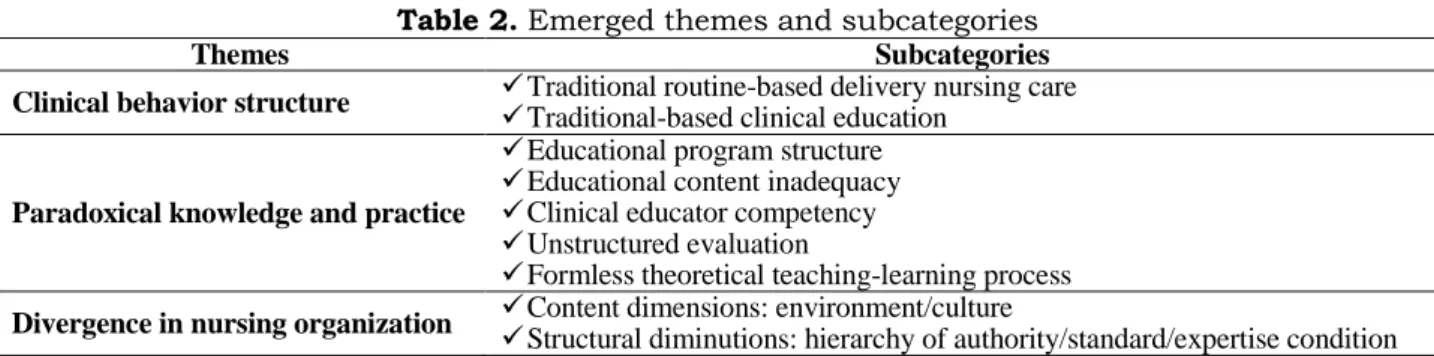
Three main themes emerged from the data including “clinical behavior structure”, ”para-doxical knowledge and practice”, and “diver-gence in nursing organization” and their sub-categories are presented in table 2, and with more details at below:
Clinical Behavior Structure
“Clinical behavior structure” was one of the main and broad themes that were categorized as following:
Traditional Routine-Based Delivery of Nursing Care
The dominant clinical behavior among the practice-based as well as educational nurses was traditional. One of the junior nurses de-scribed her experience as: where is the nursing knowledge? You are just a simple worker with some routine-bound duties; such as, giving the drugs, injections, change the sheets, and wound dressings; the duties that “Behiars” (meaning practical nursing assistants in
Ira-nian term) are doing; 6-month training to do this type of nursing is enough.”
One of the main intervening conditions on this regard has been related to senior-centered behaviors. As one junior nurse indicated: “in this hospital, nurses were educated within the old hospital-based program, are dominant; you see many nursing procedures done in the wrong way, different from what we are taught in the clinical lab in the school. If you question this, they would chastise you as a challenging staff member; frequently they say we do not do that in this way on this ward.”
On the other side, the above mentioned sta-tus continues in challenging condition as one of these senior nurses mentioned that: “I do not know, what they [meaning university edu-cators] are teaching to students; these juniors even do not know how to take care of an IV line, as their teachers.”
Moreover, contextual data revealed that in-appropriateness in some staffing ratios, such as nurse/patient ratio, heavy workload, and non-nursing duties are some causal and intervening inhibitors against advanced practice nursing that was mentioned repeatedly. A general prac-titioner who participated claimed: “the ratio of doctors and nurses to patients is very inappro-priate, in this ward, you can see, we have 2 nurses for 32 patients in this evening shift in which they would only be able to give their drugs and do our orders.” Furthermore, these concerns were affirmed by patients. A patient stated: “nurses are doing whatever the doctors say, they give our drugs, monitor our blood pressure, pulse, and temperature; take blood samples, change our IV lines; God bless all of them.”
Table 1. Individual characteristics of participants
Participants Age (year)
Sex M F
Years of service as nurse (year)
Level of education BS MSc PhD Internship students 22-27 2 7 4th year of education 9 - -
Junior nurse 24-27 1 2 1-1.5 3 - -
Staff nurse 37-40 1 1 13-16 2 - -
Supervisor 44-49 - 2 20-28 2 - -
Manager 40-70 - 4 17-52 1 2 1
Educator 36-50 3 3 8-25 - 6 -
Physician 41 - 1 13 - - 1
Table 2. Emerged themes and subcategories
Themes Subcategories
Clinical behavior structure Traditional routine-based delivery nursing care
Traditional-based clinical education Paradoxical knowledge and practice
Educational program structure
Educational content inadequacy
Clinical educator competency
Unstructured evaluation
Formless theoretical teaching-learning process Divergence in nursing organization Content dimensions: environment/culture
Structural diminutions: hierarchy of authority/standard/expertise condition Based on contextual data, one of the
com-mon recent ways of deconstructing the routine approaches was continuing education for staff which the majority of the participants found ineffective. One experienced staff nurse said “although, we had a workshop on documenta-tion, you can see the so-called nurses’ notes in the chart; well, patient’s general condition isn’t bad; drug orders were done; vital signs were checked; blood sample should be taken for FBS tomorrow.”
Traditional-Based Clinical Education
The clinical teaching climate was found not to be conductive and fruitful to the students’ clin-ical learning in order to integrate theory and practice. Students lacked qualified teachers for guidance and supervision, and experienced an autocratic relationship with them. One intern-ship student said: “our clinical experience was all about obeying the staff nurses to do their duties, division of the patients among stu-dents; you have to do their routine works.”
Field notes and memos revealed that the dominant process and interactions in the clini-cal setting were perceived as a non-scientific atmosphere. One of the students said: “we hear from medical students and their teachers, for example, according to those research find-ings, this way is better; that text says this is better; they have counseling between different specialties; they have morning report, case re-port; but in our nursing, there is not any scien-tific and human relationship among nurses; any information is being cited from texts or nursing research almost never.” In brief, this category emphasized the reciprocal theory-practice gap, more specifically, as theory-practice be-havior dominated by educators.
Paradoxical Knowledge and Practice
Paradoxical knowledge and practice was cate-gorized as following:
Educational Program Structure
Twenty-six participants emphasized the signifi-cant function of nursing education in the con-tent of developing knowledge in the minds of nurses. One senior nurse manager commented: “our academic education does not prepare stu-dents to be competent and skillful. It gives med-ical-centered theoretical knowledge from west-ern texts to them that are not applicable, and are not focused on our local and regional health needs.” In regard to this paradox, one junior nurse said: “I have heard more about ausculta-tory gap in blood pressure monitoring in class-rooms, but in the clinical education have never seen that, and other instances like this.”
Role models, as a most important interven-ing condition, also played an interactive signif-icant role in the reluctance of nurses to follow nursing information enthusiastically as partic-ipants mentioned. One of the students stated: “my classmates think the best nurses are the nurses who have more medical information. They do not listen to the sections on nursing care during the lessons in classrooms. Essen-tially, the manner of the teachers exacerbated this issue; they give us an extensive range of disease-related pathophysiological informa-tion, but do not spend even 10 minutes on the nursing care in a two-hour class.” These state-ments were confirmed by participant observa-tion from classrooms.
Educational Content Inadequacy
Contextual data indicated that basic sciences such as anatomy, physiology, and
pharmacol-ogy are required to be more scientific. It seems to be an evidence of the paradox. On the other side, many participants identified the require-ment for certain contents to be included within the curriculum such as communication skills, research concepts and principles, rehabilita-tion, cultural, ethical and spiritual subjects, special courses for clinical nurse specialists, computer and information technology (IT) ap-plications, and efficient practical English courses.
Clinical Educator Competency
According to contextual data, memos and field notes, specialty in a particular clinical field, be-ing knowledgeable theoretically and practically, and practical experience alongside being a ref-erence to staff to carry out care, and having res-pectful relationships with staff, doctors, and students, as some of the most important inter-vening conditions, were emphasized as charac-teristics of a clinical educator by participants. However, the contextual data revealed that the majority of participants perceived them as in-expert, unconfident to carry out nursing care, with role conflict between student supervision, staff, doctors, and patient care, which in turn, widened the gap between theory and practice reciprocally.
One of the nurses in the coronary care unit, stated: “she [meaning one of the faculty clinical educators] is very respectful for all; she is very useful to us; at every moment, you can learn a new thing from her; she transfers her expe-riences, and knowledge to staff; we often par-ticipate on her ward round; wishing all of the university educators were alike her.” As well, one of the nursing managers commented that: “they [meaning education executives] prefer to register newly postgraduate nurses without any additional clinical preparations for clinical teaching; whereas, we have qualified nurses that would be able to teach their students clini-cally.”
Also, lack of postgraduate students’ involv-ing in the practice settinvolv-ing as an interveninvolv-ing fa-cilitator in order to foster competent clinical educators was emphasized. One of the top
managers claimed that: “as evidence, how many of the postgraduate students are in-volved in practice, at least as a part of their education? I can claim, none; our PhD students think that they are not nurses.”
Formless Theoretical Teaching-Learning Process
All of the students and junior nurses stated that lectures in the school, as the dominant ap-proach, were not interactive and did not focus on applied knowledge, communication skills, problem-solving, decision-making, and critical thinking. One of the students stated that: “we have not had a lesson on research methods.” As well, one of the qualified lecturers stated: “the lecturers do not know how to use new teaching-learning strategies. Decision-making and critical thinking does not occur simply as a result of knowing about it. Having 10 students for each teacher in clinical training, unmoti-vated students and educators, shortage of needed facilities, and more important than others, educational management which is aw-ful, not only in nursing but also in other educa-tional systems, are the main intervening condi-tions in the way of employing these approach-es.” Contextual data and field notes included the requirement to change the methods of teaching to encourage critical thinking and problem solving in order to close the gap.
Unstructured Evaluation
Contextual data, field note and memos indi-cated that educators and managers, as evalua-tive agents in practice settings, had not been able to make an objective evaluation of stu-dents and staff. One of the experienced staff nurses stated that: “we have not a competent evaluative system to be able to separate the qualified staff from nonqualified ones; for ex-ample, when people are presented as ’proto-type nurses’ you get bewildered; I mean, per-sons are chosen based on relation not rules; in this way, the qualified and knowledgeable persons are not placed appropriately in posi-tions; criteria are not scientific values.”
Based on contextual data, in the education system that expected to be an initiator in
ap-plying the scientific approaches there were problems, too. One of the students explained that: “we do not know how they [meaning educators] evaluate us? You cannot find them in the ward; after allocating patients or ward rooms to us, they disappear and at the end of the shift they come back to check us to be present; rarely some of our good educators de-fine some criteria for evaluation; have you seen the evaluation form of the faculty? This so-called form is for all clinical area with some very subjective and general items, such as the appearance, make-up, clothing and so.” As well, one of the lecturers, while criticizing the evaluation approach, said: “multiple choice questions have been accepted as an existing approach, and you should act like others, oth-erwise they [meaning colleagues] would be chastised.” Furthermore, absence of any quali-ty control, which in turn, acts as an intervening factor in identifying advanced practice nurs-ing, was reported by the majority of the inter-viewees. One of the expert nurses with 16 years of service said that: “as we have no stan-dardized structure and system of quality con-trol or quality assurance; which items should be assessed in the hospital, is by chance.”
Final inference from the contextual data, field notes and memos revealed that paradox was the main property in this category, which in turn, is interplay among these subcategories.
Divergence Organization of Nursing
Contextual data, field notes and memos indi-cated that nursing in Iran is organizationally poor in both cultural and structural elements. The alignment of subcategories in this domain was achieved after theoretical sampling from the texts, according to Daft’s classification on organizational structure as follows:
Content Dimensions: Environment/Culture
According to the contextual data, filed notes and memos, the nursing organization con-fronts both stable and turbulent work envi-ronments. The traditional routine–based me-thods of delivery of care have induced a stable environment. With growth in the university,
the emphasis on a new brand of nursing, chal-lenges between nursing as a subordinate sys-tem and doctor-centered structure, as well as simultaneously between nursing service sec-tion and educasec-tion, also critiques of the quali-fications of nurses from this system of educa-tion, low salary, public perceptions of the low-status of nursing has made the environment much more turbulent as some important inter-vening and causal conditions. Positive human relations and communication skills, and pos-sessing a sense of responsibility and accounta-bility were emphasized by the participants as an inevitable requisite.
All participants from both settings cited the divergent climate between practice and educa-tion. One of the lecturers said that: “practice and education in our nursing are two parallel lines that, in my mind, will never come togeth-er.” Also, one of the practice managers stated: “we have not had even one session with the school of nursing; they think they are very knowledgeable and we are not scientific.” As well, the issue of divergence, one of the super-visors said: “in the past year, we had just one session with school of nursing, on our request, which have been on challenge about ‘sheet changing’ by students.”
Structural Dimensions: Hierarchy of Authori-ty/Standard/Expertise
Participants stated that in order to get con-vergence between practice and education, structured changes were required such as dif-ferent hierarchy of authority with definition of new roles or bilateral responsibilities for aca-demic and practice nurses, clinical educators appointed from practice staff, and reciprocal supervision from education. Shared programs to facilitate knowledge translation and bridg-ing the gap such as collaborative research projects; unity among main policy making sec-tions of nursing such as, board of nursing, nursing office in the Ministry of Health and Medical Education, Iranian Nursing Organiza-tion (INO), service related nursing offices in the universities, and nursing schools are needed. One of the top managers said: “this
unity would be achieved, if the academic nurses abandon egoism; indeed, try to encour-age collegiality among practice and academic nurses is the intellectual way of professional success.”
Specialization and standardization such as clinical nurse specialization, appropriate nurse/patient ratio, reasonable salary, and quality care and education in both settings were emphasized. One of the lecturers said that: “expert practitioners or academic educa-tors who are experienced and familiar with a domain of activity are very effective in bridg-ing the gap you are mentionbridg-ing.” Other one stated that: “expert nurses are initiators of es-tablishing standards in nursing care delivery; indeed, they are change agents that our nurs-ing needed them.” In regard to standard is-sues, one of the experienced nurses stated that: “like other developed countries, as I was ac-countable for maximum 3-4 patients, you can expect me to do comprehensive care.” Contex-tual notes elucidated that this theme itself act as both a condition and consequence of reci-procal gap.
Discussion
The findings of this study emphasized ambigu-ity in knowledge transfer and the reciprocal gap will continue to exist in this way of nurs-ing in Iran. Accordnurs-ing to these results, we are in the starting point in the field of study on knowledge translation and utilization that are discussed in the scholar writings or published papers under title of research-based knowing and knowledge. As other research findings in Iran indicated, research utilization in clinical settings has been limited due to lack of man-agement support, time inadequacy secondary to work overload, lack of skill and knowledge to do research, and consequently, establish-ment of knowledge-based practice depend on educational and organizational efforts and re-structurings.17
Our findings within the theme of “clinical behavior structure” proposed that practical nurses and educators are incompetent in deli-vering a new version of nursing. Other studies
in Iran confirmed that staff’s lack of knowledge and clinical educators’ lack of skills are major factors affecting competency and productivity of nurses.18,19,21 Moreover, causal condition of this process has been interrelated to inadequate essential professional competency and qualifi-cation in eduqualifi-cational and transition period.15,16 Also, the clinical environment was not a suita-ble place to experience the integration between theory and practice. While, Alavi et al27 findings indicated that through making closed relation-ships with nursing staffs, students accept them-selves as a component of caring team, so they can share and benefit from group synergies. As well, Hewison and Wildman7 claimed that the predominant values of practice are likely to dominate, again emphasizing the new dimen-sion of the theory-practice gap. Furthermore, Chun-Heung and French28 stated that both nurse tutors and practitioners should have access to continuing education to enable them to take up a clinical teaching role as well as to maintain competency in clinical nursing prac-tice; where, our findings within the theme of “paradoxical knowledge and practice” indi-cated that there is not a competent educational structure and content. The content of this recent theme implies that the students, their clinical teachers, and junior nurses acted as followers of existing routines in their clinical education, which in turn, would widen the gap and act against knowledge transfer. Greenwood 29 al-ludes to the notion of desensitization of some student nurses during their professional sociali-zation, and claims that the education of nurses often led to nurses compartmentalizing, in their minds, concepts of theory separate from con-cepts for practice. This results in “utilitarian nursing”, which in turn, is the outcome of a di-chotomy between the ideal and real world.10 Research findings in Iran indicated that the cul-ture of nursing in Iran is perceived as highly task oriented and physician-centered.30 Fur-thermore, Salsali et al31 found that there was a less caring attitude among nurses with more technical and mechanical skills without even any standard repertoire of procedures, thereby providing less individual and holistic care.
In-deed, the practice settings were predominantly oriented towards task completion, and conse-quently such factors inhibited the effective clini-cal preparation towards the integration of theory and practice.
“The competency of clinical educator" be-sides ”formless teaching-learning process” are two interrelated sub-themes of “paradoxical knowledge and practice”, as other important intervening conditions influencing educator ability to integrate the theoretical and practical knowledge. Corlett et al13 declared that “the nurse teacher did not have recent clinical expe-rience of the specialties involved, but routinely taught theoretical and practical elements asso-ciated with the first year syllabus.” Farhadian et al32 concluded that the clinical educators needed to get more information and skills on clinical education to be able to integrate theory to prac-tice. Also, comments from the participants in-cluded the requirement for encouraging critical thinking, problem solving, and teaching me-thods to foster a more realistic outlook of stu-dent and practice outcomes. The importance of this style has been well documented.7,13,33-35
The concept of ”educational content inade-quacy” within the theme of ”paradoxical know-ledge and practice” implies that nursing educa-tional content for undergraduate nursing was perceived as medical-centered, non-contextual and non-nursing. Walsh and Jones35 discussed that the education must be context-specific, i.e. specifically dedicated to educational packages for each area of practice that facilitates greater understanding and enhances clinical applica-tion and performance. As well, Prowse and Lyne36 declared that learning is effective when knowledge use is contextualized rather than abstract. Knight et al33 concluded that perhaps, by identifying the various facets of knowledge required to support nursing skills, the true val-ue of nursing care will be established. Where, it has been concluded that Iranian nurses are still seen as mere handmaidens to the doctors or simply dutiful employees at a hospital, both in the public and professional contexts.30 In addi-tion, Hoseini et al37 findings showed that from seventeen skills studied in their research, the
following have not met the expectation of pro-fessors and graduated students: subcutaneous injection, blood transfusion, urinary catheteriza-tion, nasogastric tube insercatheteriza-tion, lavage and enema with the average frequency of 0.06, 1.49, 0.79, 0.80, 0.08 and 0.17, respectively. Moattari et al38 findings demonstrated that the process of reflective thinking influencing clinical expe-rience emerges in 5 domains of caring, thinking, theory and practice integration, self-regulatory mechanisms and motivation.
The concept of ”unstructured evaluation” as another sub-theme of ”paradoxical knowledge and practice” implies that there is an unstruc-tured evaluation system at both practice and education setting in order to make an objective evaluation decisions for students and staff. French et al39 in an international comparative study found that assessment methods in nurs-ing were largely summative. While, Alavi et al40 findings emphasized that the multidimensional approaches should be adopted for comprehen-sive clinical evaluation. Also, Salsali31 stated fa-culty evaluation must be approached more ana-lytically, objectively, and comprehensively to ensure that all nursing educators receive the fairest treatment possible and that the teaching-learning process is enhanced.
The concept of “divergence in nursing or-ganization” includes interrelated concepts of ”content dimensions” and ”structural dimen-sions”, implies that nursing organization in-cluding service and education are completely divergent. As a whole picture of culture and environment in Iranian nursing, it is difficult to find a harmony between content and structural dimensions. Whilst et al41 found that there is a significant and positive relationship between total scores of nurses' affective organizational commitment and work environment conditions. Furthermore, Yaghoubi et al42 elucidated that there was a significant relationship between learning organization and organizational com-mitment and there was a significant relation-ship between learning organization and job ex-perience.
Moreover, another aspect of culture revealed that the culture of nursing was perceived as
highly task-oriented and physician-centered. Adib et al18 confirmed these findings. As well, Gerrish and Griffith43 reported that all overseas nurses commented on differences in the organi-zation of nursing care. Many were familiar with a more task-oriented approach to practice.
Based on ”hierarchy of authority’ concept, there are several nursing policy-making author-ities in service and education that are complete-ly parallel in their activities. Therefore, due to this divergent, knowledge transference and cor-relation between service and education in order to integrate theory and practice has been reci-procally influenced. Adib-Hajbaghery44 found that factors such as unsupportive management, weak teamwork and ignorance on the part of senior management of the value of scientific work make the work environment inimical to the implementation of evidence-based nursing. In addition, Hewison and Wildman7 concluded that the future of nursing can be secured, but it will involve partnership and cooperation with the new managers. Regarding the concept of ”hierarchy of authority”, one of the ways sug-gested by the participants was allocation of bila-teral responsibilities between practice and edu-cation. Salvoni6 stated that the rational for these posts, i.e. “joint appointments” are: facilitating the application of theory to practice, promoting effective collaboration between service and education, promoting research based practice, and developing nursing practice.
The concepts of “standard” and “expertise” revealed that nurses wanted to have expert field working and standardization in the nursing system such as patient/nurse ratio, standard procedures, to do better within the nursing
domain. Mirazabeigi et al45 indicated that edu-cated master degree nurses have not necessary clinical competency, and accordingly, 92.7% of them supposed the specialization programs in nursing that would be resulted in quality care promotion, specialized field of work, appropri-ate job status, and decreased cost of delivered health care.
Additionally, Houser46 demonstrated that greater expertise can have a major influence on the outcome of patient care.
Conclusion
In this paper we have shown the reciprocal rela-tionship between service and education in order to reveal the “whats” and “hows” of nursing practice. Traditional routine-based paradigm is the dominant picture of Iranian nursing in prac-tice and education at the baccalaureate level. Indeed, this indicated that nursing discipline in Iran is experiencing a theory-to-practice, and practice-to-theory gap that would move for-ward the knowledge translation ambiguously and put the discipline at risk. So, the big ques-tion you may ask is, so what?
An Iranian proverb says: “a scholar without practice is like a bee without honey”. And, “the shortest answer is doing” as an English prov-erb says.
The authors declare no conflict of interest in this study.
Acknowledgement
The authors wish to thank all the participants in this study for their time, School of Nursing and Midwifery, and also Tehran University of Medical Sciences for its financial support.
References
1. Castledine G. Clarifying and defining nursing role developments. Br J Nurs 1996 28; 5(21): 1338. 2. Salsali M. The development of nursing education in Iran. Int Hist Nurs J 2000; 5(3): 58-63.
3. Cheraghi MA, Salsali M, Ahmadi F. Iranian nurses' perceptions of theoretical knowledge transfer into clinical practice: A grounded theory approach. Nursing and Health Sciences 2007; 9(3): 212-20.
4. Cheraghi MA, Salasli M, Ahmadi F. Factors influencing the clinical preparation of BS nursing student interns in Iran. Int J Nurs Pract 2008; 14(1): 26-33.
5. Salsali M. Evaluating teaching effectiveness in nursing education: an Iranian perspective. BMC Med Educ 2005; 5: 29. 6. Salvoni M. Joint appointments: another dimension to building bridges. Nurse Educ Today 2001; 21(1): 65-70.
7. Hewison A, Wildman S. The theory-practice gap in nursing: a new dimension. J Adv Nurs 1996 Oct; 24(4): 754-61. 8. Severinsson EI. Bridging the gap between theory and practice: a supervision programme for nursing students. J Adv
9. Gerrish K. Still fumbling along? A comparative study of the newly qualified nurse's perception of the transition from student to qualified nurse. J Adv Nurs 2000; 32(2): 473-80.
10.Henderson S. Factors impacting on nurses' transference of theoretical knowledge of holistic care into clinical practice. Nurse Education in Practice 2002; 2(4): 244-50.
11.Rolfe G. Closing the theory-practice gap: a new paradigm for nursing. London: Butterworth-Heinemann; 1996. 12.Corlett J. The perceptions of nurse teachers, student nurses and preceptors of the theory-practice gap in nurse
educa-tion. Nurse Educ Today 2000; 20(6): 499-505.
13.Corlett J, Palfreyman JW, Staines HJ, Marr H. Factors influencing theoretical knowledge and practical skill acquisition in student nurses: an empirical experiment. Nurse Educ Today 2003; 23(3): 183-90.
14.Maben J, Latter S, Clark JM. The theory-practice gap: impact of professional-bureaucratic work conflict on newly-qualified nurses. J Adv Nurs 2006; 55(4): 465-77.
15.Abedi HA, Heidari A, Salsali M. Nursing graduates' experience of professional prepared during transition to their clini-cal role. Iranian Journal of Mediclini-cal Education 2004; 4(2): 64-71.
16.Valizadeh S, Abedi HA, Zamanzadeh V, Fathi Azar E. Challenges of nursing students during their study, A qualitative study. Iranian Journal of Medical Education 2007; 7(2): 397-407.
17.Mehrdad N, Salsali M. Iranian nurses' constraints for research utilization in clinical setting. Iran Journal of Nursing 2009; 22(58): 75-87.
18.Adib HM, Salsali M, Ahmadi F. A qualitative study of Iranian nurses' understanding and experiences of professional power. Hum Resour Health 2004 24; 2(1): 9.
19.Nayeri ND, Nazari AA, Salsali M, Ahmadi F. Iranian staff nurses' views of their productivity and human resource fac-tors improving and impeding it: a qualitative study. Hum Resour Health 2005 8; 3: 9.
20.Hagbaghery MA, Salsali M, Ahmadi F. The factors facilitating and inhibiting effective clinical decision-making in nursing: a qualitative study. BMC Nurs 2004; 3(1): 2.
21.Sharif F, Masoumi S. A qualitative study of nursing student experiences of clinical practice. BMC Nurs 2005 9; 4: 6. 22.Strauss AL, Corbin JM. Basics of qualitative research: techniques and procedures for developing grounded theory.
London: Sage Publications; 1998.
23.Strauss AL, Corbin JM. Grounded theory methodology. In: Denzin MK, Lincoln YS, Editors. Strategies of qualitative inquiry. London: Sage Publications; 2003. p. 158-83.
24.Denzin NK, Lincoln YS. The SAGE handbook of qualitative research. 3rd ed. London: SAGE; 2005. p. 504. 25.Strauss AL, Corbin JM. Basics of qualitative research. London: Sage; 1990.
26.Speziale HS, Carpenter DR. Qualitative research in nursing: advancing the humanistic imperative. 3rd ed. Philadelphia: Lippincott Williams & Wilkins; 2003.
27.Alavi M, Tavakol K, Behzad nejad M, Mahdi Zadeh K. Iranian nursing students' experiences of relationships with nurses in clinical setting. IJNMR 2008; 13(1): 10-4.
28.Chun-Heung L, French P. Education in the practicum: a study of the ward learning climate in Hong Kong. J Adv Nurs 1997; 26(3): 455-62.
29.Greenwood J. The apparent desensitization of student nurses during their professional socialization: a cognitive pers-pective. J Adv Nurs 1993; 18(9): 1471-9.
30.Nikbakht Nasrabadi A, Emami A, Parsa Yekta Z. Nursing experience in Iran. Int J Nurs Pract 2003; 9(2): 78-85. 31.Salsali M, Cheraghi MA, Ahmadi F. Organizational factors influencing knowledge transfer into practice in Iranian
nursing context: A grounded theory approach. Int J Nurs Pract 2009; 15(5): 426-36.
32.Farhadian F, Totoonchi M, Changiz T, Haghani F, Oveise-Gharan S. Faculty members' educational needs and skills of Isfahan University of Medical Sciences on clinical teaching approaches. Iranian Journal of Medical Education 2007; 7(1): 109-18.
33.Knight CM, Moule P, Desbottes Z. The grid that bridges the gap. Nurse Educ Today 2000; 20(2): 116-22. 34.Lambert V, Glacken M. Clinical support roles: a review of the literature. Nurse Educ Pract 2004; 4(3): 177-83.
35.Walsh P, Jones K. An exploration of tripartite collaboration in developing a strategic approach to the facilitation of practice learning. Nurse Educ Pract 2005; 5(1): 49-57.
36.Prowse MA, Lyne PA. Clinical effectiveness in the post-anaesthesia care unit: how nursing knowledge contributes to achieving intended patient outcomes. J Adv Nurs 2000; 31(5): 1115-24.
37.Hoseini SA, Islamian J, Bakhtiari S. Basic clinical skills of nursing students: a comparison between nursing students, nursing graduates' and lecturers' viewpoints. IJNMR 2009; 14(3): 123-9.
38.Moattari M, Abedi HA. Nursing students' experience on reflection. Iranian Journal of Medical Education 2008; 8(1): 101-12.
39.French P, Anderson J, Burnard P, Holmes C, Mashaba G, Wong T, et al. International comparison of baccalaureate nursing degrees: collaboration in qualitative analysis. J Adv Nurs 1996; 23(3): 594-602.
40.Alavi M, Irajpour AR, Abedi HA. Some concepts in the evaluation of clinical education: a qualitative study on the ex-periences of nursing students and clinical teachers. Strides in development of Medical Education 2007; 4(1): 10-8. 41.Vanaki Z, Vagharseyyedin SA. Organizational commitment, work environment conditions, and life satisfaction among
Iranian nurses. Nurs Health Sci 2009; 11(4): 404-9.
42.Yaghoubi M, Raeisi AR, Afshar M, Yarmohammadian MH, Hasanzadeh A, Javadi M, et al. The relationship between the learning organization and organizational commitment among nursing managers in educational hospitals of Isfahan University of Medical Sciences in 2008-9. IJNMR 2010; 15(2): 78-84.
43.Gerrish K, Griffith V. Integration of overseas Registered Nurses: evaluation of an adaptation programme. J Adv Nurs 2004; 45(6): 579-87.
44.Adib-Hajbaghery M. Factors facilitating and inhibiting evidence-based nursing in Iran. J Adv Nurs 2007; 58(6): 566-75.
45.Mirzabeigi GH, Sanjari M, Salemi S, Babaei F, Kheradmand M. Iranian nursing and midwifery faculties' perspectives on necessity of specialized programs in master degree. Iranian Journal of Medical Education 2009; 9(3): 263-71. 46.Houser J. A model for evaluating the context of nursing care delivery. J Nurs Adm 2003; 33(1): 39-47.