Sharif University of Technology
Scientia IranicaTransactions E: Industrial Engineering http://scientiairanica.sharif.edu
Research Note
A new fuzzy ELECTRE-based multiple criteria method
for personnel selection
M. Jasemi
a;and E. Ahmadi
ba. Department of Industrial Engineering, K.N. Toosi University of Technology, Tehran, Iran. b. Department of Industrial Engineering, Yazd University, Yazd, Iran.
Received 20 October 2015; received in revised form 25 October 2016; accepted 19 December 2016
KEYWORDS Personnel selection; Multiple criteria decision making; Fuzzy ELECTRE; Linguistic variables; Human resources.
Abstract.In today's competitive environment, qualied human resources are considered as one of the major keys to the organizations' success. So, an ecient solution to the problem of personnel selection is more necessary than ever. Besides many studies in the literature of the eld, this paper presents a novel fuzzy ELECTRE approach which is categorized as a Multiple-Criteria Decision Making (MCDM) technique. In this approach, the weights and ranks are determined by linguistic variables while both quantitative and qualitative criteria are considered simultaneously. At last, the implementation of the model is illustrated and the results are compared with those of TOPSIS.
© 2018 Sharif University of Technology. All rights reserved.
1. Introduction
Personnel selection is the process of choosing certain qualied candidates t to do the job awlessly among many others who have applied for a given job in the company. With the increasing competition in the global market, modern organizations face great challenges. The future survival of companies depends mainly on the contribution of their personnel to companies [1].
The personnel's features, such as capability, skill, and other abilities, play a signicant role in the suc-cessful performance of a typical organization. There-fore, naturally, the organizations always seek powerful and reliable methods to categorize, rank, and select appropriate people to achieve specic goals. Also, the literature is full of studies aimed at contributing to the solutions; refer to Robertson and Smith (2001) for more information [2].
*. Corresponding author. Tel.: +1-313-506-4105 E-mail addresses: [email protected] (M. Jasemi); [email protected] (E. Ahmadi)
doi: 10.24200/sci.2017.4435
In recent years, regarding the ever-growing ad-vances in information technology, many studies have emphasized application of decision support systems and expert systems as assistance to encounter the challenge [3-5]. Chien and Chen (2008) [6] developed 30 rules as employment strategies on the basis of the decision tree and relational rules. Their framework pre-dicts the workforce behavior by getting their personal features and educational and professional resumes.
Because of the fact that our problem is multi-dimensional, applying the concept of MCDM is com-pletely logical [7,8], and also since most of the factors and criteria have qualitative nature with vagueness and complexity in their denitions, the fuzzy theory is a good alternative to responding to the challenges [9,10]. Linguistic expressions, such as \satised", \rea-sonable", or/and \dissatised", are accepted as pref-erence or judgment of natural expression. These char-acteristics show the feasibility for a fuzzy set theory to become the preferred structure based on the views of decision-makers. Fuzzy set theory helps to measure the uncertainty of concepts about human subjectivity. Since this evaluation is made up of various evaluators interpreting linguistic variables, this situation has
re-sulted in uncertainty in the fuzzy environment. MCDM (Multiple Criteria Decision-Making) theory is used in this study to minimize the errors made in the course of decision-making and to strengthen the extent of the process [11].
The fuzzy linguistic models allow for the transla-tion of verbal expressions into numerical ones, thereby dealing quantitatively with imprecision in the expres-sion of the importance of each criterion. There are many studies, such as [1,2,12-16] that combine the concepts of MCDM and fuzzy theory to develop more ecient methods for the problem.
Kelemenis and Askounis (2010) [17] developed a fuzzy MCDM approach on the basis of TOPSIS while, instead of considering positive and negative ideal answers to calculate the distance of each point, the vetoed thresholds are applied. Dursun and Ertugrul Karsak (2010) [14] presented a fuzzy MCDM model with a 2-tuple linguistic representation method besides quantitative and qualitative measures. Gungor et al. (2009) [18] presented a personnel selection system on the basis of Fuzzy Analytical Hierarchy Process (FAHP) in which six methods of fuzzy numbers dis-tance specication are applied to do the comparisons. Lin (2010) [19] combined two methods of Analytical Network Process (ANP) and Fuzzy Data Envelopment Analysis (FDEA) for personnel selection in a Thai electrical company. Kabak et al. (2012) [15] combined Fuzzy ANP and Fuzzy TOPSIS approaches to develop-ing a more accurate personnel selection methodology. For an illustrative example, the proposed model is conducted on a sniper selection process. Afshari et al. (2013) [20] proposed a new linguistic extension of fuzzy measure and fuzzy integral for personnel selec-tion. Sanga et al. (2015) [16] proposed an analytical solution to fuzzy TOPSIS method. Some properties are discussed, and the computation procedure for the proposed analytical solution is given as well compared with the existing TOPSIS method for personnel selec-tion problem. Aliguliyev et al. (2015) [21] proposed an integrated fuzzy MCDM approach to the information personnel evaluation process.
In this paper, an MCDM approach on the basis of fuzzy ELECTRE method is developed for the problem of personnel selection. The ELECTRE (Elimination Et Choix Traduisant la REalite) method for choosing the best action(s) from a given set of actions was introduced in 1965. ELECTRE is a popular approach in MCDM, and it has been widely used in the lit-erature [22]. The main advantage of the ELECTRE method is that the comparison of the alternatives can be achieved even if there is not a clear preference. So, it is more reliable than other methods sensitive to the decision-makers' beliefs. Moreover, it has the ability to handle both quantitative and qualitative judgments.
As the conventional methods for personnel
selec-tion are inadequate for dealing with the imprecise or vague nature of linguistic assessment, a new method called the fuzzy technique for ELECTRE (Elimination Et Choix Traduisant la REalite) is proposed. The aim of this study is to compare and contrast TOPSIS and fuzzy ELECTRE methods for personnel selection. The proposed method has been applied to a real case of personnel selection process in one of the greatest and the famous companies in Iran. After determining the criteria that aect the personnel selection decisions, the results of both TOPSIS and fuzzy ELECTRE methods are presented.
The rest of the paper is organized as follows. Section 2 presents the primary points of fuzzy sets and numbers, and Section 3 describes our proposed approach. Section 4 exemplies the new method and, nally, Section 5 covers the conclusions.
2. The fuzzy sets in the new approach
The operations of multiplication and division on tri-angular fuzzy numbers do not always result in a triangular fuzzy number, but in most of the empirical applications, it is possible to benet from their esti-mation [23]. Triangular fuzzy numbers are suitable to quantify the vague information in the eld of personnel selection. The main reason for application of this category of fuzzy numbers is their intuitiveness as well as computational eciency [24].
There are dierent ways to specify the distance of two triangular fuzzy numbers while, in this study, a method proposed by Cheng (1998) [25] is applied. This method calculates the distance between two triangular fuzzy numbers of u and w as is shown by Eq. (1):
d (u; w) = R (u) R (w) : (1)
In Eq. (1), R(u) and R(w) are calculated similarly, while, for example, calculation of R(u) is illustrated by Eqs. (2)-(4):
R (u) =q(x (u))2+ (y(u))2; (2)
x (u) = b R
a x
L(x) dx +Rc
b x
R(x) dx b
R
a
L(x) dx +Rc b
R(x) dx
; (3)
y(u) = 1 R
0y
L(y) dy +R1
0 y
R(y) dy 1
R 0
L(y) dy +R1 0
R(y) dy
: (4)
To understand the above equations better, a quick review of the concept of fuzzy sets (Zadeh 1965) is
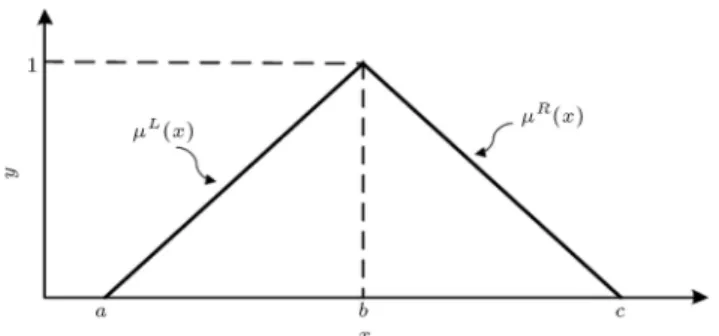
Figure 1. A triangle fuzzy number.
necessary. With the supposition that X is a reference set, eA is a fuzzy subset of X if 8x 2 X and Ae(x) 2 [0; 1] which is known as membership degree of x in eA, and Ae is membership function of eA. eA is normal and convex fuzzy subset. The normality means that Ae(x) = 1 only for one x 2 eA, while Relation (5) illustrates the concept of convexity:
8 x1; x22 X and 8 2 [0; 1]
)Ae(x1+(1 ) x2)min Ae(x1) ; Ae(x1)
: (5) A triangular fuzzy number, such as eA, can be dened as a triple of (a; b; c) as is shown in Figure 1, while L(y)and R(y) of Eq. (4) are the inverse cases of L(x) and R(x), respectively. In this regard, Relation (6) presents the membership function:
Ae(x) = 8 > > > < > > > :
0 x < a
x a
b a a x b
c x
c b b x c
0 x > c
(6)
3. The proposed approach
MCDM problems can be categorized into two cate-gories of Multiple-Attribute Decision Making (MADM) and Multiple-Objective Decision Making (MODM): the former is concerned with selecting a limited number of alternatives on the basis of some criteria; the latter deals with the optimal alternative according to some semi-inconsistent objectives. There are many dierent methods that have been developed to solve MADM problems among which AHP and TOPSIS are the most considerable ranking methods, and ELECTRE and PROMETHE are the most important outranking methods.
ELECTRE was developed by Roy (1968) [26] for the rst time; then, dierent modications have been made to it characterized as ELECTRE I, II, III, IV, and TRI where all of them have same basic features, but deal with dierent problems. This method can be considered as a non-compensatory one, i.e. an alternative low score under a criterion cannot be com-pensated by high scores on other criteria [27]. Another
important feature of the method is consideration of incomparability. For instance, two alternatives of x and y are not in any competition for the superiority of one over another.
In ELECTRE, priority is expressed by the out-ranking relationship of S. For example, the relationship of xSy means that \at least x is as good as y".
Therefore, the four following states can be con-ceived:
xSy is established and ySx is not established; then, x is superior to y (xPy);
xSy is not established and ySx is established; then, y is superior to x (yPx);
xSy and ySx are established; then, x and y are indierent to each other;
xSy and ySx are not established; then, x and y are not comparable.
ELECTRE has dierent applications in many elds, especially engineering [28]. Montazer et al. (2009) [29] used ELECTRE III for the problem of supplier selection. Afshari et al. (2010) [20] surveyed the personnel selection problem by ELECTRE under the condition of crisp weights and ranks. The proposed approach is illustrated in the following eleven steps. 3.1. Organization of decision-maker team Since personnel selection is a critical process in or-ganizations, relying on group decisions is wiser than individual decisions [17]. So, in the rst step of our ap-proach, a committee consisting of K people (including top managers and experts of dierent departments) is organized as the Decision-Maker (DM) team.
3.2. Criteria selection
In each organization, two groups of criteria, including individual and non-individual groups, are usually con-sidered to evaluate the human resources. These criteria should be dened in the way that cover the DMs issues as well as the job issues. This should be done regarding the environment in which the company works and the position for which the human resource is employed. 3.3. Selection of linguistic sets for weighting,
ranking, and specifying the candidates A linguistic variable is a variable whose values are pre-sented in linguistic terms, words, or sentences [30]. For example, communication skill is a linguistic variable if its values are linguistically weak, average, and good. Any value of such variables can be shown by a fuzzy number, while, in our approach, the triangular fuzzy numbers are applied. Linguistic sets can have dierent scales. In this study, regarding the literature, the ve-point scale is suggested for weighing the criteria and ranking the alternatives.
3.4. Weighing the criteria and ranking the alternatives (applicants) by DMs
Each DM ranks each person on the basis of the linguis-tic variables of the previous step. It should be noted that only the qualitative evaluation of the alternatives is done by DMs with linguistic variables; moreover, for the quantitative criteria (like employment exam), the person's score is considered as her/his rank under the associated criteria.
3.5. Fuzzy decision-making matrix
There is an equivalent fuzzy number for each linguistic variable; thus, by Eq. (7), the specied linguistic weights and ranks are translated into their fuzzy equiv-alents on the basis of which the fuzzy decision-making matrix of eD is achieved as is shown by Relation (8):
erij = K1 [erij1 erij2 ::: erijk] ;
i = 1; :::; m; j = 1; :::; n; (7)
e
D = [erij]mn; i = 1; :::; m; j = 1; :::; n; (8) where erijk is the rank that the kth DM gives to the ith person on the basis of the jth criterion; m, n, and K are the number of candidates, criteria, and DMs, respectively. The criteria weights vector (Relation (9)) is obtained by Relation (10):
f
W = [ ew1; :::; ewn] ; (9)
e
wj =K1 [ ewj1 ::: ewjK] ; (10) where ewjk is the weight that the kth DM gives to the jth criterion.
3.6. Normalization of the fuzzy decision-making matrix
In this step, the fuzzy decision-making matrix is normalized by application of Relations (11) and (12). erij= (aij; bij; cij) is the ith person rank on the basis of the jth criterion. B is the set of criteria whose greater amounts are more desirable, and C is the set of criteria whose smaller amounts are more desirable:8
> < > :
eij = aij c+ j ; bij c+ j ; cij c+ j
; j 2 B c+
j = Maxi cij; j 2 B
(11) 8 > < > :
eij = aij c+ j ; bij c+ j ; cij c+ j
; j 2 C c+
j = Maxi cij; j 2 C
(12) where eij is the normalized amount of erij. At last, the normalized fuzzy decision-making matrix is obtained as in Relation (13):
e
ND= [eij]mn; i = 1; :::; m; j = 1; :::; n: (13)
3.7. Making the weighted normalized fuzzy decision matrix
In this step, the criteria weights are applied to the decision matrix. In this regard, each row of eND is multiplied by the criteria weights vector, fW , element by element, as shown by Relation (14):
evij = eij ewj ; i = 1; :::; m; j = 1; :::; n
(while eV = [evij]mn): (14)
3.8. Specifying the concordanced and non-concordanced sets
In this step, all the alternatives are evaluated according to all the criteria, couple by couple, and then the sets are organized. The concordance set of Skl (as is illustrated by Relation (15)) covers all the criteria indices where alternative Ak is superior to Al:
Skl= fjj evkj evljg : (15)
The non-concordance set of Dkl (as is illustrated by Relation (16)) covers all the criteria indices where alternative Alis superior to Ak:
Dkl= fjj evkj evljg : (16)
On the basis of the method of Cheng (1998) [25] for distance specication, evkj evlj is established if and only if d(evkj; evlj) 0, and if d(evkj; evlj) 0, then evkj evlj.
3.9. Calculation of the concordance and non-concordance matrices
Concordance matrix of eI is an m m matrix with an empty main diameter, while its other elements are obtained by adding the criteria weights of the concordance sets of k and l as shown by Relation (17):
eIkl = X j2Skl
e wj; eI =
h eIkl
i
mm; (17)
where eIkl denotes the relative importance of Ak over Al.
Non-concordance matrix of NI is an mn matrix with an empty main diameter, while its other elements are obtained by Relation (18) to come to the nal matrix, as shown by Relation (19):
NIkl= Max
j2Dkljevkj evljj
Max
j2J jevkj evljj
=j2DMaxkljd (evkj evlj) j
Max
j2J jd (evkj evlj) j ; (18)
NI = [NIkl]mm; (19)
3.10. Specifying the eective concordance and non-concordance matrices
To specify the eective concordance matrix (H), rst of all, the threshold limit must be determined. If an element of the concordance matrix of eI is greater than or equal to the threshold limit, its equivalent in the eective concordance matrix will be one, otherwise zero. The threshold limit can be calculated as is shown by Relation (20):
eI =m (m 1)1 Xm k=1
m X l=1
eIkl: (20)
It is obvious that eI = (fIa;Ieb; eIc) where, for example, f
Ia is calculated by Eq. (21): fIa= 1
m (m 1) m X k=1
m X
l=1 eIa
kl: (21)
This method used to calculate the threshold limit is not the only one available, and application of any of these methods depends on the user's decision.
After calculating eI, the eective concordance matrix (Relation (22)) is accessible by Relation (23):
H = [Hkl]mm; k; l = 1; 2; :::; m; (22) Hkl =
(
1 eIkl eI
0 eIkl< eI (23)
To specify the eective non-concordance matrix (G), such as the concordance version, rst of all, the threshold limit of N I is calculated by Relation (24):
N I = 1
m (m 1) m X k=1
m X
1
NIkl: (24)
Then, the eective non-concordance matrix can be achieved by Relation (25):
Gkl= (
0 NIkl N I
1 NIkl< N I (25)
3.11. Specifying the total matrix
The total matrix (F ) indicates the relative priorities of the alternatives. For example, Fkl = 1 means that Ak is superior to Al. The matrix can be achieved according to Relation (26):
Fkl= Hkl Gkl ; k; l = 1; 2; ::: ; m
(while F = [Fkl]mm): (26)
After calculation of F , a directed graph is usually drawn accordingly. The nodes represent the alterna-tives and the edges or arcs are on the basis of the
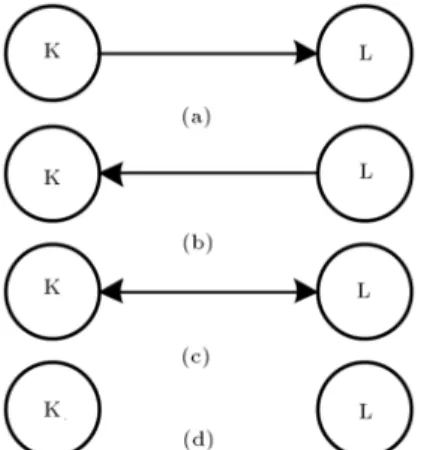
Figure 2. Dierent possible states between two nodes.
matrix numbers. For example, if FKL = 1, an arc is drawn from nodes K to L. Figure 2 shows dierent possible states between two nodes. The rst state (Figure 2(a)) indicates the relation (K P L), the second state (Figure 2(b)) indicates the relation (L P K), the third state (Figure 2(c)) indicates the relation (K I L), and the last state (Figure 2(d)) indicates the relation (K R L).
4. A numerical example
A famous pipe manufacturing plant in Iran needs to employ an industrial engineer. Five candidates of A1, A2, A3, A4, and A5 remain after a primary screening. A four-member committee (DM1, DM2, DM3, and DM4) is organized to do the interview and select the most suitable candidate. The eight considered criteria are as follows: emotional stability (C1), leadership (C2), self-condence (C3), prociency in oral communication (C4), personality (C5), previous experiences (C6), competency and general capability (C7), and perception and understanding (C8). The rst six criteria are categorized as individual criteria, and the last two criteria are categorized as non-individual ones, i.e., work-wise. The solving procedure on the basis of the algorithm steps is as follows:
- Steps 1 and 2: These steps are related to the decision-making team and specication of the cri-teria that have already been done;
- Step 3: The linguistic sets of W and A denote weighting the criteria and ranking the alternatives. Their membership functions as triangular fuzzy numbers are shown in Figures 3 and 4;
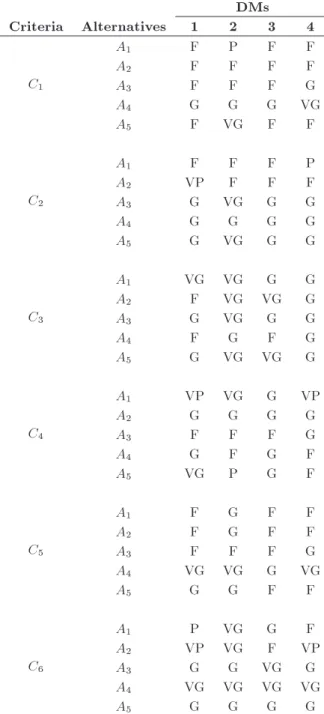
- Step 4: Every DM determines the weights of criteria and the ranks of alternatives by the linguistic variables of W and A, respectively, while the results can be seen in Tables 1 and 2. It is to be noted that the last two criteria of C7 and C8 are quantitative, and to rank the alternatives on the basis of these criteria, the DMs opinions are not needed and the
Figure 3. The membership function of the linguistic variables of W for weighting the criteria.
Figure 4. The membership function of the linguistic variables of A for ranking the alternatives.
obtained grades of each person for these measures are considered as her/his rank or score, as shown in Table 3;
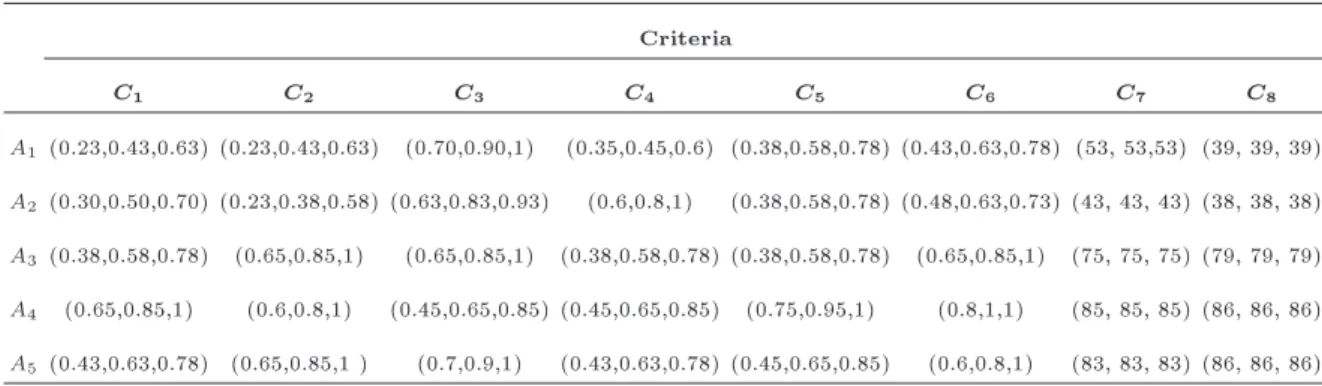
- Step 5: Table 4 shows the fuzzy values of the alternatives rankings that are presented in Table 2 linguistically. After applying Relations (7) and (8), the decision-making matrix as shown in Table 5 is obtained. It should be noted that the denite values related to criteria of C7and C8are written as triangular fuzzy numbers. For instance, 95 is written as (95; 95; 95). Besides, by applying Eq. (10), the criteria weights vector is also organized;
- Step 6: Regarding the fact that all the criteria are positive attributes and greater, they are more desir-able, and the decision-making matrix is normalized by Relation (11) as is shown in Table 6;
- Step 7: Table 7 indicates the weighted normalized decision matrix calculated by Relation (14);
- Step 8: Applying the Cheng method [25] and Relations (15) and (16), the concordance and non-concordance sets are obtained as shown in Tables 8 and 9;
- Step 9: The concordance and non-concordance matrices are obtained by Relations (17) to (19), while the results are shown in Tables 10 and 11, respectively;
- Step 10: The eective matrices are obtained; there-fore, rst, the threshold limit should be calculated by Relations (20) and (24) as follows:
eI =fIa; eIb; eIc= (2:29; 3:35; 4:05) ; N I = 0:73:
Table 1. The criteria weights by the DMs. DMs
Criteria 1 2 3 4
C1 M H H H
C2 VH VH M VH
C3 H M H VH
C4 H VH VH VH
C5 H H H VH
C6 H VH H VH
C7 H H M H
C8 VH VH VH H
Table 2. The alternatives ranks by the DMs. DMs Criteria Alternatives 1 2 3 4
C1
A1 F P F F
A2 F F F F
A3 F F F G
A4 G G G VG
A5 F VG F F
C2
A1 F F F P
A2 VP F F F
A3 G VG G G
A4 G G G G
A5 G VG G G
C3
A1 VG VG G G
A2 F VG VG G
A3 G VG G G
A4 F G F G
A5 G VG VG G
C4
A1 VP VG G VP
A2 G G G G
A3 F F F G
A4 G F G F
A5 VG P G F
C5
A1 F G F F
A2 F G F F
A3 F F F G
A4 VG VG G VG
A5 G G F F
C6
A1 P VG G F
A2 VP VG F VP
A3 G G VG G
A4 VG VG VG VG
Now, regarding Relations (23) and (25), the eec-tive concordance and non-concordance matrices are achieved and shown in Tables 12 and 13, respec-tively;
Table 3. The alternatives ranks for the non-individual criteria.
Alternatives Criteria A1 A2 A3 A4 A5
C7 53 43 75 85 83
C8 39 38 79 86 86
- Step 11: The total matrix of F is calculated by multiplying the two eective concordance and non-concordance matrices element by element according to Relation (26), as shown in Table 14.
The corresponding graph of matrix F is shown in Figure 5. As it is obvious in the graph, A4 and A5 are superior over all the other alternatives, and there is no clear intuition about their superiority over each other. A3 has superiority over the others. A1 and A2 are similar and inferior to the other alternatives. Alternatives A1 and A3 have relation R, i.e. they are incomparable and there is no clear intuition about their
Table 4. The fuzzy equivalents of the alternatives rankings. DMs
Criteria Alternatives 1 2 3 4
C1
A1 (0.3,0.5,0.7) (0,0.2,0.4) (0.3,0.5,0.7) (0.3,0.5,0.7)
A2 (0.3,0.5,0.7) (0.3,0.5,0.7) (0.3,0.5,0.7) (0.3,0.5,0.7)
A3 (0.3,0.5,0.7) (0.3,0.5,0.7) (0.3,0.5,0.7) (0.6,0.8,1)
A4 (0.6,0.8,1) (0.6,0.8,1) (0.6,0.8,1) (0.8,1,1)
A5 (0.3,0.5,0.7) (0.8,1,1) (0.3,0.5,0.7) (0.3,0.5,0.7)
C2
A1 (0.3,0.5,0.7) (0.3,0.5,0.7) (0.3,0.5,0.7) (0,0.2,0.4)
A2 (0,0,0.2) (0.3,0.5,0.7) (0.3,0.5,0.7) (0.3,0.5,0.7)
A3 (0.6,0.8,1) (0.8,1,1) (0.6,0.8,1) (0.6,0.8,1)
A4 (0.6,0.8,1) (0.6,0.8,1) (0.6,0.8,1) (0.6,0.8,1)
A5 (0.6,0.8,1) (0.8,1,1) (0.6,0.8,1) (0.6,0.8,1)
C3
A1 (0.8,1,1) (0.8,1,1) (0.6,0.8,1) (0.6,0.8,1)
A2 (0.3,0.5,0.7) (0.8,1,1) (0.8,1,1) (0.6,0.8,1)
A3 (0.6,0.8,1) (0.8,1,1) (0.6,0.8,1) (0.6,0.8,1)
A4 (0.3,0.5,0.7) (0.6,0.8,1) (0.3,0.5,0.7) (0.6,0.8,1)
A5 (0.6,0.8,1) (0.8,1,1) (0.8,1,1) (0.6,0.8,1)
C4
A1 (0,0,0.2) (0.8,1,1) (0.6,0.8,1) (0,0,0.2)
A2 (0.6,0.8,1) (0.6,0.8,1) (0.6,0.8,1) (0.6,0.8,1)
A3 (0.3,0.5,0.7) (0.3,0.5,0.7) (0.3,0.5,0.7) (0.6,0.8,1)
A4 (0.6,0.8,1) (0.3,0.5,0.7) (0.6,0.8,1) (0.3,0.5,0.7)
A5 (0.8,1,1) (0,0.2,0.4) (0.6,0.8,1) (0.3,0.5,0.7)
C5
A1 (0.3,0.5,0.7) (0.6,0.8,1) (0.3,0.5,0.7) (0.3,0.5,0.7)
A2 (0.3,0.5,0.7) (0.6,0.8,1) (0.3,0.5,0.7) (0.3,0.5,0.7)
A3 (0.3,0.5,0.7) (0.3,0.5,0.7) (0.3,0.5,0.7) (0.6,0.8,1)
A4 (0.8,1,1) (0.8,1,1) (0.6,0.8,1) (0.8,1,1)
A5 (0.6,0.8,1) (0.6,0.8,1) (0.3,0.5,0.7) (0.3,0.5,0.7)
C6
A1 (0,0.2,0.4) (0.8,1,1) (0.6,0.8,1) (0.3,0.5,0.7)
A2 (0.8,1,1) (0.8,1,1) (0.3,0.5,0.7) (0,0,0.2)
A3 (0.6,0.8,1) (0.6,0.8,1) (0.8,1,1) (0.6,0.8,1)
A4 (0.8,1,1) (0.8,1,1) (0.8,1,1) (0.8,1,1)
Table 5. The fuzzy decision-making matrix of D.
Criteria
C1 C2 C3 C4 C5 C6 C7 C8
A1 (0.23,0.43,0.63) (0.23,0.43,0.63) (0.70,0.90,1) (0.35,0.45,0.6) (0.38,0.58,0.78) (0.43,0.63,0.78) (53, 53,53) (39, 39, 39)
A2 (0.30,0.50,0.70) (0.23,0.38,0.58) (0.63,0.83,0.93) (0.6,0.8,1) (0.38,0.58,0.78) (0.48,0.63,0.73) (43, 43, 43) (38, 38, 38)
A3 (0.38,0.58,0.78) (0.65,0.85,1) (0.65,0.85,1) (0.38,0.58,0.78) (0.38,0.58,0.78) (0.65,0.85,1) (75, 75, 75) (79, 79, 79)
A4 (0.65,0.85,1) (0.6,0.8,1) (0.45,0.65,0.85) (0.45,0.65,0.85) (0.75,0.95,1) (0.8,1,1) (85, 85, 85) (86, 86, 86)
A5 (0.43,0.63,0.78) (0.65,0.85,1 ) (0.7,0.9,1) (0.43,0.63,0.78) (0.45,0.65,0.85) (0.6,0.8,1) (83, 83, 83) (86, 86, 86) Table 6. The normalized fuzzy decision-making matrix.
Criteria
C1 C2 C3 C4 C5 C6 C7 C8
A1 (0.23,0.43,0.63) (0.23,0.43,0.63) (0.70,0.90,1) (0.35,0.45,0.6) (0.38,0.58,0.78) (0.43,0.63,0.78) (0.62, 0.62, 0.62) (0.45, 0.45, 0.45)
A2 (0.30,0.50,0.70) (0.23,0.38,0.58) (0.63,0.83,0.93) (0.6,0.8,1) (0.38,0.58,0.78) (0.48,0.63,0.73) (0.51, 0.51, 0.51) (0.97, 0.97, 0.97)
A3 (0.38,0.58,0.78) (0.65,0.85,1) (0.65,0.85,1) (0.38,0.58,0.78) (0.38,0.58,0.78) (0.65,0.85,1) (0.88, 0.88, 0.88) (0.92, 0.92, 0.92)
A4 (0.65,0.85,1) (0.6,0.8,1) (0.45,0.65,0.85) (0.45,0.65,0.85) (0.75,0.95,1) (0.8,1,1) (1, 1, 1) (1, 1, 1)
A5 (0.43,0.63,0.78) (0.65,0.85,1 ) (0.7,0.9,1) (0.43,0.63,0.78) (0.45,0.65,0.85) (0.6,0.8,1) (0.98, 0.98, 0.98) (1, 1, 1) Table 7. The weighted normalized fuzzy decision matrix.
Criteria
C1 C2 C3 C4 C5 C6 C7 C8
A1 (0.10,0.28,0.60) (0.11,0. 31, 0.60) (0.46,0.84,1) (0.19,0.35,0.6) (0.23,0.49,0.78) (0.18,0.41,0.74) (0.36,0.55,0.59) (0.29,0.42,0.45)
A2 (0.13,0.33,0.67) (0.11,0.28,0.55) (0.41,0.77,0.93) (0.33,0.62,1) (0.23,0.49,0.78) (0.21,0.41,0.69) (0.30,0.45,0.48) (0.63,0.90,0.97)
A3 (0.16,0.38,0.74) (0.31,0.62,0.95) (0.42,0.79,1) (0.21,0.45,0.78) (0.23,0.49,0.78) (0.28,0.55,0.95) (0.51,0.77,0.84) (0.60,0.86,0.92)
A4 (0.28,0.55,0.95) (0.29,0.58,0.95) (0.29,0.60,0.85) (0.25,0.51,0.85) (0.45,0.81,1) (0.34,0.65,0.95) (0.58,0.88,0.95) (0.65,0.93,1)
A5 (0.18,0.41,0.74) (0.31,0.62,0.95) (0.46,0.84,1) (0.24,0.49,0.78) (0.27,0.55,0.85) (0.26,0.52,0.95) (0.57,0.86,0.93) (0.65,0.93,1)
superiority over each other, and A5 has no superiority over any alternative. Relation (27) indicates the relationships between the alternatives, while X Y
Figure 5. The corresponding graph of matrix F .
means that X is superior over Y :
fA5; A4g A3 fA1; A2g : (27) To survey the proposed approach of this study, this problem is also solved by fuzzy TOPSIS and the results are presented in Table 15. On the basis of the fuzzy TOPSIS method, A4is preferred to A5, A5is preferred to A3, A3is preferred to A1, and A1is preferred to A2 (A4A5A3A1A2), while, on the basis of the fuzzy ELECTRE method and judgment of the members of technical committee, A5 is preferred to A4 and other alternatives; therefore, A5has been selected as the best alternative.
The ELECTRE-based approach results, due to the consideration of dierent states of superiority, indif-ference, and incomparability between the alternatives,
are apparently better than the TOPSIS-based (or other similar ranking methods) approach in which only the simple ranking of the alternatives is considered, espe-cially when the number of the alternatives is greater.
Table 8. The concordance sets. (SLK) Concordanced sets
S12 f2, 3, 5, 7g
S13 f3,5g
S14 f-g
S15 f3g
S21 f1, 4, 5, 8g
S23 f4, 5, 8g
S24 f3, 4g
S25 f4g
S31 f1, 2, 4, 5, 6, 7, 8g
S32 f1, 2, 3, 5, 6, 7g
S34 f2, 3g
S35 f2, 6g
S41 f1, 2, 4, 5, 7, 8g
S42 f1, 2, 5, 6, 7, 8g
S43 f1, 4, 5, 6, 7, 8g
S45 f1, 4, 5, 6, 7, 8g
S51 f1, 2, 3, 4, 5, 6, 7, 8g
S52 f1, 2, 3, 5, 6, 7, 8g
S53 f1, 2, 3, 4, 5, 7, 8g
S54 f2, 3, 8g
Table 9. The non-concordance sets. (DLK) Non-concordanced sets
D12 f1, 4, 5, 6, 8g
D13 f1, 2, 4, 5, 6, 7, 8g
D14 f1, 2, 4, 5, 6, 7, 8g
D15 f1, 2, 3, 4, 5, 6, 7, 8g
D21 f2, 3, 5, 7g
D23 f1, 2, 3, 5, 6, 7g
D24 f1, 2, 5, 6, 7, 8g
D25 f1, 2, 3, 5, 6, 7, 8g
D31 f3, 5g
D32 f4, 5, 8g
D34 f1, 4, 5, 6, 7, 8g
D35 f1, 2, 3, 4, 5, 7, 8g
D41 f3g
D42 f3, 4g
D43 f3g
D45 f2, 3, 8g
D51 f3g
D52 f4g
D53 f2, 6g
D54 f1, 4, 5, 6, 7, 8g
5. Conclusion
Due to the importance of the personnel selection problem and its signicant role in any organization and also with regard to its multi-dimensionality, in this
Table 11. The non-concordance matrix. Alternatives Alternatives A1 A2 A3 A4 A5
A1 - 1 1 1 1
A2 1 - 1 1 1
A3 0.13 0.54 - 1 1
A4 0.40 0.32 0.62 - 0.94
A5 0 0.41 0.26 1
-Table 12. The eective concordance matrix of H. Alternatives
Alternatives A1 A2 A3 A4 A5
A1 - 0 0 0 0
A2 0 - 0 0 0
A3 1 1 - 0 0
A4 1 1 1 - 1
A5 1 1 1 0
-Table 13. The eective non-concordance matrix of G. Alternatives
Alternatives A1 A2 A3 A4 A5
A1 - 0 0 0 0
A2 0 - 0 0 0
A3 1 1 - 0 0
A4 1 1 1 - 0
A5 1 1 1 0
-Table 14. The total matrix of F . Alternatives Alternatives A1 A2 A3 A4 A5
A1 - 0 0 0 0
A2 0 - 0 0 0
A3 1 1 - 0 0
A4 1 1 1 - 0
A5 1 1 1 0
-Table 10. The concordance matrix. Alternatives
Alternatives A1 A2 A3 A4 A5
A1 { (2.31, 3.39, 3.9) (1.25, 1.78, 2) (0,0,0) (0.65, 0.93, 1)
A2 (2.23, 3.21, 3.95) { (1.8, 2.56, 3) (1.2, 1.71, 2) (0.55, 0.78, 1)
A3 (3.72, 5.47, 6.8) (3.17, 4.69, 5.8) { (1.13, 1.66, 1.95) (0.91, 1.38, 1.9)
A4 (3.29, 4.82, 5.85) (3.17, 4.69, 5.8) (3.24, 4.74, 5.85) { (3.24, 4.74, 5.85)
Table 15. The results of TOPSIS. Alternatives Distance from the ideal
positive answer d+
Distance from the ideal
negative answer d RI = d +dd + Ranking
A1 0.07 0.03 0.3 4
A2 0.08 0.02 0.2 5
A3 0.04 0.06 0.6 3
A4 0.02 0.08 0.8 1
A5 0.03 0.07 0.7 2
paper, an MCDM model is presented for the personnel selection problem. To solve the problem, a fuzzy ELECTRE method is used. A critical advantage of this evaluation method is its capacity to point to the exact needs of a decision-maker and suggest an appropriate evaluation approach.
There are both qualitative and quantitative crite-ria in the model, while qualitative critecrite-ria are ranked by application of linguistic variables. At the end, by a numerical real example, the proposed method is illustrated and the results are compared with those of a similar, yet TOPSIS-based, method. Finally, it proves that the new ELECTRE-based approach is better, especially because the TOPSIS-based method only considers the simple ranking of the alternatives, but the ELECTRE one covers all the dierent states. References
1. Zhang, Sh. and Liu, S. \A GRA-based intuitionistic fuzzy multi-criteria group decision making method for personnel selection", Expert Systems with Appli-cations, 38(9), pp. 11401-11405 (2011).
2. Robertson, I.T. and Smith, M. \Personnel selection", Journal of Occupational and Organizational Psychol-ogy, 74(4), pp. 441-472 (2001).
3. Hooper, R.S., Galvin, T.P., Kilmer, R.A., and Liebowitz, J. \Use of an expert system in a personnel selection process", Expert Systems with Applications, 14(4), pp. 425-432 (1998).
4. Mehrabad, M.S. and Brojeny, M.F. \The development of an expert system for eective selection and ap-pointment of the jobs applicants in human resource management", Journal of Computers & Industrial Engineering, 53(2), pp. 306-312 (2007).
5. Shih, H.S., Huang, L.C., and Shyur, H.J. \Recruitment and selection processes through an eective GDSS", Journal of Computers and Mathematics with Applica-tions, 50(10-12), pp. 1543-1558 (2005).
6. Chien, C.F. and Chen, L.F. \Data mining to improve personnel selection and enhance human capital: A case study in high-technology industry", Journal of Expert Systems with Applications, 34, pp. 280-290 (2008).
7. Dagdeviren, M. \A hybrid multi-criteria decision-making model for personnel selection in manufacturing
systems", Journal of Intelligent Manufacturing, 21(4), pp. 451-460 (2010).
8. Jereb, E., Rajkovic, U., and Rajkovic, V. \A hierar-chical multi-attribute system approach to personnel selection", International Journal of Selection and As-sessment, 13(3), pp. 198-205 (2005).
9. Capaldo, G. and Zollo, G. \Applying fuzzy logic to personnel assessment: a case study", Omega, the International Journal of Management Science, 29(6), pp. 585-597 (2001).
10. Miller, G. and Feinzing S. \Fuzzy sets and personnel selection: discussion and application", Journal of Occupational and Organizational Psychology, 66(2), pp. 163-169 (1993).
11. Akdag, H., Kalayc, T., Karagoz S., Zulkar, H., and Giz, D. \The evaluation of hospital service quality by fuzzy MCDM", Applied Soft Computing, 23, pp. 239-248 (2014).
12. Liang, G.S. and Wang, M.J. \Personnel selection using fuzzy MCDM algorithm", European Journal of Operational Research, 78(1), pp. 22-33 (1994).
13. Karsak, EE. \Personnel selection using a fuzzy MCDM approach based on ideal and anti-ideal solutions", Lec-ture Notes in Economics and Mathematical Systems, 507, pp. 393-402 (2001).
14. Dursun, M. and Karsak, E.E. \A fuzzy MCDM ap-proach for personnel selection", Expert Systems with Applications, 37(6), pp. 4324-4330 (2010).
15. Kabak, M., Burmaog, S., and Kazancoglu, Y. \A fuzzy hybrid MCDM approach for professional selection", Expert Systems with Applications, 39(3), pp. 3516-3525 (2012).
16. Sanga, X., Liu, X., and Qin, J. \An analytical solution to fuzzy TOPSIS and its application in personnel selection for knowledge-intensive enterprise", Applied Soft Computing, 30, pp. 190-204 (2015).
17. Kelemenis, A. and Askounis, D. \A new TOPSIS-based multi-criteria approach to personnel selection", Expert Systems with Applications, 37(7), pp. 4999-5008 (2010).
18. Gungor, Z., Serhadloglu, G., and Kesen, S.E. \A fuzzy AHP approach to personnel selection problem", Journal of Applied Soft Computing, 9(2), pp. 641-646 (2009).
19. Lin, H.T. \Personnel selection using analytic net-work process and fuzzy data envelopment analysis approaches", Journal of Computers & Industrial En-gineering, 59(4), pp. 937-944 (2010).
20. Afshari, A.R., Yusu, R.M., and Derayatifar, A.R. \Linguistic extension of fuzzy integral for group per-sonnel selection problem", Arabian Journal for Science and Engineering, 38(10), pp. 2901-2910 (2013).
21. Alguliyev, R.M., Aliguliyev, R.M., and Mahmudova, R.S. \Multicriteria personnel selection by the modied fuzzy VIKOR method", Scientic World Journal, pp. 1-16 (2015).
22. Daneshvar, R.B. and Erol, S. \Selecting the best project using the fuzzy ELECTRE method method", Mathematical Problems in Engineering, pp. 1-12 (2012).
23. Kaufmann, A. and Gupta, M.M., Fuzzy Mathematical Models in Engineering and Management Science, Am-sterdam: North-Holland (1988).
24. Karsak, EE. \Distance-based fuzzy MCDM approach for evaluating exible manufacturing system alterna-tives", International Journal of Production Research, 40(13), pp. 3167-3181 (2002).
25. Cheng, CH. \A new approach for ranking fuzzy num-bers by distance method", Journal of Fuzzy Sets and Systems, 95(3), pp. 307-317 (1998).
26. Roy, B. \Ranking and choice in the presence of multi-ple points of view (the method ELECTRE)" [Classe-ment et choix en presence de points de vue multiples (la methode ELECTRE)], RAIRO - Operations Research - Recherche Operationnelle, 2, pp. 57-75 (1968).
27. Kangas, A., Kangas, J., and Pykalainen, J. \Out-ranking methods as tools in strategic natural resources planning", Silva Fennica, 35(2), pp. 215-227 (2001).
28. Rogers, M., Bruen, M., and Maystre, L.Y. Electre and Decision Support, Methods and Applications in Engineering and Infrastructure Investment, Boston: Kluwer Academic (1999).
29. Montazer, G.A., Qahri Saremi, H., and Ramezani, M. \Design a new mixed expert decision aiding system us-ing fuzzy ELECTRE III method for vendor selection", Journal of Expert Systems with Applications, 36(8), pp. 10837-10847 (2009).
30. Siler, W. and Buckley, J.J., Fuzzy Expert Systems and Fuzzy Reasoning, New Jersey, NJ: Wiley (2005).
Biographies
Milad Jasemi accomplished his BSc, MSc, and PhD in Industrial Engineering at Iran University of Science and Technology, Sharif University of Technology, and Amirkabir University of Technology, respectively, all in Tehran, Iran in 1999-2010. Currently, he is an Assistant Professor at K.N. Toosi University of Tech-nology, and Azad University-Masjed Soleyman branch. His research interests are nancial engineering, risk management, and multiple-criteria decision making. Moreover, he has been at Wayne State University, MI, USA as a visiting scholar (Post-Doc fellow) for the last year.
Elham Ahmadi accomplished both her BSc and MSc in Industrial Engineering at Yazd University, Yazd, Iran in 2007-2013. Currently, he is a Manager in Human Resource section of a successful Engineering Company in Isfahan, Iran. Her research interests are systems and methods optimization.