Getting Started
Building a roller coaster out of nothing more than paper and tape may seem like an impossible
task, but with a little patience and practice, soon you’ll be building magnificent roller coasters
that will amaze your friends.
Supplies Needed
These are materials that you will need that are not included in the Paper Roller Coasters kit. 1. Scissors
2. Tape - clear shiny tape works best 3. Ruler or straight edge
4. Magazine or catalog - used as a cushion, it helps to score the templates when tracing. 5. Ball-point pen
6. Cardboard or Foam board - used as a base for the roller coaster
Contents
Building the Framework
3Making Beams and Columns 3
Attaching Columns to the Base 4
Attaching Diagonal Supports Between Columns and the Base 4
Attaching Beams to Columns 5
Extending Columns or Beams 6
Attaching Diagonal Supports Between Beams and Columns 6
Making the Track
7Straight Track 7
Merge 7
Curves 8
Funnel 9
Loops 10
Attaching the Track
Attaching Tracks to Beams 12
Taping Tracks to Each Other 12
Adding Cantilevers and Beams to Hold the Track 13 Adding Shelves
$GGLQJD6ZLWFKZLWK0XOWLSOH7UDFNV
13
Tips for Great Roller Coasters
14
Building the Framework
The first step in building any roller coaster is to create the structure that supports the track.
The framework is made from white columns and beams attached to the cardboard base. The Key
Heavy dotted lines - trace, then fold Heavy solid lines - cut
Thin dotted lines - cut or fold, if needed
Making Beams and Columns
1. Take one of the white beam or column templates and trace along all four thick dotted lines using a ruler and ball-point pen. Your goal is to score (dent) the paper so that it will fold easily along the correct line. Put a magazine or catalog under the template to make this task
easier. (fig. 1)
Figure 1
Figure 2
Figure 3
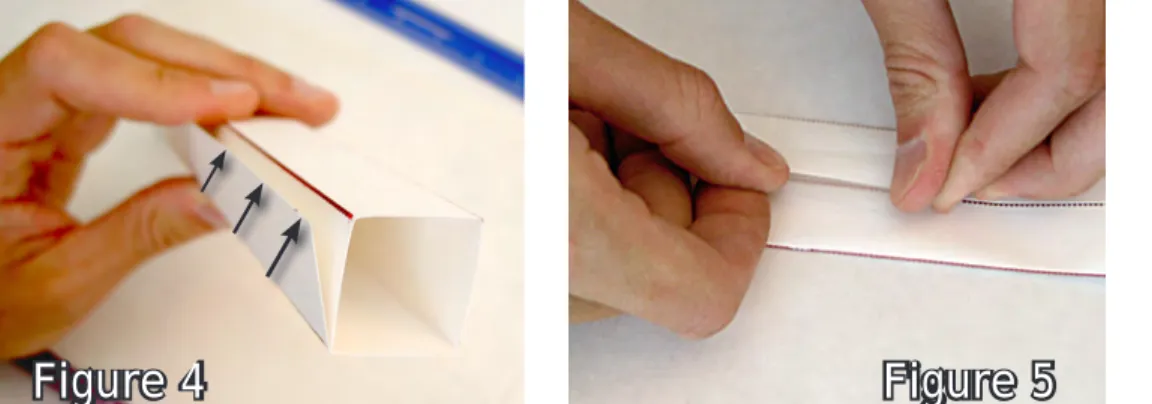
3. Overlap the two end panels to make a square column. (fig. 4) Locate the edge where the tape will be used. (arrows in fig. 4) Place the column on a flat surface and flatten it out keeping
this edge on top. Place a small piece of tape along the middle of this edge to hold it in place.
(fig. 5) Then tape along the rest of the edge. Flex the column to bring it back to a square shape. (fig. 6)
Figure 4
Figure 5
2. Fold and make a sharp crease along one of the dotted lines, keeping the dotted lines on the
outside. (fig. 2) Unfold it and do the same for the other three lines. (fig. 3)
Attaching Columns to the Base
1. Cut along the four edges of a completed column only as far as the thin dotted line that goes
around the column. (fig. 7) Fold back the four flaps along the thin dotted line. (fig. 8)
2. Place the four flaps against the board in the desired location. Tape them to the board making sure that the tape is close to the column. (fig. 9) This will limit the amount of wobble that the
column will have.
Figure 7
Figure 8
Attaching Diagonal Supports Between Columns and the Base
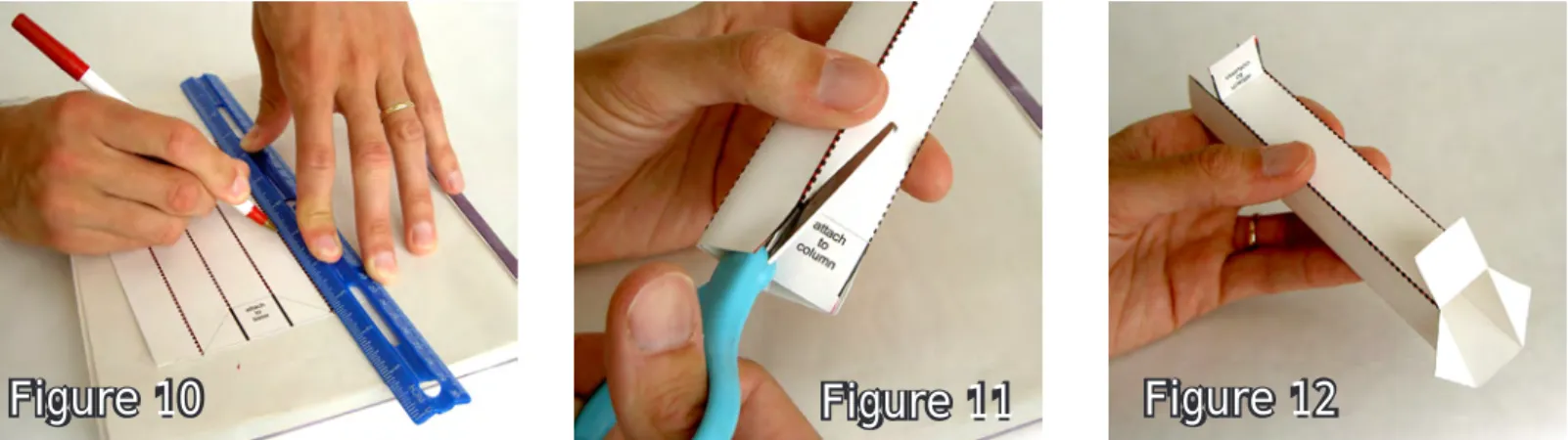
1. Take one of the Diagonal Support templates and trace along the thick dotted lines. (fig. 10) Fold and tape the support together in the same way that columns are made. (fig. 2-6) Cut along the two solid lines at each end of the support. (fig. 11) Fold along the thin dotted lines. This will create one flap on the end labeled “attach to column” and three flaps on the end labeled “attach to base or beam,” where one flap is square and the others are triangles. (fig. 12)
Figure 9
Figure 10
Figure 11
Figure 12
2. Place the support against the base and a column trying to keep all three of the flaps in contact with the base. (fig. 13) The sides of the support should hug the column. Tape these corners to the column and then tape down all of the flaps. Don’t forget to tape the two square flaps. (fig.
14) For maximum stability, use two different lengths of diagonal supports on each column at a
right angle to one another. (fig. 15)
Figure 13
Figure 14
Attaching Beams to Columns
The horizontal pieces that connect two columns together are called beams.
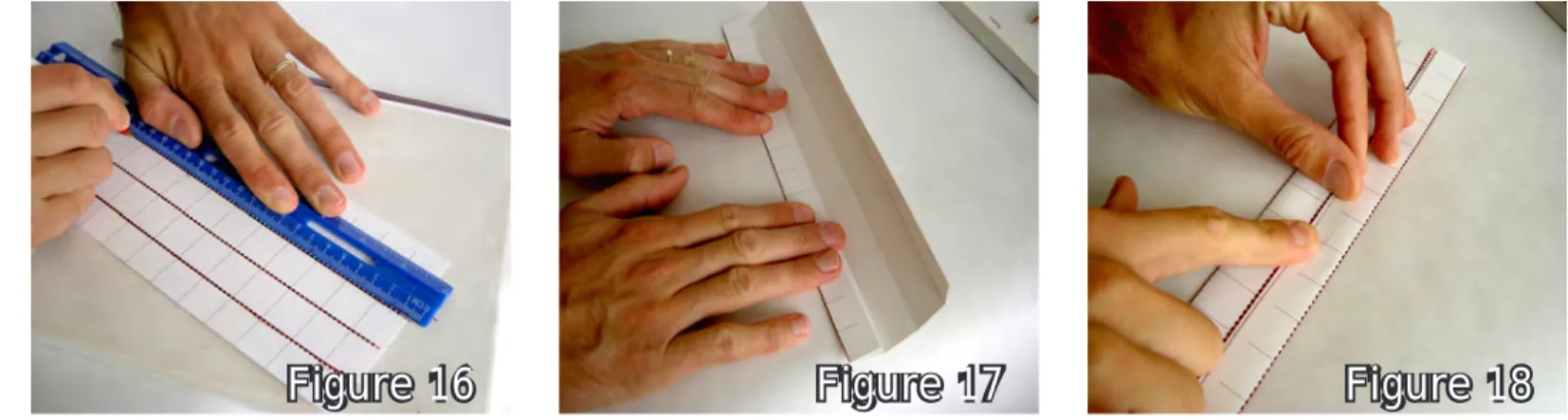
1. Trace (fig. 16), fold (fig. 17), and tape (fig. 18) a beam in the same way you would make a
column.
Figure 16
Figure 17
Figure 18
2. Hold the beam next to the two columns that you want to connect. (fig. 19) Cut the beam as shown in figure 19 so that its length matches the distance between the far edges of the columns. 3. Cut along all four edges of the beam about 2 cm (3/4 inch). Use the thin dotted lines as a guide. (fig. 20) If the end of the beam is right on one of the dotted lines, cut as far as the next dotted line. Fold back two of the flaps at each end across from each other. (fig. 21)
Figure 19
Figure 20
Figure 21
4. Holding the folded flaps pointing up and down, rotate and slide the beam in place between the two columns. (fig. 22) If it doesn’t fit, lengthen the cuts and make the flaps longer. Tape the side flaps down to the column. (fig. 23) Then tape down the top and bottom flaps to secure the beam firmly in place. (fig. 24)
Attaching Diagonal Supports Between Beams and Columns
To make a tall structure, strengthen it by using diagonal supports higher than at the base level.
1. Take one of the Diagonal Support templates and trace along the thick dotted lines. (fig. 27) Fold and tape the support together in the same way that columns are made. (figs. 4-6 on p. 3) Cut along the two solid lines at each end of the support. (fig. 28) Bend back the square flaps at each end of the support. Do not bend back the triangular flaps. (fig. 29)
Figure 29
Figure 28
Figure 27
2. Place the diagonal support between the column and beam either above the joint or below
it. (figs. 30, 31) Tape the sides of the diagonal supports to the beam and the column. (fig. 32) Tape the inner flaps down. (fig. 32) An example of a completed structure is shown in figure 34.
Figure 32
Figure 33
Figure 31
Figure 30
Figure 34
Extending Columns or Beams
If you want a long column or beam, connect pieces together end to end as follows:
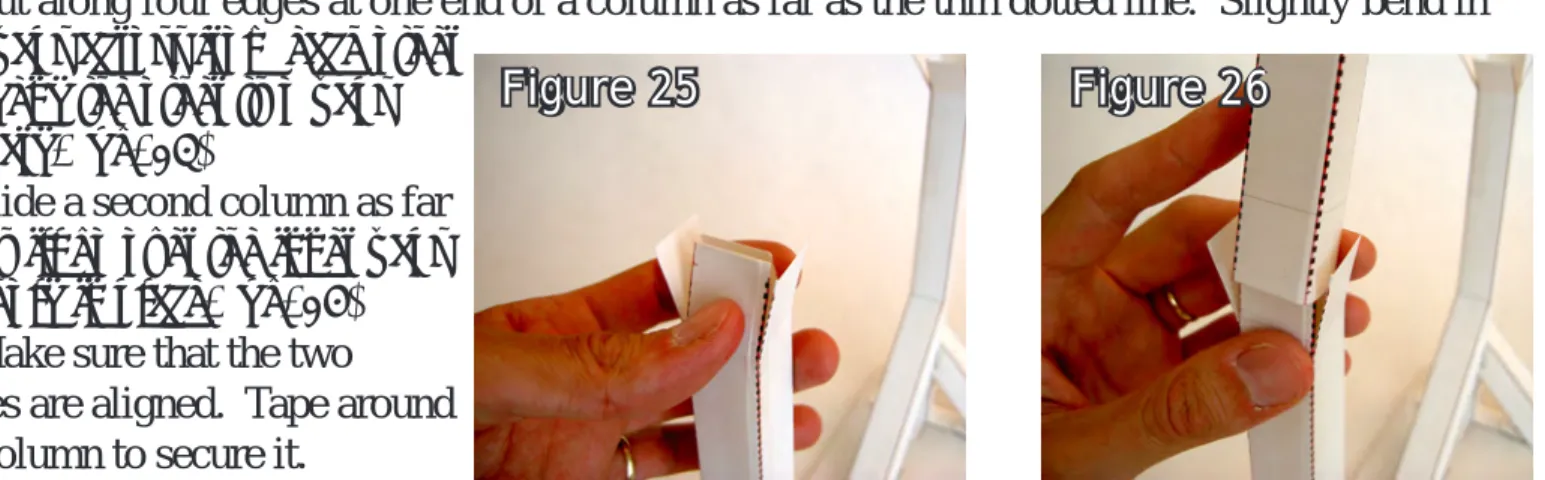
1. Cut along four edges at one end of a column as far as the thin dotted line. Slightly bend in
Figure 25
Figure 26
two flaps across from each other and bend the other two flaps outward. (fig. 25)
2. Slide a second column as far
as it will go over the inner flaps and hold in place. (fig. 26)
3. Make sure that the two
pieces are aligned. Tape around the column to secure it.
7
Making the Track
There are several different types of track. There are also some tricks and techniques for attach-ing the track to the framework.
Straight Track
The most common and the easiest to make is the straight track.
1. Take a “straight track” section and trace along the dotted lines with a ball point pen and a ruler. (fig. 35)
2. Fold along the dotted lines to make a sharp crease, keeping the lines on the inside. (fig. 36) 3. Lift up the sides to make them vertical. (fig. 37)
Figure 35
Figure 36
Figure 37
Merge
If you build two or more roller coasters on one structure, you may want them to merge together so that they finish in the same spot.
1. Trace along the dotted lines in a merge template with a ball point pen to score the paper. (fig.
38)
2. Cut along all of the solid black lines on both pieces. (fig. 39) 3. Fold along the dotted lines to make sharp creases. (fig. 40)
Figure 38
Figure 39
Figure 40
Figure 41
Figure 42
Figure 43
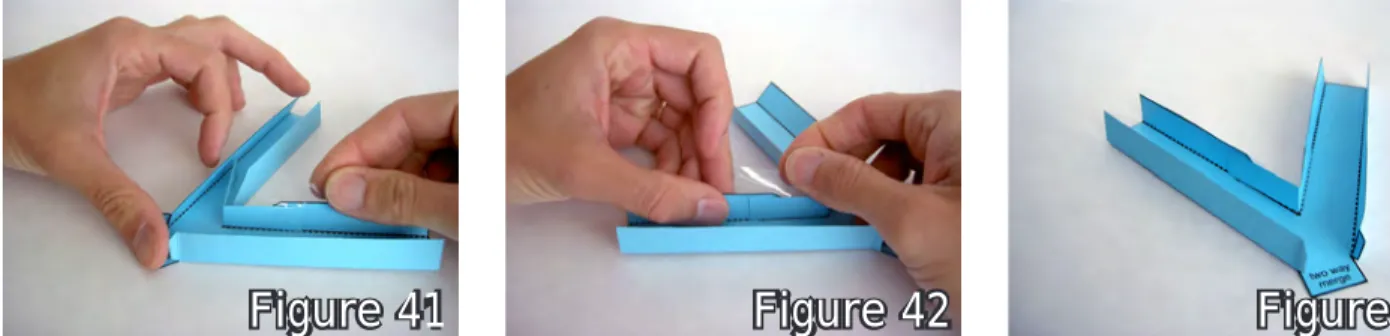
4. Line up the “merge inner wall” piece to the inside wall of the v-shaped track. (fig. 41) Tape one end of the “merge inner wall” piece and then the other end. (fig. 42)
Curves
There are wide curves and sharp curves. Wide curves will send a marble back in the direction it
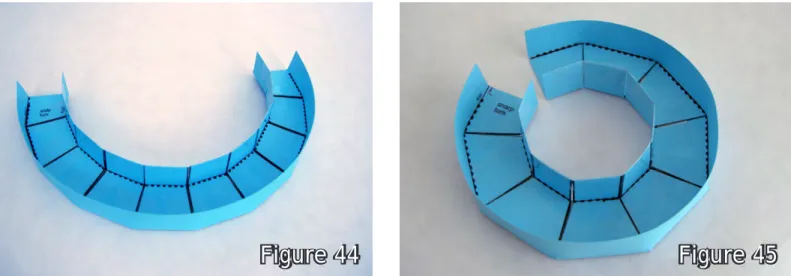
came from. (fig. 44) Sharp curves are ideal for tight spirals around columns. (fig. 45)
Figure 46
Figure 47
Figure 48
Figure 49
Figure 50
Figure 51
4. Place the strip of paper on a flat surface. Bend the uncut wall of the strip upward and bring
the other sections together so that they just touch each other. The rectangular shapes furthest
from the uncut edge should over lap slightly. (fig. 49) Use small pieces of tape to connect the floor of the curved track. Take care that the tape does not touch the rectangular shapes that will
become the inner wall.
5. Bend the rectangular shapes up until their edges barely touch. Place a small piece of tape on
the inside edge where two of these panels touch. (fig. 50)
6. Fold the tape over so that it also secures the inside wall of the track. (fig. 51)
1. Find a “wide curve” or “sharp curve” strip and trace along the dotted lines with a ball point pen to score the paper. (fig. 46)
2. Fold along the dotted lines to make a sharp crease, keeping the lines on the inside. (fig. 47)
3. Cut out the shaded shapes completely by cutting along the thick solid lines. (fig. 48) Be sure that the cuts reach the dotted line or curving the paper will be difficult.
Funnel
Funnels are difficult to make but they help vary the pace of the marble in a roller coaster and are
exciting to watch in action.
Figure 52
Figure 53
Figure 54
Figure 55
Figure 56
Figure 57
Figure 58
Figure 59
Figure 60
1. One the “Funnel Template” trace along every dotted lines with a ball point pen to score the paper. (fig. 52)
2. Remove all five pieces of the funnel by cutting along the solid black lines. (fig. 53) Do not
cut out the teeth shape pieces until you have completed the following step.
3. Fold along all of the dotted lines to make sharp creases. (fig. 54)
4. Cut along the solid black lines between the “teeth” in the wall sections. (fig. 55)
5. Cut along the straight line in the “floor” section and then cut out the small circle in the center of the “floor.” (fig. 56) This will make the floor look like a large letter “C.”
6. Overlap the two flaps of the “floor” covering up the pattern and lining up the three sets of arrows so that their tips barely touch. (fig. 57) Use a small piece of tape to hold the paper in this
position.
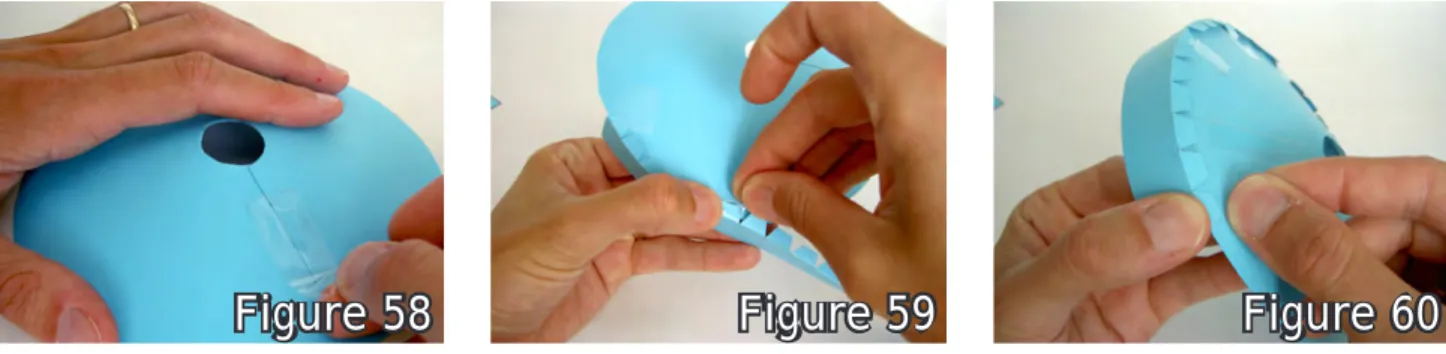
7. Turn over the “floor” of the funnel and securely tape the outer flap of the “floor.” (fig. 58) 8. Take either end of the “long funnel wall” piece and tape the small flap to the underside of the “floor.” Hold the “wall” against the “floor” of the funnel and continue to tape the “teeth” flaps to the underside of the funnel. (fig. 59) You do not need to tape every flap down yet. You should only tape down enough flaps to hold the wall in place.
9. Keep taping down flaps until you reach the other end of the “wall.” (fig. 60) Go back and tape down any flaps that you skipped.
10
Figure 61
Figure 62
Figure 63
Figure 64
Figure 65
Figure 66
Figure 67
Figure 68
Figure 69
10. After attaching the “long wall,” the funnel should look like this. (fig. 61)
11. Tape the short wall to the floor of the funnel, overlapping slightly with one end of the “long wall.” (fig. 62) It doesn’t matter which end.
12. After attaching both sections of wall, the funnel should be enclosed over three quarters of
the way around. (fig. 63)
13. Use a small piece of tape to connect the shorter wall of the “funnel entry” to the wall of the funnel. (fig. 64)
14. Tape the longer wall to the wall of the funnel, making sure that the curve of the “funnel entry” matches the curve of the “funnel floor.” (fig. 65)
15. Tape the small flaps of the “funnel entry” to the underside of the “funnel floor.” (fig. 66)
16. Use small pieces of tape to connect the rest of the “funnel entry” to the “funnel floor.” Use
tape on the top and bottom surfaces to make sure that you create a smooth transition between
these two pieces. (fig. 67)
17. Attach a very small piece of tape to the straight end of the “funnel flap.” (fig. 68)
18. Attach this piece of tape to the wall of the funnel as shown by the arrow in fig. 69. The “funnel flap” will allow the marble to enter the funnel easily and roll smoothly around the outer rim of the funnel. The flap should open and close easily.
11
Figure 70
Figure 71
Figure 72
Figure 73
Figure 74
Figure 75
Figure 76
Figure 77
Figure 78
Loops
Loops are probably the most impressive feature that you can add to your roller coaster. They
are not too difficult to make, but your marble must be moving fast when it reaches a loop or it
will not complete the loop.
1. Trace along the dotted lines with a ball point pen to score the paper. (fig. 70)
2. Fold backward along the dotted lines to make sharp creases, keeping the printed side on the
outside. (fig. 71)
3. Cut along the short solid black lines. Make sure you cut all the way to the crease or the loop
will be difficult to finish. (fig. 72)
4. Starting at one end, bring two flaps together so that the dotted pattern on one of them is just barely hidden. (fig. 73)
5. Use a small piece of tape to hold the two flaps together. (fig. 74)
6. Fold the piece of tape over so that it secures the other side of the flaps. (fig. 75) Tape all of the flaps along one side of the funnel before starting the other side.
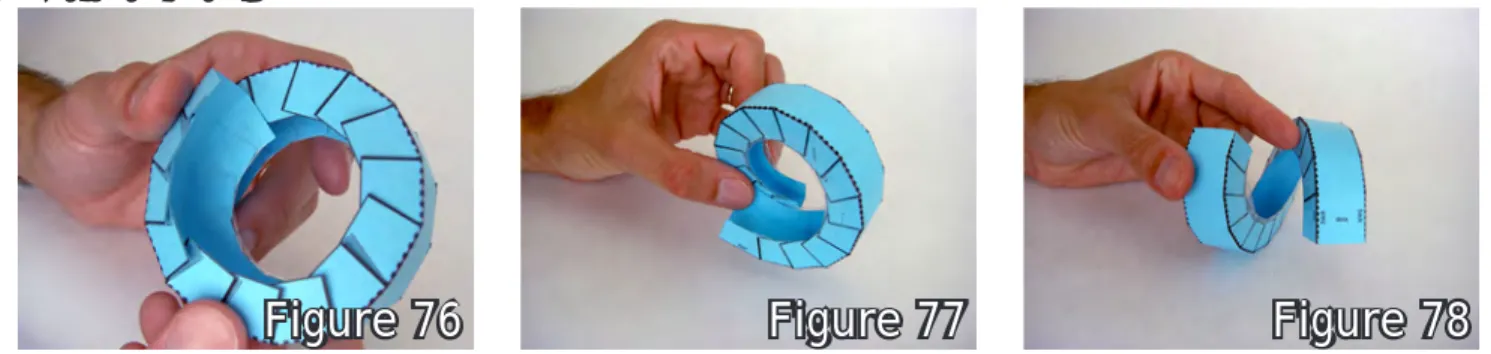
7. After taping all of the flaps along one side of the loop, it should hold its shape, allowing you to tape the flaps on the other side more easily. (fig. 76)
8. When you have taped the flaps on both sides, the loop should form a smooth circle. (fig. 77)
9. The loop can be stretched out when attached to the roller coaster making more of a
12
Figure 79
Figure 80
Figure 81
Figure 82
Figure 83
Figure 84
Figure 85
Figure 86
Figure 87
Taping Tracks to a Beam or Shelf
Using a bracket is a secure and simple way to attach track to the framework. In this example,
you’ll see how to attach a loop to a beam.
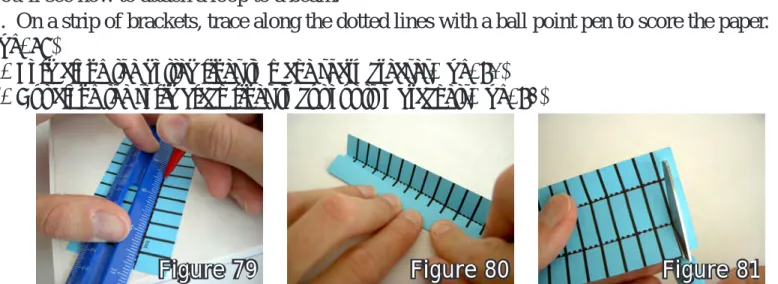
1. On a strip of brackets, trace along the dotted lines with a ball point pen to score the paper.
(fig. 79)
2. Fold along the dotted lines to make sharp creases. (fig. 80) 3. Cut along the solid black lines to cut out two brackets. (fig. 81)
4. Hold the loop in the position where it will be attached. This will show you where the
brack-ets will need to be located. (fig. 82)
5. Tape each bracket to the beam using a single piece of tape down the center of the bracket.
(fig. 83) The two arms of each bracket should still be able to stick straight up.
6. Hold the loop in position and tape the brackets to the loop. (fig. 84) Make sure that you tape
both arms of both brackets to the loop.
1. Overlap the two tracks by about an inch (2.5 cm). Lay the uphill track on top of the
down-hill segment to prevent a bump which could cause the marble to leave the track. (fig. 85) 2. Tape the walls together by placing tape on the ouside and folding inward. (fig. 86)
3. Use one piece of tape on the floor of the track to add extra strength and smoothness. (fig. 87)
Taping Tracks to Each Other
Attaching tracks to each other is a simple task but must be done with care to keep the marble’s path smooth.
1
Figure 88
Figure 89
Figure 90
Figure 91
Figure 92
Adding Cantilevers and Beams to Hold the Track
Very often, you will need to add pieces to your structure just to have more places to attach your
track. One way to do this is to add beams between two columns as you did on page 5. If you
connect a beam at only one end, it is called a cantilever. A cantilever can extend outward from any beam or column
1. Determine where you want the cantilever to support the track. (fig. 88)
2. Take a completed beam and cut it to length along a dotted line. Make sure to leave enough of
an overlap to wrap around the column. (fig. 89)
3. Cut along all four edges at one end of the cantilever about 2 cm (3/4 inch). The other end
should remain uncut. Use the thin dotted lines as a guide. If the end of the beam is right on one of the dotted lines, cut as far as the next dotted line. (fig. 90)
4. Fold back two of the flaps that are across from each other. (fig. 91)
5. Hold the cantilever in place beneath the track and tape it to the column or beam. (fig. 92)
Adding Shelves
If you need a support to hold a track, the quickest way to do that is to attach a shelf to a column.
1. Cut along the solid lines. (fig. 93) Discard the shaded sections.
2. Trace along the dotted lines with a ball point pen to score the paper. (fig. 94)
3. Fold down the sides and fold up the small flap. Tape the small flap to a column. (fig. 95)
Tape the sides of the shelf to the column to hold it in place.
Adding a Switch with Multiple Tracks
Although it’s not very difficult to use a merge piece to make more than one track join together, it’s a bit trickier to have one starting point and get the marbles to take different paths. One way to do that is to use a switch with a merge piece. Marbles going through the switch will alternate between the merge’s two possible paths.
1. Cut along the switch’s solid lines. (fig. 96) Don’t forget to cut the small straight lines that cut into the switch. (fig. 97)
2. Trace along all eight dotted lines. (fig. 98)
3. Fold down and then unfold along the two dotted lines that have small dashes. (fig. 99) 4. Fold up and then unfold along the dotted lines with long dashes. (fig. 100)
5. Fold up the two rectangular tabs labeled “A” and “B.” The tips of the two arrows on the tabs should meet and the tab with the wavy pattern should be hidden behind tab “B.” (fig. 101)
6. Tape the wavy tab to the back of tab “B” with a small piece of tape. (fig. 102)
7. Fold up the two rectangular tabs labeled “C” and “D.” The tips of the two arrows on the tabs should meet and the tab with the wavy pattern should be hidden behind tab “C.” (fig. 103)
8. Tape the wavy tab to the back of tab “C” with a small piece of tape. (fig. 104)
9. Bring tabs “A” and “D” together so they are back to back with each other. Place a small piece of tape along the top edge of tab “A” and then fold the tape over onto tab “D.” (fig. 105)
10. Tape the back of tabs “B” and “C” to the underside of the switch. (fig. 106) 11. The switch should fit nicely into a completed merge section. (fig. 107)
Figure 96 Figure 97 Figure 98
Figure 99 Figure 100 Figure 101
Figure 102 Figure 103 Figure 104
Figure 105 Figure 106 Figure 107
15
Tips for Great Roller Coasters
To make an interesting roller coaster that works smoothly takes patience and practice. Here are a few suggestions for making a great roller coaster.
1. Start small - You can always continue to build a structure taller later. Build a small structure
and start attaching tracks. You might find out that you don’t need a tall structure to make an
interesting roller coaster.
2. A slow marble can be cool - If a marble takes 30 seconds to reach the bottom of the roller
coaster, it will be more impressive than one that only takes 5 seconds. Keep the incline of your tracks gentle so the marble doesn’t reach the end too fast.
3. Only use steep tracks when necessary. If the marble flies off the track, make the slope more
gentle to keep the marble’s speed under control.
4. Be creative. The templates in this kit are just the beginning. Make tunnels, jumps, decora-tions, etc. to really make a unique roller coaster.