11
MING-MING CHEN. Computational Simulation of worker exposure Using a Particle Trajectory Method. ( Under the direction of Dr. Michael R. Flynn)
ABSTRACT
A discrete vortex model of the recirculating flow downstream of a worker is used to calculate trajectories of "massless" tracer particles released from a fixed point source. Mean concentrations in the plane of the source are estimated by averaging over a number of such trajectories. Approximations include: (1) the worker is represented by a two-dimensional elliptical cylinder; and (2) the contaminant is represented by massless tracer particles which are
generated without momentum and transported by vortex shedding and turbulent diffusion exclusively. Computer-predicted mean
Ill
TABLE OF CONTENTS
Page
TABLE OF CONTENTS... iii
LIST OF TABLES AND HGURES... i v ACKNOWLEDGEMENTS... vii
INTRODUCTION... 1
CALCULATION METHOD... 4
(a) Trajectories... 4
(b) Mean Concentrations... 7
RESULTS... 1 1 DISCUSSION... 2 3
CONCLUSIONS... 2 7
REFERENCES...'... 2 8
APPENDIX A:
Determination of Eddy Diffusivity ke... 3 0
APPENDIX B:
The Relation Between the Weighting Factor, f(t), and
the Lagrangian Integral Time-Scale, Tl... 3 2
APPENDIX C:
IV
LIST OF TABLES AND FIGURES
Page
TABLE 1
Summary of the Trajectory Algorithm of the Concentration
Particles... 7
TABLE 2
The Average Concentration from the 28 Examining Points
for Each Simulation and Experiment... 1 3 FIGURE 1
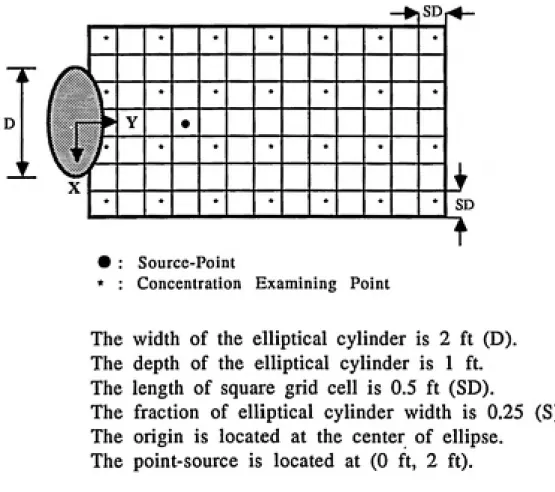
Plan View of Worker and Point-Source Relative Positions... 2
FIGURE 2
The Dimensions of the Grid Cells in the Plane of Point-Source 3
FIGURE 3
The Total Number of Particles Generated in Two-Dimensional
Concentration Field... 1 4
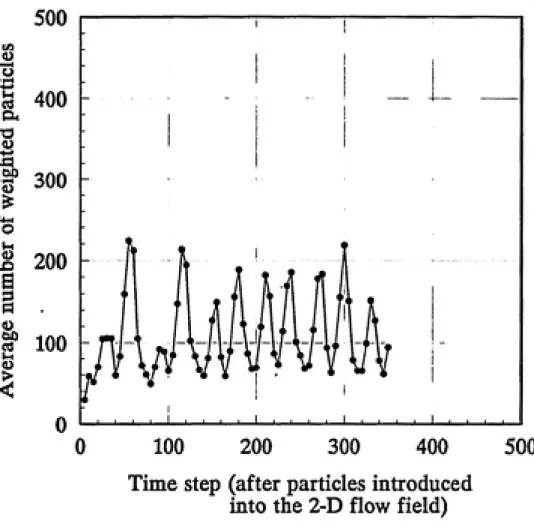
FIGURE 4
The Average Number of Weighted Particles in the Cell of
the Point-Source... 1 5
FIGURES
The Average Number of Weighted Particles in the area
FIGURE 6
The Concentration Contours for Point-Source at (0 ft, 2 ft)
with ke=0.074, Tl=0.58... 1 7
FIGURE?
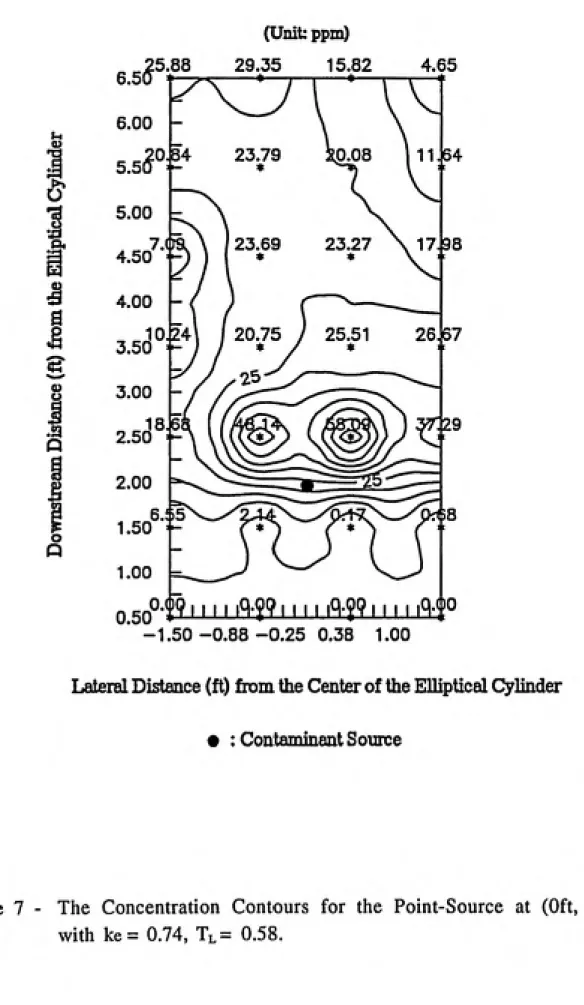
The Concentration Contours for Point-Source at (0 ft, 2 ft)
with ke=0.74, Tl=0.58... 1 8
FIGURES
The Concentration Contours for Point-Source at (0 ft, 2 ft)
withke=7.4, Tl=0.58... 1 9
FIGURE 9
The Concentration Contours for Point-Source at (0 ft, 2 ft)
with ke=7.4, Tl=2.0... 2 0
FIGURE 10
The Concentration Contours for Point-Source at (0 ft, 2 ft)
with ke=74., Tl=10.0... 2 1
FIGURE 11
The Concentration Contours of Experiment... 2 2 FIGURE 12
Air Flow Structure Downstream of the Mannequin... 2 5
FIGURE 13
Velocity Field around an Elliptical Cylinder in a Uniform
VI
FIGURE B.l
Particle Variances in Z-Direction, ^z, with Different Tl
Values... 3 3
FIGURE B.2
Vll
ACKNOWLEDGEMENTS
I wish to express my thanks to my advisor. Dr. Michael R. Flynn, for his knowledge and guidance throughout this research; to Dr.
INTRODUCTION
In a paper entitled 'Discrete vortex methods for the simulation
of boundary layer separation effects on worker exposure', Flynn and
Miller (1991) point out that one of the most significant aspects of
contaminant dispersion in the vicinity of a worker is the tendency
for the contaminant to recirculate. The phenomenon of boundary
layer separation is responsible for the formation of rotating eddies
on the downstream side of the worker. These eddies can transport
contaminant into the breathing zone and reduce the effectiveness of
the intended ventilation (Flynn and Miller, 1991).The objective of this research is to develop a computer model
to calculate trajectories of particles released from a fixed
point-source in a two-dimensional flow field and to estimate mean
concentrations in the plane of this source. The model represents the
worker as an elliptical cylinder. The time-dependent air flow is
around this elliptical cylinder which is immersed in a uniform free
stream (see Figure 1). The recirculating flow downstream of the
worker is computed with a discrete vortex code developed by Flynn
and Miller (1991) and a fast-multipole algorithm developed by
Greengard and Rokhlin (1987) for calculating vortex interactions.
The dispersion of contaminant from a point-source is examined
by calculating trajectories for a number of particles released into the
flow field. Mean concentrations are predicted by imposing a uniform
grid of cells on the wake region (see Figure 2) and counting the
average number of particles in each grid cell. This two-dimensional
point-source by using a time-dependent particle weighting factor
(Turfus, 1988). A comparison between the mean concentrations
computed from the simulation and those measured using a
mannequin and sulfur hexafluoride (SFg) tracer gas (Flynn and Kim,
1990), is conducted to examine the model's validity.
Wall
Tunnel
Inlet
I--- Elliptical Cylinder (represents worker)
Concentration Area
r
i
— Contaminant Source
U (Freestream Velocity)
Removal Boundary
(for Concentration Particles)
Tunnel Outlet
Wall
D
-
ͨ
]
SDr4-* * * * * * *
1*^
T
Y
* * * ͣk * •
J^
Y •/
* * • * * *
X
il
* * * * * * ͣk
SD
• : Source-Point
* : Concentration Examining Point
The width of the elliptical cylinder is 2 ft (D). The depth of the elliptical cylinder is 1 ft.
The length of square grid cell is 0.5 ft (SD).
The fraction of elliptical cylinder width is 0.25 (S). The origin is located at the center of ellipse.
The point-source is located at (0 ft, 2 ft).
CALCULATION METHOD
(a) Trajectories
Airflow around an elliptical cylinder is time-dependent;
entrainment of air into the near-wake region results in the periodic
shedding of vortices. It is assumed that this determines the
concentration of contaminant to which the worker is exposed.
Trajectories for passive tracer particles released from a given point
source in this two-dimensional flow field, are calculated using a
discrete vortex model (Flynn and Miller, 1991). This model relies
upon the fact that vorticity is a material property of the fluid that is
convected and diffused. It is possible to use the method of fractional
steps (Bui and Oppenheim, 1987) and split the vorticity-transport
equation into Euler's equation and the diffusion equation,
respectively:
-^ + (V- V)^ = 0
at '^ (1)
and
at ^, (2)
where ^ is vorticity, V is the two-dimensional velocity, and v is the
kinematic viscosity.
The solution for Euler's equation depends upon a theorem
(Batchelor, 1967) that guarantees, for an incompressible flow, that a
diffusion equation, with an impulse initial condition, is a Gaussian
distribution of zero mean and variance:
2
a- = 2v At, (3)
where a is the standard deviation of a blob or sheet displacement
and At is a finite interval of time.
Under the assumption that the small scale contaminant
diffusivity, ke is a constant, then the contaminant-transport equation
can be split into Euler's equation and the diffusion equation,
respectively:
3C
—- + (V • V) C = 0
at (4)
and
^t , (5)
where C is the concentration of the contaminant, V is the two-dimensional velocity, and ke is the diffusivity.
Concentration particles are treated as massless tracer particles
that are generated without momentum. In simulation, the movement
of the concentration particle is affected by the convection of vortex
blobs and the diffusion of eddies in the flow field. The movements of
the concentration particles are according to the equations:
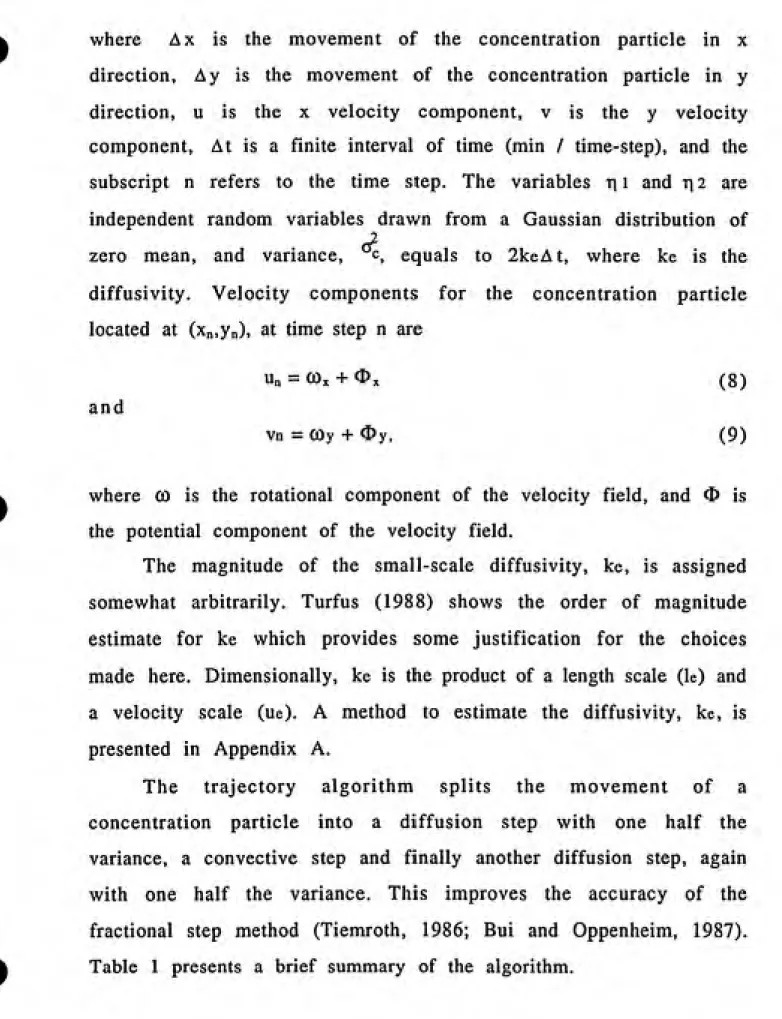
Ax = Xn+, - x„ = At u„ + rii (6) and
where Ax is the movement of the concentration particle in x
direction, Ay is the movement of the concentration particle in y
direction, u is the x velocity component, v is the y velocity
component. At is a finite interval of time (min / time-step), and the
subscript n refers to the time step. The variables r| i and ri 2 are
independent random variables drawn from a Gaussian distribution of
J.
zero mean, and variance, c, equals to 2keAt, where ke is the
diffusivity. Velocity components for the concentration particle
located at (Xn,yn), at time step n are
u„ = C0x + O^ (8)
and
Vn = COy + Oy, (9)
where CO is the rotational component of the velocity field, and O is
the potential component of the velocity field.
The magnitude of the small-scale diffusivity, ke, is assigned
somewhat arbitrarily. Turfus (1988) shows the order of magnitude
estimate for ke which provides some justification for the choices
made here. Dimensionally, ke is the product of a length scale (le) and
a velocity scale (ue). A method to estimate the diffusivity, ke, is
presented in Appendix A.
The trajectory algorithm splits the movement of a
concentration particle into a diffusion step with one half the
variance, a convective step and finally another diffusion step, again
with one half the variance. This improves the accuracy of the
fractional step method (Tiemroth, 1986; Bui and Oppenheim, 1987).
TABLE 1
Summary of the Trajectory Algorithm for the Concentration Particles
Within each time step:
(1) Generate the new concentration particles at the source point.
(2) Diffuse all old concentration particles.
(3) Reflect and / or remove the concentration particles from
domain as needed.
(4) Convect all old concentration particles.
(5) Reflect and / or remove the concentration particles from
domain as needed.
(6) Diffuse all old concentration particles.
(7) Reflect and / or remove the concentration particles from
domain as needed.
(b) Mean Concentrations
The main purpose of this research is to predict mean
concentrations resulting from a constant generation rate of
contaminant from a fixed point-source. After the flow field develops,
concentration particles are released, ten particles per time-step, from
a fixed point source. They are allowed to move under the influence of
the flow field, according to Equations (4) and (5). These particles are
removed only when they cross the removal boundary (RB). RB is
y=18 ft, that was tested and set in simulation, because beyond this
boundary the probability of particle being recirculated back to the
wake region is zero. After a given time, the distribution of particles
in the flow reaches a statistical equilibrium, i.e. the expected number
increase or decrease with time. By the ergodic theorem (Panchev,
1971), if the distribution of particles were statistically stationary
throughout this time period and the average number of particles in
each cell at each time-step had therefore converged to a number
independent of time, then we could equate this number to the
ensemble mean concentration (due to a line-source of strength Qs = N
particles /At) integrated over the cell.
Turfus (1988) presents a method for estimating concentration
from point and line sources in a two-dimensional flow. For a
line-source, the mean concentration, C, can be expressed as a
dimensionless group % by the following transform:
CILD
X(xi,yj)= ^°° ao)
where U~ is the freestream velocity (fpm), Qs is the two-dimensional
source strength (ft2 /min), and D is the width of the mannequin (ft)
which is perpendicular to the free stream.
By imposing a uniform grid over the computational domain
with square cells of length SD, if Ny is the calculated mean number of
particles in a cell with center at (Xi, yj), then the dimensionless mean
concentration within this cell can be approximated as:
NijU^DAt NijU^At
X Xi, yj) = / .— = -7^-^^— a 1)
(SD) N (s^d) N
where S is a fraction of length D, and N is the number of particles
A similar analysis is presented by Turfus (1988) for calculating
concentration fields in the plane of a point-source, in a
two-dimensional flow, by including a weighting factor inversely
proportional to the age of the particle (i.e. the time since the particle
is released). Thus, the dimensionless mean concentration for a
point-source, X3D, is defined as:
O(xi,yj,z=0) U^D^
X3D(xi, yj) = —---^-^--- a^
where Qs is the contaminant source flow in cfm. Equation (9) can be
modified as:
N*ij U^ At
*
where "^ '' is the number of weighted tracer particles in the ij cell.
Equation (13) is used to approximate the concentration field in the
plane of the point source by weighting the contribution of each
particle with a factor, f(t), where:
f(t) = -1---=--- a 4)
^2k G^it)
and
(4(t) = 5^ -h 2(4 1? a - e T^ -H ^) a 5)
where ^ is the particle variance in z direction, t is the age of the
10
a small distance to avoid singularity in the formlation, and *^ is the
velocity variance out of the plane of simulation (i.e. the square of the
z-velocity fluctuation). Based on homogeneity, "w is calculated
assuming a 10% overall turbulence intensity.Turfus (1988) examined the recirculation bubble downstream
of a backward facing step and concluded a dimensional simulation
time of Td = 144 D (U~>)" had a 10% error. Based upon similar
reasoning for our research if D is the mannequin cross body
dimension of 8 inches, U- is 200 fpm, and At is 0.002 min; then 240
RESULTS
The simulations conducted here represent flow of air around a
worker by modelling this worker as a two-dimensional elliptical
cyclinder. The cylinder is 2.0 ft wide, and 1.0 ft deep. The free
stream velocity was set to 66.67 fpm, with the direction of air flow
perpendicular to the major axis, thus giving a Reynolds number of
13890, in the range applicable to industrial ventilation.
A time increment of 0.002 min was selected for the runs
displayed here. After 150 time steps (i.e. the time needed to develop
the velocity flow field), concentration particles were released, 10
particles per time step, from a point-source into the two-dimensional
flow field. The time needed for the concentration field to reach
statistical equilibrium, after the particles are introduced into the flow
field, is presented in Figure 3. This shows the development of
concentration particles with time in the region -7.5 ft < x < 7.5 ft and
0 ft < y < 18 ft. It indicates that after about 200 time steps, the
distribution of particles in the flow reaches equilibrium. Figure 4 and
Figure 5 show the distributions of weighted particles with time in the
cell of the point-source and in the area -1.25 ft < x < 1.25 ft and 0.75
ft< y < 3.25 ft, respectively. These show that the equilibrium state can
be reached quickly in the area close to the cylinder. The calculation
was continued for 100 time steps to calculate the mean
concentrations of examining points in the wake region.
Mean concentration contours resulting from a point-source
located at (0.0 ft, 2.0 ft) were calculated. Figures 6-8 present the
12
ke=0.74, and ke=7.4 and Tl=0.58, respectively. It shows mean
concentrations near the worker increase when the diffusivity
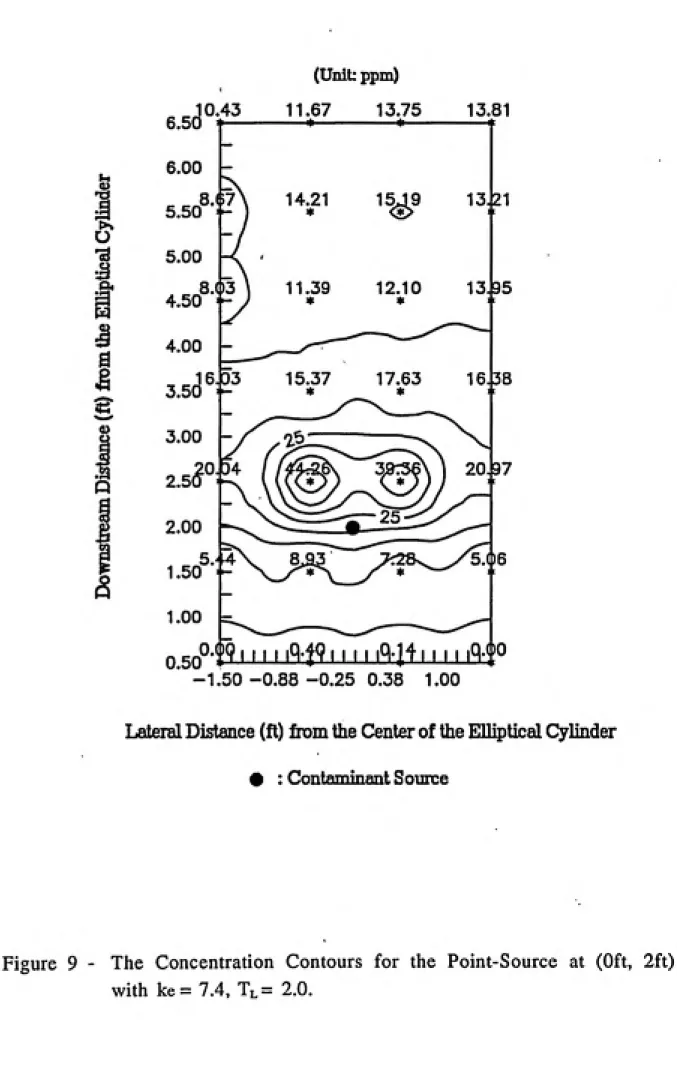
increases. Results for mean concentration contours with Tl=2.0, andTl = 10.0 and ke=7.4 are presented in Figure 9 and Figure 10,
respectively. The mean concentration contours of experimental data
are presented in Figure 11 (Flynn and Kim, 1990). Table 2 presents
the average concentration from the 28 examining points for each
simulation and experiment. It shows that the mean concentration
decreases when either the diffusivity (ke) or the Lagrangian integral
time scale (Tl) increases.
The simulations displayed here adopt a fast-multipole
algorithm developed by Greengard and Rokhlin (1987) which
reduces computational time from order N^ to order N (where N is the
TABLE 2
The Average Concentration from the 28 Examining Points
for Each Simulation and Experiment
13
Case Diffusivity ke
Lagrangian integral
time scale, Tl
Average mean 1
concentration (ppm) 1
1 0.074 0.58 17.40
2 0.74 0.58 17.10
3 7.4 0.58
14.16 1
4 7.4 2.00 12.98
5 7.4 10.0 7.89
14
ex
o
2000
1600 Q
(^
.S
I 1200
800
^ 400
0
0 100 200 300 400 500
Time step (after particles introduced
into the 2-D flow field)Figure 3 - The Total Number of Particles Generated in Two-Dimensional
15
xi
cd 100
80
S 60
40
20
-0
0 100 200 300 400 500
Time step (after particles introduced
into the 2-D flow field)
Figure 4 - The Average Number of Weighted Particles in the Cell of
16
4>
500
J3 400
Oh
ͣ
«-»
t 300
I 200
I .
I 100
0
0 100 200 300 400 500
Time step (after particles introduced
into the 2-D flow field)
Figure 5 - The Average Number of Weighted Particles in the Area of
17
I
!
I
6.50
(Unit: ppm)
33.79 36.21
T7.ZQ
o.coQ-t?...^^ Mil iq-?91111 iM-yo
-1.50-0.88-0.25 0.38 1.00
Lateral Distance (ft) from the Center of the EUipticad Cylinder
Contaminant Source
Figure 6 - The Concentration Contours for the Point-Source at (Oft, 2ft)
18
.^5.88
(Unit: ppm) 29.35 15.82
23.79
o.3oQ19...q-;9...q>y9 mm iq-f
-1.50-0.88-0.25 0.38 1.00
Lateral Distance (ft) from the Center of the Elliptical Cylinder
: Contaminant Soinx:e
Figure 7 - The Concentration Contours for the Point-Source at (Oft, 2ft)
19
e cJ 0.59
6.50
(Unit: ppm)
15.25 13.75
11.66
-1.50-0.88-0.25 0.38 1.00
Lateral Distance (ft) from the Center of the Elliptical Cylinder
: Contaminant Source
Figure 8 - The Concentration Contours for the Point-Source at (Oft, 2ft)
20 ti4
I
u •a a Q 6.50 6.00 5.50_8.()7 5.00 4.50 8.03 (Unit: ppm) 11.67 ---iti— 14.21 11.39 * 13.75 —*— 15J9 12.10 13.81 —* 13.21 13.9515.37 17.63 16J38
20.97
5.06
0.500-f9...q-t^? MM lQ^l,-^ I I I I iQ-f
-1.50-0.88-0.25 0.38 1.00
Lateral Distance (ft) from the Center of the Elliptical Cylinder
: Contaminant Source
Figure 9 - The Concentration Contours for the Point-Source at (Oft, 2ft)
21
(Unit: ppm)
4.05 5.50
-0.50
iiiiiiq>f?iiiiiqvl7MMiq-f5
-1.50-0.88-0.25 0.38 1.00
Lateral Distance (ft) from the Center of the Elliptical Cylinder
•: Contaniinant Source
Figure 10 - The Concentration Contours for the Point-Source at (Oft, 2ft)
22
(Unit: ppm)
S
0.50
1.97
1.50 "t
-J
-1.50-0.88-0.25 0.38 1.00
Lateral Distance (ft) from the Center of the Mannequin
: Contaminant Source
Figure 11 - The Concentration Contours of Experiment (Flynn and Kim,
DISCUSSION
Mean concentrations predicted in a two-dimensional flow field by using the particle trajectory algorithm, are determined by three major factors: (1) the recirculation, which is caused by vortices in the
flow; (2) the diffusivity, ke, which tends to spread the contaminant
particles away from the point-source; and (3) the weighting factor, f(t), which determines the probabilities of contaminant particles
leaving the source plane.
Mean concentrations are computed by selecting different values of diffusivity (ke) from 0.074 to 7.4 in our simulations. For ke = 0.074 and ke = 0.74, there is no concentration predicted at level
y=0.5 ft. Figures 6-8 show that for the smaller ke the spread of contaminant away from the source is slower. Because the average velocity of the flow in the wake region is difficult to be determined. It is difficult to obtain an accurate eddy diffusivity for a given simulation, but there is a method presented in Appendix A for
estimating the value of ke. The particle weighting factor which is a
function of the age of particle is affected by the Lagrangian integral
time scale (see Appendix B). Tl is considered a measure of the longest
time during which a particle persists in a motion in a given direction (Hinze, 1975). Figure 9 and Figure 10 show that the larger Tl selected the lower mean concentrations are predicted in the plane of the
source. Table 2 shows that there is no significant difference between
the mean concentrations of the examining area by selecting values of
24
selects values of Tl from 0.58 to 10.0. This indicates that mean concentrations are more strongly affected by Tl than ke.
Generally, the pattern of mean concentration contours
predicted agrees with that of experimental measurement. By
comparing concentrations predicted from simulations with those measured from experiment, the main differences are: (1) computations underpredict mean concentrations near the wake
region, but overpredict concentrations downstream of the
point-source; and (2) for computations, the highest mean concentration
area is at the downstream side of point-source which is different
from experimental where the peak occurred at the upstream side of
the point-source. These discrepancies may be due to: (1) the effect of
the mannequin's elbows, which keeps contaminant in the near wake
region; and (2) the effect of the vertical recirculating loop, which
recirculates the contaminant back to the near wake region (Kim and Flynn, 1991). Mean concentrations in the plane of the point-source are strongly affected by the vertical recirculating loop coming down from the mannequin's head in experiment (see Figure 12). This not
only disperses the contaminant out of the plane of the point-source
but also recirculates it back to the near wake region.
A skewness of the free stream toward the cylinder in the
two-dimensional velocity field was observed (see Figure 13). The effect resulting from the skewness in velocity field is still not clear, but we know that the direction of this velocity skewness is changed with time and is related to eddies formed downstream of the cylinder.
This phenomenon will be reconsidered subsequently to improve the
25
Plan View
Side View
Figure 12 - Air Flow Structure Downstream of the Mannequin (Kim and
26
K
/V/ Wk
\AA
M^
-2.00-1.00 0.00
Lateral Distance (ft) from the Center of the Elliptical Cylinder
CONCLUSION
It is important to develop a computational model for predicting worker exposure. If the worker's breathing zone concentration can be estimated before control equipment be installed, then the design of a local exhaust ventilation system can be evaluated prior to its construction. The extra cost of over control can be eliminated and the
optimal design implemented to control worker exposure to hazardous airborne pollutants. It is difficult to use a two-dimensional computational model to simulate the flow from the vertical recirculating loop and predict the three-dimensional exposure of worker. The particle trajectory algorithm provides a good research direction for the three-dimensional simulation of the mean
28
REFERENCES
Batchelor, G.K. : An Introduction to Fluid Dynamics. Cambridge University Press, Cambridge, U.K., 1967.
Bui, T.D. and A.K. Oppenheim: Evaluation of Wind Effects on Mode Buildings by the Random Vortex Method. Appl. Numer. Math. 3,
195-207 (1987).
Flynn, M.R. and T. Kim : The Impact of Separation on Exposure and Hood Capture. The Final Report on NIOSH grant 5 ROl OH 02392-02 (1990).
Flynn, M.R. and C.T. Miller : Discrete Vortex Methods for the
Simulation of Boundary Layer Separation Effects on Worker Exposure. Ann. Occup. Hyg., 35(l):35-50 (1991).
Greengard, L. and V. Rokhlin : The Rapid Evaluation of Potential
Fields in Three Dimensions, in Lecture Notes in Mathematics
-Vortex Methods. Springer-Verlag, Berlin (1987).
Hiller, R. and N.J. Cherry : The Effects of Stream Turbulence on Separation Bubbles. J. Wind Engng Ind. Aerodyn., 8: 49-58
(1981).
Hinze, J.O. : Turbulence Diffusion of Fluid Particles; Lagrangian Correlations, Turbulence 2nd ed., pp. 48-58, 1975.
Kim, T. and M.R. Flynn : Airflow Pattern Around a Worker in a Uniform Freestream. Am. Ind. Hyg. Assoc. J., 52(7):287-296
(1991).
Panchev, S. : Random Function and Turbulence. Pergamon Press,
29
Tiemroth, E.C. : The Simulation of Viscous Flow Around a Cylinder by the Random Vortex Method. Doctoral Dissertation, University of
California, Berkeley (1986).
Turfus, C. : Calculating mean concentrations for steady sources in recirculating wakes by a particle trajectory method. J. Atmos.
30
APPENDIX A
Determination of the Eddy Diffusivity, ke:
The magnitude of the small-scale diffusivity, ke, was assigned somewhat arbitrarily. Turfus (1988) shows an order of magnitude calculation for ke which provides some justification for the choices made. Dimensionally, ke is the product of a length scale (le) and a velocity scale (ue). le is a representative length scale for the fluctuations occurring on a scale smaller than the minimum length represented in the DVM. This scale is determined by the cut-off radius for the vortices; so we can suppose le = h / tt , where h is the
length of the vortex sheet (h=0.242121 ft in this study).
In the determination of ue, Turfus supposed that the turbulence at the center of the wake has an energy spectrum E(k),
--- k = fraction of the energy residing in Fourier modes with a wavelength 1 < (2n)/k. He assumes that
"' - J E(k) dk (Al)
(u) 27C/1 e
An estimation of E(k) based on the Kolmogorov similarity
theory is the most acceptable option. Thus,
0.9685
'0.558
^.558^"^
-hk^
^^^ =^ ---7---^---iTTe--- as k ^ oo (A.2)
where L is the length-scale of turbulence (Hillier and Cherry, 1981).
We estimate L=0.5 D. Then E(k) - 1.2657 k"'" and
31
u.
N'
-|l/2
-i- jE(k) dk
27t/le
1.089 (. ^l/3le ^% J
,1/3
0.34 (IJ - 0145
Turbulence intensity, TI, can be expressed as:
TI (%) = -^^^ X 100 (%)
u
(A3)
where ^™* '^ ' , and we assume u - U„
For turbulence intensity, Turfus assumes TI=10%.
Thus,
u
TI m
100 (%)
" "lioo,
U^ = 01 U^ - 6.667 fpmWhence "e = 0-145 (u,„,) = 0145 (01 UJ ^ 0.967 fpm and so,
k^ = u, 1, = 0.967
^h^
yTl J
32
APPENDIX B
The Relation Between the Weighting Factor, f(t), and the Lagrangian Integral Time-Scale, Tl:
The weighting factor, f(t), applied in our research for using a
two-dimensional model to simulate three-dimensions, is a function of
2
the age of the particle and the particle variance in z-direction, "z.
The particle variance in z-direction is a function of the age of the
particle and the Lagrangian integral time scale, Tl. The Lagrangian
integral time scale can be expressed as:
\ = \^ dx KM (Bl)
where RlCO is the Lagrangian auto-correlation coefficient, and t* is
the time for which ^^^ ) = 0 "Xhe Lagrangian integral time scale is
usually considered a measure of the longest time during which, on the average, a particle persists in a motion in a given direction"
(Hinze, 1975). The relation of particle variance, ^, and particle age
with different values of Tl is presented in Figure B.l. Particle
variance is increased when the value of Tl increases. The weighting factor is inversely proportional to the square root of the particle
variance (see Equation (9) above). Thus, the weighting factor
decreases when Tl increases. The relation of weighting factor and the
33
c
o
U
-3
N
4>
W
8
u
TL=0.58 TL=2.00 TL=10.0
200 400 600
Age of particle (Time steps)
34
u
o
o Cm
6C
IS
• mm
0.4-TL=0.58 TL=2.00 TL=10.0
0 200 400 600
Age of particle (Time steps)
35
APPENDIX C
A FORTRAN Code for Computing Mean Concentrations:
************************************************************** * *
* THIS CODE IS DEVELOPED *
* *
* BY * * *
* MING-MING CHEN *
* *
* JULY 4 , 1992 *
* *
* THIS SUBROUTINE IS DEVELOPED TO CALCULATE THE DIMENSIONLESSAL * * MEAN CONCENTRATIONS IN THE PLANE OF A POINT-SOURCE. *
* *
* - TEN PARTICLES ARE GENERATED PER TIME STEP. * * - PARTICLE IS INTRODUCED AFTER 150 TIME STEPS. *
* - A CONCENTRATION EQUILIBRIUM IS REACHED ABOUT 200 TIME STEPS *
* AFTER PARTICLES ARE INTRODUCED INTO THE FLOW. *
* - TOTAL TIME STEPS OF 500 IS RUN FOR CALCULATING THE *
* CONCENTRATIONS. *
* - THE BOUNDARY SET TO REMOVE PARTICLES FROM CALCULATING *
* DOMAIN IS 18 FT. *
* - TURBULENCE INTENSITY APPLIED HERE IS 10%. * * - THE EDDY DIFFUSIVITY APPLIED HERE IS 7.4. * * - THE LAGRANGIAN INTEGRAL TIME SCALE USED HERE IS 10.0. *
* *
* ͣ *
* WITHIN EACH TIME STEP: *
* *
* 1. GENERATE NEW CONCENTRATION PARTICLES AT THE POINT-SOURCE. *
* 2. DIFFUSE ALL OLD CONCENTRATION PARTICLES. * * 3. REFLECT AND / OR REMOVE PARTICLES FROM CALCULATING DOMAIN *
* AS NEEDED. *
* 4. CONVECT ALL OLD CONCENTRATION PARTICLES. *
* 5. REFLECT AND / OR REMOVE PARTICLES FROM CALCULATING DOMAIN *
* AS NEEDED. *
* 6. DIFFUSE ALL OLD CONCENTRATION PARTICLES. *
* 7. REFLECT AND / OR REMOVE PARTICLES FROM CALCULATING DOMAIN *
* AS NEEDED. *
* *
36
SUBROUTINE CONC( K )
IMPLICIT REAL*8(A-H,0-Z)
REAL* 8 NBLT
PARAMETER (NCX=9, NCY=15, MAXTS=50000, SX=0.0, SY=2.0) COMMON /SIZE/ MAXEQN
COMMON /BLK/ XE(MAXTS,2),YE(MAXTS,2),SE(MAXTS,2),
* LIND(MAXTS),SEFAC,XC(20),YC(20),UPGP(20),VPGP(20),VXBLBGP(20) * VYBLBGP(20),VT(20),SHTL,CVX,CVY,NBLT,ARC(20),XRHS(21),
* XTS(50),YTS(50),X(50),Y(50),XSTRGP(20),A,B,BR,NEL,UMIN, *UMAX,XSEED,VISC,DELT,N,XLIM,YLIM,IBL
COMMON /CELLS/ INTS,NTS,NCP,NPR,NP,NETS,NCKTS,NCOUNT, * PX(MAXTS,2),PY(MAXTS,2),PA(MAXTS),WPCEL(NCX,NCY), * WPCELS(NCX,NCY),CONKI(NCX,NCY),CELLX(NCX),CELLY(NCY), * YRB,CPKE,CONPPM(NCX,NCY),UAVG,TI
KTS = K-INTS
IF (KTS .EQ. 1) THEN
DO 100 1=1.NP
PX(NCP+I,2)= SX PY(NCP+I,2)= SY PA(NCP+I)= l.DOO 100 CONTINUE WPCELS(5,5)= 1.0D00*NP NCP= NCP+NP ELSE
DO 200 I=1,NCP
PA(I)=PA(I)+1.D00
200 CONTINUE
DO 300 1=1,NP
PX(NCP+I,2)= SX PY(NCP+I,2)= SY PA(NCP+I)= l.DOO 300 CONTINUE NCP=NCP+NP CALL CPDIFF CALL CPMETA CALL CPCONV CALL CPMETA CALL CPDIFF CALL CPMETA
IF (KTS .GT. (NETS-INTS)) THEN CALL CALCON(KTS)
ENDIF
ENDIF
RETURN
37
************************************************************** * * * THIS SUBROUTINE IS DESIGNED TO DIFFUSE CONCENTRATION PARTICLES. *
* *
**************************************************************
SUBROUTINE CPDIFF
IMPLICIT REAL*8(A-H,0-Z)
REAL* 8 NBLT
PARAMETER (NCX=9, NCY=15, MAXTS=50000, PI=3.141592654)
COMMON /SIZE/ MAXEQN
COMMON /BLK/ XE(MAXTS,2),YE(MAXTS,2),SE(MAXTS,2),
* LIND(MAXTS),SEFAC,XC(20),YC(20),UPGP(20),VPGP(20),VXBLBGP(20), * VYBLBGP(20),VT(20),SHTL,CVX,CVY.NBLT,ARC(20),XRHS(21),
* XTS(50),YTS(50),X(50),Y(50),XSTRGP(20),A,B,BR,NEL,UMIN,
* UMAX,XSEED,VISC,DELT,N,XLIM,YLIM,IBL
COMMON /CELLS/ INTS,NTS,NCP,NPR,NP,NETS,NCKTS,NCOUNT, * PX(MAXTS,2),PY(MAXTS,2),PA(MAXTS),WPCEL(NCX,NCY), *WPCELS(NCX,NCY),CONKI(NCX,NCY),CELLX(NCX),CELLY(NCY), * YRB,CPKE,CONPPM(NCX,NCY),UAVG,TI
URMS= (TI/100.0)*UAVG
CPKE= (0.145*URMS)*(SHTL/PI)* 100.0
CPMU= O.ODOO
CPSIG= DSQRT(DELT*CPKE)
DO 100 I=1,NCP-NP PX(I,1)= PX(I,2)
PY(I,1)= PY(I,2)
CALL NORM(CPMU,CPSIG,PD)
PX(I,2)= PX(L1)+PD
CALL NORM(CPMU,CPSIG,PD) PY(I,2)= PY(I,1)+PD
100 CONTINUE
RETURN END
*****************************************************^^jj.5|j^^5|.^^
* ͣ *
* THIS SUBROUTINE IS DESIGNED TO REFLEDT AND / OR REMOVE *
* CONCENTRATION PARTICLES: *
* *
* LIE PARTICLES BEYOND THE INDECATING BOUNDARY THEN REMOVE *
* THEM. *
* 2. IF PARTICLES BEYONY THE SIDE-WALLS OF THE WIND TUNNEL * * OR GET INTO THE ELLIPTICAL CYLINDER THEN REFLECT THEM *
38
100
SUBROUTINE CPMETA
IMPLICIT REAL*8(A-H,0-Z)
REAL* 8 NBLT
PARAMETER (NCX=9, NCY=15, MAXTS=500()0)
COMMON /SIZE/ MAXEQN
COMMON /ELK/ XE(MAXTS,2),YE(MAXTS,2),SE(MAXTS,2),
* LIND(MAXTS),SEFAC,XC(20),YC(20),UPGP(20),VPGP(20),VXBLBGP(20), * VYBLBGP(20),VT(20),SHTL,CVX,CVY,NBLT,ARC(20),XRHS(21),
* XTS(50),YTS(50),X(50),Y(50),XSTRGP(20),A,B,BR,NEL,UMIN, *UMAX,XSEED,VISC,DELT,N,XLIM,YLIM,IBL
COMMON /CELLS/ INTS,NTS,NCP,NPR,NP,NETS,NCKTS,NCOUNT, *PX(MAXTS,2),PY(MAXTS,2),PA(MAXTS),WPCEL(NCX,NCY), *WPCELS(NCX,NCY),CONKI(NCX,NCY),CELLX(NCX),CELLY(NCY),
* YRB,CPKE,CONPPM(NCX,NCY),UAVG,TI
ICP = 0 XL= -7,5D00 XR= 7.5D00
DO 100 1=1,NCP
ESP= (PY(I,2)/B)**2+(PX(I,2)/A)**2
IF (PY(I,2) .GE. YRB) THEN
ICP= ICP+1 NPR= NPR+1
ELSE IF (PX(I,2) .GT. XR) THEN PX(I,2)= XR-(PX(L2)-XR) ELSE IF (PX(I,2) .LT. XL) THEN
PX(I,2)= XL+(XL-PX(I,2)) ELSE IF (ESP .LT. l.ODOO) THEN
CALL REFLECT(I,XNEW,YNEW) PX(I,2)= XNEW
PY(I,2)= YNEW
ENDIF
IF (PY(L2) .LT . YRB) THEN
39
* *
* THIS SUBROUTINE IS DESIGNED TO CONVECT THE CONCENTRATION *
* PARTICLES. *
* * * A SUROUTINE, DAPIF2, IS ADOPTED HERE WHICH IS DEVELOPED BY *
* GREENGARD FOR FAST CALCULATING VORTEX INTERACTIONS. *
* *
SUBROUTINE CPCONV
IMPLICIT REAL*8(A-H,0-Z)
REAL* 8 NBLT
PARAMETER (NCX=9, NCY=15, MAXTS=50000, PI=3.141592654)
INTEGER IOUT(2),IERR(2),INFORM(4) COMPLEX* 16 FIELD(MAXTS),QA(MAXTS)
DOUBLE PRECISION XA(MAXTS),YA(MAXTS),POTEN(MAXTS), * WKSP(16*MAXTS+1000)
COMMON /SIZE/ MAXEQN
COMMON /BLK/ XE(MAXTS,2),YE(MAXTS,2),SE(MAXTS,2),
* LIND(MAXTS),SEFAC,XC(20),YC(20),UPGP(20),VPGP(20),VXBLBGP(20), * VYBLBGP(20),VT(20),SHTL,CVX,CVY,NBLT,ARC(20),XRHS(21),
* XTS(50),YTS(50),X(50),Y(50),XSTRGP(20),A,B,BR,NEL,UMIN,
* UMAX,XSEED,VISC,DELT,N,XLIM,YLIM,IBL
COMMON /CELLS/ INTS,NTS,NCP,NPR,NP,NETS,NCKTS,NCOUNT,
* PX(MAXTS,2),PY(MAXTS,2),PA(MAXTS),WPCEL(NCX,NCY), *WPCELS(NCX,NCY),CONKI(NCX,NCY),CELLX(NCX),CELLY(NCY),
* YRB,CPKE,CONPPM(NCX,NCY),UAVG,TI
DO 100 1=1,IBL
XA(I)= XE(I,2) YA(I)= YE(I,2)
QA(I)= DCMPLX(SE(I,2),0.0D00)
100 CONTINUE
DO 200 1=1,NCP
XA(IBL+I)= PX(I,2) YA(IBL+I)= PY(I,2)
QA(IBL+I)= DCMPLX(O.ODOO,O.ODOO)
200 CONTINUE
NAT=IBL+NCP
CALL DAPIF2(IOUT,IFLAG7,NAT,NAPB,NINIRE,MEX,IERR,INFORM,
* T0L,EPS7.XA,YA,QA,P0TEN,FIELD,WKSP,NSP,CL0SE) TEMP= 1.0D00/(2.0D00*PI)
DO 300 I=1,NCP-NP
PX(I,1)= PX(I,2) PY(L1)= PY(I,2)
40
VYBLB = TEMP*DREAL(FIHLD(IBL+I))
CALL POTVEL(PX(I,2),PY(I,2),VXPOT,VYPOT) PX(I,2)=PX(I,1)+DELT*(VXBLB+VXP0T) PY(I,2)= PY(I,1)+DELT*(VYBLB+VYP0T)
300 CONTINUE
RETURN END
* *
* THIS SUBROUTINE IS DESIGNED TO CALCULATE THE DMENSIONLESS *
* MEAN CONCENTRATIONS IN THE PLANE OF THE POINT-SOUREC AND * * TO CONVERT THEM TO MEAN CONCENTRATIONS IN ppm. *
* *
*^u•i>^*i'^«£#4I#^•l^>l'>l**£#4^^1'*i'•I'•l*^^^ ^ ^^y^^^^^^^^ ^ ^ ^ ^ ^ ^^ ^ ^ ^ ^ "^ ^ '4* *!• •I' ^ *1* ^L* ^ «t* *l« ^ «i« «i* «!• ^ «i« (la hU *l* ?I* 5J* #p *!* *p Jp ^ *p ^ <T* *1* 'f* '^ T* ^ ^ ^ '^ •^ ^ ^ ^ T* *1* ͣ*• "T* "T* •»• T* 'r' •?• •^ •!• •T* •?• '^ ^ •?• ^ ^ ^ ^ 'P T* T* *!> ^ ^ ^ ^ ^ i^ ^ *p »p ^ ^ ^ ^ ?|^ r(?
SUBROUTINE CALCON(KTS)
IMPLICIT REAL*8(A-H,0-Z)
REAL* 8 NBLT
PARAMETER (NCX=9, NCY=15, MAXTS=50000, PI=3.141592654, S=0.25) COMMON /SIZE/ MAXEQN
COMMON /BLK/ XE(MAXTS,2),YE(MAXTS,2),SE(MAXTS,2),
* LIND(MAXTS),SEFAC,XC(20),YC(20),UPGP(20),VPGP(20),VXBLBGP(20), * VYBLBGP(20),VT(20),SHTL,CVX,CVY,NBLT,ARC(20),XRHS(21),
* XTS(50),YTS(50),X(50),Y(50),XSTRGP(20),A,B,BR,NEL,UMIN,
*UMAX,XSEED,VISC,DELT,N,XLIM,YLIM,IBL
COMMON /CELLS/ INTS,NTS,NCP,NPR,NP,NETS,NCKTS,NCOUNT, *PX(MAXTS,2),PY(MAXTS,2),PA(MAXTS),WPCEL(NCX,NCY), *WPCELS(NCX,NCY),CONKI(NCX,NCY),CELLX(NCX),CELLY(NCY),
* YRB,CPKE,CONPPM(NCX,NCY),UAVG,TI
UINF= VCY
DELTAS= l.G/(2.0*PI)
SIGW^O.l TL= 10.0 DS=2.0 QS= 0.005 UE= 200.0 DE= 8.0/12.0
DO 100 I=1,NCX DO 200 J=1,NCY
WPCEL(I,J)= O.ODOO
200 CONTINUE
100 CONTINUE
DO 300 1=1,NCP
IF(((PX(L2).GE.-2.25D00).AND.(PX(I,2).LE.2.25D00)).AND
41
IF ((PXa,2).LE.2.25D00).AND.(PX(I,2).GT.L75D00)) THEN
IX=1
ELSE IF((PX(L2).LE.L75D00).AND.(PXa,2).GT.L25D00))THEN
IX = 2
ELSE IF((PX(L2).LE.L25D00).AND.(PX(I,2).GT.0.75D00))THEN
IX = 3
ELSE IF((PX(L2).LE.0.75D00).AND.(PXa,2).GT.0.25D00))THEN
IX = 4
ELSE IF((PX(L2).LE.0.25D00).AND.(PX(I,2).GT.-0.25D00))THEN
IX = 5
ELSE IF((PX(L2).LE.-0.25D00).AND.(PX(I,2).GT.-0.75D00))THEN
IX = 6
ELSE IF((PX(I,2).LE.-0.75D00).AND.(PX(I,2).GT.-1.25D00))THEN
IX = 7
ELSE IF((PX(I,2).LE.-L25D00).AND.(PX(I,2).GT.-L75D00))THEN
IX=8 ELSE
IX = 9
ENDIF
IF ((PY(L2).GE.-0.25D00).AND.(PY(I,2).LT.0.25D00)) THEN
IY=1
ELSE IF((PY(L2).GE.0.25D00).AND.(PY(I,2).LT.0.75D00))THEN
IY = 2
ELSE IF((PY(I,2).GE.0.75D00).AND.(PY(I,2).LT.1.25D00))THEN
IY = 3
ELSE IF((PY(I,2).GE.L25D00).AND.(PY(I,2).LT. 1.75D00))THEN
IY = 4
ELSE IF((PY(I,2).GE.L75D00).AND.(PY(I,2).LT.2.25D00))THEN
IY = 5
ELSE IF((PY(I,2).GE.2.25D00).AND.(PY(I,2).LT.2.75D00))THEN
IY = 6
ELSE IF((PY(I,2).GE.2.75D00).AND.(PY(I,2).LT.3.25D00))THEN
IY = 7
ELSE IF((PY(I,2).GE.3.25D00).AND.(PY(I,2).LT.3.75D00))THEN
IY=8
ELSE IF((PY(I,2).GE.3.75D00).AND.(PY(I,2).LT.4.25D00))THEN
IY = 9
ELSE IF((PY(I,2).GE.4.25D00).AND.(PY(I,2).LT.4.75D00))THEN
IY= 10
ELSE IF((PY(I,2).GE.4.75D00).AND.(PY(I,2).LT.5.25D00))THEN
IY= 11
ELSE IF((PY(I,2).GE.5.25D00).AND.(PY(I,2).LT.5.75D00))THHN
42
T= (PA(I)*DELT)/(DS/UINF)
FA= 1.0/DSQRT(2.0*PI*(DELTAS+(2.0*SIGW**2.0*TL**2.0)*
* (1.0-DEXP(-T/TL)+(T/TL)))) WPCEL(IX,IY)=WPCEL(IX,IY)+FA
ENDIF
300 CONTINUE
DO 400 I=1,NCX
DO 500 J=1,NCY
WPCELS(IJ)= WPCELS(IJ)+WPCEL(I,J)
500 CONTINUE 400 CONTINUE
NCOUNr=NCOUNT+l
IE ((KTS+INTS) .EQ. NTS) THEN
DO600I=l,NCX
DO 700 J=1,NCY
WPCELS(IJ)= WPCELS(I,J)/DELOAT(NCOUNT)
CONKI(I,J)= (WPCELS(I,J)*UINE*DELT)/(S**2.0*DS*DFLOAT(NP))
CONPPM(I,J)= (CONKI(I,J)*QS/(UE*DE**2.0))*1.0D06
700 CONTINUE 600 CONTINUE
DO 800 1=1,NCX DO 900 J=1,NCY
WRITE(6,10) I, J, CELLX(I), CELLY(J), CONKI(I,J), CONPPM(I,J)
900 CONTINUE 800 CONTINUE
ENDIF
10 FORMAT(2(15,2X),4(F15.5,2X))
RETURN END