FROM OBAMA TO TRUMP: WHITE STATUS ANXIETY IN THE 2016 PRESIDENTIAL ELECTION
By: Drake Buxton
Senior Honors Thesis Department of Public Policy
University of North Carolina at Chapel Hill
April 4th, 2018
Approved:
___________________________ Anna Krome-Lukens Ph.D.
ACKNOWLEDGEMENTS
I would like to thank two incredible thesis advisors, Dr. Anna Krome-Lukens and Dr. Rebecca Kreitzer who were pivotal to the direction and completion of this thesis - even with a new baby and an intensive research project on their plates!
I also want to thank my parents, for debating and discussing every aspect of this paper and my friends, specifically Eliza Filene, Michael Shanahan, Max Satter, Sammy Martinez, Caroline Ririe, Radhika Pasi, Taylor Alfonso, Maddie Murphy, Jessi Boose and Merrill Stovroff for listening to me talk about my thesis an exhausting amount and supporting me throughout the process.
ABSTRACT
This honors thesis examines the underlying causes that led to the shift in electoral support from Barack Obama to Donald Trump. White status anxiety led to an increase of voters in the white working class, the demographic primarily responsible for the election of Donald Trump. By studying the question of what led to the polarizing presidential election of Trump, this thesis contributes to knowledge of underlying policy tensiosn in America. This diagnosis will lead to better policy that addresses underlying tensions racial status and gender status. I use two main approaches to address this topic: 1) historical research and contextualization and 2) case studies of three counties that switched from voting from Obama in 2008 and 2012 to Trump in 2016. I conducted qualitative interviews with public officials in each county to understand context and attitudes from 2000 to 2016. I find that while each county’s economy remained stable during the 2008-2016 time period, each county experienced changing demographics and, among white citizens, a perception of a declining status relative to other racial or ethnic groups. This racial status anxiety was born from centuries of policies that have
TABLE OF CONTENTS
Chapter 1: Introduction
...6Chapter 2: Literature Review on Theories of Shifts in the 2016
Election
... 10Populism and the Economy …………...10
Russian Interference ...17
Gender and Democratic Party Failings...21
Race and White Status Anxiety………25
Historical Context of Race and White Status Anxiety ………...27
Race and White Status Anxiety in the 2016 Election………...36
Chapter 3: Methodology
...45Chapter 4: Case Studies
...47County Summaries...47
Demographics .. ………...53
Voting...63
Economies ...69
Cultural Trends………..………...86
Chapter 5: Analysis
...100White Status and the Zero-Sum Game………....………105
Chapter 6: Conclusion
...111Policy Implications ...113
Limitations ...114
List of References
...115APPENDICES
...129Appendix A: Public Official Interview Questions ………..129
Appendix B: Case Study Figures ………...130
TABLE OF FIGURES
Figure 2.1 GOP Vote Share Change ...42
Figure 4.1 Macomb County Reference Map ………...48
Figure 4.2 Cedar County Reference Map...50
Figure 4.3 Granville County Reference Map ... ...51
Figure 4.4 Population Density in Macomb, Cedar and Granville Counties...54
Table 4.5 Percent Black Population in Macomb...56
Table 4.6 Percent White Population in Cedar ...58
Table 4.7 6 Percent Foreign Born Population in Cedar ...58
Table 4.8 Percent White Population in Granville...59
Table 4.9 Percent Hispanic Population in Granville ...60
Table 4.10 Percent Population 65+ in Macomb County ...60
Table 4.11 Percent Population 65+ in Cedar County...61
Table 4.12 Percent Population 65+ in Granville County...62
Figure 4.13 Turnout Rate of Registered NC Voters for General Elections By Race...64
Table 4.14 Voting in Granville County 2016 General Election by Precinct……….65
Figure 4.15 Granville County 2016 Presidential Primary…………...……….…….67
Table 4.16 Average Wage in Manufacturing in Cedar County ……….……...73
Table 4.17 Average Wage in All Goods Producing Industries in Cedar …………..……74
Table 4.18 Percent Manufacturing Industry Employment in Granville County…………75
Table 4.19 Jobs in All Industries in Granville………...…75
Table 4.20 Unemployment Rate in Macomb ………...…79
Table 4.21 Unemployment Rate in Cedar ………...……79
Table 4.22 Unemployment Rate in Granville………...…80
Table 4.23 Percent of People in Poverty in Wayne and Macomb Counties….……...…82
Table 4.24 Percent of White People in Poverty in Cedar ………...…83
Table 4.25 Percent Hispanics in Poverty in Cedar ……….………...…83
Table 4.26 Percent of People in Poverty in Oxford and Creedmoor ………...…85
Table 4.27 Percent of White People in Poverty in Granville County………...…85
Figure 5.2 Perceptions of anti-White and anti-Black bias in each decade…..………..106 CHAPTER 1: INTRODUCTION
Context
On the morning of November 9, 2016, many Americans woke up in disbelief. Donald Trump had been elected as the 45th president of the United States—a shocking and puzzling verdict to at least half of America, and apparently to most of the mainstream media. Just eight years prior America had elected its first black president, and Barack Obama’s victory in 2008 and reelection in 2012 seemed to be indicative of the
progressive direction the country was moving. America was regarded both at home and abroad as a place of inclusivity and progress. The election of Trump stood in sharp contrast, and prompted many to question the nation’s core values. As Patrick Healy and Jeremy Peters of the New York Times (2016) reported, “The American political
establishment reeled on [November 9] as leaders in both parties began coming to grips with four years of President Donald J. Trump in the White House, a once-unimaginable scenario.” However, a notable handful of commentators were underwhelmed. For example, political scientist Larry Bartels concluded, “An extraordinary campaign has produced a remarkably ordinary election outcome, primarily reflecting partisan patterns familiar from previous election cycles” (Bartels, 2016).
United Kingdom, “Brexit,” the separation of Britain from the European Union, came to fruition in June of 2016. In France, it was Marine Le Pen, the leader of the National Front, with a platform that vowed to disenfranchise immigrants and favor protectionist economics. In Germany, the Alternative for Germany Party, with a message opposed to establishment politics, immigration and liberalization, won up to 25 percent of the vote in March of 2016. Groups in countries across Europe have had similar success in calling for a restriction on immigrations or immigrants themselves, from the Sweden Democrats to Jobbik in Hungary to Greece’s neo-fascist party “Golden Dawn” (NYT, 2016). And this is just to mention a few.
There is no shortage of theories as to why Donald Trump was elected. Most fall in the following categories: economic changes and concerns, the Russian influence on the media, turnout issues among Democrats, highly polarized politics and political distrust, the impact of sexism on the race of the nation’s first female presidential major party nominee, the fear of societal change and the swing of white working class voters. My research indicates that white status anxiety was the primary driver motivating the white working class and thus shifting the election from proverbial blue to red. However, each of these factors interacted in important ways that resulted in the election of Trump. My findings are derived from both historical trends and thematic observations and analysis of three bellwether counties that shifted from Obama to Trump this past election.
Significance
examination of the role that race played in this historic election and the societal implications of the racial politics that played such an important role in the outcome. Finally, due to the close proximity of this paper to the occurrence of the 2016 election, there are few comprehensive evaluations of this political shift available. The case studies completed in this thesis give a more complete and contextualized understanding of dynamics and environments that shaped the results of the 2016 election. The case studies go beyond a quantitative analysis and draw out important cultural themes across counties.
Deeper knowledge of historical context of nativism and racial anxiety serve as a framework to address tensions evident across the gamut of policy issues.
Research Question
The goal of this thesis is to understand the dominant underlying causes that resulted in the election of Donald Trump. My approach to understanding this is two-fold. First, I examine the history of nativism and nationalism in the United States, particularly that involving racial anxiety and anti-immigration political movements and the context in which they occurred.
suburbs of Detroit, has been the focus of a number of different pieces of literature, due to its striking turnaround from firmly blue to red, tipping Michigan to Trump (Schulzke, 2016). Granville County in North Carolina is perched in the middle of a swing state, making it a pivotal county for Trump’s victory in North Carolina.
My Hypothesis
My hypothesis is that white status anxiety caused an increase of white working class voters to go vote for Trump. (The white working class is defined as people without college degrees or salaried jobs.) The economy functioned only as a mechanism through which racial anxiety affected white nationalism and nativism. Any economic change that impacted whites and minorities disparately contributed to a fear of a decline in the status of the white working class. This anxiety has been created and embedded through policy and rhetoric throughout American history. In 2016, concerns about declining white status, immigration, greater minority influence and gender were particularly central. These concerns drove different voters to show up and vote for Trump in 2016.
Roadmap
used in my thesis. Chapter 4 presents the results from three case studies and connects historical data to current trends and events. This chapter will further discuss the strengths and weaknesses of my findings and data and its resulting relevance and robustness. Chapter 5 will offer an analysis of these results. Finally, Chapter 6 will discuss policy implications.
CHAPTER 2: LITERATURE REVIEW ON THEORIES OF SHIFTS IN THE 2016 ELECTION
It would be impossible to write this paper without acknowledging the vast number of theories that attempt to explain the shift from Barack Obama to Donald Trump. This chapter will review the existing literature on dominant theories that have emerged in the midst of and following the 2016 election. These main themes include populism and the economy; Russian influence on the elections; gender; and failings of the Democratic party; and anxiety over race and status.
Populism and the Economy
Many scholars and pundits have published pieces that point to the shock many Americans felt when Donald Trump was elected. However, another body of literature, albeit smaller in scope, finds the election of Trump to be unsurprising and almost predictable. Scholars discuss Trump’s election to be the result of another populist rising to power by addressing economic, race and class frustrations.
Only twice since 1828 have the Democrats won a presidential election after their candidate won two prior elections. It happened once in 1836, when the Democratic Vice President Martin Van Buren succeeded Andrew Jackson by defeating four Whig
Republicans have fared slightly better with Ulysses S. Grant (1868), Rutherford B. Hayes (1876), Theodore Roosevelt (1904), and George H.W. Bush (1988) winning the election for their party for the third time (Constitution Daily, 2013). However, this pattern does not explain voters’ selection of Donald Trump as the Republican nominee over more mainstream options.
Populism generally calls for “kicking out the political establishment,” but it often does not answer who should replace it—and therefore is often paired with ideologies from both ends of the political spectrum from far left to far right (Muddle, 2017, p. 2). Michael Kazin, a Georgetown University historian, has studied populism throughout his career. Recently, he examined the Trump phenomenon through the lens of the history of American Populism in his journal article “Old Whine New Bottles” (2016). Kazin describes two separate and competing traditions of populism in the United States, both recurrent throughout our history. Often populists rise to prominence in tandem with a declining economy or significant loss of jobs (Kazin, 2017, p. 5)
terms, as a people held together by common blood and skin color and by an inherited fitness for self-government” (Gerstle, 2016, p.5). John Judis, journalist and author of The Populist Explosion (2016), writes about the second strain of populism as defending a
different grouping of people: the elite who they believe help outsiders such as immigrants and Islamists at a disproportionate rate to the sect of America “deserving” of this support.
Kazin writes that Trump’s appeal falls directly in line with the racial-nationalist group. The way Trump defines “the people,” or rather, the way he lacks a coherent description of the people he speaks for, seems to follow a recent trend in American populism. Kazin accounts for Trump’s lack of a clear description as an effect of the increasing multiculturism in the United States. He believes no one, even Trump, can afford to talk about “the people” and clearly exclude those not identifying as white or Christian. For this reason, Trump does not explicitly define his people as such, although he clearly illustrates those who he is against, from Mexicans and Muslims to “Crooked Hillary” and “Lyin’ Ted.”
Trump’s “racist-nationalist” brand of populism often arises in times of crisis (Judis, 2016). In The Populist Explosion, Judis walks through populist movements in history and demonstrates how populism has encapsulated both economic and political grievances over time. In many instances they reflect the movement Trump ushered in. Populism began with the people’s party as early as the 1880’s, as “middle American radicalism,” which seemingly reflects the basis of Trump’s challenge to the Republican establishment. A pattern is demonstrated from the Farmers Alliance predating the 1900s that wanted the government to combat economic injustice as well as ban Chinese
domestic issues, particularly those involving race. Judis argues that Wallace laid the foundations for Trump to challenge the Republican establishment by creating a new right-wing form of populism in 1963. To Judis, Trump’s alignment with nativist, anti-immigration and anti-trade views and his self-appointed position as the “champion of the silent majority” makes him another figure of the populist movement in a long line of successors. This, he argues has always been at the core of the movement’s refrain.
Judis believes that populist campaign “often function as warning signs of a political crisis.” For example, in the United States populist movements succeed at times when the current establishment is viewed as continuing to push policy and norms that are at odds with “their own hopes, fears and concerns” (Judis, 2016). Trump addressed the fears that grew among certain demographics in the Obama era. Political experts observed Trump “playing on racist opposition to Barack Obama’s presidency or exploiting a latent sympathy for fascism among working class white Americans” (Judis, 2016).
Scholars also note populist movements in American history largely play on economic grievances. Richard Worsnop stipulates in his 1972 publication The New Populism that populism has often thrived in times of economic distress of sorts and faded as prosperity regained its foothold. Chris Lehman (2015) writes that Trump falls in line with a long-standing populist tradition, reviving the “old populist cause of economic nationalism.” For example, he writes that the populist movement in the late 19th century was based on economic grievances. Leaders of the movement sought to unite the working class—from farmers to businessmen to shop workers—in order to overcome what
globalization is only hurting their earnings and have a protectionist outlook on wages— believing immigration is pulling them down. Michael Lind, co-founder of the New America Foundation and the author of Land of Promise: An Economic History of the United States (2013) agrees with this notion:
“Progressives insist that mass immigration doesn’t lower wages. But up until the decline of the labor wing of the Democrats in the 1990s, labor took the opposite view. If you are an American or European populist, and you don't trust benevolent government to
manipulate tax credits or make transfer payments to give you a middle class income, then creating a tighter labor market by restricting immigration and also by protectionism makes sense, given your interests.”
While some scholars write that Trump’s brand of populism successfully played on economic tensions of the white working class, other scholars discuss a different but related phenomenon: the failure of the Democrats to address economic woes of the
working class. Priorities USA found the voters who switched from Obama to Trump were more likely to think more Democrats look out for the wealthy over the poor (Edsall, 2017). Greenberg believes frustrations began during the Obama administration. While working class incomes declined, Obama seemed to bail out “irresponsible elites” in the name of economic progress. Clinton then dug the grave deeper, Greenberg says, by ignoring economic stress among working-class women and even minorities, millennials, and unmarried women, typically part of the Democratic base. Griffin, Halpin and
Teixeira (2017) write in an essay, “Democrats allowed themselves to become the party of the status quo — a status quo perceived to be elitist, exclusionary, and disconnected from the entire range of working-class concerns, but particularly from those voters in white working-class areas.”
class and the perception of the privileged elite. Joan C. Williams, a professor at the University of California Hastings College of the Law and author of the 2017 book White Working Class: Overcoming Class Cluelessness in America, critiques the Democrats’
inability to understand this constituency. Rather than moving on from identify politics, she suggests Democrats would have fared far better had they remembered the role social class played in voting. She highlights the seemingly overlooked misfortunes of the white working class by Democrats; while the typical white working class household income doubled during the three decades following World War II, incomes have not risen (at adjusted rates) since. Further, the death rate for both middle-aged men and women in the white working class increased 1993 to 2013, and almost 20% more white children live in impoverished neighborhoods now than in 1970. She does not believe courting the
working class involves Democrats simply moving to the center, favoring trade agreements and the Wall Street elite, which she believes further alienates this group.
the like was only used a mere three times in his inaugural address. Beyond this rhetoric, Mudde notes that Trump promoted a nativist attitude towards immigrants and opposed elites, which are classic indicators of populism.
Pippa Norris, professor at Harvard University, found parallels between traditional populist movements and that of Trump. “Stylistically, populists often use short, simple slogans and direct language, and engage in boorish behavior, which makes [them] appear like the real people. They are typically transgressive on all the rules of the game.”
Further, she explains why populism is likely to fade again, despite its current rise to prominence. When populists come into real power they “actually have to deal with things on a daily basis, they often become more moderate as they gradually learn that bomb-throwing doesn’t work when they’re trying to get things done,” Norris explains. Over time, they lose their power as they lose their appeal of a political outsider.
Mudde also asserts that Trump further followed another populist tradition of attempting to undermine powers that challenge his authority—including courts, media and other parties. Trump consistently campaigned against the media, nearly trademarking the idea of “fake news.” He went a step beyond undermining other parties by challenging the establishment of the Republican Party under which he was running (Mudde, 2016).
The body of literature that explains the shift of Obama to Trump as another rise of populism is prevalent. One of the strongest strains of this argument brands Trump’s populism to be “racial-nationalist.” Scholars find this strain to be a constant theme throughout American history in response to times of crisis and articulated economic and cultural fears. Although most who subscribe to this idea recognize the differences
new period of time. However, scholars such as Mudde acknowledge that however many parallels are drawn, it is difficult to find an example of a populist that aligns exactly with Trump, noting that his amateurism is something that has never been observed before.
Some believe that the Democrats may have come out on top had they turned to populism in the 2016 race. While reports from campaign insiders seemed to suggest they considered the path, they ultimately did not pursue it (Foer, 2017). Some academics believe Trump took this coveted populism position instead, and with it, seized the election.
Russian Influence
Another theory that seeks to explain the election of Trump focuses on Russian interference in the 2016 election. This growing body of thought speculates that the Russian government influenced the election, in favor of Donald Trump, mainly through the creation and spreading of false news and propaganda throughout targeted areas in the U.S. The literature on this explanation tends to be more speculative, as new information is continually being released.
The U.S. Intelligence community, specifically the Central Intelligence Agency, the Federal Bureau of Investigation and the National Security Agency, released a declassified document on January 6, 2017, detailing its assessment of Russian
interference with the 2016 election. The document stated, “Vladimir Putin ordered an influence campaign in 2016 aimed at the US presidential election,” with the specific goal of harming Hillary Clinton’s “electability and potential presidency.” They continue, “We further assess Putin and the Russian Government developed a clear preference for
A report published in The Atlantic (2017) analyzed the validity of the claim that the Russian government was fully responsible for the hack. The context proved to be notable; the hacking and propaganda occurred at the time Vladimir Putin explicitly blamed Clinton for “inciting protest against his rule” in her time as Secretary of State and as Trump stood as an especially pro-Russian candidate. Further, the Obama White House imposed sanctions against Russia on December 29, 2016, in light of cybercriminal activity. The FBI and Department of Homeland security released a statement on the same day, specifying, “This document provides technical details regarding the tools and
infrastructure used by the Russian civilian and military intelligence Services (RIS) to compromise and exploit networks and endpoints associated with the U.S. election.”
The New York Times sought to uncover how the Russians conducted the hack and propaganda attack. One NYT report details Russia’s creation of fake social media
accounts that were used to influence the election. These hundreds of fake accounts across Facebook and Twitter were filled with anti-Clinton rhetoric. As of 2017, Facebook officials have reported closing accounts that have been used to buy $100,000 worth of ads discussing prominent issues in the 2016 campaign. For example, on Election Day, Russian bots on Twitter sent out 1,700 #WarAgainstDemocrats messages. The New York Times report on Russian cyberpower highlights that, just like Watergate, this election
This leaked information worked in tandem with the Russian bots created to spread unreliable and often verifiably false information about Clinton. Most of this information was spread through WikiLeaks. However, it might not have been solely WikiLeaks that served as the vessel for Russian information. America’s mainstream media often pushed these stories of Clinton’s emails and other sensitive D.N.C. emails and information. The stories of her personal emails and other scandals were often prioritized as the central news story, rather than reports of a Russian hack. Lipton (2017) asserts, “Every major publication, including The Times, published multiple stories citing the D.N.C. and Podesta emails posted by WikiLeaks, becoming a de facto instrument of Russian
intelligence.” In this way, Putin and the Russian government used social media in tandem with America’s own mainstream media to push through damaging content about Clinton in order to influence the election.
Scholarship on this theory additionally points to collusion between the Trump campaign and Russian operatives as a major cause of the election results. A February 2017 report in The Washington Post confirms, “members of the Trump campaign interacted with Russia at least 31 times throughout the campaign” (Kelly, 2017). A host of emails, meetings and other correspondence between Russian operatives and members of the Trump campaign have been uncovered, leading to a number of indictments and clear evidence of some degree of collaboration (Kelly, 2017).
spoke to the Russian government’s ability to use its computer industry to hack its targets. “We have maybe the biggest engineer community in the world, and lots of great
specialists. They are not criminals, they are professionals—and they are not bothered or afraid to refuse requests from government agencies.” (Gilsinan, 2017).
Putin further denied the claim that Russia was behind these ads, arguing that there is no proof that any other IT specialist in the world did not create the bots. However, one of his top cyberintelligence advisers seemed to hint otherwise. In a speech in February of 2015, the advisor referred to the eve of the first Soviet atomic bomb test, saying “We are living in 1948…I’m warning you: We are at the verge of having something in the
Democratic Party Failings and Clinton’s Gender
A third theme of the literature addresses the failings of the Democratic Party as the main cause for the shift from Obama to Trump. Scholars contend the missteps of the Democrats caused Trump to be elected, as opposed to an insurmountable degree of popularity accumulated by the candidate himself. The literature that points to Democratic Party failings as the cause of the 2016 election of Trump generally subscribe to two different schools of thought: 1) Democrats failed to appeal to important cohorts of the electorate with their campaign strategy and messaging, and 2) Clinton was an unelectable candidate due to her gender and image.
The Democrats failed to appeal to white working class voters. Most describe this failing as a result of both economic concerns about Democrats’ policies and a cultural war for which the Democrats were ill-prepared. Franklin Foer, former editor of The New Republic, wrote a piece in The Atlantic, titled “What’s Wrong With the Democrats.” Foer
(2017) argues that the most crucial challenge Clinton and the Democrats had to overcome in the 2016 election was both to “celebrate multiculturism and at the same time to
cushion against its backlash, which would inevitably come from white working class voters.” He believes that the Democrats failed to do this. Clinton aides echoed this sentiment in Shattered: Inside Hillary Clinton’s Doomed Campaign(2017), by Jonathan Allen and Amie Parnes, relaying that they failed to reach out to white voters starting with the early New Hampshire primary and never changed course.
America,” aimed at calming any anxiety over race of the candidate himself and tensions across the United States. Further, he targeted rural counties, even though it was evident to the campaign that he would not be able to carry them. While he did not win them, he “redirected populist anger” and “allayed cultural anxieties,” helping him to lose fewer crucial white non-college voters (Foer, 2017). On the other hand, Clinton only aimed to campaign in high-density urban areas, ignoring large sects of voters.
Academics believe this was a miscalculation of the Democrats. While the Clinton campaign believed it was a waste of time to win over what they saw as ideologically conservative or culturally stubborn voters, pollster Guy Molyneux finds evidence to the contrary. Through his Working America survey, he found that the white working class is not so far removed from the Democratic Party and that this cohort contains an important share of progressives and economically liberal citizens. He believes that this group is large enough the turn elections from Republican to Democratic—so long as the Democrats court to this constituency (Molyneux, 2016). In the 2016 election, this constituency was left largely untouched by the Clinton campaign (Prospect, 2017).
margin among whites without a college degree is the largest among any candidate in exit polls since 1980. Two-thirds (67%) of non-college whites backed Trump, compared with just 28% who supported Clinton, resulting in a 39-point advantage for Trump among this group.” New studies (Pew Research Center, 2018) demonstrate that these projected numbers of white working class voters are likely understated compared to the actual number that voted.
An article by Guy Teixeira, John Halpin, and Robert Griffin points to the
importance of the white working class, which was primed for political influence through their geographical distribution and their disproportional concentration in swing states. For example, in Rust Belt states the average swing Congressional district was “11 points more white working class than the average Congressional district and 16 points less minority” (Prospect, 2017). Trump swept many crucial states in the Midwest, areas where immigrant populations continue to wane, due to poor economic prospects (Prospect, 2017). Foer (2017) echoes these concerns, stipulating that the electoral system tends to punish parties with support concentrated within and around cities.
Finally, scholars address gender as a major factor in the 2016 election. This is often written about under the theme of Clinton being an unelectable candidate. Generally, findings support that gender dynamics have been in effect in all US Presidential elections to date and the President’s office is “arguably the most masculine in American politics” (Dittmar, 2016, p. 807). Research on gender’s effect on the 2016 election finds that “the mere presence of a woman candidate [Clinton] could be sufficient to activate sexism.” (Braric et al. 2018, p. 5). Scholars describe similar effects on sexist voting patterns in American history (Dwyer et al. 2009; Paul and Smith 2008).
Analysis of Election Day exit poll surveys revealed that gender mattered in the 2016 beyond just the identity category. Both stereotypes about gender and fitness for office influenced candidate preferences (Braric et. al 2018, ). Further analysis finds, “a positive and significant relationship between sexism in the political realm and vote choice as well as favorability toward Trump.” This relationship was strongest among white voters (Braric et al., 2018, p. 11).
Sexism played a role in voting preferences of both men and women. While male respondents are more likely to believe that men are better suited emotionally for politics than female respondents, (Bracric, 2018, p. 11), women who expressed high levels of agreement with the idea that men are better suited for politics are much more likely to vote for Trump (Bracric, 2018. p. 12).
substance” (Dittmar, 2016, p.809). For example, Clinton was increasing critiqued on aspects of her femininity: “for her ‘masculine’ pantsuits, for how she carried herself, for how she didn’t smile enough, for how old she looked” (Reiheld, 2017, p.5). Overall, scholars found that sexism towards Clinton played a large role in the 2016 election and negatively impacted the perception and legitimacy of Clinton as a presidential candidate. White Status Anxiety and Voting
A final theme in current literature is a focus on the role of race and white status anxiety among the white working class in the 2016 election. This discussion on racial tension has been present in scholarship throughout American history. It is important to contextualize these writings and discussions in order to fully understand the impact of race on the Trump election.
Election results show that the white working class citizens voted for Donald Trump over Hillary Clinton by a margin of almost two to one (Green, 2017). White working class voters who voted for Trump seem to have views on immigration and race that go against core tenets of the Democrats’ philosophy. Foer (2017) writes that race and class, prominent Democratic concerns, are becoming increasingly tense topics.
Polling and focus groups conducted by Priorities USA found that those who switched to Trump were largely driven by powerful feelings on race and immigration. Trump was regarded to be masterful in forcing white working class voters to pick a side on a cultural war he gleefully created (Edsall, 2017).
American history, it has taken on many different shapes and formed a myriad of in-groups and out-in-groups. History demonstrates that nativism never disappears but rather dissipates and then re-emerges (Yang, 2017). White Americans have enjoyed this status since the formation of the working class and something that has become part of their identity.. This sense of whiteness and nativism encompass more than black Americans but now immigrants—Mexicans, Asians and Muslims more prominently. Writers such as David Roediger, Michelle Alexander and Arlie Hochschild have found racial anxiety through historical, quantitative and qualitative research
For example, in Strangers In Their Own Land, Arlie Hochschild’s exploration of the contemporary American Right in rural areas, finds that the people who feel like the “strangers” are white: marginalized by demographic shifts, stagnant wages and a politically correct environment that seems to oppress their core beliefs and ideas. The “strangers” feel that blacks and immigrants are moving into this higher position of power and becoming the central targets of resources and support. A NYT review points out that while “Hochschild takes care not to call anyone racist” she concludes that “race is an essential part of this story” (DeParle, 2016).
More white working class citizens—a group that accounts for one-third of the American electorate (Green, 2017)—turned out to vote because they had not been asked to vote by any recent politician other than Trump. Theory by Rosenstone and Hansen (1993) suggests that people do not vote for three main reasons: they are unable to due to voting laws, they do not feel motivated to do so or they feel a detachment from the parties and candidates—as if no one asked them to vote (p. 217). However, it can only be
what person voted for whom. For this reason, this theory remains an assumption based on facts, but not a fact itself.
Census data showed that a record number of Americans voted in the 2016 presidential election to the tune of 137.5 million. The voter turnout percentage fell just below the 63.6% who voted in the 2008 election. However, it appears that different people voted in this election. Black voter turnout fell, white voter turnout increased and the non-white electorate remained stagnant in 2016. While voter turnouts across all women remained stagnant, white women voters increased their turnout rate in 2016 (Krogstad and Lopez, 2017). Education has also played a more and more important role in party identification, as college graduates become more likely to identify as Democrats and those without a college degree become more likely to identify as Republicans
(Dimock, 2017). Further, a collection of groups from Pew Research, to Fox News, to the Cooperative Congressional Election Survey, found that exit polls overestimated the support of Trump by well-educated white voters and “severely underrepresented” older white voters without a college degree, especially older ones (Cohn, 2018).This means even a greater number of white working class voters turned out than even initially understood.
Due to a frustration of being “cut in line” by minority groups (Hoschchild, 2013), it seems the white working class came out in droves to support the only candidate
The following section will review how scholarship has discussed nativism, nationalism and race in key periods of American history. Finally, it will review the role of race in the 2016 election. In order to fully understand the role of racial anxiety, this section will address nationalistic and nativist policy as well as trends of racial rhetoric. Nativism and nationalism often surge in response to new racial dynamics, such as a large influx of immigrants, or changing roles of minorities in America.
Creation of White Status (1600s) and Formation of the White Working Class
As early as 1676, American policy discriminated against racial out-groups. Events such as Bacon’s Rebellion hastened the systematic oppression of African-Americans in order to drive a wedge between a powerful alliance of poor whites and slaves and indentured servants. In response to a potential alliance, the planter class granted poor whites special privileges that were not extended to blacks. For example, whites were allowed to police slaves through slave patrols and were given greater access to Native American lands. Further, they created barriers that removed the competition between free labor and slave labor. By creating this system of privilege, whites did not necessarily have a better economic position, but they were situated in a better place than slaves and indentured servants (Alexander, 2011, p. 25).
Another important part of the formation of working class “whiteness” developed at the start of the 19th century. David Roediger argues that the systematic formation of the white working class and a strong sense of whiteness went hand in hand (2007, pg. 7). Following Reconstruction, when African-Americans started to gain economic and political power, the Jim Crow system emerged. Once again, the effort was driven by white elites in a move to eliminate an alliance of poor people of all races. The
discriminatory barriers created allowed poor whites to retain a sense of superiority over African-Americans and redirected their hostilities from the elite class to black citizens (Alexander, 2011, p. 34). Alexander calls these “racial bribes” and finds them to be primarily psychological, as the economic situations of poor whites remained largely the same.
Nativist Groups Emerge (1800s)
Social and political groups with nativist undertones emerged starting in the 1800s. These groups have parallels to similar entities today, including misconceptions that immigrants are a danger to U.S. native-born citizens, fear that immigration threatens American workers, and a disdain for racial out-groups.
eight governors, more than 100 congressmen, a controlling share of legislatures and thousands of additional local politicians. In the beginning, the party was a secret society, until the thoughts became popular enough to move into the public eye as a political party (Boissoneault, 2017, pg. 2-3).
In the 1800s, Chinese immigrants also became a target of nativism. They were labeled as an “unassimilable, even subversive group, [whose] vicious customs and habits were a social menace” (Jones 1960) likely due to their new presence in America. This attitude towards Chinese immigrants manifested in a series of legislation passed starting in the late 1800’s. The Chinese Exclusion Act of 1882 suspended immigration of Chinese laborers for 10 years, and was renewed periodically until 1943. In 1887, the Scott Act did not allow any Chinese individuals to re-enter the country upon departure, even if they were citizens or legal residents. Lastly, the Exclusion Act required all Chinese individuals have certificates that detailed their eligibility to live and work in the United States (Young, 2016).
Oppression of Immigrants (1900s)
In the 1900s, around 70 percent of immigrants arrived from regions in Eastern Europe and Russia. Many of these new immigrants were Jewish and were unwelcomed by both the American working class and elites. They were stereotyped as greedy and many believed they were taking away work from American-born citizens. This hostility towards Jewish immigrants resulted in anti-Semitic protests by populist groups such as the Knights of Labor (Garis, 1927; Curran, 1975).
Klux Klan, a notorious hate-group formed in the Reconstruction-era South, was on the rise in the 1920s. Although it had been previously shut down by the federal government, a second installment was assembled starting in 1915, and attracted Americans across the nation. This group sought to take away rights of African Americans, particularly equal protection under the law and the right to vote (Kazin, 2016). The KKK also sought to undermine the rights of some European immigrants, previously targeted by populist groups. With the power of five million members, they lobbied Congress to pass quotas in 1924 that limited immigration from Southern and Eastern Europe to be only few hundred per nation, a system that remained in place for four decades (Kazin, 2016; Howland, 1929, pg. 444). This legislation, among others driven by fear of immigrants, caused the number of foreign-born immigrants to sharply decline for many years after the 1920s (Young, 2017).
In the 1930s, Filipinos were the next immigrant group to face hostility in America. Nativists portrayed them as “immoral, criminal and unassimilable.” The Philippine Independence Act of 1934 limited Philippine immigration to only 50 a year (Jones, 1960). This quota, in tandem with that of the Chinese Exclusion Act, limited Asian immigration to the United States almost completely for decades to come.
the program well into the 1940s as farmers outsourced their work to unauthorized
workers from Mexico in an effort to keep up with a demanding economy. Public Law 78 then made the bracero program permanent and this fixture remained through the 1950s (Ward, 2014, p. 12).
However, Mexican immigrants faced hostility in America. Conditions in the 1950s brought on a tidal wave of fear; with a minor recession and anti-communist sentiment the public cry was directed towards border concerns (Ward, 2014, p. 12). However, even as the public demanded greater border security as an answer to concerns of their own safety and job security, there was still a need and desire for cheap labor from Mexico. In response to this conundrum, the Immigration and Naturalization Service (INS) created “Operation Wetback.” This operation intended to create an image of strength and intimidation around border concerns: militarization around the U.S./ Mexico border was increased. However, to keep up with labor demands, the INS was
simultaneously doubling bracero visas. The situation often played out in a nearly satirical fashion; the INS would raid fields and bring unauthorized immigrants back to the border only to register them as braceros so they could continue working on U.S. farms (Ward, 2016, p. 13).
relationship that would become one of the public’s greatest fears” (Ward, 2014, p.14). While the U.S. remained dependent on labor from Mexican immigrants, public sentiment towards this group remained hostile.
Between 1970 and 1980, the U.S. economy struggled. For parts of the 1970s, America experienced a recession; the unemployment rate rose to 50%, median income decreased while income inequality rose and the value of the dollar plummeted (Ward, 2014). In 1973, oil prices shot up due to the Arab oil embargo, prolonging the recession (Ward, 2014). Further, the Cold War was still raging on. The U.S., following historical precedents, needed a scapegoat: immigrants. Border security was framed as a “matter of national security” and was continually linked to the Cold War, the threat of foreign terrorism and violence associated with drug importation and usage. The approach to border security shifted to be more cautious and distanced, with violence taking a back seat to working with local law enforcement to patrol, observe and report (Doty, 2009).
Racial Resentment and Rhetoric (1900s)
As anti-immigration sentiment was growing, anti-black resentment seemed to be surfacing again as well. Following the Civil Rights movement, some whites responded to blacks’ elevated position in society with discomfort, anxiety and anger. One way this sentiment manifested was the high frequency of racial language in Nixon’s 1972 election. His campaign appealed to whites’ racial resentment. For example, on a televised
addressed in 1969, Nixon called white Americans who were disgruntled by “racial liberalism” the “Silent Majority.” This was an attempt to capture votes of unaligned Democrats who felt “unjustly neglected” and angered that they were “paying the price for past discrimination against blacks (Peretz, 2014, pg. 10). This resentment shifted from an old-style racism that was centered around the biological superiority of white Americans to black and shifted to resentment based on “traditional American values” that blacks were accused of betraying (Kinder, 1996, pg. 13). Nixon capitalized on these sentiments in his campaign, cracking down on ‘welfare policy’ and being ‘tough on crime.’
Minorities as Scapegoats (1980s-1990s)
These policies—from border security to immigration law—were often more symbolic than functional. They were driven by fear over more integration with Mexico, ironically a result of trade policies by the U.S. government. Due to public insecurities, it became a politically intelligent move to strongly support immigration policy into
prominence. They used immigrants as scapegoats to satiate public fear around broader social and economic changes (Ward, 2014, p. 26).
In 1990, the Immigration Act was passed to crack down on border crossing and serve as a symbol of America’s “anti-immigration backlash.” In 1998, half of states passed laws to make English the official language of the state, with the intention of sending a message to immigrants. This interaction of political actors and the public framed the border and immigration as a crisis, creating a climate of fear.
In the 1990s political communication cued Americans to believe that not only immigrants were a threat, but fellow American citizens as well. Crime news that featured black perpetrators increased the potency of racial animosity as a predictor of “harsh criminal justice policy support compared to those exposed to no such story” (Peffley et al. 1997; Valentino 1999; Domke 2001). Further, language that included words like “inner city” found similar results (Hurwitx 2005). Images in campaign advertising of black Americans were paired with narratives that detailed “wasteful government
spending” and caused strong shifts in racial attitudes (Valentino, 2002, p. 8). Lastly, news outlets consistently covered stories and images of black Americans in policy, leading the public to believe a far greater proportion of welfare recipients were black than was the case (Gilens, 1996).
The early 2000s ushered in more racial hostility—targeted towards Hispanic immigrants and Muslims in America. The “Latino Threat Narrative” continued into the 2000s, with characterizations, images and comments that collectively created a negative image of Hispanic immigrants and portrayed them as a security threat. This narrative was particularly persuasive and helped grow the anti-immigration movement (Ward, 2014, p. 26).
The September 11, 2001 terrorist attack by al-Queda extremists created a climate of fear and embedded anti-immigration fears into the American public’s psyche (Ward, 2014, p. 20). The attack not only refined already established practices against
immigration but created another out-group that became a central target of the Trump campaign: Muslims.
Race and White Status Anxiety’s Impact on the Election (2016)
Trump took advantage of existing racial anxiety around minorities, primarily black people and Hispanic and Muslim immigrants. His appeals to nativist and nationalist sentiments were particularly undressed and highly public (Green, 2017).
disparity between the attitude of the white-working class and the rest of the American population.
National surveys found that cultural anxiety was a stronger driver of support for Trump than economic concerns. Reports in 2017 found that fear of cultural displacement, defined as white working class Americans who feel like “strangers in their own land,” pushed the white working class to Trump (The Atlantic and PRRI on Immigration, 2017). Overall, these surveys found that cultural issues were the strongest predictors of support for Trump, more so than economic factors. While “economic fatalism” was a factor in support for Trump, “economic hardship” was identified as a factor in support for Clinton.
Studies such as Brookings and PRRI on Immigration in 2016, reported that the strongest predictor of a vote for Trump was anxiety over cultural change. Of white working class voters, 68% said the “American way of life needs to be protected from foreign influence” and half agreed with the sentiment that “things have changed so much that I often feel like a stranger in my own country.” Of people with these opinions, 79% voted for Trump. A PPRI survey found that while only 27% of white working class voters said they “favor a policy of identifying and deporting immigrants who are in the country illegally,” 87% of people who held this belief voted for Trump. Survey results show that some concern with immigration is related to economic concerns, whether this view is founded or not. Eight in ten Trump supporters agreed that “immigrants constitute a burden on America” because they take jobs, housing, and healthcare (PRRI on
American jobs to American workers, preserving America’s Christian heritage, and stopping the threat of Islam” (Kazin, 2012).
Tensions around racial bias were also highlighted as drivers of a Trump vote. Around 43% of white college-educated Americans and 66% of white working-class Americans agreed, “discrimination against whites is as big a problem today as discrimination against blacks and other minorities.” This belief is not shared with other Americans: only 38% of Hispanic Americans and 29% of black Americans held this opinion. Other national studies reported similar findings, reporting that a majority of white working class
Americans (52%) believed discrimination against whites has become as big a problem as discrimination against minorities (Cox, 2017).
Survey data reveals that many white working-class Americans believe the U.S. is in decline—nearly two-thirds responded that American culture has gotten worse since the 1950s (Green, 2017) and a majority of white Americans (55%) and white-working class Americans (62%) think specifically culture and society has changed for the worse since 1950 (Jones, 2016). In contrast, majorities of Hispanic (54%) and black Americans (71%) say things have changed for the better since the 1950 (Jones, 2016).
Arlie Hochschild (2016) explored the psychographics of white working class Americans through in-depth interviews across rural America in attempt to explain the type of attitudes apparent in these national studies. She explained the racial anxiety of these citizens as a response to a perception that they were being “cut in line” by
community among each other, yet estranged from other parts of America, leading them to look inward and reiterate negative attitudes towards career politicians, immigrants and mainstream media, just to name a few. This thinking is reiterated by their majority-white communities. Opinions about those outside of their community—the line cutters— become further rooted and exaggerated in the minds of community members due to the phenomenon of group-think that is not often challenged by outside perspectives.
Kaiser (2017) reiterates this sentiment of shared community among white
Americans living in rural communities. “The sense of shared identity that connects many rural Americans—which factors into rural America’s sense of fairness and
estrangement—is less intense among rural minorities than among rural whites.” While 78% of white rural residents say other rural residents share their values, that falls to 64% among Hispanics and to 55% of black residents (Cox, 2017).
Paul Manuel writes a similar assessment of the Trump election. Trump’s anti-political-correctness and racially charged campaign appealed to those who felt threated by changing demographics and progressive political climates in America. This new world seemed to reward immigration, minorities, women in politics, and gay/lesbian and
transgender citizens above white, heterosexual men. Trump’s campaign rhetoric that referred to the American past being better than today appealed to those, primarily in the white-working class (67%), who believed America was better in the 1950s than it is today (Jones, 2016). These citizens are opposed to liberal policies and feel threatened by the generational change taking place (Manuel, 2017).
Brookings, report data that shows that white-working class Americans would have connected more to this slogan. This cohort is more likely to support a ban on Muslim immigration (54%).
A partner at Global Strategies, Nick Gourevitch, also attempted to address components of cultural anxieties and how they drove support for Trump. Gourevitch writes that economics and culture are intertwined, and the Obama to Trump shift
occurred in areas that are less economically vibrant than they used to be (Edsall, 2016)— and it seems to be that people are blaming this on foreigners and minorities. While Gourevitch uses the world ‘culture’ as a description, my analysis finds that ‘race’ would more clearly communicate the anxiety the communities he described experienced. White Status Anxiety the 2016: the Economy is Not the Main Driver
Qualitative assessments also point that concerns over white status drove more voters out on Election Day than economic grievances. One aspect of white status anxiety is immigration. An article published by Pew Research Center reports that while economic factors often play the greatest role in U.S. presidential elections, in the 2016 election, it was foreign policy. It specifies, “the public now sees national security concerns, not economic issues, as the most significant challenge facing the nation in this election year” (Stokes, 2016). Pew Research Center data supports this claim. In December 2012, when Obama was elected, 55% of Americans listed economic concerns—including
unemployment, inequality and poverty—as the most important problems in the U.S. Only six percent cited foreign policy as the main problem. In December 2014, only three percent more cited foreign policy as a main concern. However, in December of 2015, 32% cited international issues/foreign policy as the biggest challenge the U.S. was facing, with terrorism being the largest concern, while only 23% referenced economic issues—a complete reversal (Pew Research Center ISIS and Terrorism, 2015).
White Status Anxiety and Voting
Votes for Trump were highest in “very white suburbs,” roughly defined as 85 percent white or greater. These areas are concentrated in the Midwest and Northeast: areas where Trump’s vote increased tremendously above that of Mitt Romney (Edsall, 2017). On the other hand, Trump’s vote did not increase in racially diverse suburbs, especially those that had been diverse for over a decade (Edsall, 2017). As discussed above, Trump’s messages resonated the most among white, working class Americans— particularly those in the whitest and most racially isolated communities.
Figure 2.1: GOP Vote Share Change, 2012-2016 – Major Metros, PA, MI, WI, OH
SOURCE: Edsall, 2017
support may have mobilized different types of citizens to come out to the polls than before, particularly ones not often active in civic engagement.
The graphic above shows the four Rust Belt states key to Trump’s victory and the strong outpouring of support from “very white” districts. The demographic shows the areas where Trump’s margin hits its highest points—municipalities with 85% white populations or greater. Areas where this majority exists include urban fringe, rural areas, and second ring suburbs. Wisconsin, Michigan, Ohio and Pennsylvania carry some of the highest density of ultra-white communities, and they are the very areas that carried Trump to an electoral victory (Edsall, 2017). Data has shown that white, working-class voters, the majority of the population in these areas, had the strongest anxiety regarding immigration and racism against whites. These populations are simultaneously the ones most insulated from the “threats” they cite as the most concerning to them.
It is possible that these anxieties would not rise to the level they did had the white working-class been living in integrated communities. A report by Orfield (2013) finds that in integrated communities, whites and nonwhites have the most positive perceptions of one another. However, fewer white Americans are living in integrated areas, and many communities that were once integrated have now re-segregated. Of the neighborhoods that were integrated in 1980, most became primary nonwhite by 2010. As of 2010, 39% of suburban residents live in predominately white communities, and while this number is decreasing—this number was 51% in 2000—it is still surprisingly high (Orfield, 2013).
live in communities with high numbers of recent immigrants, 49% say that the low-cost labor provided by illegal immigrants help the economy, and only 40% believe they drive down wages. However, Americans in areas with nearly no new immigrants—these majority white communities—are far more likely to answer that immigrants hurt the economy, with 61% believing they drive down wages and only 32% holding the opinion that low-cost labor is beneficial (Green, 2017).
Racial Politics and Rhetorical Change
Racial rhetoric shifted after the 2008 election of Obama to be more explicit, signaling a shift in white anxiety. A research paper, The Changing Norms of Racial Political Rhetoric and the End of Racial Priming, finds that citizens “recognize racially
hostile content in political communications, but are no longer angered or disturbed by it” (Valentino, 2017, p. 3) regardless of implicit or explicit nature. After the election of America’s first black president, logic ensued that suggested that if a black man can be president, America must have a post-racial society and therefore policies that “balanced the playing field” actually work to disadvantage whites in America, particularly non-college educated whites (Valentino, 2017, p. 5). Explicitly hostile rhetoric towards minorities arose out of this conception.
The explicit racial messaging could be seen directly following Obama’s election, from posters depicting Michelle and Barack Obama as apes, to the n-word appearing more frequently at Tea Party rallies. For example, a leader of the Tea Party, Mark
Over the last few election cycles, this strong white identity has grown
tremendously as demographic shifts led whites to believe their position in society was threatened. (Knowles and Peng, 2005). Increases in “entitativity” have also been detected—“the perception that one belongs to a coherent and unified collective.”
Entitativity makes explicit expressions of outgroup stereotypes and discrimination more acceptable (Effron and Knowles, 2015).
This out-group hostility reverses a historical trend of more subtle racial messaging post Civil Rights (Mendelberg, 2001). As this hostility becomes more explicit and even acceptable, polarization over these issues and the potential for conflict grow (Valentino, 2017), as well as the possibility for polarizing figures, such as Donald Trump, to be elected president.
CHAPTER 3: METHODOLOGY AND DATA SOURCES
In order to understand the underlying causes that shifted white working-class voters from Barack Obama to Donald Trump, I conduct three case studies in counties that voted for Obama in 2008 and 2012 and then voted for Trump in 2016. Case studies offered the best opportunity to explore opinions and trends that are nearly impossible to capture through statistical measures and numeric assessments.
nativism and nationalism in American history in order to extrapolate trends at the county level to the results of the national election.
I selected Macomb County due to its relevance to the history of shifts in majority support. After Ronald Reagan was elected in 1984, Stanley Greenberg, a researcher for Democracy Corps, conducted focus groups and research on “Reagan Democrats” in 1985. He conducted similar research again in 2008, prior to Macomb voting for the first African American president. Macomb switched again in this election, voting for Trump and likely delivering him the margin necessary to carry Michigan (Greenberg, 2018). Macomb is majority white (81.90%) and has a large working class, with a median household income across the county of $55,951.
Cedar County’s vote has reflected the winner of every presidential election since 1992, historically moving with national shifts in majority support. Cedar County, Iowa is 97.40% white, has a large number of rural areas and has a strong representation of the working class with a median income of $60,435 as of 2016.
Granville County, North Carolina, selected to represent the South, is composed of 64.4% white citizens, 32.20% black citizens, and 7.8% Latino citizens. The median income is $50, 217 as of 2016 (U.S. Census, 2016). Granville sits in the “swing state” of North Carolina.
Policy Map and Social Explorer. I also examined election data provided by states, counties and precincts to observe how demographic groups and populations voted. To examine economic trends, I used U.S. Census data as well as the Bureau of Labor Statistics, among other sources.
To support this analysis of trends, I conducted original research to obtain primary data. For each county, I conducted in-depth phone interviews with public officials in Macomb, Cedar and Granville counties. I contacted these public officials through public emails found on government websites or through clerk’s offices. After I requested in-depth interviews, I spoke to any public official willing to take the interview. I interviewed 12 public officials in Granville County, 6 in Cedar County and 4 in Macomb County. During these interviews, I asked about shifts and trends in all relevant areas including demographic, economic, environmental, political, cultural and racial trends. My
interviews were semi-structured in order to allow for insights, observations and opinions of public officials (see Appendix 1A). This qualitative data was used to identify trends in conjunction with quantitative data from secondary sources and historical data from peer-reviewed journals and other publications.
In my results section, I briefly discuss findings from each case study and
summarize trends for each county. Then, I analyze the trends across all three counties in conjunction with historical trends, as well as other studies, to reach a conclusion and derive policy implications.
CHAPTER 4: CASE STUDY RESULTS
Macomb County is one of the most studied cases on shifts in majority support. In 1985, Stanley Greenberg was sent on behalf of Democracy Corps to understand the so-called “Reagan Democrats” and their motivations and attitudes behind voting against the Democratic Party. Democracy Corps studied Macomb again in 2008 before voters there elected Barack Obama. After Macomb County went for Trump, it was viewed nationally Figure 4.1: Macomb County Reference Map
SOURCE: Macomb County Reference Map, Data Driven Detroit, 2013
revolt of working class whites ... who’d been part of the Democratic coalition for years” (Burns, 2016). Greenberg visited Macomb again in 2017 to conduct focus groups with 35 participants, funded by Democracy Corps and the Reagan Institute, in an effort to
understand the shift back away from the Democratic Party. Greenberg’s research in Macomb from 1985 to 2017 served as supporting research in Macomb County and a guide to my primary and secondary research of all three counties.
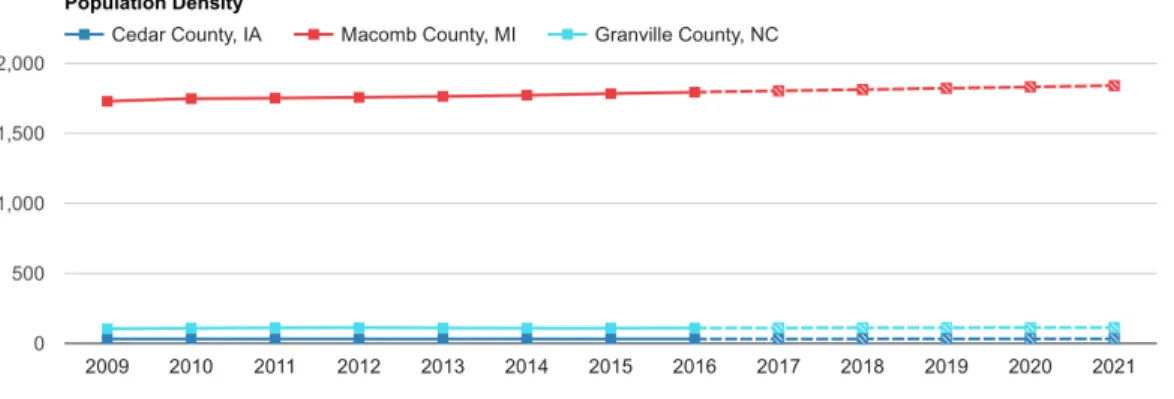
Macomb County, in the suburbs north of Detroit, has grown 9.08% over the past 16 years, largely driven by black, Asian and Hispanic populations. Notably, Macomb has become the home to a large Chaldean refugee population over the past 5 years. The county has aged over the years and although it skews to the older demographic, 62% of the population remains working age. Its population density was 1,794 per square mile in 2016 and is forecasted to continue growing (Open Data Network, 2016).
II. Characteristics of Cedar County
Figure 4.2 Cedar County Iowa Reference Map
SOURCE: Cedar County Iowa, Google Maps, 2018
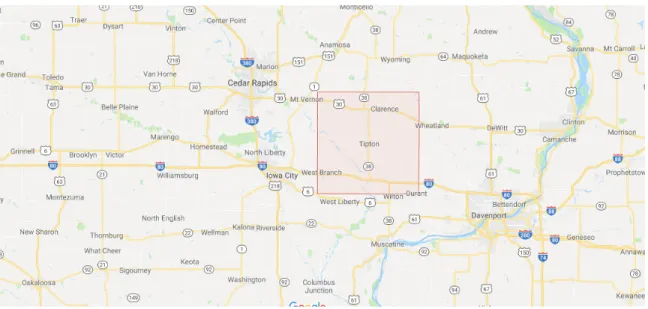
Cedar County sits on the east side of Iowa and is a small rural county with a population density of 32 per square mile as of 2016. Its population growth has remained relatively stagnant (Open Data Network, 2016). It is overwhelmingly white (97.08%) with a slightly increasing growth of minorities including black, Asian and Hispanic populations and a miniscule number of immigrants. Cedar is an aging county, with 18.21% of its population being 65 and older. Nearly 60% are working age (18-64).
Cedar’s economy is dominated by Agriculture, Forestry, Fishing and Hunting, Management of Companies and Enterprises and Manufacturing. In particular,
would be expected in a location the size of Cedar. The median household income in Cedar is $59,047—slightly above that of the U.S. The population is staunchly middle class with a majority of households making from $35,000 to $99,000. Six percent of the county is in poverty, a steady trend that has affected all races in Cedar. Manufacturing, Health Care and Social Assistance and Retail Trade provide the greatest number of jobs in Cedar. The unemployment rate has consistently remained low, with some fluctuation in industry employment as the economy diversified when agriculture shifted to play a smaller role in the economy. Relevant cultural trends include 1) greater interaction with local governments than federal, 2) reinvigorated conservatism and 3) fear of change. III. Characteristics of Granville County
Figure 4.2 Granville County Reference Map
SOURCE: NCSU Library GIS data, 2018 Granville County is located north of Wake County and the state capital of
a large African-American population, and over the past eight years, a large growth in the Hispanic population. Granville is aging, but has a large working population.
Granville borders the nearby counties of Vance, Warren and Gates and is essentially composed of two distinctive parts, north and south. Officials describe the county as being divided by the Tar River. The Northern part of the county includes towns like Oakhill, Oxford and Stovall and is far more rural and agrarian, with more of an aging demographic. This part of Granville is “underdeveloped” and far less dense. The
Southern part is closer to the Research Triangle Park and to the cities of Raleigh, Durham and Chapel Hill. Due to this proximity, it has become a bedroom community for younger professionals working in these areas—from RTP to Duke to Hospital Systems. This part of the county is generally wealthier, younger, and socially disconnected from the county. Towns in this part of the county include Creedmoor, Butner and Stem.
Officials described this divide originating with power systems and phone utilities stopping at the Tar River, so residents had different energy suppliers and phone providers based on which side of the river they lived on. These distinctions created a north/south divide and reinforced sentiments of difference that grew over time, with the north being “extremely more rural “and the South more urbanized and increasingly becoming a bedroom community for those working in larger cities. Officials say the divide still stands due to the long history in rural communities, even if infrastructure systems have become more blended.
The Granville economy is specialized in Agriculture, Forestry, Fishing, Hunting, Public Administration and Manufacturing. The largest industries in Granville are
slightly increased since 2011 and now sits around $50,225, just below the U.S. median income. Granville’s middle class is slanted toward the lower end of the distribution, more so than Cedar and Macomb (see Appendix 3A).
There has been a small decrease in employment in manufacturing, although average wages have been increasingly higher for these jobs. The unemployment rate in Granville has been consistently low, but poverty has increased since 2008. Black
populations in Granville have a much higher poverty rate than white ones (around 24%), but the recent increase in poverty rate has impacted white populations more, with the percent in poverty almost doubling from 6% to 12%. The main cultural themes emerging from Granville were 1) dependence on local over federal government, 2) distancing from Democratic politicians and 3) anxiety over race and gender.
Demographic Trends
Summary
There were common themes across demographics in each county. The
populations of all three were notably aging; this was demonstrated in Census data but also noted by all public officials. Most officials addressed concerns that their county populations were aging and few college graduates and young families were moving back.