In Plain Sight:
Analysis of Twitter Conversations Regarding Non-Partner Sexual Violence in India
By Nicole Ippoliti
A paper presented to the faculty of The University of North Carolina at Chapel Hill in partial fulfillment of the requirements for the
degree of Master of Public Health in the Department of Maternal and Child Health.
Chapel Hill, N.C.
April 4th, 2015
Approved by:
_____________________________________ First Reader
_ ______
Abstract:
Background: In recent years, reports of sexual violence against women in the public sphere in India have been gaining an increasing amount of publicity both on formal news outlets and social media.
Increasingly, Indian citizens have been leveraging the power of Twitter as a platform through which to report, discuss, and advocate for social reform and justice in order to protect women from sexual violence in India.
Objective: The goal of this investigation was to conduct a proof of concept for a methodological study on how to code, analyze, and monitor discussion about non-partner sexual violence (NPSV) in India. The primary objective was to introduce a systematic methodology in which to examine the defining
characteristics, extensiveness, and reach of Twitter messages pertaining to NPSV.
Methods: The study utilized standardized and systematic content analysis to reveal how NPSV information is disseminated and diffused through Twitter. The social media conversation sample (SM sample) included messages on NPSV with the search terms of #IndiaRape, #RapeIndia, #Nirbhaya that took place from January 1-December 31, 2014. The sampling strategy of every fifth tweet was used to select the final SM sample for analysis. Messages that were irrelevant to the topic, duplicative, or not in English were skipped.
Results: Out of a total of 902 messages across all hashtags, 154 tweets were selected for final analysis. Eighty percent of users listed India as their geographic location, 48% of users were male, 86% of
messages were from individuals, and 38% of messages were reports of incidences of NPSV. Twenty-eight percent of tweets demonstrated a dynamic level of secondary engagement.
I. Introduction
Background
Despite rising levels of education, gender awareness, and development, violence against women, particularly sexual violence, remains a pervasive public health problem and human rights violation in India.1 Historically, gender-based violence has remained a highly stigmatized and taboo topic. However, as India modernizes and technology is becoming increasingly more accessible, Indian citizens have been leveraging the power of social media to broaden and promote discussion as well as disseminate reports on violence against women. A systematic analysis that captures the transition between information sharing, discussion, and call to action within the context of non-partner sexual violence is useful to understand the utility of social media as user-driven platform to advocate for the elimination of violence against women.
The topography of violence against women in India
In the past five years, reports of gender-based violence in public arenas by non-partner
perpetrators have become increasingly more prevalent. A recent study published by Abrahams et al (2014) in The Lancet found that an estimated 7% of women globally reported being sexually assaulted by a person who was not their partner.2 Data from the Asia Pacific region published in this journal show that in some countries, like Papua New Guinea, the figure rises to 27%.
1WHO and London School of Hygiene and Tropical Medicine. Global and regional estimates of violence against
women: prevalence and health effects of intimate partner violence and non-partner sexual violence. World Health Organization, Geneva; 2013
2Abrahams N, Devries K, Watts C, et al. Worldwide prevalence of non-partner sexual violence: a systematic
India is no exception. The National Family Health Survey (NFHS-3) in India has
determined that over one-third (34 percent) of women in India ages 15-49 have experienced some form of physical violence since the age of 15. Respondents report that most often, the cause of violence is domestic abuse, with 77 percent of total women reporting that the
perpetrator of violence is her current husband.3 Recently, publicity about cases of non-partner sexual violence (NPSV) against women in public spaces within India have provoked worldwide condemnation of the country’s ineffective response to such habitual and unacceptable behavior. Such infamous cases include the 2012 Delhi Gang Rape Case which occurred on a public bus, the 2014 Utter Pradesh Rape which transpired in an open field, and the recent rape case by a cab service driver in New Delhi.45
While these events succeeded in igniting worldwide attention to the lack of women’s safety in public places in India, the perceived threat or experience of such violence (especially sexual violence) in public places remains a routine occurrence for girls and women there. In 2012, UN Women and The International Center for Research on Women (ICRW) conducted a household survey of over 2,000 girls and women to determine the perceptions towards women’s safety and prevalence of violence in public places in Delhi. The survey (in which respondents were able to respond to more than one choice) revealed that 80 percent of respondents found streets to be the most unsafe, followed by markets (50 percent), parks (47
3International Institute for Population Sciences (IIPS) and Macro International. 2007. National Family Health
Survey (NFHS-3), 2005–06: India: Volume I. Mumbai: IIPS.
4Mandhana, N. “Indians Outraged Over Rape on Moving Bus in New Delhi.” New York Times. 2012
http://india.blogs.nytimes.com/2012/12/18/outrage-in-delhi-after-latest-gang-rape-case/
percent) and bus stops (37 percent). In the low-income group, approximately 25 percent of women perceive public toilets as unsafe.6 Similarly, The State of the Girl Child in India Report 2010, which surveyed 10,000 adolescent girls from 10 cities across India, found that fear of
violence in the public area is endemic nationwide with 77% of girls reported facing harassment in the public arena and 32% fearing it.7
Although these reports highlight the recent status of NPSV against women in India, it’s difficult to determine whether the prevalence or incidence of NPSV in India has changed over time. According to the National Crime Records Bureau, the number of registered rape cases in India increased by 873.3% from 2,487 in 1971 to 24,206 in 2011.8 Naturally, India experienced a significant increase in population size between 1971 and 2011 which could partly account for the increase in the number of reported rapes. Furthermore, it is unknown, whether the increase in rape cases are due to a veritable increase in sexual assaults, or whether there has been an increase in reporting due to a greater willingness of victims to file charges, or a greater willingness of police officials to accept those charges.
While there remains insufficient data to reveal the true extent of non-partner sexual
violence in India, there have been other mechanisms through which audiences worldwide have been receiving continuous information about this topic: social media and mass communication outlets. In the past five years, formal news outlets such as the New York Times, the Guardian, and The Washington Post, have published an increasing amount of articles detailing specific
6UN Women and ICRW. Safe cities free from violence against women and girls: Baseline findings from the "Safe
City Delhi Programme."2012
7Plan India. Girls in a changing landscape: Urban and digital frontiers. The State of the Girl Child in India. 2010.
incidences and public reaction to sexual assault in India. A recent search in the New York Times archives revealed that from January 1st 2010 to December 15th 2012, 47 articles were published on the topic of sexual assault in India. From December 16th, 2012 to January 1, 2015, however, the number of articles published on sexual assault in India increased to 140. The events that took place on December 16, 2012 offer a possible explanation as to what may have facilitated this increase in formal news reporting on sexual assault in India.
The Nirbhaya Effect
On December 16, 2012, Nirbhaya, a 23 year old female paramedical student, was raped (and subsequently died) by a group of men on a public bus in Delhi. What otherwise could have been another unpublicized incident of non-partner sexual violence in India, transformed into a
watershed moment for the role of social media in aggregating and diffusing information about sexual violence in India on a global scale. The brutality of the attack on a middle class woman prompted an unprecedented level of civil protest from Indian citizens throughout the nation. In order to stay on the pulse of this rapidly evolving civil demonstration and public outcry, many journalists turned to Facebook and Twitter to capture the sentiments of varied interest groups, individuals, and even government officials.9
As a result of the December 16th event, this gruesome behavior was brought to light through immense civil protest, largely galvanized by the power of social media platforms. For perhaps the first time in India’s history, India’s estimated 93 million Facebook users and 33
9Belair-Gagnon V. Emerging spaces for storytelling: Journalistic lessons from social media in the Delhi gang rape
million Twitter accounts were leveraged to incite civic dialogue about a historically taboo subject, a dialogue which was dispersed globally and not only encouraged formal media
channels to publicize this event, but also pressured the Indian government to take swift political action to safeguard women’s rights at the policy level.10 These efforts culminated in India’s groundbreaking 2013 Criminal Law Act that called for stronger protective laws against rape, sexual assault, eve-teasing, and stalking. Ultimately, this catalytic event managed to transform the role of social media from one of a social networking site, to an empowering mechanism for information sharing, agenda setting, and political reform.
The Agenda-Setting Power of Social Media
Social media’s role in allowing users to transition between information sharing, discussion, and call to action within the context of non-partner sexual violence is worth investigation.11 Social media provides a relatively new and untapped resource for monitoring and understanding public health problems, especially as they pertain to social issues that remain uncaptured or delayed by household surveys.
In addition to a research tool, journalists have described social media as an advocacy tool, best understood within a framework of agenda setting through mass media.12 Within this paradigm, the social media user becomes engaged and empowered as an active consumer of
10 Patel A. India’s social media election battle. BBC News. 2014. http://www.bbc.com/news/world-asia-india-26762391. Accessed February 13, 2015.
11Neiger, Brad L. (2013). "Use of Twitter Among Local Health Departments: An Analysis of Information Sharing,
Engagement, and Action." Journal of Medical Internet Research 15.8
12Mccombs, M., & Shaw, D. (1972). The Agenda-Setting Function of Mass Media. Public Opinion Quarterly, 36(2),
communication and has abundant control over content, dissemination, and even impact of information regarding non-partner sexual violence in India. In addition, the interactive nature of social media means that consumers likely receive greater exposure to anti-violence content and messages disseminated via social media compared to messages in more traditional static
media.13,14 With increased interaction and exposure, there is deeper processing of the message and the content and the potential for greater behavioral impact.15
Unlike previous forms of one-directional messaging to influence knowledge or behavior, social media allows for a multi-dimensional form of producing and responding to messaging— otherwise known as engagement. Social media users engage with content at increasing levels of interaction, moving back and forth along a spectrum from watching to sharing to
commenting.16 The degree of user engagement may influence behavior change and eventually, a change in social norms regarding the acceptance of violence against women.
This study will investigate how social media can be used to monitor discussion about non-partner sexual violence in India, examining the defining characteristics, extensiveness, and reach about that type of discussion.
II. Methods
The study utilized standardized and systematic content analysis to reveal how NPSV information is disseminated and diffused through Twitter, a ubiquitous and active domain of
13 Ribisl, K. M. (2003). "The potential of the internet as a medium to encourage and discourage youth tobacco use." Tob Control 12 Suppl 1: i48-59.
14 Freeman, B. (2012). "New media and tobacco control." Tob Control 21(2): 139-144.
15Freimuth, V. S. and S. C. Quinn (2004). "The contributions of health communication to eliminating health
disparities." Am J Public Health 94(12): 2053-2055.
16Neiger, Brad L. (2013). "Use of Twitter Among Local Health Departments: An Analysis of Information Sharing,
social media in India. The social media conversation sample (SM sample) has the following inclusion criteria: Twitter conversations in English that took place from January 1-December 31, 2014, relating to non-partner sexual violence in India. Posts that were immaterial to the topic or duplicative were skipped. #IndiaRape, #RapeIndia, #Nirbhaya have been described as hashtags which were found to be frequently used in discussions on NPSV in India, and have therefore yielded the most amount of conversations on this topic in a calendar year. As such, these hashtags were used for the search in this investigation. In order to collect a
representative SM sample of the total tweets per hashtag, the sampling strategy of every fifth tweet was used to select the final SM sample for analysis, which yielded a total of 154 twitter conversations out of a possible 902 tweets.
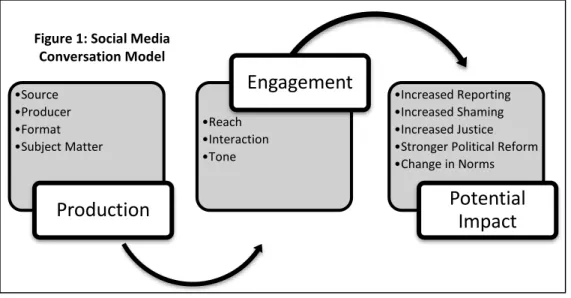
Figure 1 illustrates the conceptual model that was used to frame this analysis. Social media conversations can be conceived of as three action steps: (1) producing content, (2) engaging with content, and (3) acting on content to influence behavior. Across social media conversations, all three action steps may be influenced by the source of the communication, the characteristics of the content, and the strength and identity of the social networks of users.17
17Hanson, C. (2013). “Tweaking and Tweeting: Exploring Twitter for Nonmedical Use of a Psychostimulant Drug
Source: Model adapted from work done in collaboration with FHI 360
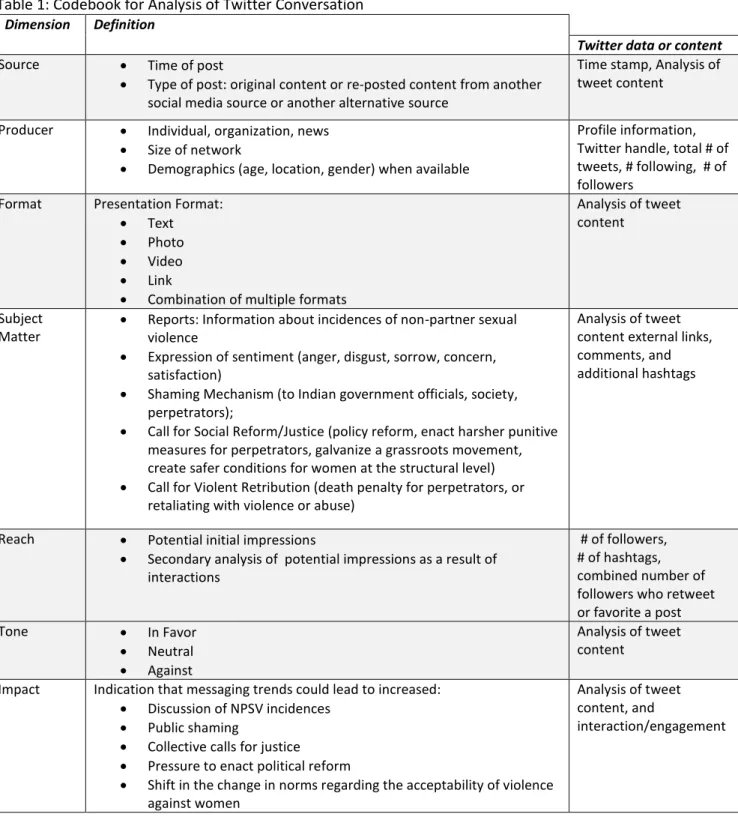
The analysis of each conversation was conducted using a detailed coding guide (Table 1) that is standardized for analysis across the three different hashtags.
•Source •Producer •Format •Subject Matter
Production
•Reach •Interaction •Tone
Engagement
•Increased Reporting •Increased Shaming •Increased Justice •Stronger Political Reform •Change in Norms
Potential
Impact
Figure 1: Social MediaTable 1: Codebook for Analysis of Twitter Conversation
Dimension Definition
Twitter data or content
Source Time of post
Type of post: original content or re-posted content from another social media source or another alternative source
Time stamp, Analysis of tweet content
Producer Individual, organization, news Size of network
Demographics (age, location, gender) when available
Profile information, Twitter handle, total # of tweets, # following, # of followers
Format Presentation Format: Text Photo Video Link
Combination of multiple formats
Analysis of tweet content
Subject Matter
Reports: Information about incidences of non-partner sexual violence
Expression of sentiment (anger, disgust, sorrow, concern, satisfaction)
Shaming Mechanism (to Indian government officials, society, perpetrators);
Call for Social Reform/Justice (policy reform, enact harsher punitive measures for perpetrators, galvanize a grassroots movement, create safer conditions for women at the structural level) Call for Violent Retribution (death penalty for perpetrators, or
retaliating with violence or abuse)
Analysis of tweet content external links, comments, and additional hashtags
Reach Potential initial impressions
Secondary analysis of potential impressions as a result of interactions
# of followers, # of hashtags, combined number of followers who retweet or favorite a post
Tone In Favor
Neutral Against
Analysis of tweet content
Impact Indication that messaging trends could lead to increased: Discussion of NPSV incidences
Public shaming
Collective calls for justice Pressure to enact political reform
Shift in the change in norms regarding the acceptability of violence against women
Analysis of tweet content, and
Each conversation was coded first for primary content of the post, followed by a brief secondary analysis of the level of engagement of the post, such as number of retweets,
favorites, and mentions of other users. Analyses focus on differences in characteristics of social media content as it relates to non-partner sexual violence in India to discern the nature of the conversation, determine what kind of users are producing this content, how diffused this content becomes, and implications of what the potential impact of both the production and engagement of this content has in changing norms regarding sexual violence in India.
III. Results
Unfiltered results of each hashtag yielded 902 tweets from January-December 2014:
#IndiaRape (173), #RapeIndia (31), #Nirbhaya, (698). After selecting the tweets that met the inclusion criteria and randomly selecting every fifth tweet, the total final SM sample yielded 154 tweets.
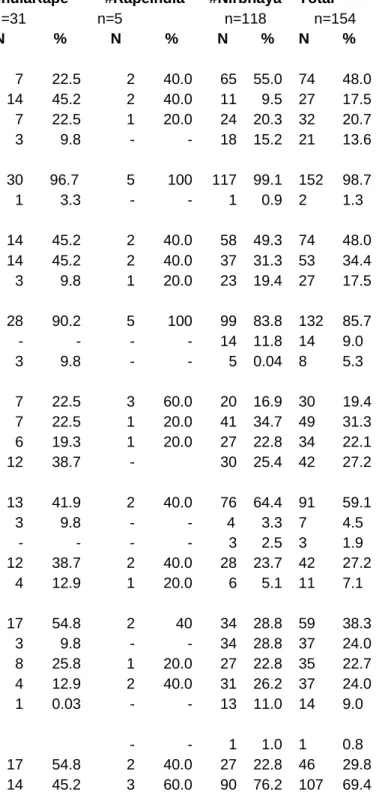
retweeted from an external source. The #IndiaRape and #RapeIndia reflect an equal
distribution among female and male producers, while more male users included the #Nirbhaya in their conversations. Nearly 86% of the twitter conversations were produced by individuals themselves, as opposed to organizations or news sources. Thirty-one percent of producers had a network size or following of 101-500 users, and 27% had a following greater than or equal to 1,000. Results indicate that nearly 60% of users created “text-only” content, with 27%
Table 2: Summary of Social Media Content Analysis Results for Each Hashtag
#IndiaRape #RapeIndia #Nirbhaya Total
n=31 n=5 n=118 n=154
N % N % N % N %
Source-Month
Jan-March 7 22.5 2 40.0 65 55.0 74 48.0
April-June 14 45.2 2 40.0 11 9.5 27 17.5
July-Sept 7 22.5 1 20.0 24 20.3 32 20.7
Oct-Dec 3 9.8 - - 18 15.2 21 13.6
Source-Type of Post
Original Content 30 96.7 5 100 117 99.1 152 98.7
Reposted Content 1 3.3 - - 1 0.9 2 1.3
Producer-Sex
Male 14 45.2 2 40.0 58 49.3 74 48.0
Female 14 45.2 2 40.0 37 31.3 53 34.4
N/A 3 9.8 1 20.0 23 19.4 27 17.5
Producer-Type
Individual 28 90.2 5 100 99 83.8 132 85.7
Organization - - - - 14 11.8 14 9.0
News 3 9.8 - - 5 0.04 8 5.3
Producer-Size of Network
<100 7 22.5 3 60.0 20 16.9 30 19.4
101-500 7 22.5 1 20.0 41 34.7 49 31.3
501-999 6 19.3 1 20.0 27 22.8 34 22.1
1000< 12 38.7 - 30 25.4 42 27.2
Format
Text only 13 41.9 2 40.0 76 64.4 91 59.1
Text + Photo 3 9.8 - - 4 3.3 7 4.5
Text + Video - - - - 3 2.5 3 1.9
Text + Link 12 38.7 2 40.0 28 23.7 42 27.2
Text + Link + Photo 4 12.9 1 20.0 6 5.1 11 7.1
Subject Matter
Reports 17 54.8 2 40 34 28.8 59 38.3
Shaming Mechanism 3 9.8 - - 34 28.8 37 24.0
Expression of Sentiment 8 25.8 1 20.0 27 22.8 35 22.7
Call for Social Reform/Justice 4 12.9 2 40.0 31 26.2 37 24.0
Call for Violent Retribution 1 0.03 - - 13 11.0 14 9.0
Tone
In favor - - 1 1.0 1 0.8
Neutral 17 54.8 2 40.0 27 22.8 46 29.8
Table 3 reflects the total depth and level of engagement across each hashtag. The highest level of both engagement and dissemination is reflected through the 138 retweets, or reposting of messages from one user to another.
Table 3: Number of Retweets, Favorites, @ Mentions per Hashtag and in Total
#IndiaRape #RapeIndia #Nirbhaya Total
# Retweets 22 2 114 138
# Favorites 15 1 59 75
@ Mentions of other users
10 1 23 34
IV. Discussion
The purpose of this investigation was to put forth a proof of concept for a methodological study on how to analyze Twitter conversations on the topic of non-partner sexual violence in India. The results of this study reveal the following: (1) Twitter is a useful tool to monitor a real-time discussion of a topic that traditionally remains undiscussed; (2) the majority of these messages were dedicated to reporting incidences on NPSV; (3) the SM sample reflects messages that include both dynamic and static levels of engagement, which offers suggestions on how to optimize messaging for maximum reach.
reports of incidences of NPSV. These results reflect the utility of social media as a news-sharing mechanism, particularly in broadcasting reports of NPSV that would otherwise go unnoticed. Results also reveal that nearly 86% of the SM sample were individuals, and 59% of messages were constructed in a text-only format. Given that Twitter messages are confined to 140 characters, we can assume that in order to optimize the utility of a platform in which free speech is unhindered, users (predominantly individuals) are opting for a text-only format in order to maximally leverage the space to broadcast their own perspective.
Future Considerations
Implementing this methodology on the topic of NPSV yields several recommendations for future studies. Firstly, future studies should employ the use of several hashtags for analysis in order to produce greater variation in results and sample size across hashtags. It is possible that had this study included a more extensive selection of hashtags for analysis, the final outcome would have resulted differently. Secondly, a greater SM sample, that is at least half of the total available tweets, is needed in order yield findings that are generalizable to the greater public. A larger SM sample could also be helpful in determining whether a set combination of format and tone could let to higher secondary engagement and dissemination of messages. Thirdly, this study used a manual approach to sampling and collecting data. Future studies should
estimated 33 million Twitter users, the potential impact and reach of health messaging in India could be immense.18
Limitations
There was a small sample size that was collected for final analysis. Given that the sampling strategy removed all duplicative messages, the final SM sample for analysis amalgamated to only 17% of the total possible tweets across all hashtags. As such, it is possible that this SM sample is not representative of the entire selection of tweets used across all three hashtags. Future studies should select a greater number of hashtags for analysis in order to generate a more robust, diverse, and representative SM sample.
V. Conclusion
The potential role of media in raising worldwide awareness and visibility around the status of women in India cannot be understated. In the past two years, it is evident that heightened media attention to the harmful gender norms that allow for such complicity of sexual violence have placed pressure on the Indian government to seek more legal and political reform that uphold women’s rights. Subsequent work should be directed at determining the potential impact of these social media conversations. Potential impact could be manifested through behavior change communication, a shift in social norms regarding violence against women, or stronger punitive measures against perpetrators of violence. Future studies should
18Patel, A. “India’s Social Media Election Battle.” BBC. March 2014
retrospectively analyze social media content around NPSV over multiple social media platforms for a longer period of time in order to determine the potential impact of social media