Trends
and
Best
Practices
to
Control
International
Roaming
Costs
January
2012
__________________________________________________________________________________________________
roaming costs. CCMI’s survey uncovered the following highlights on travel trends and roaming expenditure:
Nearly 70% of the Fortune 1000 are battling increases in international wireless network services charges (see Figure 1, next page).
37% of the companies spend on average $1,000 or more per user per month on wireless roaming costs for their international travelers, and 12% of these companies find monthly costs soaring to $3,500 or more per user.
Nearly 70% of the companies surveyed support employees that, on average, make four or more international trips each year, and more than half (57%) have users that travel overseas at least once a month, if not multiple times each month.
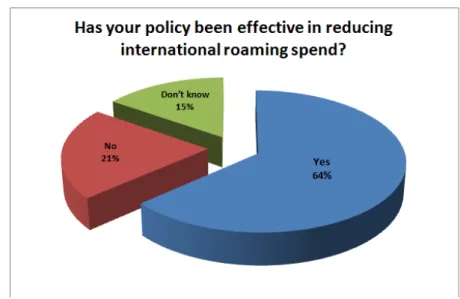
57% of survey respondents currently have formal mandates aimed at reducing international wireless expenditures (see Figure 2, next page).
The question is: What tools and resources do enterprises have at their disposal to comply with their mandates and reduce the excessive mobile charges racked up by their international travelers?
The remainder of this report will examine what enterprises have been doing to cut costs, how well those approaches have been working, and other options they might consider trying.
Figure 1. International wireless roaming expenses are skyrocketing for a number of reasons: Globalization of business in general; the swift uptake in mobile data applications, smart phones, tablets, and broadband mobile networks; and hefty inter-country roaming and long-distance fees imposed by mobile operators.
__________________________________________________________________________________________________
following their overseas trips.
“Educate, educate, educate,” advises a dismayed respondent who reported that an employee traveling to France racked up a $24,000 bill. Reports another: “One of our employees had a bill for $200,000 for one month of services because they used our data plan carelessly. It was a nightmare for us.”
• The SIM Card Shuffle. Some approaches have users carrying a “bag” of subscriber identity module (SIM) cards with them as they travel and swapping the cards in and out of their phones to get local rates in each country they visit. Nearly three quarters of the respondents (72%) have experienced swapping their service for local SIM cards. This is perhaps the most widely used option today.
There are some downsides, however. This option changes the user’s phone number from country to country, making on-the-road users more difficult to reach, particularly as travelers attempt to transfer calls from the home office to the phone they are using overseas. The multiple-SIM card approach is also cumbersome for non-techie travelers who aren’t familiar with how and where to get the SIM cards or, if procured for them, how to swap them in and out of their phones. Finally, some users get burned thinking they can forward calls from their primary cell phones to the international SIM; they don’t realize carriers often restrict international call forwarding altogether.
• Expense Management Investments. Some enterprises have experimented with fixed-mobile convergence (FMC) equipment, which automatically transfers users onto a fixed-rate or free Wi-Fi connection when in the coverage range of a wireless LAN. They might also invest in wireless telecom expense management software packages to set and enforce policies for what wireless network behavior is allowed/disallowed when an employee crosses a border into another country (see Figure 3).
Figure 3. Automatically enforcing policy through the use of wireless expense management software can be most successful at slashing costs. It does, however, require an investment in a management platform and client software and can reduce user productivity if too restrictive.
In some cases, the software will simply alert the employee that he or she is approaching a usage or dollar threshold or is about to incur a roaming charge, leaving it to the employee to take cost-cutting action. Some expense management software will simply prohibit usage beyond a certain level or in a certain region. This is the more successful cost-reduction option, yet it does negatively impact users’ productivity and ability to communicate.
• International Component to Domestic Plan. It’s also possible to tag on an international component – for a flat monthly fee – to users’ North American wireless network service subscriptions that lower the per-minute usage charges and offer bundled megabyte data allowances associated with international travel. That certainly helps. Still, these plans often only reduce the inter-carrier roaming fees that mobile network operators charge one another when a subscriber crosses country borders and moves off one operator’s network and onto another’s. The business’s primary carrier simply passes the significant roaming charge along to the entity paying the bill. In addition, the carrier usually requires advance notice of the travel so that it can activate the special rate while the user is traveling. This step is often worth the effort, yet it adds another layer of complexity that, if overlooked, can result in bill shock.
• Using Wi-Fi. Some companies encourage users to make use of soft phone capabilities by running a voice over IP (VoIP) application on their devices and making voice or data calls when within the
_______________ important c while travel This option Traveling Nearly 70% internationa month, if no
Figure 4. A b travel interna
In addition, internationa
As a result, bite out of i employees’ improve se
___________
ontacts.” Co ing, and rec
appears to
Trends
% of the com al trips each ot multiple ti
big chunk of F ationally at le
well over a ally, and 14%
businesses nternationa ’ time and p rvice, many
___________
ohen contin ceive a reas
be an eleg
mpanies surv h year, and m
imes each m
Fortune 1000 ast 4 times p
a third (36%) % of those s
s need to ta l wireless ro productivity. y survey res
___________
nued: “Truph sonable bill.
ant solution
veyed supp more than h month (see
companies (8 er year.
) of respond said that mo
ake a top-do oaming cost When aske pondents c ___________ hone offers ”
n to today’s
ort employe half (57%) h
Figure 4).
89%) have em
dents said th ore than 30
own, structu ts without ta ed what thei
ited actions
___________
an alternati
current cha
ees that, on have users t
mployees that
hat more th % of their e
red approac aking an equ ir internation s having to d
___________
ve: use you
llenges.
average, m that travel o
t
an a fifth (2 mployees d
ch to figurin ually big bite nal wireless do with cost
___________
ur mobile de
make four or overseas at
0%) of their do so.
ng out how t e out of the s provider co
t control.
___________
evice as nor
r more least once a
r users trave
to take a big ir traveling ould do to
_____
rmal
a
el
“Have the wireless provider provide better international plans,” says one respondent. “Current plans do not provide much in the way of international coverage, usage, data, or alternatives.”
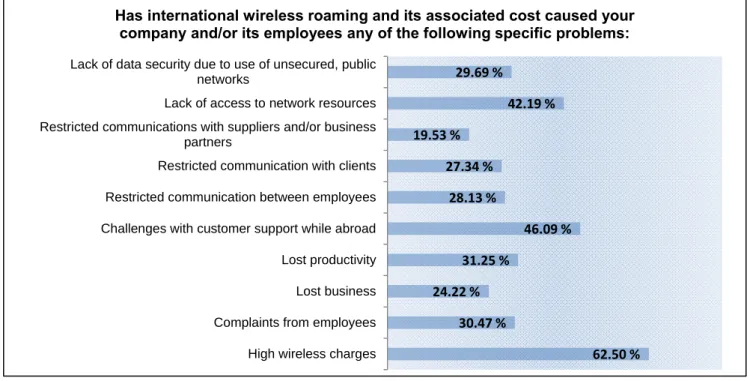
In fact, when asked what kinds of problems international wireless roaming had caused their companies, far and away the greatest number (nearly 63%) specified “high wireless charges” as a problem they faced (see Figure 5).
Figure 5. International wireless roaming has caused a whole host of issues for businesses.
Conclusion
Businesses are going global and employees are continuing to travel internationally. As a result, they’re seeing a steep rise in global communications costs and usage, even as they create wireless cost-cutting mandates and otherwise struggle to contain costs overall.
There are a number of ways to reduce international wireless spend. The most basic is clear – and vehement – user education about what services cost accompanied by general best-practice usage tips.
29.69 %
42.19 %
19.53 %
27.34 %
28.13 %
46.09 %
31.25 %
24.22 %
30.47 %
62.50 %
Lack of data security due to use of unsecured, public networks
Lack of access to network resources Restricted communications with suppliers and/or business
partners
Restricted communication with clients
Restricted communication between employees
Challenges with customer support while abroad
Lost productivity
Lost business
Complaints from employees
High wireless charges
Has international wireless roaming and its associated cost caused your company and/or its employees any of the following specific problems:
__________________________________________________________________________________________________
VoIP app for Nokia in 2006 and has since been the first on the iPhone, iPod and iPad devices. Tru’s application supports all leading mobile platforms and devices including Blackberry, iPhone, iPod touch, iPad, Nokia E and N series, and Android. For more information, please visit
http://www.truphone.com. About CCMI
CCMI is the industry’s leading provider of telecom rate and data solutions and information. We are dedicated to delivering relevant, highly specialized and strategically focused content. Find a
complete product listing at http://www.ccmi.com/Products. CCMI publishes Voice Report, the leading independent source of telecom news, analysis and award-winning guidance on communications technology services and equipment for the enterprise. For analysis and guidance on the latest telecom happenings, visit http://www.TheVoiceReport.com, and sign up to receive email updates.