V
viewpoints
U
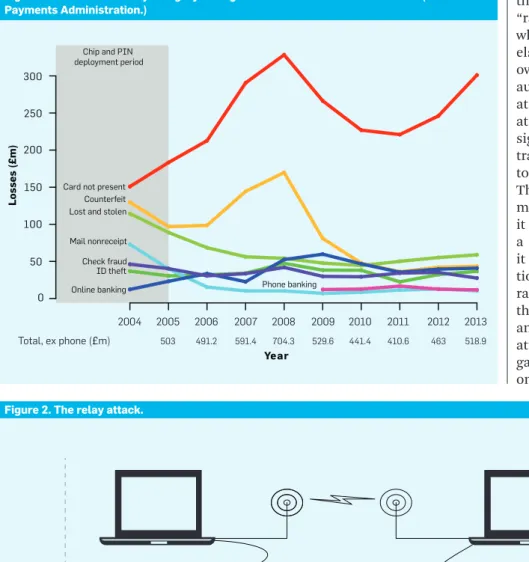
.S. CREDIT CARD companiesand banks are beginning to distribute new credit cards with an embedded chip as well as the magnetic strip that has been in use since the 1970s. Named for its promoters Europay, MasterCard, and Visa, the EMV sys-tem augments the old magnetic strip cards with a chip that can authenti-cate a transaction using cryptogra-phy—a so-called “smartcard.” EMV was deployed in the U.K. from 2003 to 2006 and in other European coun-tries shortly afterward; it is now being rolled out from India to Canada. The idea was to cut fraud drastically, but real-world experiences turned out to be somewhat more difficult than the-ory. As shown in Figure 1, fraud in the U.K. went up, then down, and is now heading upward again.
The idea behind EMV is simple enough: The card is authenticated by a chip that is much more difficult to forge than the magnetic strip. The card-holder may be identified by a signature as before, or by a PIN; the chip has the ability to verify the PIN locally. Banks
in the U.K. decided to use PIN verifica-tion wherever possible, so the system there is branded “chip and PIN”; in Singapore, it is “chip and signature” as banks decided to continue using signatures at the point of sale. The U.S. scheme is a mixture, with some banks issuing chip-and-PIN cards and others going down the signature route. We may therefore be about to see a large natural experiment as to whether it is better to authenticate transactions with a signature or a PIN.
The key question will be, “better for whom?” The European experience
sug-gests this will not be a straight fight be-tween the fraudsters and everyone else. The interests of banks, merchants, regulators, vendors, and consumers clash in interesting ways; the outcome will not just be determined by how the fraudsters adapt to the technology, but by a complex tussle over who pays for the upgrade and who enjoys the ben-efits. Fraud savings are not the biggest game in town; while fraud costs the U.S. $3–$4 billion, interchange fees are an extraordinary $30 billion and EMV will likely have an impact on both.
Attacks
Although U.S. banks are issuing EMV cards now, it will be some time before they start to see a reduction in fraud. Cards will still have the magnetic strip and banks will continue to accept magnetic strip transactions because it will take many years to upgrade all the ATMs and point-of-sale terminals. EMV terminals still process unencrypt-ed card numbers, expiration dates, and PINs, so if hacked (as occurred in the late-2013 Target data breach), crimi-nals can steal enough data to perform
Inside Risks
EMV: Why Payment
Systems Fail
What lessons might we learn from the chip cards used for
payments in Europe, now that the U.S. is adopting them too?
DOI:10.1145/2602321 Ross Anderson and Steven J. Murdoch
Although U.S. banks
are issuing EMV
cards now, it will be
some time before
they start to see a
reduction in fraud.
CREDIT TK
viewpoints
V
draw cash from an ATM. Chip and PIN changed that: as merchants started accepting PINs at the point of sale, card forgery became easier and more prevalent. As Figure 1 shows, counter-feit card fraud went up after EMV was deployed, and took five years for it to fall back to the previous level. So U.S. banks can expect a lot of attacks using compromised or counterfeit terminals until they can start turning off magnet-ic-strip fallback mode.
Another attack we worried about in the early days of EMV was the “relay at-tack.”2 This exploits the fact that while
the card authenticates itself to the mer-chant terminal, the customer does not know which terminal the card is com-municating with. If a customer inserts her card into a fake terminal, it can relay a transaction with a quite differ-ent terminal. So a crook, Bob, can set up a fake parking meter in New York, and when an unwitting cardholder Alice uses it, Carol (who is colluding with Bob) can stroll into Dave’s jew-elry store in San Francisco and buy a diamond using a fake card connected to the reader in the parking meter. The fraudulent online purchases. Also, as
many chip cards still contain a full un-encrypted copy of the magnetic strip data, the criminals can steal this. If they can get the PIN too, they can make forged cards and use them at an ATM.
EMV also introduces some new vulnerabilities. The first-wave EMV cards in the U.K. were cheap cards ca-pable only of Static Data Authentica-tion (SDA), where the card contains a certificate signed by the bank attest-ing the card data is genuine. Since this certificate is static, it is trivial to copy it to a counterfeit chip, which can be programmed to accept any PIN—a so-called “Yes-card.” Criminals exploited this flaw at a small scale in France, but elsewhere it was not a serious problem. The Yes-card attack can be defeated by online transactions where the mer-chant contacts the bank to verify the card computed a correct message au-thentication code on the transaction data. (This uses a key shared between the card and the issuing bank, so the merchant must be online for the code to be checked.) More modern EMV cards also support Dynamic Data
Au-thentication (DDA), which uses asym-metric cryptography and defeats the Yes-card attack even for offline trans-actions. It is likely that U.S.-issued EMV cards will support DDA and the vast majority of transactions will be online anyway, so the Yes-card attack is un-likely to be a major issue in the U.S.
A much more serious type of fraud in the U.K. was tampering with chip-and-PIN terminals to record card de-tails and customer PINs. Although terminals were certified to be tamper resistant, they were not, and the certi-fication process was seriously flawed.3
Criminals were able to modify termi-nals on a large scale to collect custom-er details as the card sent them to the terminal, and the PIN entered by the customer as it was sent to the card for verification. Because most U.K. cards stored a copy of the magnetic strip on the chip, criminals could then make fake magnetic-strip ATM cards. Before the use of chip and PIN in the U.K., cus-tomers signed for store transactions and PINs were only used at ATMs, so tampering with a store terminal did not yield enough information to
with-viewpoints
ing to do so. In the meantime, French criminals have been caught exploiting a more sophisticated variant of this at-tack in the wild.
The latest family of attacks, seen in the last two or three years in Spain, exploits a classic cryptographic vulner-ability—the way in which EMV systems generate and use random numbers. When a terminal initiates an EMV transaction, it sends the card not just the date and the amount but a random number, so that each transaction is different and a crook cannot simply replay old transactions. However, there are two flaws in this system. The first is an implementation flaw: it turns out that some ATMs generate predictable “random” numbers, so an attacker who has temporary access to someone else’s card (say, a waiter in a criminal-owned restaurant) can calculate an authentication code that he can use at some predictable time in the future at a known ATM. Worse, there is a de-sign flaw in that the terminal does not transmit its choice of random number to the bank in an authenticated way. This means, for example, that if a ter-minal is running malicious software, it can harvest from a customer’s card a series of authentication codes that it can then use to make extra transac-tions in the future, and it can fix up the random numbers in the protocol so that the issuing bank does not notice anything suspicious.1 This is a serious
attack because it can scale; a crime gang that managed to install malware on a number of legitimate terminals poor cardholder thinks she paid $20
for a parking space, and gets a state-ment showing she spent $2,000 in a store she never visited. The counterfeit card inserted into the genuine termi-nal simply relays the transaction back to the genuine card via the fake termi-nal (see Figure 2). While there is no real defense against the relay attack, it does not scale well, so is likely only going to be used against high-value targets.
A more serious vulnerability is the No-PIN attack.5 In this case, a
crimi-nal who has stolen a card but does not know the correct PIN can put a small electronic device between the stolen
card and the terminal and use it with any PIN he likes. The device tricks the card into believing it is doing a chip and signature transaction while mak-ing the terminal believe the card ac-cepted the PIN that was entered. This attack works against all types of cards, and even for online transactions. Fix-ing it properly would require a change to the EMV protocol, which would take years to agree. In the interim, it is often possible for the card-issuing bank to detect the attack by carefully comparing the card’s version of the transaction with the terminal’s. So far, it appears only one U.K. bank is
try-Figure 1. U.K. card fraud by category during and since the introduction of EMV. (Source: U.K. Payments Administration.)
Losses (£m)
Year 0
50 100 150 200 250 300
Card not present Counterfeit Lost and stolen ID theft Mail nonreceipt Online banking Check fraud Chip and PIN deployment period
Phone banking
2004
503 491.2 591.4 704.3 529.6 441.4 410.6 463 518.9
Total, ex phone (£m)
2005 2006 2007 2008 2009 2010 2011 2012 2013
Figure 2. The relay attack.
Bob
Dave Alice
PIN
PIN
Carol
$$
$2000 $20
(as happened in the Target case) could harvest authentication codes to autho-rize large numbers of transactions at businesses under its control.
Finally, the elephant in the room with EMV deployment is card-not-present (CNP) fraud (Internet, phone, and mail-order purchases). Although CNP fraud was low when EMV start-ed to be deploystart-ed in the U.K., it had grown to over half of U.K. card fraud by the time the rollout was complete. EMV does almost nothing to stop CNP fraud (cards were never designed to be connected to customer PCs, even if smartcard readers were to become prevalent) and so the crooks’ initial re-action to the EMV deployment was just to take their business online, as we can see from the graph in Figure 1. U.S. banks would be well advised to invest in further measures to mitigate CNP fraud rather than putting their entire security budget into deploying EMV. EMVCo (the consortium that main-tains the EMV standard) has already started work on a “tokenization” speci-fication, allowing CNP transactions to be performed with limited-use tokens (in effect, one-time credit-card num-bers) rather than a static credit-card number, so reducing the damage re-sulting from merchant data breaches or malware on customer PCs. Tokeni-zation has almost nothing to do with EMV chips, but rather than setting up an new industry body, the banks have drafted in EMVCo to deal with it.
The Business Battleground
When credit cards were first intro-duced by Diners Club in the 1960s, they had high fees; typically the mer-chant paid the bank 6% or more of transactions. The emergence in the 1970s of the Visa-MasterCard duo-poly stabilized things with standard contracts for banks and merchants, technical standards so their comput-ers could swap data, and standard fees at 2.5% for credit cards and 1.5% for debit. This enabled a huge expansion of the industry, and cards became the standard way to pay for items costing more than a few dollars. Card trans-action processing has become a huge revenue generator for the banking in-dustry, especially as the clunky old ad-dressograph machines for taking pa-per imprints were replaced by cheapa-per
online systems, and as card payments spread online too. Many merchants see the card industry as an exploit-ative cartel, in need of trustbusting or competitive innovation. In 2005, mer-chants filed a class-action suit against Visa and MasterCard; a settlement in 2013 lowered fees by 0.1% and al-lowed merchants to charge customers the higher costs of credit-card trans-actions (which they already do in Eu-rope). There has also been legislative action, with the Durbin amendment to the Dodd-Frank bill empowering the U.S. Federal Reserve to write the rules for fees on debit card transactions.
The sums involved are large. A re-tailer like Walmart, for example, takes over $200bn in credit-card sales; if these customers could be moved to PIN-based debit card transactions, that would save $2bn in fees. So some retail-ers have strongly supported the move to EMV. At the same time, the versions of the EMV protocol being introduced in the U.S. to support contactless pay-ments (such as where your credit card becomes an app on your NFC mobile phone) are designed to make it more difficult for merchants to move cus-tomers to debit card payments. These market dynamics are unlike those seen in Canada or Europe, where the bank-ing industry motivated merchants to install EMV terminals by means of a “liability shift”: the banks changed their terms and conditions so that merchants were charged the cost of all customer disputes where a PIN was not used. Where a PIN was used, the banks would then pass the liability on to the cardholder, saying “Your chip was read and your PIN was used, so you must have been negligent or complicit.” Such a liability shift would be more
dif-The most widespread
problem that will
be encountered
by cardholders
is likely to be in
dispute resolution.
ficult in the U.S. because the retailers’ lobby is as powerful as the banks, and because consumer protection is better entrenched in U.S. regulation.
Yet consumer protection may be un-dermined in a multitude of ways. One example is the protocol used to decide how to authenticate the cardholder. According to the EMV standards, each card has a cardholder verification method (CVM) list that states a pref-erence such as ‘first, signature; then PIN’; the terminal should read this and use the highest-ranked method it supports. We would expect to see ag-gressive retailers programming their terminals to insist on a PIN whenever it is supported, if (as we expect) the fee or liability for a PIN-based transaction is lower. In fact we have encountered cases where merchants have simply lied to the banks about the method used. One fraud victim whose card was stolen while he was on vacation in Tur-key was denied a refund for a charge made to his card because the merchant reported it as PIN-based; he managed to get a copy of the receipt for the pur-chase and discovered the thief had in fact signed for the goods. If you wish to avoid this sort of problem, it is prudent to demand a card that only supports chip-and-signature.
Indeed, as the U.S. will be the first country with a mixture of chip-and-PIN and chip-and-signature cards in issue, we should be able to learn a lot from the crime figures after a few years. And this is not just about fraud, but robbery too. Chip-and-PIN cards are typically capable of offline PIN verification, and European banks have issued millions of card readers that enable cardholders to compute authentication codes for online bank-ing. These readers can be used by muggers to check whether a victim is telling the truth when they demand his PIN as well as his cards; in one un-fortunate case, two French students were tortured to death by robbers.
The most widespread problem that will be encountered by cardholders is likely to be in dispute resolution. One of the problems highlighted by the ex-perience in Europe is the lack of suit-able tools for courts, arbitrators, and even front-line dispute resolution staff in banks. When disputes arose with magnetic-strip cards, the consumer
viewpoints
news, and bad news. The good news is that EMV systems have been deployed in Europe for 11 years now, and there is a lot of experience to build on. Al-most everything that could go wrong, has gone wrong: several protocol flaws that allowed attacks nobody had an-ticipated; tamper-resistance that did not work; certification schemes that turned out to be a sham; and evidence-collection systems that were not fit for purpose. These should not just be aca-demic case studies for security engi-neering classes, but should be studied by engineers who want to build robust payment systems.
The bad news is that the interests of banks, merchants, vendors, card-holders, and regulators diverge in sig-nificant ways. In Europe, many failures were due to banks dumping liability on merchants and cardholders, who were in no position to defend themselves. In the U.S., the dynamic is different and more complex, with the main fight being over the interchange fees the merchants pay the banks for process-ing their transactions. These fees are an order of magnitude greater than the fraud is, so we may find that the security of the system will be a side ef-fect of the project rather than its main goal. The details may be fought over for years to come in the courts and by lob-byists in Washington, D.C.
References
1. Bond, M., Choudary, O., Murdoch, S.J., Skorobogatov, S., and Anderson, R. Chip and skim: Cloning EMV cards with the pre-play attack. In Proceedings of the IEEE Symposium on Security and Privacy (San Jose, CA, May 18–21, 2014).
2. Drimer, S. and Murdoch, S.J. Keep your enemies close: Distance bounding against smartcard relay attacks. In Proceedings of the USENIX Security Symposium
(Boston, MA, Aug. 6–10, 2007).
3. Drimer, S., Murdoch, S.J., and Anderson, R. Thinking inside the box: System-level failures of tamper proofing. In Proceedings of the IEEE Symposium on Security and Privacy (Oakland, CA, May 18–21, 2008). 4. Murdoch, S.J. and Anderson, R. Security protocols
and evidence: Where many payment systems fail. In Proceedings of Financial Cryptography and Data Security (Barbados, Mar. 3–7, 2014).
5. Murdoch, S.J., Drimer, S., Anderson, R., and Bond, M. Chip and PIN is broken. In Proceedings of the IEEE Symposium on Security and Privacy (Oakland, CA, May 16–19, 2010).
Ross Anderson ([email protected]) is Professor of Security Engineering at the Computer Laboratory, University of Cambridge, U.K.
Steven J. Murdoch ([email protected]) is a Royal Society University Research Fellow at the Computer Laboratory, University of Cambridge, U.K.
Copyright held by Authors.
typically got the benefit of the doubt as these were widely known to be forge-able. EMV systems, on the other hand, create large amounts of log data that appear to be impressive but are often not understood, and can sometimes be the result of forgery by merchants (as in the Turkish case) or by malware on merchant terminals (as in the recent Target case, which would likely have been unaffected by the move to EMV). Also, the move from signature to PIN verification shifted dispute resolution in the banks’ favor. Any forged signa-ture will likely be shown to be a forgery by later expert examination. In con-trast, if the correct PIN was entered the fraud victim is left in the impossible position of having to prove that he did not negligently disclose it.
The main lesson to be learned from these experiences is that the collec-tion, analysis, and presentation of evidence is a function that needs to be specified, tested, and debugged like any other. Simply dumping many pag-es of printout on a court and leaving it to an expert to pore through the digits, comparing them with EMV manuals, is not a robust way to do things; often the necessary evidence is not even re-tained. The forensic procedures also need to be open and transparent to stand up in court, and their gover-nance needs to be improved; this prob-lem cannot just be left to a disparate vendor community.4 Here, some
guid-ance from the Fed would be welcome.
Conclusion
The EMV protocol is not a rigid way of doing card payments so much as a tool-kit with which banks can build systems that can be pretty secure, but which can also be pretty awful. There is good