Taxonomic revision of Neotropical
Murdannia
Royle
(Commelinaceae)
Marco Octávio de Oliveira Pellegrini1,2,3, Robert B. Faden3, Rafael Felipe de Almeida4
1 Universidade de São Paulo, Departamento de Botânica, Rua do Matão 277, CEP 05508-900, São Paulo, SP, Brazil 2 Jardim Botânico do Rio de Janeiro, Rua Pacheco Leão 915, CEP 22460-030, Rio de Janeiro, RJ, Brazil 3 Smithsonian Institution, NMNH, Department of Botany, MRC 166, P.O. Box 37012, Washington D.C. 20013-7012, USA 4 Universidade Estadual de Feira de Santana, Programa de Pós-Graduação em Botânica, Avenida Transnordestina s/n, Novo Horizonte, CEP 44036-900, Feira de Santana, BA, Brazil
Corresponding author:Marco Octávio de Oliveira Pellegrini ([email protected]; [email protected])
Academic editor:Peter Boyce | Received 12 July 2016 | Accepted 23 October 2016 | Published 8 November 2016
Citation: Pellegrini MOO, Faden RB, Almeida RF (2016) Taxonomic revision of Neotropical Murdannia Royle (Commelinaceae). PhytoKeys 74: 35–78. doi: 10.3897/phytokeys.74.9835
Abstract
This study provides a taxonomic revision for the Neotropical species of the genus Murdannia. Six species are recognized as native, including a new species and a new combination, while two Asian species are recognized as invasive. We present an identification key, a table summarizing the morphologic differences among the species, a new synonym, six lectotypifications, a distribution map, and descriptions, comments and photographic plates for each species. We also provide comments on the morphology of the Neotropi-cal species of Murdannia, comparing them with the Paleotropical species, and a discussion of inflorescence architecture in the genus as a whole.
Keywords
Aquatic plants, Brazil, Commelinales, Commelineae, dewflower, Neotropical flora, spiderwort http://phytokeys.pensoft.net
Introduction
Murdannia Royle is one of the largest genera in Commelinaceae, comprising ca. 60 species (Faden 1998; eMonocot 2010; The Plant List 2013; Govaerts and Faden 2016).
It was described by Royle (1840), based on Aneilema scapiflorum Roxb. [= M. edulis
(Stokes) Faden], and was named after Murdan Ali, the keeper of the Saharanpur Bo-tanic Garden herbarium at India. Unware of Royle’s name, Brückner (1926) described Phaeneilema G.Brückn., and transferred several species from Aneilema to his new ge-nus (Brückner 1926, 1927). A few years later, in his treatment for Commelinaceae
in Engler’s Natürlichen Pflanzenfamilien, Brückner (1930) realized that Phaeneilema
and Murdannia were congeneric and made the required combinations. Pichon (1946)
pointed out the existence of two names prior to Murdannia (i.e. Dilasia Raf. and
Strep-tylis Raf.), both published by Rafinesque (1838) in his Flora Telluriana. Since both
names were published in the same work and none had priority over the other, Dilasia
was adopted by Pichon (1946) as the accepted name. Nevertheless, Brenan (1952),
noted that most of the necessary combinations in Murdannia had already been made
by Brückner (1930). Thus, the author proposed to conserve Murdannia against Dilasia
and Streptylis, to avoid the unnecessary creation of about 30 new combinations in the
monospecific Dilasia (Brückner 1930; Merrill 1937).
Murdannia nom. cons. is currently placed in subfamily Commelinoideae, tribe
Commelineae, together with Aneilema R.Br., Buforrestia C.B.Clarke, Commelina L.,
Floscopa Lour., Pollia Thunb., and Stanfieldiella Brenan, among others (Faden and Hunt 1991; Evans et al. 2003; Burns et al. 2011; Faden 1998). As aforementioned, Murdannia species have been historically treated under Aneilema by several authors (e.g. Brown 1810; Clarke 1881; Bentham and Hooker 1883; Woodson 1942), and
sometimes also under Commelina. Nevertheless, Murdannia can be easily differentiated
from Aneilema and Commelina by its flowers commonly enantiostylous, petals sessile
and equal to subequal, three antesepalous stamens (one sometimes staminodial), three antepetalous staminodes, 3-lobed antherodes, capsules always equally 3-locular, and 3-valved (Brenan 1952, 1966; Faden 1998). The genus has a Pantropical and Warm Temperate distribution, being especially diverse in Asia, where most (more than 50%) of the accepted species and morphological diversity are known to occur (Nandikar 2013; Ancy 2014; Ancy and Nampy 2014; Nandikar and Gurav 2015). Most recent
studies on Murdannia have focused on the Paleotropical species, especially the Asian
(e.g. Faden 2001; Nandikar 2013; Ancy 2014; Ancy and Nampy 2014; Nandikar and Gurav 2015) and the African (Faden 2012) members of the genus. Nevertheless, very little is known about the Neotropical species of the genus (Pellegrini et al. 2013). A
total of four Neotropical species of Murdannia were accepted in the most recent
ac-count on the group (Barreto 1997; eMonocot 2010), with the occurrence of M.
schom-burgkiana (Kunth) G.Brückn. in Brazil being considered doubtful. Barreto (1997), in her unpublished Ph.D. thesis and based on the limited material she had available,
also considered the M. gardneri (Seub.) G.Brückn. species complex to be composed
for the Brazilian Flora (BFG 2015), Barreto’s taxonomic viewpoints were followed in
detail, with the sole addition of M. nudiflora (L.) Brenan as an invasive species.
Recent field and herbaria studies have shed some light in this neglected group. As a first attempt to clarify the taxonomy and systematics of Neotropical Commelinaceae,
the present study provides a revision of the Neotropical species of Murdannia, with the
description of a new species (endemic to Central-Western Brazil), and a new combina-tion. We also provide a detailed taxonomic treatment on the group and comments on
the morphology and systematics of Murdannia as a whole.
Methods
The descriptions and phenology of the species were based on herbaria, spirit, fresh
mate-rial and literature. Descriptions of M. engelsii M.Pell. & Faden, sp. nov., M. nudiflora
and M. paraguayensis (C.B.Clarke ex Chodat) G.Brückn. were complemented, using spirit samples kindly provided by the collectors, and living samples. Specimens from the following herbaria were also analyzed: ALCB, B, BHCB, BHZB, BM, BRIT, C, CE-PEC, CESJ, CNMT, CVRD, ESA, F, FCAB, FLOR, FURB, G, GH, GUA, HAMAB, HAS, HB, HBR, HERBAM, HRB, HSTM, HUEFS, HURB, IAC, ICN, INPA, K, MBM, MBML, MG, MO, MY, NY, P, PORT, R, RB, RFA, RFFP, SP, SPF, TANG, TCD, UEC, UPCB and US (herbaria acronyms according to Thiers, continuously up-dated). The distribution of the species is based on herbarium materials, field data and literature. The classification of the vegetation patterns follows IBGE (2012). The indu-menta and shapes terminology follows Radford et al. (1974); the inflorescence terminol-ogy and morpholterminol-ogy follows Weberling (1965, 1989) and Panigo et al. (2011); the fruit terminology follows Spjut (1994) and Ancy and Nampy (2014); and seeds terminology follows Faden (1991) and Ancy and Nampy (2014). The conservation statuses were
pro-posed following the recommendations of IUCN Red List Categories and Criteria, Version
3.1 (IUCN 2001). GeoCAT (Bachman et al., 2011) was used for calculating the Extent
of Occurrence (EOO) and the Area of Occurrence (AOO). The generic description of Murdannia presented in this work applies only to the Neotropical region, and is not meant to reflect the entire morphological diversity of this widespread and diverse genus.
Results
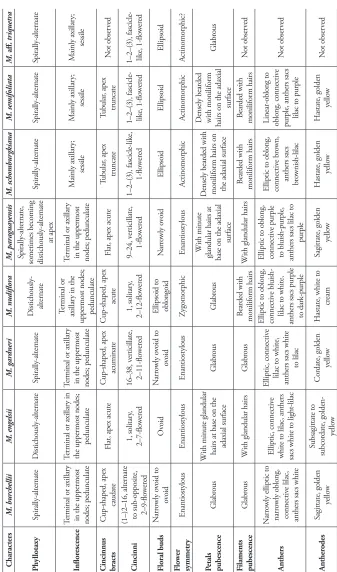
In the present work, we accept six species native to the Neotropical region, with a new combination and a new species, and recognize two invasive Asian species. We present below descriptions for all native species, detailed diagnosis for the two invasive species, and a table summarizing the morphologic differences between all species found in the Neotropical region (Table 1). We also provide comments on the morphology of the
Neotropical species of Murdannia, comparing them with the Paleotropical species, and
Tab
le 1.
M
orphologic characters differ
entiating the species of
M
ur
dannia
kno
wn for the N
eotr opical r egion. Characters M. bur chellii M. engelsii M. gar dneri M. nudiflor a M. par aguay ensis M. schombur gkiana M. semifoliata M. aff. triquetr a Phyllotaxy Spirally-alternate D istichously-alternate Spirally-alternate D istichously- alternate Spirally-alternate, sometimes becoming
distichously-alternate at apex Spirally-alternate Spirally-alternate Spirally-alternate Inflor escence
Terminal or axillar
y
in the uppermost nodes; pedunculate
Terminal or axillar
y in
the uppermost nodes;
pedunculate
Terminal or axillar
y
in the uppermost nodes; pedunculate Terminal or axillar
y in the
uppermost nodes; pedunculate
Terminal or axillar
y
in the uppermost nodes; pedunculate
M ainly axillar y; sessile M ainly axillar y; sessile M ainly axillar y; sessile C incinnus bracts C
up-shaped, apex caudate
Flat, apex acute
C
up-shaped, apex acuminate
C
up-shaped, apex
acute
Flat, apex acute
Tubular , apex truncate Tubular , apex truncate N ot obser ved C incinni
(1–)2–16, alternate to sub-opposite, 2–9-flo
wer ed 1, solitar y, 2–7-flo wer ed 16–38, v er ticillate, 2–11-flo wer ed 1, solitar y, 2–12-flo wer ed 9–24, v er ticillate, 1-flo wer ed 1–2–(3), fascicle-like, 1-flo wer ed
1–2–(3), fascicle- like, 1-flo
wer
ed
1–2–(3), fascicle- like, 1-flo
wer ed Floral buds N arr owly o void to ov oid Ov oid N arr owly o void to ov oid
Ellipsoid to oblongoid
N arr owly o void Ellipsoid Ellipsoid Ellipsoid Fl owe r symmetr y Enantiostylous Enantiostylous Enantiostylous Zygomorphic Enantiostylous Actinomorphic Actinomorphic Actinomorphic? Petals pubescence G labr ous W
ith minute glandular hairs at base on the adaxial sur
face G labr ous G labr ous W ith minute
glandular hairs at base on the adaxial
sur
face
D
ensely bear
ded with
moniliform hairs on the adaxial sur
face
D
ensely bear
ded
with moniliform hairs on the adaxial
sur face G labr ous Filaments pubescence G labr ous W
ith glandular hairs
G labr ous Bear ded with moniliform hairs W
ith glandular hairs
Bear ded with moniliform hairs Bear ded with moniliform hairs N ot obser ved Anthers N arr
owly elliptic to
narr
owly oblong,
connectiv
e lilac,
anthers sacs white
Elliptic, connectiv
e
white to lilac, anthers sacs white to light-lilac
Elliptic, connectiv
e
lilac to white,
anthers sacs white
to lilac
Elliptic to oblong, connectiv
e
bluish-lilac to white,
anthers sacs purple to dar
k-purple
Elliptic to oblong, connectiv
e purple
to bluish-purple, anthers sacs lilac to
purple
Elliptic to oblong, connectiv
e br
own,
anthers sacs brownish-lilac Linear-oblong to oblong, connectiv
e
purple, anthers sacs lilac to purple
N ot obser ved Anther odes Sagittate, golden yello w Subsagittate to subcor
date, golden- yello
w
Cor
date, golden yello
w
H
astate, white to cr
eam
Sagittate, golden
yello
w
H
astate, golden yello
w
H
astate, golden yello
w
N
ot obser
Characters M. bur chellii M. engelsii M. gar dneri M. nudiflor a M. par aguay ensis M. schombur gkiana M. semifoliata M. aff. triquetr a G ynoecium pubescence G labr ous W
ith glandular hairs
G labr ous G labr ous W
ith glandular hairs
G labr ous G labr ous G labr ous Fr uiting pedicel Er ect D eflex ed Er ect Er ect D eflex ed Er ect Er ect Appar ently er ect C apsules
Subglobose to globose
Br
oadly o
void to
br
oadly ellipsoid
Subglobose to globose
Ov oid to subglobose O blongoid to br oadly oblongoid O
blongoid to br
oadly oblongoid O blongoid to br oadly oblongoid O
blongoid to ellipsoid
Seeds
1 per locule,
reniform to br
oadly ellipsoid, v entri-lateral appendage pr esent
1 per locule, r
eniform
to br
oadly ellipsoid, ventri-lateral
appendage pr
esent
1 per locule,
reniform to br
oadly ellipsoid, v entr -lateral appendage pr esent
2 per locule,
br
oadly ellipsoid to oblongoid, ventri-lateral
appendage absent
2 per locule,
reniform to br
oadly-ellipsoid, v entri-lateral appendage pr esent
6 per locule, cuboid to polygonal, v
entri-lateral appendage
absent
6 per locule, cuboid to polygonal, ventri-lateral appendage absent 3 per locule, transv
ersely
ellipsoid, v
entri-lateral appendage
Murdannia Royle, Ill. Bot. Himal. Mts. 1: 403, pl. 95, f. 3. 1839.
Aphylax Salisb., Trans. Hort. Soc. London 1: 271. 1812, nom. nud. Type species. Aphy-lax spiralis (L.) Salisb. [≡Murdannia spirata (L.) G.Brückn.].
Baoulia A.Chev., Bull. Soc. Bot. France 58 (8): 217. 1912.Type species. Baoulia ten-uissima A.Chev. [≡M. tenuissima (A.Chev.) Brenan].
Dichaespermum Wight, Icon. Pl. Ind. Orient. 6: 31. 1853. Type species (designated
here). Dichaespermumlanceolatum Wight [≡M. lanceolata (Wight) Kammathy].
Dilasia Raf., Fl. Tellur. 4: 122. 1838, nom. rej. Type species. Dilasia vaginata (L.) Raf. [≡M. vaginata (L.) G.Brückn.].
Ditelesia Raf., Fl. Tellur. 3: 69. 1837 nom. rej. Type species. Ditelesia nudiflora (L.) Raf. [≡Murdannia nudiflora (L.) Brenan].
Phaeneilema G.Brückn., Bot. Jahrb. Syst. Beibl. 137: 63. 1926, nom. illeg. Type
spe-cies. Phaeneilema sinicum (Ker Gawl.) G.Brückn. [=M. simplex (Vahl) Brenan]
Prionostachys Hassk., Flora 49: 212. 1866. Type species (designated here). Prionos-tachys ensifolia Hassk. ex C.B. Clarke [= M. gigantea (Vahl) G.Brückn.].
Streptylis Raf., Fl. Tellur. 4: 122. 1838, nom. rej. Type species. Streptylis bracteolata
Raf. [= M. spirata (L.) G.Brückn.].
Talipulia Raf., Fl. Tellur. 2: 17. 1837, nom. rej. Type species. Talipulia malabarica
(L.) Raf. [= Murdannia nudiflora (L.) Brenan].
Type species.Murdannia scapiflora (Roxb.) Royle [= Murdannia edulis (Stokes) Faden].
Description.Herbs, perennial or annual, rhizomatous or not, with a definite or
indefinite base, terrestrial to paludal to rooted emergent aquatics. Roots thin and
fi-brous or tuberous and fusiform. Rhizomes short to elongate. Stems trailing and
ascend-ing at the apex or erect, unbranched to densely branched, rootascend-ing in the rhizome
and at the basal nodes, rarely at the distal ones when they touch the substrate. Leaves
sessile; distichously or spirally-alternate, congested at the apex of the stem or evenly distributed along the stem; lamina flat to slightly falcate to falcate and/or condupli-cate, base symmetrical, midvein inconspicuous to conspicuous, adaxially impressed or not, abaxially prominent or not, secondary veins conspicuous to inconspicuous. Synflorescence composed of a solitary main florescence or with 1–several coflorescences. Main florescences (inflorescences) terminal or axillary in the in the uppermost nodes, not perforating the leaf-sheaths; main florescence a thyrse, composed of 1–many cincinni; basal bract reduced to leaf-like; peduncle bracts (sterile bracts) absent; cincinni bracts persistent; cincinni, sessile to pedunculate, contracted to elongate, bracteoles flat or
tubular, persistent or caducous. Flowers bisexual or male (the male ones with a reduced
filaments bent ca. 30° either to the left or to the right, free, glabrous or with minute glandular hairs or medially bearded with moniliform hairs, anthers dorsifixed, rimose, connective narrow, anther sacs parallel, elongate; staminodes 3–(4), antepetalous (if 4 staminodes are present, than 1 antesepalous to the lower sepal), filaments free, gla-brous, minutely glandular-puberulous basally or medially bearded with moniliform hairs, antherodes dorsifixed, 3-lobed, indehiscent, connective expanded, golden yel-low or mauve to purple; ovary sessile, bent ca. 30° on the opposite direction as the stamens, smooth, glabrous or glandular-puberulous, 3-locular, locules equal, locule 1–2–(6)-ovulate, style erect or gently curved at the apex, stigma truncate to capitate,
papillate. Capsules loculicidal, 3-valved, apiculate due to persistent style base, smooth,
glabrous or glandular-puberulous. Seeds exarillate, farinose, uniseriate, 1–2–(6) per
locule, reniform to broadly ellipsoid or cuboid to polygonal, slightly to strongly cleft towards the embryotega, ventrally flattened or not, testa costate to slightly rugose or shallowly scrobiculate to scrobiculate to foveolate, with ridges radiating from the em-bryotega, appendaged or not, hilum elliptic or linear, embryotega lateral to semilateral or semidorsal.
Ecology and habitat. As with most aquatic plants, Neotropical Murdannia are
sel-dom collected throughout their distribution range. Despite that, they seem to be locally common or uncommon, depending on the species. They all seem to be intimately related to permanent and seasonal water bodies of drier domains and vegetation, such as flooded grasslands in the Cerrado, Chaco and Pantanal domains, or the white sand formations in the Amazon basin.
Morphological relationships among the Neotropical species and within the
genus. Murdannia is one of the six (i.e. Aneilema, Buforrestia, Commelina, Floscopa and
Pollia) out of 41 genera of Commelinaceae distributed in the Neotropics and
Paleo-tropics. (Faden 1998). Although few in number, the Neotropical species of Murdannia
exhibit all the extremes in inflorescence morphology found in Murdannia as a whole.
The terminal thyrse consisting of well-spaced whorls of cincinni, present in M. gardneri
and M. paraguayensis, is elsewhere present only in the rare Central African M. allardii
(De Wild.) Brenan, and in the Asian species M. divergens (C.B.Clarke) G.Brückn, and
M. juncoides (Wight) R.S.Rao & Kammathy (Ancy 2014; Faden & Pellegrini pers.
obs.). Glandular-pubescent sepals and pedicels, present in M. burchellii (C.B.Clarke)
M.Pell., comb. et stat. nov., M. englesii, M. gardneri, and M. paraguayensis, are
other-wise known only from the Asian species M. medica (Lour.) D.Y.Hong (usually present)
and M. spectabilis (Kurz) Faden. Moniliform hairs on the upper surface of the petals,
present in M. schomburgkiana (Kunth) G.Brückn. and M. semifoliata (C.B.Clarke)
G.Brückn., are recorded only in the Asian and African M. simplex (Vahl) Brenan.
One-seeded capsule locules, which characterize M. burchellii, M. engelsii and M. gardneri,
are known only in the Asian/Malaysian M. vaginata (L.) G.Brückn., and in the Indian
M. assamica Nampy & A.Ancy (Ancy and Nampy 2014). Finally, characters present in one or more Neotropical species that are not recorded elsewhere in the genus, include:
(1) inflorescences with whorls of 1-flowered cincinni (present in M. paraguayensis); (2)
(present in M. burchellii, M. englesii, M. gardneri, and M. paraguayensis); (3) petals
with minute glandular hairs at base on the adaxial surface (present in M. engelsii and M.
paraguayensis); (4) the presence of glandular hairs on the filaments, ovaries and capsules
(present in M. engelsii and M. paraguayensis); (5) long moniliform hairs on the petals
and not confined to the petal bases (present in M.schomburgkiana and M. semifoliata);
and (6) appendages on the seeds (present in M. burchellii, M. engelsii, M. gardneri and
M. paraguayensis).
Inflorescence architecture in Murdannia. Brenan (1966) has shown a great
di-versity of inflorescence architecture in Murdannia, with variations in the position of
the main florescence, total number of cincinni, number of nodes with cincinni, num-ber of cincinni per node, and degree of development of each cincinnus. According to Panigo et al. (2011), the basic inflorescence pattern for Commelinaceae is a many-branched, pedunculate and terminal thyrse, with verticillate cincinni, each cincinnus multi-flowered. Based on Brenan (1966) and Panigo et al. (2011), we could also infer
that the plesiomorphic inflorescence architecture for Murdannia would correspond
to the basic inflorescence pattern for Commelinaceae. Brenan (1966) indicates that most of the variation in inflorescence architecture could be derived from this basic
type, as exemplified by the Asian M. divergens, by only three changes. On the other
hand, Panigo et al. (2011) states that additional changes would be necessary to
ex-press all the known variation in the inflorescence morphology for Murdannia, as: (1)
the production of coflorescences, in addition to the main florescence; (2) variation in the length of the peduncle and internodes of the main florescence; (3) variation in the number of cincinni per node; (4) variation in the arrangement of cincinni on each node of the main florescence; (5) variation in the length of the cincinnus peduncle; and (6) variation in the total flower number per cincinnus. These changes can occur separately or in different combinations. In the most extreme cases, the inflorescences are mainly axillary, each being fascicle-like, and composed of a few 1-flowered cincinni.
If we were to consider this stepwise change a possible evolutionary sequence within Murdannia, then the South American species with the most plesiomorphic
inflores-cence type would be M. gardneri. By its reduced number of cincinni per node and
change in their arrangement, the inflorescence of M. burchellii could be
morphological-ly derived from M. gardneri. Murdannia paraguayensis, shares the numerous verticillate
cincinni of M. gardneri, but each cincinnus is reduced to a single flower. Murdannia
engelsii has terminal or terminal and axillary inflorescences, that are reduced to single cincinni, but the cincinnus is 2–several-flowered. The most reduced inflorescences, and perhaps the ones that accumulated the greatest number of stepwise changes, can
be observed in M. schomburgkiana and M. semifoliata, in which most inflorescences are
fascicle-like, axillary in the distal leaves, and with all cincinni 1-flowered. Species with
similarly reduced inflorescences are numerous in Asia [e.g. M. blumei (Hassk.)
Bre-nan, M. crocea (Griff.) Faden, M. keisak (Hassk.) Hand.-Mazz., M. lanuginosa (Wall.
ex C.B.Clarke) G.Brückn., M. pauciflora (Wight) G.Brückn., M. triquetra (Wall. ex
Africa by M. axillaris Brenan (Faden 2012; Ancy 2014). Nonetheless, some of them show characters not present in any of the Neotropical species, such as annual habit, biseriate seeds and yellow to orange flowers. Thus, in the absence of a well sampled molecular phylogeny it would be impossible to state whether the Neotropical species
represent one or several distinct lineages in Murdannia.
Key to the native and invasive species of Murdannia in the Neotropics
1 Inflorescences composed of 2–several verticillate or alternate to subopposite
cincinni, rarely composed of a solitary cincinnus, bracteoles persistent; flow-ers enantiostylous, sepals with glandular hairs or with a mixture of glandular and eglandular hairs, androecium glabrous or with minute glandular hairs;
seeds with a ventri-lateral appendage ...2
– Inflorescences composed of a solitary cincinnus or fascicle-like, bracteoles
caducous; flowers non-enantiostylous, sepals glabrous, androecium medially
bearded with moniliform hairs; seeds without a ventri-lateral appendage ....5
2 Bracteoles cup-shaped; pedicels erect at post-anthesis and in fruit; petals glabrous,
filaments, ovaries and capsules glabrous; hilum in a deep depression ...3
– Bracteoles flat; pedicels deflexed at post-anthesis and in fruit; petals with
minute glandular hairs at base on the adaxial surface, filaments, ovaries and
capsules with glandular hairs; hilum in a shallow depression ...4
3 Cincinni alternate, rarely subopposite, sinuate; plants generally delicate;
stems prostrate, thin, densely branched at the base; leaves chartaceous, linear to linear-oblong; main axis of inflorescence with sparse eglandular and glan-dular hairs; cincinnus bracts with caudate apex; seeds densely farinose, the
testa costate to slightly rugose ...M. burchellii (C.B.Clarke) M.Pell. (Fig. 1)
– Cincinni verticillate, straight; plants generally robust; stems ascending to
erect, succulent, little branched at base to unbranched; leaves succulent, linear-lanceolate to linear-lanceolate; main axis of inflorescence with dense glandular and sparse eglandular hairs; cincinnus bracts with acuminate apex; seeds farinose, the testa scrobiculate to foveolate ...
...M. gardneri (C.B.Clarke) G.Brückn. (Figs 3–4)
4 Inflorescence reduced to a solitary cincinnus (but sometimes several clustered
in a synflorescence near towards the shoot apex), peduncles with a mixture of eglandular (scabrid) and glandular to densely glandular hairs, cincinni 2–7-flowered; plants without a definite base; leaves distichously-alternate; flowers buds ovoid; capsules broadly ovoid to broadly ellipsoid, locules
1-seeded ...M. engelsii M.Pell. & Faden (Fig. 2)
– Inflorescence a terminal thyrse composed of several whorls of 1-flowered
cin-cinni, peduncles with glandular to densely glandular hairs, cincinni 1-flow-ered; plants with a definite base; leaves spirally-alternate; flower buds ellip-soid to narrowly ellipellip-soid; capsules oblongoid to broadly oblongoid, locules
5 Leaves distichously-alternate; inflorescences long-pedunculate, exerted from the leaf-sheaths, cincinni 2–12-flowered, pendent; flowers zygomorphic, sta-mens 2, staminodes 4 (1 staminode antesepalous, sometimes lacking the an-therode), antherodes white to cream; capsules ovoid to subglobose ...
...M. nudiflora (L.) Brenan (Fig. 5)
– Leaves spirally-alternate; inflorescences sessile, enclosed by the leaf-sheaths;
cincinni 1-flowered, erect; flowers actinomorphic, stamens 3, staminodes 3,
antherodes yellow (flowers uncertain in M. aff. triquetra); capsules oblongoid
to ellipsoid ...6
6 Annuals without a definite base; roots thin; stems trailing, apex ascending,
densely branched; petals glabrous; capsules with 3-seeded locules; seeds
trans-versely ellipsoid ...M. aff. triquetra (Wall. ex C.B.Clarke) G.Brückn. (Fig. 9)
– Perennials with a definite base; roots tuberous; stems erect (only the short
rhizome prostrate), unbranched; petals medially bearded with moniliform hairs on the adaxial surface; capsules with 6-seeded locules; seeds cuboid to
polygonal ...7
7 Leaf-blades margins glabrous throughout, inflorescences-bearing leaves with
expanded blades (2.2–13.6 cm long); anthers brown ...
...M. schomburgkiana (Kunth) G.Brückn. (Fig. 7)
– Leaf-blades margins ciliate at least at base, inflorescences-bearing leaves
re-duced to bladeless sheaths or with much rere-duced blades (0.2–1.8 cm long);
anthers purple ...M. semifoliata (C.B.Clarke) G.Brückn. (Fig. 8)
1. Murdannia burchellii (C.B.Clarke) M.Pell., comb. et stat. nov. urn:lsid:ipni.org:names:77158526-1
Figs 1, 10
Aneilema gardneri var. burchellii C.B.Clarke, Monogr. Phan. 3: 217. 1881. Lectotype (designated here): BRAZIL. s.loc., fl., fr., s.dat., W.J. Burchell 8165 (K barcode K000363240!; isolectotypes: GH barcode GH00415446!, P barcode P02088020!). Aneilema gardneri var. glabrior C.B.Clarke, Monogr. Phan. 3: 217. 1881. Lectotype
(designated here): BRAZIL. Goyaz, fl., fr., 1841, G. Gardner 4020 (P barcode P02088023!; isolectotypes: BM not found, G barcode G00098263!, NY barcode
NY00247402!). Syn. nov.
Description.Herbs ca. 14.0–55.0 cm tall., perennial, rhizomatous with a definite base,
terrestrial to paludal to rooted emergent in flooded fields. Roots thin, fibrous, brown
to dark-brown, densely to sparsely pilose with medium to dark brown hairs, emerging
from the rhizome and from the basal most nodes. Rhizomes short, light to medium
brown, buried in the sand or ground. Stems trailing with ascending apex, thin, densely
age, with a line of eglandular hyaline hairs opposite the leaf above. Leaves spirally-alternate, evenly distributed along the stems, the distal ones gradually smaller than the proximal ones; sheaths 0.3–1.3 cm long, vinaceous to reddish brown, sparsely pilose to hispid with hyaline hairs, becoming glabrous with age, hairs hyaline, margins setose, with a line of eglandular hairs opposite to the leaf above; lamina 2.7–13 × 0.3–0.6 cm, linear to linear oblong, membranous, conduplicate, slightly falcate, light green to grey-ish green on both sides, drying light brown to olive-green on both sides, sparsely pilose to hispid, becoming glabrous with age, rarely glabrous, base truncate, margins green, ciliate to setose throughout or only at base, apex acuminate to mucronate; midvein conspicuous, impressed adaxially, prominently acute abaxially, secondary veins 2–(3) pairs, adaxially inconspicuous to slightly conspicuous, dark green, abaxially somewhat
conspicuous, dark green. Inflorescences 1–2–(4) thyrsi, terminal or axillary in the
up-permost nodes, thyrse with (1–)2–16, alternate to subopposite cincinni; peduncles 2.3–7.6 cm, with a sparse mixture of eglandular (scabrid) and glandular, hyaline hairs; basal bract reduced or leaf-like, 1.4–5.1 × 0.1–0.3 cm, lanceolate to linear, sparsely pi-lose to hispid, rarely glabrous, base truncate, margins ciliate to setose, apex acuminate, veins inconspicuous, concolorous or green; cincinni bracts ca. 0.2–1.1 × 0.1–0.4 cm, triangular to broadly triangular, cup-shaped, light green to lilac, glabrous to pilose at base, base amplexicaul, non-perfoliate, margins glabrous to sparsely ciliate, apex cau-date; cincinni 2–9-flowered, erect, sinuate, cincinnus peduncle 0.4–2.2 cm, green to vinaceous to purple, with a mixture of sparse eglandular (scabrid) and sparse or more numerous glandular, hyaline hairs, cincinnus internodes 0.2–1.1 cm long, green to vinaceous to purple, with a mixture of sparse eglandular (scabrid) and sparse or more numerous glandular, hyaline hairs; bracteoles ca. 1.8–3.7 × 0.9–1 mm, persistent, tri-angular to broadly tritri-angular, cup-shaped, light green to lilac, glabrous to sparsely pi-lose, base amplexicaul, non-perfoliate, margins glabrous or rarely sparsely ciliate, apex
acuminate. Flowers bisexual or male, enantiostylous, ca. 0.5–1.2 cm diameter; floral
buds narrowly ovoid to ovoid, 2.1–4 × 1–2 mm, green to lilac; pedicels 0.3–1 cm long, green to vinaceous to purple, with a mixture of sparse eglandular (scabrid) and sparse or more numerous glandular, hyaline hairs, erect and elongate in fruit; sepals 3.2–5 × 1.5–2 mm, triangular to ovate-triangular, cucullate, green, glandular to densely glan-dular, hyaline hairs, apex acuminate, margins hyaline light green to hyaline lilac; petals equal, 4–6.3 × 3–4.2 mm, obovate to narrowly obovate, slightly cucullate, pale lilac to lilac to pink, rarely white, glabrous, base cuneate, margins entire, apex obtuse to rounded; stamens 3, equal, filaments glabrous, gently curved at the apex, 3.8–5.2 mm long, pale lilac to lilac or white, anthers narrowly elliptic to narrowly oblong, 0.8–1.0 × 0.3–0.7 mm, connective lilac, anthers sacs white, pollen white; staminodes 3, equal, filaments glabrous, straight, 1.6–2.1 mm long, pale lilac to white, antherodes sagittate, 0.8–0.9 × 0.9–1.0 mm, connective golden yellow, lobes conspicuous, cream-colored to pale yellow; ovary ellipsoid to oblongoid, 0.9–1.8 × 0.6–0.8 mm, 3-locular, white to light green, smooth, glabrous, style gently curved at the apex, ca. 1.8–3.6 mm,
pale lilac to lilac or white, stigma truncate, white to lilac. Capsules 2.8–4.4 × 3–4.8
brown when mature, glabrous, smooth. Seeds 1 per locule, 1.9–2.8 × 1.3–2.1 mm, reniform to broadly ellipsoid, cleft towards the embryotega, ventrally flattened, testa dark brown to greyish brown, densely farinose, costate to slightly rugose, with ridges radiating from the embryotega, with a tan appendage that extends ventri-laterally to the embryotega and basally into the hilum; embryotega semilateral, relatively incon-spicuous, generally covered by a cream farina, without a prominent apicule; hilum linear, approximately the same length as the seed, in a deep depression.
Specimens seen. BOLIVIA. Santa Cruz: San Ignacio de Velasco, 30 km acia
S, 12 Apr 1988, B. Bruderreck 310 (LPB, US). BRAZIL.Goiás: Provincia Goyaz,
Salinas, May–Jul 1844, M.A. Weddell 2103 (P); loc. cit., May–Jul 1844, M.A. Wed-dell 2106 (P); s.loc., 1841, G. Gardner 3481 (K); Colinas do Sul, Vila Borba, 15 Jun 1993, G. Hatschbach et al. 59587 (MBM, MO, USU); Formoso, arredores de For-moso, 3 May 2012, R.J.V. Alves 8898 (R); Paraíso, ca. 27 km sul de Paraíso, 23 Mar 1968, H.S. Irwin et al. 21659 (K, NY, UB); loc. cit., 23 Mar 1968, H.S. Irwin et al.
21717 (NY, UB); Maranhão: Carolina, 1 Jun 1950, J.M. Pires & G.A. Black 2564
(UFMA, US); Pará: Ilha do Marajó, 15 Aug 1901, fl, fr., M. Guedes 2314 (BM);
Serra do Cachimbo, Jun 1955, M. Alvarenga s.n. (RB 90541); loc. cit., 12 Dec 1956, J.M. Pires et al. 6104 (NY, UFMA); Itaituba, arredores da base aérea do Cachimbo, 25 Apr 1983, M.N. Silva et al. 90 (INPA, K, MG, NY, US); loc. cit., 26 Apr 1983,
M.N. Silva et al. 118 (INPA, MG, NY, US); Piauí: Piauhy, Parnaguá, marshy places,
Aug–Sep 1839, fl., fr., G. Gardner 2743 (BM, K); Tocantins: Araguaina, 20 km
ao Sul, 26 Mar 1976, G. Hatschbach & R. Kummrow 38378 (MBM, US).
VEN-EZUELA. Apure: Departamento Muñoz, módulos F. Corrales de la UNELLEZ,
entre los caños Guaritico y Caicara, 25 Oct 1980, B. Stergios 2379 (PORT, US); loc. cit., 10 Sep 1981, fr., G. Aymard 466 (PORT); loc. cit., 13 Sep 1981, B. Stergios et al. 9568 (PORT, US); loc. cit., 9 Dec 1986, G. Aymard & R. Schargel 5017 (PORT,
US); loc. cit., 12 Dec 1986, G. Aymard & R. Schargel 5071 (PORT, US); Cojedes:
San Carlos, en extremo Sur del Hato “El Laurel”, mas o menos km. 17 al sur de San
Carlos, 21 Aug 1976, fl., fr., B. Trujillo 13843 (MY); Guárico: Calabozo, ca. 39 km
SSW of Calabozo on Hato Masaguaral, 17 Sep 1983, R. Rondeau 469 (US);
Portu-guesa: Guanare, terrenos de la UNELLEZ, Mesa de Cavacas, 6 Sep 1986, fl., fr., B.
Stergios 7151 (PORT).
Distribution and habitat. Murdannia burchellii has a very fragmented
distribu-tion, probably due to lack of collections, being known to occur in Bolivia, Brazil (in the states of Goiás, Maranhão, Pará, Piauí and Tocantins), and Venezuela (Fig. 10). It grows in shady to open sandy river banks of the Amazon and Cerrado domains.
Phenology. It was found in bloom and fruit from October to July.
Conservation status. Murdannia burchellii possesses a wide EOO (ca.
3,513,319.273 km2), but due to the few and scattered collections known for this
spe-cies, its AOO is considerably smaller (ca. 22,500.000 km2). Thus, following the IUCN
recommendations (IUCN 2001), M. burchellii should be considered Least Concern.
Nonetheless, it is important to highlight the small number of collections and how
made in 1993. Which may indicate an ongoing decrease of size of the subpopulations and the loss of habitat for this species.
Nomenclatural notes. When describing Aneilema gardneri var. burchelli, Clarke
(1881) lists two collections (W.J. Burchell 8165 and M.A. Weddell 2106). Since the
name of Clarke’s new variety honors W.J. Burchell, it seems logical to designate his collection as the lectotype. Aside from that, this collection is well distributed in several herbaria around the world. Furthermore, the specimen from K herbarium matches Clarke’s description and has hand annotations made personally by Clarke. Thus, we
designate this specimen as the lectotype for Aneilema gardneri var. burchelli.
When describing Aneilema gardneri var. glabrior, Clarke (1881) cites three
col-lections by G. Gardner (2743, 3481, 4020). The specimen of at K Gardner 4020 is
mounted on the same sheet as Gardner 3481, and both being annotated by Clarke as
A. gardneri var. glabrior. Gardner 4020 is also the most well distributed of the three
collections. Nonetheless, the specimen of at K represents M. gardneri, so it cannot
be designated as the type of A. gardneri var. glabrior. Thus, the specimen at K is not
considered part of the original material. One of us (RBF) examined and recorded a
specimen of Gardner4020 at BM in 1993, with the following data on the label: “Moist
campos between Natividade and Conceição, Feby 1840, Herb. Gardner.” While this would appear to be the most logical choice for a lectotype, the specimen was not pho-tographed when other types were phopho-tographed at BM, and it cannot be found today. Therefore, the specimen at P is here designated as the lectotype. This specimen also bears an identification in Clarke’s handwriting.
Discussion. Murdannia burchellii is morphologically similar to M. gardneri due
to the general aspect of the plants, indumentum and by the presence of a ventri-lateral
appendage in the seeds. It was traditionally treated as part of M. gardneris.l. due to the
number of cincinni per inflorescence, the posture of the pedicels at post-anthesis and in fruit, general floral and capsule morphology, and due to the hilum being positioned in a deep depression (Table 1). Nevertheless, both species can be readily differentiated by the stature and robustness of the plants, the insertion of the cincinni in the main
axis of the inflorescence and testa ornamentation. Furthermore, the cincinni in M.
burchellii are conspicuously sinuate, while the cincinni in M. gardneri are straight.
Af-ter analyzing the syntypes for Aneilema gardneri var. glabrior, it became clear that they
were conspecific with M. burchellii. All specimens possess the characteristic alternate to
subopposite cincinni, being differentiated only from M. burchellii by sparser
eglandu-lar and glandueglandu-lar hairs in the inflorescence. All the analyzed specimens possessed some type of indumentum in the inflorescence, despite Clarke’s description (1881) stating they were completely glabrous.
Some young specimens of Murdannia burchellii with inflorescences reduced to a
solitary cincinnus, can be confused with specimens of M. engelsii. Nevertheless, these
can be differentiated by their glabrous stems, leaf-blades with truncate base, sinuate cin-cinni, cup-shaped bracteoles, and glabrous androecium and gynoecium (vs. stems with glandular hairs, leaf-blades with an amplexicaul base, straight cincinni, flat bracteoles
2. Murdannia engelsii M.Pell. & Faden, sp. nov. urn:lsid:ipni.org:names:77158529-1
Figs 2, 10
Diagnosis. Similar to M. paraguayensis due to its deflexed pedicels at post-anthesis and
when fruiting; petals with minute glandular hairs at base on the adaxial surface; fila-ments, ovaries, styles and capsules with minute glandular hairs, and capitate stigma. It can be differentiated by its trailing stems, distichously-alternate leaves, inflorescence re-duced to a solitary cincinnus, peduncles with a mixture of eglandular and glandular hairs, cincinni 2–7-flowered, capsules broadly ovoid to broadly ellipsoid, and 1-seeded locules.
Type. BRAZIL. Mato Grosso: Itaúba, Resgate de Flora da UHE Colíder, lote G
de supressão, 260 m, floresta do Planalto dos Parecís, prainha arenosa no rio Teles
Pires, fl., fr., 27 May 2015, M.E. Engels et al. 3474 (holotype: RB!; isotypes: CNMT!,
HERBAM!, MBM!, US!, TANG!).
Description.Herbs ca. 10.0–36.0 cm tall, perennial, rhizomatous without a
defi-nite base, terrestrial to paludal in river banks. Roots thin, fibrous, brown, densely to
sparsely pilose with hyaline hairs, emerging from the basalmost nodes and rhizome. Rhizomes long, trailing, light brown to light green, shallowly buried in the sand. Stems ascending to erect, thin, herbaceous to slightly succulent, usually densely branched or branched only at the base, sometimes branching from the upper nodes; internodes 1.3–3.5 cm long, green, with a mixture of eglandular (scabrid) and glandular hairs, becoming glabrous with age, with a line of eglandular hairs opposite the leaf above,
hairs hyaline. Leaves distichously-alternate, evenly distributed along the stems, rarely
somewhat congested at the apex of the stems, the distal ones gradually smaller than the proximal ones; sheaths 2–2.5 mm long, green, with glandular hairs, becoming glabrous with age, hairs hyaline, margins sparsely ciliate, with a line of eglandular hairs opposite the leaf above, hairs hyaline; lamina (0.5–)1.6–6 × 0.3–1 cm, membranous, generally conduplicate, rarely flat, slightly falcate to falcate, green on both sides, drying olive-green on both sides, narrowly elliptic to narrowly lanceolate or narrowly ovate, glabrous on both sides or the uppermost usually with glandular hairs at least basally, base amplexicaul, margins green, ciliate to setose at base or the uppermost sometimes with glandular hairs, apex acuminate; midvein slightly conspicuous, slightly impressed adaxially, prominently acute abaxially, secondary veins 2(–3) pairs, inconspicuous to
slightly conspicuous on both sides, dark green. Inflorescences 1–2–(5), terminal or
the base, base amplexicaul, non-perfoliate, margins glabrous, apex acute. Flowers bi-sexual or male, enantiostylous, 1–1.4 cm diam.; floral buds ovoid, 2.8–3.1 × 2.5–3 mm, green; pedicels 1–6 mm long, green, with glandular to densely glandular, hyaline hairs, deflexed and slightly elongate in fruit; sepals 3–3.5 × 0.5–0.8 mm, triangular to ovate-triangular, cucullate, green, with glandular to densely glandular, hyaline hairs, apex acute, margins hyaline light green; petals equal, 4.5–7.3 × 2.5–4.5 mm, obtrul-late, rarely obovate, slightly cuculobtrul-late, pale lilac to lilac, mauve or pink, rarely white, with minute glandular hairs at the base on the adaxial surface, base cuneate, margins entire, apex obtuse to rounded; stamens 3, equal, filaments basally with minute glan-dular hyaline hairs, gently curved in the middle, 4.1–5.9 mm long, pale lilac to lilac or white, anthers elliptic, 0.6–0.7 × 0.3–0.7 mm, connective white to lilac, anthers sacs white to pale lilac, pollen white; staminodes 3, equal, filaments with minute glandular hyaline hairs, straight, 1.3–1.7 mm long, white to pale lilac, antherodes subsagittate to subcordate, 0.9–1.0 × 0.9–1.0 mm, connective golden yellow, lobes conspicuous, cream-colored to pale yellow; ovary ovoid to ellipsoid, 0.9× 0.7–0.8 mm, 3-locular, white to light green, smooth, with minute glandular hyaline hairs, style curved at the
apex, ca. 3.6–8 mm, white to pale lilac or lilac, stigma capitate, white to lilac. Capsules
3-locular, 3-valved, 3.2–4.5 × 2–2.5 mm, broadly ovoid to broadly ellipsoid, apiculate due to persistent style, light brown when mature, with minute glandular hyaline hairs,
sometimes glabrescent with age, smooth. Seeds 1 per locule, 1.8–2.0 × 1–1.2 mm,
reniform to broadly ellipsoid, cleft towards the embryotega, ventrally flattened, testa medium to dark brown, sparsely farinose, scrobiculate to shallowly scrobiculate, with ridges radiating from the embryotega, sometimes with 4–7 ventral furrows, with a tan appendage that extends ventri-laterally to the embryotega and basally into the hilum; embryotega semilateral to semidorsal, relatively inconspicuous, generally covered by a cream farina, without a prominent apicule; hilum linear, approximately the same length as the seed, in a shallow depression.
Specimens seen (paratypes). BRAZIL.Mato Grosso: Itaúba, resgate de Flora da
UHE Colíder, Lote G de supressão, floresta do Planalto dos Parecís, região de ecótono entre a Floresta Amazônica e Cerrado, 3 Jun 2016, M.E. Engels & A.S. Bezerra 4510 (HERBAM, MBM, RB); Poconé, rodovia Transpantaneira, 17 May 1983, J. Barcia et al. 1560 (R); loc. cit., Fazenda Nova Berlim, Transpantaneira highway, km 85, 3 May 1992, M. Schessl 2602b (CH, UFMT, ULM, US); loc. cit., highway Poconé-Porto Cercado, 30 May 1992, M. Schessl 2631g (CH, CPAP, UFMT, ULM, US); loc. cit., estrada para Porto Cercado, km 18, 22 Apr 1993, A.L. Prado 2017 (UEC, UFMT); loc. cit., Fazenda Ipiranga, 8 May 1993, A.L. Prado & R. Ribeiro 2045 (HURB, UEC, UFMT); loc. cit., Fazenda Ipiranga, Pousada Piuvial, vazante da sede, km 11 da rodovia Transpantaneira, 20 May 1996, V.J. Pott et al. 3186 (CPAP, US); Vila Bela da Santíssima Trindade, Parque Estadual Serra de Ricardo Franco, margem do rio
Guaporé, 23 May 1978, P.G. Windisch 1863 (RB); Mato Grosso do Sul: Corumbá,
Mandovi, Nhecolândia, 3 Aug 1999, V.J. Pott & A. Rodrigues 3993 (CPAP, US);
Tocantins: Pium, Ilha do Bananal, Parque Nacional do Araguaia, base física do rio
Javaés, antigo acampamento do Projeto Quelônios do Amazônia, 27 Mar 1999, M. Aparecida da Silva et al. 4167 (IBGE, RB).
Etymology. The epithet honors the collector of the holotype, the Brazilian
bota-nist Mathias Erich Engels, Orchidaceae taxonomist and dear friend of the authors.
Distribution and habitat. Murdannia engelsii is endemic to Brazil, being known
from the states of Tocantins, Mato Grosso and Mato Grosso do Sul (Fig. 10). It grows in shady to open sandy river banks of the Amazon, Cerrado and Pantanal domains. Its prostrate stems produce dense mats, generally near rocks and grasses.
Phenology. It was found in bloom and fruit from March to August.
Conservation status. Murdannia engelsii possesses both a wide EOO (ca.
514,893.048 km2) and a wide AOO (ca. 15,000.000 km2). Following the IUCN
recommendations (IUCN 2001), M. englesii should be considered Least Concern.
Nevertheless, most of the known populations of M. engelsii are in areas currently being
deforested and turned into pasture sites for cattle. We believe that this species is highly affected by human activity and should be considered Vulnerable [VU, A2cd+ B2ab(ii, iii,v)+D2].
Discussion. Murdannia engelsii is morphologically similar to M. burchellii, M.
gardneri and M. paraguayensis due to indumentum and flower morphology, and also
similar to M. paraguayensis due to the deflexed pedicels in fruit. However, M. engelsii
can be easily differentiated by its inflorescence reduced to a solitary cincinnus (vs. thyrsi
with several, verticillate or alternate to subopposite cincinni). It can be easily
differenti-ated from M. burchellii and M. gardneri by inflorescence morphology, position of the
pedicels at post-anthesis and in fruit, by the indumentum of the filaments, gynoecium
and capsules, and seed morphology. Murdannia engelsii is much more similar to M.
paraguayensis, due to several key characters. These are the only species in the genus to have petals with minute glandular hairs at the base on the adaxial surface, androecium and gynoecium with glandular hairs, and the only Neotropical species to have
pedi-cels deflexed post-anthesis and in fruit. Nevertheless, M. engelsii can be differentiated
by its trailing habit (vs. erect in M. paraguayensis), leaves distichously-alternate (vs.
spirally-alternate), inflorescence reduced to a solitary cincinnus (vs. inflorescence with
several verticillate cincinni), cincinni 2–7-flowered (vs. 1-flowered), capsules broadly
ovoid to broadly ellipsoid (vs. oblongoid to broadly oblongoid), and locules 1-seeded
(vs. 2-seeded). Murdannia engelsii can also be confused with M. nudiflora, due to their
small stature, phyllotaxy and inflorescence morphology. However, they can be easily
differentiated by its erect cincinni (vs. pendulous), persistent bracteoles (vs. caducous),
corolla actinomorphic (vs. zygomorphic), three stamens and three staminodes (vs. two
stamens and four staminodes), filaments with minute glandular hairs (vs. bearded with
moniliform hairs), and locules 1-seeded (vs. locules 2-seeded) (Table 1). One of the
most striking features of M. engelsii would be occasional production of several
3. Murdannia gardneri (Seub.) G.Brückn., Nat. Pflanzenfam. (ed. 2)15a: 173. 1930. Figs 3–4, 10
Phaeneilema gardneri (Seub.) G.Brückn., Notizbl. Bot. Gart. Berlin–Dahlem 10 (91): 56. 1927.
Aneilema gardneri Seub., in Martius, Fl. Bras. 3 (1): 259. 1855. Lectotype (designated here): BRAZIL. Goyaz, moist places near Villa de Arrayal, fl., fr., April 1841, G. Gardner 4021 (K barcode K000363236!; isolectotypes: B barcode B100367834!, BM barcodes BM001172132!, BM001172133!, G barcodes G00098261!, G00098262!, G00165012!, K barcode K000363237!, NY barcodes NY00247400!, NY00247401!, P barcode P02088022!, US barcode US00091574!).
Description.Herbs ca. 30.0–150.0 cm tall, perennial, rhizomatous with a definite base,
terrestrial to paludal to rooted emergent in flooded fields. Roots thin, fibrous, medium
to dark brown, densely to sparsely pilose with medium to dark brown hairs, emerging
from the short rhizome and from the basalmost nodes. Rhizomes short, light to medium
brown, buried in the sand or ground. Stems prostrate, with erect to ascending apex,
suc-culent, unbranched to little-branched at the base; internodes 1.9–10.7 cm long, green to vinaceous, glabrous to sparsely pilose or hispid, becoming glabrous with age, with a
line of eglandular hairs opposite the leaf above, hairs hyaline. Leaves spirally-alternate,
evenly distributed along the stems, sessile, the distal ones gradually reduced; sheaths 0.5–3.2 cm long, green to vinaceous, sparsely pilose to hispid, becoming glabrous with age, hairs hyaline, margins ciliate to hispid, with a line of eglandular hairs opposite the leaf above, hairs hyaline; lamina 4.2–17.4 × 0.7–1.3 cm, chartaceous, conduplicate, slightly falcate to falcate, green on both sides, drying light brown to olive-green on both sides, linear-lanceolate to lanceolate, sparsely pilose to hispid, becoming glabrous with age, rarely glabrous, base truncate to rounded, margins light green, ciliate to se-tose only at base, apex acuminate; midvein inconspicuous, slightly impressed adaxi-ally, slightly obtuse abaxiadaxi-ally, secondary veins 3–4(–5) pairs, adaxially inconspicuous to
slightly conspicuous, light green, abaxially somewhat conspicuous. Inflorescences 1–(3)
Figure 3. Murdannia gardneri (Seub.) G.Brückn. A Inflorescence, showing the verticillate cincinni and open lilac flowers B detail of the inflorescence, showing the ascending and straight cincinni C flooded grassland in the state of Minas Gerais. Photographs A–B by W. Milliken, C by I.L.M. Resende.
non-perfoliate, margins glabrous to ciliate, apex acuminate. Flowers bisexual or male,
pale lilac to lilac, purple or pink, rarely white, glabrous, base cuneate, margins entire, apex acute to obtuse; stamens 3, equal, filaments glabrous, gently curved at the apex, 6.2–9.4 mm long, pale lilac to lilac or white, anthers elliptic, 0.7–0.9 × 0.3–0.4 mm, connective lilac to white, anthers sacs white to lilac, pollen white; staminodes 3, equal, filaments glabrous, straight, 3.1–5.3 mm long, pale lilac to white, antherodes cordate, 0.7–0.9 × 0.8–0.9 mm, connective golden yellow, lobes conspicuous, cream-colored to pale yellow; ovary ellipsoid to broadly ellipsoid, 0.6–0.8 × 0.4–0.6 mm, 3-locular, white to light green, smooth, glabrous, style gently curved at the apex, ca. 4.8–6.2 mm, pale
lilac to lilac or white, stigma truncate, white to lilac. Capsules 3.6–4.5 × 3.4–4.2 mm,
3-locular, 3-valved, subglobose to globose, apiculate due to persistent style, light brown
when mature, glabrous, smooth. Seeds 1 per locule, 1.9–2.6 × 1.2–1.8 mm, reniform
to broadly ellipsoid, strongly cleft towards the embryotega, ventrally flattened, testa dark brown to greyish brown, sparsely farinose, scrobiculate to foveolate, with ridges radiating from the embryotega, with a tan appendage that extends ventri-laterally to the embryotega and basally into the hilum; embryotega semilateral, relatively inconspicu-ous, without a prominent apicule; hilum linear, approximately the same length as the seed, in a deep depression.
Specimens seen. BRAZIL. Bahia: Correntina, Chapadão Ocidental da Bahia,
Islets and banks of the rio Corrente, 23 Apr 1980, R.M. Harley et al. 21668 (CEPEC, HRB, K, MBM, US); loc. cit., 21 Jan 1997, G. Hatschbach et al. 66044 (MBM);
Goiás: Cavalcante, estrada rio Trairas/rio Custódio, km 2, 28 Nov 2006, G.
Pereira-Silva & G.A. Moreira 11159 (CEN, RB); Colinas do Sul, fazenda Saracura, estrada de manutenção das novas linhas de transmissão Minacu/Niquelândia, 8 Sep 1995, B.M.T. Walter et al. 2604 (CEN, RB); Goyaz, 1841, G. Gardner 4020 (K barcode K000363238, US barcode US00160560); Itumbiara, rodovia Itumbiara–Rio Verde, a 31 km de Itumbiara, 18 Apr 1978, G.J. Shepherd et al. 7415 (F ex UEC); Niquelân-dia, 27 km de Colinas em direção a NiquelânNiquelân-dia, próximo ao rio Tocantinzinho, 6 May 1998, M.A. Silva et al. 3772 (IBGE, RB, US); Teresina de Goiás, km 12 da estra-da GO-118, sentido Nova Roma, 29 April 1996, B.A.S. Pereira & D. Alvarenga 3027
(IBGE, RB); Mato Grosso: Novo Mundo, Parque Estadual do Cristalino, entrada
para Fazenda J.J., 26 January 2008, D. Sasaki et al. 1934 (HERBAM, HURB, SPF);
Minas Gerais: Ituiutaba, 26 May 1946, A. Macedo 760 (US); Tocantins: Conceição
do Tocantins, rodovia TO-050, km 375, fazenda São José, próximo do rio Santa Isa-bel, 11 May 2000, G. Hatschbach et al. 70903 (MBM); Gurupi, próximo à Gurupi, 20 Apr 1978, R.P. Orlandi 73 (HRB, RB).
Distribution and habitat. Murdannia gardneri is endemic to Brazil, being known
from the states of Bahia, Goiás, Mato Grosso, Minas Gerais and Tocantins (Fig. 10). It grows in open sandy river banks or flooded grass fields, of the Cerrado domain.
Phenology. It was found in bloom and fruit throughout the year.
Conservation status. Murdannia gardneri possesses a EOO of ca. 497,658.992
km2 and a AOO of ca. 20,000.000 km2. Most of the known collections are
vegetation being easier to remove than the dense rainforests of the Amazon and
At-lantic Forest domains. Thus, we believe that M. gardneri should be considered Nearly
Threatened.
Nomenclatural notes. When describing Aneilema gardneri, Seubert (1855) lists
two collections from G. Gardner (4020 and 4021). As aforementioned, Gardner4020
consists of a mixture of M. burchellii and M. gardneri. Fortunately, the same is not true
for Gardner4021. Furthermore, the Gardner4020 specimen at P was designated by us
as the lectotype for A. gardnei var. glabrior. Thus, we designate a specimen at K as the
lectotype for A. gardneri.
Discussion. Murdannia gardneri is morphologically similar to M. burchellii and
M. paraguayensis due to their phyllotaxy and by the number of cincinni per
inflores-cence. It is morphologically more similar to M. burchellii due to the posture of the
pedicels at post-anthesis and when fruiting, general floral and capsule morphology, and due to the hilum being positioned in a deep depression. Nevertheless, both species can be easily differentiated based on the insertion of the cincinni in the main axis of the
inflorescence (alternate to subopposite in M. burchelliivs. verticillate in M. gardneri),
the ornamentation of the testa (costate to slightly rugose vs. scrobiculate to foveolate),
robustness of the plants (delicate vs. robust, branching pattern (densely branched at
base vs. unbranched to little-branched), leaf-blade consistency (chartaceous vs.
succu-lent), and some indumentum differences. On the other hand, M. paraguayensis can be
readily differentiated from M.gardneri by its 1-flowered cincinni (vs. many-flowered
in M.gardneri), deflexed pedicels post-anthesis and when fruiting (vs. erect), filaments
with minute glandular hairs (vs. glabrous), gynoecium and capsules with glandular
hairs (vs. glabrous), capsule oblongoid to broadly oblongoid (vs. subglobose to
glo-bose), locules 2-seeded (vs. 1-seeded), and hilum in a shallow depression (vs. in a deep
depression) (Table 1).
4. Murdannia nudiflora (L.) Brenan, Kew Bull. 7(2): 189. 1952. Fig. 5
Phaeneilema nudiflorum (L.) G.Brückn., Notizbl. Bot. Gart. Berlin–Dahlem 10 (91): 56. 1927.
Ditelesia nudiflora (L.) Raf., Fl. Tellur. 3: 69. 1837.
Aneilema nudiflorum (L.) R.Br., Prodromus Florae Novae Hollandiae: 271. 1810. Commelina nudiflora L., Sp. Pl. 1: 41. 1753. Lectotype (designated by Merrill 1937):
INDIA. s.loc., fl., fr., s.dat., P. Osbeck s.n. (LINN barcode LINN-HL65-12!).
Diagnosis.Herbs annual, with a definite base, terrestrial to paludal to rooted emergent
in flooded fields. Roots thin, fibrous, brown, densely to sparsely pilose, emerging from the
basal most nodes. Rhizomes absent. Stems prostrate, erect to ascending apex, unbranched
or branched at the base, glabrous. Leaves distichously-alternate, distributed along the
Figure 5. Murdannia nudiflora (L.) Brenan. A Habit B detail of a stem, showing the apical and long-pedunculate inflorescence C front view of a bisexual flower. Photograph A, C by W. Vargas and B by M.E. Engels.
lamina membranous, conduplicate, linear to linear-lanceolate or lanceolate-oblong,
gla-brous or with eglandular hairs. Inflorescences 1–(2), terminal or axillary from the
up-permost node, long-pedunculate, exerted from the leaf-sheaths, consisting of a solitary cincinnus; basal bract inconspicuous; cincinni bracts cup-shaped; cincinni
2–12-flow-ered, pendent, bracteoles cup-shaped, caducous. Flowers bisexual or male, zygomorphic
to the lower petals), equal, filaments gently sigmoid, closely parallel to each other, white at the base, lilac at the middle, purple at the apex, densely bearded with moniliform, pur-ple hairs, anthers elliptic to oblong, connective bluish lilac to white, anthers sacs purpur-ple to dark purple, pollen white; staminodes 4, 1 staminode antesepalous, opposite to the lower sepal, filament white to lilac, medially bearded with moniliform, purple hairs, an-therode small, white, sometimes lacking, 3 antepetalous, filaments straight, pale lilac to white, glabrous or sparsely medially bearded with moniliform, purple hairs, antherodes hastate, white to cream; ovary ellipsoid to oblongoid, 3-locular, light green smooth, gla-brous, style strongly curved at the apex, white to pale lilac, glagla-brous, stigma capitate, lilac. Capsules 3-locular, 3-valved, ovoid to subglobose, apiculate due to persistent style, light
brown when mature, smooth, glabrous. Seeds 2 per locule, broadly ellipsoid to
oblon-goid, not cleft towards the embryotega, ventrally ridged, testa yellowish brown to brown, foveolate-reticulate, with pale warts around depressions, farinose, appendage absent; em-bryotega semilateral, relatively inconspicuous, without a prominent apicule; hilum el-liptic, approximately ½ the length of the seed, on a weak ridge.
Distribution and habitat. Native toTropical Asia to Malaysia and naturalized in
West Africa, North America, Central America, the West Indies and South America; in the New World ranging from the southeastern United States to Argentina. In Brazil it is known to occur in the states of Acre, Alagoas, Amazonas, Bahia, Ceará, Goiás, Maranhão, Mato Grosso, Mato Grosso do Sul, Minas Gerais, Pará, Paraíba, Paraná, Rio Grande do Sul, Santa Catarina, São Paulo and Tocantins, in disturbed vegetation, roadsides and near rice crops.
Phenology. It was found in bloom and fruit throughout the year.
Discussion. Murdannia nudiflora can be easily recognized by its caduceus
bracte-oles, single terminal cincinni, two fertile stamens and four staminodes, and capsules with 2-seeded locules (Table 1).
5. Murdannia paraguayensis (C.B.Clarke ex Chodat) G.Brückn., Nat. Pflanzenfam. (ed. 2)15a: 173. 1930.
Figs 6, 10
Phaeneilema paraguayensis (C.B.Clarke ex Chodat) G.Brückn., Notizbl. Bot. Gart. Berlin–Dahlem 10 (91): 56. 1927.
Aneilema paraguayense C.B.Clarke ex Chodat, Bull. Herb. Boissier, sér. 2, 1: 437. 1901. Lectotype (designated here): PARAGUAY. Departamento de Canindeyú: Sierra de Maracayú, fl., fr., Oct 1898–1899, E. Hassler 5083 (G barcode G00195432!; isolectotypes: BM barcode BM000526690!; G barcode G00009034!, NY barcode NY00247403!).
Description. Herbs ca. 20.0–150.0 cm tall, perennial, rhizomatous with a definite
base, terrestrial to paludal to rooted emergent in flooded fields. Roots thin, rarely thick,
Figure 6. Murdannia paraguayensis (C.B.Clarke) G.Brückn. A Detail of a flowering shoot, showing the succulent stem, succulent, canaliculate and falcate leaves, and an inflorescence with lilac flowers B Detail of the apex of a flowering shoot, showing a terminal inflorescence with white flowers, and pedicels de-flexed post-anthesis C Inflorescence showing the 1-flowered verticillate cincinni and open mauve flowers D Side view of a male flower, showing the sepals with glandular hairs E flooded grassland in Sidrolândia, Mato Grosso do Sul. Photograph A by I.L.M. Resende, B, E by S.N. Moreira and C–D by V.C. Souza.
hairs, emerging from the short rhizome and from the basalmost nodes. Rhizomes short,
light to medium brown, buried in the sand or ground. Stems prostrate, with erect
to ascending apex, succulent, unbranched or only branched at the base; internodes 3.4–13.0 cm long, green to vinaceous, glabrous to sparsely pilose, becoming glabrous
with age, with a line of eglandular hyaline hairs opposite the leaf above. Leaves
spirally-alternate, sometimes becoming distichously-alternate at apex, evenly distributed along the stems, the distal ones gradually smaller than the basal ones; sheaths 1.2–3.3 cm long, green to vinaceous, glabrous to pilose along the fused edge, sometimes with a few scattered long, glandular hairs, margins ciliate to sparsely setose at base, hairs hya-line; lamina 2.5–23.6 × 0.4–1.2 cm, succulent, canaliculate, slightly falcate to falcate, green on both sides, drying light brown to olive-green or light green on both sides, linear-lanceolate to linear-elliptic or linear-oblong, glabrous, base truncate to rounded, margins light green to pink or vinaceous, ciliate to sparsely setose only at base, apex acute to acuminate; midvein conspicuous or inconspicuous, slightly impressed adaxi-ally, slightly obtuse abaxiadaxi-ally, secondary veins 2–3(–4) pairs, adaxially inconspicuous
or slightly conspicuous, light green, abaxially slightly conspicuous. Inflorescences 1–(2),
1.4–5.1–(10.0) × 1.0–1.6 mm, lanceolate to ovate, light green to pink or vinaceous, glandular-pubescent to glabrous, base truncate, margins glabrous, sometimes with a tooth at the base in each side, apex acute; cincinni 1-flowered, patent to erect, straight, peduncle inconspicuous, internodes absent; bracteoles ca. 0.8–1.2 × 0.3–0.6 mm, per-sistent, triangular, flat, light green to pink, glabrous, base truncate, margins glabrous,
apex acute. Flowers bisexual or male, enantiostylous, ca. 1.3–2.5 cm diam.; floral buds
narrowly ovoid, 5.3–6.2 × 2.6–3.2 mm, light green to pink; pedicels 1.0–5.2 mm long, light green to pink or vinaceous, with glandular to densely glandular, hyaline hairs, deflexed and elongate in fruit; sepals 5.3–8.0 × 1.8–4.7 mm, triangular to ovate-triangular, cucullate, light green to pink to vinaceous, with glandular to densely glan-dular, hyaline hairs, apex acuminate, margins hyaline light green to hyaline pink or vinaceous; petals equal, 0.8–1.3 × 0.5–0.7 cm, obovate to narrowly obovate, slightly cucullate, white to lilac to purple or mauve, with minute glandular hairs at base on the adaxial surface, base cuneate, margins entire to erose at the apex, apex acute to obtuse; stamens 3, equal, filaments gently curved at the apex, 6.0–9.6 mm long, pale lilac to lilac or purple, with minute glandular, hyaline hairs, anthers elliptic to oblong, 0.9–2.0 × 0.4–0.7 mm, connective purple to bluish purple, anthers sacs lilac to purple, pollen white; staminodes 3, equal, filaments straight, 3.1–5.3 mm long, pale lilac to white, with minute glandular, hyaline hairs, antherodes sagittate, 0.8–2.3 × 0.8–1.1 mm, connective golden yellow, lobes conspicuous, cream-colored to pale yellow; ovary ellipsoid to oblongoid, 1.5–3.5 × 0.7–1.3 mm, 3-locular, light green to green, smooth, with densely glandular, hyaline hairs, style gently curved at the apex, ca. 3.5–8.0 mm, pale lilac to lilac, with minute glandular, hyaline hairs, stigma capitate, lilac to
pur-ple. Capsules 5.1–9.8 × 3.2–5.0 mm, 3-locular, 3-valved; oblongoid to broadly
oblon-goid, apiculate due to persistent style, light brown when mature, smooth, with sparse
glandular, hyaline hairs, sometimes becoming glabrous with age. Seeds 2 per locule,
3.4–4.2 × 1.7–2.1 mm, reniform to broadly ellipsoid, strongly cleft towards the em-bryotega, ventrally flattened, testa dark brown to greyish brown, sparsely farinose, scro-biculate, with ridges radiating from the embryotega, with a tan appendage that extends ventri-laterally to the embryotega and basally into the hilum; embryotega semilateral, relatively inconspicuous, without a prominent apicule; hilum linear, approximately the same length as the seed, in a shallow depression.
Specimens seen. BRAZIL.Distrito Federal: Brasília, immediately N of Brasília,
rio Torto, 18 Sep 1965, H.S. Irwin et al. 8425 (NY, RB, US); Mato Grosso: Santa