ONE-POT GREEN SYNTHESIS OF
3-AMINO-1-(5-NITRO-1H-
INDOL-2-YL)-5,10-DIOXO-5,10-DIHYDRO-1H-PYRAZOLO[1,2-b]PHTHALAZINE-2-CARBONITRILE AND RELATED
COMPOUNDS
Rama Koteshwar Rao
[a]*and Shravankumar Kankala
[a]Keywords: Eco-friendly synthesis; One-pot reaction; pyrazolo[1,2-b]phthalazine; glycerol; triethylamine catalyst.
Synthesis of 3-amino-1-(5-nitro-1H-indol-2-yl)-5,10-dioxo-5,10-dihydro-1H-pyrazolo[1,2-b]phthalazine-2-carbonitriles by a one-pot green and an eco-friendly reaction of phthalic acid, hydrazine hydrate, indole-3-carboxaldehydes and malononitrile/ethyl cyanoacetate in the presence of Et3N as catalyst and Glycerol mediated at 100-105 oC for 45-60 min. This one-pot reaction proceeded in a short time with good
yields and the desired products obtained without using column purifications.
* Corresponding Authors
E-Mail: [email protected]
[a] Mewar University, Chittorgarh, Rajasthan, India- 312901
INTRODUCTION
Multi-component reactions (MCRs) are one-pot processes in which three or more compounds react in a single reaction vessel to form a product containing substantial components of all the reactants.1 Thus, design of highly efficient
chemical reaction sequences that provide maximum structural complexity and diversity with a minimum number of steps in the synthesis of compounds with interesting properties is essential for drug discovery and synthesis of natural products.2 MCRs have attracted much attention in
combinatorial and medicinal chemistry and have been designed to produce biologically active compounds.3,4
Phthalazines are important heterocycles that are known to possess multiple biological activities such as antimicrobial, anticonvulsant, antifungal, anticancer and anti-inflammatory.5 Carling et al. reported6 the synthesis of
3-phenyl-6-(2-pyridyl)methyloxy-1,2,4-triazolo[3,4-a ]phthala-zines and analogs which were found to be a critical structural element of specific CNS - active drugs. Jain et al. reported7 the synthesis of keto-glutamine tetrapeptide
analogs containing a 2-oxopyrrolidine ring as a glutamine side chain mimic which showed improved inhibition against hepatitis A virus 3C proteinase. Grasso et al. reported8 the
synthesis of 6,7-methylenedioxyphthalazin-1(2H)-ones which were found to be potent anticonvulsant agents. Nomoto et al. reported9 the synthesis of
6,7-dimethoxyphthalazine derivatives which showed relatively potent cardiotonic activity comparable to that of amrinone. Watanabe et al. reported10 the synthesis of
4-benzylamino-1-chloro-6-substituted phthalazines which were found to be vasorelaxant and some methods have been reported for the synthesis of phthalazine derivatives.11 Therefore, it was
considered worthwhile to synthesize phthalazine moiety containing 4H-pyrans.
Keeping above discussion in our mind, we now wish to report 3-amino-1-(5-nitro-1H-indol-2-yl)-5,10-dioxo-5,10-dihydro-1H-pyrazolo[1,2-b]phthalazine-2-carbonitrile derivatives by reaction of phthalic acid, hydrazine hydrate, indole-3-carboxaldehydes and malononitrile/ethyl cyanoacetate in the presence of Et3N as catalyst and glycerol
as a medium at 100-105 °C for 30-60 min.
RESULTS AND DISCUSSION:
Firstly, we have initiated the optimization of the one-pot four-component reaction by using phthalic acid (1) and hydrazine hydrate (2) to in-situ formation of phthalic hydrazide as intermediate in the presence of Et3N and
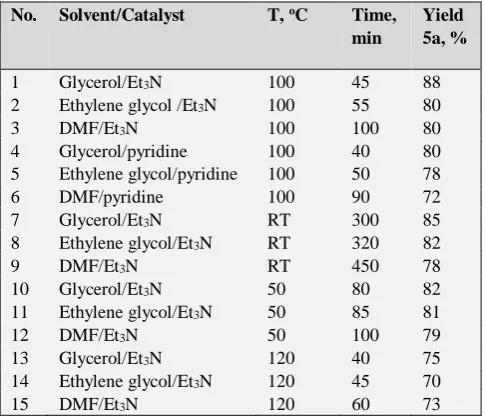
glycerol medium. To this reaction mixture, 5-nitroindole-3-carboxaldehyde (3a) and malononitrile (4a) were added for preparation of 3-amino-1-(5-nitro-1H-indol-2-yl)-5,10-dioxo-5,10-dihydro-1H-pyrazolo[1,2-b ]phthalazine-2-carbo-nitrile (5a) in the presence of different solvents (glycerol, ethylene glycol and DMF) and different bases (Et3N and
pyridine) at different temperature (RT, 50 °C, 100 °C and 120 °C) as a simple model reaction (Table 1 entries 1–3). However, it was found that the one-pot reaction of 1 (10 mM), 2 (10 mM), 3a (10 mM) and 4a (10 mM) in the presence of Et3N (2 mM) as catalyst and glycerol (50 ml) as
medium for 45 min at 100 °C gave the highest yield (88 %) and clean product (5a) (Table 1, entry 1). 1H-NMR, IR and mass spectroscop5ay have confirmed the structure of the compound 5a.
In order to examine the quantity of Et3N, the one-pot
reaction has been carried out at different quantity (1 mM, 2 mM and 5 mM) of Et3N with respect of phthalic acid 1.
However, it was found that the one-pot reaction of 1 (10 mM), 2 (10 mM), 3a (10 mM) and 4a (10 mM) in the presence of Et3N (2 mM) as catalyst and glycerol medium
Scheme 1. The general reaction route to prepare the pyrazolo[1,2-b]phthalazine derivatives
In the next step, the scope of the reaction process was explored, using the best-optimized conditions by changing the phthalic acid, the aldehyde & the nitrile (Table 3). The results are displayed in Table 3. The structures of the products were assigned on the basis of their spectral properties - IR, NMR and mass spectra (for details, please see the experimental section).
Table 1. Effect of solvent/catalyst and temperature on the one-pot reaction of 1, 2, 3a and 4a at RT yielding 5a.
No. Solvent/Catalyst T, oC Time, min
Yield 5a, %
1 Glycerol/Et3N 100 45 88
2 Ethylene glycol /Et3N 100 55 80
3 DMF/Et3N 100 100 80
4 Glycerol/pyridine 100 40 80
5 Ethylene glycol/pyridine 100 50 78
6 DMF/pyridine 100 90 72
7 Glycerol/Et3N RT 300 85
8 Ethylene glycol/Et3N RT 320 82
9 DMF/Et3N RT 450 78
10 11
Glycerol/Et3N
Ethylene glycol/Et3N
50 50
80 85
82 81
12 DMF/Et3N 50 100 79
13 Glycerol/Et3N 120 40 75
14 Ethylene glycol/Et3N 120 45 70
15 DMF/Et3N 120 60 73
A schematic mechanism for the catalytic activity of Et3N
in the synthesis of titled compounds 5 can be postulated as shown in Scheme 2. This mechanism contains three steps. In the first step, the formation of phthalic hydrazide (X1) by nucleophilic addition of hydrazine hydrate (2) to phthalic acid (1) takes place followed by dehydration. The second step involves forming heterodiene (Y1) by standard Knoevenagel condensation of indole-3-carboxaldehyde (3) and malononitrile/ethyl cyanoacetate (4). Then, in the third step, Michael-type addition of the phthalic hydrazide X1 to
heterodiene Y1 takes place forming the intermediary iminomethylene derivative Z which undergoes cyclisation affording 5.
Table 2. Effect of Et3N catalyst quantity on the one-pot reaction of
1, 2, 3a and 4a at 100-105 oC yielding 5a in glycerol.
No. Catalyst concentration
T, oC Time, min
Yield, 5a, %
1 1 mM 100 120 75
2 2 mM 100 45 88
3 5 mM 100 40 78
Table 3. Characterization data, reaction time and yields of 5
obtained from 1, 2, 3 and 4 via one-pot, four component synthesis.
Starting materials (1, 2, 3 and 4)
Product Time, min
Yield, %
3a
(R=H, Y=NO2) 4a
(X= CN) 5a 45 88
3b
(R=H, Y=H)
4a
(X= CN) 5b 48 86
3c
(R=CH3,Y=H) 4a
(X= CN) 5c 50 85
3d
(R=C2H5,Y=H) 4a
(X= CN) 5d 55 84
3a
(R=H, Y=NO2) 4b
(X=COOEt) 5e 50 87
3b
(R=H, Y=H)
4b
(X=COOEt) 5f 60 86
3c
(R=CH3,Y=H) 4b
(X=COOEt) 5g 60 84
3d
(R=C2H5,Y=H) 4b
(X=COOEt) 5h 60 86
≠ Refers to yields of crude products only.
O
O OH
OH
NH2 . H2O
N N
O
O NH2 X
N
R Y
CN Y
N
O H
R
X
NH2
Glycerol/Et3N
1
2
4
5
100-105oC/45-60 min
3a: X=H , R=H
3b: X=NO2, R=H 3c: X=H , R=CH3
3d: X=H , R=C2H5
3
5a: Y=H , R=H, X=CN 5b: Y=NO2, R=H, X= CN
5c: Y=H , R=CH3, X=CN
5d: Y=H , R=C2H5, X=CN
5e: Y=NO2, R=H, X=COOEt
5f: Y=H, R=H, X=COOEt 5g: Y=H, R=CH3, X=COOEt
5h: Y=H, R=C2H5, X=COOEt
Scheme 2. A plausible mechanism for 5 from 1, 2, 3 and 4.
EXPERIMENTAL SECTION
Melting points are uncorrected and were determined in open capillary tubes in a sulphuric acid bath. TLC was run on silica gel–G and visualization were done using iodine vapor or UV light. IR spectra were recorded using a Perkin– Elmer 1000 instrument in KBr pellets. 1H NMR spectra
were recorded in DMSO–d6 using TMS as an internal
standard at 400 MHz operating frequency. Mass spectra were recorded on an Agilent-LC-MS instrument.
General procedure for preparation of 5
Phthalic acid (1) (10 mM) and hydrazine hydrate (2) (10 mM) were charged in glycerol (50 ml) in the presence of Et3N (3 mM) and heated for 10 min at 100-105 °C to form
phthalic acid hydrazide. Then,
5-nitroindole-3-carboxaldehydes (3a) (10 mM) and
malononitrile/ethylcyano acetate (4) (10 mM) were added to this reaction mixture and again heated for 20-35 min (until no starting materials could be detected on thin-layer chromatography). After the reaction was completed, cold water was added to the reaction mixture and solid part was separated by filtration. The product was recrystallised from ethanol solvent to obtain 5.
3-Amino-1-(5-nitro-1H-indol-2-yl)-5,10-dioxo-5,10-dihydro-1H-pyrazolo[1,2-b]phthalazine-2-carbonitrile (5a)
M.p.:>220 °C; IR (KBr): 3116-3440 cm-1 (broad, medium,
-NH group), 2218 (sharp, strong, -CN group), 1669 cm-1
(sharp, strong, -CO of amide group ), 1686 cm-1 (sharp,
strong, -CO of amide group);
1H-NMR (DMSO-d
6, 400 MHz): δ 5.67 (s, 1H, -CH),
7.26-8.68 (m, 10H, Ar-H and NH2), δ 11.87 (s, 1H, -NH,); 13C-NMR (DMSO-d
6, 100 MHz): δ 61.5, 69.1, 110.6, 111.5,
115.8, 115.9, 119.2, 122.9, 123.6, 127.6, 134.6, 135.6, 138.4, 144.6, 145.8, 161.6, 164.5; [M+H]+: 400
3-Amino-1-(1H-indol-2-yl)-5,10-dioxo-5,10-dihydro-1H-pyrazo-lo[1,2-b]phthalazine-2-carbonitrile (5b)
M.p.: >220 °C; IR (KBr): 3116-3440 cm-1 (broad, medium,
-NH group), 2218 (sharp, strong, -CN group), 1669 cm-1
(sharp, strong, -CO of amide group ), 1686 cm-1 (sharp,
strong, -CO of amide group); 1H-NMR (DMSO-d 6, 400
MHz): δ 5.67 (s, 1H, -CH), 7.26-8.68 (m, 11H, Ar-H and NH2), δ 11.87 (s, 1H, -NH); 13C-NMR (DMSO-d6, 100
MHz): δ 61.0, 69.0, 110.1, 111.5, 115.9, 119.2, 122.9, 123.9, 127.3, 134.6, 135.8, 138.4, 144.6, 145.8, 161.0, 164.5; [M+H]+: 356
3-Amino-1-(1-methyl-1H-indol-2-yl)-5,10-dioxo-5,10-dihydro-1H-pyrazolo[1,2-b]phthalazine-2-carbonitrile (5c)
M.p.:>220 °C; IR (KBr) 2213 (sharp, strong, -CN group), 1668 cm-1 (sharp, strong, -CO- of amide group ), 1682 cm-1
(sharp, strong, -CO of amide group); 1H- NMR (DMSO-d 6,
400 MHz): δ 2.20 (s, 3H, -CH3), 5.30 (s, 1H, -CH),
7.21-8.68 (m, 11H, Ar-H and NH2); 13C-NMR (DMSO-d6, 400
MHz): δ 23.4, 60.1, 68.1, 111.3, 111.4, 114.8, 118.1, 122.9, O
O OH
OH H2NNH2 . H2O
O OH O
NH HN H
-H2O O
NH NH O
NC X Et3N
NC X
N R H
O Y
NC X
N R O H
H
Y
-H2O NC
X
N R
H Y
O NH NH
O NC
X
N R
H Y
X1
Y1
X1 Y1
O N NH O
X
N N R
Y
O N N O
N R
NH X H
Y
O N N O
N R
NH2 X
Y Step-II
Step-III Step-I
1 2
4
3
5
Z
O N N O
N R
NH2 X
Y
123.6, 127.4, 133.5, 134.7, 138.3, 144.2, 145.9, 161.4, 164.4; [M+H]+: 370
3-Amino-1-(1-ethyl-1H-indol-2-yl)-5,10-dioxo-5,10-dihydro-1H-pyrazolo[1,2-b]phthalazine-2-carbonitrile (5d)
M.p.:>220 °C; IR (KBr) 2216 (sharp, strong, -CN group), 1663 cm-1 (sharp, strong, -CO of amide group ), 1678 cm-1
(sharp, strong, -CO of amide group); 1H- NMR (DMSO-d 6,
400 MHz): δ 1.81 (t, 3H, CH3) 2.22 (q, 2H, -CH2), 5.26 (s,
1H, -CH), 7.21-8.94 (m, 11H, Ar-H and NH2); 13C-NMR
(DMSO-d6, 400 MHz): δ 19.2, 23.2, 60.4, 68.5, 111.2, 111.5,
114.2, 118.2, 122.4, 123.2, 127.1, 133.0, 134.3, 138.2, 144.0, 145.2, 161.5, 164.9; [M+H]+: 384
Ethyl-3-amino-1-(5-nitro-1H-indol-2-yl)-5,10-dioxo-5,10-dihyd-ro-1H-pyrazolo[1,2-b]phthalazine-2-carboxylate (5e)
M.p.:>220 °C; IR (KBr): 3076-3360 cm-1 (broad, medium,
-NH group), 2297 (sharp, strong, -CN group), 1660 cm-1
(sharp, strong, -CO of amide group ), 1666 cm-1 (sharp,
strong, -CO of amide group); 1H NMR (DMSO-d 6, 400
MHz): δ 1.32 (t, 3H, -CH3 ), 4.46 (q, 2H, -CH2), 6.02 (s, 1H,
-CH), 7.20-8.69 (m, 10H, Ar-H and NH2), δ 11.79 (s, 1H,
-NH,); 13C-NMR (DMSO-d
6, 400 MHz): δ 14.0, 61.9, 69.1,
74.0, 110.6, 111.1, 115.8, 115.9, 119.1, 122.9, 123.6, 127.1, 134.6, 135.7, 140.6, 143.7, 151.6, 155.6; [M+H]+: 402
Ethyl-3-amino-1-(1H-indol-2-yl)-5,10-dioxo-5,10-dihydro-1H-pyrazolo[1,2-b]phthalazine-2-carboxylate (5f)
M.p.:>220 °C; IR (KBr): 3112-3453 cm-1 (broad, medium,
-NH group), 2204 (sharp, strong, -CN group), 1668 cm-1
(sharp, strong, -CO of amide group ), 1672 cm-1 (sharp,
strong, -CO of amide group) ; 1H NMR (DMSO-d 6, 400
MHz): δ 1.24 (t, 3H, -CH3 ), 4.18 (q, 2H, -CH2), 5.42 (s, 1H,
-CH), 7.22-8.68 (m, 11H, Ar-H and NH2), δ 11.78 (s, 1H,
-NH,); 13C NMR (DMSO-d
6, 400 MHz): δ 15.3, 55.2, 60.5,
68.1, 110.3, 111.4, 115.0, 117.2, 122.0, 123.5, 127.2, 133.0, 134.9, 137.3, 142.5, 144.5, 150.1, 156.4; [M+H]+: 403
Ethyl-3-amino-1-(1-methyl-1H-indol-2-yl)-5,10-dioxo-5,10-di-hydro-1H-pyrazolo[1,2-b]phthalazine-2-carboxylate (5g)
M.p.:>220 °C; IR (KBr) 2213 (sharp, strong, -CN group), 1664 cm-1 (sharp, strong, -CO of amide group ), 1683 cm-1
(sharp, strong, -CO of amide group) ; 1H NMR (DMSO-d 6,
400 MHz): δ 1.12 (t, 3H, -CH3), 2.24 (s, 3H, -CH3), 4.00 (q,
2H, -CH2), 5.42 (s, 1H, -CH), 7.22-8.64 (m, 11H, Ar-H and
NH2); 13C NMR (DMSO-d6, 400 MHz): δ 15.3, 22.5, 56.3,
61.4, 67.0, 111.4, 113.5, 114.7, 118.0, 122.0, 122.7, 125.0, 132.4, 134.6, 138.0, 144.1, 143.5, 152.2, 153.5; [M+H]+:
417
Ethyl-3-amino-1-(1-ethyl-1H-indol-2-yl)-5,10-dioxo-5,10-dihydro-1H-pyrazolo[1,2-b]phthalazine-2-carboxylate (5h)
M.p.:>220 °C; IR (KBr): 2215 cm-1 (sharp, strong, -CN
group), 1666 cm-1 (sharp, strong, -CO of amide group ),
1673 cm-1 (sharp, strong, -CO of amide group); 1H NMR
(DMSO-d6, 400 MHz): δ 1.18 (t, 3H, -CH3 ), 1.69 (t, 3H,
CH3) 2.39 (q, 2H, -CH2), 4.15 (q, 2H, -CH2), 5.26 (s, 1H,
-CH), 7.22-8.93 (m, 11H, Ar-H and NH2); 13C NMR
(DMSO-d6, 400 MHz): δ 15.2, 19.4, 23.6, 54.3, 60.2, 68.4,
111.5, 111.7, 114.0, 118.1, 122.3, 124.1, 126.8, 133.4, 134.9, 138.1, 144.2, 145.5, 151.6, 154.6; [M+H]+: 431
CONCLUSION
In summary, a novel method to prepare 3-amino-1-(5-
nitro-1H-indol-2-yl)-5,10-dioxo-5,10-dihydro-1H-pyrazolo[1,2-b]phthalazine-2-carbonitrile and related derivatives have been developed by the reaction of phthalic acid, hydrazine hydrate, indole-3-carboxaldehydes and malononitrile/ethyl cyanoacetate in the presence of Et3N and
glycerol mediated at 100-105 °C for 30-60 min. This one-pot reaction proceeds in a short time with good yields and the desired products obtained without using column chromatographic purifications.
Acknowledgment
The authors would like to thank Mewar University, Rajasthan for permitting the research work and for constant encouragement.
REFERENCES
1Montagne, C., Shiers, J. J., Shipman, M. Rapid generation of
molecular complexity using “sequenced” multi-component reactions: one-pot synthesis of 5,5′-disubstituted hydantoins from methyleneaziridines, Tetrahedron Lett.2006, 47, 9207.
https://doi.org/10.1016/j.tetlet.2006.10.135
2Bienayme, H.; Multicomponent Reactions, Wiley–VCH,
Weinheim, 2005, 311-341.
https://doi.org/10.1016/j.tetlet.2006.10.135
3Braese, S., Gil, C, Knepper, K. The recent impact of solid-phase
synthesis on medicinally relevant benzoannelated nitrogen heterocycles, Bioorg. Med. Chem. 2002, 10, 2415.
https://doi.org/10.1016/S0968-0896(02)00025-1
4Hailes, H. C., Reaction Solvent Selection: The Potential of Water
as a Solvent for Organic Transformations, Org. Process Res. Dev.,2007, 11, 114. DOI: 10.1021/op060157x
5El-Sakka, S. S.; Soliman, A. H.; Imam, A. M., Synthesis,
antimicrobial activity and Electron Impact of Mass Spectra of Phthalazine-1,4-dione Derivatives, Afinidad. 2009, 66, 167.
https://core.ac.uk/download/pdf/39152404.pdf
6Carling, R. W., Moore, K. W., Street, L. J., Wild, D., Isted, C.,
Leeson, P. D., Thomas, S., O'Connor, D., McKernan, R. M., Quirk, K., Cook, S. M., Atack, J. R., Waftord, K. A., Thompson, S. A., Dawson, G. R., Ferris, P., Castro, J. L., 3-Phenyl-6-(2-pyridyl)methyloxy-1,2,4-triazolo[3,4-a
]phthala-zines and Analogues: High-Affinity γ-Aminobutyric Acid-A
Benzodiazepine Receptor Ligands with α2, α3, and α5 -Subtype Binding Selectivity over α1, J. Med. Chem. 2004, 47,
1807; DOI: 10.1021/jm031020p
7Jain, R., Vederas, J. C., Structural variations in keto-glutamines
for improved inhibition against hepatitis A virus 3C proteinase, Bioorg. Med. Chem. Lett. 2004, 14, 3655.
https://doi.org/10.1016/j.bmcl.2004.05.021
8Grasso, S., DeSarro, G., Micale, N., Zappala, M., Puia, G.,
6,7-Methylenedioxyphthalazin-1(2H)-ones, J. Med. Chem. 2000, 43, 2851; DOI: 10.1021/jm001002x
9Nomoto, Y., Obase, H., Takai, H., Teranishi, M., Nakamura, J.,
Kubo, K., Studies on Cardiotonic Agents. II.: Synthesis of Novel Phthalazine and 1,2,3-Benzotriazine Derivatives,
Chem. Pharm. Bull. (Tokyo) 1990, 38, 2179.
https://doi.org/10.1248/cpb.38.2179
10Watanabe, N., Kabasawa, Y., Takase, Y., Matsukura, M.,
Miyazaki, K., Ishihara, H., Kodama, K., Adachi, H., 4-Benzylamino-1-chloro-6-substituted Phthalazines: Synthesis and Inhibitory Activity toward Phosphodiesterase 5, J. Med. Chem.1998, 41, 3367. DOI: 10.1021/jm970815r
11Sheradsky, T., Moshenberg, R., Bridgehead hydrazines. Unusual
photorearrangement of 1,4-diphenylpyridazino[1,2-b]phthalazine-6,11-dione, J. Org. Chem. 1986, 51, 3123.
DOI: 10.1021/jo00366a008