© 2020 by the Serbian Biological Society How to cite this article: Li L, Xie Y, Shen L, Tan J, Qin Y, Yan Z. Cytoglobin 165 overexpression facilitates proliferation and migration of vascular smooth muscle
cells. Arch Biol Sci. 2020;72(2):165-72.
Cytoglobin overexpression facilitates proliferation and migration of vascular smooth
muscle cells
Lei Li1, Yilin Xie2, Li Shen1, Juanjuan Tan2, Yingchun Qin3 and Zhiqiang Yan1,4,*
1The Third School of Clinical Medicine, Southern Medical University, Guangzhou, 510515, China
2School of Life Science and Biotechnology, Shanghai Key Laboratory for Reproductive Medicine, Shanghai Jiao Tong University,
Shanghai, 200240, China
3Shanghai University of Traditional Chinese Medicine, Shanghai, 200240, China
4Central Laboratory, Fengxian Hospital affiliated to Southern Medical University, Shanghai, 201499, China
*Corresponding author: [email protected]
Received: October 24, 2019; Revised: February 15, 2020; Accepted: February 24, 2020; Published online: February 26, 2020
Abstract: Cytoglobin, a recently discovered globin, is expressed in vascular smooth muscle cells (VSMCs). Loss of cyto-globin provides a protective effect on vascular reconstruction but the effect of its overexpression is unclear. The aim of the study was to investigate the effect of cytoglobin overexpression on the migration and proliferation of VSMCs and possible mechanisms. We detected the expression of cytoglobin in hypertensive and normotensive rat aortas, with negative feedback regulation between cytoglobin and hypertension observed. The expression of cytoglobin was significantly decreased in hypertensive rats compared to normotensive rats, but VSMCs overexpressing cytoglobin displayed increased cell migration and proliferation, which led to a phenotypic switch. The increased expression of matrix metalloproteinase 9 and collagen Ia suggests a role for cytoglobin in extracellular matrix remodeling. Increased expression of proliferating cell nuclear anti-gen and decreased expression of p27 implies that cytoglobin is involved in modulating VSMC proliferation. Our findings indicate that cytoglobin may play an important role in vascular wall remodeling.
Keywords: cytoglobin; vascular smooth muscle cells; hypertension; cell migration; cell proliferation
Abbreviations: vascular smooth muscle cells (VSMCs); extracellular matrix (ECM); cytoglobin (CYGB): matrix metal-loproteinase 9 (MMP9); proliferating cell nuclear antigen (PCNA); smoothelin (SMTN)
INTRODUCTION
Hypertension is the primary risk factor for cardio-vascular diseases such as stroke, heart attack, heart failure, aneurysm, myocardial infarction and vascular dementia [1,2]. The pathological changes resulting from hypertension include: hyperplasia, migration, apoptosis of VSMCs and deposition of the ECM in vessels [3]. VSMCs, which constitute the bulk of the vascular wall, are critically involved in these processes due to their highly plastic and dynamic features and their ability to undergo phenotypic differentiation [4-6]. However, under disease conditions such as atherosclerosis and hypertension, the phenotype of VSMCs shifts from contractile to synthetic, with an increased level of migration, proliferation and decreased contractile
marker expression. Excessive proliferation of VSMCs and deposition of the ECM contribute to thickening of vessel walls and enhanced vascular stiffness [7,8]. At the molecular and cellular levels, vascular hyper-reactivity, remodeling, and stiffening involve changes in cytoskeletal organization, cell-to-cell connections, cell growth, calcification, inflammation and rearrange-ment of VSMCs [9,10].
Despite numerous studies, CYGB function remains poorly understood. In the kidney, recent studies indicate cytoprotective functions of CYGB, potentially associ-ated with direct or indirect antioxidant properties [16]. CYGB might also contribute to cell-mediated nitric oxide (NO) metabolism through NO deoxygenation to nitrate in the presence of molecular oxygen or nitrite reduction to NO under hypoxia [17-19]; deletion of CYGB in VSMCs causes an increase in NO. It has also been reported that CYGB is expressed in blood vessels primarily in differentiated medial VSMCs, where it regulates neointima formation and inhibits apoptosis after injury. This is supported by data from CYGB knockout mice that displayed little evidence of neointimal hyperplasia in contrast to their wild-type littermates four weeks after complete ligation of the left common carotid [15].
In this study, we evaluated the expression of the CYGB gene in the aorta between hypertensive and normotensive rats. We further investigated the effect of CYGB overexpression on the migration and proliferation of VSMCs, as well as on the expression of extracellular matrix components, which may help to provide deeper insight in the pathogenesis of hypertension.
MATERIALS AND METHODS
Ethics Statement
Animal care and experimental protocols were in accord-ance with the Animal Management Rules of China (55, 2001, Ministry of Health, China). All animal experi-mental procedures were performed strictly according to protocols approved by the Committee for Animal Care and Use (Ethics code SCXK Shanghai 2018-0004).
Rat model of hypertension
Sprague-Dawley (SD) male rats, 18 weeks old, weighing 240±20 g were purchased from the Shanghai Labora-tory Animal Research Center (Shanghai, China). The rats were housed at 25°C±1°C and humidity 65%-70%, and fed with standard laboratory food and water. SD rats (n=6) were randomly divided into control and hypertension groups. Animals were anesthetized by isoflurane inhalation. Hypertension was induced by
bilateral renal artery stenosis using a miniature sliver clip (0.25 mm). Animals from the control group were sham operated. Blood pressure was measured by the tail-cuff method with a BP-2010 Series Blood Pressure Meter (Softron Biotechnology, Beijing, China). Systolic blood pressure above 140 mm Hg was considered high blood pressure. Aortas were harvested from rats 4 weeks post surgery.
VSMC culture
Primary VSMCs were cultured as previously described [20]. The purity of VSMCs was confirmed by immu-nofluorescent detection of alpha smooth muscle actin expression (Beyotime Biotechnology, China). Cells were grown in Dulbecco’s modified Eagle’s medium (DMEM) supplemented with 10% FBS and 1% pen/ strep (Thermo Fisher Scientific, USA) at 37°C and 5% CO2 in a humidified incubator (Thermo Fisher Scientific, USA).
Lentiviral infection
To generate the CYGB expression construct (CYGB -OE), the CYGB open reading frame was cloned into a pLVX-IRES-ZsGreen1 lentiviral vector (Genepharma, China). An empty vector was used as a negative control (NC). HEK293T cells were co-transfected with three helper plasmids (PMDL, VSVG, REV) and with either the expression construct CYGB-OE or the empty vec-tor, using LentiFit (HANBIO, China) according to the manufacturer’s instructions (Asia-vector Biotech-nology, China). VSMCs were cultured in HEK293T supernatants collected 72 h after transfection, which contained CYGB overexpressing lentivirus or contol lentivirus. Stable cell lines were selected with puromycin (8 ng/mL), and Western blotting was used to confirm CYGB protein expression.
Real time PCR
levels were calculated using the 2–ΔΔCt method. GAPDH
was used for normalization. The primers used were: GAPDH forward primer sequence (5’-3’) AGG TCG GTG TAG ACG GAT TTG, reverse primer sequence (5’-3’) TAT AGA CCA TGT AGT TGA GGT CA, rat CYGB forward primer sequence (5’-3’) CTC TCT GGG GTC ATT CTG GA, and reverse primer sequence (5’-3’) ATG GCT GTA GAT ACC GC.
Western blot analysis
VSMCs and aorta samples were lysed in RIPA buffer containing a proteinase inhibitor cocktail (Beyotime Biotechnology, China). Lysates were treated with an ultrasonic cell disruption system (SHUNMATECH, China) at 10% intensity 3 times on ice, and centrifuged at 600 g for 5 min at 4°C. The proteins from the super-natants were separated by 10% sodium dodecyl sulfate (SDS) polyacrylamide gel electrophoresis (PAGE), transferred to nitrocellulose membrane, blocked with 5% nonfat milk in TBST for 1 h and incubated with the corresponding primary antibody at 4°C overnight. The primary antibodies and dilutions were: anti- α-tubulin (1:1000), anti-CYGB (1:2000), anti-MMP9 (1:2000), anti-SMTN (1:2000), anti-calponin (1:2000), anti-PCNA (1:2000), anti-P27 (1:2000), anti-Col Ia (1:2000), anti-Col VIII (1:2000), (all purchased from Proteintech, USA). The membranes were then incubated with corresponding HRP-conjugated goat anti-mouse (1:10000) or goat anti-rabbit secondary antibodies (1:10000) (Proteintech, USA) at room temperature for 1 h. Finally, the proteins were visualized with enhanced chemiluminescence (Absin Bioscience, China) and the signals were quantified with a Tanon image analyzer (Tanon Science, China).
VSMC migration assay
The scratch test was performed as previously reported [21] with some modifications. CYGB OE and NC VS-MCs were seeded at a density of 1×10⁶ cells/well into a
6-well plate and grown to confluency. The monolayer of VSMCs was scratched using a sterile pipette tip and washed with PBS three times. The VSMCs culture medium was replaced with a serum-free medium. The closure of the wound area was captured with a BioTek citation TM 3 cell Imaging Multi-Mode Reader (BioTek, USA).
Cell cycle analysis
Control and CYGB-overexpressing VSMCs were seeded at a density of 5×10⁶ cells/dish and incubated for 48
h. Cells were collected, fixed in 70% ethanol for 5 h at 4°C and stained with propidium iodide (50 g/mL) for 30 min at 37°C according to the manufacturer’s instructions (Beyotime Biotechnology, China). The cell cycle was analyzed by flow cytometry (BD Biosciences, USA) and the ModFIT LT 5.0 (Verity Software House, USA) was used to determine the cell cycle distribution.
Statistical analysis
The data were expressed as the mean±SD from three independent experiments. Statistical analyses were performed using GraphPad Prism 7. The P-value was calculated using Student’s t test. A P≤0.05 was considered statistically significant.
RESULTS
Decreased CYGB expression in hypertension
First, we investigated if hypertension affected both the gene and protein expression of CYGB. As shown in Fig. 1A, the expression level of CYGB mRNA in the aorta was decreased by 73% compared to normotensive rats. The expression level of CYGB protein was also decreased by 79% compared to normotensive rats (Fig. 1B, C). These data indicate that hypertension impaired CYGB expression at the gene and protein level.
Overexpression of CYGB improved VSMC migration
of MMP9 was 0.752±0.081 for VS-MCs that overexpress CYGB com-pared to 0.287±0.168 for controls (Fig. 2E, F). These data suggest that overexpression of CYGB increased VSMC migration.
Effect of CYGB overexpression on the cell phenotype
Calponin is a troponin-T-like pro-tein that interacts with F-actin and tropomyosin. Calponin is not only involved in the actin-associated sys-tem of regulation of smooth muscle contraction, but also is a differen-tiation marker of smooth muscle cells. We found that the expression of calponin in VSMCs that overex-pressed CYGB was 0.624±0.136 and Fig. 1.CYGB expression in hypertension. A – qRT-PCR to detect
decreased relative mRNA levels for CYGB gene expression in the aorta of hypertensive rats; GAPDH was used for internal normali-zation. B – Western blot analysis shows decreased CYGB protein expression in the hypertensive rat aorta; alpha tubulin was used as loading control. C – Histogram of the densitometric analysis of Western blots. All data are expressed as the mean±SD from three independent experiments. *P<0.05; **P<0.01.
Fig. 2. The effect of CYGB overexpression on migration of VS-MCs. A, B – CYGB overexpression was confirmed by Western blot; alpha tubulin was used as the loading control. C – Effect of CYGB overexpression on VSMCs migration analyzed by scratch assay. D – Quantitative measurement of cell migration rate. E, F
– Increased MMP9 protein expression in VSMCs overexpressing CYGB was confirmed by Western blotting; alpha tubulin was used as the loading control. All data are expressed as the mean±SD from three independent experiments. *P<0.05; ***P<0.001.
in controls it was 0.074±0.019 (Fig. 3A, B). However, overexpression of CYGB did not affect the expression of SMTN, which encodes for a cytoskeletal protein specific for smooth muscle cells in VSMCs (Fig. 3C, D). These data indicate that CYGB may be involved in VSMC phenotypic modulation.
Overexpression of CYGB promoted VSMC proliferation
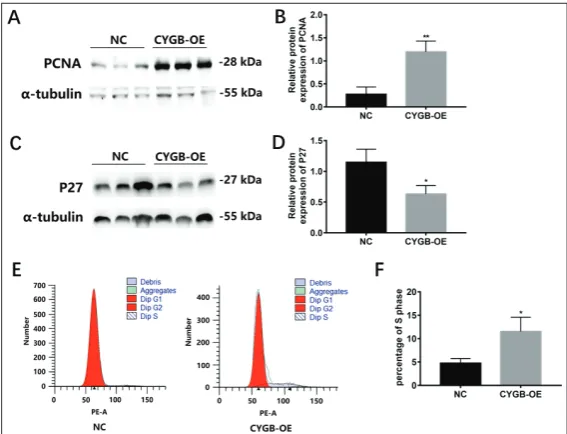
We found that PCNA, a key factor in DNA replication and cell cycle regula-tion in CYGB overexpressing VSMCs was 1.196±0.189 and 0.275±0.129 in controls (Fig. 4A, B). However, the level of cyclin-dependent kinase inhibitor 1B (p27), an inhibitor of the cyclin dependent kinase involved in the regulation of the cell cycle, was significantly decreased com-pared to control VSMCs; the expression of P27 in CYGB-overexpressing VSMCs was 0.633±0.110 and in controls it was 1.146±0.175 (Fig. 4C, D). The number of VSMCs overexpressing CYGB was 11.533±2.481 at the S phase, and in the controls it was 4.763±0.808 (Fig. 4E, F). These data indicate that overexpression of CYGB increased VSMC proliferation.
Overexpression of CYGB reduced expression of an ECM component
Collagen protein is an important compo-nent of the ECM. We tested the expression of Col Ia and Col VIII. As shown in Fig. 5, the level of Col Ia was 0.060±0.050 in CYGB-overexpressing VSMCs, and 0.307±0.073 in the controls (Fig. 5A, B). In contrast, the level of Col VIII was not significantly changed (Fig. 5C, D).
DISCUSSION
It was reported that the main pathologi-cal changes of hypertension are vascular reconstruction, VSMC proliferation, mi-gration and ECM deposition [22]. Reports on the function of CYGB in VSMCs are rare. Only a few studies have shown that in a rat balloon angioplasty model, de-creased expression of CYGB could prevent neointima formation. After complete ligation of the left common carotid, the CYGB knockout mice had no neointimal hyperplasia compared to wild-type mice [15]. Our study showed that CYGB was significantly decreased Fig. 5. The effect of CYGB overexpression on the expression of ECM components.
A, B – Reduced protein expression of Col Ia was calculated by Western blotting in VSMCs overexpressing CYGB; alpha tubulin was used as the loading control. C, D
– There was no significant difference of Col VIII expression between VSMCs over-expressing CYGB and control cells; alpha tubulin was used as the loading control.All data are expressed as the mean±SD from three independent experiments. *P<0.05.
in hypertensive rats compared to normotensive rats, thus we considered that CYGB may be involved in the pathogenesis of hypertension. To further study the effect of CYGB on VSMCs, CYGB-overexpressing cell lines were established by transfected lentivirus into VSMCs to explore the effect of CYGB on VSMCs.
The present study provides evidence for the molecu-lar basis of CYGB contribution to vascular remodeling. VSMC migration is critical in many physiological and pathological processes [23, 24]. Herein, we show that overexpression of CYGB provided faster migra-tion rates in the scratch monolayer cell wound assay compared to the control. We also found that VSMCs overexpressing CYGB had increased protein levels of MMP9, which enhanced the degradation of ECM and promoted cell migration. It has been reported that the increased MMP9 expression in arterial walls was associated with hypertension [25].
Interestingly, the role of CYGB on other cells is opposite. For example, overexpression of CYGB in murine fibroblasts reduces cell migration by inhibiting PI-3k/mTOR signal pathways [26], and ectopic expres-sion of CYGB inhibits the migration of breast cancer cells via downregulation of GLUT1 and HXK2 [27]. In contrast, the overexpression of CYGB augmented the migration of non-small cell lung cancer under hypoxia condition [28]. It appears that the effects of CYGB overexpression are cell-type specific.
VSMCs are the major cell type in normal arterial media. They have a low turnover and primarily per-form contractile functions to control vascular tone. In disease states, VSMCs switch from the contractile phenotype to a synthetic phenotype, which leads to increased proliferation, migration, deposition of ECM and decreased levels of contractile marker proteins [29, 30]. Calponin is a contractile marker of VSMCs. In previous studies, VSMCs with decreased calponin expression had increased proliferation, while increased expression of calponin correlated with decreased VSMC proliferation [31]. In our study, we found that calponin expression was increased in VSMCs that overexpressed CYGB as compared to parental VSMCs.
Thus, overexpression of CYGB in VSMCs promoted the expression of not only the cell differentiation markers such as calponin, but also of the proliferation markers such as PCNA, a key factor in DNA replication and
cell cycle regulation [32]. The mechanism to regulate the balance between differentiation and proliferation induced by the overexpression of CYGB in VSMCs remains to be elucidated.
Our results showed that not only PCNA [32], but P27, a cyclin-dependent kinase inhibitor, was decreased in CYGB-overexpressing VSMCs. The number of VS-MCs overexpressing CYGB was significantly increased at the S phase of cell division compared to controls. These data suggest that CYGB may be involved in the regulation of VSMC proliferation during the pheno-type switch. A previous study showed that the loss of CYGB prevented neointimal formation and caspase 3 activation after arterial injury [15]. Our study shows that CYGB was downregulated in the hypertensive rat, so we hypothesized that CYGB may have a protective effect and participate in feedback regulation in vivo [33].
Finally, CYGB is also involved in ECM remodeling. It is well established that CYGB modulates the expres-sion of ECM components in various tissues and cells via distinct signaling pathways. For instance, the expression of Col Ia was decreased in CYGB transgenic mice [34], and CYGB also inhibited the synthesis of collagen in immortalized kidney fibroblasts [16]. In human tendon fibroblasts, CYGB overexpression decreases the synthesis of the ECM [35]. We found that the level of Col Ia was significantly decreased in CYGB-overexpressing VS-MCs, suggesting that upregulation of CYGB in VSMCs suppresses the synthesis of Col1a. Taken together, our data indicate that CYGB plays an important role in the regulation of vascular remodeling, but the significance in physiology and pathology remains unclear and will need to be explored in future studies.
There are some limitations in this study. First, we only examined the effect of CYGB on the functions of VSMCs by the overexpression of CYGB, thus the effect of knockdown of CYGB in VSMCs remains unclear. Second, the effect of CYGB on VSMC function and vascular remodeling in hypertension was not exam-ined in in vivo experiments. These topics need to be further investigated.
CONCLUSION
Overexpression of CYGB promoted proliferation and migration of VSMCs and decreased Col1a. Ectopic expression of CYGB also modulated the expression of the VSMC phenotypic marker. The reason for this may be that CYGB plays a negative feedback regulation role in vivo. Due to its involvement in these processes, CYGB may have a potential role in the pathogenesis and vascular remodeling of hypertension.
Funding: This project was supported by the National Natural Science Foundation of China (31570949) and the Fengxian District Science and Technology Development Project of Shanghai (20151002).
Acknowledgments: The authors would like to thank all the reviewers who participated in the review and LetPub (www.letpub.com) for its linguistic assistance during the preparation of this manuscript.
Author contributions: All experiments were completed by Lei Li. Statistic analysis was performed with the help of Shen Li, Juanjuan Tan and Yingchun Qin. The revision of the paper was under the guidance of Mr. Xie. All experiments were performed under the guidance of Professor Zhiqiang Yan.
Conflict of interest disclosure: The authors have no conflict of interest.
REFERENCES
1. Lackland DT, Weber MA. Global burden of cardiovascular disease and stroke: hypertension at the core. Can J Cardiol. 2015;31(5):569-71.
2. Touyz RM, Alves-Lopes R, Rios FJ, Camargo LL, Anag-nostopoulou A, Arner A, Montezano AC. Vascular smooth muscle contraction in hypertension. Cardiovasc Res. 2018;114(4):529-39.
3. Schiffrin EL. Vascular remodeling in hypertension: mecha-nisms and treatment. Hypertension. 2012;59(2):367-74. 4. Savoia C, Burger D, Nishigaki N, Montezano A, Touyz RM.
Angiotensin II and the vascular phenotype in hypertension. Expert Rev Mol Med. 2011;13:e11.
5. Intengan HD, Schiffrin EL. Structure and mechanical prop-erties of resistance arteries in hypertension: role of adhesion molecules and extracellular matrix determinants. Hyperten-sion. 2000;36(3):312-8.
6. Montezano AC, Tsiropoulou S, Dulak-Lis M, Harvey A, Camargo Lde L, Touyz RM. Redox signaling, Nox5 and vas-cular remodeling in hypertension. Curr Opin Nephrol Hyper-tens. 2015;24(5):425-33.
7. Coll-Bonfill N, de la Cruz-Thea B, Pisano MV, Musri MM. Noncoding RNAs in smooth muscle cell homeostasis: impli-cations in phenotypic switch and vascular disorders. Pflugers Arch. 2016;468(6):1071-87.
8. Brown IAM, Diederich L, Good ME, DeLalio LJ, Murphy SA, Cortese-Krott MM, Hall JL, Le TH, Isakson BE. Vascular Smooth Muscle Remodeling in Conductive and Resistance
Arteries in Hypertension. Arterioscler Thromb Vasc Biol. 2018;38(9):1969-85.
9. Tuna BG, Bakker EN, VanBavel E. Smooth muscle biomechan-ics and plasticity: relevance for vascular calibre and remodel-ling. Basic Clin Pharmacol Toxicol. 2012;110(1):35-41. 10. Ma KT, Li XZ, Li L, Jiang XW, Chen XY, Liu WD, Zhao L,
Zhang ZS, Si JQ. Role of gap junctions in the contractile response to agonists in the mesenteric artery of spontane-ously hypertensive rats. Hypertens Res. 2014;37(2):110-5. 11. Kawada N, Kristensen DB, Asahina K, Nakatani K,
Min-amiyama Y, Seki S, Yoshizato K. Characterization of a stel-late cell activation-associated protein (STAP) with peroxi-dase activity found in rat hepatic stellate cells. J Biol Chem. 2001;276(27):25318-23.
12. Shigematsu A, Adachi Y, Matsubara J, Mukaide H, Koike-Kiriyama N, Minamino K, Shi M, Yanai S, Imamura M, Taketani S, Ikehara S. Analyses of expression of cytoglobin by immunohistochemical studies in human tissues. Hemo-globin. 2008;32(3):287-96.
13. Latina A, Viticchie G, Lena AM, Piro MC, Annicchiarico-Petruzzelli M, Melino G, Candi E. DeltaNp63 targets cyto-globin to inhibit oxidative stress-induced apoptosis in kera-tinocytes and lung cancer. Oncogene. 2016;35(12):1493-503. 14. Rowland LK, Campbell PS, Mavingire N, Wooten JV, McLean L, Zylstra D, Thorne G, Daly D, Boyle K, Whang S, Unter-naehrer J, Brantley EJ. Putative tumor suppressor cytoglo-bin promotes aryl hydrocarbon receptor ligand-mediated triple negative breast cancer cell death. J Cell Biochem. 2019;120(4):6004-14.
15. Jourd’heuil FL, Xu H, Reilly T, McKellar K, El Alaoui C, Step-pich J, Liu YF, Zhao W, Ginnan R, Conti D, Lopez-Soler R, Asif A, Keller RK, Schwarz JJ, Thanh Thuy LT, Kawada N, Long X, Singer HA, Jourd’heuil D. The Hemoglobin Homolog Cytoglobin in Smooth Muscle Inhibits Apoptosis and Regu-lates Vascular Remodeling. Arterioscler Thromb Vasc Biol. 2017;37(10):1944-55.
16. Nishi H, Inagi R, Kawada N, Yoshizato K, Mimura I, Fujita T, Nangaku M. Cytoglobin, a novel member of the globin fam-ily, protects kidney fibroblasts against oxidative stress under ischemic conditions. Am J Pathol. 2011;178(1):128-39. 17. Zhang S, Li X, Jourd’heuil FL, Qu S, Devejian N, Bennett E,
Jourd’heuil D, Cai C. Cytoglobin Promotes Cardiac Progeni-tor Cell Survival against Oxidative Stress via the Upregula-tion of the NFkappaB/iNOS Signal Pathway and Nitric Oxide Production. Sci Rep. 2017;7(1):10754.
18. Liu X, El-Mahdy MA, Boslett J, Varadharaj S, Hemann C, Abdelghany TM, Ismail RS, Little SC, Zhou D, Thuy LT, Kawada N, Zweier JL. Cytoglobin regulates blood pressure and vascular tone through nitric oxide metabolism in the vascular wall. Nat Commun. 2017;8:14807.
19. Lilly B, Dammeyer K, Marosis S, McCallinhart PE, Trask AJ, Lowe M, Sawant D. Endothelial cell-induced cytoglobin expression in vascular smooth muscle cells contributes to modulation of nitric oxide. Vascul Pharmacol. 2018;110:7-15. 20. Ray JL, Leach R, Herbert JM, Benson M. Isolation of vascular smooth muscle cells from a single murine aorta. Methods Cell Sci. 2001;23(4):185-8.
acetylated derivative on murine melanoma cells. Int J Mol Med. 2018;41(2):1048-54.
22. Alexander MR, Owens GK. Epigenetic control of smooth mus-cle cell differentiation and phenotypic switching in vascular development and disease. Annu Rev Physiol. 2012;74:13-40. 23. Chaulet H, Desgranges C, Renault MA, Dupuch F, Ezan G,
Peiretti F, Loirand G, Pacaud P, Gadeau AP. Extracellular nucleotides induce arterial smooth muscle cell migration via osteopontin. Circ Res. 2001;89(9):772-8.
24. Wang YT, Chen J, Li X, Umetani M, Chen Y, Li PL, Zhang Y. Contribution of transcription factor EB to adipoRon-induced inhibition of arterial smooth muscle cell pro-liferation and migration. Am J Physiol Cell Physiol. 2019;317(5):C1034-C47.
25. Castro MM, Rizzi E, Ceron CS, Guimaraes DA, Rodrigues GJ, Bendhack LM, Gerlach RF, Tanus-Santos JE. Doxycycline ameliorates 2K-1C hypertension-induced vascular dysfunc-tion in rats by attenuating oxidative stress and improving nitric oxide bioavailability. Nitric Oxide. 2012;26(3):162-8. 26. Demirci S, Dogan A, Apdik H, Tuysuz EC, Gulluoglu S,
Bayrak OF, Sahin F. Cytoglobin inhibits migration through PI3K/AKT/mTOR pathway in fibroblast cells. Mol Cell Bio-chem. 2018;437(1-2):133-42.
27. Feng Y, Wu M, Li S, He X, Tang J, Peng W, Zeng B, Deng C, Ren G, Xiang T. The epigenetically downregulated factor CYGB suppresses breast cancer through inhibition of glucose metabolism. J Exp Clin Cancer Res. 2018;37(1):313. 28. Oleksiewicz U, Liloglou T, Tasopoulou KM, Daskoulidou N,
Bryan J, Gosney JR, Field JK, Xinarianos G. Cytoglobin has
bimodal: tumour suppressor and oncogene functions in lung cancer cell lines. Hum Mol Genet. 2013;22(16):3207-17. 29. Owens GK, Kumar MS, Wamhoff BR. Molecular regulation
of vascular smooth muscle cell differentiation in development and disease. Physiol Rev. 2004;84(3):767-801.
30. Bennett MR, Sinha S, Owens GK. Vascular Smooth Muscle Cells in Atherosclerosis. Circ Res. 2016;118(4):692-702. 31. Zhang Y-n, Xie B-d, Sun L, Chen W, Jiang S-L, Liu W, Bian
F, Tian H, Li R-K. Phenotypic switching of vascular smooth muscle cells in the ‘normal region’ of aorta from atheroscle-rosis patients is regulated bymiR-145. Journal of Cellular and Molecular Medicine. 2016;20(6):1049-61.
32. Strzalka W, Ziemienowicz A. Proliferating cell nuclear anti-gen (PCNA): a key factor in DNA replication and cell cycle regulation. Ann Bot. 2011;107(7):1127-40.
33. Liu Y, Zhang J, Yi B, Chen M, Qi J, Yin Y, Lu X, Jasmin JF, Sun J. Nur77 suppresses pulmonary artery smooth muscle cell proliferation through inhibition of the STAT3/Pim-1/NFAT pathway. Am J Respir Cell Mol Biol. 2014;50(2):379-88. 34. Thi Thanh Hai N, Thuy LTT, Shiota A, Kadono C, Daikoku
A, Hoang DV, Dat NQ, Sato-Matsubara M, Yoshizato K, Kawada N. Selective overexpression of cytoglobin in stellate cells attenuates thioacetamide-induced liver fibrosis in mice. Sci Rep. 2018;8(1):17860.