© 2020 by the Serbian Biological Society How to cite this article: lić Milošević MM, Petrović-Obradović OT, Stanković 53 SS, Lazarević MJ, Trajković AD, Tomanović ŽM, Žikić VA. Estimation of the
competitiveness of Ephedrus plagiator in relation to other parasitoids from the subfamily Aphidiinae. Arch Biol Sci. 2020;72(1):53-61.
Estimation of the competitiveness of
Ephedrus plagiator
in relation to other parasitoids
from the subfamily Aphidiinae
Marijana M. Ilić Milošević1,*, Olivera T. Petrović-Obradović2, Saša S. Stanković1, Maja J. Lazarević1, Aleksandra
D. Trajković1, Željko M. Tomanović3 and Vladimir A. Žikić1
1Department of Biology and Ecology, Faculty of Science and Mathematics, University of Niš, Višegradska 33, Niš, Serbia 2Institute for Phytomedicine, Faculty of Agriculture, University of Belgrade, Nemanjina 6, Belgrade, Zemun, Serbia 3Institute of Zoology, Faculty of Biology, University of Belgrade, Studentski trg 16, Belgrade, Serbia
*Corresponding author: [email protected]
Received: September 23, 2019; Revised: November 4, 2019; Accepted: November 6, 2019; Published online: December 18, 2019
Abstract: The parasitoid species Ephedrus plagiator (Nees, 1811) (Hymenoptera: Aphidiinae) is one of the most important biological agents against pest aphids. We investigated whether this species was in competition with some other aphidiine species for the same hosts. We thus examined its potential in biological programs to control aphids. We applied an unsu-pervised artificial neural network, a self-organizing map (SOM), which classified the competitive parasitoids into seven groups. The SOM also visualized the distributional pattern of 31 parasitoid wasps along the neural network, revealing their competitive ability in relation to E. plagiator. Indicator value (IndVal) analysis quantified the competitive ability and showed that the most competitive species with regard to E. plagiator were Lysiphlebus testaceipes (Cresson, 1880), L. fabarum
(Marshall 1896), L. cardui (Marshall 1896) and Binodoxys angelicae (Haliday, 1833). These species appeared in four different SOM groups and mostly parasitized the Aphis fabae Scopoli, 1763 (Hemiptera: Aphididae) host.
Keywords: Braconidae; Aphididae; competitive species; trophic association; self-organizing map (SOM)
INTRODUCTION
Parasitoid wasps from the subfamily Aphidiinae (Hy-menoptera: Braconidae) are solitary endoparasitoids of aphids [1]. Over 400 species have been registered worldwide [2,3]. One of the largest genera from this
subfamily is Ephedrus Haliday, 1833, with about 55
described species worldwide [4]. Ephedrus plagiator
(Nees, 1811), as a natural enemy of pest aphids, plays an important role in biological control programs, and the parasitoid has been selected for commercial pro-duction by some companies. It has been well studied in many aspects of its morphology [5], as well as its
biology and ecology [6,7] and phylogeny [8,9]. E.
pla-gator is involved in tritrophic associations with vari-ous aphid species and numervari-ous host plants [10,11]. This parasitoid attacks more than 120 aphid species,
predominantly from the genera Aphis Linnaeus, 1758,
Macrosiphum Passerini, 1860and Myzus Passerini,
1860[11-13]. In addition, Žikić et al. (14) presented
even wider host range of E plagiator, which attacks
167 species from 51 genera belonging to seven aphid subfamilies. Its host range often overlaps with other
polyphagous parasitoids such as Aphidius ervi Haliday,
1834, A. matricariae Haliday, 1834, E. persicae
Frog-gatt, 1904, Lysiphlebus fabarum (Marshall 1896), L.
testaceipes (Cresson, 1880) and Praon volucre
(Hali-day, 1833)[14]. In addition to the Palaearctic region,
E. plagiator also inhabits the Nearctic and Oriental regions. It was introduced in Brazil to control wheat
aphids [15]. Also, E. plagiator was introduced from
Ja-pan via Australia to New Zealand to control
Acyrthosi-phon kondoi Shinji, 1938, and A. pisum (Harris, 1776) [16]. Together with six other parasitoid species, three from the subfamily Aphelininae (Hymenoptera:
Aph-elinidae) and three from the subfamily Aphidiinae, E.
plagiator was released in eastern Colorado (USA). The purpose of its introduction was to decrease the
num-ber of Russian wheat aphid species, Diuraphis noxia
species from southwestern Asia [17]. Together with
nine other parasitoids, E. plagiator was introduced in
Chile on two occasions to control three aphid species:
D. noxia, Metopolophium dirhodum (Walker, 1849) and Sitobion avenae (Fabricius, 1775) [18]. In
addi-tion, Rakhshani et al. [19] showed that E. plagiator
prefers cereal aphids as its hosts at lower altitudes, while Singh et al. [20] showed that this parasitoid has a broader altitudinal distribution ranging from 601 to
1801 m a.s.l. According to the habitat type, E.
plagia-tor spreads over different types of forests (coniferous,
deciduous or mixed), parks, gardens and urban areas (cities and villages), as well as crops [21].
Since E. plagiator is usually characterized as being
broadly oligophagous [22] and also as a polyphagous parasitoid [14], it has the opportunity to come into contact with various parasitoids, particularly with other aphidiine species. Consequently, these
poten-tially competitive parasitoids of E. plagiator share
many common hosts. These interactions have been confirmed in previous studies [12,13]. Unlike most predators, parasitoids usually have narrow or limited host ranges, so contact between them leads to compe-tition [23]. However, knowledge of the autecology of
E. plagiator is quite limited, especially information on its competitive ability, defined as the ability of one spe-cies to exclude another [24], which is the main con-straint to the successful implementation of this species in biocontrol programs. Having all this in mind, the central aim of the present study was to determine how
powerful E. plagiator is as a parasitoid in
competi-tion with other Aphidiinae species. To estimate the
competitive ability of E. plagiator, an artificial neural
network modelled all of the trophic associations in
which E. plagiator was directly or indirectly (via its
aphid host) involved.
MATERIALS AND METHODS Study area and sampling
In this analysis we used material of world Aphidiinae fauna that was sampled from 1989 to 2018. The ter-ritories investigated belong to the following geograph-ical regions: Afrotropgeograph-ical (Algeria, Libya), Nearctic (USA), Neotropical (Chile, Costa Rica), Oriental (In-dia), Eastern Palaearctic (China, Iran, Russia, Turkey)
and Western Palaearctic (Austria, Belgium, Bulgaria, Croatia, Czech Republic, France, Germany, Greece, Lithuania, Malta, Montenegro, North Macedonia, Po-land, Serbia, Slovenia, Spain, Sweden, SwitzerPo-land, Wales). Together with plant parts, live and mummified aphids were placed in plastic containers covered with muslin cloth and transferred to the laboratory where they were kept in a growth cabinet until emergence of the parasitoids. In order to identify the host aphids, several live adults were placed in small plastic tubes filled with 75% ethyl-alcohol.
The parasitoids were deposited in the collection of the Faculty of Biology, Institute of Zoology, University of Belgrade, Serbia. Aphid samples were deposited in the collection belonging to the Faculty of Agriculture, Institute for Phytomedicine, University of Belgrade, Serbia. Plant vouchers were deposited at the Faculty of Sciences and Mathematics, Department of Biology and Ecology, University of Niš, Serbia. The nomenclature of aphids followed Remaudière and Remaudière [25].
Data analysis
For this analysis we constructed a data matrix based
on the trophic associations established between E.
pla-giator and aphid hosts found in the samples. We also analyzed the samples with the same aphid hosts when
there was no occurrence of E. plagiator and we found
other parasitoids from the subfamily Aphidiinae. In Supplementary Table S1, each row of the data matrix represents one field sample. The sample contains one aphid species and all parasitoid specimens detected therein (one to several). Out of 560 samples, 15
con-tained aphids attacked only by E. plagiator. Moreover,
in 55 samples, E. plagiator was found together with
one or more other parasitoid species (maximum 4). Finally, 490 samples encompassed only aphids and
potential E. plagiator competitors.
To estimate the competitive ability of parasitoid
sets. As its output, this method ordinates and classi-fies the samples in a 2-dimentional neural network. ANNs have already been applied in many aspects of ecological studies: for clustering, classification, esti-mation, prediction, and data mining at different eco-logical levels [27-44]. Since the data set in the present study is multivariate, large and nonlinear, and as the abundance of many parasitic species broadly varies over different samples (aphids), the SOM method is a suitable approach for testing the main hypothesis and describing the complex interactions within the trophic associations.
The SOM is composed of two layers, an input and an output, each consisting of processing units, neu-rons. The construction of the input layer depends on the input matrix, which in our study was composed of 32 species of parasitic wasps (given in columns, Supplementary Table S1) and 560 samples of aphid hosts (given in rows, Supplementary Table S1). Before engaging the SOM in the training process, the data, showing parasitoid abundances, were log-transformed and then normalized and scaled from 0 to 1. During the training process, all samples (in our case, aphids) go through the network successively, being attached to a particular neuron (best matching unit; BMU) from the SOM. This is done by comparing the input pat-tern of the data matrix with each of the SOM neurons, using Euclidean distance as the criterion. All samples from the same neuron have a similar model of data (in our case, a similar suite of parasitic wasps). As the distance between the neurons on the map increases, the similarity of the patterns that these neurons carry decreases. Once the samples (aphids) have been at-tached to the appropriate neuron, the training process is completed. The k-means method [45] was applied for grouping the neurons that carry similar informa-tion (model of trophic associainforma-tions).
The size of the output layer (2-dimensional neural network) is very important for achieving a reliable in-terpretation of the results, since the wrong resolution of a 2-dimensional network can bias the variability models of the data. If the network is too small (with an insufficient number of neurons), some important vari-ability data patterns can be concealed. On the other hand, if the network is too large (with many neurons without assigned samples), the differences in the or-dinational patterns will increase and, consequently,
plausible interpretation of the results will be more
dif-ficult. Therefore, we determined the map resolution a
priori, using the appropriate methods [46,38]. In the first method, 5√n is the optimal number of neurons
in the map, where n is the number of training samples
[46]. In the second method, proposed by Park et al. [38], the size of the neural network is set by follow-ing the local minimum quantization error (QE) and topographic error (TE). Using these two approaches and trying to avoid a large number of empty neurons in the map [47], we determined the resolution of 10X9 neurons to be the most appropriate for our study.
The component plane technique was applied in order to define the competitive ability of each para-sitoid species from the SOM model [42]. This method visualizes the distributional model of each of the para-sitoid wasps across all ordinated samples (aphids) on the trained neural network. The distribution of each parasitoid species is presented through a gradient of greyness in which shades of black indicate their high abundance in particular samples (aphids). The SOM analysis does not provide any statistical indications on species responsible for the SOM groups, and so the IndVal of the indicator species was used to quantify the competitive ability of the parasitoid species [48]. If a parasitoid species appeared in a particular group of aphids (samples) defined by the SOM, with a relative frequency and abundance of at least 50%, that para-sitoid species was determined as the representative of that group, with an IndVal greater than 25% and p<0.05. If a species still appears significantly only in a single SOM group (p<0.05) but sporadically with low frequency, its IndVal will be lower than 25% and such species will be considered as a rare taxon in the sample. In this study, all parasitoid species,
representa-tive of SOM groups where E. plagiator presence was
not recorded and with IndVal≥25% were considered
as potential competitors of E. plagiator.
RESULTS
their competitive preferences. Following the degree of overlap in the distribution of aphidiine species, the IndVal method listed 32 parasitoid species and
quanti-fied their competitive ability. Besides E. plagiator, of
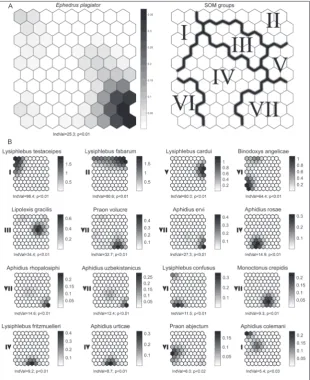
the 31 parasitoid species analyzed here, 16 showed statistically significant differences (p<0.05) (Fig. 2B). Nevertheless, only five of them could be considered
as potential competitors of E. plagiator, since their
IndVals exceeded 25% and their distributional
pat-terns did not overlap with that of E. plagiator over the
SOM. Two species, Praon volucre and Aphidius ervi,
showed IndVals>25% and had the same distributional
pattern over the SOM as E. plagiator (Fig. 2B). Species
with an IndVal lower than 25% and p<0.05 appeared sporadically in particular SOM groups as rare taxa with a restricted distribution and consequently low competitive ability (Fig 2B).
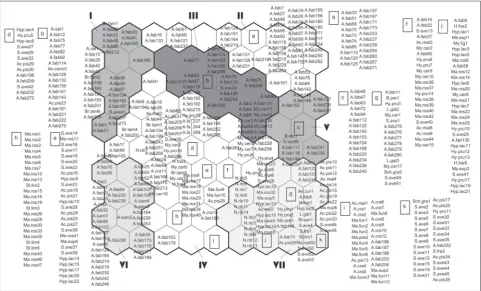
In SOM group I, the aphid host Aphis fabae was
dominant, while three other species (A. clematidis
Koch, 1854, Brachyunguis tamaricis (Lichtenstein,
1885) and S. avenae) were registered with fewer
samples in the group. All these hosts were
parasit-ized by A. colemani Viereck, 1912 and L. testaceipes
parasitoids, whereby L. testaceipes was
character-ized as the most powerful competitor to E plagiator
with IndVal=98.4 and p<0.01 (Fig. 2B). In addition,
SOM group II encompassed only the species A.
fa-bae, which was parasitized by L. fabarum. For this
parasitoid the SOM distribution pattern revealed its competitive preferences (IndVal=80.6; p<0.01). The
species Lipolexis gracilis Förster, 1862, which belongs
to SOM group III, significantly attacked aphids A.
fa-bae and Myzus cerasi (Fabricius, 1775) (IndVal=34.4;
p<0.01). There was also a low frequency (13%) of six other hosts in SOM group III (Fig. 1). In addition,
the parasitoid L. cardui attacked A. fabae and
Brachy-caudus sp., and is the representative (IndVal=80;
p<0.01) of SOM group V. The species A. fabae was
also dominant in SOM group VI, and was
parasit-ized by three species: Binodoxys angelicae, L.
confu-sus Tremblay & Eady, 1978and P. abjectum (Haliday,
1833). Among them, B. angelicae was dominant with
from group VI (IndVal=64.4, p<0.01). SOM group VII included a large number of aphid and parasitoid spe-cies. The most dominant hosts from this group were
S. avenae, A. fabae, A. pisum, Nasonovia ribisnigri
(Mosley, 1841), Macrosiphum rosae (Linnaeus, 1758)
and Hyalopterus pruni (Geoffroy, 1762). These species were parasitized by 11 parasitoids, three of which were
significant: P. volucre (IndVal=32.7; p<0.01), A. ervi
(IndVal=27.3; p<0.01) and E. plagiator (IndVal=25.3;
p<0.01) (Fig. 2A,B). Finally, group IV was composed of 16 aphid hosts and no significant parasitoid rep-resentatives (IndVal; p>0.05). The dominant aphids
in this SOM group were A. fabae, M. rosae, S. avenae,
A. craccae Linnaeus, 1758, M. fu-nestum (Macchiati, 1885) and A. pisum with 145 recorded samples, while the rest appeared with fewer than nine samples per host species.
DISCUSSION
According to the SOM distribu-tion, the native Palaearctic species
E. plagiator falls into group VII. The SOM showed that its primary hosts are S. avenae, A. fabae and A. pisum. In the same SOM group, E. plagiator shares these hosts with A. ervi (E. plagiator IndVal=25.3%, A.
ervi IndVal=27.3). There is some
evidence that these two parasit-oid species attack the same host,
e.g. A. pisum, and that E. plagiator
successfully competes with A. ervi
[49]. The same authorrevealed
that during the act of oviposition
most Ephedrus species kill
Aphid-ius Nees, 1818 embryos in the host
body using venom which they in-sert into the host. This strategy
makes E.plagiator a more
success-ful competitor in relation to A ervi.
This information is very important
since the pea aphid, A. pisum, is
specialized to feed on and trans-mit viruses to about 20 plant gen-era from the family Fabaceae, e.g.,
Trifolium L., Lotus L., Melilotus Mill. and Dorycnium
Mill. [50], and it is an extremely destructive pest in alfalfa fields. However, in the present study, it seems that these two parasitoid species can coexist, being recorded in the same samples and sharing the same hosts. This may be explained by the fact that aphid parasitoids can be polyphagous, with a wide host range. In addition to the two parasitoids mentioned
above, the parasitoid range of A. pisum includes A.
eadyi Stary, Gonzalez & Hall, 1980, A. banksae
(Kit-tel, 2016), A. smithii Sharma & Subba Rao, 1959 and
several other species from the genera Ephedrus and
Praon Haliday, 1833 [12,51]. Fig. 2. Distributional patterns of IndVal taxa (with p<0.05) across SOM groups revealing
Another frequently present parasitoid in SOM
group VII is P. volucre. It appears to be a weak
com-petitor of the first two parasitoids for S. avenae, A.
fabae and A. pisum, since the results show that P. vo-lucre predominantly parasitizes Hyperomyzus lactucae
(Linnaeus, 1758) and M. rosae. The rose aphid, M.
rosae, is the main host for A. rosae Haliday, 1834, but according to our results there is no strong
competi-tion between P. volucre and E. plagiator with A. rosae.
With an IndVal of 98.4%, from SOM group I the
parasitoid L. testaceipes appears to be the most
im-portant competitor for E. plagiator. The species L.
testaceipes was introduced in Europe (France) from
Cuba in 1973 [52] as a biological agent against
Toxop-tera aurantii (Boyer de Fonscolombe 1841) and A. spiraecola Patch 1914, which attack citrus fruit. For a relatively short period, it was established through the
whole Mediterranean. The situation where L.
testa-ceipes suppressed the native aphidiine species in new areas, albeit they were polyphagous, such as the native
E. plagiator in the Palaearctic, has led to the concern
of some braconologists [53,54]. For example, when L.
testaceipes was registered for the first time in Serbia in 2013, which is part of continental Europe, it was identified in 21 trophic associations encompassing 17 host plants and 16 aphid species [54]. Analyzing the neurons on the SOM map it seems most likely that the
main reason for the competition between E. plagiator
and L. testaceipes is their common host, A. fabae. The
second target aphid species for both parasitoids is B.
tamaricis. This is a specialized aphid from the
fam-ily Tamaricaceae, such as Tamarix africana Poir., T.
canariensis Willd., T. gallica L., and T. tetrandra Pall
ex M. Bieb.[55]. In spite of the fact that L. testaceipes
has overlapping host ranges with E. plagiator, which
was introduced and spread in other zoogeographic regions, there are no reports regarding their competi-tive relations.
Two other important competitors come from the
genus Lysiphlebus: L. fabarum and L. cardui. These two
species are morphologically and genetically very close,
belonging to the same “fabarum” complex of species
[56]. After L. testaceipes, the species L. fabarum
(Ind-Val=80.6) from SOM group II appeared as a second,
very strong competitor of E. plagiator. It is also
no-table that L. cardui (IndVal=80.0) is the key
competi-tor from SOM group V. Both Lysiphlebus species, L.
fabarum and L. cardui,are significant competitors of
E. plagiator since they appear in three different SOM groups. Also, there is strong competitive relationship
between L. fabarum and L cardui. Together with L.
testaceipes, the Lysiphlebus species from the “fabarum”
complex share the same aphid host, A. fabae. The
black bean aphid, A. fabae is the most common and
the most investigated aphid species. It is an extremely polyphagous pest on various crops and weeds [57,58].
A. fabae is also a suitable host for several other
Aphi-diinae parasitoids: A. colemani, A. matricariae, B.
acalephae (Marshall, 1896), B. angelicae, E. persicae, E. nacheri Quilis Perez, 1934, L. gracilis, L. confusus, P. abjectum and P. volucre [12,13]. Since E. plagiator,
L. fabarum, L. cardui and L. testaceipes appeared in four different SOM groups, the results confirm that direct competition is one of the factors responsible for decoupling these wasps in the same type of trophic associations.
B.angelicae, also parasitizes A. fabae to a great
extent. It is also recorded in A. sambuci Linnaeus,
1758, a specialized aphid of the black elder. B.
angeli-cae is highlighted as an important species from SOM
group VI with an IndVal of 64.4%. This parasitoid has a very broad host range [14], mostly attacking
vari-ous species from the genus Aphis, then Brachycaudus
van der Goot, 1913, Dysaphis Börner, 1931, Lipaphis
Mordvilko, 1928, Myzus, Ovatus van der Goot, 1913,
Toxoptera Koch, 1856 or Uhlmannia Börner, 1952 [12]. As mentioned, besides four species from the
genus Lysiphlebus, B. angelicae also competes with E.
plagiator for the same host, A. fabae. It is
interest-ing that B. angelicae tolerates several other
aphidi-ines from SOM group VI (primarily L. confusus and
P. abjectum), sharing the same hosts at the same time.
Lipolexis gracilis is the only species that has a sig-nificant role as a competitor from SOM group III, with
IndVal 34.4%. This species parasitizes A. fabae and M.
cerasi. There is great doubt as to whether L. gracilis
should be considered as a complex of species. A de-tailed investigation will explain how many species are
actually within the L. gracilis complex. Potentialcryptic
species hidden in this complex will probably refute the traditional statement that it is a polyphagous species.
Regarding the aphid host distribution on the
spe-cies is cosmopolitan, being the most frequent in the
samples in this study. The parasitoid range of A. fabae
is 14 out of 32 species. The SOM map shows that A.
fabae is the only host in SOM group II, and that it is
99% present in group V, putting L. fabarum and L.
cardui in direct competition. Here we can conclude that these two phylogenetically very close species ex-clude each other when they are in the same trophic
association. In the largest SOM group, IV, A. fabae
shares these neurons with the rose aphid, M. rosae, in
a mutual ratio of about 50:50%. M. rosae is a
cosmo-politan aphid that attacks many species from the genus
Rosa L., Dipsacus L., Ilex L., Knautia L., Scabiosa L., Valeriana L.[59]. M. rosae can also be found in SOM group VII, where it has a low distribution. This SOM group has a high presence of the currant-lettuce aphid
N. ribisnigri. The primary hosts for this aphid come
from the genus Ribes L., but also many species from
the family Asteraceae (Cichorium L., Crepis L.,
Hiera-cium L., Lapsana L. and Leontodon L.),
Orobancha-ceae (Euphrasia L.), Plantaginaceae (Veronica L.) and
Solanaceae (Nicotiana L. and Petunia Juss.) [60].
The English grain aphid S. avenae occupies
sev-eral neurons in SOM group VII and it is sporadically present in SOM group IV. However, the SOM analysis showed that this aphid is not the host over which 4
parasitoids, E. plagiator, P. volucre and two
phyloge-netically sibling species, A.rhopalosiphi and A.
uz-bekistanicus, compete.
Generally, as a polyphagous species, three
para-sitoids of Lysiphlebus – L. testaceipes, L. fabarum and
L. cardui – together with B. angelicae, are the most
powerful competitors of E. plagiator in this analysis,
establishing the highest number of tritrophic asso-ciations. Since they all appear in four different SOM
groups (I, II, V and VI), and E. plagiator is from group
VII, they are frequently found alone in the samples,
somehow not allowing E. plagiator to oviposit or
de-velop in aphid colonies.
Finally, E. plagiator, as a native Palaearctic species
that has been successively introduced worldwide, has artificially become a cosmopolitan species. However, due to its wide geographical distribution, the study area is also wide, including samples from 29 countries. This fact partly influences the results since some of the parasitoid species with limited areal of distribution
have poor chances to compete directly with E.
plagia-tor in trophic associations. Nevertheless, the statistical
design used here substantially diminished the influ-ence of such species on the main SOM model. More precisely, parasitic wasps with IndVal<25 appeared in only a few samples. In this specific case, such taxa have limited geographic distribution, which leveled off their frequency and consequently decreased their IndVal score [42]. Moreover, since these taxa could not significantly affect the main trends in the SOM model, they were not considered in further analyses of the study. However, in order to completely eliminate this effect from the model, the next step in
investigat-ing the competitive ability of E plagiator should be
to include the spatial dimension in the SOM model.
Funding: This study was supported by the Ministry of Educa-tion, Science, and Technological Development of the Republic of Serbia, Grant III43001.
Acknowledgments: We wish to thank Dr. Đurađ Milošević (De-partment of Biology and Ecology, Faculty of Science and Math-ematics, University of Niš, Serbia) for his help in data processing.
Author contributions: All authors were involved in data collec-tion. MIM and VŽ designed the study and wrote the manuscript. OPO, SSS, ŽT contributed to the discussion of the results and revised the manuscript. ML, AT prepared the data for statistical analysis.
Conflict of interest disclosure: The authors declare no conflict of interest.
REFERENCES
1. Starý P. Biology of aphid parasites (Hymenoptera: Aphidiidae) with respect to integrated control. J Pest Sci. 1969;42(12):190. 2. Starý P. Aphidiidae. In: Minks AK, Harrewijn P, editors.
Aphids, their biology, natural enemies and control. Vol. 2B. Amsterdam: Elsevier; 1998. p. 171-84.
3. Dolphin K, Quicke DLJ. Estimating the global species rich-ness of an incompletely described taxon: an example using parasitoid wasps (Hymenoptera: Braconidae). Biol J Linn Soc. 2001;73:279-86.
4. Yu DSK, Achterberg C van, Horstmann K. Taxapad 2012, Ich-neumonoidea 2011. [DVD]. Canada, Ottawa, Ontario; 2012. 1 DVD: color, 4 3/4 in.
6. Jackson HB, Rogers CE, Eikenbary RD, Starks KJ, Mcnew W. Biology of Ephedrus plagiator on different aphid hosts and at various temperatures. Environ Entomol. 1974;3:618-20. 7. Tomanović Ž, Petrović A, Starý P, Kavallieratos NG, Žikić V,
Rakhshani E. Ephedrus Haliday (Hymenoptera: Braconidae: Aphidiinae) in Serbia and Montenegro: tritrophic associa-tions and key. Acta Entomol Serb. 2009;14:39-53.
8. Belshaw R, Quicke DLJ. A molecular phylogeny of the Aphi-diinae (Hymenoptera: Braconidae). Mol Phylogenet Evol. 1997;7:281-93.
9. Derocles SAP, Plantegenest M, Rasplus J, Marie A, Evans DM, Lunt DH, Ralec AL. Are generalist Aphidiinae (Hym. Braconidae) mostly cryptic species complexes? Syst Entomol. 2015;41:379-91.
10. Gärdenfors U. Taxonomic and biological revision of Palaearc-tic Ephedrus Haliday (Hymenoptera: Braconidae: Aphi-diinae). Entomol Scand Suppl. 1986;27:1-95.
11. Rakhshani E, Barahoei H, Ahmad Z, Starý P, Ghafouri-Moghaddam M, Mehrparvar M, Kavallieratos NG, Čkrkić J, Tomanović Ž. Review of Aphidiinae parasitoids (Hymenop-tera: Braconidae) of the Middle East and North Africa: key to species and host associations. Eur J Taxon. 2019;552:1-132. 12. Kavallieratos NG, Tomanović Ž, Starý P, Athanassiou CG,
Sarlis GP, Petrović O, Niketić M, Veroniki MA. A survey of aphid parasitoids (Hymenoptera: Braconidae: Aphidiinae) of Southeastern Europe and their aphid–plant associations. Appl Entomol Zool. 2004;39:527-63.
13. Žikić V, Ilić Milošević M, Stanković S, Petrović A, Petrović-Obradović O, Kavallieratos N, Starý P, Tomanović Ž. Aphidiinae (Hymenoptera: Braconidae) of Serbia and Montenegro—tritrophic interactions. Acta Entomol Serb. 2012;17:83-105.
14. Žikić V, Lazarević M, Milošević D. Host range patterning of parasitoid wasps Aphidiinae (Hymenoptera: Braconidae). Zool Anz. 2017;268:75-83.
15. Starý P, Sampaio MV, Bueno VHP. Aphid parasitoids (Hyme-noptera, Braconidae, Aphidiinae) and their associations related to biological control in Brazil. Rev Bras entomol. 2007;51:107-18.
16. Cameron PJ, Thomas WP, Hill RL. Introduction of lucerne aphid parasites and a preliminary evaluation of the natural enemies of Acyrthosiphon spp. (Hemiptera: Aphididae) in New Zealand. In: Crosby TK, Pottinger RP, editors. Proceed-ings of the 2nd Australasian conference on grassland inver-tebrate ecology; 1978 May 22-26; Palmerston North, New Zeland. Wellington, N.Z.: Govt. Printer; 1980. 219-23 p. 17. Burd J, Shufran K, Elliot NC, French BW, Prokrym DA.
Recovery of imported hymenopterous parasitoids released to control Russian wheat aphids (Homoptera: Aphididae) in Colorado. Southwest Entomol. 2001;26:23-30.
18. Starý P. The fate of released parasitoids (Hymenoptera: Braco-nidae, Aphidiinae) for biological control of aphids in Chile. Bull Entomol Res. 1993;83:633-39.
19. Rakhshani E, Tomanović Ž, Starý P, Talebi AA, Kavallieratos NG, Zamani AA, Stamenković S. Distribution and diversity of wheat aphid parasitoids (Hymenoptera: Braconidae: Aphi-diinae) in Iran. Eur J Entomol. 2008;105:863-70.
20. Singh PM, Devjani P, Devikarani KH, Singh TK. Biodiversity, Distribution and Host Range of the Genus Ephedrus Haliday
(Hymenoptera: Aphidiidae) in Manipur, N.E. India. J Exp Sci. 2011;2:24-6.
21. Starý P, Havelka L. Fauna and associations of aphid parasit-oids in an up-dated farmland area (Czech Republic). B Insec-tol. 2008;61:251-76.
22. Starý P. On the strategy, tactics and trends of host specificity evolution in aphid parasitoids (Hymenoptera, Aphidiidae). Acta Entomol Bohemoslov. 1981;78:65-75.
23. Harvey JA, Poelman EH, Tanaka T. Intrinsic inter- and intra-specific competition in parasitoid wasps. Annu Rev Entomol. 2013;58:333-51.
24. Hart S.P, Freckleton RP, Levine JM. How to quantify competi-tive ability. J Ecol. 2018;106(5):1902-9.
25. Remaudière G, Remaudière M. Catalogue des Aphididae du monde – Catalogue of the world’s Aphididae: Homoptera Aphidoidea. Paris: Nantes; 1997. 473 p.
26. Kohonen T. Self-organized formation of topologically correct feature maps. Biol Cybern. 1982;43:59-69.
27. Lek S, Delacoste M, Baran P, Dimopoulos I, Lauga J, Aulag-nier S. Application of neural networks to modelling nonlinear relationships in ecology. Ecol Model. 1996;90:39-52. 28. Tuma A, Haasis HD, Rentz O. A comparison of fuzzy expert
systems, neural networks and neuro-fuzzy approaches con-trolling energy and material flows. Ecol Model. 1996;85:93-8. 29. Tan SS, Smeins FE. Predicting grassland community changes with an artificial neural network model. Ecol Model. 1996;84:91-7.
30. Chon TS, Park YS, Moon KH, Cha EY. Patternizing com-munities by using an artificial neural network. Ecol Model. 1996;90:69-78.
31. Chon TS, Park YS, Park JH. Determining temporal pattern of community dynamics by using unsupervised learning algo-rithms. Ecol Model. 2000;132:151-66.
32. Levine ER, Kimes DS, Sigillito VG. Classifying soil structure using neural networks. Ecol Model. 1996;92:101-8.
33. Recknagel F, French M, Harkonenen P, Yabunaka KL. Arti-ficial neural network approach for modelling and prediction of algal blooms. Ecol Model. 1997;96:11-28.
34. Paruelo JM, Tomasel F. Prediction of functional characteris-tics of ecosystems: a comparison of artificial neural networks and regression models. Ecol Model. 1997;98:173-86. 35. Özesmi S, Özesmi U. An artificial neural network approach to
spatial habitat modelling with interspecific interaction. Ecol Model. 1999;116:15-31.
36. Lek S, Guégan JF. Artificial neural networks as a tool in ecologi-cal modelling, an introduction. Ecol Model. 1999;120:65-73. 37. Lek S, Guégan JF. Artificial Neuronal Networks: Application
to Ecology and Evolution. Berlin: Springer; 2000. 248 p. 38. Park YS, Céréghino R, Compin A, Lek S. Applications of
artificial neural networks for patterning and predicting aquatic insect species richness in running waters. Ecol Model. 2003;160:265-80.
39. Park YS, Chon TS, Kwak IS, Lek S. Hierarchical community classification and assessment of aquatic ecosystems using arti-ficial neural networks. Sci Total Environ. 2004;327:105-22. 40. Verdonschot PFM. Macroinvertebrate community
41. Chon TS. Self-organizing maps applied to ecological sciences. Ecol Inform. 2011;6:50-61.
42. Milošević D, Simić V, Stojković M, Čerba D, Mančev D, Petrović A, Paunović M. Spatio-temporal pattern of the Chi-ronomidae community: toward the use of non-biting midges in bioassessment programs. Aquat Ecol. 2013;47:37-55. 43. Milošević D, Mančev D, Čerba D, Stojković Piperac M,
Popović N, Atanacković A, Đuknić J, Simić V, Paunović M. The potential of chironomid larvae-based metrics in the bioassessment of non-wadeable rivers. Sci Total Environ. 2018;616-617:472-9.
44. Milošević D, Stojanović K, Đurđević A, Marković Z, Stojković Piperac M, Živić M, Živić I. The response of chironomid tax-onomy- and functional trait-based metrics to fish farm efflu-ent pollution in lotic systems. Environ Pollut. 2018;242:1058-66.
45. Jain AK, Dubes RC. Algorithms for clustering data. New Jer-sey: Prentice Hall; 1988. 356 p.
46. Vesanto J, Himberg J, Alhoniemi E, Parhankangas J. Som toolbox for matlab 5. Technical Report A57. Helsinki: Neural Networks Research Centre, Helsinki University of Technol-ogy; 2000. 59 p.
47. Penczak T, Głowacki Ł, Kruk A, Galicka. Implementation of a self-organizing map for investigation of impoundment impact on fish assemblages in a large, lowland river: Long-term study. Ecol Model. 2012;227:64-71.
48. Dufrêne M, Legendre P. Species assemblages and indicator species: the need for a flexible asymmetrical approach. Ecol Monogr. 1997;67:345-66.
49. Polaszek A. The effects of two species of hymenopterous para-sitoid on the reproductive system of the pea aphid, Acyrtho-siphon pisum. Entomol Exp Appl. 1986;40:285-92.
50. Dewar AM, Denholm I. Chemical control. In: van Emden HF, Harrington R, editors. Aphids as crop pests. 2nd ed. Walling-ford: Cab International; 2007. p. 398-425.
51. Ghaliow ME, Petrović A, Kocić K, Čkrkić J, Mitrovski Bogdanović A, Starý P, Kavallieratos NG, Tomanović Ž. Key for identification of the parasitoids (Hymenoptera: Braconi-dae: Aphidiinae) of aphids infesting alfalfa in Europe. Zoo-taxa. 2018;4378:98-110.
52. Starý P, Lyon JP, Leclant F. Biocontrol of aphids by the intro-duced Lysiphlebustestaceipes (Cress.) (Hym., Aphidiidae) in Mediterranean France. J Appl Entomol. 1988;105:74-8. 53. Hofsvang T, Godonou I, Tepa-Yotto GT, Sæthre MG. The
native hyperparasitoid complex of the invasive aphid parasitoid Lysiphlebus testaceipes (Hymenoptera: Braconidae: Aphidiinae) in Benin, West Africa.Int J Trop Insect Sci. 2014;34:9-13. 54. Žikić V, Stanković SS, Ilić Milošević M, Petrović-Obradović
O, Petrović A, Starý P, Tomanović Ž. First detection of Lysi-phlebus testaceipes (Cresson) (Hymenoptera: Aphidiinae) in Serbia: an introduced species invading Europe. North-West J Zool. 2015;11:97-101.
55. Blackman RL, Eastop VF. Aphids on the world’s trees: an identification and information guide. Wallingford: Cab Inter-national; 1994. 987 p.
56. Petrović A, Mitrović M, Ivanović A, Žikić V, Kavallieratos NG, Starý P, Mitrovski Bogdanović A, Tomanović Ž, Vor-burger C. Genetic and morphological variation in sexual and asexual parasitoids of the genus Lysiphlebus–an apparent link between wing shape and reproductive mode. BMC Evol Biol. 2015;15:5.
57. Völkl W, Stechmann DH. Parasitism of the black bean aphid (Aphis fabae) by Lysiphlebus fabarum (Hymenoptera, Aphidi-idae): The influence of host plant and habitat. J Appl Entomol. 1998;122:201-6.
58. Raymond B, Darby AC, Douglas AE. Intraguild preda-tors and the spatial distribution of a parasitoid. Oecologia. 2000;124:367-72.
59. Blackman RL, Eastop VF. Aphids on the world’s herbaceous plants and shrubs, 2 volume set. Chichester: John Wiley & Sons; 2008. 1438 p.
60. Heie OE. The Aphidoidea (Hemiptera) of Fennoscandia and Denmark. V, Family Aphididae, part 2 of tribe Macrosiphini of subfamily Aphidinae. New York: Brill; 1994. 226 p.
Supplementary Material