Research Article
a
November
2017
Computer Science and Software Engineering
ISSN: 2277-128X (Volume-7, Issue-11)
Appraisal of the „Prospects and Challenges‟ of Cloud
Computing and Distance Learning in the National Open
University of Nigeria
Touitou, Tina C
Department of Mass Communication, Babcock University, Ilishan-Remo, Ogun State, Nigeria
Abstract: This paper focuses in examining the distance education, cloud computing and platforms, E- learning and its approaches via cloud computing, benefits and challenges in National Open University (NOUN) in Nigeria.Cloud computing and distance learning are rising speedily and play vital and powerful roles in education and learning in Nigeria today. The use of distance education in learning has come to stay and is being adopted, it needs to be constantly dynamic and innovative. It’s has the potential to transform the way distance education is consumed along with internet resources. It supports the smart phone mobile users to perform their tasks effectively- through paying less cost by utilizing the cloud based applications offered by the cloud service providers. The review of literature shows that the use of cloud computing is the best practice for the present educational situation. Despite the benefits associated with cloud-computing, there are still factors hindering the effective adoption of cloud computing in Nigerian educational system which among others include the epileptic power supply, low bandwidth just to mention a few.Survey study that was conducted by DAMAR &NUHU 2015, that was adopted to authenticate this study, one hundred and seventy (170) students who indicated knowledge on the importance of cloud computing, but were not very satisfied with the confidentiality and accessibility of the services rendered to them in the cloud computing platform. Some of the reasons could be as a result of poor network and lack of confidence using information technology. The paper recommended among others, steady power supply, guarantee service confidentiality, accessibility and more reduction in cost.
Keywords: Cloud Computing, Distance Education and National Open University of Nigeria
I. INTRODUCTION
Cloud computing is a type of computing that relies on sharing computer resources rather than having local servers or personal devices to handle applications. Cloud computing is comparable to grid computing where unused processing cycles, of all computers in a network are harnessed to solve problems too intensive for any stand-alone machine (Mell & Grance, 2009).In cloud computing the word cloud (also phrased as “the cloud') is used as a metaphor for the internet, so the phrase cloud computing means a type of internet -based computing where different services such as servers, storage and applications are delivered to an organization‟s computer and devices through the internet. It is a general term for delivering hosted services over the internet.
Mell and Grance (2009) had defined cloud computing as a model for enabling convenient, on-demand network access to a shared pool of configurable computing resources such as networks, servers, storage, applications and services that can be rapidly provisioned and released with mimmal management effort or rapidly provide interaction service.
CISCO Unified Computing System (CUCS 2012) found that the goal of cloud computing is to allow users take benefit from all technologies such as smarter computing and oracle cloud without need for deep knowledge about expertise with each of them. More benefit of cloud computing is to reduce cost, reduce time spent and this can increase efficiency and standardization. Maron, Singh and Mario (2011) had earlier discovered that cloud computing may prevent financial waste, track activities of employee and students and avert technological headaches such as computer viruses, system crashes and loss of data
ISSN(E): 2277-128X, ISSN(P): 2277-6451, pp. 14-21
educational materials, hardware resources and services can be delivered to students and educators. This can be done in even the most impoverished or remote school location without need for advanced Information Technology (IT) expertise at those locations.
The concept of cloud computing on the students as listed out in Wikipedia (2015) includes agility because it can re-provision technological infrastructure resources. Cost reduction is benefited by converting capital expenditure to operational expenditure and lowers the barrier to entry, as infrastructure is typically provided by a third party. However, the infrastructure does not need to be purchased for one time or infrequent „intensive computing tasks. This is carried out with little IT requirement for implementation. It is also discovered that users can benefit from cloud computing by being able to access systems using a web browser regardless of location or what device they use such as personal computer (PC) mobile phone (iPad or iPhone). The maintenance is easier because the application does not need to be installed on each user‟s computer, rather, it can be accessed from different places. Users can share resources and cost across a large pool of users. Time is saved as information does not need to be re-entered when files are matched.
While cloud computing technologies have thrived in the mainstream, educational institutions have been reluctant to apply a cloud-based system to enterprise uses on campus (Sheard, 2010) because of security, privacy, and other barriers that prevent the widespread enterprise adoption of cloud computing (Li et al. 2009; Armbrust, 2010; Khajeh-Hosseini, Sommerville & Sriram, 2010). Cloud computing poses challenges and risks which require careful consideration during the planning process.
The use of distance education is growing exponentially. More and more courses and degrees at institutes of higher education are becoming available through distance-education programs (Howell, Williams & Lindsay, 2003; Johnson, 2010).
According to Mujibul (2008), distance learning is any type of education that occurs while location, time, or both separate the participants. In distance learning, the teacher through the use of technology delivers instruction to the students at a separate location. The teacher then receives feedback, either immediate or delayed from the students. Distance learning could be in the form of synchronous learning where the students and the trainer interact with each other in real time or in the form of asynchronous learning where the students do not interact with the trainer in real time as trainers rely on delayed feedback. The number of learners who are trained through the distance education process has increased tremendously. The distance education offers more and more people the opportunity to learn at their convenience especially those who had no opportunity of being educated in the conventional regular programmes of our various higher institutions of learning.
II. THE CONCEPT OF CLOUD COMPUTING
Cloud computing is defined according to Shubert (2010) as an elastic execution environment of resources involving multiple stakeholders and providing a metered service at multiple granularities for specified level of quality (of service).Cloud computing is a collection of servers delivering resources that can be accessed remotely via the internet in real time. It is also a place for the users to create, store and access personal information by much more efficient way of computing technology. The development of these technologies is directly related to the increasing access to the communication technology as well as its decreasing cost provided by the mobile service providers. The learners choose to learn over distance or in person at the traditional campus. The power of e-leaming and virtual collaboration is growing fast in education and in the worldwide economy. This power is best realised with a well-planned cloud computing and e-leamingstrategy. Learners can use the enormous interactivity innovation media anddevelop their skills, knowledge and awareness of the future domain.
Cloud computing is the next natural step in the evolution of on-demand information technology services and products. The cloud is a ' metaphor' for the internet, based on how it is depicted in computer networkdiagrams and is an abstraction for the complex infrastructure it conceals. It is a style of computing in which IT related capabilities are provided “as a service”, allowing users to access technology enabled services from the internet (i.e. the cloud) without knowledge of, expertise with, or control over the technology infrastructure that supports them. Loosely speaking, cloud computing represents a new way of deploy-computing technology to give users the ability to access, work on, share and store information using the internet
Benefits of Cloud Computing:
Benefits of cloud computing as outlined by Sudhir, NIdhi and Monisha (2014) include:
ISSN(E): 2277-128X, ISSN(P): 2277-6451, pp. 14-21
Cost Efficiency: This is one of the biggest benefits of cloud computing as the cloud is generally available at much cheaper rates. This is achieved by the elimination of the investment in stand-al one software or servers.
Resiliency and Redundancy: A cloud deployment is typically built on a robust architecture thus providing resiliency and redundancy to its users.
Better Storage Capacity: Cloud accommodates much more data on a server compared to a personal computer. It offers bundles storage capacity and eliminates worries of the e-user about running out of storage space at the same time.
Easy to get the Latest and Greatest Updates: Software updates are also handled by the cloud vendor and occur several times a year at no price to the customer. This helps the user to remain up to date with on-going business demands.
Improved Information Security: Data confidentiality issues such as data location, segregation and privileged access control, become greater in the cloud. Threats introduced by cloud computing infrastructures include new types of privilege escalation vulnerabilities from virtual machine to virtual machine. Organisations are much more concerned about the safety of the user‟s data and discovers new security solutions day to day.
Challenges of Cloud Computing
Ensuring Adequate Performance: The intrinsic restrictions of the internet apply to cloud computing. These enactment limitations, cantake the form of interruptions caused by traffic spikes, strikes caused by malicious traffic/attacks, haste in the server and many more.
Ensuring Adequate Security; several cloud based applications contain private data and individual information. So, one of the crucial barriers cloud providers have had to overcome is the perception that cloud based amenities are less secure than desktop-based or data centred based services.
Performance and Bandwidth Cost: Companies can save money on hardware but they have to spend more for the bandwidth. This can be a low-cost for smarter applications but can be significantly high for the data intensive applications. Delivering intensive and complex data over the network requires sufficient bandwidth, because of this, many businesses are waiting for reduced cost before switching to the cloud.
Harmful Competition: Too many companies are entering in the cloud environment and crowd the stage. The result is virtual scrap where some are not afraid of using erroneous procedures to gain the upper hand. This can include false claims or trying to damage, the reputation of a competitor.
Major Failures: The major challenge to cloud computing is how to address the security and privacy concerns of businesses thinking of accepting. Issues related to data security need to be taken more seriously by the vendors particularly the big players that fully trust on the cloud data storage.
Political and Legal Issues: Cloud computing legal issues result from where a cloud provider retains important data of the consumer. The data centers of the cloud service providers (CSP) may be located beyond the boundaries of the client‟s nation. When this arises, the political and legal unit will have to ensure that CPS complies with that countries business policies and regulations.
Approaches to Distance Learning Facilities via Cloud Computing
There are various e-learning facilities from open source tocommercial for the educators and apprentices that are discussed below; according to Sudhir, Nidhi and Monisha (2014):
Multimedia: This is a combination of text, graphics, animation, audio and video to enhance the online learning process that helps the e-learner users to grasp the pedagogy and concept maps associated with the technical concepts of the educational materials.
Interactivity Skills: An instructional strategy that helps a learner practice what they have leant and implement them in their behavioural interaction.
Bookmarking: With the advancement of technology, e-learning can be beneficial to the users in the comfort of their homes and the willingness to start and commence the course according to their timeline with preference to the job at their disposal.
Search: The technology helps the e-leamer user to search the particular information required to complete a task while on the move.
ISSN(E): 2277-128X, ISSN(P): 2277-6451, pp. 14-21
V Online Experts: While accessing the internet, the e-learner user can easily access to subject experts through chat or online discussion on a particular topic of their interest.
Computer-Based Training: Computer based training provides delivery of training or education through electronic media such as internet, CD/DVD and many more. It also provides learning management system through software such as web courses that help educators and smart users in their knowledge base.
Concept of Distance Learning Education
According to Okworo, G. S. & Anatsui T. (2016), distance education can be defined as a system of education in which there is a quasi-separation of the learner and the teacher or instructor or facilitator in time and space. The instructors/ instructional materials and teaching methods are subsumed into the learning materials (popularly referred to as study materials) that have been designed as a self-directed learning guide for the students.
However, difference nomenclatures have been used by scholars to convey the concept of distance education such as open learning, Open University, correspondence, on-line learning and distancelearning. The following features are common of all these; the courses and questions as written, printed and sent to the learners by post, the learners study the courses, answer the questions and also sent them in written form to the instructors for correction. Learners also take some time to read and write responses to exercises or examination questions set on the course. Likewise, teachers take some time to mark, assess check and award grades and mailed back tolearners. They are like schools but without walls or open learning situations where the choice of time and place to study becomes that of the learners.
Distance education though operate like open learning is not absolutely without a walls because the students are identified and grouped. Holmberg (1981) defines it as various form of study which are not operated under the contiguous and direct supervision of teachers and their students on the same premises or lecture rooms but which benefit from the planning and guidance of an educational organization.
Major Features of Distance Education
The separation of the teacher and learner is time or place in both time
The use of technical media involving mixed media course ware such as print, radio and television broadcasts, video and audio cassettes, computers, telecommunication
The provision of two-way communication allowing for interaction between learners and tutors either synchronously as opposed to the passive receipt of broadcast signals.
The Purpose of Distance Education
Distance education as a system serves so many purposes:
Continued demand for university education
On the job improvement
Inability of existing conventional educational institutions to accommodate increasing population
Lack of facilities and capable hands in the existing universities
Inability to attend the regular system of education on account of their physical, mental, emotional and social handicapped condition
Those denied admission into regular system of school
Those who are poor and cannot afford the cost of regular system.
Challenges of Distance Education Programme in Nigeria
In spite of the fact that distance education systems facilitates skills and knowledge acquisition to those supposedly deprived ones. The programme is still bedeviled with so many problems:
Instability of electricity supply: The erratic power supply in Nigeria does grossly cause a setback in the full implementation of the distance education programme. This in many instances often leads to outright cancellation or abandonment of educational programme.
ISSN(E): 2277-128X, ISSN(P): 2277-6451, pp. 14-21
III. METHODOLOGY
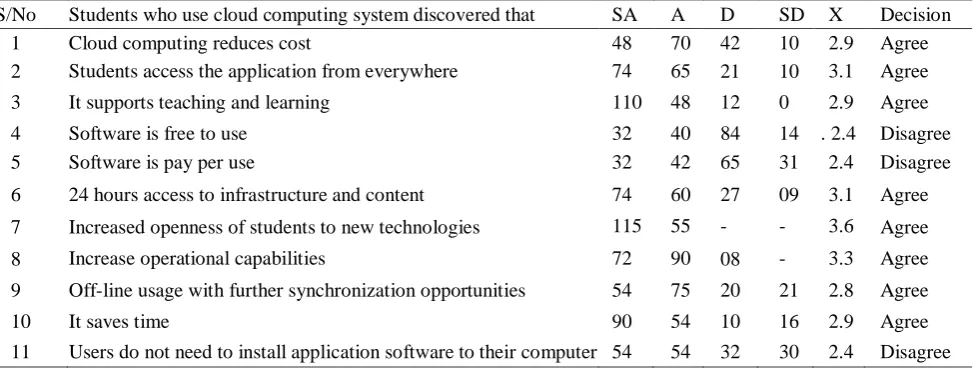
The paper adopted empirical secondary data, generated from a study carried out byDAMAR&NUHU (2015),at National Open University of Nigeria Kaduna. The reason for adopting the findings of the study is to authenticatethis paper on the prospects and challenges of Cloud Computing for distance learning in Nigeria‟s Open University. Based on the study carried by DAMAR&NUHU 2015, the mean statistics was employed to analyze the data collected in Table 1 -4 b e l o w . Table 1 and -4 use a four point rating scale, any item with a mean of 2.5 and above will be said to be agreed while any item with a mean below 2.5 is considered disagreed. While for calculated mean in Table 2 and 3 that used a three point rating scale was decided that any item with a mean of 2.0 is said to be highly confidential or accessible while any item with the mean below 2, 0 is low.
Data Analysis and Presentation of Results
The data collected were analyzed using the mean. One hundred and seventy copies of the questionnaires were administered and retrieved. The results were presented in Tables 1-4.
Table 1: The importance of cloud computing
S/No Students who use cloud computing system discovered that SA A D SD X Decision 1 Cloud computing reduces cost 48 70 42 10 2.9 Agree 2 Students access the application from everywhere 74 65 21 10 3.1 Agree 3 It supports teaching and learning 110 48 12 0 2.9 Agree 4 Software is free to use 32 40 84 14 . 2.4 Disagree 5 Software is pay per use 32 42 65 31 2.4 Disagree 6 24 hours access to infrastructure and content 74 60 27 09 3.1 Agree 7 Increased openness of students to new technologies 115 55 - - 3.6 Agree 8 Increase operational capabilities 72 90 08 - 3.3 Agree 9 Off-line usage with further synchronization opportunities 54 75 20 21 2.8 Agree 10 It saves time 90 54 10 16 2.9 Agree 11 Users do not need to install application software to their computer 54 54 32 30 2.4 Disagree
The result in Table 1 revealed the respondents agree with the statements in items 1,2,3,6,7,8,9 and 10 and disagree with items 4, 5 and 11. This means that cloud computing increased openness of students to new technologies.
Students Rating of the Confidentiality of Service Rendered
The result in Table 2 indicated that the respondents rated the confidentiality of services rendered in all the items low. This means that services rendered to the students is not strictly confidential.
The result in Table 3 shows that the respondents rated the accessibility of the services as high in items 25, 26, 27 and 31, but rate items 24, 28, 29, 30, 32 and 35 as low. This mean that most of the services are not accessible.
S/No Services Rendered High Medium Low X Decision 12 Student scholastic records 65 15 90 1.8 Low 13 Student assignment 65 20 85 1.9 Low 14 Teaching materials 12 42 116 1.9 Low 15 Curriculum 32 21 116 1-5 Low
16 Projects information 32 21 117 1-5 Low 17 Projects management 121 58 91 1.6 Low
18 Results 48 32 90 1.7 Low
ISSN(E): 2277-128X, ISSN(P): 2277-6451, pp. 14-21
Table 3: Student Rating of the Accessibility of Services
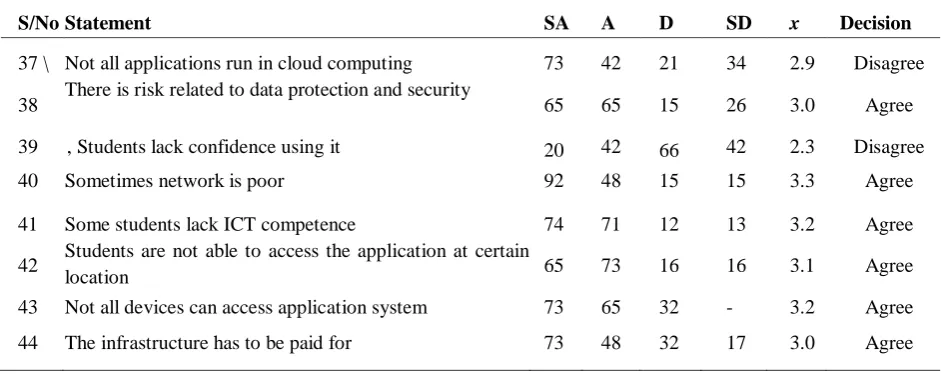
Table 4: Problems Students Encountered.
S/No Statement SA A D SD x Decision
37 \ Not all applications run in cloud computing 73 42 21 34 2.9 Disagree
38 There is risk related to data protection and security 65 65 15 26 3.0 Agree
39 , Students lack confidence using it 20 42 66 42 2.3 Disagree 40 Sometimes network is poor 92 48 15 15 3.3 Agree
41 Some students lack ICT competence 74 71 12 13 3.2 Agree
42 Students are not able to access the application at certain
location 65 73 16 16 3.1 Agree 43 Not all devices can access application system 73 65 32 - 3.2 Agree
44 The infrastructure has to be paid for 73 48 32 17 3.0 Agree
The result in Table 4 shows that the respondents agree with all the items except item 37 and 39. This means students agree that there are problems with cloud computing.
IV. DISCUSSION OF FINDINGS
The discussion of the findings was based on the data presented in Tables 1-4 on the importance of cloud computing, the result in Table 1 reveals that students in National Open University of Nigeria Kaduna Study Centre are aware that cloud computing reduces cost and can access the application from everywhere. Cloud computing increases openness of student to new technologies. Kumar et al (2013) had discovered that cloud computing can be used to develop skill and reduce operational cost while improving quality access to education. The respondents also agreed that cloud computing saves time and increase students‟ operational capabilities.
This agrees with the report given in Wikipedia (2015) on the benefits of cloud computing. On services rendered, respondents indicated that most of the services rendered are not strictly confidential as evident in the results in Table 2. This may not be far from the problems stated in Table 4 where students indicated that they lack confidence in using technology and that some students lack ICT competence. The problem of privacy and security will remain a problem as explained by Nicholson (2009). This may be because students release their pin number to those who can operate the computer. The respondents also indicated that most of the services rendered in National Open University (NOUN) is not accessible to them as shown in Table 3 of this work. Most of the items rated not low may not be available which could possibly be as a result of administrative lapses or lack of concern. The researchers questioned some of the students on teaching materials such as audio and video which are very necessary for a student of this nature yet, none of them indicated receipt of those materials. This does not agree with what NOUN said it will provide to their students. Tools such as e-book, digitized lecture video and audio materials for an enhanced student‟s learning experience and other services have been listed in NOUN website as materials that they have provided. With these the claims in this work is
S/No Services Rendered High Medium Low Decision 24 Student scholastic records 65 20 85 1.9 Low 25 Student assignment 74 32 64 2.1 High 26 Teaching materials 32 118 20 2.1 High 27 Curriculum 65 38 67 2.0 High 28 Projects information 65 52 23 1.9 Low 29 Projects management 42 '65 63 1.9 low
30 Results 21 65 59 1.8 Low
ISSN(E): 2277-128X, ISSN(P): 2277-6451, pp. 1-6
© www.ijarcsse.com, All Rights Reserved Page | 20
justified, which gives the future researcher the modus operandi of making generalization.
V. CONCLUSION
The advent of cloud environment makes online and distance education more popular and convenientto access. People of all age groups are connected through the internet and mobile devices, thus increasing awareness.In short, One can conclude that distance education via e-learning and cloud computing is the best feasible solution for the education of students of the internet age, as much as the challenges are takingcare of. With cloud computing, students can study and learn whenever and wherever they want via their network capable devices. Though NOUN is Nigeria‟s largest tertiary institution in terms of students‟ enrolment, much is to be desired if quality is expected, judging from the results obtained from the research conducted, providedif the lapses discovered are addressed.
RECOMMENDATIONS
The following recommendations include:
The supply of electricity and energy need to be improved upon in Nigeria in order to efficiently manage cloud computing in its use in distance learning programmes especially in the rural areas.
Administration of National Open University of Nigeria (NOUN) should guarantee service accessibility and personal data protection in whichever form they are prepared.
Attention should be paid to the quality of internal and external networks by creating virtual network.
Open University students should be as a matter of concern encouraged to get themselves acquainted to the use of technology so that the privacy of their data be maintained.
There should be increased training of personnel, adequate motivation and special scholarship.
Security issues should be handled by popularizing existing laws, legislating against decadent technologies, cyber-crime and electronic waste
REFERRENCES
[1] Awotua-Efebo, E.B (2002): Effective teaching principles and practice; Port Harcourt paragraphics.
[2] Allen, E. & Seaman, J. (2010):Learning on Demand online Education in the United States, 2009. Wellesley, MA: The Sloan Consortium.
[3] Adewoyin, J.A (2006): The place of information and communication Technology in Designing and utilizing instructional material in C.O Tiamiyu: Understanding New Technology in instructional medial materials Utilisation. A book of proceeding on a one Day Train the Trainer open workshop (48-68)
[4] Chaka, J. G (2008): Information and communication Technology (ICT) as a vital Tool in the Education Sector reform in Nigeria. Nigeria Journal of sociology in Education (NJSE).2, (2), 182-190
[5] CISCO Unifed Computing Systems (UCS) (2013): Developing a cloud-computing strategy for Higher Education. U.S.A. Cisco Unified Computing Systems (UCS). Retrieved from www, cis cos.
com/c/dom/en/services/co llateral/ser vices/services-education/cloud-101 -hi ghe r-education-wp.pdf
[6] Das, P. &Bhatawala, P. (2004) Cloud Computing: Prospects and Challenges. Journal of Computer Engineering, 16 (4) 15-20.
[7] Damar, D.N.(2015): Assessment of the use of cloud computing in distance learningprogramme of national open university of Nigeria (noun), kaduna study center
[8] Federal Republic of Nigeria (2013) National policy of education. Abuja NERDC.
[9] Grance, T: & Mell, P. (2011): The National Institute of Standards and Technology (NIST):Definition of cloud computing. NIST Publication. Retrieved from http://csrc.Nist.gov/publications/nistpubs/800-145/5p 800-145 pdf.
[10] Grispo, G; Storer, T and Glisson, W, B (2012) Calm Before the Storm: The Challenges of Cloud Computing in Digital Forensics. International Journal of Digital Crime and Forensics, 4 (2)28-48.
[11] Institute of Internal Auditors (2012). Cloud computing: A study of internal audif s preparedness in the Dallas Area. Retrieved from http://na.theiia.org/iiarf/publicDocuments/IIADalla ResearchProject-Finalsubmission pdf. [12] Kumar, B.P., Kommareddy S. & Rani, N.U. (2013 July). Effective Ways Cloud Computing can Contribute to
Education Success. Advanced Computing: An International Journal (ACIJ), 4,4: 17-32
[13] Manro, S.; Singh, J., & Manro, R. (2011). Cloud Computing in Education: Make India better with emerging trends. In A. Mantri 5. Nandi Sumah, G. Kumar & S. Kumar (Eds). Higher performance architecture and grid computing, (pp. 131-139). Berlin: German Springer.
ISSN(E): 2277-128X, ISSN(P): 2277-6451, pp. 1-6
© www.ijarcsse.com, All Rights Reserved Page | 21
[15] National Open University of Nigeria-WHED-IAU‟S World Higher Education Database" [16] Retrieved from www.whed.net.
[17] National Open University of Nigeria- Wikipedia, the free encyclopedia. Retrieved from
https://en.rn.wikipedia.org/.. .NAtionall...
[18] Nicholson, J. L. (2009): Cloud Computing‟s Top Issues for Higher Education USA. University Business. Retrieved from http://www.universitybusiness.com/articles/ cloud-computings-top issues-higher-education. 20/09/2015.
[19] Wikipedia, (2015). Cloud Computing. Wikipedia the Free Encyclopedia. Retrieved from
https://en.wikipedia.org/wiki-cloud-computing.
[20] MacMillan English Dictionary for Advanced Lerners (2007) New Edition.
[21] Inyang- Abia, M.E (2014). Clouds in the “Light Kingdom”: Reboot the curriculum 60th in augural lecture of the University of Calabar: University of Calabar.
[22] Kaplan, S and Ashlay, J. I. (2003) Beyond the breakout room: How technology can help sustain community. http/www. . asaccenter.org/ Resources/ articledatail.Cfm? iternumber=13572
[23] Meloin, J (2010) Tools for synchronous and Asynchronous classroom discussion (online blog) the chronicle of higher education (http. // chronicle. Com /blogs / prof hacker / tools – for – Synchronous asynchronous – classroom – discussion/ 22902)
[24] Njoku, Steve (2006). Teacher, ICT and the challenge for the 21st Century. A Lehman, R and Dewey, B (2001). Distance Education Technologies. MaeGranihi!
[25] Sudhir, K. S, Nidhi G &Monisha. S (2014). Distance Education Technologies: Using 'E-leaming and Cloud Computing.. International Journal of Computer Science and Mformation Technologies, 5 (2) 1451-1454. [26] Mangal, S.K &MangaI Uraa (2011) Essentials of Educational Technology. New Delhi: PHI Learning Private
Limited.