SOME NEW PERMUTATION GRAPHS
S. G. Sonchhatra
1Ph. D. Scholar, School of Science, R.K. University, Rajkot,
Assistant Professor, Government Engineering College, Rajkot.
G. V. Ghodasara
Assistant Professor, H. & H. B. Kotak Institute of Science, Rajkot.
Abstract
——————————————————————————————
L
etG = (V, E)be a(p, q)graph. An injectionf : V(G) → {1,2, . . . , p}is called permutation labeling if the edge values are obtained by the number of permuta-tions of the larger vertex label taken smaller vertex label at a time are all distinct. If a graphGadmits such labeling, it is called a permutation graph. In this paper we prove that cycle with one chord, cycle with twin chords,P2+Kn, book graph, tadpole andlotus inside a circle are permutation graphs.
————————————————————————————————— Key words :Permutation graphs, Join of two graphs.
Subject classification number:05C78.
1
Introduction
LetGbe a simple, finite, connected and undirected graph withpvertices andqedges. We follow Harary[3] for the standard terminology and notations. Graph labeling is the assignment of real values or subsets of a set, subject to certain conditions, have been motivated due to its usefulness and applications in various fields. Permutation and com-binations play an important role in combinatorial problems. In [4] Hegde et al. proved thatKn is permutation graph if and only ifn≤ 5. Further in [1] Baskar et al. proved
that cycles, path, stars are permutaion graphs. We present several definitions which are necessary for our present investigation.
Definition 1.1Achordof a cycle is an edge joining two non-adjacent vertices of a cycle, where chord forms a triangle with two edges of the cycle.
Definition 1.2Two chords of a cycle are said to be twin chords if they form a triangle with an edge of the cycle.
For positive integers nandpwith3 ≤ p ≤ n−2,Cn,p is the graph consisting of a
cycleCn with a pair of twin chords with which the edges ofCnform cyclesCp,C3and
Cn+1−pwithout chords.
Definition 1.3LetG1andG2be two graphs such thatV(G1)∩V(G2) =φ. The join of G1andG2denoted byG1+G2is the graph with vertex setV(G1+G2) = V(G1)∪ V(G2), and edge setE(G1+G2) =E(G1)∪E(G2)∪J, whereJ ={uv/u∈V(G1) andv∈V(G2)}.
Definition 1.4LetCnbe a cycle withnvertices{u1, u2, . . . , un}andK1,n be the star
graph withn+1vertices{v, v1, v2, . . . , vn}, wherevis the apex vertex and{v1, v2, . . . , vn} 1Corresponding Author: S. G. Sonchhatra
Ph. D. Scholar, School of Science, R.K. University, Rajkot, Assistant Professor, Government Engineering College, Rajkot, India.
are the pendant vertices. The lotus inside a circleCn, denoted byLCn, is obtained by
joining eachvitouiandui+1(modn), fori= 1,2, . . . , n.
Definition 1.5LetG = (p, q)be a graph. An injectionf : V(G) → {1,2, . . . , p} is calledpermutation labelingofG, if the induced edge function gf : E(G) → N given
bygf(uv) =f(u)Pf(v), iff(u)> f(v)andf(v)Pf(u), iff(v)> f(u)is injective, where
f(u)P
f(v)denotes the number of permutations off(u)things taken alongf(v)at a time. for allu, v∈V(G).
2
Main Results
Theorem 1CycleCnwith one chord is permutation graph, for alln≥4,n∈N.
Proof :LetGbe the cycle with one chord. Let{v1, v2, . . . , vn}be the successive vertices
ofCnand{e1, e2, . . . , en}be the edges ofCn, whereei =vivi+1,1 ≤i≤n−1and
en =vnv1.
Lete0=v2vnbe the chord in cycleCn. Here|V(G)|=nand|E(G)|=n+ 1.
We define injectionf :V(G)→ {1,2, . . . , n}by f(v1) = 1,
f(vi) = 2i−2; 2≤i≤ bn2c+ 1,
= 2(n−i) + 3;bn
2c+ 2≤i≤n. Injectivity for edge labels:
Here we note thatgf(v1v2) = 2, is the smallest edge label among all edge labels in graph G. For2 ≤ i ≤ bn
2c+ 1, gf is increasing for increasing value off(vi)and so we getgf(vivi+1) < gf(vi+1vi+2). Similarly forbn2c+ 2 ≤i ≤n,gf is decreasing for
decreasing value off(vi)and so we getgf(vivi+1)> gf(vi+1vi+2). Now we claim thatgf(vivi+1)6=gf(vjvj+1), for2≤i≤ bn2candb
n
2c+ 2≤j≤n−1. Suppose gf(vivi+1) = gf(vjvj+1). We have f(vi) = r, for some r, where r is an
even positive integer andf(vj) = t, for somet, wheretis an odd positive integer. So r+2P
r=t+2 Pt=⇒ (r+2)!2! = (t+2)!2! =⇒(r+ 2)! = (t+ 2)!, which is not possible as
L.H.S. of this equation is factorial of an even number and R.H.S. is factorial of an odd number. Hence the claim is proved.
Furthergf(vbn
2c+1vbn2c+2) =n!, which is the highest among all the edge labels in graph G. Also we havegf(v1vn) = 3andgf(v2vn) = 6, which appear only once inG.
Hence the induced edge labelinggf :E(G)→Nis injective. So graphGis permutation
graph, for alln≥4,n∈N.
Theorem 2CycleCnwith twin chords is permutation graph, for alln≥5,n∈N.
Proof : LetG be the cycle with twin chords. Let{v1, v2, . . . , vn} be the successive
vertices of cycleCnand lete0=v2vn,e00=v3vnbe the two chords ofCn,|V(G)|=n
and|E(G)|=n+ 2.
We define the similar injection, as we have defined in Theorem 1.
We also apply the similar arguments for injectivity of edge labels in graphG.
Furthermoregf(v3vn) = 4!, which is also distinct from all other edge labels. Hence the
induced edge labelinggf :E(G)→Nis injective. So graphGis permutation graph, for
alln≥5,n∈N.
Theorem 3P2+Knis permutation graph, for alln∈N.
{v1, v2, . . . , vn} be the vertices corresponding toKn. Here | V(G) |= n+ 2and |
E(G)|= 2n+ 1.E(G) ={u1u2} ∪ {u1vi; 1≤i≤n} ∪ {u2vi,1≤i≤n}.
We define injectionf : V(G) → {1,2, . . . , n+ 2}asf(u1) = 1,f(u2) =n+ 2, and f(vi) =i+ 1,1≤i≤n.
Injectivity for edge labels:
Heregf(u1vi) =i+1are distinct for increasing value ofi,1≤i≤n. Alsogf(u2vi) =n+2
Pf(vi)are distinct for increasing values ofi,1≤i≤n. Claim 1 :gf(u1vi)6=gf(u2vi), for alli,1≤i≤n.
The highest value ofgf(u1vi) =gf(u1vn) =n+ 1, which is smaller than the smallest
value ofgf(u2vi) =gf(u2v1) = (n+ 1)(n+ 2). So claim 1 is proved.
Claim 2 :gf(u1u2)6=gf(u1vi), for alli,1≤i≤n.
The highest value ofgf(u1vi) =gf(u1vn) =n+ 1, which is smaller thangf(u1u2) = n+ 2. So claim 2 is proved.
Claim 3 :gf(u1u2)6=gf(u2vi), for alli,1≤i≤n.
The smallest value ofgf(u2vi) =gf(u2v1) = (n+ 1)(n+ 2), for alln. Butgf(u1u2) = (n+ 1)<(n+ 1)(n+ 2). So claim 3 is also proved.
Hence the induced edge labelinggf :E(G)→Nis injective. So graphGis permutation
graph, for alln∈N.
Theorem 4TadpoleTm,nis permutation graph, for allm, n∈N,m≥3.
Proof : Let{v1, v2, . . . , vm}be the successive vertices corresponding to cycleCmand
{vm+1, vm+2, . . . vm+n}be the successive vertices corresponding toPnin tadpoleTm,n.
Lete=vmvm+1be the bridge in tadpoleTm,n. Here|V(G)|=m+nand|E(G)|=
m+n.
We define injectionf :V(G)→ {1,2, . . . , m+n}by f(v1) = 1,
f(vi)=2i−2;2≤i≤ bm2c+ 1;
= 2(m−i) + 3;bm
2c+ 2≤i≤m, =i;m+ 1≤i≤m+n.
Injectivity for edge labels : For2 ≤ i ≤ bm
2c+ 1, gf is increasing for increasing value of f(vi) and so we get gf(vivi+1) < gf(vi+1vi+2). Similarly for bm2c+ 2 ≤ i ≤ m, gf is decreasing for
decreasing value of f(vi) and so we get gf(vivi+1) > gf(vi+1vi+2). Also f(vi) is
increasing, for increasing values ofi,m+ 1≤i≤m+n.
Claim :gf(vivi+1)6=gf(vjvj+1)6=gf(vtvt+1),2≤i≤ bm2c,bm2c+ 2≤j ≤m−1
andm+ 1≤t≤m+n−1.
Assume if possiblegf(vivi+1) =gf(vjvj+1).
We have f(vi) = r, rbeing an even positive integer and f(vj) = t,t being an odd
positive integer. So we getr+2Pr=t+2Pt=⇒ (r+2)!2! = (t+2)!2! =⇒(r+ 2)! = (t+ 2)!
, which is not possible as L.H.S. is factorial of an even number and R.H.S. is factorial of an odd number. Hencegf(vivi+1)6=gf(vjvj+1).
Supposegf(vjvj+1) =gf(vtvt+1).
Here we have the highest edge label ofgf(vjvj+1)ism−1Pm−3, whenm is even and mP
m−2, whenmis odd. But the lowest edge label ofgf(vtvt+1)is(m+ 2)!, which is larger than the highest edge label ofgf(vjvj+1). Hencegf(vjvj+1)6=gf(vtvt+1). Similarly by applying the above argument, we getgf(vtvt+1)6=gf(vivi+1).
Hence the claim is proved. Hence the induced edge labelinggf :E(G)→Nis injective.
Theorem 5Book graphBnis permutation graph, for every positive integern.
Proof : LetBn=K1,n×P2be book graph. Let{u2i−1, u2i}be the vertices ofithcopy
ofP2,1≤i≤n+ 1. Here|V(Bn)|= 2n+ 2and|E(Bn)|= 3n+ 1.
Here we have taken{u1, u2}as the vertex set of central copy ofP2. FurtherE(Bn) =
{u1uj,3≤j≤2n+ 1, jis odd}S{u2uj,4≤j≤2n+ 2, jis even}S{ujuj+1,1≤
j≤2n+2, jis odd}. We define injectionf :V(Bn)→ {1,2, . . . ,2n+2}, asf(ui) =i,
1≤i≤2n+ 2.
Injectivity for edge labels :
Asgf(u1uj)(3≤j≤2n+ 1, jis odd), is increasing, for increasing values ofj, we get
gf(u1uj)< gf(u1uj+1). Similarlygf(u2uj)< gf(u2uj+1), for4 ≤j ≤2n+ 2,jis
even. Moreovergf(u1u2) = 2is the smallest edge label in graphBn.
Claim: gf(u1uj)(3≤j ≤2n+ 1, jis odd)6=gf(u2uj)(1≤j ≤2n+ 2, jis even)
6
=gf(utut+1)(1≤t≤2n+ 2, tis odd).
Heregf(u1uj)=jP1=j, is always an odd number andgf(u2uj)=jP2 =j(j−1), is always an even number. So clearlygf(u1uj)6=gf(u2uj).
Now it is enough to provegf(u2uj)=6 gf(utut+1)
Supposegf(u2uj) = gf(utut+1), for somejandt. SojP2=(t+ 1)! =⇒j(j−1)=
(t+ 1)!. Now asjis even letj= 2p, for somep∈N,p >1and for oddt,t= 2p−1, for somep∈N,p >1.
So2p(2p−1) = (2p−1 + 1)! ⇒2p(2p−1)=(2p)!
⇒2p−2 = 0or2p−2 = 1
⇒p= 1orp=32, which is not possible asp∈Nandp >1.
Hence the claim is proved. So the induced edge labelinggf :E(G)→Nis injective. So
graphBnis permutation graph, for every positive integern.
Theorem 6Lotus inside a circle is permutation graph.
Proof :LetLCnbe a lotus inside a circle. Let{u1, u2, . . . , un}be the successive vertices
corresponding to cycleCnand{v, v1, v2, . . . , vn}be the successive vertices
correspond-ing to star K1,n,where v is the central vertex of K1,n. Here | V(LCn) |= 2n+ 1
and | E(LCn) |= 4n. Also E(LCn) = {uiui+1,1 ≤ i ≤ n}S{viui,1 ≤ i ≤
n}S{v
iui+1,1≤i≤nS{vvi,1≤i≤n}.
We define injectionf :V(LCn)→ {1,2, . . . ,2n+ 1}byf(v) = 2n+ 1andf(ui) =
2i,1≤i≤n,f(vi) = 2i−1,1≤i≤n.
Injectivity for edge labels:
Claim 1:For allui,1 ≤ i ≤ n,rPr−2 6=r+2 Pr, wheref(ui) = r= an even positive
integer.
Suppose claim 1 is not true, sorPr−2=r+2Pr⇒ 2!r! = (r+2)!2! ⇒1 = (r+ 2)(r+ 1)⇒
r=−3± √
5
2 , which contradicts the choice ofr. Hence Claim 1 is proved.
Claim 2: For{viui,1 ≤i ≤n}and{viui+1,1 ≤i ≤n},rPr−1 6=r+2 Pr−1, where
f(ui) =r= an even positive integer.
Suppose claim 2 is not true, sorP
r−2=r+2Pr−1⇒ r1!! = (r+2)!
3! ⇒6 = (r+ 2)(r+ 1) ⇒r= 1orr=−4, which contradicts the choice ofr. Hence claim 2 proved.
Claim 3:For{vvi,1≤i≤n},2n+1Pr6=2n+1Pr−2, for1≤r≤n.
Suppose Claim 3 does not hold. So we get 2n+1Pr =2n+1 Pr−2 ⇒ (2(2nn+1−+1)!r)! = (2n+1)!
(2n+1−r+2)! ⇒(2n−r+ 3)! = (2n−r+ 1)! Suppose2n−r=t, we gett2+ 5t+ 5 = 0⇒t= −5±
√ 5
⇒r >2n, which is contradiction as1≤r≤n. So claim 3 is proved. Claim 4:gf(ui+1ui)=6 gf(viui)6=gf(viui+1)6=gf(vvi), for1≤i≤n
We note thatgf(ui+1ui) =rPr−2, wheref(ui+1 =r= an even positive integer,r >2, 1 ≤ i ≤ n,r ≤ n. gf(viui) =q Pq−1, wheref(ui) = q= an even positive integer,
1 ≤ i ≤n,1 ≤q ≤n. gf(viui+1) =t Pt−3, wheref(ui+1) =t = an even positive
integer,t >2,1≤i≤n,t≤n.gf(vvi) =2n+1P2i−1,1≤i≤n.
Supposegf(ui+1ui) = gf(viui)⇒rPr−2 =q Pq−1 ⇒ r2!! = 1!q! ⇒ qr!! = 12 and for if gf(viui) =gf(viui+1)⇒qPq−1=tPt−3⇒q! = 3!t! ⇒
q!
r! = 1 6,
But the ratio of factorial of two consecutive even integers(greater than2) is atmost121 and sogf(ui+1ui)=6 gf(viui)6=gf(viui+1). Similarly we getgf(viui+1)6=gf(vvi). Hence
the claim is proved.
Hence the induced edge labelinggf :E(LCn)→N is injective. So GraphLCnis
per-mutation graph, for alln.
3
Figures and Examples
Illustration 1 Permutation labeling of cycleC8with one chord and cycleC8with twin chords are given in followingFigure 1.
1
2 3
4 5
6 7
8
1
2 3
4 5
6 7
8
Figure 1 : permutation labeling of cycleC8with one chord and cycleC8with twin chords.
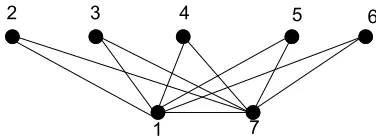
Illustration 2 Permutation labeling ofP2+K5is given in followingFigure 2.
1
2 3 4 5 6
7
Figure 2 : permutation labeling ofP2+K5
1
2
4
3 5 6 7
Figure 3 : permutation labeling ofT4,3
Illustration 4 Permutation labeling ofB4is given in followingFigure 4.
1
2 3
4
5 6
7 8 9 10
Figure 4 : permutation labeling ofB4
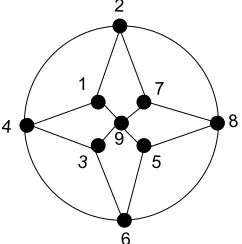
Illustration 5 Permutation labeling ofLC4is given in followingFigure 5.
1
3 5
7 2
4 6 8
9
4
Conclusion and Open Problems
Due to the present investigation, six new results related to permutation graphs are found. Here We also put open problems related to permutation labeling.
Problem 1: To prove or disprove star of some graph is permutation.
Problem 2: To characterize graphsGandHsuch that join ofGandHis permutation.
References
[1] Baskar J., Babujee, Vishnupriya V., Permutation labeling for some trees, International Journal of Mathematical and Computer Science, 3(2008),31−38
[2] Gallian J. A., A dynemic survey of graph labeling, The Electronics Journal of Com-binatorics, 17(2014),]DS6 1−250.
[3] Harary F.,Graph theory, Addision-wesley, Reading, MA, 1972.
[4] Hegde S.M., Shetty S., Combinatorial Labelings Of Graphs, Applied Mathematics E-Notes, 6(2006),251−258.
[5] Shiama J., Permutation Labeling for Some Shadow Graphs, International Journal Of Computer Applications, 40(2012),31−35.
[6] Shiama J., Permutation Labeling for Some Split Graphs, Proceedings of the National Conference on Mathematical Modelling and Simulation. NCMS’12 11thFeb. 2012.
Source of support: Nil, Conflict of interest: None Declared