ISSN: 2347-7474
International Journal Advances in Social Science and Humanities
Available online at: www.ijassh.com
RESEARCH ARTICLE
Public Sports Policies: A Tool for Characterization of Municipal
Sports Services in Mozambique
Paipe, Gustavo
1*, Ubago-Guisado, Esther
2, Rodríguez-Cañamero, Sergio
2,
García-Unanue, Jorge
2, Felipe, José Luis
3,Gallardo, Leonor
4, Carvalho María
José
51PhD Student in Sport Sciences at the Faculty of Sport of the University of Porto. Member of the Research Centre in Formation, Innovation and Intervention in Sport - CIFID2, Porto, Portugal. Lecturer at the Pedagogical University of Mozambique.
2Sport Management Lab of the Faculty of Sport Sciences of the University of Castilla-La Mancha. Toledo, Spain.
3Full Professor and researcher at European University, Madrid, Spain.
4Full Professor at Faculty of Sport Sciences of the University of Castilla - La Mancha. Toledo, Spain. 5Auxiliary Professor at Faculty of Sport of the University of Porto. Effective member of Research Centre in Formation, Innovation and Intervention in Sport – CIFID2. Porto, Portugal.
Abstract
Over the past 40 years, the municipalities have been the main promoters of sport development in several parts of the world. They were also crucial in the definition of sport policies with actions focused on the promotion of healthy lifestyles through physical activity and sport practice for all sectors of society. Nevertheless, in the municipalities of Mozambique, the intervention in sport is a relatively new activity. Research in these fields is very rare, so it is urgent to proceed with disaggregated studies on sport reality in municipalities of Mozambique. The aim of this study was to design and validate a specific tool for characterization of municipal sports services. For this purpose, an ad hoc instrument based on a previous literature review was designed and submitted to validation process by academic experts. After the instrument obtained a positive evaluation, a pilot study was conducted. Forty-one items, divided into nine dimensions, compose the final version. The instrument showed a good validity indices (V of Aiken = 0.85), and reliability (W of Kendall = 0.82). The tool will help and guide policy makers for best practices in sport programs in their municipalities, since it provides feedback about the overall development of sport services and identifies which resources they have and which are needed in each municipality to ensure that all activities can successfully deliver and respond to the demands of the citizens. The final tool was named Fer Cas DemuP.
Keywords: Sport policies, Municipal sport services, Municipalities, Designed and evaluation, Instrument.
Introduction
The municipalities have an important role in development of sport, because they are boosters of sports policies at local level, they are close to the citizens and know the local sport reality [1-4]. Thereby, the increased interest of the population in physical activity and sport practice as part of their lifestyle requires governments, whether central or local, to delimit sports policies centred on improving quality of life of the citizens. The strategy adopted by developed countries to respond to this demand has been the
development of sports policies and programs based on international recommendations, in good practices for health promotion through physical activity and sport [5-7]. The
municipalities, together with central
Government, are main promoters and organizers of these activities.
process of municipalities’ creation in Mozambique is relatively recent, and the services offered present deficiencies, in particular the sports services [8].
In a meticulous analysis about municipal sport policies in Mozambique, some studies found [9-11] were performed in two southern municipalities and one in the centre of the
country. They present a general
characterization of sport policies carried out by the municipalities.
These studies applied instruments validated in other contexts and realities. There has been no tool validated in Mozambique which allows studying the reality of the municipalities sport services, while taking into account its characteristics and the local context.
Thus, there is a need to create a tool that allows characterization of municipal sports services in Mozambique, taking into account the context and local reality. To this end, it is pertinent that the tool amasses a series of indicators to make possible an in-depth analysis about the deployment and organization, programs, as well as sports and physical activities offered in municipal sports services.
For those reasons, the aim of this study was to design and validate a tool for characterization of municipal sports services and sport policies undertaken to promote physical activity practice and sport development at the local level.
As set out by Gutierrez [12], one of the key issues in the study of sports policies is the need to qualify the political action in its ability to provide adequate and quality
responses to the demands of the population. This requires knowing the sports reality, needs of the population, existing structures and the potential of sports sector in each region to invest adequately in sports services.
Therefore, the decision makers need to have knowledge about sports in order to discern which sports activities or sport disciplines can be offered in each region [13].
Thus, a review of the literature was conducted in order to develop a tool that would allow policy makers set sports policies based on local reality.
Researches about municipal sports services or municipalities sport policies, [14-23] focus on human resources, financial resources, organizational culture, sports facilities management, relationship with other organizations, sport and sustainability,
sporting opportunities, creation and
evolution of services, information
management, service management, quality of services, and sports policies.
After a thorough literature review, the following 10 dimensions were selected to integrate the tool: 1) Creation of the services; 2) Human resources; 3) Economic
resources; 4) Sports facilities; 5)
Management of the service; 6) Municipal sports offer; 7) Organizational culture; 8) Relationship with other entities; 9)
Information and communication
management; 10) Sport and environment. These dimensions have been submitted to the evaluation and validation process in three phases, which we describe below.
Method
The research purpose of this study required a methodology, which was multidisciplinary in approach and essentially inductive. The mix of research methodologies chosen was necessary in order to determine the dimensions of the questionnaire, followed by identification of items for each dimension. In order to achieve this objective, a systematic and progressive approach was
developed, involving a focus group, high-ranking officials from the Ministry of Youth and Sport, academic experts and a pilot study carried out with municipal directors from municipalities of Mozambique [24-26]. The ethical council of the Faculty of Sport of the University of Porto approved the research protocol with process number
CEFADE 05.2015. Design of the Tool
After selecting the dimensions, the following sequence of research phases occurred:
Phase One: focus group research. The focus
group was held with members Sport
questionnaire; second, to set out the items that will constitute these dimensions; and third, the hierarchical order in which they would be organized.
The group was briefed with findings of the literature and given the opportunity to debate the philosophy of whether or not it
was reasonable to integrate the
questionnaire.
The group was also asked to place the dimensions in hierarchical order. In addition, they were asked to identify the items that would integrate the dimensions. The group met twice per week over three months in order to refine the constituent items of the dimensions and a primary document.
The primary document was composed by 41 items distributed in 10 dimensions: “Creation of the services; Human resources;
Economic resources; Sports facilities;
Management of the service; Municipal sports offer; Organizational culture; Relationship with other entities; Information and communication management; Sport and environment”.
Following the methodology proposed in other researches, [27-30] and in order to verify if the dimensions had an impact in
characterization of municipal sports
services, the document was submitted to
high-ranking officials of Ministry of Youth and Sport familiar with national sport organization and other key activities undertaken in Mozambique.
Phase Two: analyses by high-ranking
officials. The second phase of the research was to submit the first document to high-ranking officials of the Ministry of Youth and Sport to further examine and refine the dimensions and its items prepared by previous focus group. Once again, it was asked the officials to add to the list or adjust the order as they saw fit. Due to the distance, the document was sent by email. After the first document was analysed by the officials, it was recommended to change the name of the economic resources dimension to financial management, and to unify the
dimensions of sport facilities with
management of the service, as approaching these two dimensions separately could be redundant. The new dimension was
designated, ´Sports facilities and
management`, and the document turned into nine analysis dimensions.
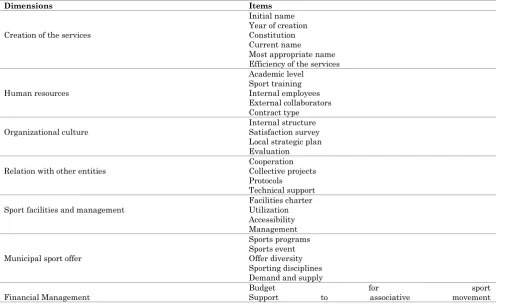
At the end of both phases, we summarized the evidence obtained from the focus group and the officials from the Ministry to refine the list in order to assess which dimensions and items would precede or follow other, as shown in Table 1.
Table 1: Order of dimensions and its items
Dimensions Items
Creation of the services
Initial name Year of creation Constitution Current name
Most appropriate name Efficiency of the services
Human resources
Academic level Sport training Internal employees External collaborators Contract type
Organizational culture
Internal structure Satisfaction survey Local strategic plan Evaluation
Relation with other entities Cooperation Collective projects Protocols
Technical support
Sport facilities and management Facilities charter Utilization Accessibility Management
Municipal sport offer
Sports programs Sports event Offer diversity Sporting disciplines Demand and supply
Financial Management
Budget for sport
Investment Expenses
Information management and communication
Database Website
Section for sport
Advertising and Marketing
Information dissemination points
Sport and environment
Preserving plan of environment
Conservation sporting patrimony
Walking routes
Environmental guide
After this, the final document was sent to the sport academics experts, in order to continue with the validation process as
recommended by literature [31-33]. The experts profile is described in Table 2.
Table 2: Experts profile
Experts 4 University lectures, researchers in management and sport organizations, public and private facilities; 1 University lecturer, researcher and consultant in public sport policy.
Gender
2 women 3 Men
Nationality 3 Spanish 2 Portuguese
Professional profile
University lectures, PhD in Physical Activity and Health, and PhD in Sport Sciences, more than 10 years of experience in sports management, as well as in the direction of public and private sports entities. Large experience in research and accredited in research centres with prestige.
Total 5
The selection of the expert group followed criteria suggested by literature [34,35]: i) Experience in issuing criteria and evidence based on decision making and expertise (academic degree, research and publications, experience and awards); ii) Reputation in
the academic community, and; iii)
Availability and motivation to participate in the validation process.
For the validation process, a systematic process organized in five steps was followed:
apparent or logical validity, content validity, criterion validity, construct validity and
reliability of the instrument, as
recommended by literature [36-37].
Academic experts evaluated each dimension (including question and the possible answers) three times with a Likert scale of 5 points, from 0 = Item strongly disapproved up to 4 = Item strongly approved.
Validation Process
In order to be considered valid, a questionnaire should be: a) reliable; b) able to detect and measure changes; c) simple and acceptable by the respondents and other researchers; d) suitable for measuring the phenomenon that aims to study and, e) reflect the theory under the phenomenon studied. These properties are summarized in two properties: reliability and validity. After the validation process by academic experts, a pilot study was carried out. The
aim of pilot study was to test the validity of the tool, to estimate response rate, to test the questionnaire wording and sequencing as well as to verify the plainness of its language [30,33].
The questionnaire was applied face-to-face in the municipalities of Dondo, Inhambane and Xai-Xai, with three directors of municipal sports services. All of them were male, aged between 34 to 42 years, and with over 5 years of experience. The general characteristics of the municipalities are
presented in Table 3
Table 3: General characteristics of the municipalities
Name Population Density km2 Category Province
Dondo 71 644 175 D Sofala
Inhambane 72 508 371.7 C Inhambane
The pilot study was conducted in June 2015. Findings of pilot study indicate no need to
change any dimension or item of the questionnaire
Data analysis
Content validity was calculated using the mean scores attributed by academic experts [20] and the test of V of Aiken [38,39] according to the methodology described by
Gómez, Sainz de Baranda, Ortega,
Contreras and Olmedilla.
The index of concordance was calculated with non-parametric test W of Kendall during three moments of evaluation, ensuring internal consistency of the questionnaire. It was sought control and minimization of possible bias throughout all process with support of software IBM SPSS v 21.0 (IBM Software Company, US). The
significance level was 0.05%.
Results
Once the instrument was approved by the focus group and the officials from the Ministry of Youth and Sport, it was submitted for evaluation and validation process by academic experts on three different occasions.
The results are presented in Table 4. The
evaluation of each dimension was given in Likert scale of 5 points. The average and the V of Aiken were subsequently calculated during its development to ensure the validity.
Table 4: Results of evaluation by experts
Dimensions First evaluation Second evaluation Final version
M V. Aiken M V. Aiken M V. Aiken
Creation of the services 2.6 0.65 4 1 4 1
Human resources 1.8 0.45 3.6 0.90 3.8 0.95
Financial management 2.8 0.70 3.6 0.90 3.8 0.95
Sports facilities and management 2.8 0.70 4 1 4 1
Municipal sports offer 2.8 0.70 3.8 0.95 4 1
Organizational culture 2.4 0.60 3.6 0.90 3.8 0.95
Relationship with other entities 2.4 0.60 3.6 0.90 4 1
Information management and
communication 2.8 0.70 3.8 0.95 4 1
Sport and the environment 2.8 0.70 3.6 0.90 4 1
In the first evaluation, the dimensions had an average of 2.57 scores. It is equivalent to a rate of 0.64 in the table of critical values of Aiken [40] with suggestions to improve the questions.
In the second evaluation of the
questionnaire, there was significant
improvement in the scores assigned to the dimensions, obtaining an overall average of 3.73, equal to 0.93 in table of critical values of Aiken [41].
Even with a high level in this evaluation, a perfect agreement between academic experts was not achieved, because suggestions were given in most questions of the dimensions. The exceptions were the dimensions
Creation of the servicesand Sports facilities
and management, which reached the maximum score.
Table 5: General questions in relation to the questionnaire
Questions First evaluation Second evaluation Final Version
M V. Aiken M V. Aiken M V. Aiken
General structure 2.6 0.65 3.8 0.95 4 1
Relevance and order of dimensions 2.8 0.70 3.8 0.95 4 1
Degree of interrelation 3 0.75 4 1 4 1
Language used 2.4 0.60 3.4 0.85 4 1
A careful analysis of the table above shows that in the first evaluation of general questions the overall mean was 2.7, equivalent to 0.65 in the table of critical values of Aiken [40].
However, and taking into account the observations made by the experts, the
averages were increasing from one
evaluation to another, and a perfect agreement was obtained in the third evaluation, with Aiken index reaching the highest score in all questions [40].
Despite the high index of agreement, it was relevant to calculate the degree of agreement among experts throughout all process of evaluation and validation of the
construct, since this process is very subjective [42,43].
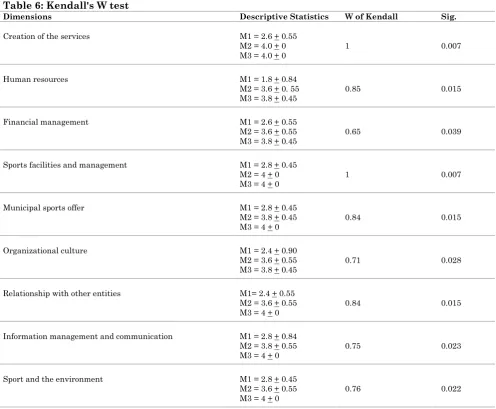
So, in order to determine the degree of agreement among experts and provide greater reliability to the validation process, it was calculated the index of concordance W of Kendall during the three moments of evaluation. This ensured the internal consistency of the questionnaire, while seeking to control and to minimize a bias throughout all process.
With the level of significance in 0.05, the results of W of Kendall varied from 0.65 to 1, as presented in the table 6. For each dimension, the sig was statistically significant.
Table 6: Kendall's W test
Dimensions Descriptive Statistics W of Kendall Sig.
Creation of the services M1 = 2.6 + 0.55
M2 = 4.0 + 0
M3 = 4.0 + 0 1 0.007
Human resources M1 = 1.8 + 0.84
M2 = 3.6 + 0. 55
M3 = 3.8 + 0.45 0.85 0.015
Financial management M1 = 2.6 + 0.55
M2 = 3.6 + 0.55 M3 = 3.8 + 0.45
0.65 0.039
Sports facilities and management M1 = 2.8 + 0.45
M2 = 4 + 0
M3 = 4 + 0 1 0.007
Municipal sports offer M1 = 2.8 + 0.45
M2 = 3.8 + 0.45 M3 = 4 + 0
0.84 0.015
Organizational culture M1 = 2.4 + 0.90
M2 = 3.6 + 0.55 M3 = 3.8 + 0.45
0.71 0.028
Relationship with other entities M1= 2.4 + 0.55
M2 = 3.6 + 0.55
M3 = 4 + 0 0.84 0.015
Information management and communication M1 = 2.8 + 0.84
M2 = 3.8 + 0.55 M3 = 4 + 0
0.75 0.023
Sport and the environment M1 = 2.8 + 0.45
M2 = 3.6 + 0.55 M3 = 4 + 0
0.76 0.022
management, information management and
communication, organizational culture,
sports and environment, present relatively low indices of agreements.
Despite these values, it does not mean that there is no agreement among experts. It is likely to obtain extreme values in all dimensions during the validation process, when we evaluate the index of agreements from experts [44,45].
Observing the sig in all dimensions, we note that it was less than the fixed significance level. From this, it is reasonable to assume that there was agreement among experts in all process of evaluation and validation of the questionnaire. Thus, we reject the null hypothesis, which states that during the process of evaluation and validation, there was no agreement among experts.
Discussion
As previously mentioned, the aim of this research was to design and validate a tool for characterization of municipal sports services and sport policies undertaken for promoting physical activity practice and sport development at the municipalities of Mozambique.
The design of the questionnaire is not an easy task and all attempts to improve validity and reliability of the instrument might be insufficient. In this sense, using focus groups, officials from the Ministry and academic experts during the design and validation processes of the content of the tool brought a satisfactory result which allowed improving its quality and validity in all phases of evaluation [46].
The results obtained through this experience are a clear example that the methodology applied was useful for ensuring viability of the instrument, as the use of experts’ consensus regarding the dimensions and their relevance allowed to answer the goals defined [47].
As observed in Table 6, the experts participating in the validation process agreed across all phases in the dimensions selected – concerning their designations and the fundamental features which allow a deep characterization of municipal sports.
In other hand, we can affirm that the content has high validity. The decisions of experts were increasingly determinant in different phases, noting a significant
increase of the average and the validity index of V of Aiken at all dimensions as well as in its structure, relationship between dimensions and its language.
Taking into account the results of the pilot study, the goal was achieved and it resulted in a flexible and practical instrument in its applicability.
This tool is available to directors and municipal councillors, and it will allow to make a diagnosis regarding the reality of sports, the programs and the sport policies adopted at the municipalities. The success of these activities depends largely on the satisfaction of citizens and the results achieved in promoting physical activity and sports practice.
The definitive tool showed high average of the evaluations from the experts (≥ 4.8 on a scale of 5 points) and a great validity coefficient (≥ 90) in all dimensions in the table of critical values of Aiken. A good correlation coefficient (Kendall's W ≥ 60) in all dimensions, supported it to be a good tool for application [43].
These values demonstrate adequate
reliability and validity indices of the tool. It can be used to analyse and characterize a municipal sports service, as well as launched and existing sports policies programs, and it becomes possible to draw comparisons between the different municipalities of Mozambique.
Conclusions
Literature review shows that the policy makers should have knowledge about their
municipalities regarding to human
resources, organizational culture, relation with other entities, sport facilities and
management, municipal sport offer,
financial management, information
The participation of a focus group, officials from the Ministry of Youth and Sport and academic experts was decisive during the entire process. It improved the suitability of the dimensions to characterize municipal sports services, as well as the actions taken by municipalities of Mozambique to implement sports policies.
In relation to the reliability of the validation process, the W of Kendall test showed a significant correlation with the V of Aiken, since the two tests showed high levels of
validity (V de Aiken = 0.85 e W de Kendall = 0.82) during the process of construct validation.
After the process, we conclude that the questionnaire is a valid and reliable tool for characterization of municipal sports services in Mozambique and it can be used in the future for national and international studies oriented to study municipal sports services, while taking into account the local context and its evolution. The official name of the tool is Fer Cas Demup.
Practical Implications of the Research
This research has formed the basis of a diagnostic tool that has been developed to help analyse the internal and external states of the municipal sport services in terms of
their development across the nine
dimensions. The intention is that this analysis helps policy makers and directors to make decisions about whether it is appropriate to deliver programmes based on local sports reality.
An analysis of the gap between what the municipality have and what is required for successful delivery of programme will enable to determine the needs before a decision is made to proceed with selected programmes. Consideration of the literature [48-53] set out the evidence that the success of any organization depends on following four performance scopes that involve all dimensions of the tool:
Administration: comprising rules and
regulations, management, governance,
structure, staffing, operations,
communication and strategic planning. Physical resources: including management of the facilities and equipment for competitions, recreation and play.
Financial management: specific budget to sport, including income from sponsorship
and marketing, support to the local clubs, associations and all initiatives to develop sport.
Human resources: academic level, sport
training and incentives, degree of
specialisation, staff and management, and participation in sport at local, regional and national level.
The advantage of this tool is that it can immediately provide feedback to the policy makers on the overall development of the sport services in their municipalities. There is a need to understand the levels of development of each municipality to ensure that the activities can be successfully delivered by all and that it answers the citizens’ needs.
As noted above, this tool identifies the gap between what the municipalities currently have in place and what they need in order to efficiently deliver programs and services. This informs the planning process and allows policy makers to devise and implement plans, which further develop those areas where gaps can be found between what they have and what is required. This will improve organizational capacity, leading to more efficient and better development of physical activity and sport practice programs.
References
1 Carvalho MJ, Resende C, Cirac M, Costa J.
Desporto, política e direito: Do passado e da atualidade. Enfoque nas autarquias locais. In: Bento J, Constantino J, editors. (2012) Desporto e Municípios: Políticas, práticas e programas. Visão e Contextos, Edições e Representações, Lisboa. p. 39-71
2 Constantino JM (1999) Desporto, política e
autarquias. Livros Horizonte, Lisboa. p. 1 - 144
3 Donaldson A, Leggett S, Finch CF (2011)
Sports policy development and
implementation in context: Researching and understanding the perceptions of
Review for the Sociology of Sport 47(6):743-760.
4 Gallardo L, Gómez Jiménez A (2004). La
Gestión de los servicios deportivos municipales. Vías para la excelencia. INDE Publicaciones, Barcelona. p. 154.
5 European Commission (1992) European
Sports Charter.
6 European Commission (2007) White book
on sport. Office for official publications of the European Communities, Luxemburgo. p. 21
7 United Nations Educational Scientific and
Cultural Organization (1978) International Charter of Physical Education, Physical Activity and Sport. ‘Resolution 3/31/2 adopted by the General Conference at its twentieth session’ in Vendême Updated at the 38th UNESCO General Assembly in November 2015.
8 Associação Nacional dos Municipios de
Moçambqiue (2008) Desenvolvimento
Municipal em Moçambique. Lições da primeira década. Associação Nacional dos Municípios de Moçambique, Maputo. p. 1-370
9 Nhabomba HM. Levantamento, análise e
prospetiva do desporto no concelho municipal da Cidade de Inhambane-Moçambique, 2009 a 2012. Lisboa: H. M. Nhabomba; 2013
10 Paipe G. Politicas públicas desportivas e
gestão do desporto municipal: Estudo do caso do município da Cidade da Beira, Moçambique. Porto: Gustavo Paipe; 2013
11 Ribeiro ER. Reflexão sobre a política
desportiva em Moçambique: Diagnóstico sobre as instalações desportivas da cidade de Maputo. Campinas: E. R. Ribeiro; 1999
12 Gutierrez CAS. Políticas públicas de
esporte e lazer e a construção do
conhecimento. In: Tondin G, Vidal JR, Feix E, editors. (2014) Esporte e Lazer no
Brasil: Divisão de responsabilidades entre os entes federativos. Secretaria Estadual do Esporte e do Lazer: Fundação de Esporte e Lazer do RS, Porto Alegre. p. 100-112
13 Bayle E, Robinson L (2007) A framework
for understanding the performance of national governing bodies of sport. European sport management quarterly, 7(3):249-268.
14 Arboledas Garcia D, Puig i Barata N
(2012) Análisis comparativo de los
servicios deportivos municipales de
Andalucía y Cataluña. International Journal of Sport Science 8,(29):223-244.
15 Bergeron K, Lévesque L (2012)
Government policies for active community design in Ontario: Challenges to achieving collaboration between five ministries. Canadian Journal of Urban Research. 29-54.
16 Burillo Naranjo P, Sánchez Fernández P,
Dorado Dorado A, Gallardo L (2012). Global customer satisfaction and its components in local sports services: A discriminant analysis. Journal of Sports Economics & Management 2(1):16-33.
17 Carvalho PG, Alves AA (2011) How can we
get to know local governance of sports? A case study in a lagged region. Journal of Physical Education and Sport 11(2):194-199.
18 Castillo AD, Sarmiento OL, Reis RS,
Brownson RC (2011) Translating evidence to policy: urban interventions and physical activity promotion in Bogotá, Colombia
and Curitiba, Brazil. Translational
behavioral medicine 1(2):350-360.
19 Gallardo L (2002) Características
generales de los servicios deportivos municipales en Castilla-La Mancha. Motricidad: Revista de ciencias de la actividad física y del deporte.(9):165-191.
20 Houlihan B (2012) Sport policy
convergence: a framework for analysis. European Sport Management Quarterly 12(2): 111-135.
21 Januário C, Sarmento P, Carvalho MJ
(2009) Políticas públicas desportivas: Avaliação do nível de execução e eficácia nos municípios da Área Metropolitana do Porto. Revista Portuguesa de Ciências do Desporto 9(2):26-32.
22 Kokolakakis T, Lera López F, Castellanos
P (2014) Regional differences in sports participation: The case of local authorities in England. International Journal of Sport Finance 9(2):149-171.
23 Leber R (2012) Municipalities as sports
multipliers. Journal of Social Sciences 8(1):29-32.
24 Bernabé Valero G, García Alandete J,
un cuestionario para la evaluación de la gratitud: el Cuestionario de Gratitud - 20 items (G-20). Anales de Psicología, 30(1):278-286.
25 Gómez P, Sainz de Baranda P, Ortega E,
Contreras O, Olmedilla A (2014) Diseño y validación de un cuestionario sobre la percepción del deportista respecto a su reincorporación al entrenamiento tras una lesión. Revista de Psicología del Deporte 23(2):479-487.
26 Krueger RA, Casey MA (2014) Focus
groups: A practical guide for applied research. Sage publications
27 Anguera Argilaga MT, Arnau J, Ato M,
Martínez R, Pascual J, Vallejo G (1995). Métodos de investigación en psicología. Síntesis, Madrid. p. 179-194
28 Creswell JW (2013) Research design:
Qualitative, quantitative, and mixed methods approaches. 4th ed. Sage publications, London. p. 1 - 182
29 Robinson L, Minikin B (2011) Developing
strategic capacity in Olympic sport
organisations. Sport, Business and
Management: An International Journal 1(3): 219-233.
30 Sirakaya-Turk E, Uysal M, Hammitt W,
Vaske J. Survey research: Sampling and questionnaire design. In: Sirakaya-Turk E, Uysal M, Hammitt W, Vaske J, editors. (2011) Research methods for Leisure,
Recreation and Tourism. CABI,
Wallingford, UK. p. 94 - 113
31 Gallardo L, Garcia Tascon M, Burillo
Naranjo P (2008) New sports management software: A needs analysis by a panel of Spanish experts. International Journal of Information Management 28(4):235-245.
32 Oppenheim AN (2000) Questinnaire
Design, Interviewing and Attitude
Measurement. Continuum, London. p. 1 - 312
33 Veal AJ, Darcy S (2014) Research methods
in sport studies and sport management. A practical Guide. Routlege, Taylor & Francis Group, Londn and New York. p.
34 Escobar Pérez J, Cuervo Martínez A (2008)
Validez de contenido y juicio de expertos: Una aproximación a su utilización. Avances en medición 6:27-36.
35 Skjong R, Wentworth B. Expert
Judgement and risk perception. Det Norske Veritas [Internet]. 2000 23 de março de 2015;01-IL-47:[1 - 8 pp.].
36 Deville CW (1996). An empirical link of
content and construct validity evidence.
Applied Psychological Measurement
20:127-139.
37 Garcia Yébenes Prous MJ, Rodríguez
Salvanés F, Carmona Ortells L (2008)
Validacioón de cuestionarios.
Reumatología clínica 5(4):171-177.
38 Merino Soto C, Livia Segovia J (2009)
Intervalos de confianza asimétricos para el índice la validez de contenido: Un programa Visual Basic para la V de Aiken. Anales de psicología 21(1): 169-171.
39 Penfield RD, Giacobbi JPR (2004) Applying
a Score Confidence Interval to Aiken's
Item Content-Relevance Index.
Measurement in Physical Education & Exercise Science 8,(4): 213-225.
40 Aiken LR (1980) Content validity and
reliability of single items or
questionnaires. Educational and
Psychological Measurement, 40(4):955-959.
41 Aiken LR (1985) Three coefficients for
analyzing the reliability and validity of ratings. Educational and psychological measurement, 45(1):131-142.
42 Aiken LR (2003) Tests psicológicos y
evaluación. 11 ed. Pearson Educación, México. p. 1-529
43 Ato M, Benavente A, López JJ (2006)
Análisis comparativo de tres enfoques para evaluar el acuerdo entre observadores. Psicothema, 18(3):638-645.
44 Sperber AD (2004) Translation and
validation of study instruments for cross-cultural research. Gastroenterology 126: S124-S128.
45 Utkin LV (2006) A method for processing
the unreliable expert judgments about parameters of probability distributions. European Journal of Operational Research 175,(1): 385-398.
46 Castillo Viera E, Abad Robles MT,
47 Gil Gómez de Liaño B, Pascual Ezama D (2012) La metodología Delphi como técnica de estudio de la validez de contenido. anales de psicología 28(3):1011-1020.
48 Robinson L, Chilladurai P, Bodet G,
Downward P, Editors. (2013)
Contemporary issues in the performance of sport organizations. Routledge Handbook of Sport Management, London p.
49 Robinson L, Taylor P (2003) The
performance of local authority sports halls
and swimming pools in England.
Managing Leisure 8,(1): 1-16.
50 Shilbury D, Ferkins L, Smythe L (2013)
Sport governance encounters: Insights from lived experiences. Sport Management Review 16,(3): 349-363.
51 Sotiriadou P, Brouwers J, De Bosscher V.
High performance development pathways. In: Sharry E, Schulenkort N, Philips P,
editors. (2016) Managing Sport
Development: An International Approach. Routledge: Francis & Taylor Group, London and New York. p. 63
52 Taylor T, Doherty A, McGraw P (2015).
Managing people in sport organizations: A strategic human resource management perspective. Routledge, New York. p. 1 - 229
53 Truyens J, De Bosscher V, Sotiriadou P,
Heyndels B, Westerbeek H (2015) A
method to evaluate countries’
organisational capacity: A four country
comparison in athletics. Sport