KINETIC-SPECTROPHOTOMETRIC DETERMINATION OF
TRACE AMOUNTS OF SULFIDE WITH MALACHITE GREEN
IN MICELLAR MEDIUM
Nina Alizadeh
[a]*and Mohammad Mahjoub
[a]Keywords: Kinetic spectrophotometry; sulfide determination; malachite green; micelle.
The determination of trace amount of sulfide based on the addition reaction of sulfide with malachite green at pH= 7.5 and 25 ºC has been investigated in micellar media. Surfactants studied include non-ionic surfactant, Trition-x-100, anionic surfactant, sodium dodecyl sulfate (SDS), cationic surfactant, cetyltrimethylammonium bromide (CTAB) and cetylpyridinium chloride (CPC). The reaction is followed spectrophotometrically by measuring the decrease in absorbance of the indicator at max= 630 nm by the fixed time method. The reaction in the presence of Trition-x-100 is faster than in the absence of surfactant in medium. No significant change was observed with SDS, CTAB and CPC. Under the optimum experimental conditions decreases in the absorbance of malachite green is proportional to the concentration of sulfide in the range 25-1750 ng ml-1 with a fixed time method at the first 5, 15 and 25 seconds from initiation of the reaction. The detection limit and quantification limit of the proposed kinetic method were 0.166, 0.207and 0.281 μg ml-1(t=5, 15 and 25 s )and 0. 555, 0.692and 0.959 μg ml-1(t=5, 15and 25) respectively. To confirm the usefulness of the proposed method, sulfide was determined in river, spring, fish farm, and tap water wastewater samples without any purification or using masking reagents.
* Corresponding Authors Fax: +981313233262
E-Mail: [email protected]
[a] Department of Chemistry, University of Guilan, Namjoo Street, P.B. 41335-1914, Rasht, Iran
Introduction
Determination of sulfide species concentration is important to a variety of studies including groundwater monitoring, assessment of biogeochemical processes, water and wastewater treatment,1 environmental protections and etc. Sulfide is toxic to fish and other aquatic organisms.2 There are limits on the total level of sulfide permitted in waste discharges.3,4
A number of techniques have been developed to measure sulfide species in natural systems.5 These include colorimetric methods,6,7 a variety of electrochemical methods using potentiometric,8 voltammetry,9 amperometry,10 and polarography,11 methods based on gas chromatography,12,13 HPLC,14 flow injection analysis15,16 and spectrophotometry.17,18 Major limit to determination of sulfide is its reactivity with O2. For this reason, sulfide is not detected far from source areas, or long after collection, unless they are preserved. Therefore, in recently research the Methods capable of rapid measurements in the field are desirable. Spectrophotometric methods are suitable methods for in situ determination. In the literature, different spectrophotometric methods for the determination of sulfide have been reported (Table 1).
Only a few studies are found on the equation rate and kinetic parameters of spectrophotometric determination of sulfide. It is important to be able to predict the rate equation at which bleaching process occurred. Kinetic parameters help to provide valuable insights into the reaction pathways and they can useful to appropriate treatment plants. So in the
presented work different kinetic parameters and rate equation was studied in the novel medium. This paper demonstrates the potential of spectrophotometric detection of the sulfide ion in micellar medium.
Experimental
Materials and methods
Reagents: All reagents used were analytical regent grade (from Merck) and their solutions made up indoubly distilled water. Standard stock sulfide solution (100 ppm) was prepared daily by dissolving 0.05 g of sodium sulfide in water and diluted to 500 ml in suitable volumetric flask. Malachite green solution(Merck, MW=927.02 g mol-1) (0.1 % w/v) was prepared by dissolving 0.1 g of the reagent compound in water and solution was diluted to the mark in a 100 ml volumetric flask. Diluted Triton X-100 solution (0.1 % W/W) was used to maintain the micellar media. The other surfactants tested, namely cetyltrimethyl ammonium bromide (CTAB) ), cetylpyridinium chloride (CPC) cationic micelles,, sodiumdodecyl sulphate (SDS) anionic micelles, were prepared in a similar way.
Buffer of different pH values were prepared by standard procedures (Britton-Robinson's instruction31).
Apparatus: Jenway 6715 UV/Vis Spectrophotometer with
Table 1. Number of different spectrophotometric methods reported of determination of sulfide in previous literatures.
Anal. methods Reaction system, method max, nm Medium Dynamic range, g mL-1
Spect.19,a Solvent extraction, methylene blue 657 No micelle 0.016-0.32
Kinetic spect.20 Methyl green indicator 637 No micelle 0.03-1.2
Spect.21 Indirect extraction flotation with copper(II) ammonium sulfate-ethanol in aq. medium
510 No micelle 0.024-3.2
Spect.22 Ammonium (2’,3’-dihydroxypyridyl-4’-azo)benzene-4-arsonate (DHP-4A)
535 No micelle 0.016-0.505
Flow injection Spect.23 Krap pulp mills with iron(III) in nitrilotriacetic acid
636 No micelle 20-100
Kinetic spect.24 Magneta 540 No micelle 0.025-2.5
Kinetic spect.25 A new fuchsin indicator - No micelle 0.05-2.5
Kinetic spect.26 Artificial neural networks with brilliant green indicator
605 No micelle 0.05-3.6
Kinetic spect.27 Partial least square (PLS) regression 617 No micelle 0.030-1.2
Kinetic spect.28 Methyl green indicator 628 No micelle 0.05-2.5
Flow injection spect.29 N,N-dimethyl-p-phenylenediamine (DMPD))
668 No micelle 0.10-1.0
Kinetic spect.30 Thionin indicator 600 No micelle 21.0-38.0(t=60 s)
10.0-20.0 (t=120 s)
Present work Malachite green indicator 630 Micellar 0.025-1.5(t=5, 25 s),
(t=15 s) aSpect. means spectrophotometry
Procedure: 2 ml of buffer solution was transferred in to a 10 ml volumetric flask and then 0.9 ml from surfactant solution added to it. Aliquot of malachite green solution was added to the flask. The solution was diluted to 9 ml with water. Then, suitable amount of sulfide was added and solution was diluted to the mark (10 ml) with water. The solution was mixed and a portion of it was transferred to the spectrophotometric cell. After distinct lag time (3 seconds), the reaction was followed by measuring the decrease in absorbance of the solution at 630 nm for 5,15 and 25 seconds from initiation of the reaction. The same procedure was repeated without adding sulfide ions for achieving to blank signal. The difference between sample and blank absorbance was shown with A).
Results and discussion
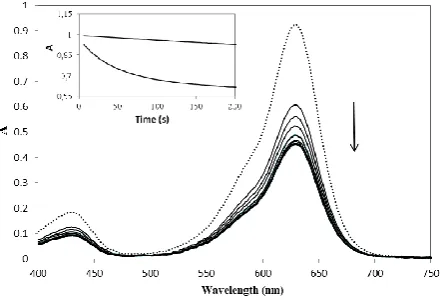
Malachite green under goes a bleaching reaction with sulfide in neutralized media. This process was followed spectrophotometricaly by measuring the decrease in absorbance. It was found that in the presence of Triton X-100 as micellar medium, the trend of reaction was reproducible. Therefore, by measuring the decrease of absorbance versus time in the presence of selected surfactant, the concentration of sulfide can be measured. Figure 1 shows the relationship between Absorbance and reaction time.
The stoichiometry indicated by the results from mole ratio method. Concentration of malachite green was kept constant, while the concentration of sulfide varied. The absorbance of the reaction mixtures was measured after 5, 15 and 25 seconds from the initiation of the reaction.
Figure 1. Absorption spectra of the malachite green-sulfide system at 25 ºC; 5.48×10⁻⁵ M malachite green, 5 g ml-1 S2-, 3.0×10⁻⁴ M Triton-X-100, 2 ml (K2HPO4-NaOH) buffer pH: 7.5; lag time: 3 seconds (absorbance measurement started 3 seconds after sulfide addition). Intercept: continues showing of decreasing in absorbance in 100 seconds (s: sample, b: blank).
Point of inflexion on the curve corresponds to reaction stoichiometry. The result from Job’s method continues variation agreed with finding previously.
The 2:1 malachite green:sulfide stoichiometry indicated by results of mole ratio and Job’s method continues variation in the presence of surfactant, suggests that the overall reaction can be proposed by reaction:
2MG+ + S2- → MG 2S
After inflexion point, when the absorbance values have been constant, the molar absorptivity calculated 1.99±0.016 ×10⁴ M-1 cm-1.
Figure 2. Plot of absorbance versus mole ratio for the reaction of malachite green with sulfide. Experimental conditions: malachite green: 6.85×10⁻⁵ M, sulfide (2.74×10⁻⁴-2.28×10⁻⁵ M), 2 ml (K2HPO4-NaOH) buffer pH: 7.5; lag time: 3 seconds; T: 25 ºC,
( t: 5 s), ( t: 15 s) and ( t: 25 s).Intercept: Job's method of continues variations of malachite green-sulfide systems; concentration of malachite green and sulfide solutions: 5.52×10⁻⁴ M.
Effect of pH: the effect of pH on the rate of reaction was investigated in pH range 5.5 – 8.5. A) in three selected fixed times measured and plotted versus pH. It was observed that the color of malachite green bleaches in neutralized pH. Therefore study was carried out in pH: 8.
Figure 3. Effect of pH on the rate of reaction. Experimental conditions: 5.48×10⁻⁵ M malachite green, 5 g ml-1 S2- (blank was without sulfide), 2 ml (K2HPO4-NaOH) buffer pH: 7.5; lag time: 3 seconds; fixed time method: ( t: 5 s), ( t: 15 s) and ( t: 25 s).
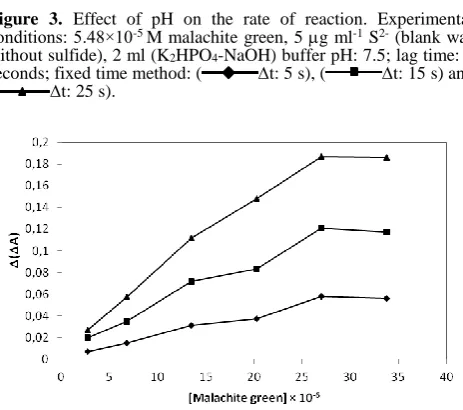
Figure 4. Effect of malachite green concentration on the rate of reaction. Experimental conditions: 1.37×10⁻⁵–1.096×10⁻⁴ M malachite green, 5 g ml-1of S2- (blank was without sulfide), 2ml (K2HPO4-NaOH) buffer pH: 7.5; lag time: 3 seconds; fixed time method: ( t: 5 s), ( t: 15 s) and ( t: 25 s).
Effect of reagent’s concentration: Fig. 4 shows the effects of concentration of malachite green. It was observed that the difference in the absorbance ((A)=AS-Ab) increases with increasing malachite green concentration up to 6.85×10⁻⁵ M and reached to constant value at higher concentration. This phenomenon was due to the fact that in high concentration of indicator the blank effect increased and caused to decrease the net reaction rate.
Effect of temperature: the effect of solution temperature on the malachite green- sulfide system was studied at various temperatures and the results obtained were shown in Figure 5. Temperature influence on the reaction rate was investigated in the range of 15 to 30 ºC at optimum conditions. The rate of reaction was increased with increasing temperature. The blank absorbance had affected up to 25 ºC more than sample. So the difference between blank and sample Absorbance ((A)) beginning to decrease or has same value after 25 ºC. Thus, 25 ºC was selected as optimum temperature.
Figure 5. Effect of temperature on the reaction rate. Experimental conditions: 6.85×10⁻⁵M malachite green, 3g/ml-1 S2- (blank was without sulfide), 2ml (K2HPO4-NaOH) buffer pH: 7.5; lag time: 3seconds;T: 5-45 ºC. Fixed time method: ( t: 5 s), ( t: 15 s) and ( t: 25 s).
Order of addition of reagents. Different order of addition of reactants was discussed in figure 6. It was found that the order of addition can affected the rate of reaction. The sequence (3) with buffer-surfactant-indicator-water-sulfide order, gave the maximum rate of reaction.
Fig. 6. Reaction rate variation with reactants addition order. (1) surfactant (Su.) + malachite green (M.G.) + buffer(Buf.) + water (W) + Sulfide ion (S) (2) Buf+M.G+Su+W+S (3)
Buf+Su+M.G+W+S (4) Buf+Su+M.G+S+W (5)
Su+M.G+S+Buf+W (6) M.G+S+Su+Buf+W. Experimental conditions: 6.85×10⁻⁵M malachite green, 5g.ml-1 S2- , 2ml (K2HPO4-NaOH) buffer pH: 7.5; lag time: 3 seconds; T: 25ºC. Black columns: t=25, white columns: t=15 and dashed columns:
t=5. 0
0,02 0,04 0,06 0,08
0 0,2 0,4 0,6 0,8 1
A
Concentration of surfactant: Under the optimum conditions, surfactants can promote the reaction rate.33-36 The influence of micellar medium on the reaction rate was examined. The surfactants solutions were used at concentration above the critical micelle concentration (CMC).
Table 4. Surfactant effects tasted on the rate of malachite green-sulfide reaction.
Surfactant Type CMC (M) Micellar effect
Triton X-100 Nonionic 3.0×10⁻⁴ Positive
SDSa Anionic 8.1×10⁻³ Negative
CTABb Cationic 1.3×10⁻³ Inert
CPCc Cationic 1.2×10⁻⁴ Inert
aSodium dodecyl sulfate. bCetyltrimethyl ammonium bromide. cCetylpyridinium chloride
It seems that both ionic micelles, cationic and anionic surfactant, are not suitable surfactant for malachite green- sulfide system. In the presence of Triton X-100, positive effect on reaction rate occurred. To see the role of nonanionic surfactant Triton X-100 on the raction rate, a series of kinetic runs were carried out with varied concentrations of surfactant from 0 M to 0.025 M (Figure 7). The reaction was found to be accelerated by Triton X-100 with the rate constant increasing as Triton X-X-100 concentration increased reaching a plateau at higher concentration.
Figure 7. Effect of Triton X-100 concentration on the reaction rate. Experimental conditions: 0–0.025 M Triton X-100, 6.85×10⁻⁵ M malachite green, 3 g mL-1 S2- (blank was without sulfide), 2 ml (K2HPO4-NaOH) buffer pH: 7.5; lag time: 3 seconds; T: 25ºC. Fixed time method: ( t: 5 s), ( t: 15 s) and ( t: 25 s).
The presence of Triton X-100 molecules on the interfacial region provides possible an additional attractive interaction for the malachite green molecules. This is likely thr role Triton X-100 is playing towards the observed catalysis. The surfactant thus, helps in bringing the reactants together into a small volume, which orients in a manner suitable for the reaction to take place followed by rearrangement of Triton X-100 molecules.
Analytical characteristics
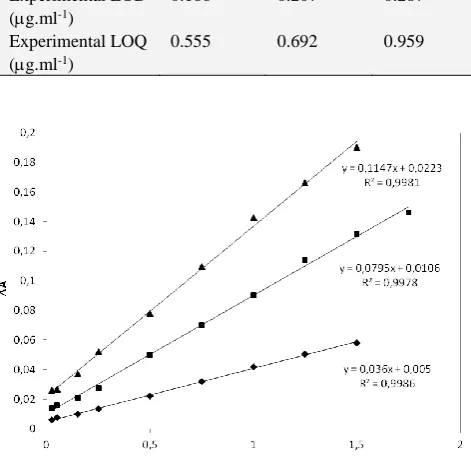
Three calibration graphs were obtained by plotting Avs. sulfide concentration, with applying the fixed time method at 5, 15 and 25 seconds from the initiation of the reaction. These interval times selected due to the good correlation obtained between A and concentration of sulfide. The linearity was obtained under the already mentioned optimum experimental conditions.The maximum linearity range was achieved 25-1750 ng.mL-1 for 15 seconds fixed time method.The statistical parameters such as different standard deviation andtheoretical and experimental limit of detection and limit of quantificationcalculated and reported in Table 2.
Table 2. Statistical and regression parameters from calibration curves.
Time interval (s) t=5 t=15 t=25
Linear range, ng mL-1
25 - 1500 25 - 1750 25 - 1500
Slope 3.6×10⁻² 7.95×10⁻² 11.47×10⁻²
Intercept 5×10⁻³ 1.06×10⁻² 2.23×10⁻²
Correlation coefficient
0.9986 0.9978 0.9981
SD(y/x) 2.86×10⁻³ 4.08×10⁻³ 1.09×10⁻²
SD of slop 1.52×10⁻³ 2.16×10⁻³ 5.78×10⁻³ SD of intercept 2.01×10⁻³ 2.87×10⁻³ 7.68×10⁻³
Number of replicate
5 5 5
Theoretical LOD (g.ml-1)
0.238 0.153 0.285
Theoretical LOQ (g.ml-1)
0.794 0.513 0.959
Experimental LOD (g.ml-1)
0.166 0.207 0.287
Experimental LOQ (g.ml-1)
0.555 0.692 0.959
A Ringbom plot is established standard method to give the effective range of concentration for a system that obeys Beer's law. The plot of Ringbom was drawn between 1-T
and log C, where T is transmittance and C is sample concentrations. The plot is not a straight line in different t. The effective range of concentration for accurate determination from Ringbom's plot obtained and reported in Table 3.
Figure 9. Ringbom plot. Experimental conditions: 6.85×10⁻⁵ M malachite green, 25-1750 ppb of S2-, 2 ml (K2HPO4-NaOH) buffer pH: 7.5; lag time: 3 seconds; T: 25 ºC. Fixed time method:
( t: 5 s), ( t: 15 s) and ( t: 25 s).
From Figure 9 the slop of the linear range of Ringbom’s plot found. Based on this value, the ratio between the relative error in concentration and photometric error are calculated. For a photometric error, P=0.01, the relative error in concentration is determined and tabulated in Table 3.
Table 3. Parameters achieved from Ringbom’s plot.
T, s Effective conc.
range, g.ml-1
Slop REa
conc./(Pb) REconc.
5 250-1500 0.064 35.54 0.35
15 250-1750 0.136 16.93 0.17
25 250-1500 0.160 14.39 0.14
a
Relative error in concentration
.
bPhotometric errorTable 4. Determination of standard solution of sulfide (n=8).
Fixed time, s
Taken amount, ng.ml-1
Founda
amount ng.ml-1
Confidence limitb
ng.ml-1
Recove-ry (%)
SD (%)
t =5 1500 1472 ±3.26 98.13 3.9
700 698 ±2.51 99.71 3.0
50 48 ±1.17 96 1.4
t =15 1500 1571 ±1.25 104.73 1.5
700 716 ±1.50 102.28 1.8
50 48 ±0.58 96 0.7
t =25 1500 1530 ±3.43 102 4.1
700 694 ±2.59 99.14 3.1
50 47 ±0.67 94 0.8
a
Average of 8 determination, bt for p: 0.05 is 2.365, respectively.32
In order to estimate the accuracy and precision of the suggested method, three standard solutions of sulfide were used. For this purpose, eight replicate determination of each concentration were done and finding results were reported in Table 4.
Effect of foreign ions
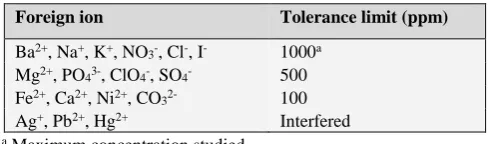
The interference of different foreign ions was discussed in the determination of 0.5 g ml-1 of sulfide. The tolerance limit was defined as a concentration of added ion causing less than a ±5 % relatively error. Aliquot amount of foreign ions with 50, 100, 500 and 1000 ppm were used. The results are summarized in Table 5.
Table 5. Influence of foreign ion on the determination of sulfide
Foreign ion Tolerance limit (ppm)
Ba2+, Na+, K+, NO3-, Cl-, I- 1000a Mg2+, PO43-, ClO4-, SO4- 500 Fe2+, Ca2+, Ni2+, CO32- 100 Ag+, Pb2+, Hg2+ Interfered a Maximum concentration studied.
Most common ions in water such as Na+, K+, NO 3-, Cl-, I -did not interfere, even when present on maximum concentration (1000 ppm). Some ions such as Ag+ and Pb2+and Hg2+ in the first concentration test at 50 ppm were shown interfered effect. In some literatures, the interfering of ions effects were considerably removed by suitable methods like that addition of EDTA or use from ion exchanger.26,28 In the presented work, the effect of diverse ions tabulated without using any masking or modified external reagents.
Determination of kinetic parameters
A primary goal of chemical kinetics experiments is to measure the rate law for a chemical reaction. One of the many ways to do this is the method of pseudo-first order conditions. All the kinetic measurements were carried out at the concentration of malachite green at least 10 folds greater than of the sulfide concentration. The total equation of reaction rate to be of the form:
(1)
(2)
2
S
A
r k
t
(3)
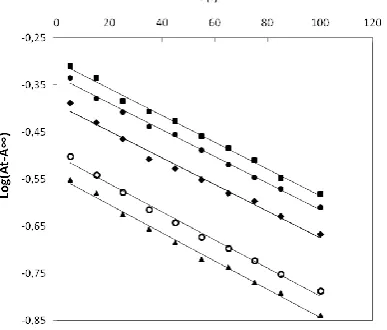
By taking a natural log of the rate equation, the pseudo-first order plots of the log(At–A∞) versus time were made (Fig. 10) (A∞ and At are the absorbance of reaction at the end and selected time t at the reaction).
n m
2
MG S
r k
m m
2 2
obs 0
MG n S
Figure 10. Pseudo-first order diagram for the reaction between malachite green and sulfide. Reaction conditions: [S2-] = 3.2×10⁻⁶, [MG+] = 4.7-3.61×10⁻⁵, max=630 nm, pH=8 and T=25ºC.
The pseudo-first order plots were linear. This suggest that the reaction is the first order in sulfide ion (m=1). The observed pseudo-first order rate constant (kobs) obtained from the slopes of the above plots. The actual rate constant (kact) was obtained from kobs/[MG+]. kobs and kact reported in Table 6. The values of actual rate constant were fairly constant. It is suggesting that the reaction is also first order in malachite green (n=1) and that the reaction is second order overall. It is verified with plotting log (At-A∞) versus time (Fig. 11) while the concentration of sulfide at least 10 folds greater than of the malachite green concentration. The new pseudo-first order plots were linear, too. This suggests that there is no product inhibition.
Figure 11. Pseudo-first order diagram for the reaction between malachite green and sulfide. Reaction conditions: [S2-] = 3.2×10⁻⁵, [MG+] = 4.7-3.61×10⁻⁶, max=630 nm, pH=8 and T=25ºC.
The overall rate equation as function of concentration of malachite green and sulfide ions can now be written as:
(4)
where kactand kobs are 1.40±0.12 M-1 min-1 and 5.76±0.16 min-1.
Table 6. Observed and actual rate constant for the reaction of malachite green with sulfide. [S2-] = 3.2×10⁻⁶ M, pH = 8, max= 630 nm and T = 25 ºC.
[Malachite green] M
kobs
min-1
kact
M-1min-1
4.70×10⁻⁵ 5.84 1.24
4.52×10⁻⁵ 5.89 1.30
4.11×10⁻⁵ 5.89 1.43
3.75×10⁻⁵ 5.59 1.49
3.61×10⁻⁵ 5.57 1.54
In order to evaluate the activation energy, Arrhenius equation was applied using the relationship below:
(5)
(6)
(7)
where E# is the Arrhenius activation energy, A is the
Arrhenius constant and R is the global gas constant. When ln(A/t) was plotted against (1/T), a straight line with slop –E#/R and intercept lnA was obtained. The founded value
of E# presented in Table 6.
The enthalpy of reaction (H≠) was obtained from equation (8) and the entropy of activation achieved from equation:
(8)
(9)
where k and h are rate constant and Plank’s factor, respectively, and A achieved from Equation 7. Finally, free energy of activation calculated according to equation:
(10)
The obtained results are shown in Table 7.
The G# values were negative which reflects the spontaneous nature of the bleaching of malachite green dye in the presence of sulfide at the range of temperatures studied. The positive H# indicates that the bleaching process was endothermic.
Determination of sulfide in real samples
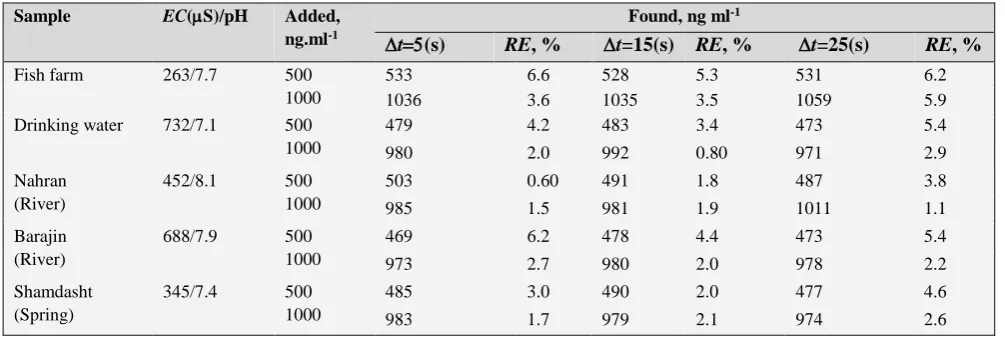
The analytical potential of the method was tested by applying it to the determination of spiked amounts of sulfide in real water samples from river, spring, drinking water and fish farms without any purification or using from masking agents. These results indicate that common constituents in real water samples did not interfere in the proposed method. The results are given in Table 8.
2 act MG S
ratek
#/
E RT
KAe
#
lnK lnA E RT
#
1
ln A lnA E
t R T
# #
E H RT
R +ΔS /R#
kT
A e
h
# #
G H T S
Table 7. Determination of kinetic parameters (H#, S# and G# calculated in 25 ºC)
t (s) E# (J mol-1) H# (J mol-1) S# (J mol-1 K-1) G# (kJ mol-1)
5 26607.29 24171.29±41.57 583.25±1.78 146.72±3.45
15 13733.89 11297.89±41.56 649.80±0.84 179.09±3.52
25 10182.60 7745.99±41.58 666.06±0.77 187.41±3.58
H#, S# and G# are the average of three calculations in three temperatures (15, 20 and 25 ºC).
Table 8. Simultaneous determination of sulfide in natural waters.
Sample EC(S)/pH Added, ng.ml-1
Found, ng ml-1
t(s) RE, % t=15(s) RE, % t=25(s) RE, %
Fish farm 263/7.7 500
1000
533 6.6 528 5.3 531 6.2
1036 3.6 1035 3.5 1059 5.9
Drinking water 732/7.1 500 1000
479 4.2 483 3.4 473 5.4
980 2.0 992 0.80 971 2.9
Nahran (River)
452/8.1 500
1000
503 0.60 491 1.8 487 3.8
985 1.5 981 1.9 1011 1.1
Barajin (River)
688/7.9 500
1000
469 6.2 478 4.4 473 5.4
973 2.7 980 2.0 978 2.2
Shamdasht (Spring)
345/7.4 500
1000
485 3.0 490 2.0 477 4.6
983 1.7 979 2.1 974 2.6
Conclusion
The malachite green- sulfide system in micellar medium, proposed in this paper, could be used successfully for the determination of trace amount of sulfide in different water samples. Using this method, it is possible to determine sulfide at levels as low as 1ng/ml without the need for any preconcentration steps. Therefore, the method could be proposed for environmental analyses. Suggested method has added advantages over other reported spectrophotometric methods (table 1) like sensitivity, time of analytical signal, simple instrument for operator and cheaper chemical reagents.
Acknowledgements
Financial support from the research affairs of University of Guilan and Qazvin water Board Company is acknowledged.
References
1Guenther, E. A., Jonson, K. S., Coale, K. H., Anal. Chem., 2001,
73, 3481-3787.
2Eaton, A. D., Clesceri, L. S., Greenberg, A. E., Standard methods
for the Examination of Water and Wastewater; 19 th Ed. American Public Health Association; Washington, 1995. 3Kirk, R. E., Othemer, D. F., Encyclopedia of Chemical
Technology; 3rd Ed.; Wiley: New York, 1981; Vol. 17. 4Ebdon, L., Hill, S. J., Jameel, M., Corns, W. T., Stochwell, P. B.,
Analyst, 1997, 122, 689.
5Kuhl, M., Steuckart, C., In: In Situ Monitoring of Aquatic
Systems: Chemical Analysis and Speciation; Buffle, J., Horvai, G., Eds.; Wiley: Chichester, U.K., 2000; p. 121. 6Cline, J. D., Limnol. Oceanogr., 1969, 14, 454-58.
7Sakamoto-Arnold, C. M., Johnson, K. S., Beehler, C. L., Limnol.
Oceanogr., 1986,31, 894-900.
8Berner, R. A., Geochim. Cosmochim. Acta,1963, 27, 563-75. 9Brendel, P. J., Luther, G. W. III., Environ. Sci. Technol., 1995, 29,
751.
10Jeroschewski, P., Steuckart, C., Kuhl, M., Anal. Chem., 1996, 68, 4351.
11Canterford, D. R., Anal. Chem., 1975, 47, 88. 12Cutter, G. A., Oatts, T. J., Anal. Chem., 1987, 59, 717. 13Radford-Knoery, J., Cutter, G. A., Anal. Chem., 1993, 65, 976. 14Tang, D., Santschi, P. D., J. Chromatogr. A, 2000, 883, 305. 15Lambert, J. L., Manzo, D. T., Anal. Chim. Acta, 1969, 48, 185. 16Roman Ceba, M., Vinagre Java, F., Munoz Leyva, J. A., Analyst,
1982, 107, 781.
17Wood, C. F., Marr, I. L., Analyst, 1988,113, 1635.
18Koh, T., Miura, Y., Yamamuro, N., Takaki, T., Analyst, 1990,
115, 1133.
19Koh, T., Takashi, N., Yamamuro, N., Miura, Y., Anal. Sci., 1993,
9, 487-492.
20Barzegar, M., Jabbari, A., Esmaeili, M., Bull. Korean Chem. Soc.
2003,24, 1261-1264.
21Zheng, H., Li, Q., Bai, H., Liu, G., J. Chinese Chem. Soc., 2005
52, 269-272.
22Varma, Y. S., Singh, I., Garg, B. S., Singh, R. P., Microchemical,
1984,30, 20-26.
24Safavi, A., Ramezani, Z., Talanta, 1997,44, 1225-1230. 25Ghasemi, J., Mohammadi, D. E., Microchem. J.,2002,71, 1-8. 26Safavi, A., Moradlou, O., Maesum, S., Talanta, 2004, 62, 51-56. 27Afkhami, A., Srlak, N., Zarei, A., Madrakian, T., Bull. Korean
Chem. Soc.,2006,27, 863-868.
28Jabbari, A., Shamsipur, M., Microchem. J., 1993,48, 349-355. 29Silva, R. C., Barros, A. F. V., Basso, L. C., Zagetto, A. G.,
Talanta, 2011, 85, 1703-1785.
30Emami, M., Mousavi, M. F., Barzegar, M., J. Chin. Chem. Soc.,
2004,51, 517-521.
31Thomas, H., Britton, S., Robinson, R. A., J. Chem. Soc., 1931, 1456-1462.
32Ensafi, A. A., Keyvanfard, M., Anal. Lett., 2000, 35, 423-433. 33Keyvanfard, M., Sharifian, A., Anal. Chem., 2006,61, 646-650. 34Ensafi, A. A., Keyvanfard, M., Anal. Chem., 2002, 83, 397-404. 35Shemirani, F., Asghari, A., Hajimoosa, M., Talanta, 1999, 48,
879-883.
36Abbasi, S., Khani, H., Gholivand, M. B., Naghipour, A., Farmany, A., Abbasi, F., Spectrochim. Acta, 2009, 72, 327 – 331. 37Miller J. N. Miller, J. C., Statistical and Chemometrics for
Analytical Chemistry., Fifth ed., Person education, London,
2005.
Received: 03.07.2014.