Analysis of Xi’s Diplomatic Speeches from the
Perspective of Appraisal Theory
Yun Lian
Shanxi Normal University, 041004, China
Abstract—From a linguistic perspective, diplomatic speeches contain a wealth of appraisal resources to show the attitude tendency of the speech subject and the government who represents. From the perspective of the construction of national discourse, diplomatic speeches have a positive effect on the transmission of positive energy in a country and have an important value for the construction of national discourse. The research will analyze speeches that president Xi has made at the "Belt and Road" summit and at the BRICS summit. By artificial annotation, the author will use Antconc3.2.4 corpus retrieval software to sum up frequency of appraisal resources appearing in the speech discourse, then combing with quantitative and qualitative analysis method to explore how president Xi used the appraisal resources to transmit the Chinese voice and build the Chinese discourse in the diplomatic speeches from the achievements of international cooperation, the challenges and the contribution made by China.
Index Terms—appraisal theory, positive discourse analysis, diplomatic speech, discourse construction
I. INTRODUCTION
At present, western media occupies a dominant position in the spread of international public opinion. There is a great imbalance in the flow and shaping of international discourse. The perception by the international community of the image of our government mainly stems from the shaping of the discourse system in the west media and is often not consistent with objective facts.[4]There are even individuals or institutions that throw "China threat theory." Zhao Qizheng (2010) pointed out that in the event of a serious imbalance, it is necessary to build China’s own words, to build Chinese discourse for the world to correctly understand China and the Chinese government.
How to understand Chinese discourse? Different scholars give different explanations. First of all, discourse is not a linguistic sign of "talking to oneself." Instead, it is a medium of communication between individuals who express themselves, communicate or reach consensus on the "other". Second, Professor Yan (2014) pointed out that Chinese discourse is a system of ideas that accurately reflects the substance of a particular practice. Therefore, the construction of Chinese discourse is to construct a language that accurately reflects contemporary Chinese social practices, accurately summarizes and expresses it in our own language. Thirdly, Professor Chen Shuguang (2015) pointed out that China is like an acting giants and a language dwarf. The construction of Chinese discourse system needs to answer a number of basic questions such as "who is speaking," "how to speak," "what to say," "whom to talk to," "how to talk," and so on.
Li Yuanshou (2003) pointed out that political speeches refer to "a speech is delivered on state affairs and diplomatic relations," including election speeches, inaugural speeches and diplomatic speeches. It can be seen that diplomatic speeches belong to political speeches which not only represents the official status of the state, but also represents the individual. It is an important channel for international exchange and dissemination and an important manifestation of the practice of political discourse. And sometimes "who is talking" is more important than "what to say." Obviously, president Xi's diplomatic speech has become an important platform to show the image of China, sends out the voice of China, and constructs Chinese discourse. Therefore, it is necessary for us to conduct an analysis of the president xi’s diplomatic address so that domestic and international audiences can better understand China's current practice and the international community can truly understand the substance of China's development path.
II. THEORY FRAMEWORK
A. Appraisal Theory
In the early 1990s, Martin has already started to study the appraisal system. From 1991 to 1994, he chaired a “Write It Right” research program to study the language proficiency of secondary and other settings in New South Wales, Australia. He later worked with Peter White, Rick Iedema, and Joan Rothery on language profiling, summarized as a "rating system." In the late 1990s, he accelerated the pace of his research and increased his research efforts. He read a paper on "Evaluation System" at the International Systemic-Functional Linguistic Symposium held in Sydney University of Technology in 1996. In 2000, his paper, “Beyond Exchange: APPRAISAL System” in English published
in the book entitled Evaluation in Text.[8] Domestic scholars such as Wang Zhenhua (2001) discussed the new development of system functional linguistics--appraisal theory and its operation; Li Zhanzi (2004) analyzed the application of evaluation theory in commercial advertisement, historical discourse and autobiographical discourse. In 2005, Zhu Yongsheng and other scholars published a book named introduction of systemic functional linguistics in which appraisal theory was talked again. The research of appraisal theory provided us with a solid theoretical foundation.
The appraisal theory deals with language resources discourse or speaker to express, negotiate specific subject relations or ideology. It consists of three main systems: "attitude", "graduation", "engagement". Attitude refers to the judgement and appreciation of human behavior or process or phenomenon speakers or subjects made after they are psychologically influenced. The central component of the attitude system is the affect system. The judgement system and the appreciation system are based on the affect system. Affect systems are mental reactions to behaviors, texts / processes and phenomena. The judgement system assesses the language user's behavior based on ethical standards and is implemented by two subsystems: social esteem and social sanction. Social esteem is about the evaluation of people's code of conduct, work ability and perseverance and it is a "moral category." Social sanction refers to reliability and legitimacy of human behavior and it is about "legal category." Appreciation system is the text/process and the phenomenon of evaluation, including the reaction, composition and value.
Engagement system is used to study sources of attitude, including monogloss and heterogloss. Heterogloss refers to state another opinion that may exist. Heterogloss can be divided into: contraction, expansion. Contraction involves attributing quoted propositions to a person with a surname, making it "warrantable," "reliable," and closing the door to other positions. Expansion alienates itself from the quoted proposition, making it "possible", in other words, it opens the door to another voice.
Graduation refers to the rise and fall of attitude, followed by the systematic into the language and focus. Grading evaluative words that indicate degree belong to the force; while evaluation words that indicate degree are hierarchical classification of non-hierarchical empirical categories are focus.
(J.R.Martin & P.R.R. White, 2008)
B. Positive Discourse Analysis
Critical discourse analysis and positive discourse analysis are two different approaches to analyze discourse, which are widely used in various discourse analysis. Critical discourse analysis is intended to reveal the implicit ideological implications of discourse through the dissection of a large number of specific and authentic corpus, with objective linguistic evidence and exhaustive analysis, especially those prejudices, discriminations and the distorted facts. On the contrary, positive discourse analysis aims to analyze discourse from the positive perspective and it is toward such a lofty goal of "peace linguistics" and to ultimately create a relaxed, reconciled and co-located human society.
Based on lexical meaning analysis, the appraisal theory is one of the theoretical resources that can be used in positive discourse analysis. This essay will analyze the shaping of China's image and the construction of Chinese discourse in the diplomatic speech of president Xi from the perspective of positive discourse.
III. DATA COLLECTION
Based on the appraisal theory, this article analyzes Xi’s diplomatic speeches. By hand-finishing the text, there were 4716 words in two speeches. Based on the well-known appraisal theory: attitude, engagement and graduation are artificially marked, and then Antconc3.2.4 corpus retrieval software is used to count the appearance frequency of each evaluation resource in the speech discourse. Finally, through quantitative comparative analysis and qualitative analysis, combined with the specific context, from three aspects: the international cooperation and development achievements, challenges and China's contribution in international cooperation, the author will explore how president Xi use a wealth of positive appraisal resources to conduct consultations with the audience and reach consensus so as to build a positive Chinese discourse and to deliver positive energy of China.
IV. ANALYSIS AND DISCUSSION
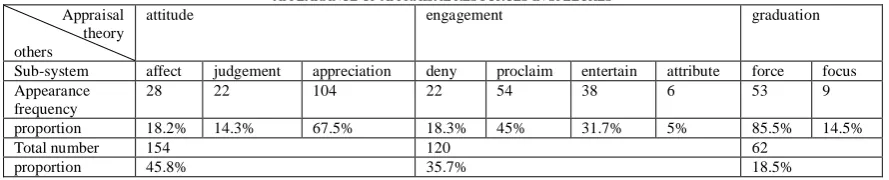
Using the corpus retrieval software Antconc3.2.4 to search and count the appearance frequency of three subsystems in the diplomatic speeches of President Xi, we find that a large number of appraisal resources are used. Sun Jinbo (2012), Luo Juan (2017) and Guo Xiaoli (2015) respectively studied Premier Wen Jiabao's speech, Trump's election speech and Ban Ki-moon's speech at Nanjing University. They found that these lectures all used rich appraisal resources, which shows that appraisal resources play an important role in the speeches. Table 1 shows the distribution of appraisal resources in president Xi's diplomatic speech.
TABLE 1
APPEARANCE OF APPRAISAL RESOURCES IN SPEECHES
Appraisal theory others
attitude engagement graduation
Sub-system affect judgement appreciation deny proclaim entertain attribute force focus Appearance
frequency
28 22 104 22 54 38 6 53 9
proportion 18.2% 14.3% 67.5% 18.3% 45% 31.7% 5% 85.5% 14.5%
Total number 154 120 62
proportion 45.8% 35.7% 18.5%
Table 1 shows that attitude resources, engagement resources, and graduation resources respectively account for 45%, 35.7% and 18.5% of the appraisal resources in president Xi's diplomatic speeches. Among them, attitudinal resources accounted for the largest proportion, close to 50%, followed by engagement resources.
A total of attitude resources are 154. Affect, judgement and appreciation are respectively 29, 22 and 104, accounting for 18.2%, 14.3% and 67.5% of the total attitude resources. Appreciation resources accounted for the largest share of attitude resources. Contract engagement includes deny and proclaim. There are 70 contraction engagement, accounting for 63.3%. Expansion engagement includes entertain and attribute and there are 44, accounting for 36.7%. The proportion of contraction engagement resources is far greater than the expansion engagement resources. Force and focus belong to graduation resource, they are 53 and 9, accounting for 85.5% and 14.5%.
TABLE 2
APPEARANCE OF POSITIVE RESOURCES AND NEGATIVE RESOURCES
Positive\negative Attitude resources
affect judgement appreciation Total number proportion
positive 25 21 96 140 90.9%
negative 1 8 14 14 9.1%
Table 2 shows that positive attitude resources and negative attitude resources are respectively 90.9% and 9.1%. Positive attitude resources are 10 times of negative attitude resources, indicating that president Xi is more inclined to use a positive attitude resources in diplomatic speeches. On the one hand, he expressed satisfaction with the achievements of international cooperation, the happiness of affect attitude; on the other hand, it shows the President Xi, on behalf of the Chinese government, takes a positive attitude to meet the new challenges and new crises facing the current international cooperation and hopefully joins hands with other countries to build a beautiful future.
A. Achievements of International Cooperation from the Perspective of Discourse Construction
Scholars who analyze discourse from the perspective of positive discourse under the framework of appraisal theory basically follow the order of attitudes, interventions and level differences. After familiarizing with the corpus text, this essay discovers that the contents of the diplomatic speech of General Secretary Xi can be summarized as three aspects, the achievements made in the cooperation between the state and BRICS countries under the strategy of "One Belt and One Road", the current challenges and the contribution made by China in international cooperation. Therefore, this article breaks the order of analysis of the original attitudes, interventions and steps, and from the above three aspects, explores how General Secretary Xi used the appraisal resources to shape China's image and build Chinese discourse.
① Over 2,000 years ago, our ancestors, trekking across vast steppes and deserts, opened the transcontinental passage connecting Asia, Europe and Africa…
③ …witness to this exciting period of history. Spanning thousands of miles and years, the ancient silk routes embody the spirit of peace and cooperation...
④ These pioneers won their place in history not as conquerors with warships, guns or swords. Rather, they are remembered as friendly emissaries leading camel caravans and sailing treasure-loaded ships.
⑤ The ancient silk routes were not for trade only, they boosted flow of knowledge as well.
⑥ From the historical perspective, humankind has reached an age of great progress, great transformation and profound changes.
⑦ Never have we seen such close interdependence among countries as today, such fervent desire of people for a better life, and never have we had so many means to prevail over difficulties.
⑧ …the Belt and Road Initiative is not meant to reinvent the wheel. Rather, it aims to complement the development strategies of countries involved by leveraging their comparative strengths....
⑨ A large number of connectivity projects are also in the pipeline. Today, a multi-dimensional infrastructure network is taking shape,...
Attitude system includes affect expression, judgement of character and value appreciation and all three have positive and negative points. Positive attitude resources indicate the active attitude of the speaker. In diplomatic speeches, when General Secretary Xi elaborated on the achievements made in international cooperation, he used a wealth of positive attitude resources such as exciting, ancient, close, great, profound, fervent, better, multi-dismensional, open, created, trekking, friendly. The "One Belt and One Road" strategy proposes to carry forward the common development and share the fruits of development with the BRIC cooperation mechanism and create a community of development and destiny that is connected with happiness and common prosperity. General Secretary Xi used positive appreciation resources such as close, great, profound, multi-demensional, open, created to prove that the remarkable achievements of international cooperation have not only made the relations between countries closer but also have occurred great changes in the field of cooperation. It is easier to get an agreement with the audience. Exciting, ancient express President Xi's satisfaction and joy towards the cooperation achievement. Rough, vast are negative appreciation resources, which shows Chinese people's determination to overcome difficulties and indomitable spirit. In addition, the use of language resources in lectures, such as over, thousands of, aims to show that the Silk Road has a long history and profound historical roots. A large number of, flow of, many, thousands of illustrate silk road has achieved great grades. Besides, the Silk Road has already surpassed the trade boundary and has achieved great changes in other aspects such as knowledge exchange, achieving the goal of mutual benefits and achieving win-win results. Finally, the use of contract resources in the speech of General Secretary Xi not, only, rather, never indicates that Chinese government would like to work together with other countries to contribute the development and create harmonious big family and share the fruits of development.
The "Belt and Road Initiative" summit and the BRICS summit are diplomatic conferences led by China. President Xi used a wealth of positive attitude resources and contract resources and differential resources aiming at showing China's firm stance and spreading China's unswerving commitment, that is, insisting the path of peaceful development and common development instead of threatening to other countries. These appraisal resources shape the image of a responsible country and build a vibrant Chinese discourse.
B. Analysis of Challenging from the Perspective of Discourse Construction
① …we find ourselves in a world fraught with challenges. Global growth requires new drivers, development needs to be more inclusive and balanced, and the gap between the rich and the poor needs to be narrowed.
②Hotspots in some regions are causing instability and terrorism is rampant. Deficit in peace, development and governance poses a daunting challenge to mankind.
③Yet today, these places are often associated with conflict, turbulence, crisis and challenge.
④We should work to resolve hotspot issues through political means… We should intensify counter-terrorism efforts,… and strive to eradicate poverty, backwardness and social injustice…we should build the Belt and Road into a road of prosperity.
⑤As the world undergoes profound and complex changes, BRICS cooperation has become more important.
⑥We must redouble our efforts to comprehensively deepen BRICS partnership and we need to make the international order more just and equitable.
⑦Without our participation, many pressing global challenges cannot be effectively resolved.
Must, should belong to expansion resources, aiming to appealing the audience standing the same line and working together to accomplish the history mission and move towards a bright future. In contrast, contract resources implies the challenge of intervention in discourse, limiting other voices and position. Without and cannot show the affirmative attitude, excluding the intervention of other discourses, indicating that Xi firmly believes that cooperation is the only option in the face of challenges. Only by cooperation can we achieve win-win results.
The use of these appraisal resources shows that Chinese government is brave enough to take responsibility for arduous task and china will cooperate other countries to establish beautiful home, construction positive Chinese discourse.
C. Analysis of Contribution of China from the Perspective of Discourse Construction
① China has signed cooperation agreements with over 40 countries…carried out framework cooperation… with more than 30 countries.
② China has reached a new starting point in its development endeavors…we will adapt to and steer the new normal of economic development and…We will actively promote supply-side structural reform to achieve sustainable development, inject strong impetus into the Belt and Road Initiative and create new opportunities for global development.
③ We are ready to share practices of development with other countries, but we have no intention to interfere in other countries' internal affairs,…
④ We have no intention to form a small group detrimental to stability, what we hope to create is a big family of harmonious co-existence.
⑤ China will provide assistance worth RMB 60 billion to developing countries and international organizations… to launch more projects to improve people's well-being.
⑥China will contribute four million US dollars… to support the business operation and long-term development of the bank. China will work with all parties to follow through on the outcomes…
Contract divided into deny and proclaim. Proclaim states that the voices in the discourse present the proposition as irrefutable, excluding other voices. In his diplomatic speech, president Xi expresses his attitude and position with a wealth of proclaim resources in explaining China's contribution. As we can see clearly in Table 3, "we" appeared 80 times, While "China" appears 43 times. It fully demonstrated that China not only has sufficient capacity but also has a firm belief to assume the responsibility of common development. At he same time, a wealth of positive attitude resources, such as new, strong, share, hope to, big, harmonious, sustainable, and contract resources no indicate that president Xi’s stance, on behalf of the Chinese government in diplomatic speeches, the development of China is meant to provide powerful impetus for other countries and share the fruits of development, build a harmonious family of development and benefit more countries and people. Graduation resources never, more than, more strengthen the voice of the speaker to prove China's development achievement. China has confidence to unite other countries to build community and make the due contribution for the world.
TABLE 3
APPEARANCE OF CHINA AND WE
preposition others
We China
appearance 80 43
proportion 65.1% 34.9%
V. CONCLUSION
Chen Shuguang (2015) pointed out that whether or not Chinese discourse making the best use of "Chinese stories" is a basic measure of constructing Chinese discourse with vitality. Whether Chinese discourse can dominate the topic of "involving China" is an important measure of constructing Chinese discourse with vitality. At the summit of the "Belt and Road Initiative" and at the BRICS Summit, president Xi used a wealth of positive attitude resources to express his pride and joy regarding the fruits of international cooperation. At the same time, China as the second largest developing countries will assume the historical mission of common development and share with the fruits of development. Secondly, the use of abundant resources for contract resources aims at excluding the involvement of other voices, demonstrating China's firm stance, that is, its development is not dominated other countries rather than join hands with more countries to create a modern international chorus. He standing for Chinese government declares to the world that China must unswervingly follow the peaceful development path. The use of force graduation resources will give prominence to the remarkable achievements made by international cooperation, highlighting China's contribution in international cooperation. President Xi's diplomatic speech shaped China as a responsible image and built a positive Chinese discourse.
REFERENCES
[2] Chen Shuguang. (2015). Chinese Discourse and Discourse Chinese. Teaching and Research, 10, 41-42 .
[3] Feng Lulu. (2017). A Positive Discourse Analysis of Political Discourse:A Case Study of the State of the Union Address in 2016. Journal of Hefei University of Science and Technology, 4, 88-93.
[4] Guo Zhiming. (2014). Positive Discourse Analysis with Appraisal Theory. Journal of North University, 2, 78-81.
[5] Guo Xiaoli. (2015). Positive Discourse Analysis of Ban Ki-moon;s Speech at Nanjing University from the Perspective of Appraisal Theory. Ph.D. dissertation, Harbin University of Science and Technology.
[6] Huang Guowen & Xin Zhiying. (2011). Functional Linguistics. Beijing: Foreign Language Teaching and Research Press. [7] Hu Zhuanglin, Zhu Yongsheng, Zhang Delu, Li Zhanzi. (2005). Systemic linguistics. Beijing: Beijing University Press. [8] Jiang Ruiping, Zhang Chuxin. (2017). Analysis of Conceptual Metaphor of President Xi’s Diplomatic Speech---Taking Xi’s the
Highest Court Speech at the Uzbekistan as an Example. Journal of Audiovisual Broadcasting and Hosting, 4, 120-121. [9] Li Jianfang. (2016). The Construction Discourse of China from the Perspective of Historical Materialism. Theoretical Guide, 9,
58-61.
[10] Li Yuanshou. (2003). Speeches. Wu Han: Hua Zhong Technology University Press.
[11] Li Zhanzi. (2004). Appraisal Theory: Applications and Problems in Discourse Analysis. Foreign Language Research, 5, 1-6. [12] Luo Juan. (2017). The Speeches of Trump from the Perspective of Appraisal Theory. The Journal of Suzhou College, 9, 8-65. [13] Martin,J.R. & White,P. (2008). The Language of Evaluation: Appraisal in English. New York: Palgrave Macmillan.
[14] Pan Feng, Hei You. (2017). The Construction of Governmental Image in Chinese Government Press Conference Interpreting: A Case Study of the Collocational Patterns of We. Foreign Language and Foreign Language Teaching, 5, 296-298.
[15] Shao Shouyi. (2003). Speeches. Changchun: Dongbei Normal University Press.
[16] Sun Jinbo. (2012). Positive Analysis of Premier Wen from the perspective of Appraisal theory. Ph.D. dissertation, Xin Jiang University.
[17] Wang Zhenhua. (2001). Appraisal System and Operating--the New Development of Systemic Functional Linguistics. Foreign Language, 6, 13-20.
[18] Xin Bin. (2005). Critical Linguistics: Theory and Application. Shanghai: Shanghai Foreign Educational Press. [19] Yan Mengwei. (2014). Understanding Chinese Discourse and Constructing Chinese Discourse. Hubei Daily, 10, 6-17.
[20] Zhang Taofu, Xiang Yiqian. (2012). The High Stands of Chinese Political Communication- Investigation of Premier Wen at the Press Conference. Journal of China University of Social Science Edition,5, 74-80.
[21] Zhao Qizheng. (2010). China Boards the Public Diplomatic Arena. Secretarial Work, 6, 46-47.
[22] Zhu Yongsheng, Wang Zhenhua. (2013). Martin Academic Thought Research. Beijing: Beijing University Press.