On the Derivation of Oblique Object
Construction in Mandarin Chinese
Haojie Li
School of Foreign Languages, Southwest University of Political Science and Law, Chongqing, China; Faculty of English Language and Culture, Guangdong University of Foreign Studies, Guangzhou, China
Abstract—This paper explores the derivation mechanism of oblique object constructions in Mandarin Chinese. Based on the Morphological Fusion and the Minimize Exponence in Distributed Morphology, this paper proposes that the oblique object is assigned by the preposition and then the verb, which is intransitive, and the preposition undertakes morphological fusion. As a result, the verb is spelled out in the phonetic components and the oblique object occurs directly after the verb. We infer that “Ta chi shitang” (He eats in the canteen) and “Ta zai shitang chifan” (he eats in the canteen) have different generation mechanisms by exploring the different generation mechanisms of “Ta chi shitang” (He eats in the canteen) and “Ta zai shitang chifan”(he eats in the canteen). They cannot be converted from each other.
Index Terms—oblique object construction, derivation mechanism, distributed morphology, morphological fusion, minimize exponence
I. INTRODUCTION
There is one class of verb-object construction in Mandarin Chinese that can take the object after the intransitive verb, such as:
(1) chi shitang eat canteen
‘to eat in the canteen’ (2) xie maobi
write writing brush
‘to write with the writing brush’ (3) fei Shanghai
fly Shanghai ‘to fly to Shanghai’ (4) shui xiaochuang sleep small bed
‘to sleep in the small bed’
In this type of construction, “canteen”, “Shanghai”, “writing brush”, “small bed” are not direct objects of verbs, but rather non-core/peripheral arguments of verbs, occupying the position of the direct object in the surface structure. (Sun, 2009).
Zhu Dexi (1982) argues that the after-verb composition of this construction is "quasi-object", but he did not give a corresponding explanation for the cause of this kind of quasi-object. Xing Fuyi (1991) maintains that this construction is a phenomenon of “object substitution” and distinguishes between ordinary object and generation object. In previous studies, most syntacticians in the circles of generative grammar used the name of Sun Tianqi (2009), which called this type of construction as the oblique object construction. This article continues to use this name. On the basis of summarizing relevant studies, we point out the problems of these studies, and then uses the Minimize Exponence and the operation of "morphological fusion" in the distributed morphology to explore the generation mechanism of the oblique construction in Mandarin Chinese, mainly focusing on how to solve the problem of licensing the oblique object. The Minimize Exponence promotes the development of DM theory. The morphological fusion is the concrete realization of the Minimize Exponence, which better embodies the economy of the language system. The oblique object construction in Mandarin Chinese is in line with the Minimize Exponence by using the operation of morphological fusion. We propose that the oblique object is assigned by the preposition and then the verb, which is intransitive, undertakes morphological fusion with the preposition. As a result, the verb is spelled out in the phonetic components and the oblique object occurs directly after the verb. We also explore the different generation mechanisms of “Ta chi shitang”(He eats in the canteen) and “Ta zai shitang chifan”(he eats in the canteen). We infer that “Ta chi shitang”(He eats in the canteen) and “Ta zai shitang chifan”(he eats in the canteen) have different generation mechanisms. They cannot be converted from each other.
For the oblique object construction, the researchers are mainly concerned with two questions: how is the oblique object generated, and what are the conditions for the legitimacy of the oblique object? Below we briefly review a few representative assumptions and then point out their problems.
A. Light Verb Hypothesis
Lin (2001) first proposed the use of light verb theory to deal with the construction of the oblique object in Mandarin Chinese. Lin (2001) believes that the light verb is an eventuality predicate, which concludes that the light verb is not included in the semantic structure of the verb. It is realized in the syntactic layer. The verbs in Mandarin Chinese are not as strict as the corresponding English verbs, so Chinese is less restricted in terms of semantic interpretation of objects than that of English. There is no selective relationship between Chinese verbs and their objects, and a light verb connects a verb (whether it is transitive or intransitive) and its subsequent arguments. Unconventional objects like the oblique object are not selected by the main verb, but by the light verb. The main verbs of the oblique object construction are incorporated into light verbs, which ultimately form the surface structure of the oblique object construction. There are four types of oblique objects in Mandarin Chinese, such as tools, locatives, time and reason, which are permitted by the light verbs USE, AT and FOR.
Feng Shengli (2005) inherited and developed the theory of light verbs, and maintains that the complex relationship of unconventional verbs in Mandarin Chinese is caused by the movement of light verbs. Light verbs can be divided into two categories according to their external forms: one is a light verb or an empty verb with no sound, and is represented by the symbol DO; the other is a light verb with a sound, denoted by do. The light verb without sound directly triggers the syntactic movement of the subordinate verbs it controls to the v position and merges with it. The movement needs to be strictly defined and the most fundamental condition is that the moved verb must be c-command by the light verb, which is shown in Figure 1 (Feng, 2005).
vP
Spec v’
v VP
v Vi NP V’
ti NP
Figure 1 Light verb movement of unconventional verb-object structure
The use of the hypothesis of light verbs to analyze the oblique object construction has a certain explanatory power. However, Lin (2001) provides three verbs of USE, AT, and FOR for the analysis of the the oblique object construction. The three verbs cannot explain the usage of “eating the mood” and “cry the Great Wall” in the oblique object construction. Feng Shengli (2005) did not conduct asufficient and reasonable argument for the establishment of the light verb DO without sound, which affected the persuasiveness of the analysis.
B. Empty Component Assumption
Guo Jimao (1999) expounds that the oblique object is permitted by the corresponding implied components. Guo believes that this kind of construction implies a semantic predicate, indicating the relationship between the verb and the following noun. This implied "predicate" is mainly embodied in verbs, prepositions (+ locative) or conjunctions. For example, "flying Shanghai" is "fly + (to + Shanghai)".
Yang Yongzhong (2007a) believes that Vi+NP can be regarded as the product of the syntactic displacement of words, which is generated by the conversion of “Vi+Prep+NP” or “Prep+ NP+Vi”. Yang Yongzhong (2007b) further points out that Vi+NP implies an empty argument and an empty predicate. The empty predicate is responsible for the permission of the oblique object. The “Ta chi shitang” (He eats in the canteen) is converted by “he eats 0 (he) 0 (in) canteen)”.
Yang Yongzhong (2009) uses verb movement to explain the generation of the oblique object construction. Take “Ta chiguo shitang” (he ate in the canteen) as an example. Yang thinks that the sentence first generates “Ta zai shitang guo chi fan”(he in the cafeteria has eaten). The aspect marker “guo”(has) attracts the verb to move, and generates “Ta zai shitang chiguo fan” (he has eaten in the canteen). The verb continues to move to the front of the prepositional phrase along with the aspect marker, generating “Ta chiguo fan zai shitang” (he has eaten at the canteen) and then generated by prepositional deletion to generate “Ta chiguo shitang” (He has eaten the canteen). But Yang did not explain the lack of “fan” (rice).
non-core argument structure (IVO) in the noun phrase arguments to establish the relation through a virtual preposition P
and the verb. Then it forms a verb phrase [VP [ V' V [PP [P' P DP]]]]. That is to say, such a noun phrase is actually a PP
projected by the virtual preposition P.
The analyses of the above three scholars can solve the problem of the licensing of the oblique object. However, setting a corresponding empty predicate or empty preposition for each the oblique object construction will encounter technical troubles in the syntactic operation.
C. Applicative Construction Hypothesis
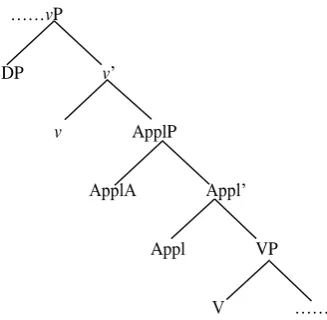
Sun Tianqi (2009) used the phenomenon of application to analyze the oblique object construction. Pylkkänen (2002) abstracts a syntactic category of Applicative Phrases that allows for non-core arguments. The non-core component is in the position of the specifier of the applicative phrase, i.e. the applicative argument. constructions such as "chi shitang"(eat the canteen) belongs to the high-applicative construction defined by Pylkkänen (2002), and the applicative phrase is incorporated above VP, as shown in Figure 2 (Sun 2009).
……vP
DP v’
v ApplP
ApplA Appl’
Appl VP
V …… Figure 2 The tree of high-applicative construction
The applicative construction hypothesis can reasonably explain the phenomenon that the non-core arguments occupy the core argument position, but the content verbs have to undergo multiple movements, which will make the process of syntactic derivation more complicated and the syntactic operation is not economical.
D. The Hypothesis of the Oblique Object Right Adjuncted to the VP
Han Jingquan and Xu Mengmeng (2014) used the phase theory to derive the generation of the oblique object. They argue that in the oblique object construction "Ta chi shitang"(he eats the canteen), the empty object "e" generated in the inner argument of the verb. The oblique object is actually formed by adding the prepositional phrase right to the VP after the preposition falls off. Since "e" does not have a phonetic feature, it will not be spelt out and finally the oblique object appears after the verb.
III. THEORETICAL FRAMEWORK
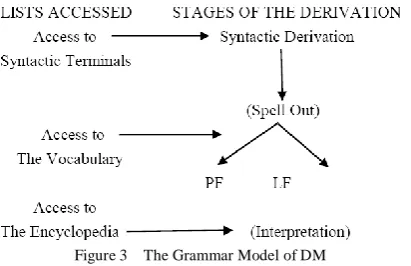
In the following, we introduce the theoretical framework of our paper, including the architecture of Distributed Morphology, the Minimize Exponence and the operation of fusion in Distribution Morphology.
A. Distributed Morphology
Figure 3 The Grammar Model of DM B. Minimize Exponence
There is a central contradiction in grammar for a long time: on the one hand, we must use words to maximize the clarity of information, and on the other hand we must convey this information in the most effective and economical way. To resolve this contradiction, Siddiqi (2009) proposes the Minimize Exponence, which prefers fusion of morphemes to concatenation.
(5) Minimize Exponence
The most economical derivation will be the one that maximally realizes all the formal features of the derivation with the fewest morphemes.
The gist of this economy constraint is that the best utterance is the one that conveys the most amount of information with the least effort (measured in number of morphemes that have to be pronounced). In terms of the production of an utterance, this constraint captures the struggle between the need to be maximally contrastive and the need to be maximally efficient. (Siddiqi 2009: 4)
C. Morphological Fusion
Embick (2015) maintains that in the DM framework, the operation of fusion creates one morpheme (with one Q position) from two by combining the features of the two morphemes prior to the application of Vocabulary Insertion.
The Minimize Exponence promotes the development of DM theory. The morphological fusion is the concrete realization of the Minimize Exponence, which better embodies the economy of the language system.
IV. OUR ANALYSIS
The Minimize Exponence and morphological fusion provide us with a theoretical tool to analyze the oblique object construction in Mandarin Chinese.
Larson (1988) points out that the verb's object and complement are different, so the syntactic structure position should be different. The verb object has substantive, satisfying the verb's requirement for the argument structure, and should be merged at the Spec-VP position. The verb complement has predicative, complements the verb itself, and should be merged at the VP-Comp position. The verb complement is more semantically close to the verb than the verb object. Therefore, in (6), “chi” (eat) is first merged with the complement “zai shitang” (in the canteen), as shown in Figure 4.
(6) Ta chi shitang. he eat canteen
CP
C TP Spec T’
He T vP
Spec v’
(He) v VP eat
V PP (eat)
in canteen Figure 4 The generation process of “Ta chi shitang” (He eats the canteen)
Let us take (6) as an example to explore the specific derivation process of the oblique object construction.
In the case of (6), when the derivation of the oblique object construction begins, the syntactic terminals have the following terms “ta; chi; zai; shitang” (he; eat; in; canteen). According to Baker (1988), when there is a preposition in the D-structure, the preposition assigns theta role and Case to the NP, then the preposition and the verb are incorporated, which is called morphological fusion in the DM framework. V first merged with “zai shitang” (in the canteen) to form a VP. Then, the words “zai” (in)and “chi” (eat) are fused, and only “chi” (eat) is displayed in the morphology. Then VP and v are merged into v', “chi” (eat) copies a copy to v, and DP “ta” (he) is generated at Spec-vP. Then vP and T are merged into TP, which is attracted by the EPP feature of T, and DP “ta” (he) copies a copy to Spec-TP and nominative Case is assigned to “ta” (he). Finally, TP and C merge into CP, and the derivation of “ta chi shitang” (he eats canteen) is completed. According to the Copy Theory of Movement (Chomsky, 1993, 2005), the components in brackets in Figure 6 represent copies left in place forms a chain of words with the merged copy. After the syntactic operation is completed and the spell-out begins, the components in the brackets often have no phonetic realization. The morpheme “zai” (in) are fused with the morpheme “chi” (eat), and they are not spelled out at the PF level, thus forming the oblique object construction. The analysis mode based on the morphological fusion operation embodies the basic spirit of the Minimize Exponence and reflects the economy requirements of the language system.
Our analysis also applies to the structure of the oblique object construction that the previous literature believes cannot supplement the corresponding “implicit components”, such as “ku changcheng” (Crying the Great Wall), “chi wenhua” (Eating the culture), “ji gongche” (Squeezing the Bus), etc. We believe that in these oblique object constructions, the intransitive verbs have the phenomenon of merging with the corresponding prepositions. For example, the “ji” (squeezing) of “ji gongche” (Squeezing the Bus), semantically implies “crowding in”, “squeezing” and “getting on the bus”.”ku” (cry) of “Crying the Great Wall” semantically implies “cry because of...” and the "chi"(eat) of “chi wenhua” (eat the culture)" semantically implies “eat because of...”. In the end, these prepositions are merged with the previous verbs and are not spelled out at PF.
Next let’s look at the example (7) that semantically corresponds to Example (6): (7) Ta zai shitang chifan.
he in the canteen eat ‘He eats in the canteen’
“zai shitang” (in the canteen) in the example (7) is a prepositional phrase, which is the adverbial of the entire sentence. In terms of Larson (1988), the DP “fan” (rice) is merged in the [Spec, VP] position, and the feature checking is performed with the V “eat” to obtain the accusative Case, and assuming the theta role of the patient of the V. Then, VP merges with the light verb v, V “chi” (eat) copies a copy to v; DP “ta” (he) merges at the [Spec1, vP] position to
form a phase vP, and DP “ta” (he) assumes the theta role of agent.
According to the interface condition (Chomsky 2008), after the phase vP is generated, “fan” (rice) is handed over to
the PF and the LF for processing. At this time, the prepositional phrase PP is generated at the [Spec2, vP] position, and
the prepositional phrase PP is formed by the combination of the preposition “zai” (in) and the noun phrase “shitang”
(canteen), and the preposition P is responsible for assigning “shitang” (canteen) the accusative Case. Then vP merges
with T; attracted by the EPP feature of T, the DP “ta” (he) at the vP edge copies a copy at the [Spec, TP] position and the
CP C TP
Spec T’ He T vP Spec2 vP In the canteen
Spec1 v’
(He) v VP eat
rice V’ V (eat)
Figure 5 The generation process of “ta zaishitang chifan” (he eats in the canteen)
Comparing Figures 6 and 7, it can be seen that the process of “ta chi shitang” (he eats the canteen) and “ta zai shitang chifan” (he eats in the canteen) is different, so we conclude that “ta chi shitang” (he eats the canteen) is not converted from “ta zai shitang chifan” (he eats in the canteen). The “chi” (eat) in “ta chi shitang” (he eats the canteen) is an intransitive verb. It is not possible to assign a theta role to “shitang” (canteen) and case-mark it. The locative of the “shitang” (canteen) is given by the preposition “in” that is base-generated at the [Comp, VP] position, and “zai shitang” (in the canteen) is the complement of the verb. Then “chi” (eat) and the preposition “zai” (in) undergo the operation of morphological fusion, only “chi” (eat) is spelled out at the PF level, and finally form the oblique object construction “ta chi shitang” (he eats the canteen). While “chi” (eat) in “ta zai shitang chifan” (He eats in the canteen) is a transitive verb that can assign a theta role to the “fan” (rice) and case-mark it. The prepositional phrase “zai shitang” (in the canteen) is a prepositional phrase, functioning as an adverbial, base-generated in the position of [Spec2, vP]. As a result, We infer that “ta chi shitang” (he eats the canteen) is not converted from “ta zai shitang chifan” (he eats in the canteen).
V. CONCLUSION
In this paper, we use the Minimize Exponence theory and the syntactic operation of morphological fusion in Distribution Morphology to explore the derivation of the oblique object construction in Mandarin Chinese. The Minimize Exponence promotes the development of DM theory. The morphological fusion is the concrete realization of the Minimize Exponence, which better embodies the economy of the language system. The oblique object construction in Mandarin Chinese is in line with the Minimize Exponence by using the operation of morphological fusion. We propose that the oblique object is assigned by the preposition and then the verb, which is intransitive, undertakes morphological fusion with the preposition. As a result, the verb is spelled out in the phonetic components and the oblique object occurs directly after the verb. We also explore the different generation mechanisms of “Ta chi shitang”(He eats in the canteen) and “Ta zai shitang chifan”(he eats in the canteen). We infer that “ta chi shitang” (he eats the canteen) is not converted from “ta zai shitang chifan” (he eats in the canteen).
ACKNOWLEDGEMENTS
This research is funded by General Project of 2017 Chongqing Municipal Education Commission Humanities and Social Sciences Research, P.R.C. Project Name: A Generative Study on the Derivation of the Oblique Object
Construction in Mandarin Chinese under the Framework of Distributed Morphology (No. 17SKG003) and 2017 Key
Project of Southwest University of Political Science and Law, P.R.C. Project Name: A Syntactic Study on the Verb-copying Construction in Mandarin Chinese (No. 2017XZZD-09).
REFERENCES
[1] Baker, M. (1988). Incorporation: A Theory of Grammatical Function Changing. Chicago: University of Chicago Press. [2] Cheng Jie. (2009). The Null Preposition Hypothesis and the applicative construction: A syntactic study of the
post-intransitive-verb non-core arguments. Modern Foreign Languages (1): 23-32.
[3] Chomsky, N. (1993). A Minimalist Program for Linguistic Theory. K.Hale and S.J.Keyser. The View from Building 20: Essays in Linguistics in Honor of Sylvain Bromberger. Cambridge, MA: The MIT Press.
[4] Chomsky, N. (2005). Three Factors in Language Design. Linguistic Inquiry, (36): 1-22.
[6] Embick, D. (2015). The morpheme: A theoretical introduction (Vol. 31): Walter de Gruyter GmbH & Co KG. [7] Embick, D., & Noyer, R. (2001). Movement operations after syntax. Linguistic inquiry, 32(4), 555-595.
[8] Embick, D., & Noyer, R. (2007). Distributed morphology and the syntax/morphology interface. The Oxford handbook of linguistic interfaces. Oxford University Press: 289-324.
[9] Feng Shengli. (2005). Light Verb Movement in Modern and Classical Chinese. Language Science (1): 3-16.
[10] Guo Jimao. A Tentative Study on “fei Shanghai” (Flying Shanghai) and other intransitive verbs with object phenomenon. Studies of the Chinese Language (5): 337-346.
[11] Halle, M. & A. Marantz. (1993). Distributed Morphology and the pieces of inflection. In K. Hale and S. J. Keyser (eds.). The View from Building 20: Essays in Linguistics Honor of Sylvain Bromberger. Cambridge, MA: The MIT Press: 111-176. [12] Han Jingquan, Xu Mengmeng. (2014). A phase-based approach to the derivation of the oblique object construction in Mandarin
Chinese. Journal of Central South University (Social Science) (2): 243-247.
[13] Larson, R. (1988). On Double Object Constructions. Linguistic Inquiry, (19): 335-391.
[14] Lin, T.-H. Jonah. (2001). Light Verb Syntax and the Theory of Phrase Structure. Ph. D. Dissertation, University of California, Irvine.
[15] Sun Tianqi. (2009). On Oblique Objects in Chinese. Chinese Language Learning (3): 70-77.
[16] Xing Fuyi. (1991). Observation on the phenomenon of object substitution of Mandarin Chinese. The World Chinese Teaching (2): 76-84.
[17] Yang Yongzhong. (2007a).On the Pragmatic Motivation of Vi.+NP Construction. Chinese Journal (1): 58-65. [18] Yang Yongzhong. (2007b). The Syntactic Status of NP in Vi+NP. Language Research (2): 59-64.
[19] Yang Yongzhong. (2009). A parametric approach to the typology of non-patient objects. Modern Foreign Languages (1): 33-41. [20] Zhu Dexi. (1982). Grammatical Lecture. Beijing: Commercial Press.
Haojie Li was born in Shandong, China in 1974. He received his M.A. degree in Sichuan International Studies University in 2005 and he is a PhD candidate majored in English Language and Literature at Guangdong University of Foreign Studies.