ISSN: 2347-7474
International Journal Advances in Social Science and Humanities
Available Online at: www.ijassh.com
RESEARCH ARTICLE
Little Hands in the Trap of Child Labour: Employment Patterns
and Causes with Special Reference to District Anantnag (Jammu
and Kashmir)
Talib Hussain Shapoo
Ph. D Research Scholar in Barkatullah University Bhopal, India.
Abstract
The present study “Child Labour” conducted on the sample of 150 respondents from district Anantnag under objectives: (i) To study the socio-economic background of child labour (ii) To study the employment patterns of child labour. (iii) To study the causes of child labour. The primary as well as secondary data was collected from the relevant sources. A well constructed interview schedule was used to collect the primary data from the respondents. Analysis revealed that an overwhelming majority of respondents having insufficient parental income; less working options; and geographical condition of District Anantnag was most important factor which forcing them for labor work, followed by the respondents having labour as their family occupation. Much of the children were engaged in carpet making and also others were worked at employers home. So, it can also easily be inferred that evil of child labour is born of poverty and other economic reasons.
Keywords: Child Labour, Employment Patterns, Causes, Illiteracy, Working condition, Education, Poverty.
Introduction
Child labour is present mostly in all developing nations of the world. In spite of all the development and legislative measures taken to prevent and regulate, the incidence of child labour has been increasing in the developing countries, including in the hazardous occupations. It is difficult to estimate how many children are actually working because many work without pay in assisting their parents or are working for employers that do not report it to the census. Studies indicate that the burden of household duties fall largely upon the female child. Definition of Child Labour
The term child labour suggests by (ILO) is the best defined as work that deprives children of their childhood their potential and their dignity and that is harmful to physical and mental development. It refers to work that is mentally physically; socially or morally schedule interferes with their ability to attend regular school, or work that affects in any manner their ability to focus during
war and clubs and Boutros, school or
experience a healthy childhood. Child labour
is work carried out to the detriment and endangerment of a child, in violation of international law and national legislation. It either deprives children of schooling or requires them to assume the dual burden of schooling and work. Child labour to be eliminated is a subset of children in employment. It includes All unconditional worst forms of child labour, such as slavery or practices similar to slavery, the use of a child for prostitution or for illicit activities Work done by children under the minimum legal age for that type of work, as defined by national legislation in accordance with international standards.
Magnitude of Child Labour
Evidence drawn from the National Sample Survey data suggest that India’s child workforce during 2004-05 was estimated at little over nine million (9.07 million) as against twenty-one and half million (21.55 million) in 1983. During this period, the number of child employment has declined sharply by 12.48 million. There is considerable fall in child workforce is observed among boys than girls. The corresponding fall in boys and girls workforce during 1983 to 2004-05 is observed to have decreased from 12.06 to 4.76 million, and 9.49 to 4.31 million, respectively.
In effect, the gender difference that existed between boys and girls (adverse against boys) during the early 1980s has almost dissipated in recent years, the difference being slowed down from 2.57 million to roughly 0.45 million. However, in absolute numbers, the problem is large. As per the Census 2001, there are 1.26 crores economically active children in the age-group of 5-14 years. It was 1.13 crores in the 1991 Census. As per NSSO survey 2009-10, the working children are estimated at 49.84 lakh which shows a
declining trend.
Objectives of the Study
In the present study, the emphasis was given to study the problems faced by child laborers. To understand these social phenomena, the investigator has formulated the following objectives: i. to study the socio-economic
resources but scarcity of skilled laborers, Anantnag has good infrastructure facilities in terms of Education, Health etc and
Government is implementing various
developmental schemes.
Sampling
To study the nature, extent and factors of child labour, the researcher has selected the district Anantnag for the present study. For the present study convenience sampling method was used. 150 respondents were analyzed in the present study. The study was carried out in Anantnag district of Jammu and Kashmir.
Method of Data Collection
The primary and secondary data was used in the present study. Primary data was collected by Interview schedule. A well constructed Scheduled was prepared for the collection of data. In the present study main attention was given to study the nature and extent of child labour. Secondary data was collected from Statistical Abstracts; Articles and Census Reports.
Result and Discussion
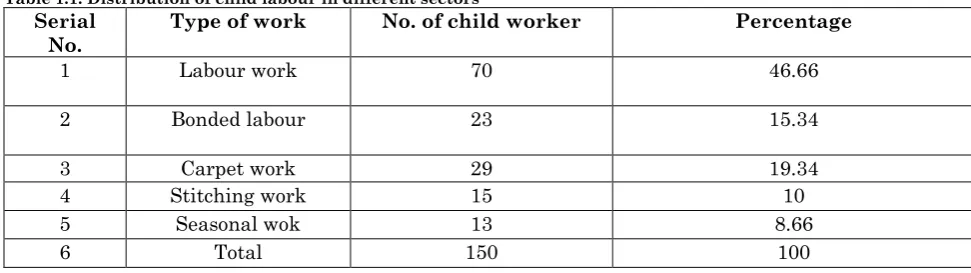
The Table 1.1 shows working distribution of child labour in the selected study area. It is pertinent from the table that majority of our respondents having their parents alive. Regarding main occupation of the family, majority of our respondents were engaged in laborer work.
Table 1.1: Distribution of child labour in different sectors Serial
No. Type of work No. of child worker Percentage
1 Labour work 70 46.66
2 Bonded labour 23 15.34
3 Carpet work 29 19.34
4 Stitching work 15 10
5 Seasonal wok 13 8.66
The above table shows that the children were engaged in different sectors of work. In above mentioned children 70 children were engaged in labour work. They usually take migration from their rural areas to urban areas, because they don’t found continue work in their hilly villages and also wage rate is low in their rural areas. Second number 19.34% consists of carpet worker; this type of work is mostly done by girls they went to any Kaleen center for work. Another is bonded labour
they consists 15.34%. Their fathers took loan from the rich people and when they don’t have anything to pay; they send their children for work, or by the reason of poverty. Another 10% consists of stitching worker; this type of work is mostly done by girls at their homes when they get time from domestic work. And the last group consists of seasonal worker. They work for few months during tourism season. They sell biscuit toys near the tourist spots.
Table 1.2: Age wise distribution of child labour
Age Boys Girls Total Percentage
7-9 7 5 12 8
10-12 31 17 48 32
13-14 67 23 90 60
Total 105 45 150 100
Education
Education is the most important tool for social, economic and political transformation. A well educated and skilled population not only drives economic and social development but also ensures personal growth. Poverty, absence of accessible schools in the villages, and the shortage of teachers prevent children from attending school and keep them in employment with merge returns. Now talking about the field area that most of the
hilly areas people are very poor and they do not have availability to raise their economic level. As they migrate from lower area to hilly tops for almost 5 months which intern affects badly their living standard and mostly their children’s educational part? And during winter season they remain idle due to snowing, and cold. So they remain poor and compelled to send their children to work and help economically their families.
Table 1.3: Educational statuses of children
Educational level Sex wise distribution Total Percentage
Boys Girls
Illiterate 54 17 71 47.33
Middle 49 15 64 42.67
Still studying 8 7 15 10
Total 111 39 150 100
Educational status of child workers shows that 47.33% of child workers are illiterate. 42.67 % had reach to middle level education. And only 10% are those who still manage to continue their study in this group of children
study area which comprises the highest number of percentage, 57%. They were initially involved in school education but soon they left school and start working. 5.33% were found those who lost their fathers and they don’t have elders one’s and they were compelled to work. After that 14.67% were those who were send for work by their parents. And 22.66% were those who were poor in reading and they left school and their parents send them to work.
At the end it was observed that child labour is present in the study area covertly. Many children are involved in doing different types of works for their survival, they help their parents economically. Because their parents do not effort good financial support to their families, as they do not get the good working options throughout year.
Because most of the families of survived area were living in hilly areas where the geographical location do not allow them to continue work. Another major problem is that difficulty is inherent fact that children working in rural areas, in urban informal sector and in domestic service are not readily visible. An integrated and effective measure to save children from hazardous or abuse should, therefore, begin by exploring the invisible visible. As long as child labour is part of the harsh reality that makes good economic sense, the conditions for change will
over the India. This brings many nomad families to this place during summer days and along with these families there is a huge influx of migrant child workers (Up, Bihar, Tamilnadu etc). Who are mostly seen as rag pickers on the road sides and in many streets in rural and urban areas? The untidy and clad in tattered garments, these children are prone to contract life threatening infection. Many children in Kashmir are caught in domestic labour where affluent class mostly in urban areas do employ little children to look after household affairs which keep these children away from, their parental affection.
Suggestions
By providing adults with opportunities of decent work, decent wages and ensuring social protection for the vulnerable, individuals and communities can begin to work their way out of poverty. This in turn will mean they are less dependent on the work of children.
There is need to study and address the linkages between village economy and global markets and production processes. Poverty issue is main problem of the study
area unless and until it will not address a proper solution it may continue. So the need is to uplift the economic condition of poor families by providing them good working opportunities and good wages.
Reference
1.AK Kanth, Anupama Sahay (2004) Globalization, Vulnerability and Child Labour: Indian Context, Journal of V.V. Giri, National Institute, New Delhi.
2.Accelerating Action Against Child Labour (2010) Global Child Labour Trends 2000, 2004 and 2008.
3.Aggarwal Suresh Chand (2008) Child Labour in India: Magnitude, Trends and Distribution: Evidence from the55th and 61st NSS0 Rounds International Journal of Employment Studies.
4.Aggrawal Suresh Chand (2004) Child Labour and Household Characteristics is Selected States Agriculture. Kurukshetra. 54(7):21-28. 5.Ahmad Ashad (2004) Child Labour in India: A
Politico-Legal Study, Kalpaz Publications, New Delhi.
7.Gomongo SP(2001) Child labour, A Precarious Future, Authors press New Delhi
8. International Labour Organization (2013) Marking Progress Against Child Labour: Global estimates and trends 2000-2012, ILO, Geneva, 9.Ravallion M, Wodon Q (2000) ‘Does child labour
displace Schooling Evidence on behavioral
responses to an enrolment subsidy’, The Economic Journal, 110:158-175.