International Journal of Advances in Management and Economics
Available online at:
www.managementjournal.info
RESEARCH ARTICLE
Green Supply Chain Management Practice and Firm’s
Environmental Performance
Abdullah Sarwar
1*, Abu Hasanat Md Monzurul Islam Bhuyan
2,
Murali
Raman
3,
Jimmy Low Jing Hong
1, Shabir Ahmad Hakim
41Faculty of Management, Multimedia University, Cyberjaya, Malaysia.
2Department of Law, Business, and Politics, University of Hull, United Kingdom.
3MMU Business School, Multimedia University, Cyberjaya, Malaysia.
4College of Business, Effat University, Jeddah, Saudi Arabia.
*Corresponding Author: Abdullah Sarwar
Abstract: Despite the importance of environmental management on firms and organizational performance, research on Green Supply Chain Management (GSCM) has not yet been actively pursued in less developed countries such as Bangladesh. Therefore, the purpose of this study is to investigate the relationship between GSCM practices and firm’s environmental performance. Data were collected from the managers in a motorcycle manufacturing company in Bangladesh through interviews. The data were tested and validated through a qualitative approach to explore the relationship between the variables of the study. The result reveals that the impact of GSCM practice has a significant benefit for the environmental performance of the company such as cost reduction, increase profit, improved product quality, reliability and efficiency in operations, waste reduction and lowering consumption of hazardous material in manufacturing. On the other hand, the challenges of adopting the GSCM include the initial investment in the practice leading to the increased cost (expensive to introduce), poor environmental management and loss of sales, which can lead to business failure. Therefore, companies that have been reluctant to adopt environmental practice should try to adopt environmental management, as a means of achieving competitive advantages of companies in all manufacturing industries within the supply chain.
Keywords: Green supply chain management, Green manufacturing, Sustainability, Performance, Developing country.
Article Received: 05 June 2019 Revised: 22 June 2019 Accepted: 26 June 2019
Introduction
The progressive expansion of the global economy has brought prosperity and stability, but it has a downside of increasing the environmental degradation through pollution, change in climate and depletion of natural resources among others [1]. These issues are evolving and becoming of vital concern to companies' operations, because agents, such as government regulatory
bodies, non-governmental organizations,
customers and competitors, are increasingly
demanding companies to incorporate
environmental sustainability in their
business operations [2].
Companies that try to minimize
environmental damage realised that the ability to improve sustainability depends on their potential to progressively address complicated supply chain relationships [3]. Supply chain management (SCM) plans coordinate a series of business activities and
processes, from raw materials to
Environmental factors such as various interests and environmental management have become the standard practice or core model of new business management. As a result, the management goals of enterprises include environmental sustainability along with pursuing economic (profit) benefit [6].
In this context, the green supply chain (GSCM) has been recognized and applied to manufacturing companies as part of firms’
environmental management. Despite the
importance of environmental management on firms and organizational performance, national research on GSCM has not yet been actively pursued in less developed countries such as Bangladesh, when compared with advanced overseas countries [7].
Bangladesh is one of the rapidly growing economies that are facing the problem of environmental degradation from industrial activities, especially the growing automobile manufacturing industries. Among the many strategies that can be applied to ensure the maintenance of environmental integrity among companies, GSCM practice and green manufacturing are pertinent [8].
GSCM recognizes the importance of the environment and can provide real insight into the benefits such as cost saving of GSCM for companies that are reluctant to introduce GSCM. This will be essential for business management because it will assist in addressing the primary challenge confronting the industry maintaining the green supply while still increasing profit. Therefore, this study aims to investigate the impact of the GSCM practice on the firm’s environmental performance.
Literature Review
The concept of supply chain management
(SCM) is considered from varying
perspectives such as logistics and
transportation, supply management,
warehousing, and operations management among others.
According to Rajeev et al [9], the study of supply chain management includes the focus on the function of customer relationship management, to managing the smooth product flow into the supply chain and delivery of value to the customers. As per the definition of supply chains by Tracey et al [10], supply chains involve the total sum of
all the processes in the production and delivery of the finished goods from the producer to the final consumer in the supply chain. Stavrulaki and Davis [11] describe the primary role of SCM as the flow of materials from the sources of supply to the terminal point of sale. SCM is a vital tool for determining the success of companies' operations due to the significant role it plays in expenditure, the cost of the inventory, commodities availability, and responsiveness in matters of delivery of the product [12].
Besides the implied demand and supply
uncertainty, various manufacturing
companies give priority to the desires, needs, and satisfaction of their customers to guarantee an active command in the industry [13]. However, a significant challenge facing supply chains managers is the dilemma on whether to employ efficient or a responsive SCM. According to Enríquez-de-Salamanca et al [14], environmental performance is the capacity of a firm to minimize the produced
waste, air emissions, environmental
accidents and consumption of hazardous materials in order to achieve environmental improvement.
Green Supply Chain Management (GSCM) Practice and Environmental Performance
GSCM practices are by and large associated with particular targets, investment and impacts on environmental performance [15]. Expanding the traditional supply chain to
enhance environmental improvement
depends on the consideration of the total immediate impacts and future environmental impacts of products and processes [16].
Internal GSCM practices have been discovered to minimize the negative environmental impacts of firms’ operations [17, 15]. Furthermore, GSCM practice through synergy with supply chain partners helps to improve environmental performance, reduce waste and achieve cost savings among business partners.
generation of waste by the consumer to the
final disposition are examples of
environmental aspects in the supply chain that are complex and cannot be adequately addressed without the participation and collaboration of several partners in the
supply chain. Effective environmental
performance requires collaboration between the buyer and the supplier through the use of improved innovation and technologies in the supply chain [20]. Although the use of improved innovation and technologies in operations can increase cost, at least in the short term [15]. Pallaro et al [21] mention that the higher the level of firms' commitment to environmental collaboration, the higher the cost saving and environmental performance. Thus, the majority of previous studies suggest that external environmental GSCM practices reduce cost and improve environmental performance [15].
However, on the contrary, Zailani et al [22] and Xu et al [23] did not find a positive impact on environmental performance
regarding external environmental
purchasing. Xu et al [23] added that the benefit of purchasing environmentally friendly materials indirectly goes to the suppliers, which increases the chance of the
suppliers improving their competitive
advantage, rather than the buying firm. Baran [24] argues that logistics activities such as inventory packaging are used to minimize the harmful effect on the environment.
This process can be achieved through environmental awareness by the partners in the supply chain. Jaehn [25] indicate that successful environmental management relies on the level of firm awareness to minimize the potential impact it has on the
environment. Firms that successfully
improve their performance have focused their effort more on aligning the level of awareness and operations strategy, which entails proactive change towards environmental friendly practice [26].
Priarone et al [27] suggest that recycled materials in the manufacturing industry, such as metal components, used motor oil and plastics, should be disposed of properly in an environmentally-friendly way to minimize the potential risk of damage to the
environment, in order to achieve
environmental performance.
Methodology
The methodology is a process that guides the researcher to conduct his study and achieve research objectives through obtaining and analyzing the data. According to Neuman and Robson [28], there is two primary type of methodology which is qualitative and quantitative. However, qualitative research allows the researcher the ability to look more beyond his data scope of findings, not because they are demanding perception but rather drawing a conclusion to the facts drawn from a real-life situation [29].
Qualitative study tends to explain more about the causality of the certain
phenomenon more than quantitative
research because it allows the researcher to capture all the elements of the research problem by allowing the participants to express a more comprehensive view of an event, in order to provide insight into a real-life problem [30]. Qualitative research tends to be more suitable for explaining the meaning and understanding of the naturally occurring phenomenon in a social world [31].
As mentioned earlier, the objective of this research was to understand the relationship between green supply chain management practice (GSCMP) and firm’s environmental performance in a motorcycle assembly and manufacturing firm in Bangladesh. The researcher used the in-depth interview to collect the data. The interviews were recorded using a call recorder. The participant company is located in Dhaka, Bangladesh. For this study, five participants were carefully selected as representatives of the targeted organization.
Analysis and Findings
Company X Bangladesh is a limited liability
company incorporated in Bangladesh.
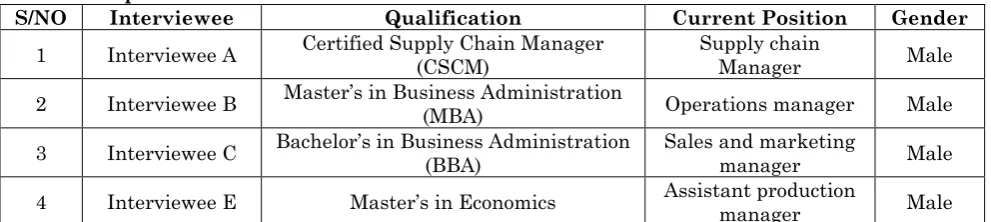
Table 1: Respondent Profile
S/NO Interviewee Qualification Current Position Gender
1 Interviewee A Certified Supply Chain Manager (CSCM) Supply chain Manager Male
2 Interviewee B Master’s in Business Administration (MBA) Operations manager Male
3 Interviewee C Bachelor’s in Business Administration (BBA) Sales and marketing manager Male
4 Interviewee E Master’s in Economics Assistant production manager Male
As the above Table shows, the participants were professionals and experts in four different departments within the company. They were asked to provide their perceptions, comments and opinions regarding GSCMP. The next presents the collected data from the interviews and a summary of the transcribed interview.
Interview Transcription and Findings Interview ‘A’
Respondent ‘A’ asserted that his company has green practice in place and the essence of implementing the practice is to measure the sustainability of products and improve their quality. He added that the only way to provide high-quality products to customers is through a green policy such as green operations in collaboration with trusted partners/suppliers.
In his view, green operations eliminate steps in production and reduce inventories that are not needed. He also mentioned that the company employs re-use practice, such as recycling of metal and chemicals, in its operations. According to the respondent, ‘‘this process is economical for us; reduce our spending on material and is better for the environment’’.
He identified the benefit of green practice for customers and suppliers as cost saving. In his opinion, in the initial stage, implementing GSCMP is very expensive because it is a capital-intensive project, but in the long run it has benefits which include efficiency, reliability and increased sales.
The respondent, personally, regarded
GSCMP as a ‘‘profitable business and financially outperforming, save money, and improve productivity. I realized this benefit when I compare the difference between the previous standards and the new one in place''. The respondent identified adverse environmental events as the primary factor
that can cause business failure, increased the cost by paying fines to the government, damage the company's image and influence customers to boycott the firm brand. The respondent further posits that in order to minimize environmental accidents, the firm has designed their products and processes with safety features that are favorable to the environment.
The respondent stated that the company manages core operations internally and outsourced external operations to suppliers for supplies and waste disposal. He identified the initial investment, increasing cost, as the disadvantage of green practice, but he
identified the essential benefits of
sustainable practice as a timely, reliable and efficient and effective way of production.
Interview ‘B’
According to the respondent B, the only way to provide a fair price to the customers and have a good return on investment is to introduce sustainable change. He added that ‘‘in all aspects of our operations we have measures and standards that minimize impacts of failure. The respondent cited the example of testing and inspection of vehicles in the assembly line to check errors and improve quality, reliability and safety in the surroundings as the significant advantage of the green practice. He also added that reducing noise pollution, emissions and waste in manufacturing is beneficial for the organization and its business surrounding.
wasted because you have to reverse your operations’’. However, the respondent further suggested that to guard against operations failure ‘‘we have incorporated all measures in order to ensure that we reduce failure in our operation’’. He identified internal operations as the key determining factor for integrating sustainable practice with the company’s customers in external operation.
The interviewee ‘B’ asserted that the ‘‘benefit of green change at its full potential helps to boost sales and lower manufacturing cost. However, lack of investment in technology and innovation is the major challenge of green practice''. He identified the significant shortcomings to be the rising cost of environmental compliance and changes in the business environment, such as changing technology. He suggested the solution would be to include full management and customers support to adopt changes that decrease resource consumption and lower consumption of hazardous materials, as one way forward to improve manufacturing performance.
Interview C
The respondent C said the company is practicing green management and has a new system in place. ‘‘Our new C.…. 1 has efficiency in productivity and reducing end-to-end environmental footprint which has improved our sales’’. He added that, together with our customers, the company contributes to the development of the company's core values and resolves all obstacles in operations and finance to achieve green performance.
In his words, the respondent asserted that ‘‘we include our suppliers in our sales strategy through visible teamwork to forecast our annual demand to avoid overproduction which is a waste to the company''. He added that GSCMP need huge funding, particularly in the earliest stage of implementation, but in the long run he said ‘‘it is a money making machine’’.
According to him, GSCM is a ‘‘harmonious
manufacturing that drives good
performance’’. The respondent identified negative environmental accidents, in his opinion as a ‘‘sign of absolute failure putting companies and its product in error condition'' or attracting reputational risk. He also suggested the company respond to GSCM through reduction of energy and cost.
He cited the example of one of the company's cars that, because of the low fuel consumption, has recorded the highest sales. Regarding internal and external operations he said ‘‘we manage internal operations with employees and top management commitment and committing our customers in external operations to our standard’’. The respondent suggested that the benefit of implementing green policy is that it performs incredibly well for simplifying work. ‘‘But the problem of the Change, is the high technology that is quite complex to operate and is quite expensive'' to implement the technology.
Interview D
The respondent D said the company is facing global challenges, which push it to change its assembly line to a modern and innovative one which focuses on perfection and improve in customers’ satisfaction. He said ‘‘we have so many processes and procedures such as our re-use policy which recently help reduce our overhead costs''. The interviewee identified the benefit of GSMP to include efficiency in operations that are environmentally-friendly, which increases speed and reliability.
The respondent added that the
implementation of the change did not affect the company’s budgets ‘‘currently, because doing more with less in our manufacturing and re-manufacturing operations reduce failures and improve success’’. Consequently, he identified the general outcome of green production, as preventing waste in all processes. In his view ‘‘in the past, our cars are designed with hard materials but now they are lighter, and they seem to be efficient and reliable to our customers''. However, according to him, environmental accidents can cause product recall.
have to manage that in-house with more effort on that aspect. However, suppliers and dealers maintained our external function''. External operations sometimes can have less impact on the environment, although they may affect the company's performance positively or negatively. According to his opinion, the benefit of green practice back and forth uses less harmful materials which are economically viable. Finally, He identified the major shortcoming in his view that ‘‘it needs time to yield it economic value’’.
Discussion of Results
The study has revealed some benefit and problems of GSCMP implementation in the context of motorcycle manufacturing firm in Bangladesh, regarding the environmental performance. The performance established by the researcher as extracted from the interviews and the reviewed literature is
divided into positive and negative
performance. The following benefits are summarized in the following themes.
Cost Reduction
Cost reduction is the main benefit of implementing GSCMP in manufacturing, and many firms are adopting the standard to reduce their overhead cost (directed or indirect cost of running a business). One of the respondents stated that to achieve cost reduction in the strategy, reducing energy and water use is essential in the programme. For example, reducing electricity by switching to solar and wind energy, along with efficient machinery can save cost for the firm.
The prime concern in manufacturing is cost. This is compared with the findings of Miroshnychenko et al [32], developing competencies through the use of initiatives
and finding radical solutions to
environmental damage, by reducing energy and preventing pollutions can improve a firm's financial performance. This means that focusing on improvements in practice can reduce fixed expenses.
Increased Profit
The respondents also confirmed that product
manufactured through GSCMP in
manufacturing are more efficient and improve customer satisfaction. As a result, the demand for the product is usually high, hence attracting more sales and increasing
profit for the organisation. For example, hybrid cars are mostly fuel efficient, and the customer is becoming more aware of and willing to buy those cars. This result is consistent with that of Laari et al [18], indicating that GSCM is related directly to the financial performance of a firm because it improves the sales volume, improves
efficiency, competitive advantage and
enhances business co-operation with partners across the supply chain. This means that a company that adopts GCSM practice will have more sales and improve its competitive advantage.
External and Internal Operations with Customers
According to the respondent's collaboration with trusted partners or suppliers has been
identified to improve a company's
performance. Two of the respondent identifies suppliers support in external operation. One respondent suggests internal operations as the key aspect to incorporate external practice. This is consistent with the results of Zhu et al [16] and Zhu et al [15], which evaluates the relationship between the internal and external practice of GSCM among manufacturing companies in China. The findings reveal that joint collaborations with customers in both internal and external operations improves firms overall positive performance. This means that to achieve the economic benefit of GSCM requires external support from the customers, such as supplies and waste disposal.
Validity and Reliability
In this research, to provide a significant and relevant discussion on the relationships of the impacts of GSCMP regarding firm’s environmental performance as well as the result finding in manufacturing firm in
Bangladesh, the researcher reviewed
relevant literature related to the research objectives and analysed the interviews to test the validity and credibility of the data.
hazardous material in manufacturing. On the other hand, the challenges of adopting the GSCMP include the initial investment in the practice leading to the increased cost
(expensive to introduce), negative
environmental events or poor environmental management increase cost and loss of sales, which can lead to business failure. Regarding the potential benefit of the GSCMP, all of the respondents mentioned cost efficiency and cost-effectiveness as the potential benefit to GSCM. Therefore, in line with the above constructive evidence, this study has tested the validity and reliability of the research.
Conclusion
Organizations are looking for ways to adapt to GSCMP in response to customer's demand for environmental preservation, which has
become an important condition for
sustainable management. Hence
environmental management activities are important for all companies. In this study, the researcher analyzed the impact of GSCM on manufacturing firm performance and explored the relationship between GSCM in three dimensions (i.e. financial, operational and environmental performance) in a
motorcycle manufacturing firm in
Bangladesh.
The study has critically addressed the research objectives, and the results of this study are as follows: This study shows that GSCMP and green manufacturing contribute positively to financial performance, which includes benefits such as cost reduction, increased profit and improvement in the firm’s overall performance.
On the other hand, it identifies the initial cost of investment in the change, as a negative aspect of the impact on firms’ performance. Secondly, GSCM practice and
green manufacturing contribute to
operational performance. Some of these benefits include eco-efficient production, that is reliable and timely, which improves the quality of products, eliminates waste and reduces over-production, which in turn improve financial performance.
The GSCM practice has a positive effect on organizational performance. The results show that reducing the use of hazardous substances reduces costs and indirect cost such as environmental accidents are also reduced when a company implements GSCM.
The results show that the lack of proper implementation of the GSCMP in a manufacturing company can increase cost and cause damage, leading to business failure. The positive impact (benefits) of GSCM practises outweighs the negative, in the long-run. This study has suggested that not only the company's productivity and profitability will improve but also their customer relations. The sample company has shown evidence that GSCMP enables it to achieve its economic benefits. GSCM in the organization has recognized the importance of the environment and customers' demands for sustainable products in the supply chain.
These results are consistent with those of Zhu et al [15]; and Laari et al [18], who found the overall outcome of GSCM to be positive. Thus, this researcher concludes that the overall performance in the three dimensions of GSCM is positive and can contribute to the overall performance of companies. Besides, companies that were practising GSCM will have high environmental performance (positive performance), while companies that do not practise such change will miss significant potential benefits on financial, operational and environmental performance, which in turn will constrain overall performance.
In other words, this suggests that firms practising GSCMP can achieve positive benefits. However, one of the conditions for the long-term success of companies is an emphasis on green manufacturing for sustainable products. Also, countries with more advanced economies are concerned with green management. Bangladeshi companies fulfil green manufacturing, but more green practice is required. This research suggests that companies that are striving to build a green image, for example by building environment-related practises or policies have a positive impact on the overall organisational performance.
The importance of the environment is recognised in Bangladesh, based on the results reported in this study. Therefore, companies that have been reluctant to adopt environmental practice should try to adopt environmental management, as a means of
achieving competitive advantages of
relationship between social responsibility and environmental performance. The results of this study offer support for the theoretical assumption that environmental performance has a direct relevance not only to the practice of GSCM but also to the companies that integrate social dimensions of sustainability.
As the awareness of environmental issues becomes more important to customers, the social costs of companies that have not introduced GSCM are increasing rapidly. Hence, the introductions of GSCM is emerging rapidly, as products that have a negative impact on the environment can be removed from the market by eco-friendly consumers and greet customers. Therefore, it
will be possible to recognize the importance of introducing GSCM for sustainable growth regarding an overall system in the supply chain, beyond the management operations of individual companies, such as product, service, production process, and logistics. Finally, in the future, it would be valuable to investigate factors affecting environmental performance by industries and how they affect overall environmental performance and organizational performance. It would also be beneficial for other researchers to use a
quantitative approach using different
dimensions of performance to empirically test the impact of the different variables, in the context of GSCMP in Bangladesh, to allow robust generalization.
References
1. U Al-Mulali, I Ozturk (2015) The effect of energy consumption, urbanization, trade openness, industrial output, and the political stability on the environmental degradation in the MENA Middle East and North African region, Energy, 84:382-389. 2. M Agi, R Nishant (2016) Understanding
influential factors on implementing green supply chain management practices: An
interpretive structural modelling
analysis, Journal of Environmental
Management, 188:351-363.
3. H Ding, Q Liuand, L Zheng (2016)
Assessing the economic performance of an environmental sustainable supply chain in
reducing environmental
externalities. European Journal of
Operational Research, 255(2):463-480.
4. U Soni, V Jain, S Kumar (2014) Measuring
supply chain resilience using a
deterministic modelling
approach. Computers and Industrial
Engineering, 74:11-25.
5. N Shah (2004) Process industry supply chains: advances and challenges. Computer Aided Chemical Engineering, 3:123-138. 6. J Horisch, E Ortas, S Schaltegger, I
Álvarez (2015) Environmental effects of sustainability management tools: An
empirical analysis of large
companies. Ecological Economics, 120:241-249.
7. Q Zhang, W Tang, J Zhang (2016) Green supply chain performance with cost learning and operational inefficiency
effects. Journal of Cleaner Production, 112:3267-3284.
8. W Yu, R Chavez, M Feng, F Wiengarten (2014) Integrated green supply chain
management and operational
performance. Supply Chain Management: An International Journal, 195/6:683-696. 9. A Rajeev, R Pati, S Padhi, K Govindan
(2016) Evolution of sustainability in supply
chain management: a literature
review. Journal of Cleaner Production, 162:299-314.
10. M Tracey, J Lim, M Vonderembse (2005) the impact of supply‐chain management capabilities on business performance. An International Journal, 10(3):179-191. 11. E Stavrulaki, M Davis (2010) Aligning
products with supply chain processes and strategy. The International Journal of Logistics Management, 21(1):127-151. 12. M Christopher (2016) Logistics and supply
chain management Harlow: Financial Times/Prentice Hall.
13. S Vachon, R Klassen (2008) Environmental
management and manufacturing
performance: The role of collaboration in the supply chain. International Journal of Production Economics, 111(2):299-315. 14. A Enríquez-de-Salamanca, R Díaz-Sierra, R
Martín-Aranda, M Santos (2016)
Environmental impacts of climate change
adaptation. Environmental Impact
Assessment Review, 64:87-96.
15. Q Zhu, J Sarkis, K-H Lai (2013)
performance outcomes of internal and external green supply chain management practices. Journal of Purchasing and Supply Management, 192:106-117.
16. Q Zhu, J Sarkis, K-H Lai (2008) Confirmation of a measurement model for green supply chain management practices implementation. International Journal of Production Economics, 111(2):261-273. 17. C Yang, S Lin, Y Chan, C Sheu (2010)
Mediated effect of environmental
management on manufacturing
competitiveness: an empirical
study. International Journal of Production Economics, 123(1):210-220.
18. S Laari, J Töyli, L Ojala (2016) Supply chain perspective on competitive strategies and green supply chain management strategies. Journal of Cleaner Production, 141:1303-1315.
19. R Dangelico, RP Pontrandolfo (2013) being ‘green and competitive’: The impact of environmental actions and collaborations on firm performance. Business Strategy and the Environment, 24(6):413-430.
20. K Tan, L Chung, L Shi, A Chiu (2016) Unpacking the indirect effects and
consequences of environmental
regulation. International Journal of
Production Economics, 186:46-54.
21. E Pallaro, N Subramanian, M
Abdulrahman, C Liu (2015) Sustainable production and consumption in the automotive sector: integrated review
framework and research
directions. Sustainable Production and
Consumption, 4:47-61.
22. S Zailani, K Jeyaraman, G Vengadasan, R Premkumar (2012) Sustainable supply chain management SSCM in Malaysia: a survey. International Journal of Production Economics, 140(1):330-340.
23. Q Xu, Y Lei, J Ge, X Ma (2016) Did investment become green in China? Evidence from a sectoral panel analysis from 2006 to 2015. Journal of Cleaner Production, 156:500-506.
24. J Baran (2016) Redesign of steam turbine
rotor blades and rotor
packages-environmental analysis within systematic eco-design approach. Energy Conversion and Management, 116:18-31.
25. F Jaehn (2016) Sustainable
operations. European Journal of
Operational Research, 25(32):243-264. 26. J Klewitz, E Hansen (2014)
Sustainability-oriented innovation of SMEs: a systematic review. Journal of Cleaner Production, 65:57-75.
27. P Priarone, G Ingarao, L Settineri, R Di Lorenzo (2016) On the Impact of recycling strategies on energy demand and CO2 emissions when manufacturing all based components. Procedia CIRP, I: 194-199. 28. WL Neuman, K Robson (2018) Basic of
Social Research: Qualitative and
Quantitative Approaches 4th ed. (Don Mills, Ontario: Pearson Canada Inc).
29. M Easterby-Smith, R Thorpe, P Jackson (2013) Management research. 5th edition (Los Angeles: Sage).
30. JF Hair, M Celsi, AH Money, P Samouel, MJ Page (2016) Essentials of business research methods 3rd Eds. (New York: Routledge).
31. U Sekaran, R Bougie (2016) Research methods for business: a skill-building approach 7th ed, (Haddington: John Wiley and Sons).