International Journal of Advances in Management and Economics
Available online at: www.managementjournal.info
RESEARCH ARTICLE
A Board of Education Decade: Study Research Activity in
Scientific Literary Bibliometric Indexed in Scopus Database
(Elsevier)
Prof. (Dr.) Edenis Cesar de Oliveira
UNIVERSIDADE FEDERAL DE SÃO CARLOS – UFSCar, Centro de Ciências da Natureza - CCN - Campus Lagoa do Sino, Rodovia Lauri Simões de Barros, Km 12 - SP 189, Bairro Aracaçu,CEP 18290-000 - CP 094 - Buri - São Paulo – Brasil.
Abstract
The wider context of inclusion of this study is the teaching of Directors. In the strictest level, is limited to analysis of papers from publications in pre-established period in Scopus data platform (Elsevier). The research aims to analyze the profile of the articles published in the Scopus database in the period 2006 - 2015 containing the keyword "business school". Characterized as exploratory, we used the documentary research and data collection instrument and bibliometrics as an analytical technique. 530 articles in total were analyzed. The results show an increase in the number of publications in the first four years, remaining volatile in the other years of the period, with high and low. The newspaper with the highest number of publications, the Journal of Management Development, with significant distance from the second place, paradoxically, does not have good score in the indices (SJR, IPP and SNIP). Considering the ten HEIs with the highest number of publications, half of them located in the United Kingdom. However, when we look at the overall picture of publications by country, the United States ranks first, scenario in which Brazil appears in twenty-first position. Ten ranqueadas institutions, only four show the subarea "Business, Management and Accounting", which were, Institute of Management Technology, Ghaziabad (45.9%), Singapore Management University (14.9%), Cranfield University (6.3 %) and University of Technology Sydney (5.1%).
Keywords: Management. Management Education, Scopus database, Bibliometrics.
Introduction
The wider context of inclusion of this study is the teaching of Directors. In the strictest level, is limited to analysis of papers from publications in pre-established period in Scopus data platform (Elsevier).
The Administration courses in the Brazilian context have a fairly short history compared to courses in American universities, when there are records that the first date from the mid-19th century.
To get an idea, in 1952, when he began teaching administration in Brazil, with the creation of the Brazilian School of Public administration (EBAP) and after two years, the São Paulo School of Business administration (EAESP), both of the Getulio Vargas Foundation (FGV), American universities have formed approximately 50,000 graduates, 4,000 masters and 100
doctors per year in Business Administration Castro [1].
Regarding the growth of business schools, both in Brazil and in other countries, it is justified in several respects: economic, political, social and basically vocational training Ramos [2].
The study by Klein [3] with 940 undergraduate and graduate pointed out that the increase in the academic level increases the capacity of objective aspects of the decision. According to the survey, students with higher education showed greater capacity in abstractions compared to less training.
conducted by the model known as holistic and integrated business, serving generic skills work and future needs too generic of students, as well define a teaching model based on generalities, ignoring all local needs and skills.
Studies show that private businesses are far ahead of the universities with regard to the management of educational technology Hook [5] Lopes contribution [6] to point out that, in Brazil, there is recognition of the importance of value for any higher education. However, there is empirical evidence that graduates of business schools face the labor market insecurity and often are incapable of competitive insertion in the typical functions of professional managers.
Thus, the process of globalization, characterized by relentless change, has conditioned the higher education institutions (HEIs) to seek new tools to ensure the quality of education Paliulis and Labanauskis [7]
The study proposed theme for this paper is justified by the pressing need that is imposed on the alignment of content covered, skills and abilities developed in the academy with the demands of the world of work in general, and the world of particular organizations.
This paper is organized as follows. Besides this brief introduction containing the question (or problem) research and general purpose in section 2 presents a theoretical framework. Section 3 presents the methodological procedures. In section 4 the presentation and analysis of data, followed by closing remarks.
Problem Research and Objective
In the context of this study, from the preliminary research theme, the context and the research gap were established Almeida
dos Santos et al.[8]
It was therefore defined the guiding question of this study that seeks to understand the interest and the scientific concerns through the causal relations with the context, in order to justify and explain it Treinta et al.[9] Almeida Santos et al.[8] It can be written as follows: What is the profile of articles published in the Scopus (Elsevier)
database from 2006 to 2015 containing the keyword "business school"?
To achieve this, this research aims to analyze the profile of articles published in the Scopus (Elsevier) database for the period 2006-2015, containing the keyword "business school".
Theoretical Foundation
This section will present the minimally necessary theoretical contributions to the foundation of the research presented here. The Administration of Education in Brazil
Faced with the need to understand and to handle issues with high and increasing level of complexity, to adapt to the inexorable and rapid changes in the social, demographic, legal, technological, cultural, political, economic, environmental, among others, aggravated by densification, ephemerality and volatility of information, amalgamated in a highly changeable world of work, with high unpredictability index, it is urgent to train professionals who are able tomeetthosedemands.
Certainly, the knowledge society is able to generate demands for quantity and quality that does not compare to those of earlier times Pozo.[10]
According to teaching in Business Administration undergraduate level in Brazil can be described in some historical phases. The first phase is the emergence of the board of education in the country in 1902, an unregulated basis.
The regulation only occurred almost three decades later, with the creation of the Ministry of Education and the structure of education at all levels. It is noteworthy that, in the graduate field, is created the Degree of Administration and Finance diplomava the bachelors in Economics. The separation of areas of educationonlyoccurredinthe1950s.
Administration Education Program and Business.
The third phase occurs from the regulation of the profession and the teaching of administrative sciences Brazil [11]. Opening possibilities for further expansion of the board of education in Brazil. In designing the fourth phase can be understood as the attempt to upgrade education in Business Administration, given the fact that it remained unchanged in its law for twenty-seven, indifferent to global changes.
The oil shock, the microelectronics revolution, the rapid emergence of new technologies, economic globalization, the breaking of boundaries, eventually changing rapidly and irreversibly, the world of organizations.
Finally, the fifth phase of the Board of Education begins with the promulgation of the Law of Guidelines and Bases [LDB] [13]. pointing to the enactment of the new guidelines as the new regulatory framework for the management education. This is the beginning of a new phase in which archaic and outdated arrangements spaces yield new and innovative institutional arrangements.
A critical perspective, Aktouf [14] and Alvesson and argue that the administration of education in Brazil has contributed to neglect of attitude toward people in organizations since students receive training consists of knowledge and techniques too restricted, which lack a wider perspective and critical of events, calculating excess, lacking real reflection capabilities, which show great insensitivity to social values and human and are too concerned about the short-term. And this is because they are the curricula offered by schools characterized by emphasis on the acquisition of technical and neglect of inter personal and communication skills.
The unpredictability of the future is represented in the know called face uncertainties. The story is not a linear evolution; rather, it is a complex of order, disorder and organization, always having two dichotomous and ambivalent faces interrelate dialectically: civilization and barbarism, creation and destruction, genesis
and death. We must learn to live with uncertainty, this was ambivalent values, where everything is intertwined. It would require the teaching principles that allow confronting the unforeseen, unexpected and uncertainty Closs [14].
There is a pressing need to align the curriculum to current business models characterized by high volatility Seethamraju[ 15]. Other studies have shown the urgent need to correct the orientation failure and integration of business processes in the curriculum of business schools Porter and McKibbin[16]. Karpin[17]. Michaelsen [18] Cecez-Kecmanovic [19] Ethie [20] Trites [21] Kumar [22].
The increased need to rethink teaching processes in a way that addresses the most diverse needs of organizations has led business schools to review their curricula more closely; however, there are educational institutions whose management courses do not appear to have any initiatives to this readaptation Bandara [23]. In this regard, various methods have been studied and implemented in the management of schools in an attempt to get the best possible adaptation of egress to the corporate world Benson [24].
Therefore, greater emphasis is given to the acquisition of knowledge and skills and development of attitudes which become criteria for evaluation and reward Lacombe [25] Addition, there is the proposal of "borderless career" where the race is no longer confined to the borders of an organization, becoming a member of all the individual life spheres such as work, family, leisure and social life Defillipi and Arthur [26].
Strictly speaking, the process adaptability and unpredictability of organizations, incorporates the continuous redesign the field of tasks and structures, whilst at the same time, the fluid nature relations results (outputs) characterized by a high degree of uncertainty, "such that it can be said that both organizations shape the career development and people like the reverse."
Methodology
The need to define the methodological approach type is key. Therefore, the development of the study should give a clear and precise manner so that there is alignment of the final results to the central research question Raffaghelli [27], Smith, [28].
This research includes an exploratory character, since it seeks to investigate publications on particular subject. With a quantitative approach was adopted as collection instrument, documentary research Mogalakwe [29]. Arguimbau-Vivó e [30]. Walsh [31]. The documentary research method is used to investigate and characterize physical sources, documents most commonly written, whether public or private domain Payne and Payne[32].
The study is published in the papers object Scopus database (Elsevier) in the period 2006-2015 (10 years) containing the keyword "business school".This type of research is called Bibliometry which consists basically in carrying out a quantitative study of a range of publications such as books, theses, journal articles, conference proceedings, among others, various researchers.
According Demo [33] it is a study dedicated to rebuild theories, concepts, ideas, ideologies, controversies, in order, in immediate terms, improve theoretical foundations.
To develop studies of the quantitative aspects of production, dissemination and use of information recorded, especially with the advent of the internet van Raan [34]. bibliometrics contributes significantly to the development of standards and mathematical models used to measure these processes, using their results to format forecasts and to support decision-making Tague-Sutcliffe [35].
Another important aspect of this method refers to its interdisciplinary character, which can be supported in setting Spinak [36] stating that "it bibliometrics es, pues, una discipline con multidisciplinary range y la which analyzes one of them bad material respects y objectives esa comunidad, la comunidad impresa ".Table 1 provides the initial criteria entered in the search process in the database Scopus (Elsevier) to start the data collection.
Table 1: basic criteria for the collection of documents in database.
Discreption Characteristics
Data base Scopus (Elsevier)
Keyword “business school”
Language english
Type of Documents articles
Period 2006 - 2015
Source: Prepared by the author.
The next section will be presented and analyzed the mined data from the Scopus database (Elsevier).
Presentation and Data Analysis
Initially, it will appear the number of papers published per year, considering the time frame established for the study.
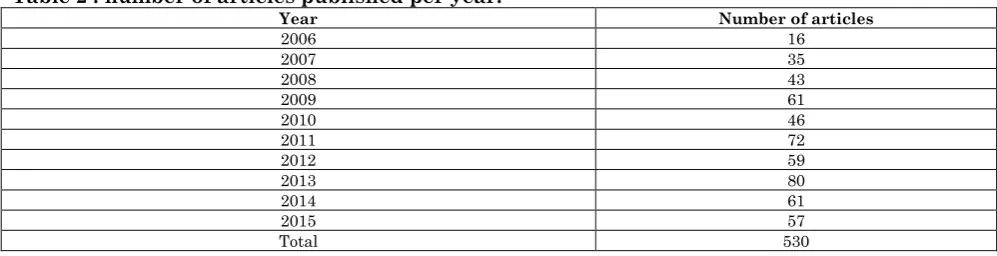
Table 2 provides the number of articles published in their respective years.
Table 2 : number of articles published per year.
Year Number of articles
2006 16
2007 35
2008 43
2009 61
2010 46
2011 72
2012 59
2013 80
2014 61
2015 57
Total 530
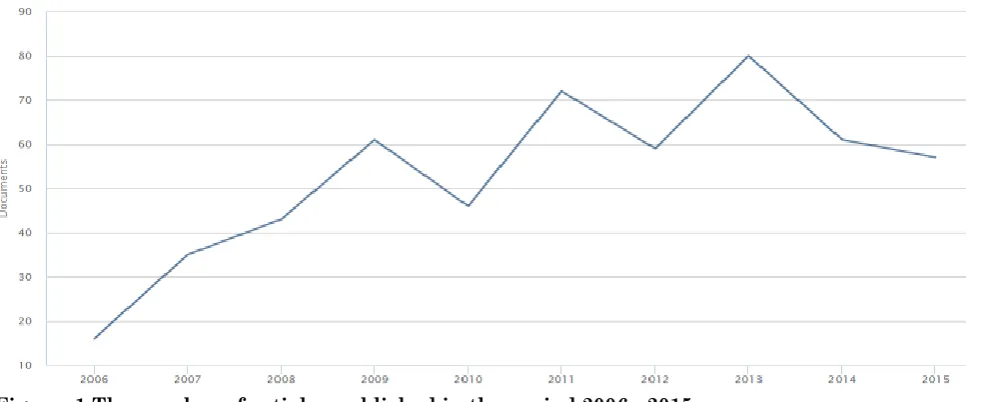
Notes a descent in the number of publications in the first four years of the period (2006-2009). Considering the year 2006 to 2009, there is an increase of approximately 280%. However, the year 2010 shows a decrease to the previous year, but even so, still higher than the average of
the first four years (38,75).In 2011 recurs an increase in the number of publications in quantity than any other previous years. Figure 1 graphically shows the variation in the published papers of the period.
Figure: 1 The number of articles published in the period 2006 - 2015
Source: Research data.
It is observed that after the year 2011 there is an asymmetry in the number of publications, keeping up characteristically fickle.
530 items determined in the survey are distributed in several dozen sources (journals). However, be considered here only the ten (10) first with highest number of publications as shown in Table 3.
Table 3: ranking of journals with the highest number of publications in the period.
Ranking Journal Number of articles
1° Journal of Management Development 34
2° Education and Training 16
3° International Journal of Educational Management 12
4° Management Learning 11
5° Journal of Business Ethics 10
6° International Journal of Management In Education 9
Journal of Teaching In International Business 9
7° Journal of Academic Ethics 8
Organization 8
8° Journal of Management History 7
Source: Prepared by the author.
The number of articles published by the ten journals cited in Table 2 represent 23.40% of total articles published in the period; in
other words, approximately ¼ of the amount.Figure 2 shows graphically the number of articles published per year per journal.
Figure 2: The number of articles published per year and periodical in the period surveyed
The graph shows that the first three journals with the highest number of publications (Journal of Management Development, Education and Training, International Journal of Management
Education) show considerable variation from year to year.The Table 4 presents a consolidated description of SJR indexes, IPP and SNIP, with their theoretical support.
Table 4: Consolidated description sjr indexes, ipp and snip.
Type Index Description Consolidated contribution Theoretical
SJR – Scientific Journal
Rankings
Provides scores for all sources on a network quotes, whereas part of the quotes are different. A source transfers its status to another source through action to quote it. A quote from a source with a relatively high score in the SJR is worth more than a citation from a source with a lower score score. The status of a source for a given year is divided equally by all the quotes he does the same
period.
González-Pereira et al. (2010); Sicilia et al. (2011); Guerrero-Bote e Moya-Anegón
(2012).
IPP - Impact per
Publication
Measures the citation relationship in a year (Y) for academic papers published in the previous three years (Y-1, Y-2, Y-3), divided by the number of papers published in those years (Y-1, Y-2 Y-3). The metric uses a period of service of three years, considering this ideal time interval to accurately measure the quotes.
Moed (2010).
SNIP - Source
Normalized Impact per Paper
Verifies the impact of contextual quote from a source, considering citations based on the total number of citations in a field. It helps to perform a direct comparison of sources in different fields. Consider the characteristics of the source field, which is the set of documents that mention. It also considers how
often authors cite other items in their reference lists, and the speed at which the impact of service matures in that the database used in the evaluation
covers the literature.
Moed (2010); Gagolewski e Mesiar (2012); Waltman et al.
(2013).
Source: Prepared by the author from Waltman et al. [37]
Considering the short description in Table 2, the respective rates of ten (10) journals with the highest number of publications in the field of research will be presented. It is not intended to deepen the discussion of these
indices, in view of the need for caution and recognition of its limitations Kelly and Jennions [38].
The Table 5 systematize these data that can be compared from journal to journal.
Table 5 : Sjr index, ppi and snip of the top ten journals in the ranking.
Journal SJR IPP SNIP Year
Journal of Management Development 0.346 0.810 0.911
2015
Education and Training 0.532 1.155 1.198
International Journal of Education Management 0.424 0.686 0.890
Management Learning 1.046 1.859 1.552
Journal of Business Ethics 1.358 2.346 1.779
International Journal of Management in Education 0.148 0.127 0.219
Journal of Teaching in International Business 0.216 0.540 0.540
Journal of Academic Ethics 0.395 0.609 0.707
Organization 1.806 2.328 1.901
Journal of Management History 0.258 1.232 0.841
Source: Prepared by the author.
The three journals with the best SJR index (over 1,000) are Organization (1806), Journal of Business Ethics (1358) and Learning Management (1046). As for the PPI index, five (5) regular stand with values above 1,000, namely: Journal of Business Ethics (2346), Organization (2328), Management Learning (1859), Journal of Management History (1232) and Education and Training (1,155).
As for the SNIP index, include four (4) regular with scores above 1,000.
Organization (1901), Journal of Business Ethics (1779), Management Learning (1552) and Education and Training (1198).
What could be considered an "outlier" would be the Journal of Management History journal that appears only in the PPI index ranking.As to the authorship of papers, the ten (10) authors with the highest number of publications in the period will be presented.
The Table 6 systematize this information presenting the authors' names, their number of articles and membership.
Table 6: Ranking of the ten authors with the highest number of publications and their affiliations Ranquing Authors Number of articles Filiation
1° THOMAS, H. 8 Singapore Management University
2° MOORE, K. 6 McGill University
3° BESANCENOT, D. 3 Universite Paris
CALDWELL, C 3 Washington State University
HUSSAIN, S. 3 Newcastle University
KNIGHTS, D. 3 Lancaster University
PARKER, M. 3 University of Leicester
RANJAN, J. 3 IMT Ghaziabad
SWAIN, D. K. 3 Kalinga Institute of Industrial Technology
4° ARBAUGH, J. B. 2 University of Winsconsin Oshkosh
Source: Prepared by the author.
The ten authors with the most publications represent about 7% of total publications. Note is an asymmetry between the first two authors and the rest of the ranking, given the fact that between the second position
and from the third, there is a difference of 50% in total publications. Figure 3 shows the ranking of the authors in graphical form.
Figure 3: ranking of the ten authors with the highest number of publications.
Source: Research data.
As for education institutions (HEI), the ten (10) best placed in the ranking with their numbers of publications in the period will be presented.
The Table 7 behind this ranking of higher education institutions, the number of articles published in the period surveyed,
and their respective countries of origin.Of the total number of institutions ranked, 50% are located in the United Kingdom; the other, each in different countries. HEI located in the United Kingdom hold 51.79% of published articles, which corresponds to a total of 29 articles 56.
Table 7 : Ranking of heis, number of articles published and countries
Ranking HEI Country Number of articles
1 University of Nottinghan United Kingdom 9
The University of Warwick United Kingdom 9
2 McGILL University Canada 6
Singapore Management University Singapore 6
University of Technology Sydney Australia 6
3 Institute of Management Technology, Ghaziabad India 5
4 Cranfield University United Kingdom 4
University of Pennsylvania U.S.A. 4
Open University United Kingdom 4
5 University of Essex United Kingdom 3
Figure 4 shows in graphical form the data outlined in Table 7, facilitating the viewing and subsequent comparison between the institutions and their respective numbers of publications.
Figure 4 - Comparison of IES and the respective numbers of published articles.
Figure 4 : Comparison of ies and the respective numbers of published articles.
Source: Research data.
Of the ten (10) institutions shown in Table 7, were selected those that appeared in the subarea "Business, Management and Accounting".Thus, the aforementioned
subarea appears with weights (percentages) different in each institution. The Table 8 shows, in ascending order, the percentage of the subarea "Business, Management and Accounting" in each of the four institutions.
Table 8 : Education institutions and the subarea representative percentages.
Ranking Institution %
1 Institute of Management Technology, Ghaziabad 45,9
2 Singapore Management University 14,9
3 Cranfield University 6,3
4 University of Technology Sydney 5,1
Source: Prepared by the author.
Refinement by subarea shows a strong presence of the Institute of Management Technology, Ghaziabad, India with a percentage of 45.9%. It follows from this that, among subfields of classification of publications of that institution, almost half of them refers to the area of Business Administration and Accounting.
The difference for the runner-up is quite significant, approximately 68% less compared to the first institution. Figure 5 shows greatest comparative details of the four institutions and the corresponding subfield.
Source: Prepared by the author.
By analyzing the research activity within the scope of this study, considering the ranking of countries, it is observed that the United States occupy the first position with a difference of 44.5% more publications in relation to the second.
The Table 9 behind the ten countries best positioned in the ranking, as well as Brazil's position, and the respective numbers of publications.
Table 9 :Ranking of countries and number of publications in the period.
Ranking Countries Number of articles
1º United States 167
2º United Kingdom 116
3º Australia 27
4º Canada 25
India 25
5º France 19
6º Netherlands 16
7º China 14
8º Singapore 13
9º Switzerland 9
21º Brazil 5
Source: Prepared by the author.
The same data are presented in graphical form in Figure 6. Brazil, occupying the 21th
position, is less than 3% of total publications of the United States, occupying the No. 1 position.
Figure 6: Ranking of countries on the number of publications in the period.
Source: Research data.
It is understanding the fact that the United States occupy the first position, given the fact that it was there that the Board of Education had its origin, marked by the first "business schools." Of course other countries are excelling in this regard, especially in this early twenty-first century. But even we care much knowledge of North American management, which is not all bad.
It is necessary a more strict interpretation of the style "hick" of management, considering its specificities. There is an urgent need for greater scientific rigor, not only in the adaptability process Weick [39]. theories coming from the north, but especially in developing native empirical studies, endowed with high degree of reliability and replicability.
Emerging organizational contexts require continuous change in the skills and knowledge of people, including the acquisition of new knowledge [know-how], through its various stakeholders, and other inter-organizational arrangements Defillipi and Arthur [26].
known for its high degree of flexibility, the era of knowledge.
Conclusion
This study aimed to analyze the profile of the articles published in the database Scopus (Elsevier) in the period 2006 - 2015 containing the keyword "business school".
Considering the criteria used for the search in the database were extracted 530 articles distributed heterogeneously in the years included in the time frame. There is a growth in the number of publications in the first four years; however, this growth is not maintained in the coming years, presenting asymmetrically.
In the ranking of journals with the highest number of publications highlighted the Journal of Management Development, with a difference of 112.5% more than in the second place, the Education of Training.
Paradoxically, the newspaper with the highest number of published articles does not occupy a prominent position when calculated its SJR index, PPI and SNIP, except the Education of Training presents the best score in the PPI index (1155) and SNIP (1198).
Regarding the authors with the most publications, highlight Thomas, H. (8 items), affiliated to the Singapore Management University (Singapore); Moore, K. (6 products), affiliated with McGill University (Canada) and Besancenot, D. (3 items), affiliated with the Universite Paris (France).
In the ranking of the ten higher education institutions with the highest number of publications, half of them are located in the UK, and the other half in different countries. Only four of these institutions explicitly found himself the subarea "Business, Management and Accounting". Overall, the United States rank first in number of publications, followed by the UK and Australia.
Despite the obvious limitations of this study, especially the self-restraint of the time frame, among others, it is considered that research achieved the goal originally proposed.
However, it is suggested as an agenda for future studies, the extension of the time frame, beyond the intersection of citations and cocitações between searched documents [43-49].
References
1. Castro CM (1981) O ensino da
Administração e seus dilemas: notas para debate. Revista de Administração de Empresas, 21(3):58-61.
2. Ramos C (2004) the development of MBAs
and Business Schools in Latin
América.Business Leardership Review, 1(2):1-6.
3. Klein J (2004) The contribution of higher education to the development of objective and subjective judgment in day-tp-day decision making.Higher Education in Europe, 29(2) 255:268.
4. Bulgacov S, Canhada DID, Bulgacov YLM (2010) A comparação dos processos de acompanhamento acadêmico e de ensino de Administração em duas universidades brasileiras e duas estrangeiras. Administração: Ensino e Pesquisa, 11(3):355:372.
5. Hook S (2002) Times Education
Supplement. 4473.40.
6. Lopes PC (2002) Reflexões Sobre as Bases da Formação do Administrador Profissional no Ensino de Administração. In: XXVI Encontro Nacional dos Programas de Pós-Graduação em Administração – EnANPAD, 2002, Salvador. Anais... Salvador: Anpad. 7. Pauliulis NK, Labanauskis R (2015)
Benchmarking as an instrument for improvement of quality management in higher education.Business, Management and Education, 13(1): 140:157.
8. Almeidados Santos A, Vieira Neto J, Farias Filho JR (2016) Três décadas de desenvolvimento da ecoeficiência: um estudo bibliométrico da atividade de pesquisa em literatura científica indexada na base Scopus. Spacius, v. 37, n. 1. Disponível em: <http://www.revistaespacios.com/a16v37n01 /16370121.html>. Acessoem 12 jul 2016. 9. Treinta FT, FariasFilho JR, Sant’Anna AP,
10. Pozo J (2002) Aprendizes e mestres: a nova cultura da aprendizagem. Porto Alegre: Artmed.
11. Brasil. Lei n° 4.769, de 9 de setembro de 1965. Dispõe sobre o exercício da profissão de Administrador e dá outras providências. (1965). Diário oficial da União, 13 set 1965, p. 9.337, retificada no Diário Oficial da União, de 16 t 1965,9:531.
12. Brasil. Lei de diretrizes e bases da educação nacional [LDB] (2016) Lei n° 9.394, de 20 de dezembro de 1996. Estabelece as diretrizes e bases da educação nacional. 12. ed. Brasília-DF: Câmara dos Deputados, Edições Câmara
13. Aktouf O (1996) A Administração entre a tradição e a renovação, São Paulo: Atlas 14. Closs LQ, Aramburu JV, Antunes EDD
(2009) Produção científica sobre o ensino em Administração:uma avaliação envolvendo o
enfoque do Paradigma da
Complexidade Revista Eletrônica de Gestão Organizacional, 7(2):150-169.
15. Seethamraju R (2012) Business process
management: a missing link in
businesseducation. Business Process Management Journal, 18(3):532-547.
16. Porter, LW McKibbin L E. (1988) Management education and development: drift or thrust into 21st Century? McGraw-Hill, New York, NY.
17. Karpin DS (1995) Enterprising nation: renewing Australia’s managers to meet the challenges of the Asia-Pacific century, Report of the Industry Task Force on Leadership and Management Skills, Australian Government Publishing Service, Canberra.
18. Michaelsen LK (1999) Integrating the core business curriculum: an experience based solution.Selections, 15(2):9-17.
19. Cecez-Kecmanovic, DJuchau, M Kay, R Wright S (2002) Australian Business Education Study: Enhancing the Quality of Australian Business Education. Available
at: www.autc.gov. au/projects/
completed/aust_business_educ/split_ prdf.htm (accessed 20 October 2004).
20. Ethie IC (2003) Developing a management information systems (MIS) curriculum: perspectives from MIS practitioners.Journal of Education for Business, 77(3):151-9. 21. Trites G (2004) Decline of the age of Pacioli:
the impact of e-business on accounting and accounting education.Canadian Accounting Perspectives, 3(2), 171-86.
22. Kumar R K (2015) Transformatory approach to imparting business education: business process management. Asian Journal of Management Sciences, 3(7):5-7. 23. Bandara W,Chand DR, Chirucu AM,
Hintringer SK, aragiannis DR, ecker JC, van Rensburg AU, soff CW, elke RJ (2010) Business process management education in academia: status, challenges and recommendation. Communications of the Association for Information Systems, 27.743:746.
24. Benson VA, nderson DO, oms A (2011) Educators’ perceptions, attitudes and practices: blended learning in business and management education. Research in Learning Technology, 19(2) 143:154.
25. Lacombe BM B (2002) O aluno de administração de empresas, o trabalho e a construção da carreira profissional: contribuições de um estudo na Grande São Paulo. Anais... XXVI EnANPAD, Salvador-BA
26. Deffillipi RJ, Arthur MB (1994) the boudaryless career: a competency-based perspective.Journal of Organizational Behavior, 15(1):307-324.
27. Raffaghelli JECucchiara, S Persico D(2015) Methodological approaches in MOOC research: Retracing the myth of Proteus.British Journal of Educational Technology, 46 (3).488-509.
28. Smith J A (2015) Qualitative psychology: A practical guide to research methods.New York: Sage
29. Mogalakwe M (2009) the documentary research method – using documentary sources in social research.Eastern Africa Social Science Research Review, 25 (1):43-58.
30. Arguimbau-Vivó, L Fuentes-Pujol, E Gallifa-Calatayud M (2013) Una década de
investigación documental sobre
cienciometría em España: análisis de lós artículos de La base de dados ISOC (2000-2009). Revista Espanhola de Documentacion Cientifica, 36,2.
31. Walsh K (2014) Documentary research and evaluation in medical education.Journal of Educational Evaluation for Health Professions, v. 11.
32. Payne G, Payne J (2004) Key concepts in social research. London: Sage Publication. 33. Demo P (2006) Pesquisa: princípio científico
34. Van Raan AFJ (2001) Bibliometrics and
Internet: some observations and
expectations. Scientometrics, 50 (1),:59:63. 35. Tague-Sutcliffe J (1992) an introduction to
informetrics.Information Processing & Management, 28(1): 1-3.
36. Spinak E (1996) Diccionario enciclopédico de bibliometría, cienciometría e informetría. Montevideo.
37. Waltman Lvan Eck, N J van Leeuwen, T N Visser M S (2013) some modifications to the SNIP journal impact indicator. Journal of Informetrics, 7, 272:285.
38. Kelly CD, Jennions MD (2006) The h index and career assessment by numbers.Trends in Ecology and Evolution.21 (4):167-170. 39. Weick K (2001) Enactment and the
boundarylesscareer: organizing as we work
In: ARTHUR, M.; ROUSSEAU,
D.TheBoundaryless Career, New York: Oxford University Press.
40. Lacombe BM B (2002) O aluno de administração de empresas, o trabalho e a construção da carreira profissional: contribuições de um estudo na Grande São Paulo. Anais... XXVI EnANPAD, Salvador-BA.
41. Quinn JB (1992) Intelligent Enterprise – a Knowledge and Service based Paradigm for industry. New York: The Free Press.
42. Senge PM (1990) The Fifth Discipline: The Art and Practice of the Learning
Organization. New York:
Doubleday/Currency.
43. Waltman Lvan Eck, N J van Leeuwen, T N Visser M S (2013) some modifications to the SNIP journal impact indicator. Journal of Informetrics, 7, 272-285.
44. Alvesson M, Willmoth H (1998) Making Sense of Management – a critical introduction. 2nd ed., London: Sage.
45. Gagolewski M MesiarR (2012) Aggregating different paper quality measures with a
generalized h-index. Journal of
Informetrics, 6,566-579.
46. González-Pereira BGerrero-Bote VP Moya-Anegón, F (2010) A new approach to the metric of journals’ scientific prestige: The SJR indicator. Journal of Informetrics 4, 379:391.
47. Guerrero-Bote VP Moya-Anegón F (2012) A further step forward in measuring journals’ scientific prestige: The SJR2 indicator. Journal of Informetrics, 6. 674-688
48. Moed HF (2010) Measuring contextual citation impact of scientific journals.Journal of Informetrics, 4(3):265-277.
49. Seethamraju R (2012) Business process
management: a missing link in