Available online throug
ISSN 2229 – 5046
EFFECT OF VARIABLE VISCOSITY ON THERMAL CONVECTIVE INSTABILITY
IN A NANOFLUID SATURATED POROUS LAYER
M. Dhananjaya
a*and I. S. Shivakumara
ba
Department of Mathematics, Bangalore Institute of Technology, Bangalore- 560 004, India.
E-mail:
b
Department of Mathematics, Bangalore University, Bangalore -560 001, India.
(Received on: 23-02-14; Revised & Accepted on: 12-03-14)
ABSTRACT
T
he effect of nanofluid viscosity varying with temperature on the onset of thermal convection in a layer of nanofluid saturated Darcy porous medium is studied. Both top and bottom-heavy basic nanoparticle distributions are considered and the resulting eigenvalue problem is solved numerically by the Galerkin method. In the case of top-heavy nanoparticle distribution, the onset is hastened with increasing basic volume fraction difference of nanoparticles and the instability sets in only as stationary convection. To the contrary, the onset is delayed and the instability occurs via oscillatory convection in the case of bottom-heavy nanoparticle distribution. Besides, oscillatory convection occurs when the volume fraction difference of nanoparticles exceeds a threshold value depending on the thermophysical properties of nanofluids. It is observed that the viscosity parameter enhances the stability of the system in both stationary and oscillatory modes. The effect of increasing Prandtl number is to hasten the onset of oscillatory convection.Key words: nanofluid; oscillatory convection; porous medium; variable viscosity; thermophoresis, Brownian diffusion.
1. INTRODUCTION
Nanofluids have attracted a great deal of interest recently because of their enhanced thermophysical properties such as thermal conductivity, viscosity and convective heat transfer coefficients compared to those of base fluids. Eastman et al
(2001) and Choi et al (2001) have shown that when a small amount of nanoparticles and nanotubes is added, the enhancement of the thermal conductivity of base fluids (ethylene glycol and oil) reaches up to 160%. For these reasons, the nanofluids are considered to be strong candidates as new heat transfer fluids for thermal management in next-generation microelectronic devices and in many other fields of science and engineering. The review articles by Kakac and Pramuanjaroenkij (2009), Jing and Wang (2011), Yu and Xie (2012) and Mahbubul et al (2012) have summarized the recent progress on the study of nanofluids.
Studies have been initiated by several researchers to understand buoyancy driven convection in a nanofluid layer. Buongiorno (2006) has proposed a model for convective transport in nanofluids incorporating the effects of Brownian diffusion and thermophoresis. Vadasz (2006) has studied heat conduction in nanofluid suspensions. Tzou (2008a,b) has studied onset of convection in a horizontal nanofluid layer heated uniformly from below using the model developed by Buongiorno (2006). The corresponding thermal convective instability problem in a nanofluid saturated horizontal porous medium has also attracted equal importance because of its importance in many fields of modern science, engineering and technology, chemical and nuclear industries and bio-mechanics. The problem was first considered by Nield and Kuznetsov (2009) using the Darcy model. Following this formalism several studies have been undertaken subsequently to investigate various additional effects on the problem by the same authors and others. The details can be found in the book of Nield and Bejan (2013).
Corresponding author: M. Dhananjaya
a*a
Department of Mathematics, Bangalore Institute of Technology, Bangalore- 560 004, India.
It is imperative to note that thermal convective instability is affected by nanofluid properties and specifically by nanofluid viscosity and thermal conductivity. Experiments by Praveen et al (2007), Naik et al (2010), Nguyen et al
(2008), Kole and Dey (2010), Turgut (2009), Duangthongsuk and Wongwises (2009) have revealed that the nanoparticles concentration and nanoparticles size influence the nanofluids viscosity under a wide range of temperatures. Zheng et al (2012) have shown that with CMC as the base solution, increasing the viscosity of the solution can alleviate the settling velocity of particles and make the suspension better. They have inferred that the viscosity drops with temperature and with concentration of nanoparticles. The onset of convection in a nanofluid saturated porous medium with thermal conductivity and viscosity dependent on the nanoparticle volume fraction is considered by Nield and Kuznetsov (2012). But it is also to be noted that the fluid viscosity varies with temperature and it affects the stability characteristics of the system significantly. For example, the fluidity of Poly-Alpha-Olefin, a synthetic lubricant that is used in cooling electronics in radar equipment, changes almost linearly with the temperature is showed by Nield and Kuznetsov (2003). Similarly, the viscosity of water decreases by about 240% when the temperature increases from 10 to50C. Under the circumstances, considering variation in viscosity of the nanofluid with temperature also becomes equally important in order to predict the correct contribution of nanoparticles on thermal convective instability in a nanofluid saturated porous layer.
Nonetheless, most of the previously mentioned works on this topic have been relied on the viscosity that is not sensitive to fluid temperature. The intent of the present paper is to investigate this aspect by considering the effect of linear variation in the viscosity of nanofluid with temperature for both top and bottom-heavy basic nanoparticle distributions. The eigenvalue problem is solved by higher order Galerkin method and more accurate results are presented. The preferred mode of instability is analyzed in detail. For this purpose, the difference in the basic volume fraction of nanoparticles between the boundaries is taken as an independent parameter and thereby the quantification of basic nanoparticles distribution on the onset is discerned clearly. From the numerical computations it is observed that oscillatory convection occurs if the basic nanoparticle distribution is bottom-heavy and also when the volume fraction difference of nanoparticles exceeds a threshold value.
2. MATHEMATICAL FORMULATION
We consider a nanofluid saturated horizontal porous layer of thicknessd. The lower surface is held at constant temperatureT0and volume fraction
φ
0, while the upper surface is held at temperature T1(<T0) and volume fractionφ1. The basic nanoparticle distribution is considered to be either top-heavy or bottom-heavy. A Cartesian coordinate system(
x y z, ,)
is chosen such that the origin is at the bottom of the porous layer and thez
−
axis verticallyupward in the presence of gravitational field. The viscosity of the nanofluid
µ
is assumed to vary linearly with temperature in the form(
)
0 1 η T TR
µ µ
= − − (1) where, µ0,η
are positive constants and TR is a reference temperature. Following Buongiorno (2006) and Nield and Kuznetsov (2009), the governing equations are:0
q
∇⋅ = (2)
f q
p g q
t K
ρ ρ µ
ε ∂
= −∇ + −
∂
(3)
( )
( ) (
)
2( )
TB
m f p
R
T D
c c q T k T c D T T T
t T
ρ ∂ + ρ ⋅∇ = ∇ +ε ρ ∇ ⋅∇ +φ ∇ ⋅∇
∂ (4)
(
)
2 21 T
B
R
D
q D T
t T
φ
φ
φ
ε
∂ + ⋅∇ = ∇ + ∇
∂ (5)
(
1)
f{
1(
)
}
p ρ T TR
ρ φρ
= + −φ
−β
− (6)where, q=
(
u v w, ,)
the velocity vector, pthe pressure,ρ
the overall density of the nanofluid, ρp the density ofnanoparticles, ρf the density of base fluid, g the gravitational acceleration,
φ
the nanoparticle volume fraction, Kthe permeability of the porous medium,
ε
the porosity of the porous medium, T the temperature of the nanofluid, βthe volumetric coefficient of thermal expansion, c the specific heat, k the thermal conductivity, DB the Brownian
The basic state is quiescent. The basic temperature and volume fraction distributions satisfying the boundary conditionsTb =0, φ =b 0 at z=0 and Tb = −1, φ =b 1 at z=1 are respectively given by Tb = −z and φ =b z.For the
bottom-heavy case, the volume fraction distribution is found to beφ = −b 1 z.
To study the stability of the basic state, we now superimpose perturbations on the basic state in the form
, b , b , b
q =q′ T =T +T′ φ φ φ= + ′ p=p +p′. Following the standard linear stability analysis procedure as outlined in [11], the dimensionless stability equations can then be shown to be
(
2 2)
(
)
(
2 2)
2 2 2(
)
1
D a W DW z D a W Rn a Rt a Rt a z
Pr
ω − = − Γ + + Γ − + ∆φ Φ − Θ + ∆φ Θ − Φ
(7)
(
)
2 2 NB 2NA NB
M W D a D D
Le Le
φ φ
ωΘ = + − + ∆ − Θ −∆ Φ
(8)
(
2 2)
1(
2 2)
A
N
W D a D a
Le Le
ω
φ
Φ = − + − Θ + − Φ
∆ (9)
where, D=d dzand a= l2+m2 is the horizontal wave number.
In the above equations, Rt=dK
βρ
f(
T0−T g1)
/µ κ
0 is the thermal Darcy-Rayleigh number,(
)
0 0 0
{ p 1 f} /
Rm=Kd
φ ρ
+ −φ ρ
gµ κ
and Rn=Kd(
ρp−ρf)
g/µ κ0 are the density Darcy-Rayleigh numbers,/ B
Le=κ εD is the Lewis number, NA=DT
(
T0−T1)
/D TB R is the modified diffusivity ratio, NB=( ) ( )
ρc p/ ρc f isthe ratio of heat capacities, Γ = ∆
η
Tis the viscosity parameter, Pr=µ ε0 2d2/ρ κf K is the Darcy-Prandtl number( / )
M = σ ε is the heat capacity ratio and ∆ = −φ φ φ1 0.
The boundary conditions, on using Eq. (17), now become
0,
0,
0
at 0,1
W
=
Θ =
Φ =
z
=
. (10)3. NUMERICAL SOLUTION
Equations (7) - (9) constitute an eigenvalue problem with variable coefficient and solved numerically by the Galerkin method. The variables are written in a series of basis functions
( )
( )
( )
( )
( )
( )
1 1 1
, ,
N N N
i i i i i i
i i i
W z AW z z B z z C z
= = =
=
∑
Θ =∑
Θ Φ =∑
Φ (11)where, A Bi, i andCi are unknown coefficients. The basis functions are represented by the power series
( )
( )
( )
i(
1)
i i i
W z = Θ z = Φ z =z −z . (12)
It is noted that W zi
( )
,Θi( )
z and Φi( )
z given by Eq.(11) satisfy the corresponding boundary conditions. MultiplyingEq.(7) by Wj
( )
z , Eq.(8) by Θj( )
z and Eq.(9) byΦj( )
z ; performing the integration by parts with respect toz
between z=0 and 1, and using the boundary conditions , we obtain a generalized eigenvalue problem of the form
1X
ω
2 X∆ = ∆ (13)
where
∆
1 and∆
2 are real matrices of order N×Nand X is the eigen vector. By using the subroutine GVLRG of the IMSL library, the complex eigenvalueω
is determined when the other parameters are specified. Then one of the parameters, sayRt, is varied until the real part ofω
vanishes. The zero crossing of real part ofω
is achieved by4. RESULTS AND DISCUSSION
The effect of linear variation in nanofluid viscosity due to temperature on the onset of convection in a nanofluid saturated Darcy porous medium is investigated numerically. Both top-heavy and bottom-heavy basic nanoparticle distributions are considered for discussion. The basic volume fraction difference of nanoparticles
∆
φ
is considered as an independent parameter to know exclusively the quantification of nanoparticles on the stability characteristics of the system.To have a check on the accuracy of the numerical procedure used, first test computations are carried out under the limiting conditions and compared with the previously published results. It is noted that the convergence of the results is achieved by using six terms in the series expansion. The critical Rayleigh numbers computed for different values of viscosity parameter Γ when ∆ = =φ 0 NA (regular fluid) are compared with those of Lebon and Cloot (1986) in Table1 and note that our results are in excellent agreement. Besides, it is instructive to look at the results for various levels of the Galerkin approximation to know the process of convergence and also the accuracy of the results. Table 2 shows the numerically computed values of critical thermal Darcy-Rayleigh number for various values of Γ for the steady case when ∆ =φ 0.01, NA=0.1, Rn=50, Le=10, Pr=100, M =1 and NB=0.5. The results exhibited in Table 2 are for top-heavy case and the onset of convection is found to be via stationary mode. From the tabulated values, it is clear that the results converge for six terms in the Galerkin expansion. These comparisons confirm the accuracy of the numerical procedure used.
Table - 1: Comparison of Rtc with ∆φ for for different orders of approximations in the Galerkin expansion for regular fluid (∆ =
φ
0, NA=0)N c
Rt
0
Γ = Γ =0.1 Γ =0.3 Γ =0.5
1 40.000000 42.000000 46.000000 50.000000 2 40.000000 41.977832 45.817942 49.535160
3 39.478999 41.435446 45.256327 48.976617
4 39.478999 41.434866 45.251752 48.965679
5 39.478418 41.434284 45.251286 48.965385
6 39.478418 41.434283 45.251279 48.965370
Lebon &
Cloot(1986) 39.48 41.45 45.25 49
Table - 2: Comparison of Rtc with ∆φ for for different orders of approximations in the Galerkin expansion for nanofluids with∆ =φ 0.01,NA=0.1, Rn=50,NB =0.5,Le=10 and M =1
N c
Rt
0
Γ = Γ =0.1 Γ =0.2 Γ =0.3 Γ =0.4 Γ =0.5
1 33.519553 35.754190 37.988827 40.223464 42.458101 44.692737 2 33.510964 35.686335 37.815982 39.906056 41.961681 43.987154
3 32.929937 35.087136 37.207820 39.296364 41.356291 43.390495
4 32.929042 35.083835 37.200994 39.285180 41.340180 43.369117
5 32.928403 35.083242 37.200488 39.284782 41.339889 43.368916 6 32.928401 35.083234 37.200474 39.284761 41.339862 43.368885
The results obtained for the two cases namely, (i) top-heavy and (ii) bottom-heavy basic nanoparticle distributions are discussed separately below.
Case (i): Top-heavy nanoparticle distribution (φ φ1− 0= ∆ >φ 0)
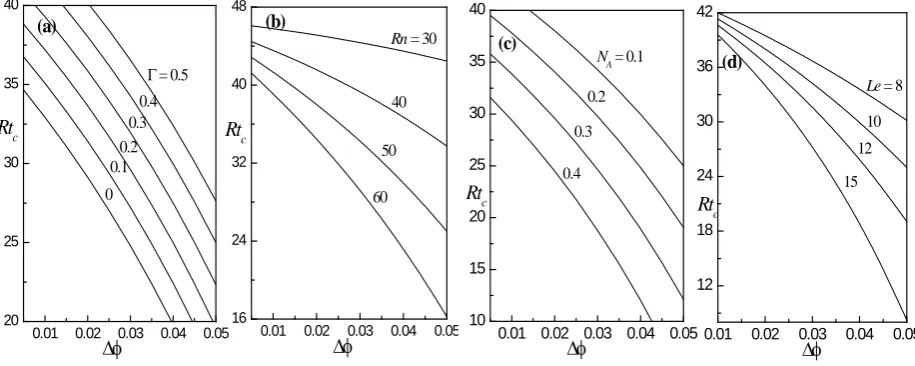
The variation of critical Darcy-Rayleigh number Rtc is shown in Figs 1(a), (b), (c) and (d) as a function of ∆φ for
different values ofΓ,Rn, NA and Le, respectively. The corresponding critical wave number
a
cfor these values isnanofluid saturated porous medium (Fig. 1a). To the contrary, increase in the values ofRn, NA and Le is to decrease the values of Rtc and hence their effect is to hasten the onset of convection. Besides, Rtc monotonically decreases with increasing ∆φ indicating its effect is to hasten the onset of convection. This result is in conformity with
0.01 0.02 0.03 0.04 0.05 20
25 30 35 40
0.01 0.02 0.03 0.04 0.05 16 24 32 40 48 ∆φ Rtc 0 0.1 0.2 0.3 0.4
Γ = 0.5 (a) ∆φ (b) 40 50 60 Rtc
Rn= 30
0.01 0.02 0.03 0.04 0.05 10 15 20 25 30 35 40
0.01 0.02 0.03 0.04 0.05
12 18 24 30 36 42 (c)
NA = 0.1
0.2 0.3 0.4 ∆φ ∆φ Rtc Rtc (d)
Le = 8
10 12
15
Fig. 1: Variation of Rtc with ∆φ for different values of (a) Γwith Le=10,Rn=50, NA=0.1,∆ =φ 0.01,
(b) Rnwith Le=10,Γ =0.4, NA=0.1,∆ =φ 0.01, (c) NA with Le=10,Γ =0.4, Rn=50,∆ =φ 0.01, (d) Le with
0.1
A
N = ,Γ =0.4, Rn=50,∆ =φ 0.01for NB=0.5
0.01 0.02 0.03 0.04 0.05 3.142 3.143 3.144 3.145 3.146 3.147 3.148
0.01 0.02 0.03 0.04 0.05 3.142 3.144 3.146 3.148 3.150 3.152 3.154 0 0.1 0.2 0.3 0.4
(a)
ac ∆φ (b)Γ = 0.5
60 50 40
Rn = 30
ac
∆φ 3.143 0.01 0.02 0.03 0.04 0.05
3.144 3.145 3.146 3.147
0.01 0.02 0.03 0.04 0.05 3.144 3.145 3.146 3.147 ∆φ ∆φ ac ac 0.1 0.2 0.3
NA= 0.4
(c) (d)
8 10 12
Le = 15
Fig. 2: Variation of ac with ∆φ for different values of (a) Γwith Le=10,Rn=50, NA =0.1,∆ =φ 0.01,
(b) Rnwith Le=10,Γ =0.4, NA=0.1,∆ =φ 0.01, (c) NA with Le=10,Γ =0.4,Rn=50,∆ =φ 0.01, (d) Le with
0.1
A
N = ,Γ =0.4, Rn=50,∆ =φ 0.01for NB=0.5
1 2 3 4 5 6 7 8
50 60 70 80 90 100 a a Rt Rt oscillatory steady
Pr = 10, 100, 1000
(a)
1 2 3 4 5 6 7 8
40 50 60 70 80 90 100
a Rt
steady
oscillatory
Γ = 0, 0.2, 0.4
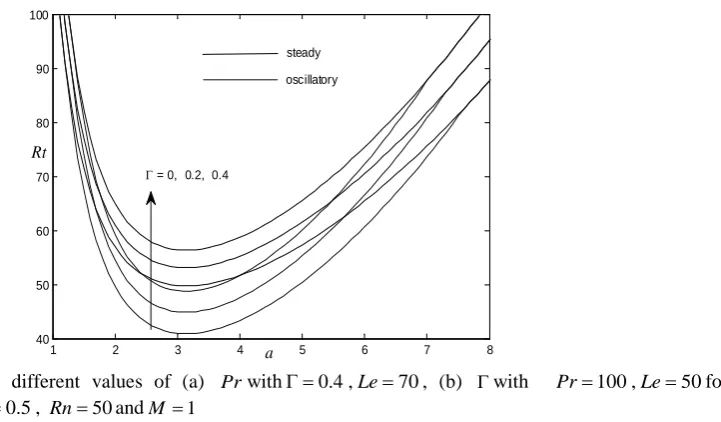
Fig. 3: Neutral curves for different values of (a) PrwithΓ =0.4,Le=70, (b) Γwith Pr=100,Le=50for
0.01 φ
∆ = , NA=0.1, NB =0.5, Rn=50andM =1
The one advocated by Nield and Kuznetsov (2009). As can be seen from Figs 2 (a-d), the variation in
a
c is found to benegligibly small for all the parametric values chosen. The critical wave number turns out to be approximately
π
.Case (ii): Bottom-heavy nanoparticle distribution (φ φ0− = ∆ >1 φ 0)
The temperature has a destabilizing effect while the volume fraction of nanoparticle distribution has a stabilizing effect on the system. Due to their opposing contributions one would expect oscillatory convection. The possibility of occurring oscillatory convection was propounded by Nield and Kuznetsov (2009) and this aspect has been explored in the present study. It is found that the onset of convection ceases to be stationary and instability sets in via oscillatory mode for certain choices of parametric values.
Figures 3(a) and (b) exhibit the neutral stability curves in the (Rt a, )-plane for different values of Prandtl numberPr
and viscosity parameterΓ, respectively. From these figures it is seen that the steady and oscillatory neutral curves are connected in a topological sense. This connectedness allows the linear stability criteria to be expressed in terms of the critical thermal Darcy-Rayleigh number, below which the system is stable and definitely unstable above.
The points where the oscillatory solutions branch off from the stationary convection can be easily identified from these figures. From Fig.3 (a) it is seen that oscillatory convection is hastened with increasing Pr and moreover for Pr≥100 all the oscillatory neutral curves coalesce indicating less significance of the fluid conductivity on the onset of oscillatory convection. Figure 3(b) shows that increasingΓ is to increase the region of stability. The critical wave number for the onset of stationary convection is lower than that of oscillatory convection.
0.005 0.010 0.015 0.020 35
40 45 50
0.005 0.010 0.015 0.020 44
46 48 50
Rtc
∆φ ∆φ
0 0.2 Γ = 0.4
(a)
Rtc
(b)
Rn = 50, 40, 30
0.01 0.02 0.03 40
44 48 52
0.01 0.02 0.03 46
47 48 49 50 51
Rtc
∆φ ∆φ
NA = 0.5
1 0.8 (c)
Rtc
(d)
50
70
Le = 30
Fig. 4: Variation of Rtc with ∆φ for different values of (a) Γwith NA=0.5=NB,Rn=50=Le, (b) Rnwith NA=0.5=NB, Le=50,Γ =0.4, (c) NA with Γ =0.4, NB =0.5, Rn=50=Le,
0.010 0.012 0.014 0.2
0.4 0.6 0.8 1.0
0.010 0.015 0.020 0.025 0.030 0.4
0.8 1.2 1.6 2.0
∆φ
Γ = 0, 0.2, 0.4
(a)
ωi c (b)
40
Rn = 50
30
ωi c
∆φ 0.01 0.02 0.03
0.4 0.8 1.2 1.6 2.0
0.01 0.02 0.03 0.4
0.8 1.2 1.6 2.0
ωi c
∆φ ωi c
NA = 0.5
0.8 1
(c)
∆φ (d)
Le = 70 50
30
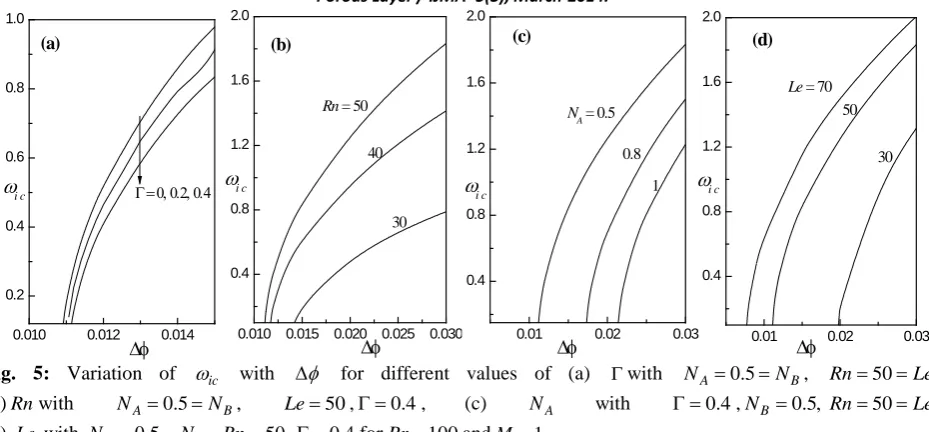
Fig. 5: Variation of ωic with ∆φ for different values of (a) Γwith NA=0.5=NB, Rn=50=Le, (b)Rnwith NA=0.5=NB, Le=50,Γ =0.4, (c) NA with Γ =0.4,NB =0.5, Rn=50=Le, (d) Le with NA =0.5=NB, Rn=50,Γ =0.4forPr=100andM =1
The critical thermal Darcy-Rayleigh number computed numerically for both stationary and oscillatory modes for various values of physical parameters are compared in Figs 4(a)-(d), while the corresponding critical frequency of oscillations is illustrated in Figs. 5(a)-(d) with∆ =φ( φ φ0− 1). In Figs 4(a)-(d) the portion of each stability boundary lying to the left of the discontinuity in slope corresponds to steady onset,while to the right the onset is of the oscillatory type. Initially, stationary onset occurs up to certain values of∆φ. As ∆φ is increased further beyond a critical value,
the convection is bifurcated into the oscillatory mode. The value of ∆φ at which the preferred mode of instability changes depends on the parametric values chosen. It is affected very little for various values of Γ (Fig. 4a). Moreover, the critical thermal Darcy-Rayleigh number for both stationary and oscillatory mode is found to increase with increasingΓ. Therefore, the viscosity parameter enhances the stability of the system in both stationary and oscillatory modes. The value of ∆φ at which the preferred mode of instability changes is found to be significant with
increasingRn, NA and Le and the same is evident from Figs. 4(b), (c) and (d), respectively. Although the effect of increasing Rn is to delay the onset of oscillatory convection, it shows a dual trend on the onset of stationary convection. It is seen that increasingRn is to hasten the onset of stationary convection till ∆ =φ 0.01and exceeding
this value the trend reverses. Increasing NA is to advance the onset of stationary convection but shows no influence on the onset of oscillatory convection. The effect of Le on the stationary and oscillatory onset is found to be different. The oscillatory convection is hastened with increased values of Le while an opposite trend is noticed on the stationary
convection. In this case also increasing
N
B shows insignificant effect on the stability of the system.The critical frequency of oscillations ωicincreases with ∆φ as seen from Figs. 5 (a)-(d). Also, increase in the value
ofΓ,NA as well as decrease in the value of Rn and Le is to decreaseωic. From these figures it is obvious that the oscillatory convection sets in only when∆φ exceeds certain value which depends on the choice of other parametric values.
5. CONCLUSIONS
The onset of convection in a nanofluid saturated Darcy porous medium is studied by considering variation in nanofluid viscosity with temperature. The eigenvalue problem is solved numerically using the Galerkin method. The onset of convection is hastened and via stationary mode if the basic nanoparticle distribution is top-heavy. However, the instability is via oscillatory mode depending on the choices of physical parameters and also the onset is delayed if the basic nanoparticle distribution is bottom-heavy. Moreover, oscillatory convection occurs when the volume fraction difference of nanoparticles exceeds a threshold value which in turn depends on the choices of physical parameters. The effect of increasing viscosity parameter Γis to delay the onset of convection irrespective of the arrangement of basic volume fraction of nanoparticles. An increase in the value of density Darcy - Rayleigh numberRn, modified diffusivity ratio NA and the Lewis numberLe is to hasten the onset of convection when the basic nanoparticle distribution is top-heavy. In the bottom-heavy case, the effect of increasing Prandtl numberPrand Le is to hasten while increasing Rn
is to delay the onset of oscillatory convection but NA shows no influence on the onset of oscillatory convection.
ACKNOWLEDGEMENT
One of the authors (M.D) wishes to thank the Head of the Department, the Principal and the Management of his college for their encouragement and support.
REFERENCES
[1] Buongiorno, J., Convective transport in nanofluids, ASME J. Heat Transf. 128 (2006), 240–250.
[2] Choi, S. U. S., Zhang, Z. G., Yu, W., Lockwood, F. E. and Grulke, E. A., Anomalously thermal conductivity enhancement in nanotube suspensions, Appl. Phys. Lett. 79 (2001), 2252-2254.
[3] Duangthongsuk, W. and Wongwises, S., Measurement of temperature-dependent thermal conductivity and viscosity of TiO2–water nanofluids, Exp. Therm. Fluid Sci. 33 (2009), 706-714.
[4] Eastman, J. A., Choi, S. U. S., Yu, W. and Thompson, L. J., Anomalously increased effective thermal conductivities of ethylene glycol-based nanofluids containing copper nanoparticles, Appl. Phys. Lett. 78 (2001), 718–720.
[5] Fan, J. and Wang, L., Review of Heat Conduction in Nanofluids, ASME J. Heat Transf.133 (2011), 1-14.
[6] Kakac, S. and Pramuanjaroenkij, A., Review of convective heat transfer enhancement with nanofluids, Int. J. Heat Mass Transf. 52 (2009), 3187–3196.
[7] Kole, M. and Dey, T. K., Viscosity of alumina nanoparticles dispersed in car engine coolant, Exp. Therm. Fluid Sci. 34 (2010), 677-683.
[8] Lebon, G. and Cloot, A., A thermodynamical modeling of fluid flows through porous media: application to natural convection, Int. J. Heat Mass Transf. 9 (1986), 381-389.
[9] Mahbubul, I. M., Saidur, R. and Amalina, M. A., Latest developments on the viscosity of nanofluids, Int. J. Heat Mass Trans. 55 (2012), 874-885.
[10]Naik, M. T., Janardhana, G. R., Reddy, K. V. K. and Reddy, B. S., Experimental investigation into rheological property of copper oxide nanoparticles suspended in propylene glycol- water based fluids, ARPN J. Eng. Appl. Sci. 5 (2010), 29-34.
[11]Nguyen, C. T., Desgranges, F., Galanis, N., Roy, G., Mare, T., Boucher, S. and Anguemintsa, H., Viscosity data for Al2O3–water nanofluid—hysteresis: is heat transfer enhancement using nanofluids reliable?, Int. J. Therm. Sci. 47 (2008), 103-111.
[12]Nield, D. A. and Bejan, A., Convection in porous media, Springer. 4th edition (2013).
[13]Nield, D. A. and Kuznetsov, A. V., Effects of Temperature-dependent viscosity on forced convection in a porous medium: layered-medium analysis, J. Porous media 6 (2003), 213-222.
[14]Nield, D. A. and Kuznetsov, A. V., The onset of convection in a layer of porous medium saturated by a nanofluid: effects of conductivity and viscosity variation and cross-diffusion, Trans. Porous Media 92 (2012), 837-846. [15]Nield, D. A. and Kuznetsov, A.V., Thermal instability in a porous medium layer saturated by a nanofluid. Int. J.
Heat Mass Trans. 52 (2009), 5796-5801.
[
dispersed in ethylene glycol and water mixture, Exp. Therm. Fluid Sci, 32 (2007), 397-402.
[17]Turgut, A., Tavman, I., Chirtoc, M., Schuchmann, H. P., Sauter, C. and Tavman, S., Thermal conductivity and viscosity measurements of water-based TiO2 nanofluids, Int. J. Thermophys. 30 (2009), 1213-1226.
[18]Tzou, D. Y., Instability of nanofluids in natural convection, ASME J. Heat Transf. 130 (2008a), 072401-1-9. [19]Tzou, D. Y., Thermal instability of nanofluids in natural convection. Int. J. Heat Mass Transf. 51 (2008b),
2967-2979.
[20]Vadasz, P., Heat conduction in nanofluid suspensions, ASME J. Heat Transf. 128 (2006), 465–477.
[21]Yu, W. and Xie, H., A Review on Nanofluids: Preparation, Stability Mechanisms, and Applications, J. Nanomaterials, (2012), 1-17.
[22]Zheng, L., Li, B., Lin, P., Zhang, X., Zhang, C., Zhao, B. and Wang, T., Sedimentation and precipitation of nanoparticles in power-law fluids, Microfluid. Nanofluid. 15 (2012), 11-18.
NOMENCLATURE
a wave number
B
D Brownian diffusion coefficient
T
D thermophoretic diffusion coefficient
d depth of the porous layer
k thermal conductivity of the nanofluid
K permeability of the porous medium
Le Lewis number
A
N modified diffusivity ratio
B
p pressure
(
, ,)
q= u v w nanofluid velocity
,
Rm Rn density Darcy - Rayleigh numbers
Rt thermal Darcy - Rayleigh number
(
x y z, ,)
Cartesian coordinatest time
T nanofluid temperature
0
T temperature at the lower boundary
1
T temperature at the upper boundary
R
T reference temperature
W amplitude of perturbed vertical component of velocity
GREEK SYMBOLS
β volumetric coefficient of thermal expansion
ε
porosity of porous media σ heat capacity ratio Γ viscosity parameterµ
viscosity of the fluidη
thermal expansion coefficient of viscosityρ
nanofluid densityΘ amplitude of perturbed temperature
φ
nanoparticle volume fraction0
φ
nanoparticle volume fraction at the lower boundary1
φ nanoparticle volume fraction at the upper boundary Φ amplitude of perturbed nanoparticle volume fraction
κ
thermal diffusivity of the fluidSUPERSCRIPTS
*
dimensionless variable'
perturbed variableSUBSCRIPTS
b basic state
f fluid
p particle