Cultivation of Intercultural Awareness in EFL
Teaching
Chenlu Liu
School of Foreign Studies, Nantong University, 226000, China
Abstracts—Language and culture are inseparable. Foreign language learning is not only the language learning, but also the culture learning. Intercultural awareness, therefore, should be cultivated so that students can have the competence to use language to fulfill the successful intercultural communication. By analyzing a survey which investigates the students’ present condition of intercultural awareness, this paper tries to put forward some measures to cultivate the students’ intercultural awareness in EFL teaching.
Index Terms—intercultural awareness, cultural differences, EFL teaching
I. INTRODUCTION
For quite a long time, English as a foreign language (EFL) teaching in China mainly emphasizes on teaching students’ grammar and language skills, ignoring the introduction of cultural differences. Nowadays, however, with the increasing international connection, people begin to realize that vocabulary and grammar can’t ensure real success in intercultural communication. Language and culture are inseparable. Therefore cultivating intercultural awareness is necessary in language teaching, which helps to strengthen English learners’ understanding of the language and improve their performance in intercultural communication.
This paper first introduces the relationship between language and intercultural awareness based on the related theories and research achievements at home and abroad. Then through a survey including cultural test and questionnaire, this paper aims to take a deep look at the college students’ current condition of intercultural awareness and tries to explore the appropriate approaches for efficient cultural teaching so as to enhance students' intercultural awareness.
II. INTERCULTURAL AWARENESS
A. Language and Culture
What is culture? There are various definitions. Actually it’s hard to give “culture” a scientific and integrated definition. British anthropologist Edward Tylor (1920) gave a profound scientific description of the term. He defined it as complex whole including knowledge, beliefs, arts, morals, law, customs and any other capabilities and habits acquired by man as a member of society. In the early 1920s, American linguist Sapir (1921) once mentioned that there is something behind language, and language cannot exist without culture. Language is a part of culture and influenced by culture. Gladstone (1972) once pointed that Language and culture are linked closely, language is the product or result of culture and it is the vehicle to shape and communicate culture. Language is the carrier and manifestation of culture. It is the tool of carrying and expressing cultural information. Rivers (1983, p.263) thought that “Language is deeply embedded in culture”. A Chinese linguist Dai (1989, p. 158) thought “language is the primary means by which a culture transmits its beliefs, values, and norms. It gives people a means of interacting with other members of the culture and a means of thinking”. Shu and Zhuang (2008) regarded language as an inalienable part of culture. Language is the carrier of culture, and culture is the foundation and circumstance of language. Culture and language are inseparably integrated. One cannot hope to really master a target language without profound knowledge of the culture linked to that language.
B. Intercultural Awareness in Language
Intercultural awareness, according to Chen and Starosta (1996), refers to an understanding of one’s own and others’ cultures that affect how people think and behave. Robert G. Hanvey developed the idea of global perspectives that has been widely used as a framework in intercultural awareness. According to Hanvey (1979), a global perspective consists of certain modes of thought, sensitivities, intellectual skills, and explanatory capacities, which is a combination of many things and any person may be rich in certain elements while relatively lacking in others. Hanvey describes four levels of intercultural awareness: (1) awareness of superficial or visible cultural traits, such as isolated facts or stereotypes; (2) awareness of significant and subtle cultural traits that contrast markedly with one’s own and interpreted as unbelievable and irrational; (3) awareness of significant and subtle cultural traits that contrast markedly with one’s own but can be understood cognitively; (4) awareness of how another culture feels from the standpoint of the insider.
Seelye, H. N. (1975) proposed some practical teaching principles for improving cultural awareness in his book “Teaching Culture”: (1) Acquiring cultural knowledge through language learning; (2) Making cultural behavior an important part of class; (3) Letting student have the capacity of occupying their social economic status; (4) A better understanding of native culture and target culture; (5) Making students know that people’s behavior was affected by culture.
The cultivation of students’ cultural awareness in EFL teaching can encourage students to break the obstacles of intercommunication and master the culture of the target language, and in turn, promote teaching effect. Therefore, to gain knowledge on culture difference and to promote the students’ cultural awareness is one of the aims of the present language teaching.
III. ASURVEY INVESTIGATING STUDENTS’INTERCULTURAL AWARENESS
The purpose of this tentative survey is to find out the present condition of the students’ cultural awareness in their English learning and whether it is important to teach intercultural knowledge and cultivate intercultural awareness in English teaching.
A. Research Questions
1. What is the current condition of the students’ intercultural knowledge? 2. What are the students’ attitudes towards intercultural awareness?
3. What are the students’ main sources of acquiring intercultural knowledge? 4. What are the problems existing in the teaching of intercultural knowledge?
B. Research Subjects
The subjects for this survey are 50 sophomores selected randomly from Nantong University.
C. The Content of the Survey
The survey includes one cultural test and one questionnaire. The cultural test was designed to find out how much cultural knowledge students have learned about English and English speaking countries. It consists of four parts, as shown in Table 1.
TABLE 1
THE CONTENT OF THE CULTURAL TEST
Category Content No. of items Part A Literature, geography and history 1-10 Part B Social conventions 11-15 Part C Religious beliefs, values 16-20
The questionnaire for students was designed to investigate students' intercultural awareness, their main sources of acquiring cultural knowledge and the possible problems of English teaching in cultivating intercultural knowledge. It consists of 16 questions. Question 2, 4, 6, 8, 9, 15, 16 were designed to investigate students' attitudes towards the cultivation of intercultural awareness. Question 1,3,5,7,10,11,12,13,14 were designed to investigate the students' main sources of acquiring cultural knowledge and the possible problems of English teaching in developing intercultural knowledge .
D. Data Collection
The cultural test and questionnaire were given to 50 subjects. Students were required to finish the test in 30 minutes and the questionnaire in 10 minutes. 50 copies of test paper and questionnaire were finally collected back. And all of them prove to be valid after careful examination.
E. Data Analysis
The total score of the test are 100, with 5 points per question. The mean of all participants’ answers was calculated by Statistical Package for Social Sciences 17.0 (SPSS). As for the questionnaire, the descriptive analysis was used.
IV. RESULTS AND DISCUSSION
A. Students' Intercultural Knowledge
TABLE 2 SCORE OF THE CULTURAL TEST
Participants Full Score Maximum Score Minimum Score Mean Score Passing Percentage
50 100 90 20 50 56%
Through the comparison of the scores of part A, part B and part C, it can be found that students do better in part B than in part A and part C (shown in Figure 1). Part B is about social conventions, while part A and part C focus on literature, geography, history, religious beliefs and values. This comparison shows that students are much more familiar with social conventions or in other words, general knowledge about English speaking countries which can be obtained easily from movies, TV, newspapers and other public media, and have mastered the basic intercultural knowledge. And for the part of literature, geography and history, most of which are taught by teachers in class and remembered by mechanical memorizing, students don’t have a good command of that.
Figure 1 The accurate rate of the cultural test Note: Part A: Literature, geography and history
Part B: Social conventions Part C: Religious beliefs, values.
B. Students' Attitude towards Intercultural Awareness
As is shown in Figure 2, only 3.64% of the subjects think intercultural awareness is useless. 34.70% think it is useful. And 76.45% of subjects think it is very useful. We can see that most subjects have fully realized the importance of cultivating the intercultural awareness in English teaching,
Figure 2 Students’ opinions of intercultural awareness in English teaching
Figure 3 The percentage of students’ interest in learning intercultural knowledge
C. Students' Main Sources of Acquiring Intercultural Knowledge
About students' main sources of acquiring cultural knowledge, we get the following result (shown in Figure 4). 23.54% think that they obtained the cultural knowledge from teachers. 13.76% think that they obtained the cultural knowledge from English books, newspapers and magazines. 21.57% think that they obtained the cultural knowledge from interactive activities in class. 35.67% think that they obtained the cultural knowledge from English TV programs and movies after class.
Figure 4 Students’ main sources of acquiring intercultural knowledge Note: A= cultural knowledge from teachers in class B= cultural knowledge from English books, newspapers and magazines
C= cultural knowledge from interactive activities in class D= cultural knowledge from English TV programs and movies after class
So it seems that students’ sources of acquiring intercultural knowledge are not limited to their teachers. Most students think it is helpful to know the English speaking countries’ culture by reading literature works, attending lectures, watching movies, and doing role play in the class, which may shed some light on teaching.
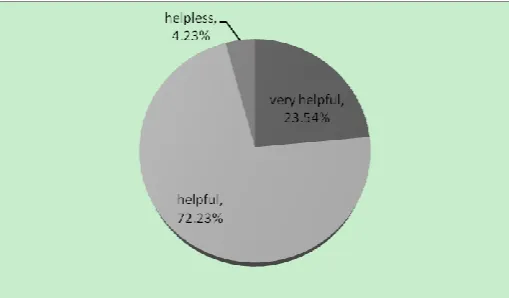
As for the way teachers cultivate students’ intercultural awareness, as is shown in Figure 5, 72.23% students think it is helpful when teachers utilize multimedia and other means to assist cultural teaching or through sitcoms and other performance forms and only 4.23% of them think it is helpless. Thus we can conclude that the majority of students think that it is helpful to have a deep understanding of cultural knowledge if teacher use some unconventional means to assist cultural teaching.
D. Problems Existing in Intercultural Knowledge Teaching
When asked about whether your teacher combines culture teaching with language teaching, 78% students thought their teachers pay more attention to language teaching. This is because nowadays, to some extent, students’ scores in various exams are still valued, which making the teaching more language-oriented. When asked about whether the intercultural knowledge in the textbook meets your need, 57% students gave negative answer and they thought the culture information is somewhat outdated. Thus, we could see textbooks including culture knowledge should be updated, or they can’t serve the students well.
E. Conclusion
According to the feedback of the questionnaire and cultural test, we can see students still have some difficulties in intercultural communication, but the majority of the students have a positive attitude towards intercultural knowledge and they are willing to cultivate their intercultural awareness. However, current language teaching only pays attention to the grammar and language points but ignores the true value of language use and language communication competence. The purpose of English teaching actually is to help students learn the cultures embodied in language and cultivate their communication competence. Therefore, teachers should be more strategic and creative in culture teaching.
V. PRINCIPLES AND APPROACHES FOR CULTIVATING INTERCULTURAL AWARENESS IN ENGLISH TEACHING
As is concluded from the survey, it is necessary to use certain teaching methods to increase learners’ interest and improve their efficiency in receiving the cultural knowledge. Therefore, some principles and approaches are put forward in order to develop English learners’ intercultural awareness
A. Principles
1. Principle of Practicality
From the results of the cultural test above, it is clear that students behave better in mastering the knowledge about social conventions than in other two parts, literature, geography, history and religious beliefs and values. This reflects that students are easier to grasp cultural knowledge that is closely related to their daily life. This requests teachers to pay more attention to the principle of practicality when teaching culture. Principle of practicality demands that the introduced cultural knowledge should be easily accepted by students and be practical (Shu, 2008). It shouldn’t be outdated because when time passes culture changes. Also, the teaching of culture could be done through verbal communication practice so that students can get more practice and preparation for intercultural communication. And this can arouse students’ interest in learning both language and culture. The purpose of English teaching is not only to develop students’ ability to use the language they have learned but also to improve their intercultural awareness of successful intercultural communication. Therefore, the introduction of cultural knowledge should take student’s language proficiency into consideration and keep the information updated timely.
2. Principle of “Step by Step”
From the data shown in Figure 2, it can be seen that the highest score of the culture test is 90 points and the lowest score is only 20 points. This result reflects students’ different language proficiency, learning capacity and apperception ability. This requests teachers to pay more attention to the penetration of the cultural content step by step when teaching culture. The content of culture teaching should be designed according to students’ language proficiency, learning capacity and apperception ability. Teachers should proceed in order and step by step, from the easy to the difficult and complicated. Teaching should be started from students’ point of view. Before the teaching or during the teaching process, teachers should fully understand their students’ knowledge level and language proficiency. Teaching should be adjusted according to students’ cognitive ability and real language proficiency. If teaching is beyond students’ ability, in the first place, it will be unfavorable for students to have a good understanding; in the second, it will be unfavorable for teachers to realize their teaching plans. Teachers may need to spend more energy and time preparing for more background knowledge so that students can better understand the content which is too profound for them. Only when the knowledge teachers teach accords with students’ cognitive ability and real language proficiency, can the knowledge be understood and accepted by students successfully.
3. Principle of Suitability
4. Principle of “Student-oriented”
Currently, autonomous learning with teachers’ guidance is popular in EFL teaching. The role of teachers and students in a class is totally different from before. Students do not passively accept the knowledge taught by the teachers. They are encouraged to give full play of their initiatives to develop their cultural awareness while teachers are no longer the dominator of the class but the facilitator of the students. With teachers’ recommendation and guidance, the knowledge students get from various channels will be merged into their minds better. Still, there is one thing that has to be mentioned. Teachers’ intercultural awareness also has to be enhanced. As is shown above, teachers pay less attention to the teaching of intercultural knowledge, which quite disappoints the students. Thus it’s time for teachers to change their teaching concept, enhance their own cultural awareness, keep pace with the times and explore more cultural notes when comes to a certain topic. Here is an example. When comes to the topic of food, students are required to find more information about food in different countries and the way of cooking, eating habits, etc. However, that is far from enough. Teachers can explore more, for instance, by asking why the staple food of Chinese people is rice which is quite related to the China’s long history and culture. In this way, teachers can exert a subtle influence on students by showing their own intercultural awareness.
B. Approaches
1. Annotation and Mergence
The method of annotation means that teachers give students some additional materials to help them solve the difficulties appearing in the text (Shu, 2008). Teachers could list the words and some expressions that might cause some difficulties in understanding and explain them in the form of notes. The advantage of this approach is that it can help the students understand the cultural knowledge better, making teaching more successful and efficient.
The method of mergence means to combine the cultural content with the language material together (Shu, 2008). When lecturing some language materials, teachers could introduce some related cultural content, such as historical events, cultural customs, origins of words and expressions and so on. Teachers can use these additional materials to arouse students' interest in culture learning. And those cultural contents added may exert a subtle effect on the learning of both culture and language. Stern (1992) believes that this method is very necessary and it can help to create a cultural context for cultural teaching.
2. Comparison and Role-play
Comparison is an important method in developing intercultural awareness in English teaching. It can help students get a clearer understanding about the differences between two different cultures and be able to develop their cultural sensitivity so that they can make proper and appropriate intercultural communication in the future. Teachers should help students to make comparisons. If students make the comparison without any guidance, they may only find the similarities while ignoring the differences. For example, when talking about smiles in different cultures, students may find that both China and America can be called smiling nations, because people in these two countries are easy to smile even meeting strangers. However, they may ignore the differences, such as the different meanings of smiles in different situations, which should be noted by the teacher.
“Role-play” is another useful teaching approach that teachers can adopt. When organizing class activities, teachers can create a certain social and cultural situation according to the teaching materials and require students to play the situation. This activity could arouse students’ interests which give them a strong willing to do their best. They may try to use the language as correctly as they can and take fully consideration of the cultural elements. For example, when teaching a passage about generation gap, teachers can ask the students to surf the internet to look for the information about the relationship between parents and children of different countries, which may be different because of different social beliefs and values, and then ask the students to make a dialogue reflecting those differences.
In addition, students can be asked to make a presentation in the class, showing cultural difference to a certain topic. Mini-drama and short play are also good ways to help students understand the culture as well as practice their language.
3. Some Assisted Teaching Methods
From the research results of the survey, students prefer to learn cultural knowledge through reading literature works, masterpieces, magazines or newspapers, watching TV programs and movies, and attending lectures. They think they can get a better learning effect under such joyful atmosphere. Hence teachers could make use of these different methods to assist their teaching.
Literature reading is an efficient way for students to know about the cultural knowledge including geography, history, belief, traditions, and values. It can also help students to better understand the language they have learned. Therefore, teachers could introduce some literature works to students or explain the cultural background that would be important for their reading. During the course of reading, students' intercultural awareness and competence could be well developed.
class.
Attending lectures is another effective way to develop students' intercultural awareness. Experts or foreign teachers can be invited to give lectures on certain topics related to culture or cross-cultural communication. After the lectures, teachers can hold discussions or debates among students and let students talk or write about their feelings about the lecture or the cultural differences they have learned.
VI. CONCLUSION
Through the tentative survey about the current condition of college students’ cultural awareness, we can see that students’ weak intercultural awareness may hinder their cultural learning and intercultural communication competence. For English learners in China, the key point of learning cultural knowledge and cultivating cultural awareness is to create a good learning environment for them. Teachers should change the conventional concepts, as well as the attitudes of regarding exams as the standard of evaluating students’ ability. Instead, they should take their responsibility in giving directions, center on the purpose of “fostering students’ communicative competence” and change their teaching concepts by adopting efficient methods and approaches. In this way, students can not only learn the language knowledge but also the social and cultural knowledge; not only develop the language ability but also the intercultural awareness, ultimately improving their intercultural communicative competence. Learning a foreign language and its culture is a long process. To develop students' intercultural awareness and the ability of intercultural communication is still a big challenge to scholars and teachers. Although this research has some limitations, such as small number of samples, it is just a start. And it shall be continued further and deeply for improvement in the future.
REFERENCES
[1] Chen, G. M. & Starosta, W. J. (1996). Intercultural communication competence: a synthesis. In Burleson, B. R. & Kunkel, A. W. (Eds.), Communication Yearbook. (Vol. 19). California: Sage Publications.
[2] Dai, W. D. (1989). A Concise Course on Linguistics for Students of English. Shanghai: Shanghai Foreign Language Education Press.
[3] Gladstone, J. (1972). Language and Culture. Boston: Mcgraw-Hill International Book Company. [4] Hanvey, R. (1979). Cross-cultural Awareness. Edinburgh: Newbury House Publishers.
[5] Rivers, M. (1983).Communicating Naturally in a Second Language. Guildford:Cambridge University Press Ltd. [6] Sapir, E. (1921). Language: An Introduction to the Study of Speech. New York: Harcourt Brace Jovanovich, Inc.
[7] Seelye, H. (1987). Teaching Culture: Strategies for Intercultural Communication. Chicago: National Textbook Company Lincolnwood.
[8] Shu, D. F & Zhuang, Z. X. (2008). Modern Foreign Language Teaching--- Theory, Practice and Method. Shanghai: Shanghai Foreign Language Education Press.
[9] Stern, H. (1992). Issues and Options in Language Teaching. Manchester: Oxford University Press.
[10] Tylor, E. B. (1920). Primitive Culture: Researches into the Development of Mythology, Philosophy, Religion, Language, Art and Custom. London: John Murray.
Chenlu Liu was born in Nantong, China in 1981. She received her M.A. degree in English language and literature from Yangzhou University, China, in 2010.