European Journal of Physical Education and Sport Science
ISSN: 2501 - 1235 ISSN-L: 2501 - 1235 Available on-line at: www.oapub.org/edu
Copyright © The Author(s). All Rights Reserved. doi: 10.5281/zenodo.1308218 Volume 4 │ Issue 9 │ 2018
DROPPING OUT OF THE FITNESS SPORT
AMONG WOMEN
Georgios F. Zarotis
University of the Aegean, Faculty of Human Sciences, Rhodes, Greece
Abstract:
In the evaluations and statistical analyses presented here, it is examined to what extent, regarding women; the various reasons for quitting activity in a gym are age-dependent. In other words, are the motives for quitting this activity different in older women than in younger women? According to the life stages, do other aspects, e.g. priorities in life, health problems or other family and professional requirements, affect the decision and, if so, how strong is their effect? A total of 164 women, who had terminated their contract with a fitness studio, were questioned. The study was conducted in a health-oriented fitness centre in east Cologne. The fitness facility was opened in 1994 and has a size of 1,100 square meters. At the time of the study, the gym had up to 1,151 memberships. Among them, 59% of the members were women and 41% were men. According to the survey results, it is obvious that only a few of the quitting reasons offered in the survey are also indicated in significant frequency as important for the quitting decision. With the exception of membership costs, these reasons have nothing to do with studio conditions, but rather, apart from the mentioned health problems, mainly address issues of time scheduling and prioritizing the training in relation to other areas of life.
Keywords: fitness sport, fitness-centre, dropping out, women
1. Introduction
│ │
The evaluations presented here and the statistical analyses address the issue to what extent the various reasons for quitting activity in a gym are age-dependent among women. In other words, are the motives for quitting this activity different in older women than in younger women? According to the life stages, do other aspects, e.g. priorities in life, health problems or other family and professional requirements, affect the decision and, if so, how strong is their effect?
Brehm and Eberhardt (1995) questioned fitness studio members about their reasons for quitting training because they had not renewed their contract. The major reason for quitting the activity was the "lack of fun in the sporting activities". Also important for the quitting decision were "motivation problems" (e.g. laziness), "lack of time" (often due to heavy workload) and "financial reasons" (too expensive membership fees). In response to an open question about the specific quitting reasons, the members criticized the "studio atmosphere" (too impersonal) as well as the "lack of social support" (e.g. no contact with other members, partner has quit the training, etc.) and also the "high membership costs" (e.g. for additional services like childcare) were viewed critically. This shows that quitting a sports program always depends on personal as well as situational characteristics (Rampf 1999). Although it is possible to identify specific reasons which finally lead to dropping out, the participation behaviour is affected by a complex factor structure.
Dishman (1982, 1998) several times remarks critically on the often-unsystematic approach of many studies and describes them as a-theoretical. This lack of standardization of theories and examination methods restricts the comparability of the studies considerably. Especially the limited data base and the lack of uniform models complicate the research.
2. Material and Methods
2.1 Survey methodology
A total of 164 women, who had terminated their contract with a fitness studio, were questioned. The survey was conducted as a telephone inquiry about the actual reasons that led to this decision.
The advantages of the telephone survey are the low cost per interview, the possibility of responding to queries and the high external validity. Disadvantages are the lower possible data volume caused by the difficulty to access the responder or lack of interest in a telephone survey, and the possible influence of the interviewer (Homburg & Krohmer, 2008).
relocation or change of the telephone number. 26 persons did not wish to participate in the survey (Zarotis/Tokarski 2005, Zarotis et al. 2017).
The persons were asked about the importance of different reasons for their decision to leave the gym. They were asked to rank the importance of each of these 19 reasons for leaving in a five-point Likert scale. The scaling ranged from "does not apply at all" (coded with the numerical value 1) and "applies strongly" (coded with the numerical value 5). The three intermediate stages were not verbally expressed in the questionnaire; only the polarity of the scale was verbalized over the two extreme points. Thus, the total of 19 individual subjects were considered as scale marks regarding the significance of individual quitting reasons even in the strict meaning of the metric theory, which in statistical evaluation makes the calculation of mean values and the use of parametric statistical methods possible.
In most of the questionnaire items there were no response refusals, so that in 15 of the 19 questionnaires there are valid values even N = 164. In two items there was a missing value, i.e. a person refused to respond, and in other 2 items there were 2 missing values.
The age of the interviewees was recorded in whole years; there was no missing value in any case, so that in N = 164 cases the information about the age is in years is available.
2.2 Statistical approach
In the data analysis, the sample characteristics are initially described in terms of age and duration of membership in the studio.
With regard to the question of the relationship between the importance of quitting reasons and the age, the female respondents of the sample are presented in a descriptive manner in their distribution characteristics of the reasons for quitting and by age groups. Therefore, age data were divided into the following four age categories:
Age group 1: Respondents up to 25 years old;
Age group 2: Respondents between 26 and 40 years old;
Age group 3: Respondents between 41 and 55 years old;
Age group 4: Respondents from 56 years old and over.
To ensure the inferential statistic of the relationship between the quitting reasons and the age, however, these age groups are not used, but correlations with the Pearson correlation coefficients, to make use of the full variance of the characteristic age in the correlation analysis.
│ │
3. Results
3.1 Sample description
The sample’s age range is between 16 and 74 years with a respondents’ average age of 43.3 years and a distribution of 11.4 years. In the age categories mentioned, exactly 50% of the respondents are in the category 3 and a further 32.2% in the age category 2. Only 5.5% of the respondents were very young and respondents over 55 were up to 12%. Contract terminations were made on average after 4.1 years of membership, with a very large distribution (standard deviation) of 3.7.
Table 1: Sample distribution characteristic values
Quantity % Mean
value
Median Standard
deviation
Quantity
Age 43.3 43.5 11.4 164
Membership duration (years) 4.1 3.0 3.7 164
Age category
Up to 25 years 9 5.5% 26-40 years 53 32.3% 41-55 years 82 50.0% over 55 years 20 12.2%
Total 164 100.0%
3.1 Descriptive statistics
A. Importance of Quitting Reasons in General
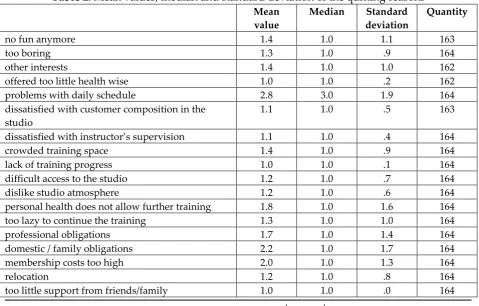
Table 2 shows the mean values, median and standard deviation of the 19 questions concerning the quitting reasons.
Table 2: Mean values, median and standard deviation of the quitting reasons
Mean value
Median Standard
deviation
Quantity
no fun anymore 1.4 1.0 1.1 163
too boring 1.3 1.0 .9 164
other interests 1.4 1.0 1.0 162
offered too little health wise 1.0 1.0 .2 162
problems with daily schedule 2.8 3.0 1.9 164
dissatisfied with customer composition in the studio
1.1 1.0 .5 163
dissatisfied with instructor’s supervision 1.1 1.0 .4 164
crowded training space 1.4 1.0 .9 164
lack of training progress 1.0 1.0 .1 164
difficult access to the studio 1.2 1.0 .7 164
dislike studio atmosphere 1.2 1.0 .6 164
personal health does not allow further training 1.8 1.0 1.6 164
too lazy to continue the training 1.3 1.0 1.0 164
professional obligations 1.7 1.0 1.4 164
domestic / family obligations 2.2 1.0 1.7 164
membership costs too high 2.0 1.0 1.3 164
relocation 1.2 1.0 .8 164
regular training timetable not compatible with my schedule
2.5 1.0 1.9 164
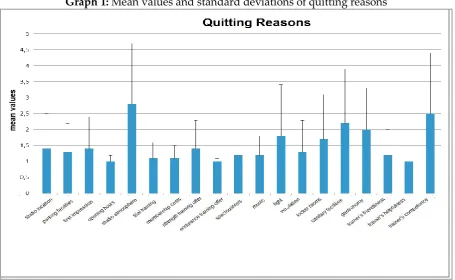
Graph 1 shows the mean values and distributions (as T bars) as a diagram of vertical bars.
Graph 1: Mean values and standard deviations of quitting reasons
B. Importance of Quitting Reasons According to Age Categories
Table 3 shows the distribution characteristic values (mean value, median, standard deviation) and the sample size differs according to the four age categories.
Table 3: Distribution characteristic values of the quitting reasons according to age categories
Mean value Median Standard
deviation
Quantity
Age category
up to 25 years
No fun anymore
1.0 1.0 .0 9
26-40 years
1.3 1.0 1.0 53
41-55 years
1.5 1.0 1.2 82
over 55 years
1.3 1.0 1.0 19
Age category
up to 25 years
Too boring
1.0 1.0 .0 9
26-40 years
1.3 1.0 .8 53
│ │
years over 55 years
1.0 1.0 .0 20
Age category
up to 25 years
Other interests
2.2 1.0 1.9 9
26-40 years
1.2 1.0 .8 52
41-55 years
1.4 1.0 1.1 81
over 55 years
1.2 1.0 .9 20
Age category
up to 25 years
Offered too little health wise
1.0 1.0 .0 9
26-40 years
1.1 1.0 .2 52
41-55 years
1.0 1.0 .2 81
over 55 years
1.0 1.0 .0 20
Age category
up to 25 years
Problems with daily schedule
2.3 1.0 2.0 9
26-40 years
3.5 4.0 1.7 53
41-55 years
2.7 1.0 1.9 82
over 55 years
1.7 1.0 1.5 20
Age category
up to 25 years
Dissatisfied with customer composition in the studio
1.0 1.0 .0 9
26-40 years
1.2 1.0 .5 53
41-55 years
1.1 1.0 .5 81
over 55 years
1.2 1.0 .7 20
Age category
up to 25 years
Dissatisfied with instructor’s supervision
1.0 1.0 .0 9
26-40 years
1.1 1.0 .2 53
41-55 years
1.1 1.0 .3 82
over 55 years
1.5 1.0 1.0 20
Age category
up to 25 years
Crowded training space
1.0 1.0 .0 9
26-40 years
1.4 1.0 .7 53
41-55 years
1.5 1.0 1.1 82
over 55 years
Age category
up to 25 years
Lack of training progress
1.0 1.0 .0 9
26-40 years
1.1 1.0 .2 53
41-55 years
1.0 1.0 .0 82
over 55 years
1.0 1.0 .0 20
Age category
up to 25 years
Difficult access to the studio
1.0 1.0 .0 9
26-40 years
1.3 1.0 1.0 53
41-55 years
1.1 1.0 .7 82
over 55 years
1.0 1.0 .0 20
Age category
up to 25 years
Dislike studio atmosphere
1.0 1.0 .0 9
26-40 years
1.2 1.0 .6 53
41-55 years
1.2 1.0 .7 82
over 55 years
1.0 1.0 .0 20
Age category
up to 25 years
Personal health does not allow further training
1.0 1.0 .0 9
26-40 years
1.6 1.0 1.4 53
41-55 years
1.7 1.0 1.5 82
over 55 years
3.3 4.0 1.9 20
Age category
up to 25 years
Too lazy to continue the training
1.0 1.0 .0 9
26-40 years
1.3 1.0 1.1 53
41-55 years
1.4 1.0 1.1 82
over 55 years
1.4 1.0 1.0 20
Age category
up to 25 years
Professional obligations
2.2 1.0 1.9 9
26-40 years
1.8 1.0 1.5 53
41-55 years
1.8 1.0 1.5 82
over 55 years
1.0 1.0 .0 20
up to 25
years Domestic / family obligations
1.0 1.0 .0 9
│ │ Age category years 41-55 years
2.0 1.0 1.6 82
over 55 years
1.2 1.0 .9 20
Age category
up to 25 years
Membership costs too high
1.7 1.0 1.0 9
26-40 years
2.3 1.0 1.4 53
41-55 years
1.9 1.0 1.2 82
over 55 years
1.9 1.0 1.2 20
Age category
up to 25 years
Relocation
2.3 1.0 2.0 9
26-40 years
1.0 1.0 .3 53
41-55 years
1.1 1.0 .8 82
over 55 years
1.0 1.0 .0 20
Age category
up to 25 years
Too little support from
friends/family
1.0 1.0 .0 9
26-40 years
1.0 1.0 .0 53
41-55 years
1.0 1.0 .0 82
over 55 years
1.0 1.0 .0 20
Age category
up to 25 years
Regular training timetable not compatible with my schedule
2.3 1.0 2.0 9
26-40 years
2.5 1.0 1.9 53
41-55 years
2.6 1.0 1.9 82
over 55 years
1.7 1.0 1.3 20
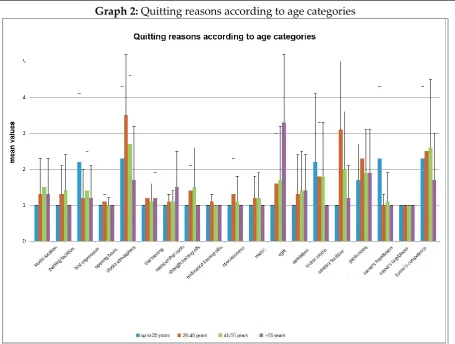
Graph 2: Quitting reasons according to age categories
3.2 Significance test of the correlations between quitting reasons and age
In Table 4, the correlation coefficients (product-moment correlations according to Pearson) of the evaluations of the quitting reasons are presented each time with the respective age:
Table 4: Correlations between quitting reasons and age
Correlations
Age
No fun anymore Pearson correlation ,153
Significance (bilateral)
,052
N 163
Too boring Pearson correlation ,028
Significance (bilateral)
,723
N 164
Other interests Pearson correlation ,006
Significance (bilateral)
,940
N 162
Offered too little health wise Pearson correlation ,021 Significance
(bilateral)
│ │
N 162
Problems with my daily schedule Pearson correlation -,252** Significance
(bilateral)
,001
N 164
Dissatisfied with customer composition in the studio Pearson correlation -,003 Significance
(bilateral)
,967
N 163
Dissatisfied with instructors’ supervision Pearson correlation ,225** Significance
(bilateral)
,004
N 164
Crowded training space Pearson correlation -.010
Significance (bilateral)
,902
N 164
Lack of training progress Pearson correlation -,075
Significance (bilateral)
,337
N 164
Difficult access to the studio Pearson correlation -,172* Significance
(bilateral)
,028
N 164
Dislike studio atmosphere Pearson correlation -.024
Significance (bilateral)
,765
N 164
Personal health does not allow further training Pearson correlation ,310** Significance
(bilateral)
,000
N 164
Too lazy to continue the training Pearson correlation ,069 Significance
(bilateral)
,378
N 164
Professional obligations Pearson correlation -,173*
Significance (bilateral)
,026
N 164
domestic / family obligations Pearson correlation -,151 Significance
(bilateral)
,054
N 164
Membership costs too high Pearson correlation -,102
Significance (bilateral)
,192
Relocation Pearson correlation -,174* Significance
(bilateral)
,026
N 164
Too little support from friends/family Pearson correlation . γ
Significance (bilateral)
.
N 164
Regular training timetable not compatible with my schedule Pearson correlation -,133 Significance
(bilateral)
,090
N 164
**. Correlation is significant by level 0.01 (bilateral). *. Correlation is significant by level 0.05 (bilateral).
c. Cannot be calculated, since at least one of the variables is constant
4. Discussion
Most of the quitting reasons present a mean value between 1 and 1.5, which means that the majority of the respondents chose the answer category "does not apply at all" and the mean value is closer to the completely negative category ("does not apply at all") than in the next category, which still represents a rejection of this quitting reason. Furthermore, in the case of the item "too little support from friends/family" the first answer category was chosen without exception. Here there is no variance in the answers.
The clearly highest rating is 3.5 and results at the quitting reason "Problems with my daily schedule".
In five further items mean values are around the value 2 (mean values between 1.7 and 2.5). These reasons, in descending order, are: "Regular training timetable not compatible with my schedule", “Domestic/family obligations”, "Membership costs too high", "Personal health does not allow further training" and "Professional obligations".
│ │
Financial aspects are also mentioned in a study by the IHRSA (2012) as main arguments for the termination of membership in a fitness club. 52.2% of the 1,000 respondents surveyed said they were no longer able to afford their membership or rated them as expensive. Therefore, in future work, the collection of the income should be considered in order to assess its impact on the dropout.
It is striking that, with the exception of the membership costs, all studio conditions do not play any role, or at least a significant role, in the quitting decision. Of equal small importance are also personal reasons concerning motives and interests. As regards to health, it is striking that, although on the one hand the reason "personal health does not allow further training" appears relatively strong, on the other hand however the reason "offered too little Healthwise" is practically not indicated.
The differentiation by age categories in these six main quitting reasons shows:
The problems with the daily schedule are clearly the lowest among those over 55 years of age and most pronounced in the age group of 26 to 40 years.
The item "regular training timetable not compatible with my schedule" is clearly rated the least important by the oldest group of respondents; in the other three age groups, the importance increases with increasing age.
The "domestic and family obligations", on the other hand, show that this reason plays practically no role in the youngest and oldest age groups, but is clearly most strongly mentioned in the 26-40 age group.
The quitting reason "Membership costs too high" shows only little age differentiation; this reason is also mentioned most frequently by the group of respondents between 26 and 40 years of age.
The quitting reason "Health does not allow any further training" is dominated, as expected, by respondents belonging to the oldest age category; the reason is much less pronounced for all other age groups and decreases monotonously the younger the respondents are.
Surprisingly, however, the quitting reason "professional obligations" is most clearly accentuated among the youngest respondents and then declines with increasing age.
The correlations between the evaluations of the quitting reasons and the respondent’s age show weak up to very weak trends with one exception. For the item "too little support by friends/family", no correlation can be calculated because this item was consistently rated as "does not apply at all" and has no variance, meaning that it is not a variable but a constant in the sample.
The only correlation that is just over .30 in the amount of the correlation coefficient, which indicates at least a mean connectivity, is the correlation of age with the item "Health does not allow further training". The correlation here is r = .310, which corresponds to r2 = 0.096, i.e. an explained variation of 9.6%. This relationship is highly significant with p <.001.
The reason "Problems with daily schedule" correlates with -.252 (explained variation 6.4%); here the quitting reason becomes less important with increasing age
The reason “dissatisfied with instructor’s supervision” correlates positively with age in the amount of r = .225 (explained variation 5.1%), so this reason tends to increase with increasing age.
Three other quitting reasons correlate, albeit weakly but significantly at the 5% level with age:
The reason "relocation" shows a correlation of r = -174 (explained variation 3.0%), so there is a verifiable albeit weak trend that this reason becomes less important with increasing age.
“Professional obligations" as a quitting reason correlates with r = -.173 (3.0% explained variation) also weakly negative with age, so this reason tends to decrease with increasing age
The statement “difficult access to the studio” shows a correlation of r = -172 (explained variation 3.0%), so there is a verifiable albeit weak trend that this reason becomes less important with increasing age.
Comparing the results of the descriptive statistics with the significance test on correlations, it should be noted that the quitting reasons "regular training timetable not compatible with my schedule", “domestic/family obligations” and “membership cost too high” although they show descriptive differences in age (relative to the age groups), these do not result in significant correlations, because here the dependence on age does not point monotonously in one direction.
Conversely, significant (albeit weak) correlations to age can be observed for the items "relocation", “difficult access to the studio” and “dissatisfied with instructor’s supervision”, although these three items are rather ordinary in descriptive terms. In all three cases, however, these reasons with mean values close to 1 are almost not mentioned at all. The significant correlations in this case therefore mean that the detectable trend differences in age refer to a very small difference in the evaluations. This is most evident in the item "difficult access to the studio", in which the mean values differ only between 1.0 and 1.3 among the various age groups. In contrast, when "relocation" is mentioned as the quitting reason, the youngest age group is clearly recognizable as "dropouts" in descriptive terms in comparison with all other age groups, and as regards the reason “dissatisfied with instructors’ supervision”, the oldest group of respondents stands out somewhat in comparison with the three other age groups.
(Electro-Myo-│ │
Stimulation) membership. Also, interesting could be a weekend membership or a morning pass from 9 a.m. to 5 p.m. with reduced fees or a sauna pass only. For persons who would like to exercise only sporadically or people who are often away on business or those who exercise elsewhere a 10-days pass or a day pass would be appropriate. The aim of all these measures is to maintain member loyalty and to customize the membership to changed life circumstances.
The overall conclusion is that there are still too few studies on the drop-out problem available globally as far as the fitness area is concerned. There is reason to believe that the companies reluctantly release such sensitive data for scientific purposes or that they don’t collect the data in the first place. However, this would be an essential instrument in order to decrease the termination ratio and to improve the success of the fitness companies in the long run (Zarotis et. al. 2017).
5. Conclusions
Overall, it is found that only a few of the quitting reasons offered in the survey are also indicated in significant frequency as important for the quitting decision. With the exception of membership costs, these reasons have nothing to do with studio conditions, but rather, apart from the mentioned health problems, mainly address issues of time scheduling and prioritizing the training in relation to other areas of life.
Only the supposed excessive costs play a role for quitting the membership. As a recommendation for action, this again suggests a more flexible and differentiated price policy on the part of the fitness companies.
Statistically significant trends concerning the age dependency of the relevant – i.e. generally worth mentioning - quitting reasons can be verified in three quitting reasons:
Health problems as a quitting reason are significantly stronger the older the respondents are.
"Professional obligations" and "Problems with my daily schedule" as quitting reasons showed a significant negative correlation with age, and thus become less important as age increases.
References
1. Brehm, W., Eberhardt J. (1995). Drop-Out and adherence in Fitness-Studio. Sports science. 25, (2): 174-186.
2. Breuer, C., Wicker, P. & Nagel, N. (2013). A time-economic analysis of fitness training. Cologne: German Sport University Cologne, Institute of Sport Economics and Sport Management.
3. Dishman, R. K. (1982). Compliance/Adherence in Health-Related Exercise. Healthy Psychology. 1: 237-267.
5. Homburg, Ch., Krohmer, H. (2008). The process of market research: definition of data collection, sample formation and questionnaire design. In: Herrmann, A., Homburg, Ch., Klarmann, M. Handbook Market research (3rd edition). (S. 21-51). Gabler, Wiesbaden.
6. IHRSA2 (May 2012). Why did you leave / quit your former health club?
7. In Statista – The Statistics Portal. Retrieved January 05, 2015, from
http://www.statista.com/statistics/246978/reasons-for-quiting-healthclub
membership/.
8. Rampf, J. (1999). Drop-out and adherence in fitness sports. Favourable and unfavourable conditions for activities in the gym. Cwalina, Hamburg.
9. Zarotis, G. (1999). Goal Fitness-Club: Motivation in Fitness-Sport. Meyer & Meyer, Aachen.
10.Zarotis, G., Tokarski, W. (2005). Gender-specific differences for motivation in health-oriented sports and fitness facilities. Spectrum free time. 28, (2): 81-89. 11.Zarotis, G., Athanailidis, I., Arvanitidou, V., Mourtzios, Ch. (2017). Age-specific
reasons for dropping out of the fitness-sport. Journal of Physical Education and Sport. 17, (2): 916-924.
12.Zarotis, G., Athanailidis, I., Arvanitidou, V., Mourtzios, Ch. (2017). Age-dependent fitness centre evaluation by resigned members. Journal of Physical Education and Sport. 17, (3): 1926-1933.
│ │
Creative Commons licensing terms