ISSN-L: 2501 - 1235
Available on-line at: www.oapub.org/edu
doi: 10.5281/zenodo.3878762 Volume 6 │ Issue 4 │ 2020
INVESTIGATION OF THE EFFECTS OF
EXPLOSIVE STRENGTH TRAINING ON PHYSICAL
AND PHYSIOLOGICAL CAPACITIES OF FUTSAL PLAYERS
Ömer Zambaki
Gumushane University, School of Physical Education and Sports, Gümüşhane, Turkey
Abstract:
The aim of the study is to investigate the effects of explosive strength training applied to futsal athletes for 8 weeks on determined physical and physiological parameters. Experimental group took explosive strength training 3 days in a week. The control group did not perform any sports activities for 8 weeks. The experimental group of the study consisted of n = 18 male futsalists with age 21.2±1.9 years, height 1.79±,038 cm and weight 71.9±4.05 kg. The control group consisted of n=18 male futsalists with age 22.3±2.2 years, 1.77±,046 cm and a body weight 73.48±3.98 kg. The participants are university students and the studies are planned in a way that will not hinder their education. In the statistical analysis research, the results of futsal players were evaluated in the SPSS-19 program. It was seen that the values obtained from the participants showed normal distribution. The results obtained from participants were evaluated with the paired-T test. After the rapid force studies, there was a statistically significant difference in the handgrip values of the experimental group athletes, while there was no significant difference in the control group. There was no statistically significant difference in experiment and control group of body weight, total muscle rate, body fat percentage, flexibility, 10m speed, vertical jump, shot velocity, resting heart rate (RHR), anaerobic power values (p<0.05). Tests were applied to all participants before and after the studies.
Keywords: futsal, explosive strength, physical parameters, physiological parameters
1. Introduction
The futsal game of our time gets more attention than expected. It is a fast-moving game where futsal people, who are close to the small sided games understanding of football, enjoy common excitement and sharing. Futsal, like a small-sided games, is a fast moving game where people enjoy watching, experiencing common excitement and sharing.
Futsal, where more clubs are established and more matches are organized in order to compete in this sports branch worldwide, reaches larger masses on this occasion. In this sport, where the game develops very fast compared to other branches, the attacks are frequent, and the ball never stops, besides the aerobic capacities of the athletes, their high speeds, especially their high anaerobic capacities, must be robust (McInnes et al., 1995, Alexander ve Boreskie, 1989). This situation creates a physical and physiological burden for athletes. During competition, futsal players face countless close contacts, using the highest level of their capacity to win these matches.
This game is determined by keeping the cadence of the match always at the top level, and the ability of the athlete to come to the fore and affect the result. While it has similarities with many sports branches in terms of play, futsal is universally represented in the FIFA organization, this sport is played in women's and men's branches. A futsal team is made up of 2 goalkeepers, 10 field players and match versus rival team in the field. If the ball goes out of, time is stopped by the referees, and numerous players substitution can be made during the match. Preparations and programs should be made by taking into account the physical, physiological capacities of futsal players. Fatigue occurs when high anaerobic exertion occurs during the long match period, where the tempo of the competition is high. Despite being in demand, perhaps very limited research studies have been done about futsal with the fact that this sport branch is not at the expected level of financial gains compared to others. If compared to different sports, futsal is a sport in which It is a sport in which futsal tactics and technical weight are felt, countless sprints and counterattacks are made, and the game without ball is active and fast (Barbero-Alvarez et al., 2008).
Compared to football, basketball, handball, futsal is among the branches where more anaerobic capacities are used and maximum speed and performance are shown (Bangsbo, J. L. Nørregaard, 1991, Bloomfield et al., 2007). Futsal in performing and resting relationship is an approximately 1 vs. 1 challenging; in other words, it is thought that the futsal player is stationary, walking or low-moving without resting. In futsal, performance is considered as the meaning studied at medium, high or maximum speed, while it is stated that it is more exhausting in terms of performance compared to different sports branches (Barbero-Alvarez et al. 2008, 2010). While elite futsalists perform on average at low intensity every 14 seconds, medium intensity every 37 seconds, high intensity every 43 sec., and maximum intensity every 56 sec. during the match, they change locomotor activities every 3.3 seconds (Dogramaci et al., 2011, Barbero-Alvarez et al., 2004, 2008). Futsal is a fast-powered sport and it can be said in the light of these data that it dominates the majority of the encounter phase.
important for athletes in practicing all technical and tactical tasks. However, explosive strength ranks high in futsal success requirements. The aim of this study is to investigate the effect of rapid strength training on the physical and physiological capacities of futsalists. Our study is to understand the physical and physiological requirements of futsal and to identify deficiencies for future research. On this occasion, it will be possible to provide futsal players with the necessary level of training. Thus, it will contribute to the development of the futsal sports after a clearer determination of physical and physiological needs.
2. Method
The aim of the study is to investigate physical and physiological capacities’ effects of the explosive strength training applied to futsal players for 8 weeks. Study group working ages 21.2 ± 1.9 years, height 1,79 ± ,038 cm, weighing 71.9 ± 4.05 within kg n = 1 8 male futsal players formed. Control group aged 22.3 ± 2.2 years, height 1.77 ±, 046 cm, weighing 73.48 ± 3.98 kg, n = 18 male futsal players formed. The participants are university students and the studies are planned so as not to hinder their education.
In order to obtain scientific data, sufficient literature searches have been made and research processes have been acted accordingly. Measurements were applied to the participants to determine the value of the parameters by performing the study in accordance with its purpose. The results are in accordance with the quality of the determined research objective. It was determined that the results reached were consistent with the literature. All participants were tested before and after research. 15min. Warming-up program was applied to the participants before the test and training. This measurement was applied twice by all participants.
• Flexibility (Sit and Reach test), the athlete sat on the marked area and rested his feet on the test bench, with the knees stretching without bending, with the hands on top of each other, the upper limb was also tense, pushing the ruler on the table as far forward as possible with the fingertips. The best rating of the participant was recorded. Sit and reach test material used (sit and reach test equipment). • Jump Test (Vertical Jump Test), when participant with upright posture, legs open
not to exceed shoulder width. This measurement was applied twice by all participants. The best rating of the participant was recorded. Vertical jump TKK 5406 jump- meter device was used.
• Anaerobic power was determined by the Lewis Formula (kg-m / sec) applied to body weight and jump distance of the athlete (Tamer, 1995).
P = √4.9 x Body Weight x √D
Where:
• 10 m. sprint test, participant runs at the highest speed from the starting point to the finish line. Score time (sn.) was determined using the photocell device. This measurement was applied twice by all participants. The best rating of the participant was recorded. 10 m. sprint Newtest 300-Finland device was used. • Body Composition, athlete's total fat, muscle ratios and weight were determined.
Body composition analyzer Tanita BC-418 device used.
• Resting heart rate (RHR), designated location where athlete sitting in resting state with the help of stethoscope and stopwatch, beat/min warning value was determined.
• Hand grip test (dominant), while athlete was standing his arm was close 45° to the body, he applied all his strength to the dynamometer without touching his body with his dominant hand. This measurement was applied by the dominant hand 2 times by all participants. The highest value is noted. Takkei brand (hand-grip) hand dynamometer device was used for handgrip strength.
• The shot velocity, participant runs from the back to the goal on the futsal field and hit the middle of the futsal ball, which was placed at the penalty point, with the top of his dominant foot, at the highest speed he could. Shooting speeds were determined with Pocket radar device. This measurement was applied twice by all participants. The highest value is noted. "Pocket Radar Ball Coach / Pro - Level Speed Training Tool" device is used.
• Height, determination of athletes’ height measurements with a stadiometer (Holtain) device.
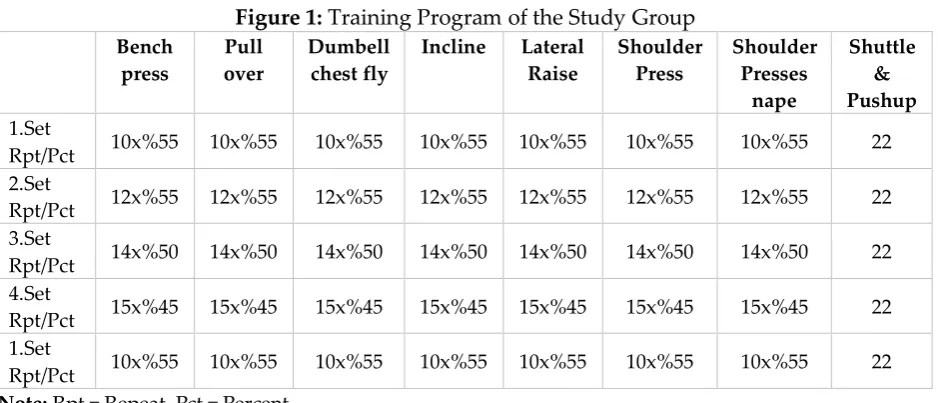
3. Training Program
Figure 1: Training Program of the Study Group
Bench press
Pull over
Dumbell chest fly
Incline Lateral Raise
Shoulder Press
Shoulder Presses
nape
Shuttle & Pushup 1.Set
Rpt/Pct 10x%55 10x%55 10x%55 10x%55 10x%55 10x%55 10x%55 22 2.Set
Rpt/Pct 12x%55 12x%55 12x%55 12x%55 12x%55 12x%55 12x%55 22 3.Set
Rpt/Pct 14x%50 14x%50 14x%50 14x%50 14x%50 14x%50 14x%50 22 4.Set
Rpt/Pct 15x%45 15x%45 15x%45 15x%45 15x%45 15x%45 15x%45 22 1.Set
Rpt/Pct 10x%55 10x%55 10x%55 10x%55 10x%55 10x%55 10x%55 22 Note: Rpt = Repeat, Pct = Percent
4. Statistical Analysis
The results obtained in the study were evaluated in the SPSS-19 program. It was understood that the values obtained from the participants showed normal distribution. The data obtained were evaluated with the paired-T test.
5. Findings
Table 1: Resting Heart Rate of the Participants
Test Group N x̅ S.S T P
RHR Study 18 ,642 ,376 1,7 ,10
Control 18 ,461 1,32 1,4 ,15
Note: *RHR; Resting heart rate,**x̅; pretest-posttest mean
As can be seen on Table 1, no statistical difference was determined in the study and control group data (p<0.05).
Table 2: Body Fat Percentage of the Participants
Test Group N x̅ S.S T P
BFP Study 18 ,315 ,885 1,5 ,14
Control 18 ,227 ,791 1,3 ,19
Note: *BFP; Body Fat Percentage **x̅; pretest-posttest mean
As can be seen on Table 2, no statistical difference was determined in the study and control group data (p<0.05).
Table 3: Total Muscle Percentage Values of the Participants
Test Group N x̅ S.S T P
TMP Study 18 ,548 1,41 1,6 ,11
Control 18 ,374 1,05 1,5 ,15
Note: *TMP; Total Muscle Percentage **x̅; pretest-posttest mean
As can be seen on Table 3, no statistical difference was determined in the study and control group data (p<0.05).
Table 4: Hand Grip Values of the Participants
Test Group N x̅ S.S T P
Hand Grip Study 18 ,705 1,45 2,0 0,05
Control 18 ,392 1,07 1,5 ,14
Note: **x̅; pretest-posttest mean
group data (p <0.05).
Table 5: Vertical Jump Values of the Participants
Test Group N x̅ S.S T P
Vertical Jump Study 18 ,555 1,29 1,8 ,09
Control 18 ,332 1,37 1,3 ,29
Note: **x̅; pretest-posttest mean
As can be seen on Table 5, no statistical difference was determined in the study and control group data (p<0.05).
Table 6: 10m. Sprint Values of Participants
Test Group N x̅ S.S T P
10m. sprint Study 18 ,072 ,017 1,7 ,09
Control 18 ,055 ,015 1,5 ,13
Note: **x̅; pretest-posttest mean
As can be seen on Table 6, no statistical difference was determined in the study and control group data (p<0.05).
Table 7: Anaerobic Power Values of the Participants
Test Group N x̅ S.S T P
Anaerobic Power Study 18 5,83 16,9 1,4 ,16
Control 18 ,833 17,6 ,21 ,48
Note: **x̅; pretest-posttest mean
As can be seen on Table 7, no statistical difference was determined in the study and control group data (p<0.05).
Table 8: Weight (kg) Values of Participants
Test Group N x̅ S.S T P
Weight (kg) Study 18 ,285 ,745 1,6 ,12
Control 18 ,328 ,898 1,4 ,14
Note: **x̅; pretest-posttest mean
As can be seen on Table 8, no statistical difference was determined in the study and control group data (p<0.05).
Table 9: Flexibility Values of Participants
Test Group N x̅ S.S T P
Flexibility Study 18 ,501 1,2 1,2 ,10
Control 18 ,389 1,1 1,3 ,18
As can be seen on Table 9, no statistical difference was determined in the study and control group data (p<0.05).
Table 10: Shot Velocity Values of the Participants
Test Group N x̅ S.S T P
Shot Velocity Study 18 1,22 2,78 1,85 ,08
Control 18 1,16 2,79 1,77 ,10
Note: **x̅; pretest-posttest mean
As can be seen on Table 10, no statistical difference was determined in the study and control group data (p<0.05).
6. Discussion
In this research study group 8 weeks duration has taken explosive strength training. The control group did not perform any sports activities for 8 weeks. After the explosive strength training, there was a statistically significant difference in the hand-grip values of the study group, while there was no significant difference in the control group.
There was a not statistically significant difference in study and control group’s body weight, total muscle percentage, body fat percentage, flexibility, 10m sprint, vertical jump, shot velocity, RHR, anaerobic power tests (p <0.05). Tests were applied to the participants before and after the studies. As a result of the research, although there are improvements in the experimental group tests, it is not statistically significant (p<0.05). Futsal is similar to small sided game, man-to-man struggles are often encountered in the attack and defender phase; so, for these reasons, futsal players are required to have improved explosive strength capacity.
Statistically significant difference was not observed in anaerobic power test values of experimental and control groups. Similarly, in a different study, no significant difference was observed in the anaerobic power values of participants (Erol and Sevim, 1993). Researches, in the past, indicate that the futsal plays fast, and accordingly, the success of this sports related to the stronger anaerobic capacities of the futsal players.
There was no statistically significant difference in body fat percentage, total muscle rate, weight values, values of the study and control groups (p<0.05). When jumping, jumping, sprints and similar performances are performed, the athlete's weight, body fat percentage, and total muscle ratio are important. This is such factors will adversely affect the performance of the futsal players (Boileau and Horswill, 2002; Heyward and Stolarczyk, 1996).
In resting heart rate (RHR) statistically significant difference was not observed in values of the experimental and control groups (p <0.05). Koç et al. (2006), in their study, did not find any difference.
values, but there was no statistically significant difference. In a different study, similarity to our study no difference was found in vertical jump values (Erol and Sevim, 1993).
Exercise and control group’s the values of flexibility there was no statistically significant difference (p<0.05). Unlike study results, another study showed an increase in flexibility values (Ateş et al., 2007). In order for the shot to be kicked fast, the joints performing the shot have a relationship with the range of motion. According to this study, the reason why the shot rate values were not statistically significant was associated with the low flexibility values. Eskiyecek et al. (2019) determined significant improvements in terms of flexibility, vertical jump force with circuit training (p <0.05). No statistically significant difference was observed in the shot velocity values of the study and control group (p<0.05). In different studies, improvement in shot velocity data has been determined (Chih & Ying, 2015). Low level of explosive strength, shooting, dribbling, preventing turns, stopping, sprinting, jumping etc. leads to the absence of strong muscle contractions that do not occur.
There was no statistically significant difference in the values of 10m sprint of study and control group (p<0.05). Similar to the results of different studies 10m sprint value was no significant statistical difference seen (Kaya, 2018; Roberts et al., 2002). Explosive strength is indisputably important for futsalists as there is a special capacity in every sport branches. Quickness, sprint, and shooting are among the important capacities in the futsal. It is important that these features are top-notch as futsal players often show their skills in the combat phases. Explosive strength allows sportsman to gain superiority to the opponent by performing body feint / dummies, deceptions in the branches with or without ball, reduces the risk of injury, reinforces the sports success, renders the opponent inactive.
Statistically significant difference was observed in hand grip values of the experimental group (p<0.05). Unlike the results of the study, another study showed a significant difference in hand grip values of athletes (Erol and Sevim, 1993).
The study demonstrated the importance of applying explosive strength training programs to futsal players.
Unlike other sports branches, studies on body composition, body fat percentage, total muscle mass, weight values are limited in futsal. Therefore, ideal futsalist norms cannot be determined by the fact that futsal cannot be centralized in research projects. For example, among the factors of success in futsal, force constitutes 35% of the overall skill of the athlete.
Therefore, a futsal player strength is not at an advanced level cannot succeed. It was determined that the average weight and height values of the sportsmen who participated in our study were similar to the literature (Arnason et al., 2004). Jumping ability, a combined skill, depends on leg explosive strength and jumping techniques (Akçakaya, 2009).
The low force capacity is directly related to the low ability of the futsalist in the phase of attack, defense and especially man-to-man (Wisloeff, et al., 1998). The research has revealed that there may be a problem in the implementation of fundamental movements at the time of confrontation with the insufficient force of futsal players. Eskiyecek et al., (2019) reported that circular rapid strength training performed on land by body weight had a positive effect on swimming performance. For more extensive explosive strength, more advanced explosive strength programs covering all extremities should be created. According to these results, it is thought that the other motor abilities and anaerobic power levels of futsal players did not develop significantly in the same direction. According to the data obtained in the study, it was observed that there were no deep differences between futsalists. Positional differentiation is more common in football when comparing parameters. Defense and offense positions, because futsal players often rotate unlike football, similar differences in football are not evident. For this reason, a connection was noted in the data of the athletes. Having advanced basic motoric features, good performance is demonstrated, and this performance continues for a long time. Thereafter, a quick strength training program should be created for each basic motor feature. Increasing the force quickly ensures that the work to be performed (product of force) is fast.
The data obtained through the study contributes by completing the knowledge of the futsalists about the force quickly. In addition, we think that the data we have applied will be a model for future studies. We think that the subjects that are not included in our study due to different reasons and restrictions, but that need to be examined, will be investigated by taking the example of our study again. With the increasing number of experimental studies, football will become a popular field among scientific circles. The absence of physical and physiological parameters of athletes is explained as follows; Developments are considered to be limited with the focus of the applied program mostly on the upper extremity. Nonetheless, the limited number of participants in the experimental and control groups is thought to be the reason for the lack of statistical significance. Increasing the number of participants should be taken into consideration in future studies.
The difference between body fat percentage, total muscle and weight values of futsalists who participated in our study compared to elite futsal players in different studies is observed (Álvarez, D'ottavio, Vera, & Castagna, 2009).
7. Suggestions
Participants who will be determined for future research should determine the factors such as their athletes' age, training histories, training times, etc. and choose among the athletes whose values are close to each other.
It is thought that the applied statistical significance level will be determined in parameters by spreading over 12 weeks and increasing the number of participants.
References
Akçakaya, İ. (2009). Comparison of Some Motoric and Anthropometric Properties of Athletes in Trakya University Football, Athletics and Basketball Teams, Trakya University Institute of Health Sciences Physical Education and Sports Department, Master Thesis.
Alexander M. J., Boreskie S. L. (1989). An analysis of fitness and time-motion characteristics of handball Am J Sports Med, 17; 76-82.
Álvarez, J. C. B., D'ottavio, S., Vera, J. G., & Castagna, C. (2009). Aerobic fitness in futsal players of different competitive level. Journal of Strength & Conditioning Research, 23 (7), 2163-2166.
Arnason, A., Sigurdsson, SB, Gudmundsson, A., Holme, I., Engebretsen, L., & Bahr, R. (2004). Physical fitness, injuries, and team performance in soccer. Medicine and Science in Sports and Exercise, 36;(2), 278-285.
Ateş M., Demir M., Ateşoğlu U. (2007). The effect of plyometric training on some physical and physiological parameters of 16-18 age group male footballers. Niğde University Journal of Sports Sciences.1: 1-12.
Bangsbo, J. L., Nørregaard, F. (1991). Thorsoe Activity profile of competition soccer Can J Sport Sci , 16, pp . 110-116.
Barbero-Alvarez, J. C., Soto, V., Barbero-Alvarez, Granda-Vera J. (2008). Match analysis and heart rate of futsal players during competition J Sports Sci, 1;26(1):63-73. Barbero-Alverez, J. C., Soto V. M., Barbero-Alverez, V., Granda-Vera J. (2010). Match
Analysis and Heart Rate of Futsal Players during Competition, Journal of Sport Sciences 26: 63-73.
Barbero-Alvarez, J. C., Soto, V. Hermoso J., Granda Vera, (2004). Effort profiling during indoor soccer competition J Sports Sci, 22 ; 500-501.
Barišić, V. (1996). Strukturalne analiza Nogomet to libre na temelj the nekih antropoloških karakteristika (Structural analysis of football games based on some anthropological karakteristikleri (Unpublished masters' thesis).
Bloomfield, R. J., Polman, P. O'Donoghue (2007). Physical demands of different positions in FA Premier League soccer J Sports Sci Med, 6; 63-70.
Boileau R. A., Horswill C. A. (2002). Body composition in sports: Measurement and applications for weight loss and gain, in “Exercise and sport science” (Ed. W. E., Garrett, D. T., Kirkendall), Lippincott Williams and Wilkins, Philadelphia, USA., 319-338.
male handball players. International Journal of Medical and Health Sciences, 40, 3145.
Christian K. Roberts; Nosratola D. Vaziri, M. D.; R. James Barnard (2002). Effect of diet and exercise intervention on blood pressure, insulin, oxidative stress, and nitric oxide availability, Circulation; 106:2530.
Dogramaci S. N., Watsford M. L., Murphy A. J. (2011). Time-motion analysis of international and national level futsal J Strength Cond Res , 25 ; 646-651.
Erol E., Sevim Y. (1993). Investigation of the effect of fast force exercises on the motor characteristics of basketball players aged 16-18. Journal of Sports Sciences (4);3:25-37.
Eskiyecek, C. G., Bayazıt, B., Tan, H. & Akkaya, C. C. (2019). The Effect of Circular Training Program on Balance and Motor Properties of 16-17 Age Group Students. Turkish Studies in Educational Sciences, DOI: 10.29228/Turkish studies. 23313.14;(4):1353-1366.
Eskiyecek, C. G., Gül, M., Çizgi, O., Gül, G. K., Savucu, Y. & Esmer, O. (2019). The Effect of Circular Rapid Force Studies on Swimming Performance of 17-19 Age Group Male Swimmers. 3rd International Academic Sports Research Batumi- Georgia Congress, 36-42.
Gürbüz, M. H. (2013). Effects of 6-Week Maximal Strength Training on Physical Physiological Parameters in 17-22 Age Group Young Men, Master Thesis, 39. Heyward V. H. and Stolarczyk L. M (1996). Applied body composition assessment.
Champaign, IL; Human Kinetics.
Kaya, K. (2018). Investigation of the Effect of 12-Week Rapid Strength Training Program on Wrestlers' Dynamic Balance, Leg Force, Relative Strength, Speed and Body Composition Master Thesis, 29.
Koç, H. Kaya, M. Sarıtaş, N. Çoksevim, B. (2006). And tennis players in football in some physical and physiological parameters Comparison of Medical Sciences Journal (Journal of Health Sciences) 15 (3) 161-167.
McInnes S. E., Carlson J. S., Jones C. J., McKenna M. J. (1995). The physiological load imposed on basketball players during competition J Sports Sci, 13: 387-397.
Tamer, K., Cicioğlu, İ., Yüce, A., & Çimen, O. (1996). Comparison of Some Physical and Physiological Features of Professional Football Players Fighting in Three Different Leagues. Journal of Football Science and Technology, (2), 23.
Wisloeff, U., Helgerud, J., & Hoff, J. (1998). Strength and endurance of elite soccer players. Medicine and Science in Sports and Exercise, 30, 462-467.
Creative Commons licensing terms