D
Load Clocks and Unload Clocks Can Be
Asynchronous or Coincident
D
2048 Words by 9 Bits
D
Low-Power Advanced CMOS Technology
D
Fast Access Times of 15 ns With a 50-pF
Load
D
Programmable Almost-Full/Almost-Empty
Flag
D
Expansion Logic for Depth Cascading
D
Empty, Full, and Half-Full Flags
D
Fall-Through Time of 20 ns Typical
D
Data Rates up to 50 MHz
D
3-State Outputs
D
Package Options Include 44-Pin Plastic
Leaded Chip Carrier (FN), 64-Pin Thin Quad
Flat (PM), and Reduced-Height 64-Pin Quad
Flat (PAG) Packages
description
A FIFO memory is a storage device that allows data to be written into and read from its array at independent
data rates. The SN74ACT7808 is a 2048-word by 9-bit FIFO designed for high speed and fast access times.
It processes data at rates up to 50 MHz and access times of 15 ns in a bit-parallel format.
Data is written into memory on a low-to-high transition at the load-clock (LDCK) input and is read out on a
low-to-high transition at the unload-clock (UNCK) input. The memory is full when the number of words clocked
in exceeds the number of words clocked out by 2048. When the memory is full, LDCK signals have no effect
on the data residing in memory. When the memory is empty, UNCK signals have no effect.
Status of the FIFO memory is monitored by the full (FULL), empty (EMPTY), half-full (HF), and
almost-full/almost-empty (AF/AE) flags. The FULL output is low when the memory is full and high when the
memory is not full. The EMPTY output is low when the memory is empty and high when it is not empty. The HF
output is high when the FIFO contains 1024 or more words and is low when it contains 1023 or fewer words.
The AF/AE status flag is a programmable flag. The first one or two low-to-high transitions of LDCK after reset
can be used to program the almost-empty offset value (X) and the almost-full offset value (Y) if program enable
(PEN) is low. The AF/AE flag is high when the FIFO contains X or fewer words or (2048 – Y) or more words.
The AF/AE flag is low when the FIFO contains between (X + 1) and (2047 – Y) words.
A low level on the reset (RESET) input resets the internal stack pointers and sets FULL high, AF/AE high, HF
low, and EMPTY low. The Q outputs are not reset to any specific logic level.
The first word loaded into empty memory causes EMPTY to go high and the data to appear on the Q outputs.
It is important to note that the first word does not have to be unloaded. Data outputs are noninverting with respect
to the data inputs and are in the high-impedance state when the output-enable (OE) input is low. OE does not
affect the output flags.
Cascading is easily accomplished in the word-width and word-depth directions. When not using the FIFO in
depth expansion, cascade enable (CASEN) must be tied high.
The FIFO must be reset upon power up.
The SN74ACT7808 is characterized for operation from 0
°
C to 70
°
C.
Please be aware that an important notice concerning availability, standard warranty, and use in critical applications of Texas Instruments semiconductor products and disclaimers thereto appears at the end of this data sheet.
Q1 VCC Q2 Q3 GND Q4 VCC Q5 Q6 GND Q7 39 38 37 36 35 34 33 32 31 30 29 7 8 9 10 11 12 13 14 15 16 17 D0 D1 D2 GND D3 D4 D5 VCC D6 D7 D8 FN PACKAGE (TOP VIEW) XO OE GND Q0
HF AF/AE GND PEN RESET
CASEN UNCK Q8 GND LDCK DP9 XI FULL EMPTY FL VCC Q2 Q3 GND GND Q4 Q5 Q6 GND GND Q7 NC VCC V CC V CC VCC Q1 PAG OR PM PACKAGE (TOP VIEW) NC Q0 GND GND OE XO VCC VCC RESET PEN GND GND AF/AE HF VCC NC Q8 VCC VCC UNCK CASEN NC FL EMPTY FULL XI DP9 LDCK GND GND VCC 6 5 4 3 2 1 44 43 42 41 40 18 19 20 21 22 23 24 25 26 27 28 1 2 3 4 5 6 7 8 9 10 11 12 13 14 15 48 47 46 45 44 43 42 41 40 39 38 37 36 35 34 64 63 62 61 60 59 58 57 56 55 54 53 52 51 50 49 VCC
logic symbol
†
0 7 D0 8 D1 9 D2 11 D3 12 D4 13 D5 15 D6 16 D7 8 17 D8 Q0 40 0 Q1 39 Q2 37 Q3 36 Q4 34 22 FULL HF 5 HALF FULL AF/AE 4 ALMOST FULL/EMPTY 23 EMPTY Q5 32 Q6 31 Q7 29 Q8 28 8 Data 1 RESET 1 RESET 19 LDCK LDCK EN1 42 OE EXPANSION IN 21 XI Data 26 UNCK UNCKPEN 2 PROGRAM ENABLE
FL 24 FIRST LOAD
CASEN 25 CASCADE ENABLE
DATA PIN 9 20 DP9 FULL EMPTY XO 43 EXPANSION OUT Φ FIFO 2048 × 9 SN74ACT7808
† This symbol is in accordance with ANSI/IEEE Std 91-1984 and IEC Publication 617-12. Pin numbers shown are for the FN package.
functional block diagram
Location 2047 Location 2048 2048 × 9 RAM OE D0–D8 UNCK LDCK DP9 RESET PEN EMPTY FULL FL CASEN XI Expansion and Status-Flag Logic Read Pointer Write Pointer Reset Logic Location 1 Location 2 HF AF/AE XO Q0–Q8Terminal Functions
TERMINALNAME I/O DESCRIPTION
AF/AE O
Almost-full/almost-empty flag. Depth-offset values can be programmed for AF/AE or the default value of 256 can be used for both the almost-empty offset (X) and the almost-full offset (Y). AF/AE is high when memory contains X or fewer words or (2048 – Y) or more words. AF/AE is high after reset.
CASEN† I Cascade enable. When multiple SN74ACT7808 devices are depth cascaded, every device must have CASEN tied low. CASEN must be tied high when a device is not used in depth expansion.
D0–D8 I Nine-bit data input port
DP9 I DP9 is used as the most significant bit when programming the AF/AE offset values.
EMPTY O Empty flag. EMPTY is low when the FIFO memory is empty. A FIFO reset also causes EMPTY to go low.
FL† I First load. When multiple SN74ACT7808 devices are depth cascaded, the first device in the chain must have its FL input tied low and all other devices must have their FL inputs tied high.
FULL O Full flag. FULL is low when the FIFO is full. A FIFO reset causes FULL to go high.
HF O Half-full flag. HF is high when the FIFO memory contains 1024 or more words. HF is low after reset. LDCK I Load clock. Data is written to the FIFO on the rising edge of LDCK when FULL is high.
OE I Output enable. When OE is low, D0–D8 are in the high-impedance state.
PEN I Program enable. After reset and before the first word is written to the FIFO, the binary value on D0–D8 and DP9 is latched as an AF/AE offset value when PEN is low and LDCK is high.
Q0–Q8 O Nine-bit data output port
RESET I Reset. A low level on RESET resets the FIFO and drives FULL and AF/AE high and HF and EMPTY low. UNCK I Unload clock. Data is read from the FIFO on the rising edge of UNCK when EMPTY is high.
XI† I Expansion input (XI) and expansion output (XO). When multiple SN74ACT7808 devices are depth cascaded, the XO of one device must be connected to the XI of the next device in the chain The XO of the last device in the chain is
XO† O
of one device must be connected to the XI of the next device in the chain. The XO of the last device in the chain is connected to the XI of the first device in the chain.
offset values for AF/AE
The AF/AE flag has two programmable limits: the almost-empty offset value (X) and the almost-full offset
value (Y). They can be programmed after the FIFO is reset and before the first word is written to memory. If the
offsets are not programmed, the default values of X = Y = 256 are used. The AF/AE flag is high when the FIFO
contains X or fewer words or (2048 – Y) or more words.
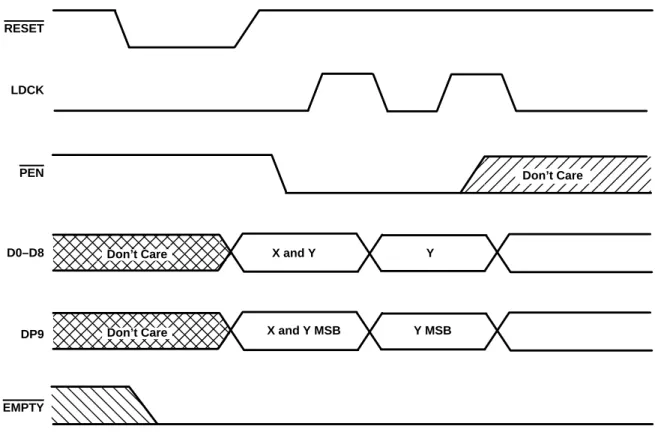
To program the offset values, program enable (PEN) can be brought low after reset only when LDCK is low. On
the following low-to-high transition of LDCK, the binary value on D0–D8 and DP9 is stored as the almost-empty
offset value (X) and the almost-full offset value (Y). Holding PEN low for another low-to-high transition of LDCK
reprograms Y to the binary value on D0–D8 and DP9 at the time of the second LDCK low-to-high transition.
Writes to the FIFO memory are disabled while the offsets are programmed. A maximum value of 1023 can be
programmed for either X or Y (see Figure 1). To use the default values of X = Y = 256, PEN must be held high.
ÎÎ ÎÎ ÎÎ ÎÎÎÎÎÎÎÎ ÎÎÎÎÎÎÎÎ ÎÎÎÎÎÎÎÎ ÏÏÏÏÏ ÏÏÏÏÏ ÏÏÏÏÏ ÌÌ ÌÌ ÌÌ ÌÌÌÌÌÌÌÌ ÌÌÌÌÌÌÌÌ ÌÌÌÌÌÌÌÌ ÌÌÌÌÌÌÌÌ ÌÌÌÌÌÌÌÌ ÌÌÌÌÌÌÌÌ ÌÌ ÌÌ ÌÌÌÌÌÌÌÌ ÌÌÌÌÌÌÌÌ ÌÌÌÌÌÌÌÌ ÌÌÌÌÌÌÌÌ RESET X and Y Y PEN D0–D8 LDCK Don’t Care EMPTY X and Y MSB Y MSB Don’t Care DP9 ÉÉÉÉ Don’t Care
ÌÌ ÌÌ ÌÌ ÌÌ ÌÌ ÌÌ ÌÌ ÌÌ ÌÌ ÌÌ ÌÌ ÌÌ ÌÌ ÌÌ ÌÌ ÌÌ ÌÌ ÌÌ ÌÌ ÌÌ ÌÌ ÌÌ ÌÌ ÌÌ ÌÌ ÌÌ ÌÌ ÌÌ ÌÌ ÌÌ ÌÌ ÌÌ ÌÌ ÌÌ ÌÌ ÌÌ ÌÌ ÌÌ ÌÌ ÌÌ W2048 FULL EMPTY D0 – D8 RESET PEN Q0 – Q8 AF/AE W2 W1025 W1026 HF OE LDCK UNCK W1 W2 W1024 W2047 W1 ÌÌ ÌÌ ÌÌ ÌÌ ÌÌ 1 0 ÌÌ ÌÌ ÌÌ ÌÌ W (2049 – x) W (2048 – X) W (Y+2) W (Y+1) W (2048 – Y) W (X+1) CASEN 1 0 W2048 Don ’t Care Define the
AF/AE Flag Using
the Default V
alue or X and
Y
Figure 2. Read
absolute maximum ratings over operating free-air temperature range (unless otherwise noted)
†
Supply voltage range, V
CC. . .
–0.5 V to 7 V
Input voltage range, V
I. . .
–0.5 V to 7 V
Voltage range applied to a disabled 3-state output
. . .
–0.5 V to 5.5 V
Package thermal impedance,
θ
JA(see Note 1): FN package
. . .
46
°
C/W
PAG package
. . .
58
°
C/W
PM package
. . .
67
°
C/W
Storage temperature range, T
stg. . .
–65
°
C to 150
°
C
† Stresses beyond those listed under “absolute maximum ratings” may cause permanent damage to the device. These are stress ratings only, and functional operation of the device at these or any other conditions beyond those indicated under “recommended operating conditions” is not implied. Exposure to absolute-maximum-rated conditions for extended periods may affect device reliability.NOTE 1: The package thermal impedance is calculated in accordance with JESD 51.
recommended operating conditions
’ACT7808-20 ’ACT7808-25 ’ACT7808-30 ’ACT7808-40
UNIT
MIN MAX MIN MAX MIN MAX MIN MAX UNIT
VCC Supply voltage 4.5 5.5 4.5 5.5 4.5 5.5 4.5 5.5 V
VIH High level input voltage XI 3.85 3.85 3.85 3.85 V
VIH High-level input voltage
Other inputs 2 2 2 2 V
VIL Low-level input voltage 0.8 0.8 0.8 0.8 V
IOH High-level output current –8 –8 –8 –8 mA
IOL Low level output current Q outputs 16 16 16 16 mA
IOL Low-level output current
Flags 8 8 8 8 mA
TA Operating free-air temperature 0 70 0 70 0 70 0 70 °C
electrical characteristics over recommended operating free-air temperature range (unless
otherwise noted)
PARAMETER TEST CONDITIONS MIN TYP‡ MAX UNIT
VOH VCC = 4.5 V, IOH = –8 mA 2.4 V
VOL Flags VCC = 4.5 V, IOL = 8 mA 0.5 V
VOL
Q outputs VCC = 4.5 V, IOL = 16 mA 0.5 V
II VCC = 5.5 V, VI =VCC or 0 ±5 µA
IOZ VCC = 5.5 V, VO =VCC or 0 ±5 µA
ICC VCC = 5.5 V, VI = VCC – 0.2 V or 0 400 µA
∆ICC§ VCC = 5.5 V, One input at 3.4 V, Other inputs at VCC or GND 1 mA
Ci VI = 0, f = 1 MHz 4 pF
Co VO = 0, f = 1 MHz 8 pF
‡ All typical values are at VCC = 5 V, TA = 25°C.
timing requirements over recommended operating conditions (unless otherwise noted) (see
Figures 1 through 3)
’ACT7808-20 ’ACT7808-25 ’ACT7808-30 ’ACT7808-40
UNIT
MIN MAX MIN MAX MIN MAX MIN MAX UNIT
fclock Clock frequency 50 40 33.3 25 MHz
LDCK high or low 8 9 11 13
t Pulse duration UNCK high or low 8 9 11 13 ns
tw Pulse duration
PEN low 9 9 11 13 ns
RESET low 10 13 16 19
D0–D8, DP9 before LDCK↑ 5 5 5 5
tsu Setup time LDCK inactive
before RESET high 5 5 5 5 ns
PEN before LDCK↑ 5 5 5 5
D0–D8, DP9 after LDCK↑ 0 0 0 0
th Hold time
LDCK inactive
after RESET high 5 5 5 5 ns
h
PEN low after LDCK↑ 4 4 4 4
PEN high after LDCK low 0 0 0 0
switching characteristics over recommended ranges of supply voltage and operating free-air
temperature, C
L
= 50 pF (unless otherwise noted) (see Figure 3)
PARAMETER FROM TO ’ACT7808-20 ’ACT7808-25 ’ACT7808-30 ’ACT7808-40 UNIT
PARAMETER
(INPUT) (OUTPUT) MIN TYP† MAX MIN MAX MIN MAX MIN MAX UNIT
fmax LDCK or UNCK 50 40 33.3 25 MHz t LDCK↑ Any Q 5 20 5 22 5 25 5 28 ns tpd UNCK↑ Any Q 4.5 11 15 4.5 18 4.5 20 4.5 22 ns tpd‡ UNCK↑ Any Q 10 ns tPLH LDCK↑ EMPTY 4 15 4 17 4 19 4 21 ns UNCK↑ EMPTY 2 15 2 17 2 19 2 21
tPHLPHL RESET low EMPTY 2 16 2 18 2 20 2 22 ns
LDCK↑ FULL 4 15 4 17 4 19 4 21
tPLH UNCK↑ FULL 4 14 4 16 4 18 4 20 ns
tPLH
RESET low FULL 2 18 2 20 2 22 2 24 ns
t d LDCK↑ AF/AE 2 16 2 18 2 20 2 22 ns
tpd
UNCK↑ AF/AE 2 16 2 18 2 20 2 22 ns
tPLH RESET low AF/AE 0 10 0 12 0 14 0 16 ns
tPLH LDCK↑ HF 2 19 2 21 2 23 2 25 ns tPHL UNCK↑ HF 2 16 2 18 2 20 2 22 ns tPHL RESET low HF 2 12 2 14 2 16 2 18 ns tPLH UNCK↑ XO 2 11 2 13 2 15 2 17 ns tPHL LDCK↑ XO 2 11 2 13 2 15 2 17 ns ten OE Any Q 1 10 1 12 1 14 1 16 ns tdis OE Any Q 1 9 1 11 1 13 1 15 ns
ten XI high Any Q 3 13 3 15 3 17 3 19 ns
tdis XO high Any Q 4 4 4 4 ns
† All typical values are at VCC = 5 V, TA = 25°C.
operating characteristics, V
CC
= 5 V, T
A
= 25
°
C
PARAMETER TEST CONDITIONS TYP UNIT
Cpd Power dissipation capacitance per FIFO channel Outputs enabled CL = 50 pF, f = 5 MHz 91 pF
PARAMETER MEASUREMENT INFORMATION
VOH VOL th tPLH tPHL Output Control Output Waveform 1 S1 at 7 V Output Waveform 2 S1 at Open tPZL tPZH tPLZ tPHZ 1.5 V 1.5 V 1.5 V 1.5 V 3 V 0 V 1.5 V 1.5 V VOH VOL 0 V 1.5 V VOL + 0.3 V 1.5 V VOH – 0.3 V ≈0 V 1.5 V 3 V 0 V 1.5 V 1.5 V 0 V 3 V 0 V 1.5 V 1.5 V tw Input 3 V 3 V ≈3.5 V VOLTAGE WAVEFORMS
SETUP AND HOLD TIMES
VOLTAGE WAVEFORMS PROPAGATION DELAY TIMES
VOLTAGE WAVEFORMS PULSE DURATION
VOLTAGE WAVEFORMS ENABLE AND DISABLE TIMES Timing Input Data Input Output Input S1 500 Ω LOAD CIRCUIT 500 Ω 7 V From Output Under Test Test Point CL = 50 pF (see Note A) tsu tPZH tPZL tPHZ tPLZ tPLH tPHL Open Closed Open Closed Open Open PARAMETER S1 ten tdis tpd
TYPICAL CHARACTERISTICS
Figure 4
PROPAGATION DELAY TIME vs LOAD CAPACITANCE 0 50 100 150 200 250 300 CL – Load Capacitance – pF VCC = 5 V RL = 500 Ω TA = 25°C pd t typ + 8 typ + 6 typ + 4 typ + 2 typ typ – 2 – Propagation Delay T ime – ns
Figure 5
80 40 20 0 0 10 20 30 40 50 120 140 SUPPLY CURRENT vs CLOCK FREQUENCY 160 60 70 80 100 60 VCC = 5.5 V VCC = 4.5 V TA = 75°C CL = 0 pFfclock – Clock Frequency – MHz VCC = 5 V – Supply Current – mA CC(f) I
APPLICATION INFORMATION
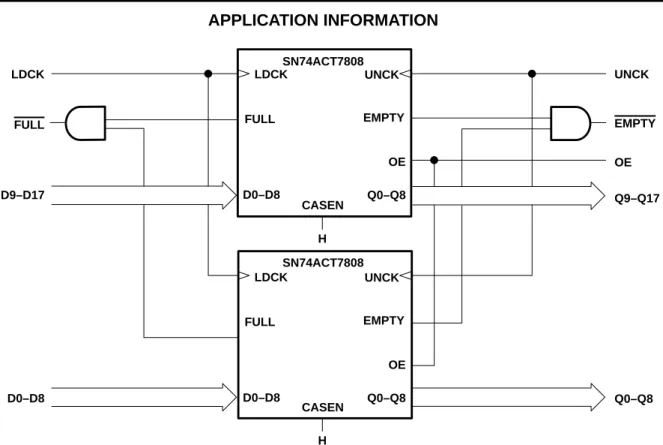
D0–D8 OE Q0–Q8 LDCK LDCK UNCK UNCK FULL EMPTY FULL EMPTY SN74ACT7808 SN74ACT7808 D9–D17 D0–D8 CASEN H H OE Q9–Q17 Q0–Q8 D0–D8 OE Q0–Q8 UNCK LDCK FULL EMPTY CASENAPPLICATION INFORMATION
depth cascading (see Figure 7)
The SN74ACT7808 provides expansion logic necessary for cascading an unlimited number of the FIFOs in
depth. CASEN must be low on all FIFOs used in depth expansion. FL must be tied low on the first FIFO in the
chain; all others must have FL tied high. The expansion-out (XO) output of a FIFO must be tied to the
expansion-in (XI) input of the next FIFO in the chain. The XO output of the last FIFO is tied to the XI input of
the first FIFO to complete the loop. Data buses are common to each FIFO in the chain. A composite EMPTY
and FULL signal must be generated to indicate boundary conditions.
Q0–Q8 XI XO RESET D0–D8 LDCK UNCK CASEN FULL EMPTY FL OE SN74ACT7808 L L RESET OE Q0–Q8 UNCK EMPTY FULL LDCK D0–D8 XI XO RESET Q0–Q8 LDCK UNCK CASEN FULL EMPTY FL OE SN74ACT7808 L H XI XO RESET Q0–Q8 LDCK UNCK CASEN FULL EMPTY FL OE SN74ACT7808 L H D0–D8 D0–D8 9 9 9 9 9 9 9 9
PACKAGING INFORMATION
Orderable Device Status(1) Package
Type
Package Drawing
Pins Package Qty
Eco Plan(2) Lead/Ball Finish MSL Peak Temp(3)
SN74ACT7808-20FN ACTIVE PLCC FN 44 26 Green (RoHS & no Sb/Br)
CU NIPDAU Level-3-260C-168 HR SN74ACT7808-20PAG ACTIVE TQFP PAG 64 160 Green (RoHS &
no Sb/Br)
CU NIPDAU Level-3-260C-168 HR
SN74ACT7808-20PM OBSOLETE LQFP PM 64 TBD Call TI Call TI
SN74ACT7808-25FN ACTIVE PLCC FN 44 26 Green (RoHS & no Sb/Br)
CU NIPDAU Level-3-260C-168 HR SN74ACT7808-25PAG ACTIVE TQFP PAG 64 160 Green (RoHS &
no Sb/Br)
CU NIPDAU Level-3-260C-168 HR
SN74ACT7808-25PM OBSOLETE LQFP PM 64 TBD Call TI Call TI
SN74ACT7808-30FN ACTIVE PLCC FN 44 26 Green (RoHS & no Sb/Br)
CU NIPDAU Level-3-260C-168 HR
SN74ACT7808-30PM OBSOLETE LQFP PM 64 TBD Call TI Call TI
SN74ACT7808-40FN ACTIVE PLCC FN 44 26 Green (RoHS & no Sb/Br)
CU NIPDAU Level-3-260C-168 HR SN74ACT7808-40PAG ACTIVE TQFP PAG 64 160 Green (RoHS &
no Sb/Br)
CU NIPDAU Level-3-260C-168 HR
SN74ACT7808-40PM OBSOLETE LQFP PM 64 TBD Call TI Call TI
(1)The marketing status values are defined as follows:
ACTIVE: Product device recommended for new designs.
LIFEBUY: TI has announced that the device will be discontinued, and a lifetime-buy period is in effect.
NRND: Not recommended for new designs. Device is in production to support existing customers, but TI does not recommend using this part in
a new design.
PREVIEW: Device has been announced but is not in production. Samples may or may not be available. OBSOLETE: TI has discontinued the production of the device.
(2)Eco Plan - The planned eco-friendly classification: Pb-Free (RoHS), Pb-Free (RoHS Exempt), or Green (RoHS & no Sb/Br) - please check
http://www.ti.com/productcontentfor the latest availability information and additional product content details.
TBD: The Pb-Free/Green conversion plan has not been defined.
Pb-Free (RoHS): TI's terms "Lead-Free" or "Pb-Free" mean semiconductor products that are compatible with the current RoHS requirements
for all 6 substances, including the requirement that lead not exceed 0.1% by weight in homogeneous materials. Where designed to be soldered at high temperatures, TI Pb-Free products are suitable for use in specified lead-free processes.
Pb-Free (RoHS Exempt): This component has a RoHS exemption for either 1) lead-based flip-chip solder bumps used between the die and
package, or 2) lead-based die adhesive used between the die and leadframe. The component is otherwise considered Pb-Free (RoHS compatible) as defined above.
Green (RoHS & no Sb/Br): TI defines "Green" to mean Pb-Free (RoHS compatible), and free of Bromine (Br) and Antimony (Sb) based flame
retardants (Br or Sb do not exceed 0.1% by weight in homogeneous material)
(3)
MSL, Peak Temp. -- The Moisture Sensitivity Level rating according to the JEDEC industry standard classifications, and peak solder temperature.
Important Information and Disclaimer:The information provided on this page represents TI's knowledge and belief as of the date that it is
provided. TI bases its knowledge and belief on information provided by third parties, and makes no representation or warranty as to the accuracy of such information. Efforts are underway to better integrate information from third parties. TI has taken and continues to take
PAG (S-PQFP-G64)
PLASTIC QUAD FLATPACK
0,13 NOM 0,25 0,45 0,75 Seating Plane 0,05 MIN 4040282 / C 11/96 Gage Plane 33 0,17 0,27 16 48 1 7,50 TYP 49 64 SQ 9,80 1,05 0,95 11,80 12,20 1,20 MAX 10,20 SQ 17 32 0,08 0,50 0,08 M 0°– 7°NOTES: A. All linear dimensions are in millimeters. B. This drawing is subject to change without notice. C. Falls within JEDEC MS-026
FN (S-PQCC-J**)
PLASTIC J-LEADED CHIP CARRIER
4040005 / B 03/95 20 PIN SHOWN 0.026 (0,66) 0.032 (0,81) D2 / E2 0.020 (0,51) MIN 0.180 (4,57) MAX 0.120 (3,05) 0.090 (2,29) D2 / E2 0.013 (0,33) 0.021 (0,53) Seating Plane MAX D2 / E2 0.219 (5,56) 0.169 (4,29) 0.319 (8,10) 0.469 (11,91) 0.569 (14,45) 0.369 (9,37) MAX 0.356 (9,04) 0.456 (11,58) 0.656 (16,66) 0.008 (0,20) NOM 1.158 (29,41) 0.958 (24,33) 0.756 (19,20) 0.191 (4,85) 0.141 (3,58) MIN 0.441 (11,20) 0.541 (13,74) 0.291 (7,39) 0.341 (8,66) 18 19 14 13 D D1 1 3 9 E1 E 4 8 MIN MAX MIN PINS ** 20 28 44 0.385 (9,78) 0.485 (12,32) 0.685 (17,40) 52 68 84 1.185 (30,10) 0.985 (25,02) 0.785 (19,94) D / E 0.395 (10,03) 0.495 (12,57) 1.195 (30,35) 0.995 (25,27) 0.695 (17,65) 0.795 (20,19) NO. OF D1 / E1 0.350 (8,89) 0.450 (11,43) 1.150 (29,21) 0.950 (24,13) 0.650 (16,51) 0.750 (19,05) 0.004 (0,10) M 0.007 (0,18) 0.050 (1,27)PM (S-PQFP-G64)
PLASTIC QUAD FLATPACK
4040152 / C 11/96 32 17 0,13 NOM 0,25 0,45 0,75 Seating Plane 0,05 MIN Gage Plane 0,27 33 16 48 1 0,17 49 64 SQ SQ 10,20 11,80 12,20 9,80 7,50 TYP 1,60 MAX 1,45 1,35 0,08 0,50 0,08 M 0°– 7°NOTES: A. All linear dimensions are in millimeters. B. This drawing is subject to change without notice. C. Falls within JEDEC MS-026
sold subject to TI’s terms and conditions of sale supplied at the time of order acknowledgment.
TI warrants performance of its hardware products to the specifications applicable at the time of sale in accordance with TI’s standard warranty. Testing and other quality control techniques are used to the extent TI deems necessary to support this warranty. Except where mandated by government requirements, testing of all parameters of each product is not necessarily performed.
TI assumes no liability for applications assistance or customer product design. Customers are responsible for their products and applications using TI components. To minimize the risks associated with customer products and applications, customers should provide adequate design and operating safeguards.
TI does not warrant or represent that any license, either express or implied, is granted under any TI patent right, copyright, mask work right, or other TI intellectual property right relating to any combination, machine, or process in which TI products or services are used. Information published by TI regarding third-party products or services does not constitute a license from TI to use such products or services or a warranty or endorsement thereof. Use of such information may require a license from a third party under the patents or other intellectual property of the third party, or a license from TI under the patents or other intellectual property of TI.
Reproduction of TI information in TI data books or data sheets is permissible only if reproduction is without alteration and is accompanied by all associated warranties, conditions, limitations, and notices. Reproduction of this information with alteration is an unfair and deceptive business practice. TI is not responsible or liable for such altered documentation. Information of third parties may be subject to additional restrictions.
Resale of TI products or services with statements different from or beyond the parameters stated by TI for that product or service voids all express and any implied warranties for the associated TI product or service and is an unfair and deceptive business practice. TI is not responsible or liable for any such statements.
TI products are not authorized for use in safety-critical applications (such as life support) where a failure of the TI product would reasonably be expected to cause severe personal injury or death, unless officers of the parties have executed an agreement specifically governing such use. Buyers represent that they have all necessary expertise in the safety and regulatory ramifications of their applications, and acknowledge and agree that they are solely responsible for all legal, regulatory and safety-related requirements concerning their products and any use of TI products in such safety-critical applications, notwithstanding any applications-related information or support that may be provided by TI. Further, Buyers must fully indemnify TI and its representatives against any damages arising out of the use of TI products in such safety-critical applications.
TI products are neither designed nor intended for use in military/aerospace applications or environments unless the TI products are specifically designated by TI as military-grade or "enhanced plastic." Only products designated by TI as military-grade meet military specifications. Buyers acknowledge and agree that any such use of TI products which TI has not designated as military-grade is solely at the Buyer's risk, and that they are solely responsible for compliance with all legal and regulatory requirements in connection with such use. TI products are neither designed nor intended for use in automotive applications or environments unless the specific TI products are designated by TI as compliant with ISO/TS 16949 requirements. Buyers acknowledge and agree that, if they use any non-designated products in automotive applications, TI will not be responsible for any failure to meet such requirements.
Following are URLs where you can obtain information on other Texas Instruments products and application solutions:
Products Applications
Amplifiers amplifier.ti.com Audio www.ti.com/audio
Data Converters dataconverter.ti.com Automotive www.ti.com/automotive
DSP dsp.ti.com Broadband www.ti.com/broadband
Clocks and Timers www.ti.com/clocks Digital Control www.ti.com/digitalcontrol
Interface interface.ti.com Medical www.ti.com/medical
Logic logic.ti.com Military www.ti.com/military
Power Mgmt power.ti.com Optical Networking www.ti.com/opticalnetwork
Microcontrollers microcontroller.ti.com Security www.ti.com/security
RFID www.ti-rfid.com Telephony www.ti.com/telephony
RF/IF and ZigBee® Solutions www.ti.com/lprf Video & Imaging www.ti.com/video
Wireless www.ti.com/wireless