Integrating Civic
Responsibility into
the Curriculum
K a r l a G o t t l i e b
a n dG a i l R o b i n s o n
,
E d i t o r sA Practical Guide for
Community College Press ®
a division of the American Association of Community Colleges Washington, D.C.
Integrating Civic
Responsibility into
the Curriculum
E d i t e d b y
K a r l a G o t t l i e b a n d
G a i l R o b i n s o n
A Practical Guide for
The American Association of Community Colleges (AACC) is the primary advocacy organization for the nation’s community colleges. The association represents 1,200 two-year, associate degree– granting institutions and 11 million students. AACC promotes community colleges through six strategic action areas: national and international recognition and advocacy, learning and accountability, leadership development, economic and workforce development, connectedness across AACC membership, and international and intercultural education. Information about AACC and community colleges may be found at www.aacc.nche.edu.
This material is based upon work supported by the Corporation for National and Community Service under Learn and Serve America Grant Numbers 00LHEDC001 and 03LHHDC001. Opinions or points of view expressed in this document are those of the authors and do not necessarily reflect the official position of the Corporation or the Learn and Serve America program.
Cover photos courtesy Miami Dade College and American Association of Community Colleges © 2002, 2006 American Association of Community Colleges Photocopying for nonprofit educational purposes is permitted.
Designed by VC Graphics Printed in the United States of America
● iii
Preface...iv
Contributing Writers ...v
Introduction...1 Chapter 1
The Need for Civic Responsibility in Service Learning ...5
Chapter 2
Defining Civic Responsibility...13
Chapter 3
The Practice of Civic Responsibility ...21
Chapter 4
Assessing Civic Responsibility ...51
Chapter 5
A Final Reflection ...63
References...65
Appendix A
Films, Quotations, and Articles ...69
Appendix B
Reflection Resources...71
Appendix C
Reflection Exercises ...73
Appendix D
Bibliography ...79
Appendix E
Organizations and Web Sites ...81
Appendix F
Supplemental Materials ...83
Index...93
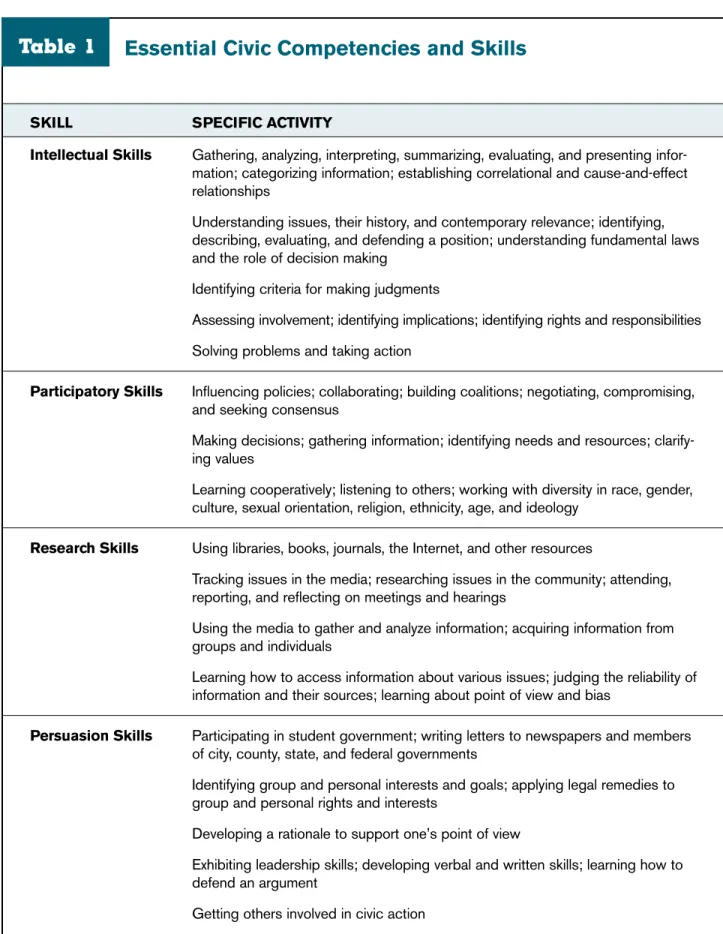
Table 1
Essential Civic Competencies and Skills ...22
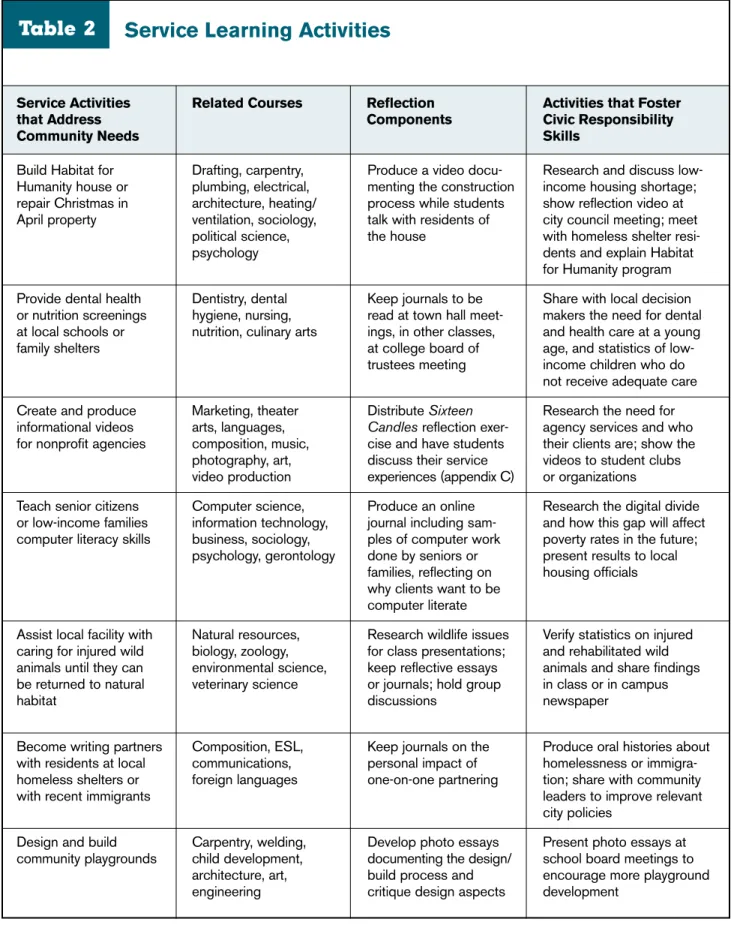
Table 2
Service Learning Activities ...48
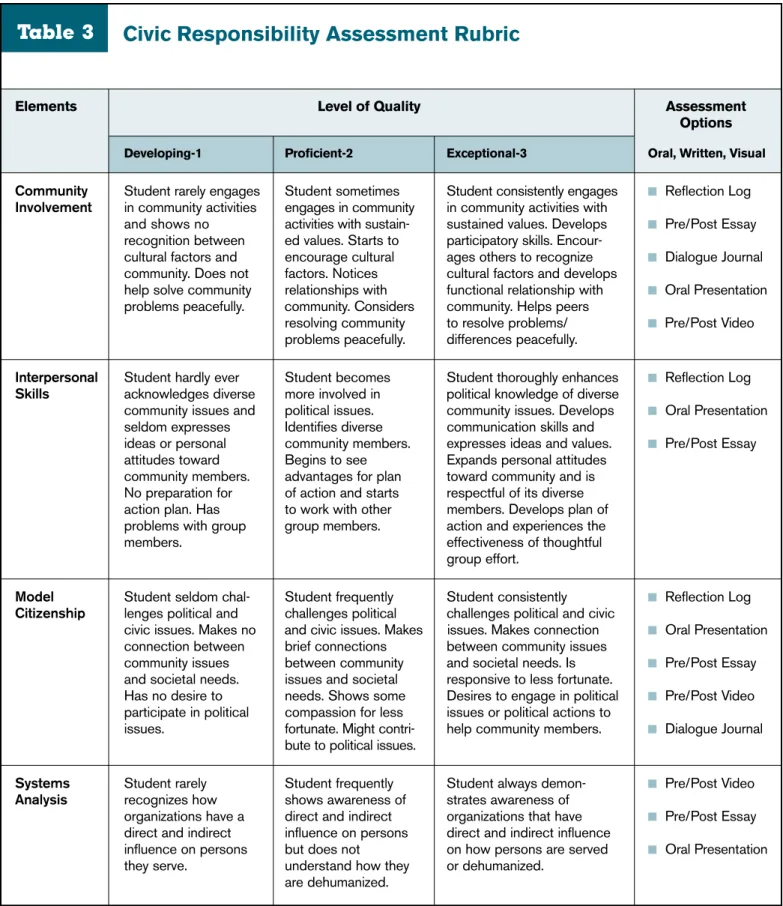
Table 3
Civic Responsibility Assessment Rubric ...59
Preface
iv ●
This curriculum guide evolved from a national service learning project of the American Association of Community Colleges (AACC) funded by the Corporation for National and
Community Service (CNCS). AACC’s project,Community Colleges Broadening Horizons through Service Learning, has worked to integrate service learning into the institutional climate of community colleges since 1994.
Recognizing that an intentional civic responsibility component was missing from many service learning initiatives, AACC selected six colleges from around the country to participate in a pilot proj-ect whose purpose was to identify service learning strategies to boost civic engage-ment and foster civic responsibility among community college students. The six participating colleges were
Albuquerque TVI Community College, Albuquerque, New Mexico; Glendale Community College, Glendale,
California; Hocking College, Nelsonville, Ohio; Mesa Community College, Mesa, Arizona; Miami Dade College, Miami, Florida; and Oakton Community College, Des Plaines, Illinois.
This guide is the result of two years of work by faculty, staff, and administra-tors at these colleges. The 13 contribut-ing writers are listed on the followcontribut-ing page. We especially want to acknowledge Gwen Nyden and Emily Morrison for their extensive contributions in writing and editing portions of this guide.
Thanks go to our colleagues who reviewed the guide in its various stages, including Lynn Barnett, Ossie Hanauer, Dave Johnson, Sharon Johnson, Nan Ottenritter, and Mary Prentice. We would also like to thank service learning practitioners from many community col-leges around the country who helped “test drive” several concepts, definitions, and exercises that appear within these pages.
Finally, thank you for picking up this guide. We hope that it will give you new ideas, prompt you to revisit some long-held notions, and, in the end, benefit your students as they make their way through college, their communities, and the world.
Karla Gottlieb Gail Robinson
● v
Elaine Dabelko
Associate Vice President of Academic Affairs Hocking College Nelsonville, Ohio
Rudy Garcia
Director of Experiential Education Albuquerque TVI Community College Albuquerque, New Mexico
Virginia Gibbons
Professor of English
Oakton Community College Des Plaines, Illinois
Karla Gottlieb
Service Learning Consultant Miami, Florida
Jonelle Moore
English Faculty
Mesa Community College Mesa, Arizona
Emily Morrison
Service Learning Intern American Association of
Community Colleges Washington, D.C.
Gwen Nyden
Professor of Sociology Oakton Community College Des Plaines, Illinois
Duane Oakes
Faculty Director, Center for Service-Learning Mesa Community College Mesa, Arizona
Gail Robinson
Manager of Service Learning American Association of
Community Colleges Washington, D.C.
Alan Rubin
Professor of Psychology Oakton Community College Des Plaines, Illinois
Margo Shea
Service Learning Coordinator Berkshire Community College Pittsfield, Massachusetts
Josh Young
Director, Center for Community Involvement
Miami Dade College Miami, Florida
Hoover Zariani
Director, Service Learning Center Glendale Community College Glendale, California
W
hat does it mean to integrate civic responsibility into community col-lege curricula?For a student, it can mean:
• learning actively, not just through lecturing
• understanding the skills of active citizenship
• participating in service learning by serving in the community, and rec-ognizing that he or she can make a difference and have an impact on one life (e.g., tutoring a child; assist-ing a homebound senior citizen) or many lives (e.g., implementing a neighborhood watch program; petitioning for a traffic light at a dangerous intersection)
For a faculty member, it can mean: • giving students a chance to reflect on
what it means to be a responsible member of society
• taking service learning one step further to include reflection on changed attitudes, the impact of the service experience on the individ-ual and the community, and an increased understanding of the responsibilities of living in a demo-cratic society
• getting personally involved in service projects, with or without students
For an institution, it can mean: • creating a culture of service and
engagement
• embracing a mission of educating students for citizenship
• taking on greater responsibility to serve the community
For a community partner, it can mean: • creating collaborative partnerships
between agencies and faculty • informing and involving individuals
in community building
• being actively involved in mentoring service learning students through reflection, guidance, and feedback With these ideas in mind, we address the following questions in this guide: What is civic responsibility? How is it tied to service learning? How can faculty integrate concepts and exercises in a practical way that will encourage students to develop their own sense of civic
responsibility? How can faculty assess the development of civic responsibility in their students?
For the purposes of this publication, civic responsibility means active partici-pation in the public life of a community in an informed, committed, and con-structive manner, with a focus on the
● 1
common good. We define and discuss civic responsibility in depth in chapter 2 (service learning is defined in chapter 1).
While some people categorize civic responsibility as an ethic and civic engagement as a behavior, we use both terms in this guide, as they relate to the same general concepts of involvement in civil society. When we refer to citizens and citizenship, we do so in a broad sense, not limited to official U.S. citizen-ship but including all residents or mem-bers of a community.
This curriculum guide is intended to provide practical, easy-to-use applications for the widest range of faculty who would like to develop their students’ citizenship skills by integrating civic responsibility concepts and practices into their college courses. We recognize that community college faculty teach courses that reflect varying levels of student development, so we have incorporated ideas that can be applied to a large number of courses, from developmental to honors. Similarly, because some faculty may have more flex-ibility than others in course content or structure, we present activities that can work at several levels of involvement.
We have also taken into account the various disciplines and certificate and degree programs offered at community colleges, so that faculty members from liberal arts, social sciences, physical sciences, mathematics, and vocational and technical programs all may find this guide useful and appropriate for their classes.
How to Use This Guide
As the title suggests, we have tried to create a practicalguide. Several of us are classroom teachers and have used our own experiences with service learning in shaping this publication. As you read through the following chapters, you will move from thinking about what civic responsibility means to finding ways of integrating it into your classes and assess-ing the outcomes that result.
Chapter 1looks at the need for serv-ice learning and civic responsibility in the curriculum, as a response to larger changes and trends in society and the mission of higher education. In this chapter we also ask you to consider your own classroom practices as related to civic responsibility.
Chapter 2examines the meaning and implications of civic responsibility—how it can be defined, how teaching civic skills is highly compatible with the larger mission of higher education, and how civic responsibility is related to service.
Chapter 3focuses on the practice of civic responsibility. Here we explore strategies that classroom teachers can use to integrate civic responsibility concepts and activities into their courses so that students come away with a greater understanding of what is expected of them as citizens in our society. These strategies, all of which can be used with service learning, range from one-time experiences or activities to multi-class or semester-long involvement.
Chapter 4addresses assessment. Although it may prove difficult to assess the level of civic responsibility acquired by students because the goals of a civic curriculum are not as easily quantifiable as many other learning objectives, several strategies are offered that have been used successfully in community colleges.
Chapter 5poses closing questions about the mission of your course and your college and the challenges you may face as you integrate civic responsibility into your curriculum.
It is up to you how to use this guide. Within each chapter you will find a number of exercises that are designed to get you and your students thinking about
the ideas we present. We include strate-gies that have been tested and demon-strated to work. You may try them or adapt them in whatever ways you see fit. If you are already familiar with service learning and civic responsibility, you may decide to skim the first two chapters.
Our most important goal is to inspire you to think about different ways to get your students engaged in their communities and then to help them develop a strong sense of civic responsi-bility. If you find ideas and practices that do this, then we have succeeded. Good luck in your efforts to inspire your stu-dents to leave the world a better place than they found it.
Introduction ● 3
“My idea of citizenship has changed as a result of service learning. Before this assignment, I believed that citizenship was only about voting and abiding by laws. We need to endorse our political efficacy…A civil society lacking active citizens possesses no enrichment, diversity, or meaning.”
need
Courtesy Gadsden State Community College
civic responsibility
A
ACC defines service learning as the combination of community service and classroom instruction, with a focus on critical, reflective thinking as well as person-al and civic responsibility.We believe service learning offers the greatest potential for fostering civic responsibility because it provides oppor-tunities for students to engage directly in their communities and meet community needs while enhancing their course work. It is important that, at the same time, students purposefully explore what civic responsibility means and the importance of both understanding and embracing this concept.
With the belief in the potential of service learning in mind, we decided to write this curriculum guide to address sev-eral issues and areas of concern. First, because some college students reflect the pattern of the larger society toward civic
disengagement, one of the roles of higher education should be to find ways to renew and strengthen the commitment of stu-dents to civic life. It is critically important for the leadership of higher education to call on their institutions to play an active role in civic renewal. However, this renew-al will not happen until faculty find ways to engage students in their communities and take the time to help them think crit-ically about the importance of civic responsibility and their role as citizens.
Second, although there are hopeful signs that students, especially those in high school and college, are now more involved in service than in the past, it is not clear whether this service is actually cultivating a greater understanding and commitment to civic responsibility, or indeed how this could be measured (Sax 2000; Skinner and Chapman 1999). Here again, higher education can pro-mote civic renewal through innovative initiatives such as service learning.
The Need for
Civic Responsibility
in Service Learning
Chapter 1
Third, we are concerned that not enough attention is being paid to service learning’s goal of fostering civic responsi-bility. Although service learning continues to gain momentum as an important and far-reaching movement in higher educa-tion, it seems that faculty and service learning program coordinators are not sufficiently addressing the concept of civic responsibility with their students. Simply involving students in a service experience does not necessarily result in students gaining a better understanding of the importance and complexities of civic responsibility. It is imperative that we help faculty better understand this con-cept and how it relates to service learning, and provide tools to help them more pur-posefully integrate learning about civic responsibility into their teaching.
Finally, the increase in immigration experienced by our society in the last two decades has transformed both our com-munities and our college campuses. Faculty can help recent immigrants and international students find avenues toward wider participation in civil society and understand the values and beliefs that underlie our political and civic life.
Civic Disengagement in
Contemporary Society
Much has been written about the grow-ing disengagement of young people from civic life. Robert Putnam’s work is often cited as evidence of the general decline in civic engagement. Based on research using a number of independent data sources, he found that older Americans—
specifically those who reached adulthood during the Depression and World War II—have been much more deeply
engaged in civic life than the generations that came after them (Putnam 1996). In subsequent investigations, Putnam dis-covered that the trend toward civic disen-gagement has become even more signifi-cant since 1985 (Putnam 2000).
In 1998, the National Commission on Civic Renewal issued a report titled
A Nation of Spectators: How Civic
Disengagement Weakens America and What We Can Do About It.It concluded:
Too many of us have become passive and disengaged. Too many of us lack confidence in our capacity to make basic moral and civic judgments, to join with our neighbors to do the work of community, to make a difference. Never have we had so many opportunities for participation, yet rarely have we felt so powerless…. In a time that cries out for civic action, we are in danger of
becoming a nation of spectators.
Of special concern in much of this discussion is the disengagement of young people. Student responses to an annual nationwide survey of college freshmen conducted by the Higher Education Research Institute of the University of California–Los Angeles demonstrated the degree of disengagement from certain forms of civic life. For example, interest in politics has plummeted, as measured by students understanding the impor-tance of being informed, voting, and dis-cussing political affairs (Sax 2000).
According to a recent analysis of voter apathy among different cohorts of young people, there were strong indications that “political disinterest and disengagement are more widespread and deeper than was true of young people in previous decades” (Bennett 2000).
In response to these trends, the presi-dents of several colleges and universities from across the nation issued a declara-tion on the civic responsibility of higher education at a 1999 meeting of Campus Compact, a national organization of col-lege presidents that focuses on civic engagement and service in higher educa-tion. They acknowledged that a growing number of students were participating in public and community service, but that these experiences did not necessarily lead them to embrace the duties of active citi-zenship. The assembled presidents iden-tified a set of related trends among young people: a decline in voter turnout,
increased feelings of indifference to polit-ical participation, a sense of cynicism, and a growing lack of trust in the politi-cal process.
In their declaration, the presidents called on their colleagues to take action against a rising tide of civic disengagement:
Colleges and universities have long embraced a mission to educate stu-dents for citizenship. But now, with over two-thirds of recent high school gradu-ates, and ever larger numbers of adults, enrolling in postsecondary studies, high-er education has an unprecedented opportunity to influence the democratic knowledge, dispositions, and habits of
the heart that graduates carry with them into the public square.
Higher education is uniquely positioned to help Americans understand the his-tories and contours of our own present challenges as a diverse democracy. It is also uniquely positioned to help both students and our communities to explore new ways of fulfilling the prom-ise of justice and dignity for all, both in our own democracy and as part of the global community. We know that plural-ism is a source of strength and vitality that will enrich our students’ education and help them to learn both to respect differences and work together for the common good. (Campus Compact 1999)
Some Hopeful Signs
Despite these negative trends, there are some hopeful signs. Young people today show an increased involvement in volun-teerism and community service apart from politics. There are many different routes to involvement in the community. The Corporation for National and Community Service, created in 1993, is a federal agency that supports institutional and individual efforts to provide service to local communities. Each year more than a million Americans, young and old, participate in activities and projects fund-ed through the Corporation.
Thanks in part to the Corporation’s support, there has been an increase in the number of students—at all levels of edu-cation, from primary through higher
education—who perform service as part of their school experience. By 1998, a record number (74.2 percent) of college freshmen reported doing volunteer work during their senior year of high school, up from approximately 62 percent in 1988 (Sax 2000). A growing number of states and school districts require service or service learning as a condition for high school graduation.
In 1999, the Mellman Group conducted a national survey of 800 college students under the age of 31 for the Leon and Sylvia Panetta Institute for Public Policy at California State University at Monterey Bay. The survey results indicated that nearly three-quarters of college students had recently done volunteer work in an organization or for a cause they supported. This same survey also found that young people are significantly less cynical about politics and government than their elders, but they do not necessarily see these institu-tions as relevant to their lives or the issues that are important to them— something that service learning can help overcome (Panetta Institute 2000).
While volunteer service provides benefits to both the people who engage in it and the community agencies that receive the help, what is often missing from these experiences is structured reflection that leads to critical thinking about how the service experience is relat-ed to the life of the volunteer as an indi-vidual and as a community member.
One avenue for providing students with such structured support is service learning. While some service is performed through involvement in
extracurricular activities such as student government, clubs, religious groups, sports teams, or honor societies, a grow-ing number of students today are intro-duced to service through service learning in their college classrooms. According to four national surveys conducted by AACC between 1995 and 2003, faculty at nearly 60 percent of all community col-leges offer service learning. Another 30 percent of survey respondents indicated an interest in this teaching and learning strategy (Robinson and Barnett 1996; Phinney, Schoen, and Hause 2002; Prentice, Robinson, and McPhee 2003).
Service learning can be a way for stu-dents to connect or re-connect with civic society. By engaging in these activities, they may develop a set of attitudes and behaviors that is consistent with the expectations of citizenship. Sax (2000) suggests that
It is quite possible that students are simply placing their energies where they feel they can make a difference— by getting involved in issues such as education, crime, the environment, and homelessness in their local communi-ties. Given their frustration with political scandals and negative political
campaigns, students simply may not perceive politics as an effective vehicle for positive change.
As a growing body of research indi-cates, service learning can be a potent civic educator (Battistoni 2000). Two different studies revealed that participat-ing in service as an undergraduate stu-dent significantly enhanced the stustu-dent’s
sense of civic responsibility, academic development, and overall life skill devel-opment (Astin and Sax 1998; Astin et al. 2000). A third study showed that stu-dents who performed community service were more aware of the need to become involved in the policy process, felt a greater connection to the community, and were better able to view situations from others’ perspectives (Eyler, Giles, and Braxton 1997). It is important to note, however, that unless civic responsi-bility is intentionallyintegrated into the academic curriculum, this potential is not likely to be realized. (For examples of activities related to service learning, see box 1.1.)
Changing Demographics
of Our Communities
and Our Colleges
Since the early 1980s, the United States has experienced an upsurge in immigra-tion. By the end of the 1990s, the U.S. Census Bureau estimated that there were 26.4 million foreign-born people residing in the United States, representing nearly 10 percent of the total population (Brittingham 1999).
In their community college classes, immigrants and international students may not only be learning English, but also the American way of life. When faculty offer service learning opportunities, espe-cially those that emphasize civic engage-ment and foster civic responsibility, their students are given a chance to learn important lessons. As Battistoni (2000) suggests, “civic and political learning are
not innate, but the result of conscious and ongoing work by educators.” While recent immigrants and international students may be accustomed to helping others in their family or ethnic community, the idea of providing service to the wider commu-nity may be an unfamiliar concept to them. (However, some countries such as Nigeria, China, Ghana, Canada, France, and Germany do have well-established national service programs similar to the
The Need for Civic Responsibility ● 9
• Take some time for self-reflection. Why did you become a teacher? Why do you teach in your disci-pline? Why have you integrated or are thinking about integrating service learning into your courses? Why are you interested in civic responsibility? Share your answers with your students.
• Assign Robert Coles’s book The Call of Service, particularly chapter 2, in which he talks about dif-ferent types of service. In your discussion of this reading, ask students about their own experiences with service and what led them into these activities. How does their service fit within Coles’s frame-work? (See box 2.1 for more ideas.)
• Discuss with students what they gain by doing service as well as what their communities gain from it. Explore with them whether service is an obligation of citizenship, a privilege, a right, or none of these.
• Review the faculty case study in appendix C. Consider how faculty viewpoints on civic responsi-bility and involvement affect and influence students.
1.1
Some Activities Related to
federal AmeriCorps programs.) Service learning provides these students with a unique opportunity to become better inte-grated into the civic and social life of their new communities, alongside U.S.-born students. (See box 1.2 for activities related to cultural diversity.)
Just like students from other coun-tries, U.S.-born students may not have had adequate exposure to or education about civic responsibility concepts and practices. Many of these students enter community college without a basic understanding of civic responsibility, even though some of them may have been required to do service in high school.
The increasing diversity in the class-room and the workforce provides oppor-tunities for cross-cultural engagement and understanding. The challenge for faculty is how to make the most of this situation. By using service learning, stu-dents can explore the different meanings of civic responsibility and how to put them into practice.
This curriculum guide is a response to the challenges mentioned above. We hope that, by reading this publication, faculty and service learning coordinators will be encouraged to find new ways to promote civic responsibility on campus and in the community. Whether you are one of the thousands of higher education faculty who now use service learning or are just beginning to think about using it in your courses, we think you will find this publication helpful.
10 ● A Practical Guide
• Have your students research how your own com-munity or college has changed since 1980. Are there more people who have emigrated from anoth-er country? What countries have they come from? What prompted their emigration? How can we use this increased diversity to strengthen our communi-ties and our democracy?
• If you have a culturally diverse classroom, pair students together and have them talk about the concepts of citizenship and service in each of their cultures. Is there a tradition of community service? What are the criteria that establish citizenship? What is expected of citizens? If you have a diverse campus, but not a diverse classroom, work with an ESL teacher to pair students in both your class-rooms. When students finish their dialogues, have them write essays or assemble the information in a publication that could be shared across the campus or the community.
• Invite speakers into your classroom who have become naturalized citizens and ask them to speak with the class about what becoming an American citizen means to them. How does living in this soci-ety differ from the country of their birth? Do they perceive the United States as a democratic society? • In many communities there is a real need for tutors to work with people who are studying to become U.S. citizens. Find out if your local adult literacy project is looking for volunteers to work with immigrants and then recruit your students to help. For trade or technical programs, students and immigrants could work together building or refur-bishing homes. Turn these into service learning projects if they relate to your course objectives.
1.2
Some Activities Related to
Our Changing Communities
and Colleges
The Need for Civic Responsibility ● 11
“Our students were talking about the Columbine school shooting and how they felt that the same thing could possibly happen at [their own school], which is my old high school! This shocked me and I decided that I needed to do something about violence. The [service learning] program and students motivated me to work on vio-lence prevention in my regular paid job, which is working with at-risk youth for the city of Glendale in conjunction with the police department. I found a curriculum for a program that helps kids find alternatives to violence and, with the help of the police department, made it part of my job.”
defining
civic responsibility
If there is a crisis in education in the United States today, it is less that test scores have declined than it is that we have failed to provide the education for citizenship that is still the most significant responsibility of the nation’s schools and colleges. (Newman 1985)
I
f community college faculty and administrators are to address effectively the contemporary crisis cited by Frank Newman, they would do well to examine their role in instilling students with the requisite knowledge and skills to become active, effective citizens. This examina-tion should take place on all levels, rang-ing from the educational institution as a whole to individual classes to specific interactions with students. We begin by considering the goals and purposes of community colleges and then explore what civic responsibility means and how it can be nurtured within the context of higher education.Goals and Purposes of
Community Colleges
In Democracy and Education, John Dewey ([1916] 1966) proposed two radical ideas: first, that all citizens—not just the elite—can have a life of the mind, and second, that lives that are only of the mind are not adequate to meet the demands of democracy. At a fundamental level, Dewey declared that Americans, as citizens, must be engaged both in thought and in action. He argued that education is the key to civic engagement. Therefore, institutions of learning must adequately prepare students for such activity and should be viewed as microcosms of society that should model community behavior (Ehrlich 2000, 1999).
Using service learning to develop civic responsibility allows community colleges to fulfill their basic mission of providing a quality educational experi-ence and serving the needs of the com-munity. Since their inception, colleges
Defining Civic
Responsibility
Chapter 2
and universities in the United States have been responsible for developing both knowledge and character in their stu-dents (Colby et al. 2000; Komives and Woodard 1996). In fact, the goal of higher education is not only to prepare students for productive careers, “but also to enable them to live lives of dignity and purpose; not only to generate new
knowledge, but to channel that knowl-edge to humane ends; not merely to study government, but to help shape a citizenry that can promote the public good” (Boyer 1987). Community colleges in particular have worked to achieve these goals while also remaining accessi-ble and affordaaccessi-ble to all who wish to study at these institutions.
By nurturing the development of civic responsibility in students, communi-ty colleges can help counteract citizen disengagement. To do this, however, opportunities must first exist or be creat-ed for citizen involvement in solving public problems (Boyte 1991). Many
stu-dents care about the world around them but need to learn how they can affect community issues. Students also need to recognize their own voices, as well as hear and consider the voices of their fel-low citizens in the decision-making process. Classroom and service activities that include discussions of civic responsi-bility can help students hone the skills that are vital to the success of the college and the community at large.
Community college faculty and administrators need to examine their institutional mission and assess how well they are fulfilling it. At the very core of community colleges is the call to serve all segments of society and the community (Vaughan 2000). How evident is this mission in classes, personal interactions, curriculum, and general college activities? To serve the community, institutions must help prepare students to be effective leaders and citizens who understand and embrace the concept of civic responsibili-ty (see box 2.1).
14 ● A Practical Guide
“I definitely think our kids have learned and benefited by this program. The children learned how to apply the Cesar Chavez principles in their lives. One child told us very excitedly … that he had almost gotten into a fight out in the school yard but that he remembered Cesar Chavez’s values and decided that violence wasn’t the way to resolve the issue. He said that he talked it out with the other boy and they decided on a compromise. He was very proud because he finally understood why Cesar didn’t believe in violence. He said he felt much better after fixing the problem than he does after a fight.”
This exercise is designed to help you understand your students’ backgrounds regarding service and civic responsibility. It is a good idea to use this exercise early in the academ-ic term, before your students have begun any servacadem-ice assignments.
Give students these questions or similar ones and ask them to respond in a short one- or two-page written essay. In a subsequent class session, ask students to pair up and share their personal histories with each other, or present them in class by reading their essays and showing any photos or other visual aids they may wish to share. Then lead a classroom discussion on similarities and differences among students.
1. What has been your history of service or civic involvement as a child, teenager, young adult, or adult? If you have not participated in service, describe some examples of service of which you were aware.
2. Did you participate with your family in any regular service projects? If so, what were they? What were your feelings about participating in service at that time?
3. Were you involved in service with any other organizations, such as church, synagogue, temple, mosque, youth league, Boys and Girls Clubs, Girl Scouts or Boy Scouts, or elementary school? If so, how?
4. If you were involved at an early age, do you think it affected the service you do today? Did it affect your desire to serve? Positively or negatively? 5. How has service in the community affected you, your family, or someone
you know?
6. Would you classify yourself as someone who has a strong sense of civic responsibility? Why or why not?
Now consider the questions above in terms of your own personal history of civic responsibility. Whether you are a faculty member, service learning coordinator, or agency supervisor, it is important to discuss your service experiences with students and your colleagues. After answering these questions and sharing them with others, consid-er doing a sconsid-ervice project of your own. Select an agency whose mission intconsid-erests you and dedicate a regular number of hours there each week over a period of time. Be sure to reflect on your involvement, either in a journal or in discussions with students, colleagues, or others.
2.1
Personal History of Civic Responsibility
What Does Civic
Responsibility Mean?
Attempting to define civic responsibility can be a daunting task because of fre-quently overlapping constructs, values, and interpretations. Indeed, the very mention of the term civic responsibility
evokes notions of what it means to live in a democracy, in addition to the comple-mentary ideas of citizenship, social responsibility, civic engagement, and community involvement.
In constructing a working definition of civic responsibility for this guide, we chose to depict it as an overarching con-cept that encompasses civic engagement and what it means to be a citizen:
Civic responsibility means active par-ticipation in the public life of a community in an informed, committed, and constructive manner, with a focus on the common good.
We encourage you to work with your students to reshape or change this defini-tion entirely to formulate one that works for your class. For example, is anything missing from the definition? What about concepts such as social justice, social change, or respecting the rights of oth-ers? Who decides what the “common good” is? Does the notion of the com-mon good include respecting and pro-tecting the rights of others? Does this definition only work in a democracy? Given the working definition, how can faculty make civic responsibility an inte-gral part of their curriculum and poten-tially affect student learning outcomes?
Other definitions of civic responsi-bility often exhibit some or all of the following characteristics:
• Addressing society’s problems in an informed manner
• Showing respect as well as dissent for laws
• Recognizing the difference between legally defined and culturally defined citizenship
• Engaging in an active process that goes beyond passive citizenship • Establishing a balance between rights
and responsibilities
• Understanding the concept of the common good and who defines it • Being able to negotiate differences • Involving the community in
deci-sion-making processes
• Embracing the concept of participa-tory democracy
• Questioning governmental policies and practices
• Determining ways to alter public policy
• Exhibiting stewardship, i.e., being responsible for one’s community • Recognizing the value and human
dignity of each person
• Reaching varying degrees of political awareness and advocacy, ranging from basic knowledge (e.g., knowing the local mayor’s name) to developing a voice and making oneself heard
As you work with your students to define civic responsibility, you might find the activities in boxes 2.2 and 2.3 helpful. In addition to these activities, we have provided a variety of tools, exercises, and activities in chapters 3 and 4 and appen-dix C to help you guide active, critical reflection when using service learning as a teaching strategy.
One Student’s Story
Malu Alfaro is an example of one student who took to heart service learning’s call to action. A single mother of four who emi-grated from the Yucatán peninsula in the 1980s, Alfaro recognized the importance of education. She waited until she had raised her children before returning to school herself. When she did return, she excelled, earning top grades and making the honor roll in her first semester at Mesa Community College in Arizona.
Alfaro then recognized a need in her community. Despite the large population of Spanish-speaking residents, there were no Spanish-language GED preparation classes in the vicinity—so she decided to do something about it. The GED test is offered in English, Spanish, and French, but without adequate English language skills and lack of information about the Spanish-language version, many local residents were hesitant to take it. As part of a service learning project for an educa-tion class, Alfaro designed, coordinated, and implemented the college’s first
Defining Civic Responsibility ● 17
These activities can be adapted for use in a class-room or a faculty workshop setting.
• Ask students to define “citizen” and “citizenship.” • Have students define civic responsibility from individual, family, community, national, and global perspectives.
• Effective citizens possess specific knowledge, skills, attitudes, and behaviors that allow them to excel. Ask students to list as many items as possible under each category that are necessary for effective citizenship.
• Have your students discuss articles, quotations, or videos that present different images of civic engage-ment and communicate the message of civic respon-sibility (see appendix A for suggestions).
• Pose the questions, “What kind of society do we want? What can each of us do to make it that way? What role does civic responsibility play in creating the society we want?” Have students pair up and share their ideas with each other, then ask them to share with the larger group.
• Ask students how civic responsibility can be related to your course, discipline, or profession. Do certain professions model a greater sense of civic responsibility and engagement than others? • Assign students to write their “citizenship resumé,” summarizing their own personal experiences in civic engagement.
2.2
Some Activities Related to
Civic Engagement and Civic
Responsibility
Spanish-language GED preparation class. Alfaro’s class attracted 30 students on the first day, with no advertising, and by the end of the semester, 50 students had successfully completed the class.
Long after her education class ended, Alfaro continues to be involved in this project. Her daughter now teaches the GED preparation class Alfaro designed, and the success stories of students who have completed it abound. For her efforts, Alfaro received a $1,000 Coca-Cola Service Scholarship and was nomi-nated for the Howard R. Swearer
Student Humanitarian Award.
Once immigrants feel good about the class, Alfaro hopes they will take more classes at Mesa Community College and also encourage their children to pursue college degrees. “I want to help people who are in my situation,” Alfaro said. “I want to help single moms or dads in very low-income jobs, who dream of going to college, but who don’t know of the opportunities…People have a chance if they have an education” (Searer 2002; “Launching Spanish GED” 2001).
A quality service learning experience provides meaningful service that address-es community-defined needs and course-relevant learning to the students. The challenge for faculty is to integrate, at the core of the course, civic responsibility concepts and practices that contribute to a quality service learning experience. The next two chapters provide additional sug-gestions on how to do this.
18 ● A Practical Guide
The following questions about civic responsibility can be used to start a class discussion, as the basis for a research project, or as the foundation for an essay about personal opinions. They can be used in class, in small groups, in faculty trainings, or as a part of a post-service reflection session. They would work well with most of the activities described in chapter 3.
What does civic responsibility mean?
What does it mean to be an effective citizen? Why is active citizenship particularly impor-tant in a democratic society?
How can community colleges help produce effective citizens?
What is the connection between your service learning project and civic responsibility? What is the connection between service and living in a democracy?
2.3
General Questions about
Civic Responsibility
“My idea of citizenship and civil society has changed as a result of my [service learning] experience. I now feel like it is my duty to give back to the community by becom-ing an involved citizen. Because of this wonderful experience, I now see the positive effects service learning has on society. This has helped me to really feel as though I am a part of America.”
- Service learning student, Miami Dade College
practice
of civic
responsibility
Courtesy Richland CollegeT
his chapter provides suggestions on how to foster civic responsibility in students by integrating civic engagement components into course curricula. Faculty should consider the following:• What are your learning objectives in introducing service learning and civic responsibility?
• How will students’ service experi-ences relate to the course material? • How much time do you want to
dedicate to service learning? • How can you design your course
so that student service enhances classroom learning, meets communi-ty needs, and promotes civic
responsibility?
First, think about what you want stu-dents to gain from a service learning activ-ity. Every course has a number of specific learning objectives. They may be compati-ble with the broader goal of developing the knowledge, skills, attitudes, and behav-iors necessary to become engaged citizens.
Another way of analyzing civic responsibility is to explore the intellectu-al, participatory, research, and persuasive skills that one needs to be a good citizen. Table 1 describes some of the compo-nents of each of these areas. See exercise 3.16 and table 2 for examples of service learning and civic responsibility activities related to a variety of courses.
As you plan your course, think about how service activities will enhance these competencies and skills as related to your discipline and learning objectives.
The Practice of
Civic Responsibility
Chapter 3
22 ● A Practical Guide
SKILL SPECIFIC ACTIVITY
Intellectual Skills Gathering, analyzing, interpreting, summarizing, evaluating, and presenting infor-mation; categorizing inforinfor-mation; establishing correlational and cause-and-effect relationships
Understanding issues, their history, and contemporary relevance; identifying, describing, evaluating, and defending a position; understanding fundamental laws and the role of decision making
Identifying criteria for making judgments
Assessing involvement; identifying implications; identifying rights and responsibilities Solving problems and taking action
Participatory Skills Influencing policies; collaborating; building coalitions; negotiating, compromising, and seeking consensus
Making decisions; gathering information; identifying needs and resources; clarify-ing values
Learning cooperatively; listening to others; working with diversity in race, gender, culture, sexual orientation, religion, ethnicity, age, and ideology
Research Skills Using libraries, books, journals, the Internet, and other resources
Tracking issues in the media; researching issues in the community; attending, reporting, and reflecting on meetings and hearings
Using the media to gather and analyze information; acquiring information from groups and individuals
Learning how to access information about various issues; judging the reliability of information and their sources; learning about point of view and bias
Persuasion Skills Participating in student government; writing letters to newspapers and members of city, county, state, and federal governments
Identifying group and personal interests and goals; applying legal remedies to group and personal rights and interests
Developing a rationale to support one’s point of view
Exhibiting leadership skills; developing verbal and written skills; learning how to defend an argument
Getting others involved in civic action
Table 1
Essential Civic Competencies and Skills
Once you have determined what your objectives are, the next step is to decide how much time you want to devote to a service assignment. Some faculty may see service learning as a minor part of their course and dedicate only a single class period or a single assignment to it. Others may believe it is central to their course and will want to devote the entire quarter or semester to service learning. Most faculty fall somewhere in between these two extremes.
Because there is such a range of opportunities for fostering civic responsibility, this chapter includes a section on creating an institutional cul-ture of civic responsibility, which lists activities that involve the college and the surrounding community. You will also find suggestions for single service activities, activities that may involve more than one class period, and finally, assignments that can take the entire academic term.
Creating a Culture of
Civic Responsibility
You might want to consider organizing one or more of the following activities on your campus to reach more students—as well as faculty, administrators, staff, and the surrounding community—and to increase the effectiveness and scope of civic engagement on your campus. An underlying goal of community colleges is to serve the community, and these activi-ties have the potential to do just that. Include pre- and post-service reflection exercises for each activity.
• Offer a “taste of service” event for your campus. Students, faculty, staff, administrators, and sometimes fami-lies spend a day serving at different agencies. Projects that provide oppor-tunities for teamwork (e.g., environ-mental cleanups, tree plantings, con-struction, house painting, etc.) are especially good.
• Host an environmental fair. Invite elementary schools, middle schools, high schools, agencies, and college students to learn about what different environmental agencies do and how people can get involved.
• Plan issue-specific, campus-wide forums. Students, faculty, community members, and agency partners can share information about such topics as breast cancer, substance abuse, domestic violence, homeland security, gangs, teen pregnancy, family plan-ning, AIDS awareness, women’s his-tory, civil rights, homelessness,
The Practice of Civic Responsibility ● 23
“Many people are not aware of their legal rights and government assistance programs. It caused great sadness and frustration to find out how little low-income people know about their legal rights and benefits. I will definitely continue fighting for their rights.”
- Communications student, Albuquerque TVI Community College
human rights, teen suicide, and gay rights issues. The event could be fol-lowed by service at a related agency. • Organize a Hunger Banquet on
campus. The Oxfam America Hunger Banquet engages partici-pants in a dramatization of the unequal distribution of resources and wealth in the world. It challenges students to realize how their deci-sions affect others. (See appendix E for contact information.)
• Coordinate blood, food, clothing, or toy drives on campus, and follow up with service at an appropriate agency. • Plan an off-campus project that
involves technical or trades disci-plines (e.g., electrical, carpentry, engi-neering, architecture, plumbing) where students, faculty, and staff work with groups like Habitat for Humanity or Rebuilding Together with Christmas in April to build or renovate houses for low-income indi-viduals. (See appendix E for contact information.)
• Organize a forum on civic responsi-bility or a town hall meeting (see exercises 3.13 and 3.14).
How to Use Class
Activities and Assignments
Exercises 3.1 through 3.12 include a num-ber of short activities and assignments that can be carried out in a single class period. Some of these are meant to be used prior to students visiting their service sites; others may be helpful for post-service reflection. Exercises 3.13 through 3.16 are meant for longer-term service learning projects.
Diversity of all sorts is prevalent with-in most classrooms, with-includwith-ing differences in levels of preparedness for college course work. Recognizing this, the exercises in this chapter can be modified for use with students in courses that range from devel-opmental to honors. Faculty in all divi-sions, from general education to vocation-al and technicvocation-al programs, should be able to adapt these exercises to the particular types of courses they are teaching.
Some of these exercises share common questions or themes. Review and adapt them as needed for your own course or situation. Some of these activities may also be appropriate for use in faculty or com-munity partner training workshops.
24 ● A Practical Guide
“Through this learning community, I was educated about the necessity to become a more engaged citizen. My special project for this class focused on researching funding for education. As I served in a local school, I saw the evidence of funding inequality and the need to represent those who cannot assist themselves in enhancing their educational opportunities, specifically disabled individuals.”
The Practice of Civic Responsibility ● 25
3.1
Pre-Service Assignment
Objective:To define civic responsibility, using references
Special requirements:Access to journals, articles, books, newspapers, and/or Web sites that discuss civic responsibility
Time required:A take-home assignment requiring an hour or less, plus in-class dis-cussion requiring 45 minutes or less
Directions:Ask students to define civic responsibility using at least two sources. What knowledge, skills, attitudes, and behaviors should an effective citizen have? Ask students to explain the connections they see among service, civic responsibility, and democracy.
Sample reflection:Discuss students’ responses in class. Are their definitions differ-ent? How? What are some common characteristics that the students described? Do most students see connections among service, civic responsibility, and democracy?
3.2
Defining Service
Objective:To identify what service means to each individual and understand that people define it differently
Special requirements: Copies of this exercise
Time required:20 to 45 minutes, depending on number of students
Directions: Give students a few minutes to read and rank the items below. Select one of the items for discussion and have students line up according to how they ranked it (in order from 1 to 15). Have them talk about why they ranked the items as they did. Repeat the process with two or three other items.
People define service in many different ways. Represented below are some exam-ples of service. Study the list carefully. Place a 1 next to the action that most closely models your personal philosophy of service. Place a 2 next to the action that is the second closest to your philosophy of service, and so on, until you have ranked every item up to 15.
Helping to start an after-school program for children whose parents work during the day
Joining the armed forces
Providing dinner once a week at a homeless shelter
Talking with a friend about a social issue of importance to you Working for a candidate in a local election
Painting a community mural
Chaining yourself to an old growth tree as loggers enter the forest Leaving your car at home and biking to work every day
Donating money to a local charity Giving blood
Tutoring a migrant worker
Visiting different houses of worship (churches, synagogues, mosques, temples) every week to learn about different religions in the community Adopting a child
Choosing professional work that makes a difference Voting
Sample reflection: Reflection should be used to acknowledge people’s different opinions. What in their history, family background, or past experiences caused them to choose the order that they did? Did the degree of personal sacrifice involved or level of engagement lead them to rank items in the way they did? Are there any circumstances under which the students would change their rankings? How do their definitions of service relate to civic responsibility?
How many different ways can they categorize the examples of service? For example, which items relate to advocacy? Which represent direct service, charity, or personal choices?
Is there a universal definition of service? If there are so many types of service, how do groups or organizations proceed with a common language of service?
Adapted from Koth and Hamilton, Redefining Service for Long Term Social Change, 1993; used with permission
3.3
Self-Inventory Matrix
Objective:To help students assess their strengths and weaknesses for effective citizenship Special requirements:Copies of the matrix
Time required:30 minutes to one hour
Directions:Distribute the self-inventory matrix. Ask students to think about them-selves and then fill in each of the four boxes with words that describe their strengths and weaknesses. Ask students to think about this activity in the context of their service site. The matrix may be used either before or after the service experience.
For example, if a student served at a nursing home and really enjoyed interacting with residents but did not think she was good at it, she would write “personal interac-tions” or “working with different kinds of people” in the upper left box. (This would fall in the participatory skills category in table 1.) Similarly, if a student spent four hours at the library researching homelessness as part of his group’s work for a homeless shelter, and he thought he was good at it but found it tedious, then he would write “research skills” or “using books and the Internet” in the lower right box. (This would fall in the research skills category in table 1.)
Sample reflection:When everyone is finished, share with students the essential civic competencies and skills printed in table 1 or generate your own list as a class. Once you have a list, ask them how many of their strengths match the list of compe-tencies and skills. Finally, ask them what they could do to turn their weaknesses into strengths that would enhance their effectiveness as citizens and why they believe that type of change is important.
Adapted from Shea and Mattson, Building Citizens,1998; used with permission
28 ● A Practical Guide
WHAT I LIKE WHAT I DON’T LIKE WHAT I DON’T
DO WELL
WHAT I DO WELL
3.4
Class Discussion on Civic Responsibility
Objective:To introduce students to the idea of civic responsibilitySpecial requirements:An article, quotation, or film with a theme of civic responsi-bility (see appendix A for suggestions)
Time required: One hour, plus advance time for students to read article, study quotation, or view film
Directions:Assign a short article, write quotations on the board, or show a film or film clip that focuses on civic responsibility.
Sample reflection:Ask students to consider some of the following questions: What are our responsibilities as citizens of our communities, our society, or the world? If you have students in your classroom who come from other countries, ask them to share with the class what expectations surround citizenship in their native lands. They could also consider what qualities make up a good citizen; what kinds of issues are public issues; and what potential solutions exist for these concerns. How do film characters exhibit examples of active citizenship? How do the quotations or articles teach us about civic responsibility? For example, students viewing Gandhi or Malcolm Xor reading Dr. Martin Luther King, Jr.’s “Letter from Birmingham Jail” could research the main char-acter’s life and message and how they relate to civic responsibility.
3.5
Picture Your Community
Objective: To understand how we define our communities and why we choose the boundaries we do
Special requirements: Paper and drawing materials Time required: 45 minutes to one hour
Directions:How do students conceptualize their own communities? Do they consist of their friends, their college, their town, their state, their country? Or do they picture a more global community? What kind of boundaries—real or imagined—do they place around their communities? One method of helping students think about this concept is to ask them to create a picture of their community. This can initially be a quick drawing in class that takes only a few minutes. After some discussion of the drawings, students may wish to elaborate on their community representations by developing a collage, display board, photographic record, or computer-generated images.
Sample reflection:Ask students to discuss their drawings. Why did they choose the boundaries they did? How have these boundaries changed over the years? In one class, a student depicted her community by drawing a picture of her house surrounded by a fenced yard. The gate to the yard was locked. Within the yard were her child and her dog. When encouraged to conceptualize a somewhat larger community, the stu-dent said that she did not want to expand her community any further because in her small rural town, everyone outside of her fence was either “stupid or drunk.” When asked how she might be able to exert a positive influence on the community outside of her fence, she was quick to say, “It’s hopeless.” How could you as a teacher challenge this student to become more civically engaged? How could you engage your students in a discussion to respond constructively to the issues raised by this student?
Relate this exercise to community asset mapping. What resources or services are in local neighborhoods (hospitals, schools, colleges, stores, faith-based organizations)? What resources are lacking? How does their existence affect the level of safety, affluence, or individual involvement of community members?
3.6
Rights vs. Responsibilities
Objective:To understand the relationship between rights and responsibilities in a democratic society
Special requirements:None
Time required:At least one hour of outside research and 30 minutes of in-class reflection
Directions:Ask students to read the following paragraph and research the differences between rights and responsibilities and the relationship between the two.
Living in a democratic society we have many rights that we often take for granted. We frequently fail to understand that along with rights come many responsibilities. If we do not fulfill our responsibilities, we jeopardize our rights. For example, although most of us take for granted the right of trial by jury, the majority of us complain and look for ways of getting out of serving on a jury. We want the right but we are not willing to accept the responsibility. Good citizens understand the balance between rights and responsibilities and are willing to accept and fulfill the responsibilities inherent in a democratic society.
Sample reflection: Ask students to list as many rights as they can think of that we have in a democratic society. Ask them also to list as many responsibilities as possible. Finally, ask them to think of examples of how rights are dependent on citizens uphold-ing their responsibilities, as well as examples of instances where we have the responsi-bility to give up some rights for the public good.
3.7
Dialogue vs. Debate
Objective: To understand the importance of listening and empathy as fundamental citizenship skills; to understand the difference between dialogue and debate
Special requirements: None
Time required: One hour of outside research and one hour of in-class dialogue, debate, and reflection
Directions:Select a topic that students can discuss, for example, a local or national public policy issue or a school policy. Divide students into four groups of equal size. Ask each group to research the selected topic or issue on their own. During a subsequent class period, Group 1 will debate the issue from a supportive viewpoint, and Group 2 will debate the same issue from an opposing viewpoint. Groups 3 and 4 will conduct a dialogue on the issue, discussing both “sides” equally and without antagonism.
Sample reflection:Ask students to analyze dialogue and debate from a democratic/ citizenship perspective. Why is dialogue an important concept in effective citizenship? Why is dialogue more conducive to civic responsibility and citizenship skills? What is consensus? How can we move from debate to dialogue when dealing with our commu-nities’ tough issues?
3.8
Report on a Model Citizen
Objective:To develop civic competencies while learning more about citizenship Special requirements:A list of names—contemporary and historical, from the local area and around the world—of individuals whose life work reflects qualities of good or active citizenship; this list could be discipline-specific, to tie the activity more closely to course material
Time required:One or two class sessions
Directions: Ask each student to research and write a brief report or profile about one person on your list. They should include information about what the person accom-plished and how this work reflected a positive contribution to the community. Each student should be prepared to share his or her findings with the class.
Sample reflection:When everyone has reported on her or his individual citizen, ask the class to consider what qualities or characteristics these individuals shared and what makes a “model” citizen. Talk about how these qualities reflect citizenship and civic responsibility. Ask students to consider what forces were influential in the devel-opment of these qualities. What key decisions did these people make? What barriers, if any, did they overcome? What lessons did they learn? What legacy did or could they leave?
If someone has immigrated to a country illegally, can he or she be a model citizen? Can a prisoner be a model citizen? What role does legal status play in determining who is a model citizen?
3.9
Higher Education’s Role in Promoting Citizenship
Objective: To explore and understand the relationship among higher education, democracy, and citizenshipSpecial requirements:Copies of the quotation and questions below Time required:30 minutes to one hour
Directions:Ask students to read Alexander Astin’s (1995) quotation below, then dis-cuss it in large or small groups.
We [higher education] educate a large proportion of the citizens who bother to vote, not to mention most of the politicians, journalists, and news com-mentators. We also educate all the school administrators and teachers, who in turn educate everyone at the pre-college level. And we do much to shape the pre-college curriculum through what we require of our college applicants. In short, not only have we helped create the problems that plague American democracy, but we are also in a position to begin doing something about them. If higher education doesn’t start giving citizenship and democracy much greater priority, who will?
Sample reflection: With Astin’s quotation in mind, think about the following questions:
• Do you think that our educational institutions are preparing students for a life of engaged, democratic citizenship?
• How does service learning play a role in giving citizenship and democracy greater priority?
• What specifically can higher education do to give citizenship and democra-cy greater priority?
• Will involvement in service learning necessarily foster civic responsibility in students?
• How can we create a culture of civic engagement that results in a more humane and just society?
• How can service learning and civic responsibility relate to institutional accreditation criteria?
3.10
Panel of Local Engaged Citizens
Objective: To learn more about citizen engagementSpecial requirements:A list of questions relating to issues the class has been deal-ing with, to be given to speakers ahead of time so that they can reflect and provide richer detail
Time required:One class session, plus additional time for preparation before the panel and in-class reflection after the event
Directions:Invite a panel of local citizens who are engaged in civic life to talk to stu-dents about their experiences. The panel could be tailored for the specific class. For example, nurses who volunteer their services to provide healthcare for the homeless could talk with nursing students; carpenters or electricians who work with Habitat for Humanity could speak with building trades students; local elected officials or activists could talk with students in a political science class; or community members who have formed a neighborhood watch organization could talk with criminal justice students. The purpose of this exercise is for students to explore the concept of civic responsibili-ty by interacting with citizens involved in their communities.
Sample reflection:Ask the students to prepare questions about civic engagement that they can ask the panel members. Afterward, ask students what conclusions they can draw about the character of civic work; the skills necessary to be engaged; any problems or challenges to be addressed; and the nature of civic responsibility, including who defines it and how each person’s definition may be unique.