Seeing the Need for ISO 14001
Ruihua Joy Jiang and Pratima Bansal
Richard Ivey School of Business, The University of Western Ontario Many firms worldwide have adopted environmental management systems, and some have taken the extra step and had their systems certified for the international standard ISO 14001. While institutional pressures and market demand often motivate firms to adopt an EMS, the reasons why they certify for ISO 14001 are less clear. In this study, we interviewed members of the Canadian pulp and paper industry who had either an EMS or ISO 14001 certification to understand why they may have become ISO 14001 certified. We found that task visibility and
environmental impact opacity lead to differences in a firm’s approach to ISO 14001 certification in the absence of coercive pressures.
INTRODUCTION
When ISO 14001 was officially published in September 1996, scholars had expected that firms, especially those in developed economies, would quickly adopt it. This standard for an environmental management system (EMS) was expected to confer the legitimacy that comes from being certified with an ISO standard and improve firms’ environmental performance. However, North American firms oper-ating in similar industries have not responded in the same way to the standard. Some corporations have readily embraced the standard and pushed assiduously towards certification in all their plant facilities. Others have been much less recep-tive to the standard and some even discouraged their subsidiaries from seeking cer-tification. More interestingly, multinational firms with multiple subsidiaries and facilities have responded differently to ISO 14001 in their different sites. Varia-tions in response to the ISO 14001 lead to a question: under what circumstances would managers see the need for ISO 14001 certification?
While the question of ‘why firms are environmentally responsible’ has been investigated (e.g., Bansal and Roth, 2000), relatively little attention has been given
© Blackwell Publishing Ltd 2003. Published by Blackwell Publishing, 9600 Garsington Road, Oxford, OX4 2DQ ,
Address for reprints: Ruihua Joy Jiang, Richard Ivey School of Business, The University of Western
to the reasons for the voluntary adoption of ISO 14001. Given that many of the benefits of environmental responsibility can be accrued through an EMS, it is not clear why firms would incur the extra time and expense to certify for ISO 14001. To answer this question, we developed theory grounded in data (Glaser and Strauss, 1967). From in-depth interviews of environmental managers in 16 Canadian pulp and paper companies, we found that while market demand and institutional pressures pushed firms towards the implementation of an EMS, two contextual factors – task visibility and environmental impact opacity – were instru-mental in pushing firms towards ISO 14001 certification.
We distinguish two situations regarding ISO 14001 certification. One is when firms face direct pressures from their ‘dominant’ and ‘definitive’ stakeholders (Mitchell et al., 1997), such as supply chain pressure or customer demand. In this situation, ISO 14001 is really not ‘voluntary’ but necessary based on market pres-sures. The other situation is when institutional forces favour attention to environ-mental performance in general, but do not demand firms to certify for ISO 14001. We focus on the latter situation because it is more interesting theoretically and explains why firms have differential rates of adoption.
In the following sections, we first describe an EMS in general and ISO 14001 in particular. Then, we discuss the rationales for corporate environmental prac-tices based on previous research on organizations and natural environment. In the Methodology section, we describe our research context, the Canadian pulp and paper industry and the method we applied in collecting and analysing the data. Testable propositions are then developed by applying grounded theory. We con-clude with a discussion of the implications of the findings and offer future direc-tions for research.
ENVIRONMENTAL MANAGEMENT SYSTEMS AND ISO 14001
An EMS is expected to induce corporate environmental responsiveness because it establishes appropriate organizational structures. While EMSs vary considerably among firms, there are some common elements. An EMS requires that a firm identify general environmental goals and targets and develop an environmental policy. The firm must identify its environmental impacts as well as relevant envi-ronmental regulations imposed by various levels of governments and other local authorities. It also needs to set up management and operational control, moni-toring and measurement procedures and programmes for its environmental impacts. Meanwhile, employee training programmes are also necessary to ensure that employees are aware of any established environmental policy and objectives, as well as the environmental aspects of their own activities. Moreover, the whole process requires a structured documentation system so that a paper trail will be left to facilitate both management review and auditing. Finally, an EMS often
involves auditing, either of the system or of the firm’s environmental performance. While many firms engage in internal auditing, some firms prefer external audit-ing because they do not have the internal capabilities or they seek external validation.
ISO 14001 is the EMS standard developed by the International Organization for Standardization (ISO). It requires a similar set of procedures and structures as the typical EMS we described above. However, while an in-house EMS can be fully customized to meet the needs of the organization, for ISO 14001 certifica-tion the EMS must be certified by a third-party registrar and so the firm must adhere to all of the elements stated above.
External auditing and third party certification incur costs. According to an esti-mate by the Global Environmental and Technology Foundation (GETF), the initial implementation and certification could cost firms between $24,000 and $128,000, depending on the size of the facility and the procedures. Moreover, maintaining the system could cost about $5,000 to $10,000 annually (GETF, 1996). If a firm already had a sophisticated in-house EMS, the additional costs of certifying and maintaining ISO 14001 could be considerably lower. The estimated costs do not seem to present too high a hurdle for firms, and some firms that are experi-encing financial difficulties have become certified (Bansal, 2002). Moreover, ISO 14001 certified firms may attract customers that they would not have otherwise, such as General Motors and Ford, that are requiring ISO 14001 certification of their major suppliers. The higher revenues could offset the costs of ISO 14001 certification.
Like any effective EMS, ISO 14001 is believed to provide a systems approach to environmental issues in a firm. First, it is intended to reduce the firm’s negative environmental impacts both through process control and technological innova-tions. Second, it emphasizes continual improvement, which advocates an attitude or organizational culture that does not stop with compliance to regulations and rules, but rather seeks to exceed the standards. Third, it requires structured processes for identifying and solving problems, and for making improvements, involving, for instance, requirements for employee training programmes, docu-mentation and auditing processes. Training and paper trails aim to reduce sys-tematic variances in environmental practices. Auditing helps to maintain or raise the standards and spot opportunities for further improvements. Finally, an EMS encourages employee participation. A formal process of training, a process of going through every link in the business operations and identifying environmen-tal aspects, and a process of seeking improvements in reducing environmenenvironmen-tal impacts, often instils environmental awareness among employees.
Unlike just any EMS, however, ISO 14001 was born with the credibility and authority that come from being a product of International Organization for Stan-dardization (ISO), whose success with the ISO 9000 series of quality management
standards has established it as one of the most influential standard setters in the world. In other words, ISO 14001 was likely perceived legitimate from the very beginning.
REASONS FOR ENVIRONMENTAL RESPONSIBILITY
Prior research on organizations and natural environment focused on institutional forces such as regulatory, market and social pressures as the drivers behind firms’ move towards more environmentally responsible operations (Bansal and Roth, 2000). Researchers have recognized the role of regulatory pressure in pushing firms to be environmentally responsive (Fineman and Clarke, 1996; Lampe et al., 1991; Lawrence and Morell, 1995; Newton and Harte, 1997; Post, 1994). Firms seek to comply with legislation to avoid legal liabilities, penalties, and fines. Firms also proactively or strategically adopt environmentally responsive activities to keep ahead of regulatory changes and remain competitive (Aragõn-Correa, 1998; Clark, 1999; Rondinelli and Vastag, 1996). Market pressures from customers and suppliers, and social pressures from local community, environmental activists, and the general public further help to induce ecological responsiveness from the cor-porate world (Berry and Rondinelli, 1998; Bucholz, 1991; Fineman and Clarke, 1996; Lawrence and Morell, 1995; Starik and Rands, 1995).
Researchers have also explored economic rationales for corporate ecological responsiveness. Bansal and Roth (2000) labelled this as a competitiveness motiva-tion. Often anchored in the resource-based view of the firm, this perspective looks at firms’ ecological responses, like eco-labelling, green marketing, and EMS implementation, as sources of competitive advantage (Russo and Fouts, 1997; Shrivastava, 1995). Early adoption of these responses were believed to build cor-porate reputation, pre-empt competition, and create value for firms (Hart, 1995; Russo and Fouts, 1997). Ecologically responsive operations have also been reported to lead to cost reduction, due to lower input and waste, as well as decreased liabilities (Lampe et al., 1991; Porter and van der Linde, 1995).
While previous research on organizations and natural environment provides rationales for general corporate ecological responses, it fails to explain: (1) why firms facing similar institutional pressures would respond differently to ISO 14001; and (2) why a firm would adopt a home-grown EMS in one facility, yet certify for ISO 14001 in another. Since existing theories could not answer these questions, we applied grounded theory building, seeking to produce theory to further under-stand the mechanisms behind firms’ ISO 14001 certification decisions. Grounded theory building is appropriate when the nature of the research is exploratory rather than confirmatory, and the purpose is theory building rather than theory testing (Glaser and Strauss, 1967; Strauss and Corbin, 1990). We went to the field without any preconceived hypotheses or models, and let the theory emerge from careful analysis of the data.
METHODOLOGY Sampling
Given that we are interested in explaining differences in responses among firms in similar situations, we selected firms within one industry and one country. We chose the Canadian pulp and paper industry for three reasons. First, the pulp and paper industry has a significant impact on the natural environment. It was important to select an industry in which most firms had evaluated ISO 14001 in order to iden-tify the reasons for differential responses to ISO 14001 certification. Second, firms in the pulp and paper industry produce relatively similar products. For instance, most of the companies own woodland operations, pulp mills, and paper mills simultaneously, and their main products are pulp, Kraft paper, newsprint, print-ing and writprint-ing papers, boards, and other paper by-products. This makes the firms in the sample more comparable and allows us some control for firm-level vari-ances. Third, the forestry industry is connected tightly to its constituents so that the institutional aspects will be apparent. The forestry industry, of which pulp and paper makes up about 75 per cent of total earnings, is the largest net export indus-try and the largest industrial employer in Canada, making it important to regu-lating government bodies, local communities, and the environment-conscious public.
The pulp and paper industry includes the following sectors: woodland opera-tions, pulp, paper, converters, and by-products. Woodland operations provide the raw materials, or forestry products, for the processing operations. Pulp manufac-turing produces market pulp from wood. Paper manufacmanufac-turing transforms pulp into paper, which includes newsprint, printing and writing papers, specialty papers and boards. Converters make wrapping and packaging containers from pulp, paper, and recycled materials. By-products from these processes can be used for other products such as alcohol, black liquor, chlorines, and turpentine.
Names of the members of Canadian Pulp and Paper Association (CPPA) were obtained from the CPPA’s website (www.CPPA.org[1]). Of the 39 companies listed
in 1999, we were unable to reach 15 companies because of wrong contact infor-mation or failure to obtain an appropriate contact person. Of the remaining 24, 16 agreed to participate and eight declined our request. Data on sales and employ-ment of both participants and non-participants were obtained from the Canadian Key Business Directory, and independent t-tests did not reveal any systematic dif-ferences between the two groups.
Interviews
We interviewed managers in charge of their respective firm’s environmental man-agement activities. Corporate level interviewees had titles like Vice President of Environment or Environmental Director, and were responsible for making
environmental policies and strategies for their corporations. Facility level inter-viewees had titles like Operations Manager, Environment Manager or Coordina-tor. They were often the point person in making ISO 14001 certification decisions when certification was not mandated by corporate policy. The interviews were all conducted by telephone and ranged in length from 45 minutes to one hour and 45 minutes. All but two of the interviews were audio recorded and fully transcribed for data analysis. For the two interviews that were not tape recorded, detailed notes were taken by both authors and transcribed immediately after the interviews occurred.
Because of the explorative nature of our study, we kept the interview questions open-ended. We started each interview by introducing the study and assuring absolute confidentiality. Next, we asked the interviewees to briefly describe their companies and their operations, their titles or roles in the firms, and what their firms had done in environmental management. Then, we asked about reasons for adopting certain policies, practices, EMS, and/or ISO 14001. We also asked about outcomes of their environmental practices as well as their opinion of EMSs in general and ISO 14001 in particular. We kept our questions open-ended and short, in an effort to allow the managers to do most of the talking.
Data Analysis
The QSR NVivo software package was used to code and organize the data. Using the software, pieces of text could be flagged or marked with one or more codes. Once the transcripts were coded, all of the text associated with a code could be viewed and the codes associated with the text could be refined further into yet more descriptive codes. Using this software is superior to margin coding because of its ability to summarize large amounts of text. It is helpful in applying grounded theory, as the codes can emerge from the text. It also allows the user to keep memos associated with a code or a piece of text as ideas emerge while coding.
We initially coded the interviews into three categories: antecedents, prac-tices/EMS stage, and outcomes. Managers often did not discriminate between an EMS and ISO 14001 at the beginning of the interviews, and offered the same drivers for adopting one or the other (e.g., customer demand, institutional pres-sure, management control). However, when probed further as to why they had or had not certified for ISO 14001, they mentioned different reasons. We distin-guished two different situations regarding the adoption of an EMS or ISO 14001. One is when ISO 14001 certification was clearly demanded by dominant stake-holders (Mitchell et al., 1997) like customers or governments. In this situation, ISO 14001 was no longer truly voluntary but coercive, as firms were in fact ‘forced’ to satisfy these powerful, legitimate, and urgent demands (DiMaggio, 1988; Mitchell et al., 1997). The other situation was when strong coercive forces did not exist and ISO 14001 certification was voluntary. The firms in our sample seemed to
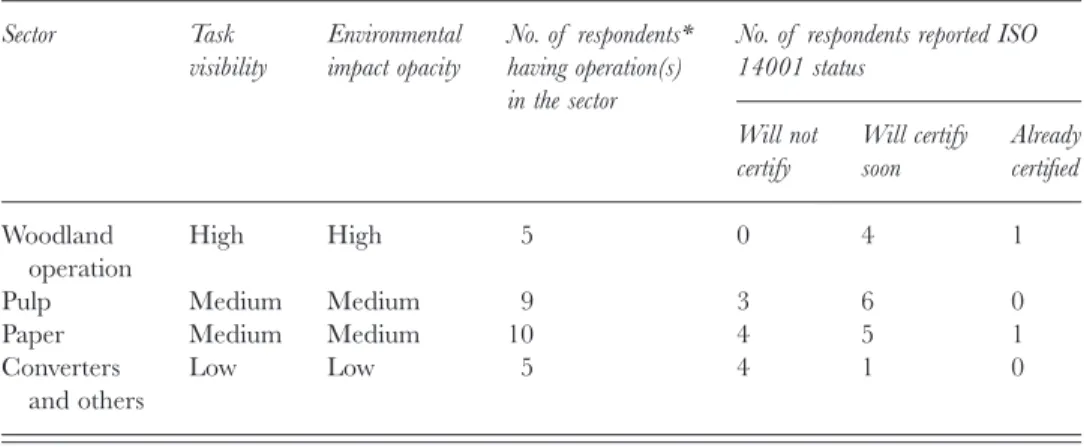
per-ceive themselves mostly in this second situation. We therefore re-coded the tran-scripts, discriminating between the motivations for the EMS and the motivations for ISO 14001 certification. After several iterations through the interview tran-scripts, two variables emerged that discriminated between EMS adoption and ISO 14001 certification: task visibility and environmental impact opacity. To confirm our suspicions, we developed a table in which the respondent firms’ EMS and ISO 14001 stages were listed by sectors, the results of which are shown in Table I. We then compared the ISO 14001 adoption status of the sectors by rear-ranging the data (shown in Table IV), where sectors were rated on task visibility and environmental impact opacity, based on the comments drawn from the interviews.
THE REASONS FOR ADOPTING AN EMS
The managers we interviewed generally agreed that environmental management had become a part of their business operations. Respondents varied considerably, however, in their stages of implementation of an EMS. Table I summarizes the stages of EMS and ISO 14001 adoption according to firm size, headquarter loca-tion, and sector in the pulp and paper industry.
Analysis of the data confirmed the basic driving forces behind firms’ decisions to adopt environmentally responsive practices as uncovered by prior researchers. Three factors stood out from the data: institutional pressures, market demand, and management control. The first two represented external pressures pushing firms towards ecologically responsible practices. The last factor reflected firms’ strategic choice in handling demands for environmental responsiveness. Exemplary quotes supporting these motivations are presented in Table II.
Managers stressed that market pressure was the most influential factor impact-ing environmental management decisions. They concurred that environmental management was a ‘customer-driven thing’. The same reason was given for pur-suing an EMS for ISO 14001 as well as for not purpur-suing one or both. One manager said: ‘we’re pulp producers so we ship our pulp to paper makers, and paper makers send us all kinds of questionnaires about our environmental performance. Ques-tions they typically ask include “Are you environmentally certified?” and “Are you trying to achieve ISO 14000?” ’. As a result of these customer inquiries, the company started the ISO 14001 certification process. The manager of another firm said that his firm was not in a hurry to push for ISO 14001 certification, because ‘actually we haven’t received any sort of pressure from customers. Our customers are 20 per cent in Canada and 80 per cent in the United States’. The impact of market demand on EMS adoption and ISO 14001 certification appears to be both direct and strong. This is consistent with accepted theory that says firms respond quickly to demands from dominant and definitive stakeholders that provide essential resources for them to gain exchange legitimacy (Suchman, 1995)
Ta b le I. Stages of en vir
onmental management b
y le
vel/siz
e,
HQ loca
tion and sector
Le ve l F acilities in T otal HQ Sector/pr oduct EMS status
ISO 14001 status
Canada employment Location 1 Cor pora te 19 mills 13,000 Canada W oodland opera tions V arious stages W
ill be certified soon
Pulp V arious , to war ds cor p . wide EMS Compa tib le only , no certifica tion P aper V arious , to war ds cor p . wide EMS Compa tib le only , no certifica tion 2 Cor pora te 1 mill 463 Canada Pulp Since 1993 Half wa
y to certifica
tion 3 Cor pora te 13 mills 3,300 Canada W oodland opera tions No f o rmaliz ed EMS W o
rking on certifica
tion Pulp No f o rmaliz ed EMS No P aper No f o rmaliz ed EMS No 4F acility 80 Canada Sticks Nothing Not consider ed 5 Division 5 mills
6,000 in 3
USA
Pulp and paper
Implementing EMS in 1 mill
4 mills close to certifica
tion,
HQ
countries
EMS in 4 mills
ag ainst certifica tion 6F acility 400 Canada Tissue paper Elements of EMS W o n ’t bother 7F acility 1,000 Canada P aper/newsprint Elements of EMS W
ill seek ISO 14001 in a y
ear
or tw
o
,
due to cor
pora te manda te 8 Division 5 mills 2,696 USA Pulp
All mills certified
P
aper/newsprint
Just started certifica
tion 9 Division 5 mills 9,700 USA
Pulp and paper
R
equir
ed in all mills b
y 1999
2 mills certified
10 Cor pora te 1 mill 190 Canada Con verter fr om Elements of EMS
Not in f
o reseeab le futur e 100% r ecy cled ma terial 11 Division 1 mill 1,100 Canada P aper/newsprint Elements of EMS Compa tib le only , no certifica tion 12 F acility
17,500 in 33
USA Con verter No No countries 13 Division 1 mill, 1
45,000 in 40
Eur
ope
W
oodland
EMS since 1990
Certified in 1998
w
oodland
countries
Pulp
EMS since 1990
W
o
rking on certifica
tion
P
aper
EMS since 1990
W
o
rking on certifica
tion 14 Cor pora te m ultiple 5,000 Canada Pulp , paper ,
All facilities be ISO 14001 r
ead y b y mills bo xw ood, and mid-2000, certifica
tion left to
b y-pr oducts facilities 15 Cor pora te 12 mills 3,280 Canada Pulp Y es W
ill all certify in 2000
W oodland opera tions Y es W
ill all certify in 2000
16
Division
28 mills
47,000 in 17
USA W oodland opera tions Cor pora te EMS W
ill all certify b
y 2002 countries Pulp , paper , veneer W o
rking on cor
pora te EMS Compa tib le only , no certifica tion
Ta
b
le II.
Motiv
ations f
or adopting an EMS
Motivation
Exemplar
y quotes
Number of times sug
gested Mar ket • T ha
t is a customer driv
en thing . 8 interview ees Demand • If w
e get driv
en b
y the customer
s in the end to pa
y mone
y to be certified b
y ISO 14000,
w
e will go
.
•
But our customer
s la
tely ha
ve
n
’t been insisting tha
t w
e need to ha
ve
our f
o
rest certified or an
ything like tha
t or w
e need to
Su
g
gested 26
ha
ve
an EMS in place f
or them to b
uy our pr
oducts . times •S o, wh at we ar
e seeing is a big y
awn fr
om North American customer
s sa
ying
,
‘ISO 14000 f
or mills , I don ’t think so , I don ’t car e’. • Wha
t is happening
,
is ther
e is an ISO 14000 pull starting in J
apan as y
ou w
ell kno
w and it is rising fast in Eur
ope and
pr
obab
ly w
e ar
e gearing f
or our e
xport mills to Eur
ope to be ISO 14000 certified because w
e can see tha
t coming b
ut f
or
the North American side w
e r eally can ’t . Institutional •
Britain has a lot of
legisla
tiv
e pr
essur
es as w
ell as trade r
ela
ted pr
essur
es within the Eur
opean Union to ha
ve so mething like 8 interview ees Pr essur e ISO 14000. •T her
e is a tr
end out ther
e with the r
egula
tor
s tha
t ar
e looking a
t ISO 14001 as a good wa
y to pr
omote self-r egula tions . Sug gest ed 20 •P eople w ho w o rk a
t these plants liv
e in the comm
unity and the last thing y
ou want people to think about y
ou as a member
times
of
the comm
unity is tha
t y
ou ar
e a polluter
.
•W
e see it as a big r
eputa
tional issue f
or the compan
y. Social pr essur e...t h at ’s
the engine tha
t driv
es the r
egula tio n... social pr essur e driv
es the mar
ket place too
.
Management
•
It’
s like an
y management tools
.
It puts rigour
s in the wa
y of doing things . 5 interview ees Contr ol • Certainly w e ar
e not doing it because w
e fear per
mit viola
tions
.
W
e ar
e doing it f
or good management practices
.
Just a v
ery
good wa
y to sort of
encompass all of
the aspects of
running the mill under a management plan tha
t has got en
vir onmental Sug gested 8 compliance a t heart. times •J
ust a consistent appr
oac
h with solid paperw
or
k to support actions an
d...
basically
,
just a further minimiza
tion of the risks of viola tions of an y le ve l •T
he plan is tha
t ther
e will be no disaster
s
•I
f
it’
s a system,
tha
t means tha
t e
ver
ybod
y under
stands the same thing
. So it’ s r eally b usiness contin uity . Making sur e w e’ re doing al wa
ys the same thing and w
hen w e cor rect things , w hen w e impr ov e, then w e impr ov
e all fr
om the same basis
and to survive (Mitchell et al., 1997). When this was the case, EMS and ISO 14001 was no longer voluntary, but ‘coercive’.
Institutional pressures arise from overall social pressures that drive regulations, environmental activists, and market demand, that in turn directly affect firm behaviour (Christmann and Taylor, 2001; Fineman and Clarke 1996). As one manager succinctly put it: ‘social pressure . . . [is] the engine that drives the regu-lations . . . social pressure drives the market place too’. Several respondents sug-gested that having an effective EMS helped them to manage and establish a better relationship with regulators and local communities. Institutional pressures seem to explain much of the differences in EMS adoption. As in other studies (e.g., Bansal and Roth, 2000), large firms were further along in their EMS development than smaller ones, especially large firms with multiple manufacturing facilities and those selling to or operating in multiple geographic markets. These firms generally had a corporate-wide environmental policy, environmental officers and/or offices, and some sort of environmental reporting system in place. They often pushed for a corporate-wide formal EMS, while the decision for ISO 14001 certification was often left to local facilities. Small firms, on the other hand, were less concerned about environmental management as long as they remained in compliance with regulations. One manager commented that firms of their size had ‘not given a whole lot of thought to environmental issues’. Some small companies had no envi-ronmental policy, no monitoring, no auditing, ‘nothing whatsoever’. This is con-sistent with institutional theory, which argues that larger firms are more likely to respond to institutional pressures, as they are more visible and often more inte-grated within their communities (Goodstein, 1994; Greening and Gray, 1994; Meyer and Rowan, 1977; Tolbert and Zucker, 1983).
For the same institutional argument, the location of the firm’s headquarters seemed to affect the firm’s approach to environmental management. A firm we interviewed that was headquartered in Europe established a corporate policy of getting ISO 14001 certification for all their divisions and facilities. While most North America-based large corporations started to require their facilities to be ISO 14001 ready, they were not pushing for the actual certification. Firms that had exposure to international markets had a more advanced EMS or were more likely to be ISO 14001 certified than those that were active only in North America. One manager explained that the reason why they did not bother to seek certification was because their customer base was entirely in North America, so they had not felt any pressure. Respondents attributed the differences in responses across geo-graphical domains to differences in institutional pressures for environmental responsiveness. One manager commented: ‘I think there is a major difference in culture between German countries and American countries, or North American countries’, in that the European public are more aware of environmental issues, and hence firms selling to Europe face more pressure for responsible environ-mental practices.
Management control is another factor mentioned by managers that motivated them to adopt an EMS. Some managers we interviewed mentioned that adopting an EMS was a proactive way of managing regulatory changes, community rela-tions, and public opinion, as well as a way of ensuring consistent management control on environmental issues. As regulatory requirements became more onerous and complex, regulatory compliance was more difficult. Respondents indicated that an EMS could help firms in that regard because it required systematic mon-itoring and benchmarking. One manager said that by having an effective EMS, a firm could stay ahead of regulatory changes, so that it would not be hit with changes that require large investments ‘at a time you least want them’.
The respondents indicated that the structure of an EMS or ISO 14001 could bring rigour and consistency to environmental management. One manager com-mented that they started implementing an EMS to maintain consistency and con-tinuity in environmental management practices and procedures in the face of personnel turnover, so they did not have to ‘reinvent the wheel every time’. Con-sistent with structuration theory (Barley and Tolbert, 1997; Giddens, 1984), man-agers unanimously mentioned that a significant benefit of having an EMS is the enhanced employee awareness of environmental management issues and the con-sequent changes in behaviour. Since an EMS involves an all-encompassing struc-ture and specific procedures, it tends to be integrated into the overall management system, rather than just a decoupled ‘window dressing’ (Weaver et al., 1999). One manager said emphatically: ‘It is not just an environmental management system, it is a management system’. Another manager said that the purpose of installing an EMS was to weave environmental management into ‘the organizational fabric’.
DRIVERS FOR ISO 14001 CERTIFICATION
In spite of collective consciousness of the importance of an EMS, there was con-siderable variation in firms’ responses to ISO 14001 certification. One big Canada-based corporation was demanding that all their facilities be ISO 14001 ready towards the middle of year 2000 – but would not necessarily go for certification. A European company was pushing all its global divisions and subsidiaries towards ISO 14001 certification. A US-based company, on the other hand, strongly dis-couraged its facilities from pursuing certification for fear that the required docu-mentation might actually be used by government agencies against the firm to expose environmental infractions.
Several managers indicated that ISO 14001 did not offer substantial value over an in-house EMS, and they would not bother to go the extra distance of certify-ing with ISO 14001 unless their customers explicitly asked for it. One manager was very certain that ‘from the effectiveness (perspective) of the implemented EMS, the non-14000 (EMS) are better positioned than the ISO 14000 ones. And the reason is that the non-14000 ones really went after what is important and only
after what is important’. Several others, who believed that ISO 14001 certification did ‘not add much more’, echoed this view. This seemed to go against the claim that ISO 14001 certification will lend a competitive edge to the adopters (e.g., Davies and Webber, 1998; Ralborn et al., 1999). On the other hand, literature on standardization asserts that standardization leads to uniformity rather than excellence (Brunsson, 2000). According to Brunsson (2000), standardization can disconnect the firm from what is actually done to what is said is being done. As a result, standardization creates uniformity in symbolic elements such as speech and policy papers rather than in substantive ways. Previous studies of voluntary envi-ronmental management standards such as Responsible Care and ISO 14001 have also revealed similar scepticism (King and Lenox, 2000; Yap, 2000). Managers seemed to believe that most of the functional benefits claimed for ISO 14001 could be achieved by an effective EMS. Moreover, firms could implement a completely ISO 14001-compatible EMS and self declare compliance without actually obtain-ing the certification and incurrobtain-ing the costs.
If ISO 14001 certification did not offer additional functional benefits to an uncertified EMS and there were no coercive forces for it in North America, firms had discretionary power regarding the certification. The question that needs to be asked then, is, under what circumstances would a firm see the need for ISO 14001 certification?
The data revealed that pulp and paper firms had different environmental policies in their facilities in different sectors. Facilities in woodland operations were more likely to be ISO 14001 certified. All five firms that had woodland operations had or were working to have their facilities certified for ISO 14001. Facilities in the pulp and paper sectors, on the other hand, were more likely to have only an EMS. The converters were least concerned with having an EMS or ISO 14001. As we probed the data for reasons for the differences in the responses to ISO 14001, two factors were revealed: task visibility and environmental impact opacity. A discussion of the reasons why these factors influence certifica-tion decisions follows. Exemplary quotes highlighting these concepts are provided in Table III. A summary of firm responses to ISO 14001 by sector is provided in Table IV.
Task Visibility
We define task visibility as the extent to which a particular firm task is easily observ-able or attracts the attention of the public. A firm’s task can be visible because: (1) it is noticeable to the public eye; or (2) the firm itself has a high profile. Firms’ tasks can be visible because they are completed publicly and the results can be viewed easily. Woodland operations, for instance, were carried out in the forest, open to the public. ‘Everybody can go out and see a tree being cut down’, as one manager commented. A firm’s tasks can become visible because the firm’s high
Ta b le III. T ask visibility , en vir
onmental impact opacity
,
and ISO 14001 certifica
tion F actor s Exemplar y quotes
Number of times sug
gested
T
ask visibility
•
ISO 14001 on the W
oodlands was lar
gely a cor
pora
te decision to get e
xter nal r ecognition tha t w e ar e tr
ying to i
mplement 5 interview ees sustainab le f o
rest management practices
.
•W
e felt tha
t w
e had to ha
ve some wa y of pr oving , b y e xter nal means , tha
t the f
o
rest practices tha
t w e w er e undertaking Sug gested 1 2 we re
in fact sustainab
le and w
er
e the right things to be doing
. times •T he f o restr
y sector is a v
er
y visual industr
y in m
y opinion.
Ev
er
ybod
y can go out and see a tr
ee being cut do
wn as
opposed to g
as or oil coming out of
the g round. So pub lic per ce ption of tha t compan
y is v
er y visib le . (Wh y w oodland opera
tions get ISO 14001 fir
st?)
•T
her
e is m
u
ch
mor
e pr
essur
e on our w
oodlands g
roup in ter
ms of
being in the pub
lic e
ye out harv
esting in the b
ush
ve
rsus someone tha
t just w
o
rks in the mill.
T h at ’s v er y appar ent. •
In the sa
wmills
,...
aspects and potential risks ar
e mor
e limited than on the f
o
restr
y.
It is not subjected as m
u
ch
to pub
lic
scrutin
y as it is on the f
o
restr
y side
.
Less visib
le than the f
o restr y f or sur e. En vir onmental • T her
e is a big pr
ob
lem with e
xplaining to e
xter
nal people ho
w w
e do things or ho
w things w
o rk if you will. (Wh y ISO 4 interview ees impact 14001 certifica tion?) opacity •
Pulp mills ha
ve
some ke
y parameter
s or ke
y indica
tor
s tha
t can be measur
ed ag
ainst companies w
o
rl
d
wide to measur
e Sug ges ted 10 en vir onmental perf or mance fr
om the mill side itself
.
For
estr
y,
on the other hand,
is m
u
ch
mor
e of
a softer science
. (Wh y times the w oodland opera tion r egister ed f
or ISO 14001?)
•T
he ecological pr
ocesses ar
e a lot mor
e comple
x and so an appearance of
something isn
’t
necessarily a bad thing and
sometimes w h at looks like , you kno w , visually pleasing , m ay
actually be bad f
o
restr
y in an ecological sense
. (Explaining sectorial dif fer ences betw een w oodland opera
tions and mills
.)
•T
he
y (activists) ar
e a lot,
in m
y view
,
less tec
hnically sophistica
ted in ter
ms of
under
standing of
either the man
ufacturing
pr
ocess or the f
o
rest management pr
ocess
.
Muc
h mor
e in tune to the emotional sort of
social-cultural side of
it,
w
hic
h ar
e
the visual aspects to some deg
ree and the sustainability of
old g
ro
wth harv
esting and wildlife habita
t and all tha
t kind of
side
.
•
It’
s an easy wa
y of comm unica ting tha t y ou ha ve
a certain standar
profile draws attention to them. A large multinational firm’s tree-cutting practices may be under closer scrutiny than a small firm’s for this reason.
In several cases, a firm’s woodland operations were certified prior to other mills, sometimes despite the fact that the overall corporate policy did not impose certi-fication. Forest management activities, like tree cutting or tree-planting, were very visible tasks. One manager said: ‘There is much more pressure on our woodlands group in terms of being in the public eye out harvesting in the bush versus someone that just works in the mill.’ Another manager said: ‘The forestry sector is a very visual industry. Everybody can go out and see a tree being cut down as opposed to gas or oil coming out of the ground, so public perception of that company is very visible.’ Task visibility increases the possibility of scrutiny from external stake-holders like regulatory bodies, local communities, green activists, and consequen-tially increases a firm’s need for external recognition. External recognition of good environmental practices is important for a firm to gain legitimacy and procure resources (Pfeffer and Salancik, 1978). Task visibility also increases the urgency of the issue which likely leads to a faster organizational response (Ginsberg and Venkatraman, 1995).
Likewise, the visibility of the firm would increase the scrutiny of its tasks, and lead to early actions to gain external recognition. Multinationals, for example, are more visible and also certified early for ISO 14001, which is consistent with the received theory which suggests that larger firms are usually early adopters of prac-tices or structures that cater to institutional pressures (Greening and Gray, 1994; Tolbert and Zucker, 1983). The visibility of the firm can also be enhanced as firms interact with community members by serving their needs or hiring employees. This may explain why IBM, Ford, and GM have been among the first to seek ISO Table IV. Comparison of ISO 14001 adoption status in different sectors of forest products industry
Sector Task Environmental No. of respondents* No. of respondents reported ISO
visibility impact opacity having operation(s) 14001 status
in the sector
Will not Will certify Already
certify soon certified
Woodland High High 5 0 4 1
operation
Pulp Medium Medium 9 3 6 0
Paper Medium Medium 10 4 5 1
Converters Low Low 5 4 1 0
and others
14001 certification. Firm size may also enhance the visibility of the firm’s tasks as large firms generate more economic wealth and are more closely tied to the community’s social health.
However, firm visibility is not the same as task visibility as illustrated by two facts (see Table I). First, the five firms that have woodland operations all decided to certify their woodland operations, even though some are medium to small domes-tic firms with only a few thousand workers. Second, out of the three large firms with more than 10,000 employees, one firm had certified its woodland operations before its mills, and two decided to certify their woodland operations in spite of the fact that their overall corporate policy was not to seek certification. Managers believed that the high visibility of the woodland operation itself demanded dif-ferent treatment and required extra external recognition. Therefore, task visibility is an attribute of a procedure or operational process, which, although influenced by firm visibility, is nevertheless an independent feature impacting a firm’s certifi-cation decision.
High task visibility increased the need for external recognition. Firms might be doing all the right things for the environment, but to convince the public, a third-party verification was effective. ISO 14001, by being an internationally acknowl-edged EMS standard, provides a means to gain such external recognition and credibility. A Vice President of Environment of a company explained why the firm mandated ISO 14001 certification for all the woodland operations but not the mills: ‘ISO 14001 on the woodlands was largely a corporate decision to get exter-nal recognition that we are trying to implement sustainable forest management practices.’
While managers often did not believe that ISO 14001 offered extra functional benefits to environmental management, they certainly understood its value in being an internationally recognized standard and thus having wider international credibility than a home-grown EMS. ISO 14001 was used as a symbol or signal of legitimacy. In our interviews, words like ‘demonstrate’, ‘show’, ‘prove to the public’, ‘verify to people’ were often used in discussing certification decisions, revealing the fact that ISO 14001 was considered as a legitimizing tool when high visibility demanded external recognition. This is consistent with Suchman’s (1995, p. 580) notion of procedural legitimacy: ‘. . . organizations also can garner moral legitimacy by embracing socially accepted techniques and procedures.’
Therefore, when market and institutional forces favour environmental respon-siveness but do not directly demand ISO 14001 certification, task visibility of a firm’s operation enhances the need for external recognition and pushes the firm towards ISO 14001 certification. Hence we propose:
Proposition 1: Other things being equal, operations with higher task visibility are more likely to be certified for ISO 14001.
Environmental Impact Opacity
Environmental impact opacity refers to the difficulty with which the environ-mental impact of a firm’s task can be measured and understood by external stake-holders. If the impact is opaque, then there are often no quantifiable criteria or parameters to measure the environmental impact of the operation. As a result, the firm’s environmental performance will be more difficult to evaluate, and the firm cannot easily communicate its environmental responsiveness to outside audiences. On the other hand, if the impact is not opaque but easily comprehensible, then there are usually ready-to-use criteria or parameters to measure or evaluate its per-formance, which can be shown to the external stakeholders for communication purposes. When the former is the case, procedural legitimacy gains salience because standard practices speak for the firm’s efforts to act responsibly (Scott, 1992; Suchman, 1995). By achieving ISO 14001 certification, the firm signals its sound practices in environmental management.
In the case of the forestry industry, pulp and paper sectors have criteria such as emission levels and energy consumption levels that directly measure a facility’s environmental performance and help to achieve ‘consequential legitimacy’ (Suchman, 1995), which refers to legitimacy gained through the outcomes of an action. For instance, in 1999, the CPPA reported that Canadian pulp and paper mills had improved their environmental performance by indicating that water con-sumption per tonne of pulp is less than half of what it was 20 years ago and that levels of Total Suspended Solids (TSS) and Biological Oxygen Demand (BOD) had dropped more than half since 1990. The CPPA also reported that, in 1995, the use of elemental chlorine in bleaching had dropped 87 per cent, and dioxins and the amount of furans in mill effluent was down 99 per cent from 1988 (CPPA, 2001). While an EMS may be necessary to achieve these desirable environmental performance results, ISO 14001 certification is nevertheless not a must-have to demonstrate the achievements, since the firm can show the numbers on energy consumption, TSS and BOD emission levels in their communication with the general public or enforcement agencies.
No such measure of consequential legitimacy, however, exists for woodland operations. Woodland operations lack direct measurements that signal environ-mental performance. One respondent explained his firm’s decision to register its woodland operations with ISO 14001 but not the mills: ‘pulp mills have some key parameters or key indicators that can be measured against companies worldwide to measure environmental performance. Forestry, on the other hand, is much more of a softer science.’ Another manager expressed a similar idea: ‘In the forest man-agement side . . . the ecological processes are a lot more complex and so an appear-ance of something isn’t necessarily a bad thing. . . . So what they looked for . . . is to have other outside experts to look at it and then basically tell them (the public) and verify if what we were doing was satisfactory.’ Managers felt that ‘there is a
big problem with explaining to external people how we do things or how things work’. To make communication with the public easier, an internationally recog-nized standard like ISO 14001 was useful.
Environmental impact opacity can also be determined by the stakeholders’ tech-nical knowledge of a particular operation. One manager discussed why their paper mills became certified before pulp facilities. The pulp mills, he explained, ship their products to paper mills, whose managers are familiar with the pulp manufactur-ing process. Therefore, paper manufacturers could assess the environmental per-formance of the pulp mills just by the technology or equipment being used. The paper mills, on the other hand, sell primarily to newspapers and publishing com-panies. These customers do not know much about the paper-making process, therefore, its environmental impact is opaque to them. Rather than trying to explain all the details, the paper mills can certify for ISO 14001 to show that they are managing the environmental aspects of their operations in an acceptable way. Once again, the ISO 14001 standard is not sought after for its functional ben-efits, but rather, as an effective way of transmitting information – to convince the public or stakeholders that things are being done acceptably without having to explain the complexities of the activities involved. To achieve this end, self decla-ration is not enough; a trusted and recognized third party is needed to verify to the less knowledgeable public (Brunsson and Jacobsson, 2000). ISO 14001 was conceived and used as a tool to facilitate communication and consequently gain legitimacy. Therefore, we propose the following:
Proposition 2: Other things being equal, operations with higher environmental impact opacity are more likely to be certified for ISO 14001.
DISCUSSION AND CONCLUSIONS
The main thrust of this study was to explore the circumstances under which firms would seek ISO 14001 certification when they were not required to do so by the market or regulating institutions. Most respondents believed that ISO 14001 cer-tification provided little, if any, additional functional value to an in-house EMS except for external recognition, credibility, and procedural legitimacy. Therefore, if firms did not feel any direct market demand or institutional pressure, they would probably not bother to certify. However, procedural legitimacy was more likely to matter when the organization’s tasks were highly visible (i.e., the task was easy to see and the organization was visible), and the environmental impacts were opaque (i.e., they were hard to measure and communicate). Therefore, task visibility and environmental impact opacity increase the probability and speed of ISO 14001 certification.
These constructs are related to constructs developed by others. Bansal and Roth (2000) identified the importance of issue salience in motivating corporate
environmental responsiveness. They argued that issue salience is shaped by the issue’s certainty, transparency and emotivity. Issue certainty is defined as ‘the degree to which the impact of the issue on the natural environment can be mea-sured’, while issue transparency is ‘easily attributable to a polluting firm’ (Bansal and Roth, 2000, p. 729), and issue emotivity is the affect that the issue evokes. The resulting impact of their constructs is similar to ours: the issue becomes more visible or salient in the minds of stakeholders, which allows them to see the ben-efits of environmental responsiveness more clearly, or in our case, task visibility and environmental impact opacity of an operation helps the managers to see the advantages of ISO 14001. The construct of task visibility has also appeared in the context of employee social loafing or shirking (George, 1992; Jones, 1984). George (1992) found that perceived high task visibility was negatively associated with social loafing because it would elicit greater supervisor scrutiny, which is similar to the argument that we presented. Task visibility leads to an enhanced level of external attention and impact opacity points to the difficulty of detection or evaluation.
The data analysis also confirmed the results of previous studies in finding that factors such as market demand, institutional pressure, and management control were relevant in driving a firm’s EMS adoption decision. Firms responded most strongly to the market – specifically to demands from dominant and definitive stakeholders (Mitchell et al., 1997) which had an impact on firms’ imme-diate survival, profitability, or growth (Banerjee, 2001). Firms also heeded to insti-tutional pressures from society, local community, green activists, and regulatory forces.
Obviously, firms in our sample were still at the stage of seeking pragmatic legit-imacy (Suchman, 1995) for their environmental management practices, which explains why customer demand appeared to be a most salient factor in firms’ EMS adoption decision. This is consistent with Banerjee’s finding that ‘corporate envi-ronmentalism, or a pervasive rationale for it, ultimately follows the economic bottom line’ (Banerjee, 2001, p. 507). Managers appeared to be deliberate in their thinking towards the standard. They selectively registered their facilities with ISO 14001 based on customer demands in the markets served. They weighted the possible costs and benefits of ISO 14001 certification, evaluated the legislator’s attitudes towards ISO 14001, and responded to different institutional pressures differently.
Our findings contribute to research on organizations and the natural envi-ronment. We demonstrated the following two points. First, although ISO 14001 certification helps with the maintenance and improvement of an EMS, standardization leads to ‘uniformity’ not excellence. Therefore, claiming ISO 14001 certification as a way of gaining and sustaining competitive advantages may not sell with managers, particularly if their intuition leads them to appreci-ate ISO 14001 for its legitimization value rather than for functional benefits.
Second, although environmental preservation and sustainable development seem to have become accepted values among large portions of society, firms still need to see the need for voluntary environmental standards like ISO 14001. Many firms will not certify for ISO 14001 if they do not receive clear market or institutional pressures and are not in need of external recognition and communication. There-fore, the most effective way for governments to improve the take-up rate of ISO 14001 is to increase supply chain pressure for certification by having large influ-ential firms commit to the standard. This is probably beginning to happen in North America as firms like Ford and GM announced that their suppliers need to be ISO 14001 compliant by the end of 2002.
Our findings regarding ISO 14001 certification also provide a new scenario to organizational researchers interested in the emergence and institutionalization of practices and structures. Studies of the diffusion patterns of civil service reforms, the multi-divisional form, financial reporting standards, and CEO long-term incentive plans (Fligstein, 1985; Mezias, 1990; Palmer et al., 1993; Westphal and Zajac, 1994) have come up with a consistent finding that distinguished between early and later adopters: early adopters usually base their decision on efficiency considerations and focus on the substance – functional features – of the adopted practice, while later adopters tend to subscribe for legitimacy purposes and focus more on the symbolic functions. The special status of ISO 14001 as a new yet well-recognized standard, and the co-existence of regular EMSs that share similar functional features led even the early adopters of ISO 14001 to value not only its substance but also – to a larger extent – its legitimatizing benefits. Hence, our research suggests that the symbolic elements of a standard may be relevant to administrative forms, if there are strong connections to existing forms (such as ISO 9000 in this case), or for which the functional benefits are not clearly known.
Our insights were gained from an inductive analysis of qualitative interview data. The fact that this was an explorative study of a small sample of firms in a single industry and country makes the findings limited and their generalizability untested. Further research is needed not only to validate, but also to develop our study. For example, managers did not indicate to us that they were mimicking their competitors, or even aware of what others were doing. This finding could be due to the relatively short history of ISO 14001. In a few years, we may find isomor-phic forces at work in ISO 14001 adoption. Future research can also examine other voluntary standards within the environmental management arena to see if task visibility and impact opacity have the same kind of influence in firms’ efforts to build credibility and legitimacy.
NOTE
[1] The Canadian Pulp and Paper Association has recently changed its name to Forest Products Association of Canada (FPAC). Its website address may change as well.
REFERENCES
Aragõn-Correa, J. A. (1998). ‘Strategic proactivity and firm approach to the natural environment’.
Academy of Management Journal,41, 5, 556–67.
Banerjee, S. B. (2001). ‘Managerial perceptions of corporate environmentalism: interpretations from industry and strategic implications for organizations’.Journal of Management Studies,38, 4, 489–513.
Bansal, P. (2002). ‘The corporate challenge of sustainable development’.Academy of Management
Exec-utive,16, 2, 122–31.
Bansal, P. and Roth, K. (2000). ‘Why companies go green: a model of ecological responsiveness’.
Academy of Management Journal,43, 4, 717–36.
Barley, S. R. and Tolbert, P. S. (1997). ‘Institutionalization and structuration: studying the links between action and institution’.Organization Studies,18, 1, 93–117.
Berry, M. A. and Rondinelli, D. A. (1998). ‘Proactive corporate environmental management: a new industrial revolution’.Academy of Management Executive,12, 1–13.
Brunsson, N. (2000). ‘Standardization and uniformity’. In Brunsson, N. and Jacobsson, B. (Eds),
A World of Standards. Oxford: Oxford University Press, 138–50.
Brunsson, N. and Jacobsson, B. (2000). ‘The pros and cons of standardization – an epilogue’. In Brun-sson, N. and JacobBrun-sson, B. (Eds),A World of Standards. Oxford: Oxford University Press, 169–73. Buchholz, R. A. (1991). ‘Corporate responsibility and the good society: from economics to ecology;
factors which influence corporate policy decisions’.Business Horizons,34, 1–19.
Christmann, P. and Taylor, G. (2001). ‘Globalization and the environment: determinants of firm self-regulation in China’.Journal of International Business Studies,32, 3, 439–58.
Clark, D. (1999). ‘What drives companies to seek ISO 14000 certification?’.Pollution Engineering, Summer, 14–18.
CPPA (2001). Available at: www.cppa.ca/english/wood/mill.htm, 8 October 2001.
Davies, C. and Webber, P. (1998). ‘ISO registration: the process, the benefits, and the choice of registrar’.Environmental Quality Management, Winter, 55–64.
DiMaggio, P. J. (1988). ‘Interest and agency in institutional theory’. In Zucker, L. G. (Ed.),
Institu-tional Patterns and Organizations, Culture and Environment. Cambridge, MA: Ballinger Publishing
Company, 3–21.
Fineman, S. and Clarke, K. (1996). ‘Green stakeholders: industry interpretations and response’.
Journal of Management Studies,33, 6, 716–30.
Fligstein, N. (1985). ‘The spread of multidivisional form among large firms, 1919–1979.’American
Sociological Review,50, 377–91.
George, J. M. (1992). ‘Extrinsic and intrinsic origins of perceived social loafing in organizations’.
Academy of Management Journal,35, 1, 191–202.
GETF (1996). Available at: http://www.iso14000.net/empire/?subsystemID=1&ComponentID= 16161.
Giddens, A. (1984).The Constitution of Society. Berkeley, CA: University of California Press. Ginsberg, A. and Venkatraman, N. (1995). ‘Institutional initiatives for technological change: from
issue interpretation to strategic choice’.Organization Studies,16, 3, 424–48.
Glaser, B. G. and Strauss, A. L. (1967).The Discovery of Grounded Theory: Strategies for Qualitative Research. London: Wiedenfeld and Nicholson.
Goodstein, J. D. (1994). ‘Institutional pressures and strategic responsiveness: employer involvement in work-family issues’.Academy of Management Journal,37, 2, 350–82.
Greening, D. W. and Gray, B. (1994). ‘Testing a model of organizational response to social and polit-ical issues’.Academy of Management Journal,34, 3, 467–98.
Hart, S. L. (1995). ‘A natural-resource-based view of the firm’.Academy of Management Review, 20, 986–1014.
ISO (2001). Available at: http://www.ecology.or.jp/isoworld/english.htm.
Jones, G. R. (1984). ‘Task visibility, free riding, and shirking: explaining the effect of structure and technology on employee behavior’.Academy of Management Review,9, 4, 684–95.
King, A. and Lenox, M. (2000). ‘Industry self-regulation without sanctions: the chemical industries Responsible Care program’.Academy of Management Journal,43, 698–716.
Lampe, M., Ellis, S. R. and Drummond, C. K. (1991). ‘What companies are doing to meet envi-ronmental protection responsibilities: balancing legal, ethical, and profit concerns’.Proceedings
Lawrence, A. T. and Morell, D. (1995). ‘Leading-edge environmental management: motivation, opportunity, resources and processes’. In Collins, D. and Starik, M. (Eds),Research in Corporate
Social Performance and Policy. Greenwich, CT: JAI Press Inc., 99–126.
Meyer, J. W. and Rowan, B. (1977). ‘Institutionalized organizations: formal structure as myth and ceremony’.American Journal of Sociology,83, 340–63.
Mezias, S. J. (1990). ‘An institutional model of organizational practice: financial reporting at the Fortune 200’.Administrative Science Quarterly,35, 431–57.
Mitchell, R. K., Agle, B. R. and Wood, D. J. (1997). ‘Toward a theory of stakeholder identification and salience: defining the principle of who and what really counts’.Academy of Management
Review,22, 4, 853–86.
Newton, T. and Harte, G. (1997). ‘Green business: technicist kitsch?’.Journal of Management Studies,
34, 1, 75–98.
Palmer, D. A., Jennings, P. D. and Zhou, X. (1993). ‘Late adoption of the multidivisional form by large U.S. corporations: Institutional, political, and economic accounts’. Administrative Science
Quarterly,38, 100–31.
Pfeffer, J. and Salancik, G. R. (1978).The External Control of Organizations. New York: Harper & Row. Porter, M. E. and van der Linde, C. (1995). ‘Green and competitive: ending the stalemate’.Harvard
Business Review,73, 5, 120–34.
Post, J. E. (1994). ‘Environmental approaches and strategies: regulation, markets, and management education’. In Kolluru, R. B. (Ed.),Environmental Strategies Handbook. New York: McGraw-Hill, 11–30.
Ralborn, C. A., Joyner, B. E. and Logan, J. W. (1999). ‘ISO 14000 and the bottomline’.Quality
Progress,32, 11, 89–93.
Rondinelli, D. A. and Vastag, G. (1996). ‘International environmental standards and corporate poli-cies: an integrative framework’.California Management Review,39, 1, 106–22.
Russo, M. V. and Fouts P. A. (1997). ‘A resource-based perspective on corporate environmental per-formance and profitability’.Academy of Management Journal,40, 3, 534–59.
Scott, W. R. (1992).Organizations: Rational, Natural, and Open Systems, 3rd edition Englewood Cliffs, NJ: Prentice Hall.
Shrivastava, P. (1995). ‘Environmental technologies and competitive advantages’.Strategic Management
Journal,16, 183–200.
Starik, M. and Rands, G. P. (1995). ‘Weaving an integrated web: multilevel and multisystem per-spectives of ecologically sustainable organizations’.Academy of Management Review,20, 908–35. Strauss, A. L. and Corbin, J. (1990).Basics of Qualitative Research: Grounded Theory Procedures and
Tech-niques. Newbury Park: Sage Publications.
Suchman, M. C. (1995). ‘Managing legitimacy: strategic and institutional approaches’.Academy of
Management Review,20, 3, 571–610.
Tolbert, P. S. and Zucker, L. G. (1983). ‘Institutional sources of change in the formal structure of organizations: the diffusion of civil service reform’.Administrative Science Quarterly,28, 22–39. Weaver, G. R., Treviño, L. K. and Cochran, P. (1999). ‘Integrated and decoupled corporate social
performance: management commitments, external pressures, and corporate ethics practices’.
Academy of Management Journal,42, 2, 539–52.
Westphal, J. D. and Zajac, E. J. (1994). ‘Substance and symbolism in CEO’s long-term incentive plans’.Administrative Science Quarterly,39, 367–90.
Yap, N. T. (2000). ‘Performance-based ISO 14001 case studies from Taiwan’. In Hillary, R. (Ed.),