www.nuffieldfoundation.org
Stephen Scott, Kathy Sylva, Angeliki Kallitsoglou
and Tamsin Ford
Which type of parenting
programme best improves
child behaviour and reading?
Follow-up of the Helping Children Achieve trial
Contents
Foreword from the Nuffield Foundation... 2
Executive summary... 3
1. Introduction... 6
2. Method... 11
3. Recruitment and participation in the trial... 21
4. Changes in parenting practices in the different intervention groups... 25
5. Changes in child outcomes in the different intervention groups... 30
6. Moderators and mediators of change... 34
7. Discussions and conclusions... 35
The research team
Professor Stephen Scott, Director, National Academy for Parenting Research (NAPR), King’s College London (Chief Investigator)
Professor Kathy Sylva, Department of Education, University of Oxford (Principal Investigator)
Dr Angeliki Kallitsoglou, Helping Children Achieve team, NAPR (Senior Researcher)
Dr Tamsin Ford, the Peninsula Medical School, University of Exeter (Lead Researcher)
Dr Thomas G O’Connor, University of Rochester Medical School, New York State (Statistical Adviser)
Warren Leaver (Research Assistant, London)
Louise Hurley, Anna Price, Alison Hurst and Rebecca Davies (Research Assistants, Exeter)
Fiona Jelley (Research Assistant, Oxford)
Acknowledgements
The authors would like to thank the Nuffield Foundation for funding the Helping Children Achieve (HCA) Follow-Up Study, the Department for Education for funding the original HCA study through the National Academy for Parenting Practitioners, and to all the HCA parents and children who have generously provided invaluable information on their experiences.
About the Nuffield Foundation
The Nuffield Foundation is an endowed charitable trust that aims to improve social well-being in the widest sense. It funds research and innovation in education and social policy and also works to build capacity in education, science and social science research. The Nuffield Foundation has funded this project, but the views expressed are those of the authors and not necessarily those
of the Foundation. More information is available at
Copyright © Nuffield Foundation 2014 |28 Bedford Square, London, WC1B 3JS Registered charity 206601 | ISBN 978-0-904956-93-1
2
Foreword
Helping Children Achieve (HCA) is a randomised controlled trial designed to test the effects of parenting interventions aimed at improving children’s conduct and literacy. Two different interventions were tested on 5-7 year-olds; one designed to improve behaviour and
relationships, and the other designed to improve literacy. A third group received a combination of both interventions. The effects were measured 9-11 months after the interventions began, and showed that children in all three groups saw a reduction in disruptive behaviour compared to the control group, but only those who received the behaviour intervention saw an
improvement in their reading. These findings were published by the Department for Education (DfE) in 2012.
This report presents findings from a follow-up study which measured outcomes of children in the HCA trial two years after the intervention began, when they were aged 7-9 years-old. Funded by the Nuffield Foundation and led by Professor Stephen Scott, the study found that the effects identified in the original trial were sustained over the longer time period. The report also summarises the findings from the original HCA Trial.
The findings show that tackling problem behaviour at a young age can have lasting effects, not only on children’s behaviour but also on their reading. Conversely, the intervention specifically designed to improve literacy was unsuccessful. This finding is not what was predicted and demonstrates just how vital it is to ensure large scale interventions are properly evaluated. The lack of robust evidence on the effectiveness of parenting interventions has been an area of concern for the Foundation, not least because they often require significant public investment. So we are pleased to fund projects such as this one that aim to provide a more reliable
assessment of the efficacy of these interventions, both in the short and longer term. In addition, it spans our interests in family policy, child development and educational outcomes.
Another valuable message emerging from the study is that improvements in children’s
behaviour and reading ability were seen equally strongly across the board, regardless of factors such as level of parental education, parental mental health, and whether children lived in a one or two parent household. This is important because it show the potential for narrowing the attainment gap between children from different backgrounds and consequently for reducing social inequality. It also demonstrates that although parents may not seek help themselves in relation to their child’s behaviour or reading, they are nevertheless prepared to engage and participate when the opportunity is presented.
Finally, I would like to extend my thanks to the research team for undertaking this project, which offers a valuable contribution to our understanding of the potential of high quality parenting programmes to improve behaviour and literacy in children at risk of poor outcomes.
Teresa Williams
3
Executive Summary
Study aims
This study aimed to find out which type of parenting programme would best improve the longer-term social behaviour and reading skills of young children at risk of poor outcomes due to antisocial behaviour.
Background
Three factors that reliably predispose children to underachieve and become socially excluded in childhood with enduring effects into adulthood are (1) experiencing suboptimal parenting, such as lack of praise and encouragement, being subject to overly harsh, inconsistent discipline (2)
behaving disruptively and (3) being a poor reader. Early intervention in the form of parenting programmes delivered when children are in the initial stages of school may help. However, it is not known whether it is better for programmes to help parents support their children’s behaviour, reading, or both. The original Helping Children Achieve (HCA) trial – funded by the Department for Education - set out to answer this in the short-term, 9-11 months after the trial began and indicated promising results. But we wanted to see if these were sustained beyond the first year, and were delighted that the Nuffield Foundation awarded us grant-funding for a follow-up study when the children were 7-9 years old. This report summarises the findings from the original trial study and then reports the new findings a year later, two years after the trial began.
Methods Sample
2655 families with children aged 5-7 in a disadvantaged inner London Borough and a South West city were successfully screened to assess levels of child disruptive behaviour: slightly under half (1174, 45%) met the predetermined cut-off, reported by either parent or teacher. A third of these (395) expressed interest in a research trial, 210 families eventually took part.
Interventions
The parents were randomly allocated to one of four conditions:
1. A programme to improve behaviour and relationships - the Incredible Years (IY)
2. A programme to improve literacy - the Supporting Parents on Kids Education in Schools programme (SPOKES)
3. A combined programme in which the IY programme was delivered first, followed by the SPOKES programme (COMBI)
4. A control condition in which parents could call a telephone helpline to describe any concerns they had about their child, after which they were directed to the most appropriate local service and given information on how to access it (SIGNPOSTING)
Attendance was good: three quarters (72% to 76%) of the parents attended half or more of the sessions offered, for each of the three interventions.
4 Measures
The two primary outcome measures were the child’s level of anti-social behaviour as measured on the Parent Account of Child Symptoms (PACS) semi-structured interview and the child’s word-reading ability as measured on the British Ability Scales. There were three secondary measures of children’s outcomes: two parent-reported measures of children’s difficulties and conduct problems, and a reading comprehension test. In addition, we measured parenting behaviour using the Alabama parenting questionnaire and an in-house semi-structured interview of parenting practices.
The measures were collected at three time points:
1. At enrolment, before any intervention had taken place (‘Pre’)
2. 9-11 months following enrolment, after the interventions had taken place (‘Post’) 3. A year later, almost two years after enrolment (‘Follow-Up’)
All researchers doing the assessments were blind to group allocation status.
Predictions
At the outset of the study, we expected to find changes in children as follows:
• children of parents allocated to the Incredible Years relationship programme would demonstrate an improvement in their behaviour, but not reading achievement; • children of parents allocated to the SPOKES literacy programme would experience
significant enhancement of their reading achievement, but not behaviour; and • children of parents allocated to the combined programmes would experience
improvements in both their literacy and behaviour.
And we expected to find changes in parents as follows:
• parents allocated to either of the two conditions involving the Incredible Years
relationship programme (IY or COMBI) would demonstrate an improved balance in the increased use of positive parenting techniques and decreased use of negative
parenting strategies; and
• parents allocated to either of the two conditions involving the SPOKES literacy
programme (LIT or COMBI) would demonstrate increased use of specific strategies for reading with their children.
Results
The results on each outcome measure, in each of the intervention groups, were compared with those for the control group to assess whether there were improvements over and above those that happened in the absence of the programme.
The main findings regarding changes in parenting practices were:
• In comparison with the control group, parents who were allocated to the IY relationship and behaviour intervention demonstrated an improvement in the ratio of positive to
5 negative parenting behaviour at 9-11 months; these findings were as expected. This improvement in the balance of parenting behaviours was sustained at the two year follow up. Again as expected, parents who were allocated the LIT did not show an improvement in the ratio of positive to negative parenting behaviour at 9-11 months; however, against predictions, they did show improvement at two year follow up. Finally, parents who were allocated to the COMBI interventions showed a trend towards an improved parenting ratio that did not quite reach statistical significance at either time point, but which came close.
• Those parents who were allocated interventions with a literacy component, the SPOKES programme or COMBI programme, both significantly increased their use of reading strategies at 9-11 months, compared with the control group; these findings were as expected. At the two year follow-up, the SPOKES literacy group sustained these improvements, but this was not the case for the COMBI group.
The main findings regarding changes in child outcomes were:
• Regarding disruptive behaviour, all three intervention groups – IY, LIT and COMBI – showed significant reductions compared to the control group at 9-11 months. Moreover, these effects were sustained at the two year follow-up for all three groups. The size of change in terms of effect size (a universal measure of change that can be applied to any measure; 0.2 =small, 0.5 = medium, 0.8 =large), were medium to large. Put another way, the IY children started in the worst 5% of children – at major risk for poor outcomes – but ended up in the worst 18%, at much lower risk; the control children hardly changed at all. Whilst the behaviour improvements were predicted in the IY and COMBI groups, the changes in the LIT group were unexpected.
• Regarding word-reading, the IY intervention group showed significant improvement compared to the control group at 9-11 months, but children of parents allocated the SPOKES literacy intervention, either alone (LIT) or in combination (COMBI) did not. The same pattern was seen at two years follow-up, with only the IY group showing
improvement. This is a substantial gain in the IY group, equivalent to an improvement over controls of eight months in reading age at follow up. These results were the opposite of what was expected.
Importantly, the child behaviour and reading changes occurred equally strongly in families who had less parental education, were headed by single parents, unemployed parents or by
depressed parents. The intervention may help narrow the longer-term attainment gap between children raised in families with these risk factors and those who are more fortunate, so reducing social inequality.
Discussion
The trial confirmed that community-wide screening for behavioural issues in children can lead to a substantial proportion of parents taking up intervention programmes despite the time
investment required and the fact that they were not usually seeking help at the outset. When delivered with fidelity for families with children who are already exhibiting disruptive behaviour, this trial has shown that early intervention using a high-quality evidence-based parenting
6 programme can lead to enduring improvements in the parent-child relationship, child behaviour, and also child reading skill – a novel finding. In contrast, the programme designed to improve child reading did not appear to do so, at least among this group of behaviourally challenged children – clearly a disappointing finding. The literacy programme has yet to be tested in a sample selected for literacy difficulties alone, but a trial funded by the Educational Endowment Fund is currently testing this.
It is not clear why IY on its own made for the most effective literacy programme, but a possible mechanism might be that gaining better control over a child who could be difficult, and building a better relationship with them, leads to the child complying better with reading tasks at school and at home. This may be more effective than focussing primarily on specific reading
techniques at home, as happened in the literacy-only intervention, and in the second part of the combined intervention, where the behaviour element may have become less salient over time for parents.
Conclusion
High quality parenting programmes designed to improve relationships and behaviour have enduring effects on child behaviour and reading. Wider dissemination could help more children achieve their potential in the longer term and reduce their chances of social exclusion.
1. Introduction
This reportdescribes the follow-up of the Helping Children Achieve (HCA) study. The aim of the study was to assess the longer-term effectiveness of three different parenting programmes to reduce anti-social behaviour and improve reading in primary school children aged 5-7. The original trial took place between February 2008 and March 2012, and the follow-up between September 2102 and January 2014. It was undertaken as part of the work of the National Academy for Parenting Practitioners, a large nationwide initiative to increase understanding of how best to improve parenting, and to provide training in effective methods
The findings from this trial can help inform which type of early intervention parenting
programmes should be deployed to improve children’s adjustment and life chances by reducing their levels of anti-social behaviour and improving their literacy.
1.1 Background
Persistent anti-social behaviour in children (such as tantrums, defiance, lying, stealing and destructiveness) and poor reading ability are both factors that can lead to children having poor life outcomes including elevated rates of criminality, drug misuse, violence, school failure, unemployment, depression and psychosis.
To avoid these sad outcomes both anti-social behaviour and poor reading in children need to be improved, where possible, so that children can get back on track and have the opportunity to grow up to lead happy and productive lives.
7 The children whose families were recruited into this study were at risk of these poor outcomes because they were displaying above average levels of disruptive, oppositional and defiant behaviours.
1.2 Why does it matter?
Persistent antisocial behaviour in children is common: at the more extreme level, oppositional-defiant and conduct disorders (ODD/CD) affect 5% of the population (Fergusson, Horwood & Ridder, 2005). These children are seriously impaired: at home, they are commonly criticised and have few friends, and at school they are disruptive and typically leave with no qualifications (ibid).
These negative traits carry on into adulthood - criminality, drug and alcohol misuse, and
unemployment are common and the effects are big. The odds for these children ending up with these adverse outcomes are approximately five times higher than for other children. Not only are there substantial personal costs to these individuals and their families but the public cost over the lifetime has been estimated to be £250,000 by age 25 years (Parsonage et al 2102), costing society ten times as much as other children (Scott, Knapp, Henderson & Maughan, 2001).
However, there is no sharp cut-off whereby the rest of children outside the worst affected 5% do reasonably well. Rather, there is a continuous gradient of poor outcomes. Thus even the top half of the child population in terms of antisocial behaviour live less well-adjusted lives in childhood and do notably more poorly as adults than the half with less antisocial behaviour (Fergusson, Horwood & Ridder, 2005). They also incur considerable extra public cost – estimated at £125,000 per individual by age 25 (Parsonage et al 2102). Therefore early intervention is warranted not only to prevent the worst cases doing poorly, but also to improve outcomes by intervening early with more mildly affected children.
These facts have been noted by European and American governments who have made tackling child antisocial behaviour a priority. For example, in Norway, Sweden and England there have been national initiatives rolling out evidence-based parenting programmes on a large scale (Scott, 2010). In the UK, the Allen review Early Intervention: the Next Steps (2011)
recommended the wide scale implementation of evidence-based parenting programmes and led to the establishment of the Early Intervention Foundation in 2013. The US National Academies of Science (2009) report on the prevention of mental, emotional and behavioral (MEB) disorders stated that:
“Research on the prevention of mental, emotional and behavioral disorders should focus on interventions that occur before the onset of disorder but should broaden the range of outcomes to include accomplishment of age-appropriate developmental tasks (e.g. school, social, and work outcomes).”
1.3 The need for early intervention
The need for innovative interventions early in the life-cycle has arisen because current treatments for established antisocial behaviour are unsatisfactory.
8 • Even in well developed countries, only a minority of cases meeting criteria for
oppositional-defiant and conduct disorders (the worst 5% of antisocial children) receive specialised help. For example, in England this is around a quarter (Ford, Hamilton, Goodman & Meltzer, 2005).
• Many of the specialist treatments offered are not grounded in empirically-based theory, but rather on general beliefs about psychotherapeutic counselling or medication. • Many children and families only receive treatment in later childhood or adolescence. At
these later stages outcomes are often poorer (National Academies, 2009).
• Treatments shown to work in the university clinics where they have originated typically are less effective in independent replications in ‘real-life’ practice (Weisz, Doss & Hawley, 2006).
• Most child mental health services are for clinically referred cases: there are relatively few routinely delivered prevention programmes.
For these reasons there is a need to develop and test interventions that address such issues by offering a service early on in child development, starting with the whole population. This means that the interventions need to be primary or early interventions not later ‘treatment’ when the children are older and when the condition is more severe and entrenched.
For interventions to be as effective as possible, it is important that they draw upon modern scientific studies. These show that several different factors influence the poor outcomes associated with the emergence of antisocial behaviour. Amongst many risk factors that each contribute to poor outcomes, three major ones that are potentially remediable are:
1. Negative, inconsistent parenting with lack of positive involvement in the child’s life (Loeber & Farrington, 2000)
2. Frequency and severity of antisocial behaviours (ibid)
3. Poor reading ability (Trzesniewski, Moffitt, Caspi, Taylor & Maughan, 2006)
1.4 Design of the HCA Intervention
In planning the HCA interventions, we wanted to address all three risk factors through the single portal of parental behaviour. Although improving parenting to address antisocial behaviour and attention problems is well established, its potential to improve child reading is little tested.
We know that poor reading ability is much more common in families from disadvantaged backgrounds. In England, the recent Field review (2010) on Poverty and Life Chances noted:
‘Children from poorer backgrounds perform worse cognitively and behaviourally than those from more affluent homes [whilst schools] do not effectively close that gap; children who arrive in the bottom range of ability tend to stay there.’ (p.5)
This raises the question what components lead to the socio-economic group (SEG) gap, and what can be done about it? The role of good parenting practices has been shown as very
relevant, and in general, lower SEG is associated with less optimal parenting practices (Ghate & Hazel, 2002).
9 With regard to school attainment, several studies have found parental involvement was key. Sylva, Melhuish, Sammons, Siraj-Blatchford and Taggart (2010) found that the home learning environment was more powerful in predicting attainment scores at age 11 in English and mathematics than the parents’ socio-economic group. They also found that parental support for their children’s learning (for example, reading to children, teaching them about sounds and letters) was a powerful predictor of school-readiness even after taking into account factors such as parental education, poverty, and home language.
These studies suggest that general parental involvement and a stimulating home environment influence attainment at school. The contribution of parents reading with their children on child reading attainment is less clear.
Bus, van Ijzendoorn & Pellegrini (1995) found that whether parents read with their children or not accounted for only 8% of the variance in literacy development. By contrast, in a multivariate analysis of the factors that account for the disparities in attainment seen in four-year-olds in the US, Waldfogel and Washbrook (2008) noted that after controlling for demographic factors including income and maternal education, parental relating style emerged as the single largest domain explaining the poorer cognitive performance of low-income children relative to middle-income children, accounting for 33% of the gap in language (4.4 points of the 13 percentile point gap).
In particular, maternal sensitivity and responsiveness accounted for over half of the effect on its own. A second important aspect was parental support for learning. This includes parents’ teaching behaviors in the home as well as their provision of learning materials and activities, such as books. Taken together, parenting style and home-learning environment accounted for between a third and a half of the gaps between poor and middle income children. Given the findings on the associations between parental involvement and child reading cited above, it might seem “common sense” that promoting general parental involvement in reading would lead to better educational outcomes. However, there is little evidence to support this. For example, Mattingly, Prislin, McKenzie, Rodriquez & Kayzar (2002) reviewed 41 studies that evaluated parental involvement programmes. They found ‘little empirical support for the widespread claim that parental involvement programmes are an effective means of improving student
achievement or changing parent, teacher and student behaviour’. The review by Phillips, Norris & Anderson (2008) reconfirmed this finding, and cited evidence that the usual way parents read to their children was unlikely to be very effective because typically they point to the pictures, whereas if parents were to also carefully direct their children’s attention to words in print, this would be more likely to be effective.
In summary, whilst the longitudinal studies confirm a strong association between parental involvement and child reading attainment, both the general quality of the parent-child relationship (e.g. sensitive responding) and the specific way the parent supports intellectual development and literacy are important in promoting reading skills (see Scott, Sylva, Beckett, Kallitsoglou, Doolan & Ford, 2012, for more detail).
1.5 The HCA Trial
There are many parenting programmes that tackle antisocial behaviour in children (NICE, 2013) but there are very few that deal with poor reading ability. Longitudinal surveys suggest that the
10 two issues may need different aspects of parenting to tackle behaviour and reading ability. The more emotional qualities of the parent-child relationship such as calm discipline and warmth affect a child’s behaviour, whereas parental involvement in supporting their child’s literacy should affect their reading ability.
To address the two issues together, our team conducted an earlier trial that combined two interventions: a parenting programme addressing behaviour and relationships (Incredible Years, IY), followed by a new parenting programme addressing reading ability (Supporting Parents on Kids Education, SPOKES). This earlier trial found combining these two programmes improved both child behaviour and reading a year after the trial started (Scott, Sylva, Doolan, Price, Jacobs, Crook, and Landau, 2010).
Because of these encouraging results, a new randomised controlled trial was designed to try to disentangle which ingredient had been active in producing these results.
This new trial was the Helping Children Achieve Trial to see which elements of the two
interventions were having the greatest effect on children’s outcomes. The research design was a four-armed randomised control trial that set out to compare the effects of:
• The Incredible Years parenting programme (‘IY’), which is designed to improve parenting, reduce child behavioural problems and improve child and parent relationships.
• The Supporting Parents with Kids’ Education in School Literacy parenting programme (‘Lit’), which is designed to improve parents’ ability to support child reading development and improve child literacy.
• Both Incredible Years and SPOKES programmes in combination (‘Combi’).
• A control group provided with an on-demand information service plus services as usual (‘Signposting’) which provided information to parents about services that are
appropriate for concerns they raise about their child.
To address child behaviour, we chose the younger School Age Incredible Years programme (Webster-Stratton, 1998). This had proven effective in an earlier controlled trial with clinically referred antisocial children and had improved parenting, child antisocial behaviour, and child attending ability/ADHD symptoms (Scott, Spender, Doolan, Jacobs & Aspland, 2001; Scott, Sylva, Doolan, Price, Jacobs, Crook & Landau, 2010).
To address reading, we wanted to produce a literacy programme for parents based on contemporary theory. We took the view that just encouraging parents to read with their children would not be effective enough. So, the programme we developed (SPOKES) includes techniques for parents based on recent empirical evidence to encourage their children with their reading. This programme has been used in a previous trial (Sylva, Scott, Totsika, Ereky-Stevens & Crook, 2008) and has been found to significantly improve
children’s reading scores. Since then, it has been updated for this trial with additional strengthening in several domains, especially phonics.
11
1.6 Aims of the study
There were four aims:
• To test different parenting programmes for their longer-term effectiveness in improving three main risk factors that independently contribute to the emergence of social
exclusion: parenting; antisocial behaviour and poor reading ability.
• To select children at risk of poor outcomes due to elevated levels of anti-social behaviour from a total population.
• To use two recruitment strategies: a whole population approach with screening of all followed by selection of those in need, and an indicated approach, whereby children within the study areas could also be referred due to parental or teacher concern, to reduce the chance that any children were missed.
• To intervene early in their school career, before antisocial behaviour becomes entrenched.
1.7 Hypotheses
1. Children of parents allocated to the IY relationship programme will demonstrate an
improvement in their behaviour, but not reading achievement, two years after the start of the study.
2. Children of parents allocated to the SPOKES literacy programme will experience a significant enhancement of their reading achievement, but not their behaviour, two years after the start of the study.
3. Children of parents allocated to both programmes combined will experience improvements in both their children’s literacy and behaviour two years after the start of the study.
4. Parents allocated to the IY relationship programme and to both programmes will show increased use of positive parenting techniques and decreased use of negative parenting strategies.
2. Method
2.1 SettingThe HCA study has been conducted in two contrasting local authorities: an inner London authority and a unitary authority in the South West of England. The inner London authority was the most socio-economically deprived borough in England (Communities and Local
Government, 2008). The London authority also had a very diverse ethnic population with 52% from ethnic minorities. In contrast, 96% of the population of the South West unitary authority was White British, and the city was ranked 84th out of 152 local authorities for deprivation in the 2001 census.
12
2.2 Design
The HCA trial included the following stages:
• Screen: Families with children at risk for antisocial behaviour were identified in the population.
• Pre-intervention assessment: Families who met the eligibility criteria and said they were interested in taking part in the study were assessed on a range of detailed measures. Then they were randomly assigned to the four intervention and control groups.
• Post-intervention assessment: Recruited families were assessed in detail again, 9-11 months after the first in-depth assessment.
• Follow up assessment: The families were assessed for a third time, 12 months after the second assessment. i.e. almost two years after enrolment.
Written consent was obtained from parents, and assent from children, after obtaining permission to conduct the project from the King’s College London research ethics committee. The trial is registered as a clinical trial (Clinical trials registration: ISRCTN53662728) and this report conforms to the guidelines of the Consolidated Standards of Reporting Trials (CONSORT; Moher, Schulz & Altman, for the CONSORT Group, 2001).
2.3 Identification and recruitment of families
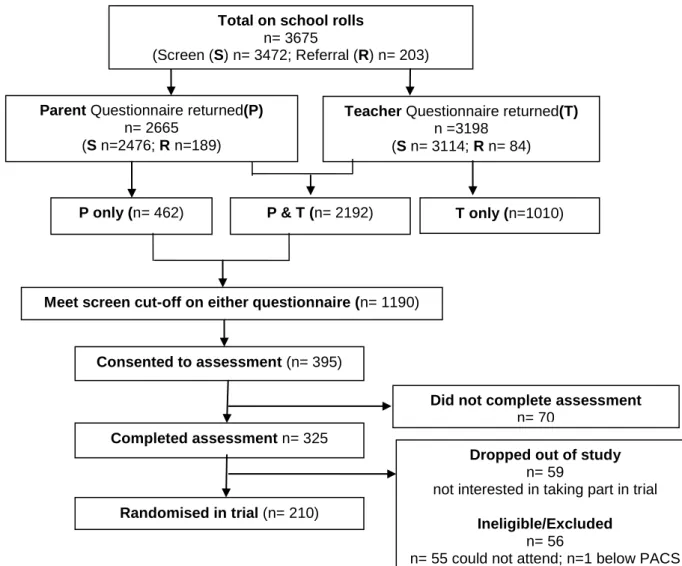
Recruitment was conducted in two ways: first by a population based screen in schools and secondly by seeking referrals from interested parents and teachers. In order to identify children at risk for antisocial behaviour, 3675 children in Reception, Year 1 and Year 2 attending 11 primary schools in London and 56 primary schools in the South West were screened for antisocial behaviour by inviting their parents and teachers to complete a short set of questions about the child’s behaviour. In addition to the number of children screened, 203 were referred to the study by their parents or following discussions with teachers or Parent Support Advisers. These parents completed the same questionnaires as part of the referral process. In total, 2665 questionnaires were received from parents (72% of those targeted) and 3198 (84%) from teachers. Children who did not have a parent questionnaire completed for various reasons but had only a teacher questionnaire (n=1010) were excluded from further study, because our primary outcome measure focuses on home-based antisocial behaviour, which teachers’ reports may not reflect. The final number of children that recruitment to the study was based on was 2665 (screen n=2476; referral n=189) (see Figure 2.1, Participant Flow Chart).
For further details of the recruitment process and challenges to recruitment see Stateva, Minton, Beckett, Doolan, Ford, Kallitsoglou, Scott & the HCA team (2013) and Beckett, Kallitsoglou, Doolan, Ford, Sylva, Scott & the HCA study teams (2010).
13 Stage 1: Screen
Parents and teachers filled out a questionnaire that included the five items of the conduct problems (CP) scale of the SDQ (Goodman, 2001) and the eight diagnostic symptom criteria for Oppositional Defiant Disorder (ODD) listed in the Diagnostic and Statistical Manual of Mental Disorders (American Psychiatric Association, 1994). These were scored on a scale of 0-2 from no problem to a frequent problem.
We used a cut-off on the SDQ CP scale (mean score ≥ 3) or DSM ODD criteria (mean score ≥ 5) on either parent or teacher questionnaire to identify children at risk of difficulties due to antisocial behaviour. This cut-off is equal to one standard deviation above the national population mean on either questionnaire and corresponds to a level of conduct problems
reached by the highest 15%. In this study, 1190 children (45% of the population) were identified as meeting the cut-off (see Figure 1, Participant Flow Chart). This percentage is considerably larger than the15% identified by each questionnaire for two reasons: 1) parents and teachers identify different children as exhibiting antisocial behaviour; 2) the SDQ and DSM questions are different, and so somewhat different children are identified (see Table 2.1).
Figure 2.1: Participant Flow Chart
Parent Questionnaire returned(P)
n= 2665 (S n=2476; R n=189)
Teacher Questionnaire returned(T)
n =3198 (S n= 3114; R n= 84)
P only (n= 462) T only (n=1010)
Meet screen cut-off on either questionnaire (n= 1190)
Consented to assessment (n= 395)
Completed assessment n= 325
Total on school rolls
n= 3675
(Screen (S) n= 3472; Referral (R) n= 203)
P & T (n= 2192)
Randomised in trial (n= 210)
Dropped out of study
n= 59
not interested in taking part in trial
Ineligible/Excluded
n= 56
n= 55 could not attend; n=1 below PACS cut point; n=1 below SDQ cut point
Did not complete assessment
14
Table 2.1 Percentage of the population that met the screen selection criteria according to questionnaire and informant
Parent report DSM ODD criteria >=5 DSM ODD criteria <5
SDQ CP scale>=3 22% 5%
SDQ CP scale<3 12% 61%
Teacher report DSM ODD criteria >=5 DSM ODD criteria <5
SDQ CP scale >=3 10% 3%
SDQ CP scale <3 4% 83%
Combined teacher or parent report on either questionnaire
Met cut-off on parent report Did not meet cut-off parent report
Met cut off on teacher report 10% 6%
Did not meet cut off on teacher report
28% 56%
Stage 2: Eligibility Criteria
Eligibility criteria were as follows: 1) child scores above the cut-off (either parent or teacher on either questionnaire); 2) parent and child had to have working fluency in English; 3) parent had to be interested in attending the intervention groups and taking part in the study; 4) child had to be free of global developmental delay according to teacher questionnaire; 5) there should be no safeguarding concerns about the child. Then 6) the problems of those children who and met the above eligibility criteria were checked against the PACS Antisocial Behaviour (AB) detailed semi-structured interview; they needed to have a mean score of ≥ .7, which is the mean for the population (Taylor, et al., 1991).
2.4 Randomisation and blinding
Participants recruited were randomised to one of the four interventions by an independent statistician who was not given any identifying characteristics of the participants. The researchers were blind to the allocation group.
2.5 Measures
The measures collected in the study were collected over the four stages and consisted of a mixture of questionnaires, interviews, assessments and observations carried out in the child’s home or in the schools. The staff were extensively trained in the administration of the measures in the trial by experts from the Institute of Psychiatry and the University of Oxford.
Strengths and difficulties questionnaire (SDQ) conduct problem scale (SDQ; Goodman, 2001).
Conduct problems: disobedience, lying, fighting, stealing and temper were scored on a scale of 0-2 from no problem to a frequent problem.
2.5.1 Measures used in the screen
Pro-social, and peer relation subscales were also completed by parents and teachers for screening purposes.
15 DSM IV Oppositional Defiant Scale. Questions related to the diagnostic criteria for Oppositional Defiant Disorder according to DSM IV (American Psychiatric Association, 1994). The eight questions include anger, losing temper, arguing, deliberately annoying others, refusing to comply, spiteful and vindictive behaviour, blaming others and being argumentative and are scored on a 0-2 scale, from no problem to a frequent problem.
Measures of the families’ socio–demographic characteristics were collected using a semi-structured interview used in a previous trial conducted by this team (Scott, Sylva et al., 2010) which included details of the family structure, occupation (used to assess the socioeconomic status) and whether the child receives free school meals.
2.5.2 Detailed measures: Socio-demographic data
SocioEconomic Status. Details of parents’ employment were assessed using the National Statistics Socio-Economic Classification (analytic class) (Office for National Statistics,
2005).The resulting data was categorised into four groups as there was an uneven distribution amongst the sample with a higher proportion of SES VIII. The four final groups were I- II: managerial or professional; III-V: intermediate, small employers, supervisory; V-VII: lower routine, technical and routine posts; VIII: never worked or unemployed.
Parental education. This data was collected at interview and covered the mother’s educational qualifications, categorised into two groups where 1 = “educated to 16yrs, 2 = “educated to 18+/secretarial/technical qualification or = “educated to degree level or professional level.
Ethnicity. Parents were also asked for details of their ethnicity based on the ONS categories (Office for National Statistics, 2002). The original 16 point distribution was reduced to a two point scale of White British or ethnic minority due to the large number of individual ethnic groups.
Single parent Parents were asked whether they had and/or living with a partner or not. This variable was also a binary variable (yes/no).
2.5.3 Detailed measures: Measures of Parenting
Alabama Parenting Questionnaire (Shelton, Frick & Wootton, 1996) is a self-report of parenting practices, measuring parental involvement, positive parenting, monitoring and supervision, consistency of discipline, corporal punishment and other discipline practices completed by parents at the pre and post assessment stages as well as at the mediator stage (12 weeks after the start of the intervention). The scale was summed into two sub-scales, reflecting positive and negative parenting behaviour.
The Interview of Parenting Practices (Scott et al, 2010) is a semi-structured interview used to provide parental reports of their own parenting. This interview is based on the earlier work of Quinton & Rutter. Topics covered include:
• Praise: frequency of labelled comments praising the child for their actions • Aversive Discipline: frequency of tap or smack, and days cross with the child
For each topic area, the parent would be asked to give detailed examples from the previous week and the investigator would make a rating about the practice in question. The interview has
16 satisfactory reliability and good validity when compared with directly observed parenting
practices and other assessments of parenting, such as being referred to social services (Dowdney et al., 1984; Quinton et al., 1985).
Its advantage over questionnaires is that the interviewer makes the judgement of the parenting using objective criteria based on detailed descriptions, whereas in questionnaires the parent endorses more general statements.
Reading strategies interview (Sylva et al., 2008). The Reading strategies interview (Sylva et al., 2008) is a measure that provides an indication of the time the parent spends with the child reading and the strategies they use to create the right environment and to help the child with any difficulties. The overall time was worked out from the number of times a week the parent read with the child multiplied by the minutes spent. The different strategies for enabling a positive atmosphere and appropriate support for reading were summed from the five questions each scored 0-2.
The two primary outcomes measures in this trial were: the child’s level of anti-social behaviour as measured on the Parental Account of Child Symptoms (PACS) and the child’s reading ability measured on the British Ability Scales.
2.5.4 Detailed measures: Primary Outcome measures
The Parental Account of Child Symptoms interview (PACS; Taylor, Sandberg, Thorley & Giles, 1991) is a semi-structured interview which is researcher rated. The measure was used to
assess the severity and frequency of the child’s disruptive behaviour through assessing detailed accounts of several common situations. The PACS is a well validated measure and predicts later poor outcomes. The questions include stealing, lying, tantrums, refusal to go to bed, rudeness, destructiveness and aggression, features of antisocial behaviour in children of this age. Such behaviours in childhood predict the development of more serious antisocial
behaviours in a substantial proportion of adolescents.
The eight items are each rated for severity (0-3) and frequency (0-3) on a four point scale. The mean score of all eight items is computed to yield the total Antisocial Behaviour (AB) score. A mean score of ≥7 was used as a final cut-off point for entry in to the study; this score is equal to the mean level of conduct problems reported in an inner-city school population on the basis of the PACS AB scale.
BAS Word Reading from the British Ability Scales (BAS; Elliot, Smith & McCulloch, 1996) is an individually administered standardised test of the child’s ability to read single words.
2.5.5 Secondary Measures of child outcome
Visual Analogue Scale (Aitken, 1969) provides the opportunity for parents to report the nature and intensity of their child’s difficulties that is concerning them most on a 10 cm scale and for this to be compared at later time points for the same problem.
The Eyberg Child Behaviour Inventory (Boggs, Eyberg & Reynolds, 1990) consists of 36 items designed to assess parent-reported conduct problems, and measures the frequency with which problems occur (Intensity Score) as well as the number of problems. This questionnaire has
17 very well established validity. This measure was collected at the pre and post assessment stage of the trial.
The Reading Comprehension test of the Wechsler Individual Achievement Test (WIAT; Wechsler, 2002) is an individually administered standardised test of the child’s ability to understand a passage and answer questions based on it.
2.6 Procedures
For all three intensive programmes, parents were invited to attend a group (parents of fifteen children as a maximum) run by two group leaders for two hours per week. All of the parent programmes adopted an active outreach approach, in order to try to engage families who may be hard to reach because they are burdened with mental health, relationship or socioeconomic difficulties. Group leaders made contact with parents prior to groups starting, through phone calls and/or home visits. The programmes were delivered in community facilities, close to local schools or in the schools themselves. Crèche facilities and transport were provided, if needed. Close contact was maintained with parents to help them work on strategies through midweek phone calls. Group leaders texted or phoned parents on group mornings if they needed extra support. If parents failed to attend or were experiencing difficulties, home visits were made to problem solve or practise specific strategies.
2.7 Interventions
The interventions offered were: a) a well-established parent-child relationship programme that targets behaviour; b) a literacy-based intervention programme that helps parents support their child’s reading; c) a combination of both these two programmes; d) a signposting service that provided parents with information about where to get help (control group). Participating families were randomly assigned to one of these four programmes.
The Incredible Years Parent Group programme (Webster-Stratton, 1989; Webster-Stratton, Reid & Hammond, 2001) aims to help parents build better relationships with their children and develop skills to manage difficult child behaviour effectively, using social learning, and cognitive, behavioural and systemic principles. It has a strong evidence base for improving child outcomes and parenting, and has been shown to create strong, positive relationships with families, paying particular attention to parents’ emotional needs.
2.7.1 Parent-child relationship Programme
The programme is respectful of parents’ own culture and beliefs, and adopts a collaborative rather than instructive approach. It has been shown to be popular with parents from diverse cultures and to have low drop-out rates in real-life conditions (Scott, Sylva et al., 2010). DVD vignettes are shown to parents in small groups; scenes depict parents sometimes behaving in a way that leads to the child being calm and obedient and at other times in a way that leads the child to misbehave and have tantrums.
The first six weeks concentrate on how to build positive relationships and promote desirable child behaviour and constructive activity through play, praise and rewards. The play element focuses on sensitive response to the child and parental approval of child on-task behaviour. The second six weeks focus on handling misbehaviour, including ignoring minor misbehaviour,
18 establishing positive routines, applying consequences, and using ‘time-out’. Through detailed group discussion, parental behaviour that leads to better child behaviour is drawn out. Parents practise the new techniques in role-play of their own situations. They are set tasks, encouraged to practise the new skills at home and they are telephoned mid-week to encourage progress and resolve any difficulties they may have. The intervention lasts 12 weeks and each session is two hours.
All group leaders were trained in the IY basic programme by an accredited IY mentor or trainer. Parent group sessions were filmed so that practitioners could examine their group leadership skills. Group leaders received weekly supervision, in groups, offered by an accredited IY mentor or trainer. In addition, group leaders were offered some individual coaching in the programme.
In supervision, group leaders practised delivery of programme elements, for example rehearsing use of DVDs, standard parent role plays and introducing programme topics. In addition, they routinely brought DVDs of parent group for review, where challenges were identified and solutions were discussed and rehearsed through role play.
Group leaders used standardised programme materials, including manuals giving protocols for each group session, DVDs of vignettes shown to parents and standard hand-outs. All parents were given a copy of the Incredible Years book or audio book, in addition to hand-outs. After each session, group leaders completed self-monitoring checklists to assist them in reviewing their own practice. They also used these checklists to help identify areas for review in
supervision.
The SPOKES literacy programme is a manualised programme originally devised by Professor Kathy Sylva, Ms Carolyn Crook, Dr Jenny Price and Professor Stephen Scott (Sylva & Crook, 2000). It combines the Pause Prompt Praise (PPP; McNaughton, Glynn & Robinson, 1987) approach to reading with a ‘whole language’ approach focusing on meaning (e.g. ‘talking around the book’ and language ‘play’ with words). In PPP, parents are trained to provide one-to-one reading support to their school-age children and its effectiveness has been replicated in many countries (Merrett, 1998). PPP gives parents techniques to encourage their children’s use of an active problem-solving approach to reading. The programme has been updated by
Professor Kathy Sylva and colleagues (Sylva, Price, Crook & Roberts, 2010; Sylva, Roberts, Price, Dolan, Beckett & Scott, 2011) to form a literacy programme based on recent empirical evidence, including systematic phonics work. It lasts for ten, two-hour sessions, including a home visit and a family literacy workshop. Parents who were not enrolled in the combined IY/SPOKES programme were given an additional initial two sessions on how to help their child to concentrate and not be oppositional during shared reading. This programme was
implemented in combination with the Incredible Years programme in a previous trial and was found to significantly improve children’s reading scores (Sylva et al., 2008).
2.7.2 Literacy-Based Parenting Programme
For the SPOKES Literacy Programme, supervision was offered by the programme developer, Professor Kathy Sylva, who is a reading support specialist, to ensure quality and fidelity.
Families allocated to the combined programme were offered the Incredible Years programme followed by the SPOKES literacy programme; the total number of sessions offered was 22. 2.7.3 Combined Programme
19 The comparison group participated in a Signposting and Information service. Parents were provided with a telephone helpline, which identified appropriate services for their concerns about their child and informed them about how to access these services. Evidence supports the efficacy of these less intensive, information based interventions (e.g., Sanders, Markie-Dadds, Tully & Bor, 2000; Sanders, Montgomery & Brechman-Toussaint, 2000; Sutton, 1992).
2.7.4 Signposting and Information service
For all three intensive programmes, parents were invited to attend a group (parents of fifteen children as a maximum) run by two group leaders for two hours per week. All of the parent programmes adopt an active outreach approach, in order to try to engage families who may be hard to reach because they are burdened with mental health, relationship or socioeconomic difficulties. Group leaders made contact with parents prior to groups starting, through phone calls and/or home visits. The programmes were delivered in community facilities, close to local schools or in the schools themselves. Crèche facilities and transport were provided, if needed. Close contact was maintained with parents to help them work on strategies through midweek phone calls. Group leaders texted or phoned parents on group mornings if they needed extra support. If parents failed to attend or were experiencing difficulties, home visits were made to problem solve or practise specific strategies.
2.7.5 Promoting parental engagement
Practitioners who take part in any of the parent programmes in the study are trained to a high standard in the intensive programmes, over at least a two-term period. Fidelity to evidence-based models has been shown to be essential to achieve good outcomes for parents and children. The Incredible Years and SPOKES programmes included a range of elements to ensure fidelity.
2.7.6 Programme fidelity
2.8 Analytic strategy
All results were analysed on the basis of an intention to treat strategy, in other words irrespective of which type of treatment they actually received.
Tests were made to assess the representativeness of those who did continue with the trial in comparison with the wider group recruited in order to establish whether there was any bias in terms of the socio-demographics or the behavioural difficulties of the group who elected to continue.
Analyses were all conducted in SPSS and involved the use of General linear Model repeated measures, covarying on a priori grounds because of findings in previous literature for single parenthood, child age and gender for behavioural outcomes, and adding parental education for reading outcomes. Tests compared the outcomes of each group to the control group, comparing pre-intervention to post-intervention and pre-intervention to follow-up.
The sample size calculation was based on 80% probability to detect an effect size of 0.5 SD (derived from the previous SPOKES trail, Scott et al 2010) between groups at a significance level of 0.05; this gave an n of 60 per group.
20 Moderators of intervention effect on children’s outcomes at follow up
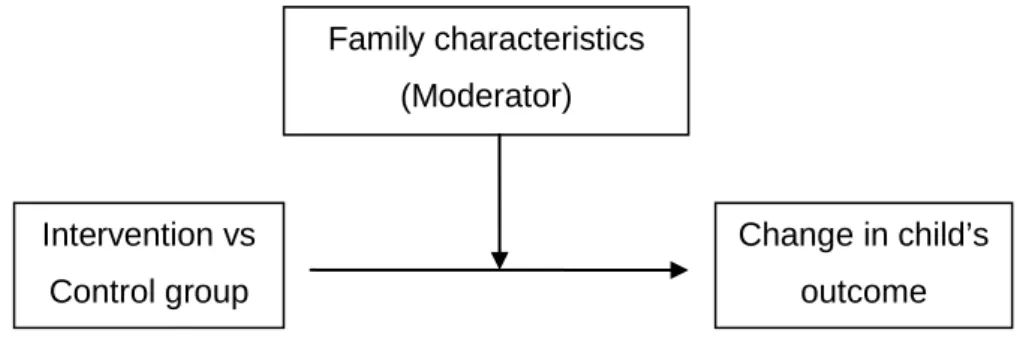
We carried out moderator analysis to answer the fourth research question, which referred to whether the intervention effect on children’s outcomes in the long term may be different for the families with certain characteristics at the start of the intervention. We followed Baron and Kenny’s (1986) method to examine moderator effects. We used hierarchical multiple regression, conducting a separate regression for each potential moderator variable. In step 1, intervention status was entered, followed by potential moderator variable measured at follow up. In step 2 the interaction term (Potential Moderator x Intervention Status) was introduced. Potential moderators included: single parent, parent education (16 years or less vs more than 16 years), employment status (unemployed/never worked vs employed) and parental depression.
Categorical moderators were binary variables (yes/no). The dependent variable was the change score in children’s outcome. We carried out moderator analysis only for the statistically
significant intervention effects on children’s outcomes (behaviour and/or literacy). Centred predictor and moderator variables were created for this analysis. A significant interaction term suggests a moderator effect. A conceptual representation of the moderation model is presented in Figure 2.1.
Figure 2.1. Moderation model
Mediators of intervention effect on children’s outcomes at follow up
The last research question concerned whether changes in children’s outcomes in the long term were influenced by the mediating change in parenting practices. We used Baron and Kenny’s (1986) steps as a guide to examine mediating models for three potential mediators measured at follow up: change in positive parenting, change in negative parenting and use of reading
strategies. First we examined whether there were significant associations between the selected mediator variables, the dependent variable and the intervention status variable. Secondly, where all these were associated, we conducted hierarchical multiple regression analyses, with change in child’s outcome as the dependent variable. In Step 1, intervention status was entered, and Step 2, change in parenting was introduced as a mediating variable. Where there was a significant reduction in the association between intervention and outcome, after introduction of the mediator, this suggests a mediation effect. A conceptual representation of the mediation model for intervention effect and child outcome is presented in Figure 2.2.
Family characteristics (Moderator)
Intervention vs Control group
Change in child’s outcome
21
Figure 2.2 Mediation model
3. Recruitment and participation in the trial
Out of the 1190 children identified as having antisocial behaviour on the screen questionnaires, the families of 395 (33%) expressed an interest in taking part and consented to be assessed. This is an acceptable response rate for a preventive intervention trial, where parents rarely start off seeking help and the assessment procedures are time-consuming. Reasons given for not taking part were: 20% not interested, 42% because they worked, and 38% because they had other commitments.
With these 395 families who consented to be assessed, researchers worked hard to engage parents with home visits to discuss and explain the study and the intervention programmes. Despite this, 70 (17%) did not complete the pre-assessment. Of the remaining 325 on whom assessments were completed, 59 then changed their minds about taking part in the trial and decided not to continue, 55 found they were unable to attend the intervention, and one did not have any antisocial behaviour once assessed by interview (PACS score <0.7). These changes by parents were often because of a change in circumstances, such as the child’s behaviour improved, or a change in the family situation, for example a bereavement, family illness, or changes in working pattern that meant that they were no longer available. For more detail of reasons for non-engagement see Stateva et al., (2012).
The remaining 210 families were then randomised to one of four groups by an independent statistician and the researchers were blind to the randomisation.
Profile of families who consented to be assessed
Perhaps not surprisingly, the 395 children whose families consented to be assessed for the study had greater levels of difficulty, as rated by parents, than those who chose not to take part, on both the SDQ Conduct Problems and the DSM Oppositional Defiant Disorder scales: SDQ CP: t (1167) =5.45, p<.001; DSM ODD: t (1102) =6.00, p<.00.
Of the 395 families who consented to take part there were differences according to the mode of recruitment with families who were referred or who referred themselves having a significantly higher level of difficulty in their behaviour than those who were recruited through the screen: SDQ, CP: t (366) = -4.90, p<.001; DSM ODD: t (359) = -4.75 p<.001.
Change in parenting (Mediator)
Intervention vs Control group
Change in child’s outcome
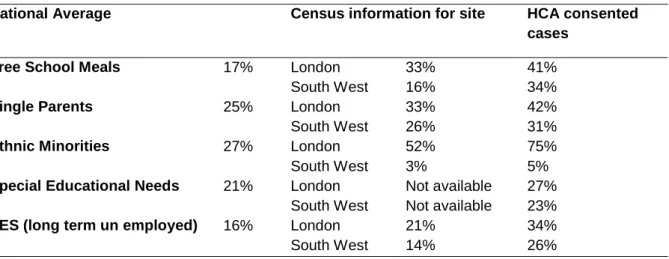
22 In both the London site and the South West site, the participants in the HCA trial had a higher proportion of social disadvantage on every index than the local population (Table 3.1). Study participants were more likely to receive free school meals, be in lone parent households, and be long term unemployed than the general population. The London site also had a higher
proportion of families from ethnic minorities than the South West site. This data was taken from the 325 participants who completed the assessment.
Table 3.1 shows the socioeconomic status of the sample in the two authorities compared to the census information. In both sites there is a cross section of participants but also a high
proportion of most disadvantaged.
Table 3.1. Socio-demographic profile of the participants in the HCA trial
National Average Census information for site HCA consented cases
Free School Meals 17% London South West
33% 16%
41% 34%
Single Parents 25% London South West
33% 26%
42% 31%
Ethnic Minorities 27% London South West
52% 3%
75% 5%
Special Educational Needs 21% London South West
Not available Not available
27% 23%
SES (long term un employed) 16% London South West
21% 14%
34% 26%
Did the families who committed to the intervention programmes differ from the families who did not continue?
Altogether the parents of 210 children committed to the intervention programmes and attended at least one session of the intervention. These families were considered to be ‘in trial’ and included in the analysis. There is remarkably little difference in the characteristics of those who committed to the intervention programmes and attended at least one session (n=210) and those who dropped out or became ineligible after they gave their consent (n=185) in terms of gender, ethnicity, special educational needs and levels of behavioural and reading difficulties of the child as perceived by parents and teachers (Table 3.2). This makes us confident that those who participated were to a large extent representative of the larger number who consented.
23
Table 3.2 Comparison of those who committed to the intervention programmes or not
In trial (n=210)
Did not continue (n=185)
Test x2
Boys 60% 55% 0.06, p=0.43
Ethnic Minorities 22% 23% 0.09, p=0.75
Special Education Needs 24% 24% 0.02, p=0.89
M (SD) M (SD) t SDQ Conduct Problems parent
report
3.40 (1.77) 3.37 (1.83) 364=-0.15, p=0.88
DSM ODD parent report 6.94 (3.56) 7.46 (3.41) 358 =-1.41, p=0.16
Profile of families who took up the intervention
Of the 210 families that took part in the intervention 55 were allocated to the relationship programme (IY: Incredible Years); 51 to the literacy programme (LIT: Supporting Parents on Kids’ Education in Schools Literacy Programme, Sylva et al., 2008); 50 to the combined literacy and relationship intervention (COMBI), and 54 to the control group (Signposting).
Table 3.3 presents the characteristics of the children and families by intervention allocation. No significant relationship was found between intervention group allocation and children’s gender, age and special educational needs. The parents in the IY group were significantly less likely to leave school at age 16 or younger; such differences not infrequently happen despite rigorous randomisation processes. To stop this potentially biasing the results, parental education was added as a covariate in the statistical analyses. No other significant differences in family characteristics across the four groups of the study were detected by the statistical tests.
Table 3.3. Child and family characteristics
IY LIT COMBI Sign Test
significance
Number 55 51 50 54
Child
Boys (%) 64 51 58 48 p = 0.321
Age in months (SD) 72.70 (6.41) 73.34 (6.66) 70.46 (6.24) 73.69 (6.57) p=0.056 Special Educational
Needs 22 30 25 19 p=0.562
Family
Single parent (%) 33 35 32 26 p=0.812
Left education at 16
yrs or earlier (%) 20 39 49 40 p=0.026
SES Never worked or
24
Retention of families (n=210) in to the study from baseline to post and follow up assessment
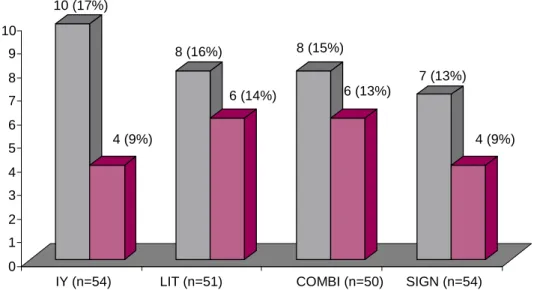
The families who agreed to be assessed at baseline and attended the first session of the intervention tended to stay in the study and carry on to the follow up assessment. We managed to collect full or some data on 80% of the families at post assessment and 70% at follow up, which represents a very good rate of retention for a preventive type of study where families are sought out and offered support rather than seeking help themselves.
Post assessment retention across the four groups was similar, ranging from 13% -17% (Figure 3.1) and suggesting that the type of intervention allocated was not related to family drop-out from the study after initial assessment. This finding also suggests that the prospect of
committing to a lengthy intervention programme like the COMBI – offered over two academic terms - did not reduce the chances of a family committing to the trial. Retention was especially high in the IY and Signposting groups. The LIT and COMBI group lost similar numbers of families at follow up as at post assessment. Altogether, the intervention groups lost between 22-30% of their families from pre to follow up assessment.
Figure 3.1. Loss from pre assessment to post and follow-up assessment
Attendance at interventions
Mean participation in the interventions was high for a preventive trial: the IY families attended 8/12 sessions, LIT families 7/12 sessions and the COMBI families 15/22 sessions. Seventy five percent in the IY group, 72% in the LIT group and 76% of the families in the COMBI group attended at least half of the sessions. The number of sessions attended was evenly disturbed across the intervention groups with the majority of families attending more than 70% of the sessions (Table 5) (x2(2, n=159) = 2.27, p=0.87).
10 (17%)
4 (9%)
8 (16%)
6 (14%)
8 (15%)
6 (13%)
7 (13%)
4 (9%)
0 1 2 3 4 5 6 7 8 9 10
IY (n=54) LIT (n=51) COMBI (n=50) SIGN (n=54)
25
Table 3.4. Proportion of families attending more than half the interventions
Were those who attended fewer than half of the sessions more likely to drop out of the research study?
The data comparing the number of sessions attended with the drop-out rate from the study are presented in Table 3.5. They show a clear tendency for the families who attended fewer than half of the sessions on any of the intervention programmes to be more likely to discontinue from the research study (x2(2, n=159) = 3.65, p=0.00). It appears that those who engaged more fully with the intervention as shown by the number of sessions attended also engaged more fully with the study.
Table 3.5. Parent drop-out rate from research study according to number of intervention sessions attended
Did the families who were assigned to the COMBI intervention attend the same amount of parent-child programme on (COMBI-IY) and literacy therapy (COMBI-LIT)?
In order to find out whether the families who were allocated the COMBI intervention benefited from the relation therapy as much as they benefited from the literacy, we examined whether they attended a similar number of sessions from each programme. Of the 50 families allocated COMBI, 86% (n=43) attended half or more of the sessions of the COMBI-IY and 76% (n=38) half or more than half of the sessions of the COMBI-LIT. This finding shows that the families of the COMBI programme received similar exposure to each intervention approach.
4. Changes in parenting practices in the different intervention groups
Changes in parenting practicesWe used both questionnaires and in-depth examiner-based interviews to assess the practices used by parents to relate to, and read with, their children.
No. of sessions IY LIT COMBI <1/2 (%) 13 (25) 14 (28) 12 (24)
>1/2 (%) 41 (75) 37 (72) 38 (76)
Total 54 51 50
Drop out from research study
Proportion of interventions sessions attended
<1/2 (%) >1/2 (%) Total Yes (%) 16 (43) 8 (7) 24 No (%) 22 (57) 109 (93) 131
26 Alabama parenting questionnaire
Overall picture: For the child, the ratio of positive to negative parenting practices is most important: this overall measure gives a picture of their experience in the home. On this index, the improvement was highly statistically significant for the IY programme both at 9-11 months and two years (p=0.003, 0.001). For the literacy programme it was not significant at 9-11 months, but was at two years (p= 0.22, 0.038). For the Combination there was trend at 9-11 months and at two years (p=0.096, 0.067) (no tables or figures).
Broken down by positive and negative parenting practices: There was not a clearly significant increase in the use of positive parenting practices by parents allocated to any group compared to controls both pre-post and at follow-up, although in all groups there were some trends towards improvement (Tables 4.5 and 4.6; Figure 4.1).
Table 4.5. Pre to post assessment change in positive parenting practices (Alabama parenting questionnaire)
Pre Score
Post Score
Raw score Change
Raw score Change vs Sign
Standardised Effect size of change score (d) vs Sign
Significance vs Sign
M (SD) M (SD)
IY 25.2 (3.5) 26.4 (2.9) 1.16 0.76 0.26 p=0.13
LIT 25.9 (2.9) 27.0 (3.0) 1.10 0.70 0.24 p= 0.15
COMBI 26.4 (2.7) 27.6 (2.4) 1.24 0.84 0.29 p=0.11
Sign 26.5 (2.6) 26.9 (2.5) 0.40
Table 4.6. Pre to follow up assessment change in positive parenting practices (Alabama parenting questionnaire)
Pre Score
Follow Up Score
Raw score Chang e
Raw score Change vs Sign
Standardised Effect size of change score (d) vs Sign
Significance vs Sign
M (SD) M (SD)
IY 25.1 (3.6) 25.5 (4.0) 0.43 0.65 0.22 p=0.37
LIT 25.4 (2.9) 26.5 (3.1) 1.16 1.38 0.48 p= 0.06
COMBI 26.66 (2.80) 27.08 (2.44) 0.42 0.64 0.22 p=0.53 Sign 26.39 (2.58) 26.17 (2.18) - 0.22