Estudos e Documentos de Trabalho
Working Papers
11 | 2007
HOW DO DIFFERENT ENTITLEMENTS TO UNEMPLOYMENT BENEFITS AFFECT THE TRANSITIONS FROM UNEMPLOYMENT INTO
EMPLOYMENT?
John T. Addison Pedro Portugal
A u g u s t 2 0 0 7
The analyses, opinions and findings of these papers represent the views of the authors, they are not necessarily those of the Banco de Portugal.
Please address correspondence to Pedro Portugal
BANCO DE PORTUGAL
Economics and Research Department
Av. Almirante Reis, 71-6thfloor
1150-012 Lisboa
www.bportugal.pt
Printed and distributed by
Administrative Services Department Av. Almirante Reis, 71-2nd
floor 1150-012 Lisboa
Number of copies printed
200 issues
How Do Different Entitlements to Unemployment Benefits
Affect the Transitions from Unemployment into
Employment?
∗ John T. AddisonDepartment of Economics, Queen’s University Belfast (U.K.) and
Pedro Portugal Banco de Portugal
Faculdade de Economia da Universidade NOVA de Lisboa (Portugal) August 2007
Abstract
In Portugal duration of benefits is exclusively age determined while replacement rates are to all intents and purposes uniform. We exploit differences in potential maximum du-ration of benefits for nearly matched pairs of individuals who differ in age by one year and in potential maximun duration of benefits by three months. In specifications that take ac-count of unobserved individual heterogeneity, while controlling for pure age effects on escape rates, we find that lower maximum benefit duration is associated with substantially higher quarterly rates of job finding in the range 53 to 106 percent.
Keywords: Unemployment benefits, unemployment duration, job search JEL codes: J64, J65.
∗The authors also gratefully acknowledge the partial financial support from Funda¸c˜ao para a Ciˆencia e a
1
Motivation
In this paper we investigate the disincentive effects of the Portuguese unemploy-ment insurance system. Since replaceunemploy-ment rates are near uniform we shall in-vestigate the effects of benefit receipt and potential duration of unemployment insurance (UI) benefits. There are a number of papers charting the effects of ben-efit duration on joblessness that complement the replacement rate literature and generally report much stronger disincentive effects.1
Theory suggests that putting a limit on benefit duration will tend to accel-erate job search and that benefit exhaustion will produce spike in escape rates Mortensen, 1977). The early empirical literature confirmed both predictions, namely, the reduction in escape rates/increase jobless duration with extended ben-efits (Katz and Meyer, 1990; Meyer, 1990) and the sharp increase in escape rates at benefit expiration (Katz and Meyer, 1990; Carling, Edin, Harkman, and Holm-lund. 1996).
Such studies exploit changes in UI rules over time. However, an enduring con-cern has been endogenous policy bias, as will arise when more generous UI rules are introduced in anticipation of a deteriorating labor market. More recent stud-ies therefore have either sought to identify legal changes in benefit duration that occur independently of labor market conditions (Card and Levine, 2000; Lalive and Zweim¨uller, 2004) or to exploit changes in the law that affect several cate-gories of (treated) unemployed workers differently (with no change in benefits for another group of controls) for a reasonably long panel of data (Lalive, van Ours, Zweim¨uller, 2006; van Ours and Vodopivec, 2006). The results are again con-sistent with (job search) theory and are economically and statistically significant particularly for benefit duration where stronger disincentive effects are observed.
Here we deploy a methodology close to a regression discontinuity analysis to identify the impact of unemployment benefits on transition rates from unemploy-ment into employunemploy-ment. We rely for traction on the fact that maximum duration 1On the cross-section replacement rate literature, see Atkinson and Micklewright, 1991; and, for more recent
studies seeking to identify disincentive effects from regime changes, see inter al. Carling, Holmlund, and Vejsiu, 2001; Rød and Zhang, 2003.
of benefits in Portugal is exclusively a function of age. Maximum potential ben-efit duration basically increases by 3 months at five-year age intervals. Focusing on paired sets of individuals on either side of each age-entitlement divide - who differ by just one year of age - we offer a treatment effect analysis of the impact of three-month increases in the maximum duration of benefits on transitions into employment. Our approach relies on a difference-in-differences framework for eval-uating disincentive effects. That is, we will obtain estimates of the difference in transition rates among younger and slightly older individuals (the first difference) for unemployment recipients and non-recipients (the second difference).
To anticipate our findings, we first report strong evidence of disincentive effects using a discrete duration (complementary log-log) model. These effects persist after controlling for unobserved individual heterogeneity using a finite mixture distribution approach (viz. a two-mass point hazard model). We further report that our results on heterogeneity are consistent with a more parsimonious split-population model in which a sizeable proportion of the unemployed is never allowed to exit joblessness. At all times, we control for the independent effects of age on escape rates, which are found to be monotonic and well determined.
2
Data
Our data are taken from the nationally representative Portuguese Quarterly Em-ployment Surveys for the period 1992(2) to 1997(4). The choice of starting and ending date is dictated by changes in the methodology of the employment sur-vey, including new sampling procedures and redefinition of the key unemployment variable, respectively. The survey has a quasi-longitudinal capacity: we have in-formation on the length of the current unemployment spell (in months), and with one-sixth of the sample rotating out of the survey each quarter we can track tran-sitions from unemployment into employment for up to five quarters.
Each survey contains information on the unemployment benefit status of the unemployed worker. It does not contain information on replacement rates. How-ever, the UI replacement rate is in general a constant proportion (65 percent) of
the previous wage.2 For this reason, our focus will be upon the role of potential
benefit duration. Under Portuguese law, duration of benefits is purely age deter-mined. The maximum duration of benefits is 10 months for those aged less than 25 years and 12 months for those aged between 25 and 29 years. It then rises in 3-month intervals for each incremental 5 years of age up to a maximun of 30 months at 55 years of age. We note parenthetically that duration entitlements did not change over the sample period.
We exploit this purely age-determined system of benefit entitlements in the present paper to determine the effects of benefit duration on escape rates from unemployment into employment by focusing on those age-adjacent - and hence roughly matched individuals - whose benefits differ by three months (actually 2 months in the case of those aged 24 to 25 years). Our sample thus comprises only those pairs of individuals aged 24 to 25 years, 29 to 30 years, 34 to 35 years, 39 to 40 years, 44 to 45 years, 49 to 50 years, and 54 to 55 years. The variable YOUNG will simply identify younger individuals in each age pair - irrespective of whether or not they draw benefits - the omitted category being those aged one year more. In other words, YOUNG takes the value of one whenever individuals are aged 24, 29, 34, 39, 44, 49, and 54 years. It will further be interacted with a receipt of benefits dummy to evaluate the disincentive effects of UI. Moreover, given well-known age effects on escape rates, we will also use six age dummies to determine the pure effect of age on escape rates/jobless duration. Here individuals aged 24 to 25 years will now constitute the omitted category, meaning that the first age dummy will be one for individuals aged 29 or 30 years, while the second age dummy will identify individuals aged 34 and 35, and so on. To estimate the discrete duration model we rely on episode-splitting along the lines proposed by Jenkins (1995). This approach implies that each spell of unemployment is transformed into a monthly series of binary indicators, identifying censored and exit times.
Finally, reflecting well-documented differences between the sexes in labor sup-2Nevertheless, the 65 percent rule cannot yield less than the minimum wage for low-wage earners or more than
three times the minimum wage for high-wage earners. Unfortunately, the dataset does not contain information on the previous wage of unemployed workers that would allow us to calculate replacement rates for these groups.
ply, we restricted the sample to males. We also required that the individual be unemployed at the time of the survey, be aged between 16 and 64 years, and be resident in mainland Portugal.
3
Model specification
3.1 The complementary log-log model
In our exercise, duration is measured in months. Conventional continuous time duration models are clearly at odds with our data. We thus consider a simple discrete time duration model: the complementary log-log (cloglog) model. Let time be divided into k intervals [τ0, τ1), [τ1, τ2) . . . [τk−1,∞). The researcher observes discrete time T ∈ {1, . . . , k}, where T = t denotes an exit within the interval [τt−1, τt). The hazard function, which gives the conditional (on t) probability of exit, is given by
h(t) =P(T =t|T ≥t), t=1,2, . . . k-1
and the survivor function, which gives the probability of staying in the same state up until t is defined as
S(t) =P(T > t) = t j=1
[1−h(j)].
A useful extension of the proportional hazards model to discrete time starts from
S(t|xi) =S0(t)exp(xiβ),
whereS(t|xi) gives the probability that individualiwith covariatesxi will survive up to time t, and S0(t)denotes the baseline survivor function (that is, where the covariates equal zero). Given the relationship between the hazard and the survivor functions with discrete time, one can write
1−h(t|xi) = [1−h0(t)]exp(xiβ),
which leads the cloglog hazard function
The baseline hazard function may then be parameterized using different func-tional forms (piecewise-constant, polynomial, logarithmic, etc.). The regression coefficients may be interpreted as in standard proportional hazards models. The model can be estimated straightforwardly transforming the duration data into bi-nary outcomes, a procedure known asepisode splitting. Fitting a generalized linear model with binomial error and complementary log-log link, leads to the following contribution of observation i to the likelihhod function
Li = [1−h(ht|(xt|i)x i)]
ci t j=1
[1−h(j|xi)], where ci identifies a complete spell of unemployment.
3.2 The binomial-mixture duration model
We generalize our model to accommodate the presence of unobserved individual heterogeneity. Unobserved individual heterogeneity may stem from omitted (or unobserved) covariates and/or measurement errors in duration. Here we will con-sider a simple model where we assume that two groups of individuals, in unknown proportions, are present in the data. The difference among the two groups stands from distinct intercepts. The group with the larger intercept (the hares) will leave unemployment at a faster rate than the group with the smaller intercept (the tur-tles). Formalizing this reasoning, we assume that the hazard function for a fraction
π of individuals is defined as
h1(t|xi) = 1−[1−h0(t)]exp(β0+β1x1i+...+βkxki),
while that of the remaining fraction of 1−π can be written
h2(t|xi) = 1−[1−h0(t)]exp(β0+δ+β1x1i+...+βkxki).
In this specification the contribution to the likelihood function of individual i is similar to that of a binary latent class model,
Li =π{[ h1(t|xi) 1−h1(t|xi)]
ci t j=1
[1−h1(j|xi)]}+ (1−π){[ h2(t|xi) 1−h2(t|xi)]
ci t j=1
3.3 The split-population model
We will now account for the possibility that there are some unemployed individuals who may never find a job. Up to now we have neglected the existence of long-term survivors (or infinite durations). This approach has been used in the econometric literature in the context a split-population framework for a single risk (Schmidt and Witte, 1989) while Addison and Portugal (2003) offer a generalization of the split-population model to independent competing risks.3
To incorporate the possibility of “defective” risks we redefine the survival func-tion (which represents the proporfunc-tion of unemployed who not find a suitable job until t) as ˜S(t) = (1−p) +pS(t) where p is the proportion of unemployed who are indeed ”susceptible” to the risk of failure. The survival probability is, there-fore, given by the proportion of long-term survivors (1−p) who do not exit into employment with probability 1, plus the proportion of ”susceptible” individuals,
p, multiplied by their corresponding probability of remaining unemployed untilt,
S(t).
In order to guarantee that each p lies between zero and one, the logit repa-rameterization for p = exp(μ)/(1 +exp(μ)) was employed. This has no other consequence, in terms of finding evidence of long-term survivors, since it does not preclude p from being as close to one (or zero) as needed. In this setup, the contribution of observation i to the likelihood function is
Li ={p h(t|xi) t−1 j=1
[1−h(j|xi)]}ci {(1−p) +p t j=1
[1−h(j|xi)]}1−ci.
4
Findings
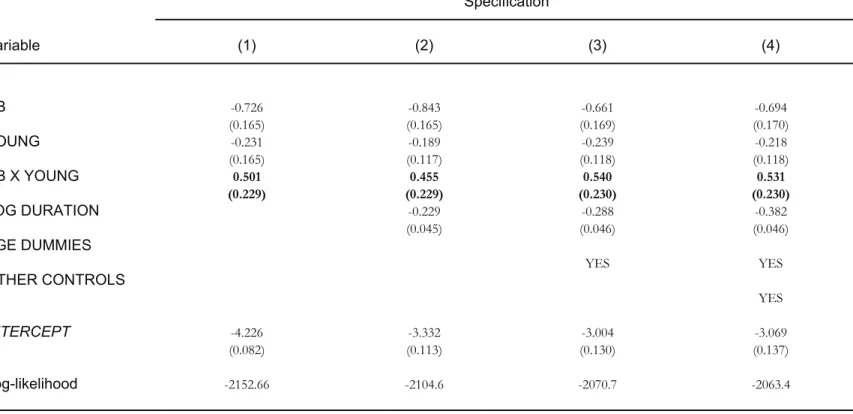
Results of fitting the proportional hazards model to the discrete duration data (the complementary log-log model) are presented in Table 1. From the first column of the table it can be seen that receipt of unemployment benefits depresses transitions into employment by no less than 52 percent compared with nonrecipients. The YOUNG variable appears to depress transition rates somewhat but only before
benefits are actually drawn. Once drawn, those in receipt of three months shorter benefits actually have 65 percent higher escape rates than their nearest neighbours.
(Table 1 near here)
Including jobless duration as a regressor (shown in the second column of the table) renders this effect of benefit duration largely unchanged while suggesting negative duration dependence in the data. Specifically, a 10 percent increase in elapsed duration at survey date is associated with a 2 percent reduction in escape rates over the following three months.
The introduction of six age dummies (recall that the reference category is the age “pair” 24 to 25 years of age), shown in the third column of the table, captures the pure effects of age on duration of joblessness. Familiarly, these age effects broadly indicate that escape rates decline strongly with age.4 The inclusion of the age dummies serves to reduce the effect of benefit receipt on joblessness and in-crease the coefficient for the interaction term (i.e. inin-crease hazard rates for shorter maximum potential benefits). Neglecting to take age effects into account also ap-parently modestly understates the indication of negative duration dependence in the data.
In the final column of the table, we include controls for number of years of schooling, the unemployment rate, and dummies for marital status and physical handicap. It is clear that the other coefficient estimates are largely unaffected. The principal exception is the coefficient estimate for elapsed duration, which points to a further strengthening of negative duration dependence.
At this stage, then, we have obtained strong evidence of the effect of length of benefits on jobless duration by exploiting natural differences in the Portuguese benefits regime across nearly matched individuals in a framework that also identi-fies the pure effects of age on transitions. We have reported that benefit recipients having three months shorter potential maximum benefits have quarterly hazard 4The regression coefficient estimates were -0.181, -0.647, -0.416, -0.415, -1.415, and -1.080, for the different age
categories (29 and 30 years, 34 and 35 years, 39 and 40 years, 44 and 45 years, 49 and 50 years, and 54 and 55 years, respectively).
rates that are 58 to 72 percent higher,cet.par. Moreover, the effects of simple benefit receipt are in line with other estimates for Portugal (e.g. Portugal and Addison, 2003).
(Table 2 near here)
But ceteris may not be paribus. In particular, despite the closeness of ad-jacent individuals, unobserved individual heterogeneity may still cast a shadow. Accordingly, in Table 2 we provide estimates for a two mass point hazard model. The heterogeneity we identify is that between more employable individuals (call them ’hares’) and less employable individuals (“turtles”). Thus, for example, if we consider the results for the size of the mass points in the first column of the table it is apparent that the turtles have a base chance of finding work of 0.684 percent as compared with 20.36 percent for the hares. Note that these intercepts are computed as 1−exp(−exp(−4.982))and 1−exp(−exp(−1.480)), respectively. Continuing with the other results in the first column of Table 2 the effects of benefit receipt are substantial, leading to a 78.6 percent fall in the hazard relative to nonrecipients. These are much higher estimates than were reported in Table 1 and so, too, are the positive effects of shorter maximum benefit duration on escape rates into employment: three months fewer maximum benefits translate into a doubling of escape rates. The results in the second column of the table indicate that that adding in elapsed duration does not materially alter any of the results; for example, the findings for the slow movers (turtles) and fast movers (hares) are virtually unchanged at 0.729 percent and 20.7 percent, respectively. In this specification, the proportion of less-employable workers (turtles) is very large, corresponding to around 85 percent of the unemployed population.
From column (3), the introduction of the age dummies, controlling for the pure effect of age on joblessness, has four main effects. First, there is a major diminution in the effect of benefit receipt on jobless, which value is in line with the corresponding estimates in Table 1. Second, there is also a (more modest) reduction in the effects of shorter benefits once drawn on escape rates. These are
approximately 72 percent, again much in line with the findings in Table 1. Third the effect of elapsed duration is now both negative and statistically significant, which can be interpreted as indicating true duration dependence. Fourth, the young hares (the 24 and 25 year olds) have a base hazard rate of a little under 9 percent, while for turtles the escape rate is just 0.00018 percent. The proportion of less-employable workers (turtles) is now much smaller, corresponding to around 44 percent of the unemployed population. Adding in demographic controls and the unemployment rate in the fourth column of the table leaves the previous results largely unaltered, with the main change being a yet firmer indication of negative duration dependence.
(Table 3 near here)
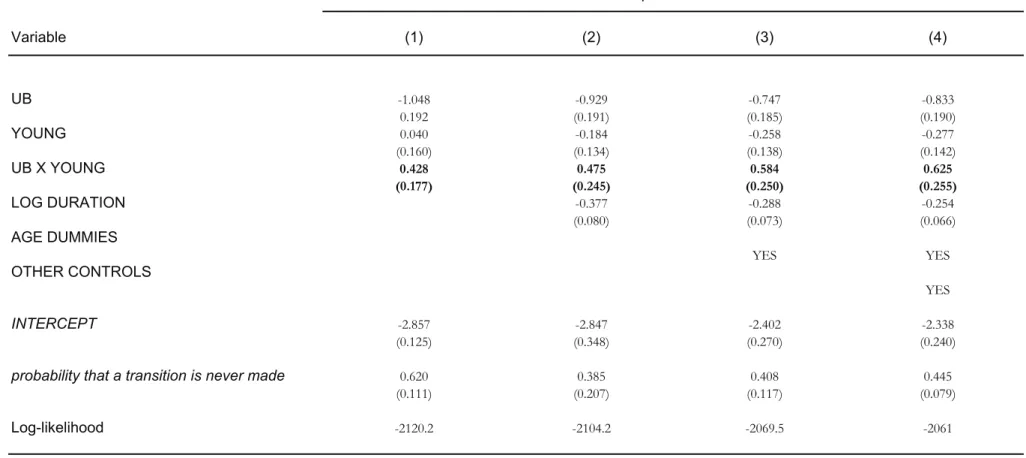
As a final exercise, we exploit the suggestion of the two mass point hazard model (especially from the last two columns of Table 2) that the escape rates of an important subset of the sample - the turtles - are virtually zero. That is to say, in Table 3 we provide results for a more parsimonious split-population model that imposes the restriction that some escape rates are indeed zero or, equivalently, that some jobless durations are infinite (see Addison and Portugal, 2003). All the regression coefficient estimates thus now refer to the susceptible individuals. Focusing here on the results for the full specification contained in the last column of Table 3, we see that the base chance of transitioning into employment over a three-month period is a little over 10 percent for individuals in the reference category (25 year old nonrecipients, etc.) among those who will eventually find employment. These movers make up a little less than one-half of the population, meaning that for more than one-half of the population unemployment duration will be infinite.5 Not surprisingly the coefficient estimates identical to those displayed
in Table 2. Receipt of benefits that are three months shorter in maximum duration than those of adjacent individuals results in higher escape rates into employment of 87 percent.
5The indication of a significant fraction of long-term unemployed - that is, of defective risks - is in line with
5
Conclusions
Typically, research points to much stronger disincentive effects for increases in maximum potential benefits than for changes in replacement rates. In Portugal, where replacement rates are virtually a datum, we report potent disincentive effects of longer benefit duration. Our identification strategy exploits the fact that max-imum potential unemployment benefit duration is a deterministic function of age. We report that, among UI recipients, three months shorter potential maximum benefits translate into 53 to 106 percent higher escape rates into employment, af-ter controlling for unobserved individual heaf-terogeneity, These results reinforce the modern predisposition toward policy intervention that focuses more on duration of benefits than on replacement rates.
6
References
Addison, J. and P. Portugal(2003). Unemployment Duration:
Compet-ing and Defective Risks. Journal of Human Resources, 38 (Winter), 156-191.
Atkinson, Anthony B. and John Micklewright (1991)
Unemploy-ment Compensation and Labor Market Transitions: A Critical Review. Jour-nal of Econmomic Literature 29 (December): 1679-1727.
Carling, K., P-A Edin, A. Harkman, and Bertil Holmlund(1996)
Unemployment Duration, Unemployment Benefits, and Labor Market Pro-grams in Sweden. Journal of Public Economics 59 (March): 313-334.
Carling, K., Bertil Holmlund, and A. Vejsiu(2001) Do Benefit Cuts
Boost Job Finding? Swedish Evidence from the 1990s. Economic Journal
111 (October): 766-790.
Card, David E., and Philip B. Levine (2000) Extended Benefits and
the Duration of UI Spells: Evidence from the New Jersey Extended Benefits Program. Journal of Public Economics 78 (October): 107-138.
Katz, Lawrence F. and Bruce D. Meyer (1990) The Impact of the
Potential Duration of Unemployment Benefits on the Duration of Unemploy-ment. Journal of Public Economics 41 (February): 45-72.
Jenkins, Stephen(1995) Easy Estimation Methods for Discrete-Time
Du-ration Models. Oxford Bulletin of Economics and Statistics 57 (February): 129-138.
Lalive, Rafael and Josef Zweim¨uller(2004) Benefit Entitlement and
Benefit Duration - The Role of Policy Endogeneity. Journal of Public Eco-nomics 88 (December): 2587-2616.
Lalive, Rafael, Jan Van Ours, and Josef Zweim¨uller (2006) How
Changes in Financial Incentives Affect the Duration of Unemployment. Re-view of Economic Studies 73 (October) :1009-1038.
Meyer, Bruce D. (1990) Unemployment Insurance and Unemployment
Spells. Econometrica 58 (July): 757-782.
Mortensen, Dale T. (1977) Unemployment Insurance and Job Search
Decisions. Industrial and Labor Relations Review 30 (July): 505-517.
Portugal, Pedro and John T. Addison(2003) Six Ways to Leave
Un-employment. IZA Discussion Paper 954 Bonn: Institute for the Study of Labor, December.
Rød, Knut and Tao Zhang (2003) Does Unemployment Compensation
Affect Unemployment Duration? Economic Journal 113 (January): 190-206.
Schmidt, P. and Witte, A.D.(1989) Predicting Criminal Recidivism
Us-ing Split Population Survival Models. Journal of Econometrics, 40 (January), 141-159.
Van Ours, Jan C. and Milan Vodopivec (2006) How Shortening the
Potential Duration of Unemployment Benefits Affects the Duration of Unem-ployment: Evidence from a Natural Experiment. Journal of Labor Economics
Table 1: Transitions into Employment, Complementary Log-Log Model (n=35,368) Specification
Variable (1) (2) (3) (4)
UB -0.726 -0.843 -0.661 -0.694
(0.165) (0.165) (0.169) (0.170)
YOUNG -0.231 -0.189 -0.239 -0.218
(0.165) (0.117) (0.118) (0.118)
UB X YOUNG 0.501 0.455 0.540 0.531
(0.229) (0.229) (0.230) (0.230)
LOG DURATION -0.229 -0.288 -0.382
(0.045) (0.046) (0.046)
AGE DUMMIES OTHER CONTROLS
INTERCEPT -4.226 -3.332 -3.004 -3.069
(0.082) (0.113) (0.130) (0.137)
Log-likelihood -2152.66 -2104.6 -2070.7 -2063.4
Asymptotic standard errors in parenthesis
YES YES
Table 2: Transitions into Employment, Two-Mass Point Hazard Model (n=35,368)
Specification
Variable (1) (2) (3) (4)
UB -1.542 -1.527 -0.747 -0.833
(0.236) (0.269) (0.185) (0.170)
YOUNG -0.267 -0.266 -0.259 -0.276
(0.180) (0.178) (0.138) (0.118)
UB X YOUNG 0.723 0.719 0.584 0.625
(0.318) (0.318) (0.250) (0.230)
LOG DURATION -0.018 -0.289 -0.254
(0.101) (0.072) (0.046)
AGE DUMMIES OTHER CONTROLS
Intercept for type 1 individuals -4.982 -4.917 -13.243 -10.509
(0.177) (0.352) (161.610) (0.177)
change in the intercept for type 2 individuals 3.502 3.458 10.841 8.171
(0.165) (0.328) (161.613) (0.165)
probability of being a type 1 individual 0.853 0.855 0.408 0.444
(0.023) (0.024) (0.117) (0.023)
probability of being a type 2 individual 0.147 0.145 0.592 0.555
(0.023) (0.024) (0.117) (0.023)
Log-likelihood -2100.4 -2099.1 -2069.5 -2061
Asymptotic standard errors in parenthesis
Notes: See note to Table 1.
YES YES
Table 3: Transitions into Employment, Split Population Model (n=35,368)
Specification
Variable (1) (2) (3) (4)
UB -1.048 -0.929 -0.747 -0.833
0.192 (0.191) (0.185) (0.190)
YOUNG 0.040 -0.184 -0.258 -0.277
(0.160) (0.134) (0.138) (0.142)
UB X YOUNG 0.428 0.475 0.584 0.625
(0.177) (0.245) (0.250) (0.255)
LOG DURATION -0.377 -0.288 -0.254
(0.080) (0.073) (0.066)
AGE DUMMIES OTHER CONTROLS
INTERCEPT -2.857 -2.847 -2.402 -2.338
(0.125) (0.348) (0.270) (0.240)
probability that a transition is never made 0.620 0.385 0.408 0.445
(0.111) (0.207) (0.117) (0.079)
Log-likelihood -2120.2 -2104.2 -2069.5 -2061
Asymptotic standard errors in parenthesis
YES YES
WORKING PAPERS 2000
1/00 UNEMPLOYMENT DURATION: COMPETING AND DEFECTIVE RISKS
— John T. Addison, Pedro Portugal
2/00 THE ESTIMATION OF RISK PREMIUM IMPLICIT IN OIL PRICES
— Jorge Barros Luís
3/00 EVALUATING CORE INFLATION INDICATORS
— Carlos Robalo Marques, Pedro Duarte Neves, Luís Morais Sarmento
4/00 LABOR MARKETS AND KALEIDOSCOPIC COMPARATIVE ADVANTAGE
— Daniel A. Traça
5/00 WHY SHOULD CENTRAL BANKS AVOID THE USE OF THE UNDERLYING INFLATION INDICATOR?
— Carlos Robalo Marques, Pedro Duarte Neves, Afonso Gonçalves da Silva
6/00 USING THE ASYMMETRIC TRIMMED MEAN AS A CORE INFLATION INDICATOR
— Carlos Robalo Marques, João Machado Mota
2001
1/01 THE SURVIVAL OF NEW DOMESTIC AND FOREIGN OWNED FIRMS
— José Mata, Pedro Portugal
2/01 GAPS AND TRIANGLES
— Bernardino Adão, Isabel Correia, Pedro Teles
3/01 A NEW REPRESENTATION FOR THE FOREIGN CURRENCY RISK PREMIUM
— Bernardino Adão, Fátima Silva
4/01 ENTRY MISTAKES WITH STRATEGIC PRICING
— Bernardino Adão
5/01 FINANCING IN THE EUROSYSTEM: FIXED VERSUS VARIABLE RATE TENDERS
— Margarida Catalão-Lopes
6/01 AGGREGATION, PERSISTENCE AND VOLATILITY IN A MACROMODEL
— Karim Abadir, Gabriel Talmain
7/01 SOME FACTS ABOUT THE CYCLICAL CONVERGENCE IN THE EURO ZONE
— Frederico Belo
8/01 TENURE, BUSINESS CYCLE AND THE WAGE-SETTING PROCESS
— Leandro Arozamena, Mário Centeno
9/01 USING THE FIRST PRINCIPAL COMPONENT AS A CORE INFLATION INDICATOR
— José Ferreira Machado, Carlos Robalo Marques, Pedro Duarte Neves, Afonso Gonçalves da Silva
10/01 IDENTIFICATION WITH AVERAGED DATA AND IMPLICATIONS FOR HEDONIC REGRESSION STUDIES
2002
1/02 QUANTILE REGRESSION ANALYSIS OF TRANSITION DATA
— José A.F. Machado, Pedro Portugal
2/02 SHOULD WE DISTINGUISH BETWEEN STATIC AND DYNAMIC LONG RUN EQUILIBRIUM IN ERROR
CORRECTION MODELS?
— Susana Botas, Carlos Robalo Marques
3/02 MODELLING TAYLOR RULE UNCERTAINTY
— Fernando Martins, José A. F. Machado, Paulo Soares Esteves
4/02 PATTERNS OF ENTRY, POST-ENTRY GROWTH AND SURVIVAL: A COMPARISON BETWEEN DOMESTIC AND
FOREIGN OWNED FIRMS
— José Mata, Pedro Portugal
5/02 BUSINESS CYCLES: CYCLICAL COMOVEMENT WITHIN THE EUROPEAN UNION IN THE PERIOD 1960-1999. A
FREQUENCY DOMAIN APPROACH
— João Valle e Azevedo
6/02 AN “ART”, NOT A “SCIENCE”? CENTRAL BANK MANAGEMENT IN PORTUGAL UNDER THE GOLD STANDARD,
1854 -1891
— Jaime Reis
7/02 MERGE OR CONCENTRATE? SOME INSIGHTS FOR ANTITRUST POLICY
— Margarida Catalão-Lopes
8/02 DISENTANGLING THE MINIMUM WAGE PUZZLE: ANALYSIS OF WORKER ACCESSIONS AND SEPARATIONS
FROM A LONGITUDINAL MATCHED EMPLOYER-EMPLOYEE DATA SET
— Pedro Portugal, Ana Rute Cardoso
9/02 THE MATCH QUALITY GAINS FROM UNEMPLOYMENT INSURANCE
— Mário Centeno
10/02 HEDONIC PRICES INDEXES FOR NEW PASSENGER CARS IN PORTUGAL (1997-2001)
— Hugo J. Reis, J.M.C. Santos Silva
11/02 THE ANALYSIS OF SEASONAL RETURN ANOMALIES IN THE PORTUGUESE STOCK MARKET
— Miguel Balbina, Nuno C. Martins
12/02 DOES MONEY GRANGER CAUSE INFLATION IN THE EURO AREA?
— Carlos Robalo Marques, Joaquim Pina
13/02 INSTITUTIONS AND ECONOMIC DEVELOPMENT: HOW STRONG IS THE RELATION?
— Tiago V.de V. Cavalcanti, Álvaro A. Novo
2003
1/03 FOUNDING CONDITIONS AND THE SURVIVAL OF NEW FIRMS
— P.A. Geroski, José Mata, Pedro Portugal
2/03 THE TIMING AND PROBABILITY OF FDI: AN APPLICATION TO THE UNITED STATES MULTINATIONAL
ENTERPRISES
— José Brandão de Brito, Felipa de Mello Sampayo
3/03 OPTIMAL FISCAL AND MONETARY POLICY: EQUIVALENCE RESULTS
4/03 FORECASTING EURO AREA AGGREGATES WITH BAYESIAN VAR AND VECM MODELS
— Ricardo Mourinho Félix, Luís C. Nunes
5/03 CONTAGIOUS CURRENCY CRISES: A SPATIAL PROBIT APPROACH
— Álvaro Novo
6/03 THE DISTRIBUTION OF LIQUIDITY IN A MONETARY UNION WITH DIFFERENT PORTFOLIO RIGIDITIES
— Nuno Alves
7/03 COINCIDENT AND LEADING INDICATORS FOR THE EURO AREA: A FREQUENCY BAND APPROACH
— António Rua, Luís C. Nunes
8/03 WHY DO FIRMS USE FIXED-TERM CONTRACTS?
— José Varejão, Pedro Portugal
9/03 NONLINEARITIES OVER THE BUSINESS CYCLE: AN APPLICATION OF THE SMOOTH TRANSITION
AUTOREGRESSIVE MODEL TO CHARACTERIZE GDP DYNAMICS FOR THE EURO-AREA AND PORTUGAL
— Francisco Craveiro Dias
10/03 WAGES AND THE RISK OF DISPLACEMENT
— Anabela Carneiro, Pedro Portugal
11/03 SIX WAYS TO LEAVE UNEMPLOYMENT
— Pedro Portugal, John T. Addison
12/03 EMPLOYMENT DYNAMICS AND THE STRUCTURE OF LABOR ADJUSTMENT COSTS
— José Varejão, Pedro Portugal
13/03 THE MONETARY TRANSMISSION MECHANISM: IS IT RELEVANT FOR POLICY?
— Bernardino Adão, Isabel Correia, Pedro Teles
14/03 THE IMPACT OF INTEREST-RATE SUBSIDIES ON LONG-TERM HOUSEHOLD DEBT: EVIDENCE FROM A LARGE PROGRAM
— Nuno C. Martins, Ernesto Villanueva
15/03 THE CAREERS OF TOP MANAGERS AND FIRM OPENNESS: INTERNAL VERSUS EXTERNAL LABOUR MARKETS
— Francisco Lima, Mário Centeno
16/03 TRACKING GROWTH AND THE BUSINESS CYCLE: A STOCHASTIC COMMON CYCLE MODEL FOR THE EURO AREA
— João Valle e Azevedo, Siem Jan Koopman, António Rua
17/03 CORRUPTION, CREDIT MARKET IMPERFECTIONS, AND ECONOMIC DEVELOPMENT
— António R. Antunes, Tiago V. Cavalcanti
18/03 BARGAINED WAGES, WAGE DRIFT AND THE DESIGN OF THE WAGE SETTING SYSTEM
— Ana Rute Cardoso, Pedro Portugal
19/03 UNCERTAINTY AND RISK ANALYSIS OF MACROECONOMIC FORECASTS: FAN CHARTS REVISITED
— Álvaro Novo, Maximiano Pinheiro
2004
1/04 HOW DOES THE UNEMPLOYMENT INSURANCE SYSTEM SHAPE THE TIME PROFILE OF JOBLESS
DURATION?
2/04 REAL EXCHANGE RATE AND HUMAN CAPITAL IN THE EMPIRICS OF ECONOMIC GROWTH
— Delfim Gomes Neto
3/04 ON THE USE OF THE FIRST PRINCIPAL COMPONENT AS ACOREINFLATION INDICATOR
— José Ramos Maria
4/04 OIL PRICES ASSUMPTIONS IN MACROECONOMIC FORECASTS: SHOULD WE FOLLOW FUTURES MARKET
EXPECTATIONS?
— Carlos Coimbra, Paulo Soares Esteves
5/04 STYLISED FEATURES OF PRICE SETTING BEHAVIOUR IN PORTUGAL: 1992-2001
— Mónica Dias, Daniel Dias, Pedro D. Neves
6/04 A FLEXIBLE VIEW ON PRICES
— Nuno Alves
7/04 ON THE FISHER-KONIECZNY INDEX OF PRICE CHANGES SYNCHRONIZATION
— D.A. Dias, C. Robalo Marques, P.D. Neves, J.M.C. Santos Silva
8/04 INFLATION PERSISTENCE: FACTS OR ARTEFACTS?
— Carlos Robalo Marques
9/04 WORKERS’ FLOWS AND REAL WAGE CYCLICALITY
— Anabela Carneiro, Pedro Portugal
10/04 MATCHING WORKERS TO JOBS IN THE FAST LANE: THE OPERATION OF FIXED-TERM CONTRACTS
— José Varejão, Pedro Portugal
11/04 THE LOCATIONAL DETERMINANTS OF THE U.S. MULTINATIONALS ACTIVITIES
— José Brandão de Brito, Felipa Mello Sampayo
12/04 KEY ELASTICITIES IN JOB SEARCH THEORY: INTERNATIONAL EVIDENCE
— John T. Addison, Mário Centeno, Pedro Portugal
13/04 RESERVATION WAGES, SEARCH DURATION AND ACCEPTED WAGES IN EUROPE
— John T. Addison, Mário Centeno, Pedro Portugal
14/04 THE MONETARY TRANSMISSION N THE US AND THE EURO AREA: COMMON FEATURES AND COMMON FRICTIONS
— Nuno Alves
15/04 NOMINAL WAGE INERTIA IN GENERAL EQUILIBRIUM MODELS
— Nuno Alves
16/04 MONETARY POLICY IN A CURRENCY UNION WITH NATIONAL PRICE ASYMMETRIES
— Sandra Gomes
17/04 NEOCLASSICAL INVESTMENT WITH MORAL HAZARD
— João Ejarque
18/04 MONETARY POLICY WITH STATE CONTINGENT INTEREST RATES
— Bernardino Adão, Isabel Correia, Pedro Teles
19/04 MONETARY POLICY WITH SINGLE INSTRUMENT FEEDBACK RULES
— Bernardino Adão, Isabel Correia, Pedro Teles
20/04 ACOUNTING FOR THE HIDDEN ECONOMY: BARRIERS TO LAGALITY AND LEGAL FAILURES
2005
1/05 SEAM: A SMALL-SCALE EURO AREA MODEL WITH FORWARD-LOOKING ELEMENTS
— José Brandão de Brito, Rita Duarte
2/05 FORECASTING INFLATION THROUGH A BOTTOM-UP APPROACH: THE PORTUGUESE CASE
— Cláudia Duarte, António Rua
3/05 USING MEAN REVERSION AS A MEASURE OF PERSISTENCE
— Daniel Dias, Carlos Robalo Marques
4/05 HOUSEHOLD WEALTH IN PORTUGAL: 1980-2004
— Fátima Cardoso, Vanda Geraldes da Cunha
5/05 ANALYSIS OF DELINQUENT FIRMS USING MULTI-STATE TRANSITIONS
— António Antunes
6/05 PRICE SETTING IN THE AREA: SOME STYLIZED FACTS FROM INDIVIDUAL CONSUMER PRICE DATA
— Emmanuel Dhyne, Luis J. Álvarez, Hervé Le Bihan, Giovanni Veronese, Daniel Dias, Johannes Hoffmann, Nicole Jonker, Patrick Lünnemann, Fabio Rumler, Jouko Vilmunen
7/05 INTERMEDIATION COSTS, INVESTOR PROTECTION AND ECONOMIC DEVELOPMENT
— António Antunes, Tiago Cavalcanti, Anne Villamil
8/05 TIME OR STATE DEPENDENT PRICE SETTING RULES? EVIDENCE FROM PORTUGUESE MICRO DATA
— Daniel Dias, Carlos Robalo Marques, João Santos Silva
9/05 BUSINESS CYCLE AT A SECTORAL LEVEL: THE PORTUGUESE CASE
— Hugo Reis
10/05 THE PRICING BEHAVIOUR OF FIRMSIN THE EURO AREA: NEW SURVEY EVIDENCE
— S. Fabiani, M. Druant, I. Hernando, C. Kwapil, B. Landau, C. Loupias, F. Martins, T. Mathä, R. Sabbatini, H. Stahl, A. Stokman
11/05 CONSUMPTION TAXES AND REDISTRIBUTION
— Isabel Correia
12/05 UNIQUE EQUILIBRIUM WITH SINGLE MONETARY INSTRUMENT RULES
— Bernardino Adão, Isabel Correia, Pedro Teles
13/05 A MACROECONOMIC STRUCTURAL MODEL FOR THE PORTUGUESE ECONOMY
— Ricardo Mourinho Félix
14/05 THE EFFECTS OF A GOVERNMENT EXPENDITURES SHOCK
— Bernardino Adão, José Brandão de Brito
15/05 MARKET INTEGRATION IN THE GOLDEN PERIPHERY – THE LISBON/LONDON EXCHANGE, 1854-1891
— Rui Pedro Esteves, Jaime Reis, Fabiano Ferramosca
2006
1/06 THE EFFECTS OF A TECHNOLOGY SHOCK IN THE EURO AREA
— Nuno Alves , José Brandão de Brito , Sandra Gomes, João Sousa
2/02 THE TRANSMISSION OF MONETARY AND TECHNOLOGY SHOCKS IN THE EURO AREA
3/06 MEASURING THE IMPORTANCE OF THE UNIFORM NONSYNCHRONIZATION HYPOTHESIS
— Daniel Dias, Carlos Robalo Marques, João Santos Silva
4/06 THE PRICE SETTING BEHAVIOUR OF PORTUGUESE FIRMS EVIDENCE FROM SURVEY DATA
— Fernando Martins
5/06 STICKY PRICES IN THE EURO AREA: A SUMMARY OF NEW MICRO EVIDENCE
— L. J. Álvarez, E. Dhyne, M. Hoeberichts, C. Kwapil, H. Le Bihan, P. Lünnemann, F. Martins, R. Sabbatini, H. Stahl, P. Vermeulen and J. Vilmunen
6/06 NOMINAL DEBT AS A BURDEN ON MONETARY POLICY
— Javier Díaz-Giménez, Giorgia Giovannetti , Ramon Marimon, Pedro Teles
7/06 A DISAGGREGATED FRAMEWORK FOR THE ANALYSIS OF STRUCTURAL DEVELOPMENTS IN PUBLIC
FINANCES
— Jana Kremer, Cláudia Rodrigues Braz, Teunis Brosens, Geert Langenus, Sandro Momigliano, Mikko Spolander
8/06 IDENTIFYING ASSET PRICE BOOMS AND BUSTS WITH QUANTILE REGRESSIONS
— José A. F. Machado, João Sousa
9/06 EXCESS BURDEN AND THE COST OF INEFFICIENCY IN PUBLIC SERVICES PROVISION
— António Afonso, Vítor Gaspar
10/06 MARKET POWER, DISMISSAL THREAT AND RENT SHARING: THE ROLE OF INSIDER AND OUTSIDER FORCES IN WAGE BARGAINING
— Anabela Carneiro, Pedro Portugal
11/06 MEASURING EXPORT COMPETITIVENESS: REVISITING THE EFFECTIVE EXCHANGE RATE WEIGHTS FOR THE EURO AREA COUNTRIES
— Paulo Soares Esteves, Carolina Reis
12/06 THE IMPACT OF UNEMPLOYMENT INSURANCE GENEROSITY ON MATCH QUALITY DISTRIBUTION
— Mário Centeno, Alvaro A. Novo
13/06 U.S. UNEMPLOYMENT DURATION: HAS LONG BECOME LONGER OR SHORT BECOME SHORTER?
— José A.F. Machado, Pedro Portugal e Juliana Guimarães
14/06 EARNINGS LOSSES OF DISPLACED WORKERS: EVIDENCE FROM A MATCHED EMPLOYER-EMPLOYEE DATA SET
— Anabela Carneiro, Pedro Portugal
15/06 COMPUTING GENERAL EQUILIBRIUM MODELS WITH OCCUPATIONAL CHOICE AND FINANCIAL FRICTIONS
— António Antunes, Tiago Cavalcanti, Anne Villamil
16/06 ON THE RELEVANCE OF EXCHANGE RATE REGIMES FOR STABILIZATION POLICY
— Bernardino Adao, Isabel Correia, Pedro Teles
17/06 AN INPUT-OUTPUT ANALYSIS: LINKAGES VS LEAKAGES
— Hugo Reis, António Rua
2007
1/07 RELATIVE EXPORT STRUCTURES AND VERTICAL SPECIALIZATION: A SIMPLE CROSS-COUNTRY INDEX
2/07 THE FORWARD PREMIUM OF EURO INTEREST RATES
— Sónia Costa, Ana Beatriz Galvão
3/07 ADJUSTING TO THE EURO
— Gabriel Fagan, Vítor Gaspar
4/07 SPATIAL AND TEMPORAL AGGREGATION IN THE ESTIMATION OF LABOR DEMAND FUNCTIONS
— José Varejão, Pedro Portugal
5/07 PRICE SETTING IN THE EURO AREA: SOME STYLISED FACTS FROM INDIVIDUAL PRODUCER PRICE DATA
— Philip Vermeulen, Daniel Dias, Maarten Dossche, Erwan Gautier, Ignacio Hernando, Roberto Sabbatini, Harald Stahl
6/07 A STOCHASTIC FRONTIER ANALYSIS OF SECONDARY EDUCATION OUTPUT IN PORTUGAL
— Manuel Coutinho Pereira, Sara Moreira
7/07 CREDIT RISK DRIVERS: EVALUATING THE CONTRIBUTION OF FIRM LEVEL INFORMATION AND OF
MACROECONOMIC DYNAMICS
— Diana Bonfim
8/07 CHARACTERISTICS OF THE PORTUGUESE ECONOMIC GROWTH: WHAT HAS BEEN MISSING?
— João Amador, Carlos Coimbra
9/07 TOTAL FACTOR PRODUCTIVITY GROWTH IN THE G7 COUNTRIES: DIFFERENT OR ALIKE?
— João Amador, Carlos Coimbra
10/07 IDENTIFYING UNEMPLOYMENT INSURANCE INCOME EFFECTS WITH A QUASI-NATURAL EXPERIMENT
— Mário Centeno, Alvaro A. Novo
11/07 HOW DO DIFFERENT ENTITLEMENTS TO UNEMPLOYMENT BENEFITS AFFECT THE TRANSITIONS FROM UNEMPLOYMENT INTO EMPLOYMENT