COMPENSATING THE SERVICE PARTNER WITH PARTNERSHIP EQUITY:
CODE §83 and OTHER ISSUES
William R. Welke Olga A. Loy1 Kirkland & Ellis
March 20012 (updated March 2002)
The use of partnerships and limited liability companies ("LLCs") has become increasingly common in structuring all sorts of investments and business transactions, ranging from "new economy" venture-capital- financed start-ups and other private equity transactions to more traditional joint ventures. One common feature of many of these transactio ns is the extensive use of partnership or LLC equity to compensate executives and other service providers, giving them incentives aligned with the entity’s equity investors.
Code §83, which governs the tax consequences of the transfer of property to a service provider, was enacted more than 30 years ago. While the operation of Code §83 is well understood where a corporation transfers its stock to an executive or other corporate employee, the operation of Code §83 where a partnership transfers a partnership interest to a service partner is in many important respects unclear, creating significant issues for partnerships, service partners and their tax advisors.3
Part A of the article briefly summarizes Code §83 and its interaction with Subchapter K. Part B focuses on the transfer of a partnership "capital" interest to a service partner. Part C focuses on the transfer of a partnership "profits" interest to a service partner. Part D focuses on the use of options on partnership interests to compensate a servic e partner as well as certain partner-to-partner transfers. Part E contains conclusions and recommendations.
A. Code §83 and Subchapter K
Under the general rule of Code §83, a service provider recognizes ordinary compensation income ("OI") equal to the fair market value ("FMV") of "property" received "in connection with the performance of services," less the amount (if any) paid for such property.4 Property, for this purpose, includes all real and personal property other than (i) money, (ii) an option, or (iii) an "unfunded and unsecured promise to pay money or property in the future."5
In many circumstances, the service recipient will transfer property to the service provider subject to "vesting" restrictions, requiring the service provider to return the property back to the service recipient if the service provider does not provide the agreed services. If the vesting restrictions constitute a "substantial risk of forfeiture" ("SRF") and the property is not transferable by the service provider free of such restrictions, Code §83 defers the recognition and measurement of the service provider’s OI until the property vests (i.e., the SRF lapses or the property becomes transferable free of such restrictions).6 Thus, the service provider recognizes
2
OI on vesting and the amount of such OI is equal to the difference between the FMV of the property at vesting and the amount (if any) paid for the property.7
Property is subject to an SRF for purposes of Code §83 if the service provider’s "rights to full enjoyment of such property are conditioned upon the future performance of substantial services by any individual."8 For example, restricted stock sold to a corporate employee is subject to an SRF where the employee must resell the stock to the employer corporation for the lesser of its cost or current FMV if the employee leaves the employ of the corporation before the end of a specified term. In most circumstances, if the service recipient has the right to repurchase the transferred property from the service provider for an amount that may be less than its FMV (at the time of the repurchase), unless the service provider performs services for a specified period, the property will be considered to be subject to an SRF for purposes of Code §83.9
Under Code §83 principles, a service provider who receives property subject to vesting restrictions is not considered to own the property until it vests. Thus, the service provider’s holding period for such property does not begin until vesting and any current income received from the property before it vests is generally treated as compensation income rather than income (e.g., dividends) from the property.10
While deferral of the service provider’s OI until vesting is a benefit, measurement of the service provider’s OI at vesting can be a significant detriment if the property appreciates between initial receipt and vesting. Code §83 allows a service provider to determine his or her OI without regard to vesting restrictions if the service provider files an election with the IRS under Code §83(b) not later than 30 days after the receipt of the property. Where the service provider makes a timely Code §83(b) election, the service provider recognizes and measures any OI on receipt of the property and recognizes no additional income when the property vests. In addition, the service provider is regarded as the owner of the transferred property and his or her holding period for the property begins on receipt.11
Code §83(h) allows the service recipient to deduct an amount equal to the OI included in gross income by the service provider, generally at the time such income is so included, subject to capitalization rules and other general limitations.12
Before discussing the application of Code §83 to transfers of partnership interests, it is useful to define two different types of partnership interests that have long been distinguished in the tax law. A partnership interest transferred to a service partner in exchange for services may be either an interest in partnership capital or an interest in partnership profits or both. A "capital interest" is a partnership interest that would entitle the partner to a share of the value of the partnership’s current assets, determined as if the partnership sold its assets for FMV and distributed the proceeds in a hypothetical liquidation of the partnership.13 A "profits interest" is a partnership interest that is not a capital interest -- in effect, an interest in the partnership’s future profits and appreciation of its assets.14 These definitions are generally applied on receipt of a partnership interest. Over time, an interest that was a profits interest on receipt may become a capital interest, as the partnership’s assets appreciate or it retains earnings.
3
Much has been written on the question of whether Code §83 applies to the transfer of a partnership interest to a service partner in exchange for services to the partnership. We will provide only a brief summary of the arguments. Readers who wish to explore this question in further detail should consult the extensive commentary on this topic.15
It is odd that, after 30 years, Code §83 and Subchapter K give little explicit guidance on the question. Code §83 and the regulations thereunder do not explicitly address it.16 A proposed regulation under Code §721 issued almost 30 years ago, but never finalized, states that Code §83 applies to a transfer of an interest in partnership capital in exchange for services, but says nothing about a transfer of an interest in partnership profits.17 The Code §704(b) regulations note that allocations respected under Code §704(b) may nonetheless have other tax consequences, citing Code §83 (along with Code §61 and Treas. Reg. §1.721-1(b)(1)), suggesting the regulatory draftsmen believed the receipt of rights to partnership allocations could, at least in some cases, be taxable under Code §83.18
Despite the lack of explicit guidance, Code §83, read literally, appears to apply to the transfer of a partnership interest to a service partner in exchange for services for the partnership. A partnership interest, whether in partnership capital or profits or both, is clearly property under state partnership and LLC law.19 A transfer of property (here a partnership interest) to compensate the service provider (here the service partner) for performing such services is clearly "in connection with the performance of services."20
This result is reasonably well settled in the courts where the transferred partnership interest is a capital interest.21 It is, however, less clear where the transferred partnership interest is merely a profits interest.
On the one hand, it is difficult to distinguish (in the absence of Rev. Proc. 93-27) between capital interests and profits interests under the actual statutory language of Code §83, except perhaps on valuation grounds.22 Both types of partnership interests appear equally to be property for purposes of Code §83.23 A profits interest seems to be no more a mere "unfunded and unsecured promise to pay money or property in the future" than a share of common stock.
On the other hand, Subchapter K contains indications that Code §83 may not apply to the receipt of a profits interest by a service partner.24 As noted above, while Prop. Reg. §1.721-1(b)(1) states a service partner’s receipt of a capital interest is taxable under Code §83, it says nothing about the receipt of a profits interest, implying receipt of a profits interest was not viewed as taxable by the regulatory draftsmen.25 In addition, Code §707(a)(2), which in some circumstances treats the receipt of a partnership interest in exchange for services as a transaction between the partnership and one who is not a partner, would largely be unnecessary (at least for the service partner) if all transfers of partnership interests to service providers were subject to tax under Code §83.26
While several courts have held that Code §83 applies to the transfer of a profits interest,27 the courts have also shown a clear reluctance to tax the service partner on receipt, avoiding immediate taxation by valuing the interest on a liquidation basis (so that its value, by definition, is zero) or by finding the transferred interest was incapable of valuation (at least in the absence of special factors indicating its FMV).28 Moreover, the Eighth Circuit in W.G. Campbell, while
4
holding the service partner had no income on valuation grounds, was clearly receptive to various arguments that Code §83 might not apply to the receipt of a profits interest.29
In many respects, the question of whether Code §83 applies to the transfer of a profits interest to a service partner has been rendered moot by Rev. Proc. 93-27 and Rev. Proc. 2001-43, which provide, as discussed below, that the receipt of a profits interest by a service partner is generally not taxable. However, Rev. Proc. 93-27 and Rev. Proc. 2001-43 do not state any underlying rationale for their conclusions and do not attempt to reconcile those conclusions with Code §83 and Subchapter K. The two revenue procedures are in the nature of administrative safe harbors, grounded in practical tax policy. Indeed, Rev. Proc. 2001-43 states that its benefits apply only if the partnership, the SP, and the other partners all treat the grant of an unvested profits interest to the SP in a manner consistent with Rev. Proc. 2001-43. This consistency requirement suggests that the IRS is concerned that Rev. Proc. 2001-43 may actually be inconsistent with Code §83, creating some risk the IRS could be subject to a whipsaw in which an SP reports no income on grant or vesting of a profits interest in reliance on Rev. Proc. 2001-43, while the partnership claims a compensation deduction on vesting on the ground that Code §83 applies and no Code §83(b) election was filed.
The IRS is currently "studying the extent to which section 83(a) applies to the issuance of certain partnership interests (i.e., a profits interest in a partnership) in exchange for services."30 The IRS declined to include a cross reference to Code §83(f)’s holding period rules in recent regulations dealing with capital gain and holding period issues for partnerships and S corporations "in order to avoid any implication that section 83(a) applies to all partnership interests issued in exchange for services."31
For the remainder of the article, we will assume, except where noted otherwise, that Code §83 applies to the transfer of a partnership interest, whether a capital or profits interest, by a partnership to a service partner. Even those who would argue that Code §83 does not apply to a service partner’s receipt of a partnership interest need to consider the risk that it does apply and the related tax consequences.
B. Transfers of a Capital Interest
While the transfer of a capital interest to a service partner ("SP") in compensation for services clearly results in the recognition of OI by the service partner under Code §83, there remain a number of important issues that are unclear. We would like to illustrate and analyze these and other issues through a series of simple, but concrete, examples.
5
Example 1: Transfer of a Simple Capital Interest. A, B, C and SP, a service partner, form a partnership. A, B and C contribute $100 each to the partnership’s capital. SP agrees to perform services for the partnership. Under the partnership agreement, A, B, C and SP are entitled to identical
allocations and distributions. Partnership
SP
Services C
$100 B
$100 A
$100
SP receives a capital interest in the partnership, because if the partnership were liquidated, SP would receive $75 cash (one- fourth of the $300 cash held by the partnership) and one-fourth of any other partnership assets. While it is clear that SP realizes OI on receipt of the capital interest, it is not entirely clear how much income SP recognizes.
One possibility is that SP simply recognizes $100 of OI, on the ground that the FMV of the partnership interest received by SP is $100 (because it is identical to the interest of A, B, and C and they each paid $100 for their interests) and SP paid nothing for it.32 Code §83(a) suggests this approach, providing that a service provider recognizes income equal to the difference between the "fair market value of [the transferred] property" (here the partnership interest) and "the amount (if any) paid for such property."
A second possibility is that SP recognizes $75 of OI, on the ground that it is the value of the assets that would have been distributed to SP on liquidation of the partnership ($300 cash x 1/4).33 Regulations under Code §721 support use of liquidation value to compute SP’s OI, indicating that an SP recognizes OI equal to the FMV of the interest in capital received:
Normally, under local law, each partner is entitled to be repaid his contributions of money or other property to the partnership ... whether made at the formation of the partnership or subsequent thereto. To the extent that any of the partners gives up any part of his right to be repaid his contributions (as distinguished from a share in partnership profits) in favor of another partner as compensation for services..., section 721 does not apply. The value of an interest in such partnership capital so transferred to a partner as compensation for services constitutes income to the partner under section 61. The amount of such income is the fair market value of the interest in capital so transferred...
(emphasis added).34 Assuming that the payment of compensation (through the transfer of a capital interest) to SP is not treated as creating a capitalized asset for the partnership,
6
the total capital of the partnership is $300 and the liquidation value of SP’s one-fourth interest in such capital is $75.
Use of liquidation value to measure SP’s OI is consistent with the principles of Rev. Proc. 93-27, which provides that an SP is generally not taxed on receipt of a profits interest.35 A, B, and C were each willing to pay $100 for a partnership interest in this example because they each received an interest in partnership capital worth $75 (after the capital shift to SP) and an interest in future partnership profits that must, on these facts, be worth $25. If we similarly bifurcate SP’s partnership interest into a $75 capital interest and a $25 profits interest, it is appropriate to tax SP on receipt of the $75 capital interest but not the $25 profits interest.
Thus, we believe that the better answer is that SP’s OI is based on the liquidation value of the transferred partnership interest rather than its FMV. This result is also strongly supported by the analysis of SP’s capital account, as discussed below.36 Of course, if the partnership’s compensation expense results in the creation of a capitalized asset for the partnership, the liquidation value of SP’s partnership interest would be greater than his share of partnership cash to the extent that SP was also entitled to a share of the capitalized asset. If the FMV of the capitalized asset is equal to the OI recognized by SP, on the facts of Example 1, SP would recognize $100 of OI.37
Two additional and related questions remain: what is SP’s capital account determined in accordance with the Code §704(b) regulations and how should the partnership allocate the compensation deduction to which it is entitled under Code §83(h)?
The Code §704(b) regulations do not explicitly address how to determine SP’s capital account in this context. Where there is no other guidance, Treas. Reg. §1.704-1(b)(2)(iv)(q) states that capital accounts should be determined so that capital accounts:
• are "consistent with the underlying economic arrangement of the partners," and • contain the same total capital reflected on the partnership’s book balance sheet.38 In Example 1, the first requirement indicates that SP’s capital account, after formation of the partnership, must be identical to the capital accounts of A, B and C because SP’s partnership interest is identical to the partnership interests of the other partners. The second requirement should be met if SP receives a capital account equal to the amount of OI recognized by SP, less the portion, if any, of the partnership’s compensation deduction allocated to SP. The simplest way to insure that both requirements are met, in a manner consistent with the general capital account maintenance rules of Treas. Reg. §1.704-1(b)(2)(iv), is to adopt a cash purchase model in which SP is treated as receiving cash compensation from the partnership (equal in amount to SP’s OI) that SP in turn uses to purchase a capital interest in the partnership.39
The partnership is entitled to a deduction under Code §83(h) equal to the OI recognized by SP. There are at least three ways in which the partnership could allocate the deduction among its partners:
7
• The partnership might seek to allocate the deduction solely to SP in an attempt to offset the OI recognized by SP.
• The partnership might seek to allocate the deduction equally to all partners, including SP, on the ground that each has an identical partnership interest and hence an identical right to distributions and allocations.
• The partnership might seek to allocate the deduction to A, B, and C on the ground that they have borne the expense of any capital shift in favor of SP.
The proper choice appears clear when the impact of the allocation on the partners’ capital accounts is taken into account.
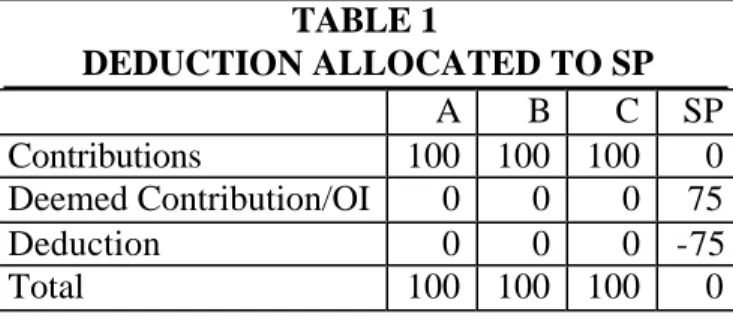
If SP recognizes $75 of OI and no capitalized asset is created, the partnership’s compensation deduction would also equal $75. If the deduction is allocated solely to SP, the partnership’s capital accounts would be as shown in Table 1.
TABLE 1
DEDUCTION ALLOCATED TO SP
A B C SP
Contributions 100 100 100 0 Deemed Contribution/OI 0 0 0 75
Deduction 0 0 0 -75
Total 100 100 100 0
This allocation has some appeal, given SP did not actually contribute any cash or property to the partnership. However, this allocation leaves the partners’ capital accounts unequal and hence is inconsistent with the economic deal among the partners and should be rejected.40
If the deduction is allocated to all partners equally, the partnership’s capital accounts would be as shown in Table 2.
TABLE 2
DEDUCTION ALLOCATED TO ALL PARTNERS
A B C SP
Contributions 100 100 100 0
Deemed Contribution/OI 0 0 0 75
Deduction -18.75 -18.75 -18.75 -18.75
Total 81.25 81.25 81.25 56.25
This allocation also produces unequal capital accounts and hence is inconsistent with the partners’ economic deal.
8
If the deduction is allocated solely to A, B and C, the partnership’s capital accounts would be as shown in Table 3.
TABLE 3
DEDUCTION ALLOCATED TO A, B AND C
A B C SP
Contributions 100 100 100 0 Deemed Contribution/OI 0 0 0 75
Deduction -25 -25 -25 0
Total 75 75 75 75
This allocation results in equal capital accounts, consistent with the partners’ economic deal, and thus is the proper allocation of the deduction.
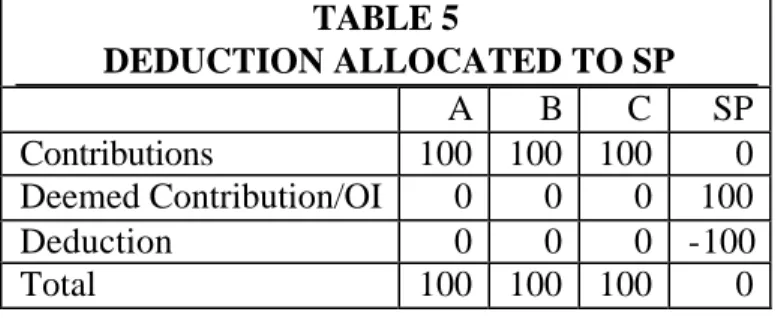
Analysis of partnership capital accounts and the allocation of the partnership’s compensation deduction also supports using liquidation value to determine SP’s OI. To illustrate this point, assume that in Example 1, SP recognizes $100 of OI based on the FMV of the transferred partnership interest. SP’s deemed contribution under the cash purchase model is $100 and the partnership has a $100 deduction (assuming the compensation expense does not create a capitalized asset) to allocate among the partners. In this situation, allocating the partnership’s $100 deduction solely to A, B, and C produces unequal capital accounts for the four partners and hence is inconsistent with the partners’ economic deal (see Table 4).
TABLE 4
DEDUCTION ALLOCATED TO A, B AND C
A B C SP
Contributions 100 100 100 0
Deemed Contribution/OI 0 0 0 100
Deduction -33.33 -33.33 -33.33 0
Total 66.67 66.67 66.67 100
Capital accounts are also unequal if the deduction is allocated solely to SP (see Table 5).
TABLE 5
DEDUCTION ALLOCATED TO SP
A B C SP
Contributions 100 100 100 0
Deemed Contribution/OI 0 0 0 100
Deduction 0 0 0 -100
Total 100 100 100 0
In this second case, capital accounts are equal only if the deduction is allocated equally to each of the partners, including SP (see Table 6).
9
TABLE 6
DEDUCTION ALLOCATED TO ALL PARTNERS
A B C SP
Contributions 100 100 100 0
Deemed Contribution/OI 0 0 0 100
Deduction -25 -25 -25 -25
Total 75 75 75 75
This capital account analysis shows that in net results, it should not matter to SP whether the OI recognized on grant of the partnership interest is $75 or $100, as long as no capitalized asset is created. If the $100 valuation is adopted, SP must be allocated $25 of the partnership’s compensation deduction to equalize capital accounts, so that SP’s net income is $75 in any event (either $75 of income or $100 of income less a $25 share of the partnership’s deduction).
More generally, if the value placed on SP’s partnership interest exceeds its liquidation value (i.e., the value of the assets SP would receive in an immediate liquidation of the partnership), SP must be allocated a share of the partnership’s compensation deduction equal to the excess in order for capital accounts to be consistent with the economic deal among the partners. Thus, under either method, SP’s net income (i.e., OI recognized on receipt of the transferred interest less SP’s share of the partnership compensation deduction) should equal the liquidation value of the transferred interest.
If a capitalized asset is created for the partnership (equal in value to SP’s OI), there is, of course, no deduction to allocate, and each of the partners would have a capital account equal to $100, as illustrated in Table 7.
TABLE 7
CAPITALIZED ASSET CREATED
A B C SP
Contributions 100 100 100 0
Deemed Contribution/OI 0 0 0 100
Deduction 0 0 0 0
Total 100 100 100 100
While we believe that the method outlined above is clearly the correct manner in which to construct capital accounts in accordance with Code §704(b), care must be taken that the actual allocations, distributions, and related capital accounts provided under the partnership agreement are consistent with this approach and with the partne rs’ economic deal. In particular, because the Code §704(b) regulations do not explicitly provide for the results outlined above, carefully drafted terms in the partnership agreement implementing this approach are advisable and may prevent ambiguity and disagreement later.
10
Example 1 is simple in that the partnership has only cash assets when SP receives an interest. The analysis becomes more complex if SP receives a capital interest at a time when the partnership has appreciated assets.
Example 2: Transfer of a Capital Interest where Partnership has Appreciated Assets. A, B, and C form a partnership and each contributes $10 for a one-third interest. After the assets of the partnership appreciate to $300 (resulting in $270 of built- in gain in the partnership assets), the partnership transfers a one-fourth interest in allocations and distributions to SP in exchange for services.
SP
Services C
B A
Partnership Capital Interest
SP has received a capital interest in the partnership, since SP would be entitled to receive $75 of assets (1/4 x $300 of partnership assets) from the partnership if it liquidated and hence should recognize $75 of OI (the liquidation value of SP’s interest)41 and the partnership should be entitled to a $75 deduction (assuming no capital asset is created), allocated to A, B and C as described above.42
Under Treas. Reg. §1.83-6(b), a person who transfers property to a service provider recognizes gain, unless Code §1032 applies, as if the property were sold for an amount equal to the sum of (i) the amount, if any, paid by the service provider and (ii) the OI, if any, recognized by the service provider. Code §1032 provides that a corporation does not recognize gain when it transfers its own stock in exchange for property and hence does not apply to a partnership transferring an interest in the partnership. Treas. Reg. §1.83-6(b) thus creates an important question.43 Does the partnership recognize any gain when it transfers a capital interest to SP and, if so, how is the gain determined?
There are at least three theoretical possibilities: • The partnership recognizes no gain;
• The partnership recognizes gain on a pro rata slice of its assets, as if it had transferred those assets to SP in exchange for services and SP then transferred those assets back to the partne rship in exchange for a partnership interest; and • The partnership recognizes gain equal to the FMV of the transferred partnership
11
As a practical and policy matter, full gain recognition based on a zero basis model seems highly unlikely. The IRS has generally been reluctant to impose taxation under zero basis theories in other areas.44 Thus, the real choice is between no gain recognition and gain recognition on a pro rata slice of partnership assets. Of these two choices, while the law is certainly not clear and there is risk a court might disagree, we believe the better answer is that the partnership recognizes no gain on the transfer of a capital interest to SP. We base this conclusion on the similarity in language between Code §721 and Code §1032, the appropriateness of a cash purchase model, the lack of policy reasons for gain recognition and the lack, after 30 years, of case law, rulings and regulations requiring gain recognition.
We start with Code §1032, which provides that a corporation does not recognize gain "on the receipt of money or other property in exchange for stock ... of such corporation." (Emphasis added.) Code §721 contains very similar language, stating that "[n]o gain or loss shall be recognized to a partnership or to any of its partners in the case of a contribution of property to the partnership in exchange for an interest in the partnership." (Emphasis added.) Given the similarity in language, Code §721 and Code §1032 should be interpreted in a similar fashion when it comes to the recognition of gain or loss by the entity on transfers of equity interests to service providers.
In the corporate context, the IRS has shown a clear reluctance to tax corporations on the issua nce of stock to service providers. Interpretive regulations under Code §1032 state that receipt of "property" for purposes of Code §1032 includes receipt of "services," so that a corporation does not recognize gain when it issues its own stock in compensation for services.45 The IRS has also extended Code §1032 non-recognition beyond its literal reach to include the issuance of parent stock to subsidiary employees in exchange for services provided to the subsidiary, first by ruling and later by regulation.46
In contrast to the regulations under Code §1032, regulations under Code §721 do not state that the receipt of services by the partnership should be treated as the receipt of property. In fact, Treas. Reg. §1.721-1(b)(1) states that Code §721 does not apply in the case of a transfer of a capital interest in compensation for services:
To the extent that any of the partners gives up any part of his right to be repaid his contributions ... in favor of another partner as compensation for services ..., section 721 does not apply. The value of an interest in such partnership capital so transferred to a partner as compensation for services constitutes income to the partner under section 61. The amount of such income is the fair market value of the interest in capital so transferred...
While this language clearly states that SP recognizes income on receipt of a capital interest for services, we do not read it as requiring the partnership to recognize income.
Code §721 is different from Code §1032 in one key respect. It provides non-recognition both for the partnership and for its partners. In contrast, Code §1032 provides non-recognition treatment only for the corporation, not the recipient of stock. Non-recognition for recipients of stock is provided, if at all, only by other provisions of the Code, e.g., Code §351.
12
Thus, we believe the quoted regulatory language is intended to clarify that Code §721 does not prevent the recipient SP from recognizing OI on receipt of a capital interest for services. In this respect, the regulatory language quoted is analogous to Code §351(d)(1), which provides that stock issued for services is not treated as issued for property and hence cannot be received tax-free by the service provider under Code §351. There is nothing inconsistent about stating that services are property for purposes of Code §1032 (so that the corporation recognizes no gain) and are not property for purposes of Code §351 (so that it is clear the service provider recognizes OI). Consistent with Code §§1032 and 351(d)(1), we believe that services should be treated as property under Code §721 for purposes of determining whether the partnership recognizes gain and should not be treated as property under Code §721 for purposes of determining whether SP has OI.
We believe that the regulatory language supports, or is at least consistent with, this view. After stating that Code §721 does not apply to the transfer of a capital interest to SP for services, the regulations go on to provide detailed rules about the amount and timing of SP’s income. The regulations also state that the value of the capital interest to SP is treated as a guaranteed payment under Code §707(c) if the services are rendered to the partnership. The regulations say nothing at all about whether the partnership recognizes income and, if so, how much. This strongly indicates the regulatory draftsmen believed the partnership would not recognize income in such case. Moreover, this argument is equally strong under the 1971 proposed regulations that will, if finalized, add a reference to Code §83 to the Code §721 regulations.
The fact that Treas. Reg. §1.83-6(b) refers to Code §1032 as the only exception to the gain recognition rule is not fatal to this argument. As noted above, the Code §83 regulations do not refer to partners, partnerships and the transfer of partnership interests and it is clear the regulatory draftsmen did not consider the application of Code §83 in the partnership context.47 Thus, it is natural that there would be no reference to an exception for gain recognition in the case of a transfer of a partnership interest to SP. Moreover, as discussed above, our reading of Code §721 and the regulations thereunder is consistent with the statutory and regulatory scheme under Code §1032. Thus, the fact that the Treas. Reg. §1.83-6(b) recognizes an exception for Code §1032 supports a similar exception for Code §721.
The cash purchase model we suggested in connection with the capital account analysis for Example 1 also supports no gain recognition by partnership. Under a cash purchase model, the partnership would be viewed as transferring the partnership interest to SP in exchange for cash (which cash SP would have previously received as a compensatory bonus), an exchange that clearly is within the nonrecognition rules of Code §721.48 The adoption of an explicit cash purchase model is well within the appropriate scope of interpretation of Code §§721 and 83. The IRS recently adopted a cash purchase model in connection with the zero basis regulations under Code §1032 as a conceptual mechanism to avoid gain recognition.49 These regulations (which deal with both compensatory and non-compensatory situations) were not adopted pursuant to any specific grant of statutory authority and hence are interpretative rather than legislative regulations. Moreover, the IRS had already reached similar results prior to the issuance of the regulations through published and private rulings.50 Thus, we believe that taxpayers, as well as the courts and the IRS, are entitled to apply a cash purchase model, as a matter of interpretation, to avoid gain recognition under Code §§83 and 721, even in the absence of specific regulations.
13
Where possible, it is generally advisable for a partnership to pay an actual cash bonus to an SP who can then use the cash bonus to purchase an interest in the partnership, so that the actual form of the transaction is within the scope of non-recognition under Code §721.51 Of course, there is risk that a court intent on finding gain recognition would collapse the cash bonus and cash purchase, treating the transaction as a simple compensatory issuance of a capital interest.52
As a policy matter, there is nothing inherent in the flow-through nature of a partnership that requires gain recognition where a partnership transfers a capital interest to an SP. No corporate- level gain is recognized when an S corporation with appreciated assets transfers stock to an employee.53 There is little reason for the IRS to favor the use of S corporations over partnerships by mandating gain recognition for a partnership where none would be required for an S corporation.
The form of the transaction and Subchapter K’s general treatment of transfers of partnership interests also favors the no gain recognition approach. Gain recognition is predicated on a hypothetical transfer of a slice of partnership assets to SP, a transaction that clearly did not occur. While a transfer of a slice of partnership assets to SP coupled with a recontribution is economically similar in effect to the direct transfer of a partnership interest to SP, the tax law often allows partners and partnerships to choose from among forms that have identical economics, but different tax results.54 Moreover, if a hypothetical transaction is needed (e.g., to provide a conceptual framework for giving SP a capital account), the cash purchase model is at least as persuasive as a transfer of a slice of assets.55 The non-recognition approach is also consistent with Subchapter K’s general treatment of the transfer of a partnership interest as a transfer of an interest in an entity rather than as a transfer of a share of the partnership’s assets.56
Finally, although there are many cases discussing the treatment of SP on receipt of a capital interest in a partnership in exchange for services,57 we have been unable to discover a case or ruling actually requiring a partnership to recognize gain on the transfer of a capital interest to an SP. In addition, as noted above, the Code §721 regulations, while describing in detail SP’s recognition of OI on receipt of a capital interest, say nothing about the partnership recognizing gain. This absence strongly suggests that the IRS has chosen, over the years, not to assert that the transfer of a partnership capital interest to SP in exchange for services requires a partnership to recognize gain.
Partner- level gain recognition has been required in one case, McDougal v. Commissioner,58 where an individual and an SP formed a two-person partnership and the individual transferred an interest in appreciated property (a racehorse) to SP in connection with formation of the partnership. Prior to formation of the partnership, SP had performed services for the individual and had been promised, in addition to a cash fee, a half- interest in the property in the future after the individual had recovered his costs of acquiring the property. The court analyzed the transaction as if the individual had first transferred a one-half undivided interest in the appreciated property to SP and the individual and SP thereafter contributed their interests in the property to the newly formed partnership. The individual (not the partnership) recognized gain on the transfer as if the undivided interest had been sold for its FMV and SP recognized OI equal to the value of SP’s interest in the appreciated property.
14
McDougal is distinguishable from Example 2 on the issue of gain recognition in two critical respects.59 First, in form, the individual transferred an interest in the appreciated property to SP prior to (or perhaps in connection with) the formation of the partnership.60 Gain was recognized on this partner-to-partner transfer of assets because Code §721 does not apply.61 Indeed, it would appear that no partnership existed until SP received a share of the appreciated property. Second, the interest in the appreciated property was transferred to SP in exchange for services rendered to the individual (not the partnership) and the individual (not the partnership) had an obligation to transfer an interest in the property to SP. In such case, treating the transaction as one involving a transfer of assets from the individual to SP may be appropriate.
McDougal, however, highlights the increased risk of gain recognition where SP receives a capital interest on fo rmation of a partnership and other partners contribute appreciated assets. While we would allow non-recognition where SP’s services are provided to or for the benefit of the partnership, if the parties first contribute the assets to a partnership and then transfer a partnership interest to SP, there is risk a court could disagree.62 It is certainly easier to recast such a transaction as a transfer of assets to SP than it is to recast the transfer of a partnership interest in an ongoing partnership as a transfer of assets.
On balance, based on the arguments set forth above, we believe that the partnership should not recognize gain in Example 2. We believe this conclusion is consistent with the position routinely taken today by many partnerships that issue capital interests to SPs. Of course, there is certainly some risk, we hope small, that the IRS and/or a court could disagree. We hope the IRS will, as part of its study of partnership options and convertibles announced in Notice 2000-29, issue clear guidance stating that gain recognition is not required.63
Under the cash purchase model, SP’s capital account in Example 2 should equal the OI recognized on receipt of the capital interest, or $75. However, in contrast to Example 1, merely giving SP a $75 capital account will not cause A, B, C, and SP to have equal capital accounts, as illustrated in Table 8.64
TABLE 8
NO CAPITAL ACCOUNT WRITE- UP
A B C SP
Contributions 10 10 10 0
Deemed Contribution/OI 0 0 0 75
Deduction -25 -25 -25 0
Total -15 -15 -15 75
However, because SP is deemed to contribute $75 cash to the partnership in exchange for an interest under the cash purchase model, the partnership is entitled to write up capital accounts under Treas. Reg. §1.704-1(b)(2)(iv)(f).65 If the partnership writes up capital accounts to reflect the $270 of built- in gain in its assets at the time of the transfer of a capital interest to SP and allocates such built- in gain to the capital accounts of A, B and C, the partners’ capital accounts will be equal (which is necessary to reflect the economic deal between the partners). (See Table 9).
15 TABLE 9
CAPITAL ACCOUNT WRITE-UP
A B C SP
Contributions 10 10 10 0
Deemed Contribution/OI 0 0 0 75
C/A Write Up 90 90 90 0
Deduction -25 -25 -25 0
Total 75 75 75 75
Because SP has been taxed on the full liquidation value of the capital interest received for services, it would be unfair and duplicative to tax SP on any of the built- in gain in the partnership’s assets to the extent that those assets are later sold or disposed of by the partnership. Writing up capital accounts generally solves this problem for SP, since it allows the partnership to apply Code §704(c) principles to allocate built- in gain in its assets to A, B, and C and not to SP (so-called "reverse Code §704(c) allocations").66
The Code §704(b) regulations do not, however, require a partnership to write-up capital accounts on admission of a new partner.67 Depending on how a partnership agreement’s capital account, allocation and distribution provisions are drafted, a failure to write up capital accounts on the transfer to SP may have important tax and economic consequences. It could expose SP to risk of taxation on the built- in gain in the partnership’s assets by preventing the partnership from using reverse Code §704(c) allocations (although properly drafted special allocations could presumably avoid this problem). It could also increase the amount of the taxable capital shift to SP. For example, assume that the partnership agreement in Example 2 gave SP a $75 capital account on receipt of his capital interest and the partnership did not write up capital accounts. If SP is viewed as entitled to his $75 capital account plus 1/4th of the appreciation in the partnership’s assets, the liquidation value of his interest could be $142.50 ($75 + (1/4 x $270 built- in gain)) instead of $75.
In Examples 1 and 2, the partnership interest received by SP was fully vested. The analysis becomes more complex if, as is often the case, SP’s partnership interest is subject to vesting restrictions designed to insure that SP performs the agreed services.
16
Example 3: Transfer of a Capital Interest Subject to Vesting. A, B, C and SP, a service partner, form a partnership. A, B and C contribute $100 each to the partnership’s capital. SP agrees to perform services for the partnership. Under the partnership agreement, A, B, C and SP are entitled to identical allocations and distributions. If SP fails to perform services for two years, SP forfeits the partnership interest back to the partnership. The partnership’s assets appreciate to $600 at the end of year two.
Partnership
SP
Services C
$100 B
$100 A
$100
Measured at formation, SP has received a capital interest, since SP would receive $75 (1/4 x $300 cash) if the partnership liquidated immediately after SP received the partnership interest. However, because SP forfeits the partnership interest back to the partnership if SP does not perform services for two years, SP’s interest is subject to vesting restrictions that constitute an SRF within the meaning of Code §83. Thus, the tax consequences to SP and the partnership turn on the timing rules of Code §83.
If SP does not make a Code §83(b) election, SP’s OI is measured when the partnership interest vests at the end of year two.68 Because the partnership’s assets have appreciated to $600, the liquidation value of SP’s capital interest is $150 on vesting (1/4 x $600) and SP recognizes $150 of OI. The partnership is entitled to a $150 deduction, equal to SP’s OI.
Although there was no built- in gain in the partnership’s assets when SP received the partnership interest, there is built- in gain in the partnership’s assets when the interest vests. Because the Code §83 timing rules measure SP’s OI and the partnership’s deduction at vesting (where no Code §83(b) election was filed), the vesting restrictions make Example 3 more like Example 2 than Example 1. SP’s capital account, the amount of any capital account write-up and the built- in gain for purposes of reverse Code §704(c) allocations should, in this case, all be determined at the time of vesting, not initial grant. Moreover, as discussed above in connection with Example 2, there is a small risk that the partnership may recognize gain at vesting on a slice of its assets attributable to the capital interest transferred to SP.69
Under Code §83 principles, SP would apparently not be treated as a partner in the partnership until vesting.70 A number of important consequences follow. All of the partnership’s taxable income and loss prior to SP’s vesting would be allocated to A, B and C for income tax purposes and none would be allocated to SP. Any distribution of cash or other property to SP prior to vesting would not be a partnership distribution subject to Code §§731-737; rather it would be treated as a payment of compensation to SP generally causing SP to recognize OI and entitling the partnership to an equal deduction.71 Allocations of income to SP for partnership book capital account purposes would generally not result in income to SP
17
(provided that distributions related to such allocations remained subject to vesting). However, such allocations would generally increase the taxable capital shift to SP on vesting (and the related deduction to the partnership).
The consequences to SP and the partnership change markedly if SP makes a timely election under Code §83(b).72 The vesting restrictions are ignored for purposes of determining SP’s OI and the partnership’s deduction.73 Thus, on partnership formation, SP recognizes $75 of OI and the partnership is entitled to a $75 deduction. In essence, the Code §83(b) election causes Example 3 to be treated as Example 1.74 Moreover, if SP makes a timely Code §83(b) election, SP will be treated as a partner from the original transfer of the partnership interest, eliminating the complexities caused by Code §83(f) and related rules. Thus, many partnerships require that an SP make a Code §83(b) election with respect to a partnership interest subject to vesting.
C. Transfers of a Profits Interest
Partnership profits interests come in many varieties.75 A profits interest may represent a simple constant percentage share of all partnership profits. Alternatively, it may represent a formula share of partnership profits, with the holder’s share increasing or decreasing with the level of partnership profits. In some cases, a profits interest receives a share of partnership profits only after the partners providing capital receive a preferred yield on their invested capital.
Although a profits interest, by definition, has no liquidation value, it may be, nonetheless, a valuable property right, since it allows the holder to receive a share of partnership profits without investing (or, in many cases, even risking) any capital. As described in Part A above, prior to the issuance of Rev. Proc. 93-27, the tax treatment of an SP who received a profits interest in exchange for services rendered to a partnership was subject to significant uncertainty and controversy.
The issuance of Rev. Proc. 93-2776 brought much needed certainty to this confused area. Under its safe harbor, the receipt of a profits interest by an SP is not "a taxable event for [SP] or the partnership" if five conditions are met:
1. SP must receive the profits interest in exchange for "the provision of services to or for the benefit of [the] partnership."
2. The services must be provided by SP "in a partner capacity or in anticipation of being a partner;"
3. SP may not dispose of the profits interest within two years of its receipt;
4. The profits interest must not relate to "a sub stantially certain and predictable stream of income from partnership assets, such as income from high-quality debt securities or a high quality net lease;" and
5. The partnership must not be a publicly traded partnership.
The result in Rev. Proc. 93-27 is strongly suggested by capital account analysis. SP’s capital account should be zero immediately after receipt of a profits interest, reflecting the fact
18
that SP has made no contribution of property and has no other right to current partnership capital (i.e., the liquidation value of SP’s interest is zero). If SP were required to recognize OI on receipt of the profits interest, as if the partnership paid SP a bonus equal to its FMV, SP would apparently receive a capital account equal to the OI recognized (under the cash purchase model discussed in Part B above).77 The partnership would be entitled to a deduction equal to SP’s OI, but would be required to allocate the deduction to SP in order to reduce SP’s capital account to zero. Thus, SP’s income and deduction would wash. If SP recognized OI, but received no capital account, allocation of the partnership’s deduction to SP or the other partners would distort partnership capital accounts so that they would not reflect the economic deal among the partners.
The treatment of SP’s receipt of a profits interest under Rev. Proc. 93-27 is significantly better than the treatment of an employee’s receipt of corporate stock. While the economics of a profits interest can be approximated in the corporate context by giving investors preferred stock for most of their invested capital and selling investors and the employee "cheap" common stock, the employee will recognize OI under Code §83 equal to the excess of common stock’s FMV (not liquidation value) over the amount paid for such stock. In addition, if the common stock layer is too thin, there may be risk that value could be reallocated from the preferred stock to the common stock, creating additional OI for the employee. In contrast, in the partnership context, the fact that partners who provide capital are merely entitled to a return of their capital (but no yield) before SP shares in profits generally does not create an OI risk for SP. Because the partners providing capital are entitled to a return of their capital before SP is entitled to anything, SP’s interest is still a profits interest with a zero liquidation value.
Rev. Proc. 93-27 makes compensating SP with a partnership profits interest very attractive. As discussed below, it creates a number of opportunities as well as a few tax issues. For purposes of the examples, we will assume that SP is treated as a partner of the partnership for federal income tax purposes.78 We will also assume that requirements 3, 4, and 5 of Rev. Proc. 93-27 are met (i.e., SP does not dispose of the partnership interest within 2 years of receipt, the profits interest does not relate to a substantially certain and predictable stream of income, and the partnership is not a publicly traded partnership). Finally, we assume that SP has, or may obtain (through the performance of services), a fully vested interest in future profits and appreciation not thereafter dependent on the performance of additional services.79
19
Example 4: Transfer of a Simple Profits Interest. A, B, C and SP, a service partner, form a partnership. A, B and C contribute $100 each to the partnership’s capital. SP agrees to perform services for the partnership. Under the partnership agreement, A, B and C are entitled to return of their capital; thereafter profits (and related distributions) are split equally between A, B, C and SP (1/4th each).
Partnership
SP
Services C
$100 B
$100 A
$100
SP receives a profits interest because if the partnership liquidated immediately after formation, the partnership’s $300 would be distributed to A, B, and C to return their invested capital and SP would receive nothing. Thus, Rev. Proc. 93-27 applies and SP recognizes no OI on receipt of the interest. Instead, SP will be taxed on his or her share of partnership income under Code §702 and the character of that income will be determined by the character of the partnership’s income. Thus, if the partnership recognizes capital gain, SP’s allocable share of the gain will also be capital gain, even though the allocation is made for SP’s services.80
Because SP recognizes no OI on receipt of the profits interest, the partnership is not entitled to any deduction under Code §83(h). However, the amount of income included by A, B, and C in the future will be reduced by allocations of partnership income to SP. In addition, the partnership does not recognize any gain with respect to the issuance of the profits interest to SP.81
As we noted in Part A above, a profits interest received by SP may become a capital interest over time, as the partnership’s assets appreciate or the partnership retains its earnings. Assume after formation of the partnership in Example 4, it breaks even on day-to-day operations for three years, while its assets appreciate in value to $600, at which point the partners decide to liquidate the partnership, distributing to each partner a share of the partnership assets in kind. A, B, and C would be entitled to receive $175 in assets each ($100 capital contribution + 1/4 x $300 appreciation in the partnership assets) and SP would be entitled to receive $75 in assets (1/4 x $300 appreciation in the partnership assets).82 Because SP receives the distribution of assets as a partner, it should generally be tax- free under Code §731 and the same should generally be true for A, B and C.83 On these facts, SP would take a zero basis in his or her share of the distributed assets.84
In many cases, SP will also make a capital investment in the partnership in addition to receiving a profits interest.85 For example, the managers of a private equity fund gene rally make a capital investment in the fund and receive both a carried interest in fund profits and a return on their invested capital.
20
Example 5: Profits Interest with Purchased Capital Interest and Tiered Partnerships. SP1 and SP2 form a partnership, MgmtCo, to serve as the general partner of a private equity fund partnership. SP1 and SP2 contribute $5 each to MgmtCo, which MgmtCo in turn invests in the fund. Limited partner investors contribute $990 to the fund. MgmtCo is entitled to 20% of the fund’s profits as a carried interest and a share of the fund’s profits (after carried interest) in proportion to contributed capital. Thus, MgmtCo receives 20.8% of the fund’s profits (20% carried interest plus 1% x (100% - 20%) of profits). All partners in the fund (including MgmtCo) are entitled to a return of their invested capital before MgmtCo is entitled to carried interest profits. SP1 and SP2 share all allocations and distributions from MgmtCo equally.
SP2 SP1 $5 & services $5 & services Mgmt Co (GP) Investors (LPs) $990 $10 & Services Private Equity Fund
20.8% of Profits
If the private equity fund and MgmtCo were liquidated immediately after formation, SP1 and SP2 would merely receive back their contributed capital ($5 each). Under a literal reading of Rev. Proc. 93-27, SP1 and SP2 have capital interests because they are entitled to a share of partnership capital on liquidation.86 However, their interest in partnership capital is exactly equal to the amount they contributed. It would clearly make no sense to deny SP1 and SP2 the benefits of Rev. Proc. 93-27 with respect to their carried interest merely because they have also purchased a capital interest with a liquidation value exactly equal to the value of their contributions. Thus, we would bifurcate SP1's and SP2's partnership interest into a purchased capital interest (resulting in no OI since they paid an amount equal to the liquidation value of the capital interest) and a profits interest (here the carried interest) received tax- free under Rev. Proc. 93-27. Even if SP1 and SP2 were technically denied the benefits of Rev. Proc. 93-27 as a result of their purchased capital interest, the capital account analysis discussed above in connection with Example 1 indicates that their OI should be measured by the excess of the liquidation value of their interest (here $5 each) over the amount they paid for the interest (here also $5), so again they should recognize no OI.
Example 5 contains a subtler issue produced by the tiered-partnership structure.87 The assets of MgmtCo include both its $10 capital interest in the fund and its carried interest in fund profits. MgmtCo’s carried interest in fund profits is an asset that likely has significant value and, if this carried interest value is taken into account in determining the liquidation value of the MgmtCo interests received by SP1 and SP2, SP1 and SP2 would potentially recognize significant OI. While SP1 and SP2 could clearly avoid this risk by becoming direct general partners of the fund, we see no reason, policy or otherwise, to force them to do so in order to avoid the recognition of OI on formation of a fund. Thus, we would look through a
tiered-21
partnership structure in applying Rev. Proc. 93-27 or, equivalently, we would value MgmtCo’s interest in the fund on a liquidation basis in determining the liquidation value of SP1's and SP2's interests in MgmtCo.
Examples 4 and 5 involve the issuance of profits interests to SPs on formation of a partnership. Profits interests are also issued to SPs by existing partnerships. The existence of appreciated assets complicates the analysis.
Example 6: Profits Interest where Partnership has Appreciated Assets. A, B, and C form a partnership and each contributes $10 for a one-third interest. After the assets of the partnership appreciate to $300 (resulting in $270 of built- in gain in the partnership assets), the partnership transfers to SP, in exchange for services, a one- fourth interest in future profits (and related distributions) after A, B and C receive the $300 of existing value.
SP
Services
C B
A
Partnership
Profits Interest
SP receives a profits interest because, if the partnership were liquidated immediately after SP received the interest, A, B, and C would receive the $300 of partnership assets (including the $270 of built- in gain) and SP would receive nothing. Thus, SP recognizes no OI and the partnership has no deduction.
The partnership is not entitled to write- up capital accounts and apply reverse Code §704(c) allocations to allocate built- in gain to A, B, and C when it is later recognized, because SP makes no actual or deemed contribution to the partnership.88 However, as long as SP’s interest is a true profits interest, SP has no economic interest in existing capital and built- in gain. Any built- in gain, as it is later recognized, ought to be allocated to A, B and C under normal Code §704(b) principles. Ins uring that this is the case generally requires careful drafting of the partnership’s allocation and distribution provisions.
To achieve this result, the partnership agreement should allocate the built- in gain in the partnership’s assets to A, B, and C. Alternatively, if the partnership agreement uses "distribution-driven" or "forced" allocations,89 the agreement could provide that the first $300 of distributions attributable to disposition proceeds90 from the partnership’s assets will be made to A, B, and C and that all other distributions will be made equally to all four partners. If neither approach (or equivalent) is used, SP may be entitled to a share of built- in gain under the agreement and SP’s interest may not be a profits interest at receipt (with the consequences discussed in Part B, Example 2 above).
22
A partnership will often impose vesting restrictions on SP’s ability to retain the profits interest in order to insure that SP performs the agreed services. Such vesting restrictions raise the issue of whether the timing rules of Code §83 apply.
Example 7: Transfer of a Profits Interest Subject to Vesting Restrictions. A, B, C and SP, a service partner, form a partnership. A, B and C contribute $100 each to the partnership’s capital. SP agrees to perform services for the partnership. Under the partnership agreement, A, B and C are entitled to return of their capital; thereafter profits (and related distributions) are split equally between A, B, C and SP (1/4th each). SP forfeits the interest if SP fails to perform services for the partnership for two years. The partnership’s assets appreciate in value to $600 at the end of year two.
Partnership
SP
Services C
$100 B
$100 A
$100
Although in our experience, vesting restrictions are the norm, Rev. Proc. 93-27 did not address the effect of vesting on SP’s and the partnership’s tax consequences. Rev. Proc. 93-27 states that the determination of whether a partnership interest is a capital interest or a profits interest is "generally made at the time of receipt of the partnership interest." It is unclear whether the use of the word "generally" was intended to allow the Code §83 timing rules to govern when to measure whether SP’s interest is a profits interest (by acknowledging such determination could be made at a time other than receipt) or, perhaps more likely, was intended to leave the question ambiguously unanswered.91
If the Code §83 timing rules govern and if SP does not make a Code §83(b) election, SP’s interest will be tested on vesting at the end of year two. At that point, SP’s interest will be a capital interest since SP would receive $75 on liquidation of the partnership (1/4 x $300 of appreciation in the partnership’s assets). SP thus would recognize $75 of OI and the partnership would be entitled to a $75 deduction, allocated to A, B, and C.92 In addition, as discussed in Example 3, SP would apparently not be treated as a partner until the interest vests.93
In contrast, if SP makes a timely Code §83(b) election with respect to the receipt of the partnership interest94 (or if the Code §83 timing rules do not apply), SP’s interest will be tested on receipt when it is clearly a profits interest. SP will recognize no OI on receipt under Rev. Proc. 93-27, the partnership will have no deduction and SP will be recognized as a partner for tax purposes from the initial transfer.
The IRS issued Rev. Proc. 2001-43 to clarify the application of Rev. Proc. 93-27 to grants of unvested profits interests.95 Under Rev. Proc. 2001-43, the IRS will treat SP as receiving an unvested profits interest on its grant date and "will not treat the grant of the interest
23
or the event that causes the interest to become substantially vested ... as a taxable event for [SP] or the partnership" provided that each of the following conditions are met:
1. Both the partnership and SP treat SP as the owner of the profits interest from its grant date and SP "takes into account the distributive share of partnership income, gain, loss, deduction and credit associated with that [profits] interest in computing [SP’s] income tax liability" for all periods during which SP holds the interest.96 2. "[N]either the partnership nor any of the partners deducts any amount (as wages,
compensation or otherwise) for the fair market value of the [profits] interest" at grant or on vesting.
3. All conditions set forth in Rev. Proc. 93-27 are satisfied.
Rev. Proc. 2001-43 states that an SP "to which this revenue procedure applies need not file an election under section 83(b) of the Code."
While we welcome Rev. Proc. 2001-43 as good practical tax policy, unfortunately it leaves a number of questions and risks for taxpayers in practice. First, like Rev. Proc. 93-27, Rev. Proc. 2001-43 is an administrative safe harbor and does not state any rationale for its conclusions. While it is tempting to conclude that the IRS believes Code §83 does not apply to the grant of a profits interest to an SP, the most that can be said is that the IRS has determined the timing rules of Code §83 should not, as a matter of tax policy, apply to the grant of an unvested profits interest to an SP who comes within the terms of Rev. Proc. 93-27 and Rev. Proc. 2001-43. Indeed, Rev. Proc. 2001-43 contains some suggestion that the IRS is worried Code §83 may, under a literal reading, apply to the grant of a profits interest. Rev. Proc. 2001-43 provides that its benefits apply only if the partnership, the SP, and the other partners all treat the grant of an unvested profits interest to the SP in a manner consistent with Rev. Proc. 2001-43 (i.e., conditions one and two above are satisfied). Absent this consistency requirement, the IRS is apparently concerned it could be subject to a whipsaw in which an SP reports no income on grant or vesting of a profits interest in reliance on Rev. Proc. 2001-43, while the partnership claims a compensation deduction on vesting on the ground that Code §83 applies and no Code §83(b) election was filed.
Second, Rev. Proc. 2001-43's consistency requirement creates the risk that an SP who relies on the revenue procedure and does not file an election under Code §83(b) on receipt of an unvested profits interest could lose the benefits of the revenue procedure’s safe harbor (with potentially disastrous tax consequences if the partnership’s assets appreciate significantly between grant and vesting) merely because the partnership or one of its partners (perhaps a former partner who left the partnership on poor terms but retained a partnership interest) claims a compensation deduction on grant or vesting. An SP can obtain some protection from inconsistency if the partnership and its partners agree contractually (in the partnership agreement or a side agreement) to treat the grant and vesting of the profits interest in a manner consistent with Rev. Proc. 2001-43. However, the costs of obtaining such an agreement, monitoring it, enforcing it, and claiming damages if it is breached appear to significantly exceed the costs of filing an election under Code §83(b) that should avoid the issue altogether.
24
Third, Rev. Proc. 2001-43 applies only if all of the requirements of Rev. Proc. 93-27 are satisfied, which means that all of the ambiguities created by Rev. Proc. 93-27 must be addressed prior to the reliance on the seemingly simple rules of Rev. Proc. 2001-43. For example, the safe harbor of Rev. Proc. 2001-43 could be lost (on the grounds that the conditions of Rev. Proc. 93-27 are not met) where:
• SP’s services are not provided "to or for the benefit of the partnership in a partner capacity or in anticipation of being a partner,"
• SP leaves within 2 years of the grant of the profits interest and is required to sell the profits interest back to the partnership,
• SP purchases a capital interest at the same time SP receives a profits interest (if the IRS refuses to bifurcate the interest into separate capital and profits interests), or
• The IRS argues SP received a capital interest (rather than a profits interest) in an existing partnership, because the IRS disagrees on audit with the partnership’s valuation of its assets and argues that SP received an interest in existing capital appreciation.
While these ambiguities also exist under Rev. Proc. 93-27, the consequences of being wrong under Rev. Proc. 2001-43 may be more severe (and more easily avoided). An SP who does not file a Code §83(b) election in mistaken reliance on Rev. Proc. 2001-43 could be required to recognize huge amounts of OI if the partnership’s assets appreciate between grant and vesting. In contrast, an SP who files a Code §83(b) election and later finds that Rev. Proc. 93-27 does not apply may still argue, as discussed above, that the profits interest should be valued on a liquidation basis or that the profits interest is incapable of valuation. In addition, even if the partnership interest is found to be a capital interest, the SP should, based on the Code §83(b) election, be entitled to value the partnership interest at grant when its value may be significantly lower than at vesting.
Taxpayers should be entitled to rely on Rev. Procs. 93-27 and 2001-43, at least when they are squarely within the terms of the revenue procedures.97 In addition, as a practical matter, having openly invited taxpayers not to file Code §83(b) elections with respect to profits interests, we hope the IRS would be slow to deny the benefits of Rev. Proc. 2001-43's safe harbor to an SP on the basis of the ambiguities set forth above.98 Thus, on the facts of Example 7, Rev. Proc. 2001-43 should generally apply (assuming the Rev. Proc. 2001-43 consistency requirements are met) and SP should recognize no OI on the grant or vesting of the profits interest, whether or not SP files a Code §83(b) election with the IRS. In addition, SP should be regarded as a partner of the partnership from the grant date and, while the partnership will not be entitled to any deduction, the amount of partnership income allocated to A, B, and C will be reduced by allocations of income to SP in respect of its profits interest.
However, because of the ambiguities outlined above, we generally continue to recommend that an SP file a Code §83(b) election with respect to the receipt of an unvested profits interest. The risk of falling outside Rev. Proc. 2001-43's safe harbor (with its potentially
25
high tax cost) can be eliminated entirely by filing a simple Code §83(b) election with little cost (i.e., SP should report no income as a result of the election based on Rev. Proc. 93-27).
If the IRS would like to reduce the number of Code §83(b) elections it receives with respect to unvested profits interests, it should consider modifying Rev. Proc. 2001-43 to provide greater certainty to taxpayers. For example, the IRS could provide that the consistency requirement of Rev. Proc. 2001-43 is deemed met if the SP and the partnership agree contractually (either in the partnership agreement or in a side agreement) to treat the grant and vesting of the profits interest in accordance with Rev. Proc. 2001-43. In addition, the IRS could provide that where an SP fails to file a Code §83(b) election in reliance on Rev. Proc. 2001-43 and is later found to be outside the terms of the safe harbor (e.g., because one of the conditions set forth in Rev. Proc. 93-27 is not met), the IRS will deem a Code §83(b) election to have been made.
In many cases, a partnership would like to grant SP an interest in existing capital, but does not want SP to recognize OI. It is generally possible to grant a profits interest to SP that disproportionately allocates profits to SP, until SP catches up to the desired level of capital. Depending on the parties’ expectations as to the future level of partnership profits, such catch-up allocations may approximate the economics desired by the parties without creating OI for SP on receipt of the partnership interest.
Example 8: Profits Interest with Catch-Up Allocations. A, B, C and SP, a service partner, form a partnership. A, B and C contribute $100 each to the partnership’s capital. SP agrees to perform services for the partnership. Under the partnership agreement, A, B and C are entitled to return of their capital; the first $100 of profits are allocated to SP; thereafter, profits (and related distributions) are split equally between A, B, C and SP (1/4th each).
Partnership
SP
Services C
$100 B
$100 A
$100
SP has received a profits interest within the meaning of Rev. Proc. 93-27. If the partnership were liquidated, A, B, and C would receive the $300 of partnership cash as a return of their capital and SP would receive nothing. Thus, SP should recognize no OI on receipt of the interest. However, if the partnership has at least $100 in profits, SP’s capital account will catch up to A, B, and C’s capital accounts and thereafter the partners’ capital accounts will remain equal (see Table 10).