Chapter Overview Questions
Chapter Overview Questions
What are the advantages and disadvantages What are the advantages and disadvantages of conventional oil and nonconventional
of conventional oil and nonconventional
heavy oils?
heavy oils?
What are the advantages and disadvantages What are the advantages and disadvantages of natural gas?
of natural gas?
What are the advantages and disadvantages What are the advantages and disadvantages of coal and the conversion of coal to gaseous
of coal and the conversion of coal to gaseous
and liquid fuels?
Chapter Overview Questions (cont’d)
Chapter Overview Questions (cont’d)
What are the advantages and disadvantages What are the advantages and disadvantages of conventional nuclear fission, breeder
of conventional nuclear fission, breeder
nuclear fission, and nuclear fusion?
Core Case Study:
Core Case Study:
How Long Will the Oil Party Last?
How Long Will the Oil Party Last?
Saudi Arabia could supply the world with oil Saudi Arabia could supply the world with oil for about 10 years.
for about 10 years.
The Alaska’s North Slope could meet the The Alaska’s North Slope could meet the world oil demand for 6 months (U.S.: 3
world oil demand for 6 months (U.S.: 3
years).
years).
Alaska’s Arctic National Wildlife Refuge Alaska’s Arctic National Wildlife Refuge would meet the world demand for 1-5
would meet the world demand for 1-5
months (U.S.: 7-25 months).
Core Case Study:
Core Case Study:
How Long Will the Oil Party Last?
How Long Will the Oil Party Last?
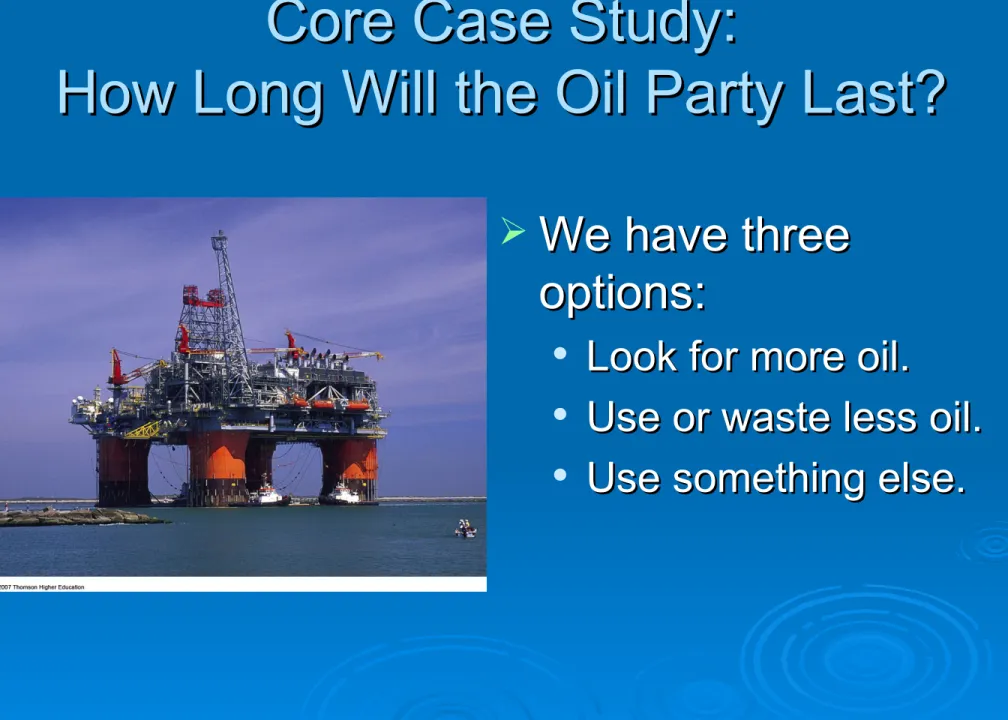
We have three We have three options:
options:
Look for more oil.Look for more oil.
Use or waste less oil.Use or waste less oil. Use something else.Use something else.
Figure 16-1
TYPES OF ENERGY RESOURCES
TYPES OF ENERGY RESOURCES
About 99% of the energy we use for heat About 99% of the energy we use for heat
comes from the sun and the other 1% comes
comes from the sun and the other 1% comes
mostly from burning fossil fuels.
mostly from burning fossil fuels.
Solar energy indirectly supports wind power, Solar energy indirectly supports wind power, hydropower, and biomass.
hydropower, and biomass.
About 76% of the commercial energy we use About 76% of the commercial energy we use comes from nonrenewable fossil fuels (oil,
comes from nonrenewable fossil fuels (oil,
natural gas, and coal) with the remainder
natural gas, and coal) with the remainder
coming from renewable sources.
TYPES OF ENERGY RESOURCES
TYPES OF ENERGY RESOURCES
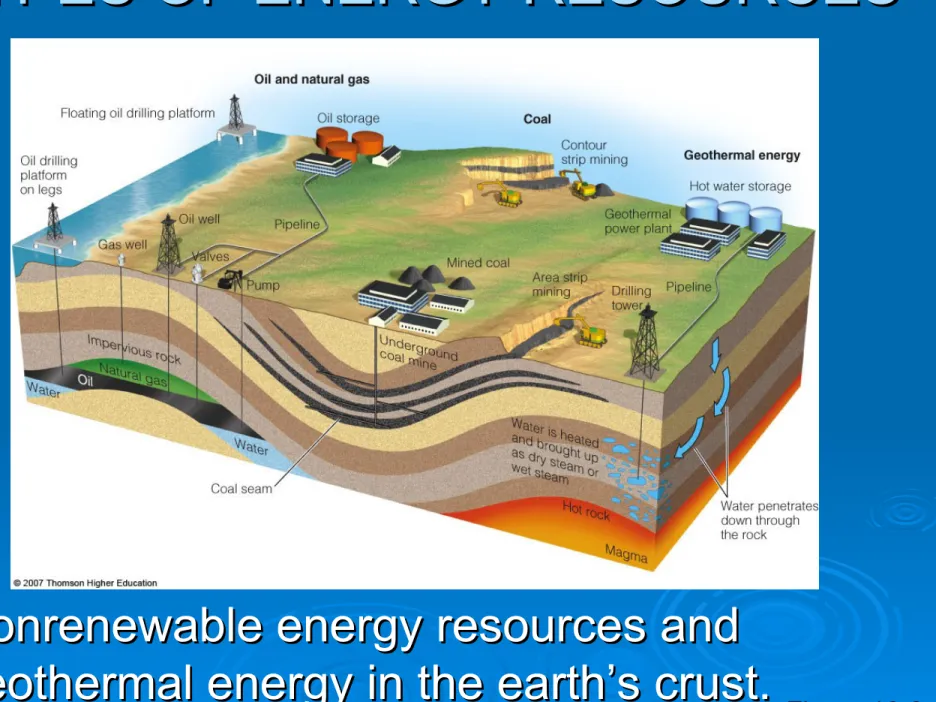
Nonrenewable energy resources and Nonrenewable energy resources and geothermal energy in the earth’s crust.
geothermal energy in the earth’s crust.
Figure 16-2
Fig. 16-2, p. 357 Oil and natural gas
Oil and natural gas Floating oil drilling
platform Oil storage CoalCoal
Contour strip mining Oil drilling platform on legs Geothermal Geothermal energy energy
Hot water storage Oil well
Pipeline Geothermal
power plant Gas
well Valves Mined coal
Pump Area strip
mining Drilling
tower
Pipeline
Impervious rock Underground coal mine
Natural gas
WaterOil Water is h
eated and brought up as dry steam or wet steam Water
Coal seam Hot rock
Water penetrates down through the rock
TYPES OF ENERGY RESOURCES
TYPES OF ENERGY RESOURCES
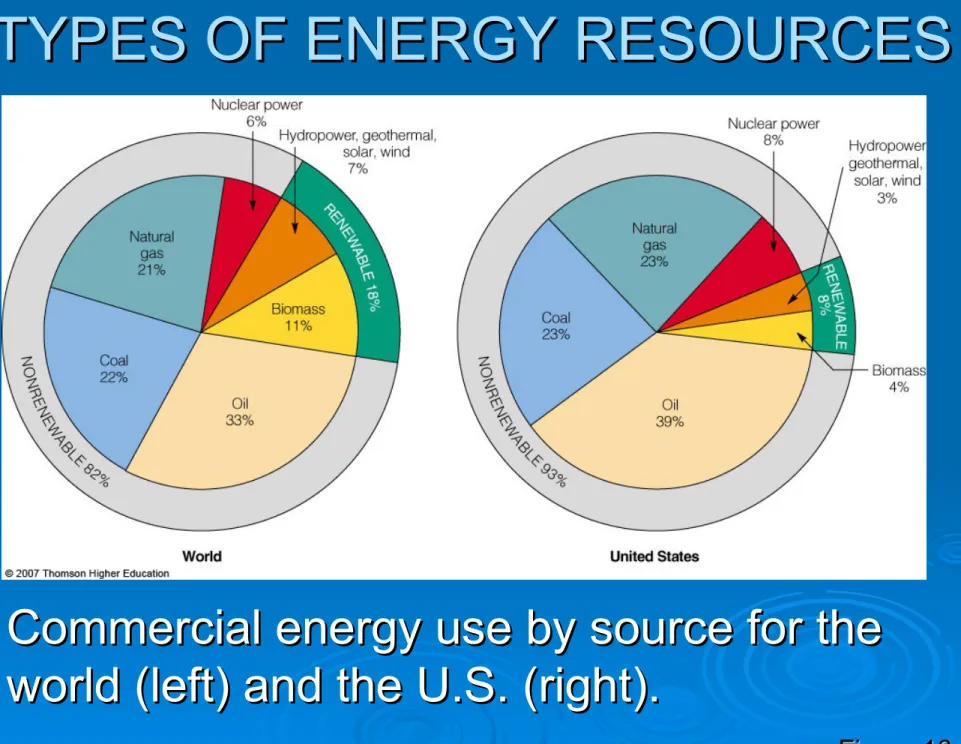
Commercial energy use by source for the Commercial energy use by source for the world (left) and the U.S. (right).
world (left) and the U.S. (right).
Figure 16-3
Fig. 16-3a, p. 357 Nuclear power 6%
Fig. 16-3b, p. 357 Hydropower geothermal, solar, wind 3% Nucle
ar po
TYPES OF ENERGY RESOURCES
TYPES OF ENERGY RESOURCES
Net energy is the amount of high-quality Net energy is the amount of high-quality
usable energy available from a resource after
usable energy available from a resource after
subtracting the energy needed to make it
subtracting the energy needed to make it
available.
Net Energy Ratios
Net Energy Ratios
The higher the net energy ratio, the greater The higher the net energy ratio, the greater the net energy available. Ratios < 1 indicate
the net energy available. Ratios < 1 indicate
a net energy loss.
Fig. 16-4, p. 358 Space Heating
Space Heating
Passive solar 5.8 Natural gas
Oil 4.5
Active solar 1.9 Coal gasification 1.5 Electric resistance heating (coal-fired plant) 0.4
0.4
Electric resistance heating (nuclear plant) 0.3
High-Temperature Industrial Heat High-Temperature Industrial Heat
28.2 Surface-mined coal
Underground-mined coal 25.8
Natural gas 4.9
Oil 4.7
Coal gasification 1.5 Direct solar (highly concentrated by mirrors,
heliostats, or other devices) 0.9
Transportation Transportation
Natural gas 4.9 Gasoline (refined crude oil) 4.1
Biofuel (ethyl alcohol) 1.9 Coal liquefaction 1.4
Oil shale 1.2 Electric resistance heating (natural-gas-fired plant)
OIL
OIL
Crude oil (petroleum) is a thick liquid Crude oil (petroleum) is a thick liquid
containing hydrocarbons that we extract from
containing hydrocarbons that we extract from
underground deposits and separate into
underground deposits and separate into
products such as gasoline, heating oil and
products such as gasoline, heating oil and
asphalt.
asphalt.
Only 35-50% can be economically recovered Only 35-50% can be economically recovered from a deposit.
from a deposit.
As prices rise, about 10-25% more can be As prices rise, about 10-25% more can be
recovered from expensive secondary extraction
recovered from expensive secondary extraction
techniques.
techniques.
OIL
OIL
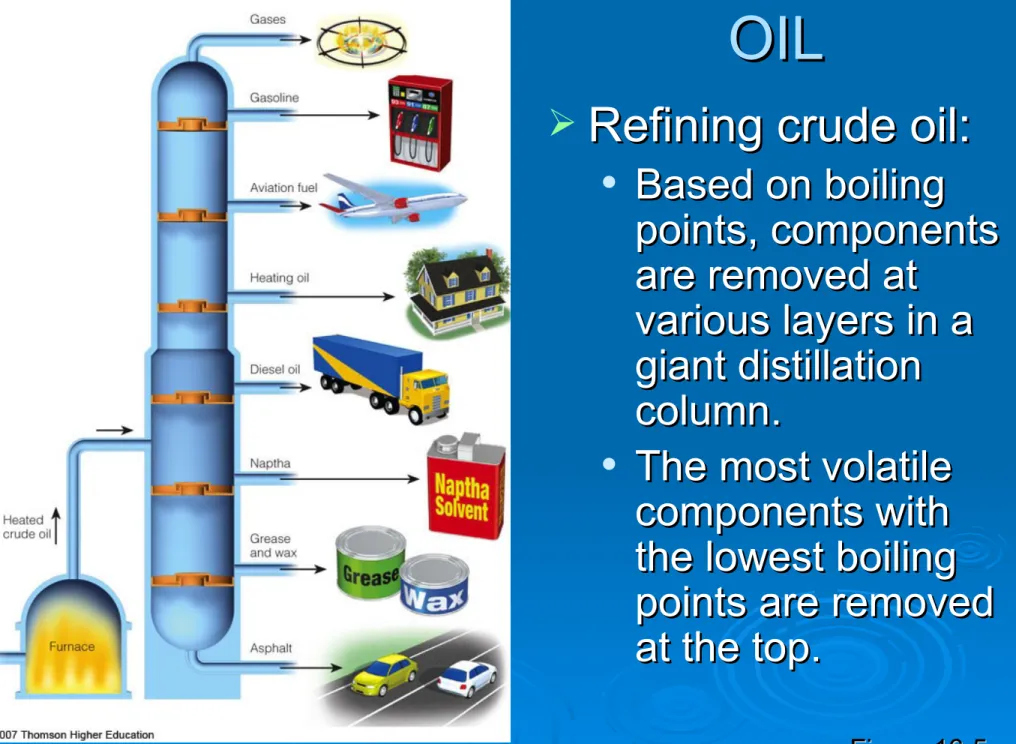
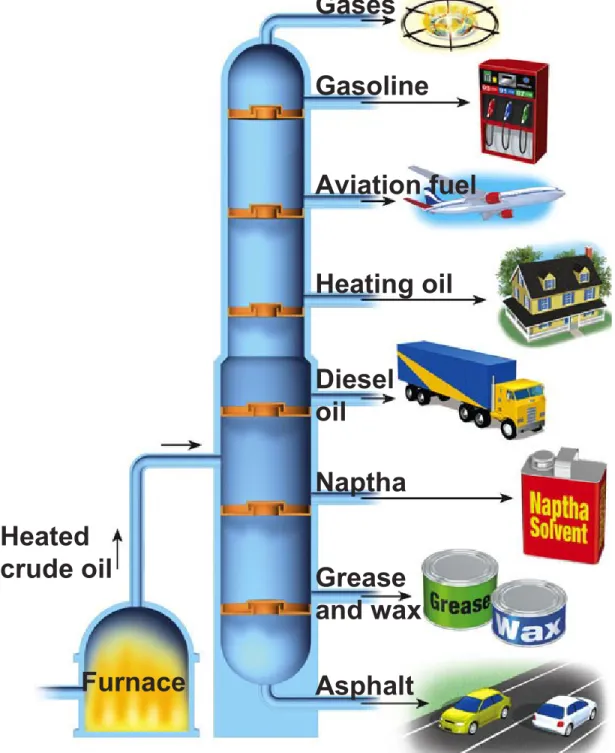
Refining crude oil:Refining crude oil:
Based on boiling Based on boiling
points, components
points, components
are removed at
are removed at
various layers in a
various layers in a
giant distillation
giant distillation
column.
column.
The most volatile The most volatile components with
components with
the lowest boiling
the lowest boiling
points are removed
points are removed
at the top.
at the top.
Figure 16-5
Fig. 16-5, p. 359
Gases
Gasoline
Aviation fuel
Heating oil
Diesel oil
Naptha
Grease and wax
Asphalt Heated
crude oil
OIL
OIL
Eleven OPEC (Organization of Petroleum Eleven OPEC (Organization of Petroleum
Exporting Countries) have 78% of the world’s
Exporting Countries) have 78% of the world’s
proven oil reserves and most of the world’s
proven oil reserves and most of the world’s
unproven reserves.
unproven reserves.
After global production peaks and begins a After global production peaks and begins a slow decline, oil prices will rise and could
slow decline, oil prices will rise and could
threaten the economies of countries that
threaten the economies of countries that
have not shifted to new energy alternatives.
OIL
OIL
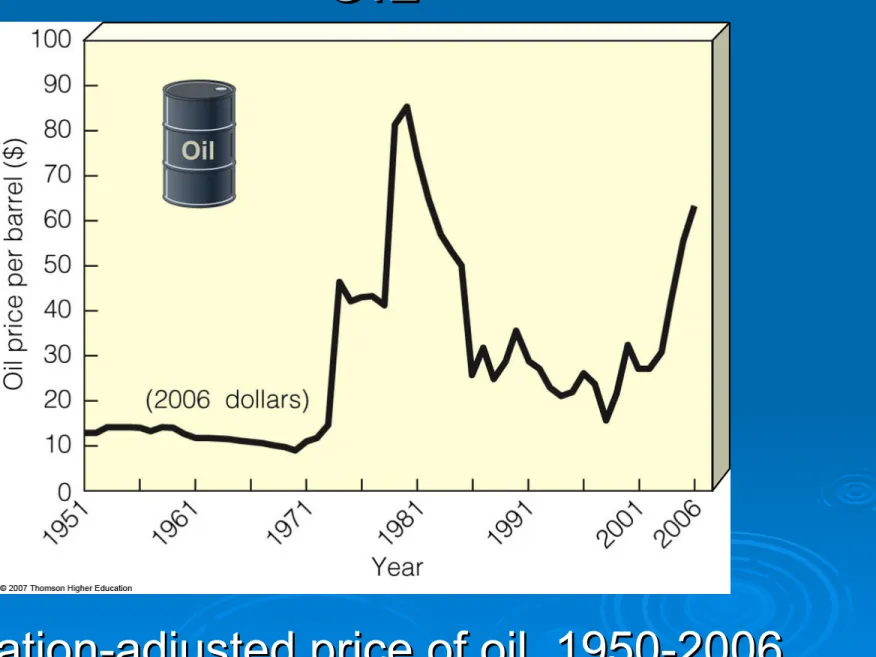
Inflation-adjusted price of oil, 1950-2006.Inflation-adjusted price of oil, 1950-2006.
Figure 16-6
Fig. 16-6, p. 361
O
il
p
ri
ce
p
e
r
b
a
rr
e
l (
$
)
(2006 dollars)
Case Study: U.S. Oil Supplies
Case Study: U.S. Oil Supplies
The U.S. – the world’s largest oil user – has The U.S. – the world’s largest oil user – has only 2.9% of the world’s proven oil reserves.
only 2.9% of the world’s proven oil reserves.
U.S oil production peaked in 1974 (halfway U.S oil production peaked in 1974 (halfway production point).
production point).
About 60% of U.S oil imports goes through About 60% of U.S oil imports goes through refineries in hurricane-prone regions of the
refineries in hurricane-prone regions of the
Gulf Coast.
OIL
OIL
Burning oil for Burning oil for transportation
transportation
accounts for 43%
accounts for 43%
of global CO
of global CO22
emissions.
emissions.
Figure 16-7
Fig. 16-7, p. 363
Trade-Offs
Conventional Oil
Advantages Disadvantages
Ample supply for
42–93 years Need to find
substitutes within 50 years
Low cost (with huge subsidies)
Artificially low price encourages waste and discourages search for alternatives
High net energy yield
Easily transported within and between countries
Air pollution when burned
Low land use
Releases CO2 when burned
Technology is well developed
Efficient distribution
system Moderate water
CO
CO
22Emissions
Emissions
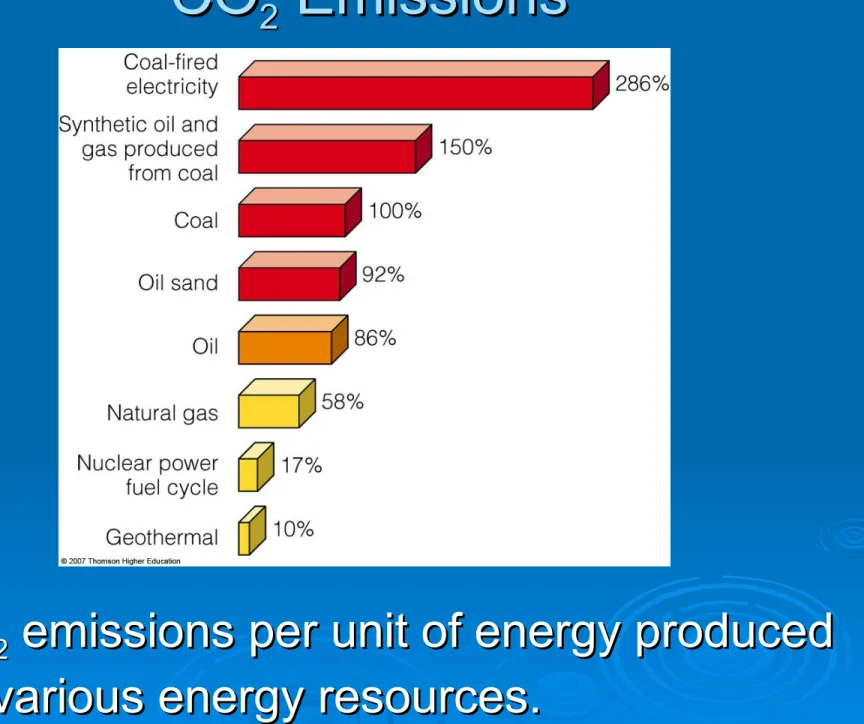
COCO22 emissions per unit of energy produced emissions per unit of energy produced for various energy resources.
for various energy resources.
Figure 16-8
Fig. 16-8, p. 363 Coal-fired
electricity 286%
Synthetic oil and gas
produced from coal 150%
Coal 100%
Oil sand 92%
Natural gas 58%
Oil 86%
Nuclear power fuel cycle
17%
How Would You Vote?
How Would You Vote?
Do the advantages of relying on conventional Do the advantages of relying on conventional oil as the world’s major energy resource
oil as the world’s major energy resource
outweigh its disadvantages?
outweigh its disadvantages?
a. No. The environmental, political, and economic a. No. The environmental, political, and economic costs of petroleum are too high.
costs of petroleum are too high.
b. Yes. Petroleum is needed until suitable b. Yes. Petroleum is needed until suitable alternatives can be developed and
alternatives can be developed and
commercialized.
Heavy Oils from Oil Sand and Oil
Heavy Oils from Oil Sand and Oil
Shale: Will Sticky Black Gold Save Us?
Shale: Will Sticky Black Gold Save Us?
Heavy and tarlike oils from oil sand and oil Heavy and tarlike oils from oil sand and oil shale could supplement conventional oil, but
shale could supplement conventional oil, but
there are environmental problems.
there are environmental problems. High sulfur content.High sulfur content.
Extracting and processing produces:Extracting and processing produces: • Toxic sludgeToxic sludge
• Uses and contaminates larges volumes of waterUses and contaminates larges volumes of water
• Requires large inputs of natural gas which reduces net Requires large inputs of natural gas which reduces net
energy yield.
Oil Shales
Oil Shales
Oil shales contain Oil shales contain a solid
a solid
combustible
combustible
mixture of
mixture of
hydrocarbons
hydrocarbons
called
called kerogenkerogen..
Figure 16-9
Heavy Oils
Heavy Oils
It takes about 1.8 It takes about 1.8 metric tons of oil
metric tons of oil
sand to produce
sand to produce
one barrel of oil.
one barrel of oil.
Figure 16-10
Fig. 16-10, p. 365
Trade-Offs
Heavy Oils from Oil Shale and Oil Sand
Advantages Disadvantages
Moderate cost (oil sand)
High cost (oil shale)
Low net energy yield
Large potential supplies,
especially oil sands in
Canada Large amount of water needed for processing Easily transported within and between countries Severe land disruption Severe water pollution Efficient distribution system in place Air pollution when burned
CO2 emissions when burned Technology is
NATURAL GAS
NATURAL GAS
Natural gas, consisting mostly of methane, is Natural gas, consisting mostly of methane, is often found above reservoirs of crude oil.
often found above reservoirs of crude oil.
When a natural gas-field is tapped, gasses are When a natural gas-field is tapped, gasses are liquefied and removed as liquefied petroleum gas
liquefied and removed as liquefied petroleum gas
(LPG).
(LPG).
Coal beds and bubbles of methane trapped Coal beds and bubbles of methane trapped in ice crystals deep under the arctic
in ice crystals deep under the arctic
permafrost and beneath deep-ocean
permafrost and beneath deep-ocean
sediments are unconventional sources of
sediments are unconventional sources of
natural gas.
NATURAL GAS
NATURAL GAS
Russia and Iran have almost half of the Russia and Iran have almost half of the world’s reserves of conventional gas, and
world’s reserves of conventional gas, and
global reserves should last 62-125 years.
global reserves should last 62-125 years.
Natural gas is versatile and clean-burning Natural gas is versatile and clean-burning fuel, but it releases the greenhouse gases
fuel, but it releases the greenhouse gases
carbon dioxide (when burned) and methane
carbon dioxide (when burned) and methane
(from leaks) into the troposphere.
NATURAL GAS
NATURAL GAS
Some analysts see Some analysts see natural gas as the
natural gas as the
best fuel to help us
best fuel to help us
make the transition to
make the transition to
improved energy
improved energy
efficiency and greater
efficiency and greater
use of renewable
use of renewable
energy.
energy.
Figure 16-11
Fig. 16-11, p. 368
Trade-Offs
Conventional Natural Gas
Advantages Disadvantages
Ample supplies (125 years) Nonrenewable resource
High net energy yield
Releases CO2 when
burned Low cost (with huge
subsidies)
Methane (a greenhouse gas) can leak from pipelines
Lower CO2 emissions than
other fossil fuels
Difficult to transfer from one country to another
Moderate environmental
impact Shipped across ocean as
highly explosive LNG Easily transported by pipeline
Sometimes burned off and wasted at wells because of low price
Low land use
Good fuel for fuel cells and gas turbines
Requires pipelines Less air pollution than other
COAL
COAL
Coal is a solid fossil fuel that is formed in Coal is a solid fossil fuel that is formed in
several stages as the buried remains of land
several stages as the buried remains of land
plants that lived 300-400 million years ago.
plants that lived 300-400 million years ago.
Figure 16-12
Fig. 16-12, p. 368
Increasing heat and carbon content
Increasing moisture content
Peat (not a coal)
Lignite (brown coal) Bituminous (soft coal) Anthracite (hard coal)
Heat Heat Heat
Pressure Pressure Pressure
Partially decayed plant matter in
swamps and bogs; low heat content
Low heat content; low sulfur content; limited supplies in most areas
Extensively used as a fuel because of its high heat content and large supplies; normally has a high sulfur content
Fig. 16-12, p. 368 Highly desirable fuel because of its high heat content and low sulfur content;
supplies are limited in most areas
Extensively used as a fuel because of its high heat content and large supplies; normally has a
high sulfur content Low heat content;
low sulfur
content; limited supplies in most areas
Partially
decayed plant matter in
swamps and bogs; low heat content
Increasing heat and carbon content
Increasing moisture content
Peat (not a coal)
Fig. 16-13, p. 369
Waste heat
Coal bunker Turbine transfers waste Cooling tower heat to atmosphere Generator
Cooling loop
Stack Pulverizing
mill
Condenser Filter
Boiler
COAL
COAL
Coal reserves in the United States, Russia, Coal reserves in the United States, Russia, and China could last hundreds to over a
and China could last hundreds to over a
thousand years.
thousand years.
The U.S. has 27% of the world’s proven coal The U.S. has 27% of the world’s proven coal reserves, followed by Russia (17%), and China
reserves, followed by Russia (17%), and China
(13%).
(13%).
In 2005, China and the U.S. accounted for 53% In 2005, China and the U.S. accounted for 53% of the global coal consumption.
COAL
COAL
Coal is the most Coal is the most
abundant fossil fuel,
abundant fossil fuel,
but compared to oil
but compared to oil
and natural gas it is
and natural gas it is
not as versatile, has
not as versatile, has
a high environmental
a high environmental
impact, and releases
impact, and releases
much more CO
much more CO22 into into the troposphere.
the troposphere.
Figure 16-14
Fig. 16-14, p. 370
Trade-Offs Coal
Advantages Disadvantages
Ample supplies (225–900 years) Severe land disturbance, air pollution, and water pollution High net energy yield
High land use (including mining) Low cost
(with huge subsidies)
Severe threat to human health Well-developed
mining and combustion
technology High CO2
How Would You Vote?
How Would You Vote?
Should coal use be phased out over the next Should coal use be phased out over the next 20 years?
20 years?
a. No. Coal is an abundant energy source and a. No. Coal is an abundant energy source and
we should continue to develop clean ways to use
we should continue to develop clean ways to use
it.
it.
b. Yes. Mining and combusting coal create b. Yes. Mining and combusting coal create serious environmental impacts.
COAL
COAL
Coal can be converted into synthetic natural Coal can be converted into synthetic natural gas (SNG or syngas) and liquid fuels (such
gas (SNG or syngas) and liquid fuels (such
as methanol or synthetic gasoline) that burn
as methanol or synthetic gasoline) that burn
cleaner than coal.
cleaner than coal. Costs are high.Costs are high.
Burning them adds more COBurning them adds more CO
2
2 to the troposphere to the troposphere
than burning coal.
COAL
COAL
Since Since COCO22 is not is not regulated as an air
regulated as an air
pollutant
pollutant and costs are and costs are high, U.S.
high, U.S.
coal-burning plants are
burning plants are
unlikely to invest in
unlikely to invest in
coal gasification.
coal gasification.
Figure 16-15
Fig. 16-15, p. 371
Trade-Offs Synthetic Fuels
Advantages Disadvantages
Large potential supply Low to moderate net energy yield Higher cost than coal Vehicle fuel Requires mining 50% more coal High environmental impact Moderate cost (with large government subsidies) Increased surface
mining of coal
High water use Lower air
pollution when
burned than coal
Higher CO2
NUCLEAR ENERGY
NUCLEAR ENERGY
When isotopes of uranium and plutonium When isotopes of uranium and plutonium undergo controlled nuclear fission, the
undergo controlled nuclear fission, the
resulting heat produces steam that spins
resulting heat produces steam that spins
turbines to generate electricity.
turbines to generate electricity.
The uranium oxide consists of about 97% The uranium oxide consists of about 97%
nonfissionable uranium-238 and 3% fissionable
nonfissionable uranium-238 and 3% fissionable
uranium-235.
uranium-235.
The concentration of uranium-235 is increased The concentration of uranium-235 is increased through an enrichment process.
Fig. 16-16, p. 372
Small amounts of radioactive gases Uranium fuel input (reactor core) Control rods Containment shell Heat exchanger
Steam Turbine Generator
Waste heat Electric power Hot coolant Useful energy 25%–30% Hot water output Pump Pump
Coolant Pump Pump
Moderator Cool water input Waste heat Shielding Pressure vessel Coolant passage Water Condenser
Periodic removal and storage of radioactive wastes and spent fuel assemblies
Periodic removal and storage of radioactive liquid wastes
NUCLEAR ENERGY
NUCLEAR ENERGY
After three or four After three or four years in a reactor,
years in a reactor,
spent fuel rods are
spent fuel rods are
removed and stored
removed and stored
in a deep pool of
in a deep pool of
water contained in a
water contained in a
steel-lined concrete
steel-lined concrete
container.
container.
Figure 16-17
NUCLEAR ENERGY
NUCLEAR ENERGY
After spent fuel rods are cooled considerably, After spent fuel rods are cooled considerably, they are sometimes moved to dry-storage
they are sometimes moved to dry-storage
containers made of steel or concrete.
containers made of steel or concrete.
Figure 16-17
Fig. 16-18, p. 373 Decommissioning of reactor Fuel assemblies Reactor Enrichment
of UF6 Fuel fabricationFuel fabrication
(conversion of enriched UF
(conversion of enriched UF66
to UO
to UO22 and fabrication of and fabrication of fuel assemblies)
fuel assemblies) Temporary storage of Temporary storage of
spent fuel assemblies
spent fuel assemblies
underwater or in dry
underwater or in dry
casks
casks Conversion of
U3O8 to UF6
Uranium-235 as UF
Uranium-235 as UF66
Plutonium-239 as PuO
Plutonium-239 as PuO22
Spent fuel Spent fuel reprocessing reprocessing Low-level radiation Low-level radiation
with long half-life
with long half-life
Geologic disposal of moderate & high-level radioactive wastes
What Happened to Nuclear Power?
What Happened to Nuclear Power?
After more than 50 years of development and After more than 50 years of development and enormous government subsidies, nuclear
enormous government subsidies, nuclear
power has not lived up to its promise
power has not lived up to its promise
because:
because:
Multi billion-dollar construction costs.Multi billion-dollar construction costs.
Higher operation costs and more malfunctions Higher operation costs and more malfunctions than expected.
than expected.
Poor management.Poor management.
Public concerns about safety and stricter Public concerns about safety and stricter government safety regulations.
Case Study: The Chernobyl Nuclear
Case Study: The Chernobyl Nuclear
Power Plant Accident
Power Plant Accident
The world’s worst nuclear power plant The world’s worst nuclear power plant accident occurred in 1986 in Ukraine.
accident occurred in 1986 in Ukraine.
The disaster was caused by poor reactor The disaster was caused by poor reactor design and human error.
design and human error.
By 2005, 56 people had died from radiation By 2005, 56 people had died from radiation released.
released.
4,000 more are expected from thyroid cancer and 4,000 more are expected from thyroid cancer and leukemia.
NUCLEAR
NUCLEAR
ENERGY
ENERGY
In 1995, the World In 1995, the World Bank said nuclear
Bank said nuclear
power is too costly
power is too costly
and risky.
and risky.
In 2006, it was found In 2006, it was found that several U.S.
that several U.S.
reactors were leaking
reactors were leaking
radioactive tritium into
radioactive tritium into
groundwater.
groundwater.
Figure 16-19
Fig. 16-19, p. 376
Trade-Offs
Conventional Nuclear Fuel Cycle
Advantages Disadvantages
Large fuel supply Cannot compete economically
without huge government subsidies
Low environmental impact
(without accidents) Low net energy yield
High environmental impact (with major accidents)
Emits 1/6 as much CO2 as coal
Catastrophic accidents can happen (Chernobyl)
Moderate land disruption and water pollution
(without accidents)
No widely acceptable solution for long-term storage of radioactive wastes and decommissioning worn-out plants
Moderate land use
Low risk of accidents because of multiple safety systems
(except for 15 Chernobyl-type reactors)
Subject to terrorist attacks
NUCLEAR
NUCLEAR
ENERGY
ENERGY
A 1,000 A 1,000
megawatt nuclear
megawatt nuclear
plant is refueled
plant is refueled
once a year,
once a year,
whereas a coal
whereas a coal
plant requires 80
plant requires 80
rail cars a day.
rail cars a day.
Figure 16-20
Fig. 16-20, p. 376
Coal vs. Nuclear Trade-Offs
Coal Nuclear
Ample supply Ample supply of uranium
High net energy yield Low net energy yield
Very high air pollution Low air pollution (mostly from fuel reprocessing)
High CO2 emissions Low CO2 emissions (mostly
from fuel reprocessing)
High land disruption from
surface mining Much lower land disruption
from surface mining
Low cost (with huge subsidies) High cost (even with huge subsidies)
NUCLEAR ENERGY
NUCLEAR ENERGY
Terrorists could attack nuclear power plants, Terrorists could attack nuclear power plants, especially poorly protected pools and casks
especially poorly protected pools and casks
that store spent nuclear fuel rods.
that store spent nuclear fuel rods.
Terrorists could wrap explosives around Terrorists could wrap explosives around
small amounts of radioactive materials that
small amounts of radioactive materials that
are fairly easy to get, detonate such bombs,
are fairly easy to get, detonate such bombs,
and contaminate large areas for decades.
NUCLEAR ENERGY
NUCLEAR ENERGY
When a nuclear reactor reaches the end of When a nuclear reactor reaches the end of its useful life, its highly radioactive materials
its useful life, its highly radioactive materials
must be kept from reaching the environment
must be kept from reaching the environment
for thousands of years.
for thousands of years.
At least 228 large commercial reactors At least 228 large commercial reactors
worldwide (20 in the U.S.) are scheduled for
worldwide (20 in the U.S.) are scheduled for
retirement by 2012.
retirement by 2012.
Many reactors are applying to extent their 40-Many reactors are applying to extent their 40-year license to 60 40-years.
year license to 60 years.
Aging reactors are subject to embrittlement and Aging reactors are subject to embrittlement and corrosion.
NUCLEAR ENERGY
NUCLEAR ENERGY
Building more nuclear power plants will not Building more nuclear power plants will not lessen dependence on imported oil and will
lessen dependence on imported oil and will
not reduce CO
not reduce CO22 emissions as much as other emissions as much as other alternatives.
alternatives.
The nuclear fuel cycle contributes to COThe nuclear fuel cycle contributes to CO
2
2
emissions.
emissions.
Wind turbines, solar cells, geothermal energy, Wind turbines, solar cells, geothermal energy, and hydrogen contributes much less to CO
and hydrogen contributes much less to CO22
emissions.
NUCLEAR ENERGY
NUCLEAR ENERGY
Scientists disagree about the best methods Scientists disagree about the best methods for long-term storage of high-level radioactive
for long-term storage of high-level radioactive
waste:
waste:
Bury it deep underground.Bury it deep underground. Shoot it into space.Shoot it into space.
Bury it in the Antarctic ice sheet.Bury it in the Antarctic ice sheet.
Bury it in the deep-ocean floor that is geologically Bury it in the deep-ocean floor that is geologically stable.
stable.
New and Safer Reactors
New and Safer Reactors
Pebble bed Pebble bed
modular reactor
modular reactor
(PBMR) are
(PBMR) are
smaller reactors
smaller reactors
that minimize the
that minimize the
chances of
chances of
runaway chain
runaway chain
reactions.
reactions.
Figure 16-21
Fig. 16-21, p. 380
Each pebble contains about 10,000 uranium dioxide
particles the size of a pencil point.
Pebble detail
Silicon carbide
Pyrolytic carbon
Porous buffer
Uranium dioxide
Graphite
shell Helium
Turbine
Generator Pebble
Core Hot
water output
Recuperator Reactor
vessel Water
cooler
New and Safer Reactors
New and Safer Reactors
Some oppose the pebble reactor due to :Some oppose the pebble reactor due to :
A crack in the reactor could release radioactivity.A crack in the reactor could release radioactivity. The design has been rejected by UK and The design has been rejected by UK and
Germany for safety reasons.
Germany for safety reasons.
Lack of containment shell would make it easier Lack of containment shell would make it easier for terrorists to blow it up or steal radioactive
for terrorists to blow it up or steal radioactive
material.
material.
Creates higher amount of nuclear waste and Creates higher amount of nuclear waste and increases waste storage expenses.
NUCLEAR ENERGY
NUCLEAR ENERGY
Nuclear fusion is a nuclear change in which Nuclear fusion is a nuclear change in which two isotopes are forced together.
two isotopes are forced together.
No risk of meltdown or radioactive releases.No risk of meltdown or radioactive releases. May also be used to breakdown toxic material.May also be used to breakdown toxic material. Still in laboratory stages.Still in laboratory stages.
There is a disagreement over whether to There is a disagreement over whether to
phase out nuclear power or keep this option
phase out nuclear power or keep this option
open in case other alternatives do not pan
open in case other alternatives do not pan
out.
How Would You Vote?
How Would You Vote?
Should nuclear power be phased out in the
Should nuclear power be phased out in the
country where you live over the next 20 to 30
country where you live over the next 20 to 30
years?
years?
a. No. In many countries, there are no suitable a. No. In many countries, there are no suitable energy alternatives to nuclear fission.
energy alternatives to nuclear fission.
b. Yes. Nuclear fission is too expensive and b. Yes. Nuclear fission is too expensive and produces large quantities of very dangerous
produces large quantities of very dangerous
radioactive wastes.