Genome-Wide Analysis of Heterogeneous Nuclear
Ribonucleoprotein (hnRNP) Binding to HIV-1 RNA Reveals a
Key Role for hnRNP H1 in Alternative Viral mRNA Splicing
Sebla B. Kutluay,aAnn Emery,bSrinivasa R. Penumutchu,cDana Townsend,aKasyap Tenneti,aMichaela K. Madison,a
Amanda M. Stukenbroeker,aChelsea Powell,fDavid Jannain,fBlanton S. Tolbert,cRonald I. Swanstrom,b,d,ePaul D. Bieniaszf,g
aDepartment of Molecular Microbiology, Washington University School of Medicine, Saint Louis, Missouri, USA
bLineberger Comprehensive Cancer Center, University of North Carolina at Chapel Hill, Chapel Hill, North Carolina, USA
cDepartment of Chemistry, Case Western Reserve University, Cleveland, Ohio, USA
dDepartment of Biochemistry and Biophysics, University of North Carolina at Chapel Hill, Chapel Hill, North Carolina, USA
eUNC Center for AIDS Research, University of North Carolina at Chapel Hill, Chapel Hill, North Carolina, USA
fLaboratory of Retrovirology, The Rockefeller University, New York, New York, USA
gHoward Hughes Medical Institute, The Rockefeller University, New York, New York, USA
ABSTRACT Alternative splicing of HIV-1 mRNAs increases viral coding potential and controls the levels and timing of gene expression. HIV-1 splicing is regulated in part by heterogeneous nuclear ribonucleoproteins (hnRNPs) and their viral target se-quences, which typically repress splicing when studied outside their native viral con-text. Here, we determined the location and extent of hnRNP binding to HIV-1 mR-NAs and their impact on splicing in a native viral context. Notably, hnRNP A1, hnRNP A2, and hnRNP B1 bound to many dispersed sites across viral mRNAs. Con-versely, hnRNP H1 bound to a few discrete purine-rich sequences, a finding that was mirroredin vitro. hnRNP H1 depletion and mutation of a prominent viral RNA hnRNP H1 binding site decreased the use of splice acceptor A1, causing a deficit in Vif ex-pression and replicative fitness. This quantitative framework for determining the reg-ulatory inputs governing alternative HIV-1 splicing revealed an unexpected splicing enhancer role for hnRNP H1 through binding to its target element.
IMPORTANCE Alternative splicing of HIV-1 mRNAs is an essential yet quite poorly understood step of virus replication that enhances the coding potential of the viral genome and allows the temporal regulation of viral gene expression. Although HIV-1 constitutes an important model system for general studies of the regulation of alternative splicing, the inputs that determine the efficiency with which splice sites are utilized remain poorly defined. Our studies provide an experimental framework to study an essential step of HIV-1 replication more comprehensively and in much greater detail than was previously possible and reveal novelcis-acting elements regu-lating HIV-1 splicing.
KEYWORDS HIV-1, hnRNP, splicing
D
uring HIV-1 infection, a single viral transcript undergoes extensive alternative splicing, generating over 50 alternative spliced mRNAs that are classified by size (1–3). The 1.8-kb class comprises completely spliced mRNAs that encode Tat, Rev, and Nef proteins, while the incompletely spliced 4-kb-size-class mRNAs encode Vif, Vpr, Env, Vpu, and a truncated form of Tat. The unspliced primary transcript encodes the Gag and Gag-Pro-Pol proteins and serves as genomic RNA. A novel 1-kb class of transcripts was recently identified (4), but no functionality has yet been assigned to this class of transcripts. While completely spliced transcripts are exported from the nucleus byCitationKutluaySB,EmeryA,PenumutchuSR, TownsendD,TennetiK,MadisonMK, StukenbroekerAM,PowellC,JannainD,Tolbert BS,SwanstromRI,BieniaszPD.2019. Genome-wideanalysisofheterogeneousnuclear ribonucleoprotein(hnRNP)bindingtoHIV-1 RNArevealsakeyroleforhnRNPH1in alternativeviralmRNAsplicing.JVirol 93:e01048-19.https://doi.org/10.1128/JVI .01048-19.
EditorVivianaSimon,IcahnSchoolof MedicineatMountSinai
AddresscorrespondencetoSeblaB.Kutluay, [email protected],orPaulD.Bieniasz, [email protected].
Received23 June 2019
Accepted23 July 2019
Accepted manuscript posted online14 August 2019
canonical cellular mRNA export pathways, export of incompletely spliced and unspliced transcripts is mediated by the viral Rev protein (5). Rev binds to a highly structured RNA element termed the Rev-responsive element (RRE) and mediates RNA export by re-cruiting the host karyopherin Crm1 (6). This mode of regulation allows for the initial appearance of regulatory proteins, followed by the production of virion proteins a few hours later (7).
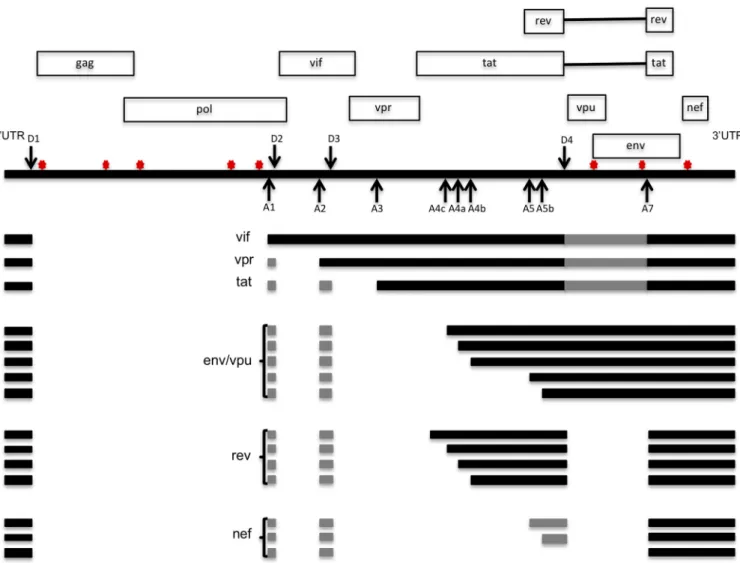
The numerous spliced HIV-1 mRNAs are generated through the utilization of at least four splice donor sites (D1, D2, D3, D4) and eight acceptor sites (A1, A2, A3, A4c, A4a, A4b, A5, and A7) (1–3) (Fig. 1). All spliced RNAs use D1, located in the 5=noncoding region, and one of the downstream acceptor sites (1, 2). The members of the fully spliced 1.8-kb class of RNAs undergo further splicing to remove the D4-A7envintron (1, 2). A small fraction of RNAs contain two additional small exons in their 5= untrans-lated regions (UTRs), A1-D2 and A2-D3, generated by utilization of the D2 and D3 donor sites (1, 2). It has been proposed that inclusion of these exons can impact transcript stability, splicing, and viral gene expression in heterologous expression systems (1, 2, 8–10). However, it remains to be determined whether they have a functional impact on HIV-1 replication. Additional cryptic splice donor and acceptor sites are utilized at lower frequencies (4), but it is currently unknown whether these alternative splicing events have a functional significance.
The intrinsic strengths of the donor and acceptor sites are governed in part by the
extent of their similarity to the consensus donor and acceptor sequences (2). For example, the D1 sequence is 100% identical to the consensus sequence, and all subsequentsplicingeventsrequiretheuseofD1.Otherdonorandacceptorsitesare generally suboptimal,andtheir utilizationisfurtherregulatedbyproximalcis-acting elements,includingexonic splicingenhancers (ESEs),exonicsplicingsilencers(ESSs), and intronic splicing silencers (ISSs). These cis-acting elements can bebound by membersoftheserine-arginine-richproteinfamily(SRproteins)andtheheterogenous nuclearribonucleoprotein(hnRNP)family,whichgenerallyenhanceandrepresstheuse of nearby splice sites, respectively. However, splice site utilization is often context dependentandreflectsthecombinatorialnatureofbothcis-andtrans-actinginputs (11).
hnRNPs have also been ascribedadditional roles, including theretention of un-splicedviralgenomicRNAinthenucleus(12,13),nuclearexportofviral/cellularRNAs (14),andviralmRNAtranslation(14,15).ThemajorityofhnRNPproteinsarelocalized primarilyinthenucleus,butcertainhnRNPscanshuttlebetweenthenucleusandthe cytosol (16).Cytosolic hnRNPscanlocalize toRNA/stressgranulesandregulate pro-cesses such asRNA translation, storage, degradation, andstress responses(17, 18). Notably, HIV-1infectionmay preventtheassembly ofstressgranules (19,20). Thus, hnRNPs could affect HIV-1 replication by influencing splice site utilization or later events intheviruslife cycle,including nuclearexport,RNA stability,trafficking,and translation.
hnRNPsaremodularproteinsthatcommonlyencode2to4RNArecognitionmotifs (RRMs)orKhomology(KH)domains.MosthnRNPsalsocontainRGGboxes(Arg-Gly-Gly repeats)andauxiliarydomainswithdistinctiveaminoacidcompositions(e.g., glycine-rich,acidic,orproline-rich domains)thatprimarilymediateprotein-proteinand non-specificnucleicacid-proteininteractions(21).Thegeneralconsensus,basedon invitro
bindingstudies,isthathnRNPsformspecificcontactswithshortdegeneratesequences using RRM orKH domains.For somehnRNPs, the sequencepreferences have been furthersubstantiatedusingglobalandcompetitivebindingmethods(22–24).
Basedprimarilyonexperiments employinginvitrosplicingreportersandgenetic assays,afewhnRNPproteinsarethoughttoplayparticularlyimportantrolesinHIV-1 alternativesplicing.MembersofthehnRNPA/Bfamilyhavebeenstudiedmost exten-sivelyandshowntobindtotheexonicsplicingsilencersESS2within tatexon2(25,26); ESS3,locatedwithin tat/revexon3(27,28);ESSV,locatedinthe vif-codingexon(29); and an ISS element withintat intron 2 (28, 30, 31). Similarly,hnRNP H1 has been suggestedtobindtoESS2p(32),acrypticexonwithintheEnvopenreadingframe(33, 34),andG-richmotifswithin tatexon2(35)andtatintron3(36).Otherstudieshave proposed that hnRNP D (37), hnRNP E (38), and hnRNP K (39)can regulate HIV-1 splicing.Inmoststudies,regulationofHIV-1splicinghasbeenstudiedusing invitroand
invivosplicingreporters,whereinviralsubgenomicfragmentsweremovedtoforeign geneticenvironmentssoastodeterminehowtheyinfluencethedistributionofspliced reporterproducts.Inaddition,thebindingofhnRNPstotargetelementswasassessed largely in vitro, using defined targets. Whether the presumed target sites are also selectivelyboundbyhnRNPsincellsandwhether otherbinding sitesonHIV-1RNA existareunknown.
weredepletedortheirbindingsitesweremutated.WefoundthatthehnRNPA/Bgroup ofproteinsdoesnotbindtodiscreteelementsonHIV-1RNA.Rather,theybindtomany sitescontainingAGGmotifsthatarewidespreadinHIV-1RNA.Instarkcontrast,hnRNP H1boundtoasmallnumberofdiscretesiteswithintheviralgenome,comprisedof fourormoreconsecutiveguanosines,frequentlyembeddedinA-richelements. Com-plementarybiochemicalandNMRexperimentswithisolatedRNA-bindingdomainsof hnRNP H1 revealed a clear preference for G-rich sequences. Notably, depletion of hnRNPsusingRNAinterference(RNAi)perturbedsplicing,mostprominentlyatA1,A2, and/orA3.MutationsatdiscretehnRNPH1bindingsitesonviralRNAalsoperturbed HIV-1splicingand, inparticular,decreased theuseof spliceacceptor A1,causinga reductioninVifexpressionandviralfitness.Overall,ourstudiesprovidean experimen-tal framework to study an essential step of HIV-1 replication in a quantitativeand comprehensivemannerandingreaterdetailthanwaspreviouslypossible,andreveal anovelhnRNPH1bindingcis-regulatoryelementthatcontrolsHIV-1splicing.
RESULTS
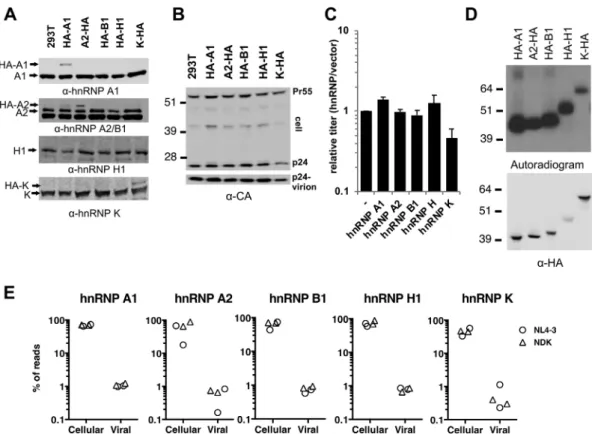
Expression of 3ⴛHA-tagged hnRNP proteins for CLIP assays. We previously showedthat thepattern of HIV-1RNA splicingisstrikingly similarinHEK293T cells transfectedwithproviralplasmidsandinfectedTcelllines(43).Thus,fortheease of furthermanipulation,wefirstgeneratedHEK293T-derivedcelllinesthatstablyexpress 3ⴛHA-tagged versions of the hnRNP A1,A2, B1, H1,and K proteinsat lower-than-endogenouslevels.Thus,thetotallevelsofeachhnRNPwereonlymarginallyaffected (Fig.2A).Importantly,thesemanipulationsdidnotaffectviralprotein(Gag)expression incellstransfectedwithproviralplasmids(Fig.2B),nordidtheyaffectparticlerelease (Fig.2B)orvirioninfectiousness(Fig.2C).
Cellsweregrowninthepresenceof4-SUandUVirradiatedtoinduceprotein-RNA cross-linking at 4-SU-modified nucleotides. Following RNase digestion, hnRNP-RNA adductswereimmunoprecipitated,thecross-linkedRNAwaslabeledwith polynucle-otidekinase,andtheadductswerevisualizedbyautoradiographyfollowingseparation by SDS-PAGE and transfer to nitrocellulose membranes. All of the tagged hnRNPs cross-linked to cellular RNAs andwere efficiently immunoprecipitated (Fig. 2D). To identifybindingsitesforhnRNPsonviralRNA,similarexperimentswereconductedin cellstransfectedwithaplasmidcontainingafull-lengthDNAcopy oftheHIV-1NL4-3
(subtype B) orHIV-1NDK(subtypeD) viral genome.Cross-linked hnRNP-RNA species
wereisolatedbyimmunoprecipitationandenzymaticdigestion,togenerateCLIP-seq libraries.TwoindependentlibrariesforeachhnRNPandeachvirusstrainwere gener-ated.Afterhigh-throughputsequencing, theCLIPreadsweremappedtothehuman andHIV-1genomes(Fig.2E).Themajorityofsequencingreadsmappedtothehuman genome,andonlyasmallfractionofreads(⬃1%orless)werederivedfromviralRNAs (Fig.2E).Becausethesevaluesreflecttheapproximaterelativeabundanceofviraland cellularmRNAsinsimilarsettings(44),wespeculatethathnRNPsmaybindwithsimilar frequenciestoviralandcellularRNAs.
revealed the presence of CGAU and CCAUAGA motifs within a subset of cellular binding sites (Fig. 3C).
FIG 2Generation of cell lines stably expressing HA-tagged hnRNPs and summary of CLIP experiments. (A) Western blot analysis of stably expressed HA-tagged and endogenous hnRNP proteins in the HEK293T cells used for CLIP experiments. (B, C) HEK293T cells expressing 3⫻HA-tagged hnRNPs were transfected with HIV-1NL4-3. (B) Western blot analysis of cell lysates and virions using an anti-CA antibody. (C) Infectious virion yield was determined using MT4-green fluorescent protein reporter cells. Values are normalized to the infectious virion yield from cells transduced with the empty vector-only control and represent
the average from two independent experiments. (D) Immunoprecipitated and [32P]ATP- and polynucleotide kinase-labeled
hnRNP-RNA adducts from 4-SU-treated cells were visualized by autoradiography (top). Western blot analysis of the same membranes (bottom). (E) Proportion of raw CLIP-seq reads that map to the human (cellular) and viral genomes, obtained from
experiments conducted with HIV-1NL4-3and HIV-1NDK. Data represent those from four independent CLIP-seq experiments (two
with HIV-1NL4-3and two with HIV-1NDK). Numbers to the left of gels in panels B and D are molecular masses (in kilodaltons).
BindingsitesofhnRNPsonviralRNAs.Next,wedeterminedwhereonviralRNAs hnRNPsboundandwhetherthebindingspecificitiesofhnRNPsforviralRNAsmirrored those for cellular RNAs. Although hnRNP A1, A2, and B1 proteins were previously proposed to bind to discrete sequences on HIV-1 RNAs (25–31), our CLIP analysis revealedmany bindingsites dispersed acrossthe viralgenome, whichappeared to indicate alack of specificity (Fig. 4and5). Nevertheless, regions overlapping splice acceptorA7(atapproximatelynucleotide[nt]7860)andsequencespositioned3=toA7 (atapproximatelynt8300)werefrequentlyboundinbothHIV-1NL4-3andHIV-1NDK(Fig.
4and5).Possibly,thesepatternsofbindingmayreflectthespreadingofhnRNPsinthe 5= and 3= directionthrough oligomerization, following an initial interaction with a high-affinitybindingsite(51).ThebindingpatternsofthecloselyrelatedhnRNPA1,A2, andB1proteinsweresimilaronboththeHIV-1NL4-3andHIV-1NDKgenomes.However,
hnRNPB1bindingappearedtobemoreprominentatdiscretelocations(Fig.4and5). Potentially, this property might be due to thepresence of an extended N-terminal domain in hnRNP B1 that contains several basic amino acids that may alter its RNA-bindingaffinityandspecificity.
FIG 3Classification of hnRNP-bound cellular RNAs and the binding motifs identified within them. (A) hnRNP CLIP-seq-derived sequencing reads were mapped to the human genome, clustered, and classified based on whether they map to RNA-coding genes (genic) or intergenic regions. The total number of sequencing reads in each RNA class is represented below the pie charts. (B) Further classification of genic clusters is detailed. The total number of sequencing reads in each group is represented below the pie charts. miRNA, microRNA; lincRNA, long intergenic noncoding RNAs. (C) Binding motifs within these clusters and the cumulative percentages of their occurrence within clusters.
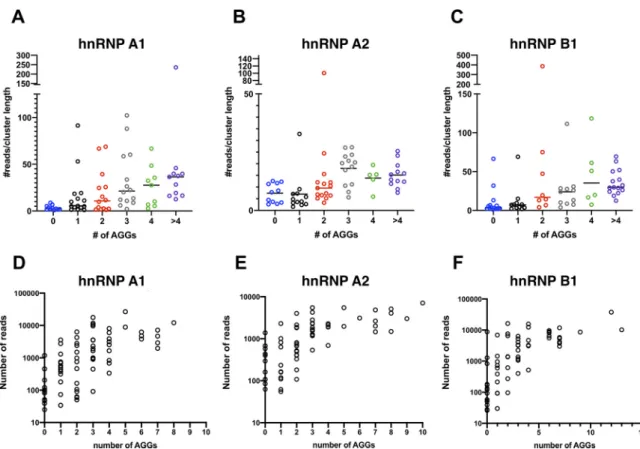
clusters,asdeterminedbyuseofthePARalyzertool)containedoneoroftenmultiple AGGmotifs(Fig.4and5).Furthermore,anincreasednumberofAGGrepeatswithina clusterofreadsinviralRNAcorrelatedwithanincreasedreaddensity(Fig.6AtoC)and anincreasedabsolutenumberofreadsassociatedwiththatcluster(Fig.6DandE).
Incontrast tothewidespreadbindingpatternof hnRNPA/B proteins,hnRNPH1 boundtoasmallnumberofdiscrete,well-definedsequencesonHIV-1RNAs(Fig.7A and B). While the majority of the binding sites were conserved in HIV-1NL4-3 and
HIV-1NDK,themostfrequentlyboundsitewithinHIV-1NL4-3(atapproximatelynt5800)
wasnotpresentinHIV-1NDK(Fig.7AandB).Althoughapreviousstudyindicatedarole
for hnRNP K inthe regulation of HIV-1 splicing(39), hnRNP K binding to the viral genomewasatbackgroundlevels(Fig.7AandB).ThepaucityofCnucleotidesinthe HIV-1genome(52)andtheevengreaterrarityofCGdinucleotides(53)maycontribute totherelativelackofhnRNPKbindingtotheHIV-1genome.
FIG4BindingsitesofthehnRNPA1,A2,andB1proteinsonviralRNAs(NL4-3)derivedfromCLIP-seq.
HEK293Tcellsstablyexpressing3⫻HA-taggedhnRNPA1,A2,andB1proteinsweretransfectedwitha
full-lengthHIV-1NL4-3proviralplasmidpriortoCLIP-seqanalysis.Thefrequencydistributionofnucleotide
occurrence(readdensity,yaxis)ofreadsmappingtoHIV-1NL4-3isshownforhnRNPA1(black),hnRNPA2
(red),andhnRNPB1(blue).ThepositionsoftheAGGmotifsintheHIV-1genomeareindicatedasredlines
andareoverlaidontheCLIPdata.
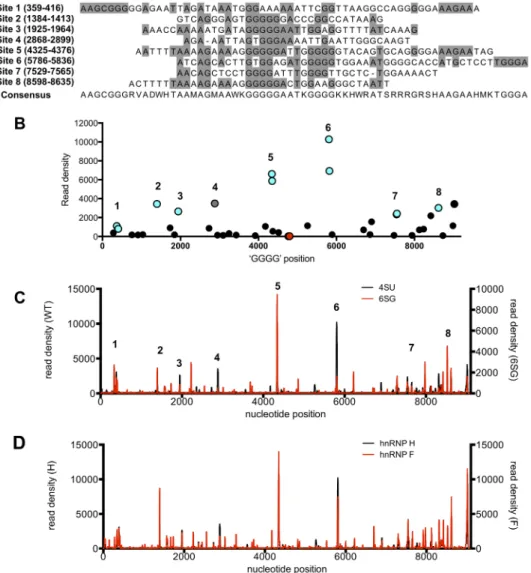
A-richflankingsequencesratherthanaGGGGmotif(Fig.8AandB).Ofthe41GGGG motifsintheHIV-1NL4-3genome, 39werecoincidentwithhnRNPH1bindingpeaks,
FIG5BindingsitesofthehnRNPA1,A2,andB1proteinsonviralRNAs(NDK)derivedfromCLIP-seq.HEK293T
cellsstablyexpressing3⫻HA-taggedhnRNPA1,A2,andB1proteinsweretransfectedwithafull-length
HIV-1NL4-3proviralplasmidpriortoCLIP-seqanalysis.Thefrequencydistributionofnucleotideoccurrence (readdensity,yaxis)ofreadsmappingtoHIV-1NL4-3isshownforhnRNPA1(black),hnRNPA2(red),andhnRNP B1(blue).ThepositionsofAGGmotifsintheHIV-1genomeareindicatedasredlinesandareoverlaidonthe CLIPdata.
FIG 6Increased occurrence of AGG motifs correlates with increased read density in hnRNP A1-, hnRNP A2-, and hnRNP B1-bound viral
clusters. Reads that map to the viral genome (HIV-1NL4-3) derived from the hnRNP A1, A2, and B1 CLIP experiments were formed into
clusters (i.e., discrete binding sites) using the PARalyzer tool. (A to C) The number of AGG motifs in each cluster (xaxis) and the
corresponding normalized read density (number of reads/cluster length,yaxis) in each cluster are shown. (D to F) Number of AGG motifs
(xaxis) and the corresponding number of reads (yaxis) in each cluster are shown.
CLIP-seqexperiments(Fig.8C).Othersites,includingsite5(nucleotides4325to4376), which includes the central polypurine tract, remained among the most frequently hnRNPH1-boundsites(Fig.8C).
hnRNP H1 isone of afamily of three closely relatedproteins (theothers being hnRNP H2 and hnRNP F). To determine whether another member of this family exhibitedsimilarbindingproperties,wemappedhnRNPFbindingsitesusingCLIP-seq. ThemajorityofthehnRNPFandhnRNPH1bindingsites,includingsite2(nucleotides 1384to1413),site5(nucleotides4325to4376),andsite6(nucleotides5786to5836), overlapped,butsomeadditionallower-frequencybindingsiteswereobserved(Fig.8D). Overall,thesefindingscorroboratethefindingsoftheaforementionedCLIP-seqstudies withhnRNPH1(Fig.7AandB)andindicatetheexistenceof severalspecificbinding sitesforhnRNPH1andcloselyrelatedproteinsonHIV-1RNAs.
CalorimetricandNMRtitrationsvalidatehnRNPH1RNA-bindingpreferences. Human hnRNP H1consistsof three quasi-RNArecognition motifs(qRRMs) andtwo glycine-richdomains.AtitsNterminus,qRRM1andqRRM2areconnectedthroughan approximately20-amino-acidlinker(referredtohereasHqRRM1,2),whereasqRRM3is embeddedbetweentheglycine-richdomainsatitsCterminus.Whilemembersofthe hnRNPH/FfamilyareknowntobindG-richsequences,ourCLIP-seqexperimentsreveal anobviousA-richpreferencesurroundingthesesequences(Fig.8A).Toquantitatively describehowhnRNPH1bindspurine-richsequences,wecarriedoutcalorimetricand nuclear magneticresonance (NMR)titrations. Calorimetrictitrationsof itsHqRRM1,2 domainwithanRNAoligonucleotidecorrespondingtosite5showedthatHqRRM1,2 bindssite5withamoderateaffinity(KD[dissociationconstant]⫽0.62M)andwitha
FIG 7Binding of hnRNP H1 and K on the NL4-3 and NDK genomes. HEK293T cells stably expressing 3⫻HA-tagged hnRNP
H1 and hnRNP K proteins were transfected with full-length HIV-1NL4-3and HIV-1NDKproviral plasmids prior to CLIP-seq
analysis. For each chart, the position in the HIV-1 genome is represented on thexaxis, and the schematic diagram of HIV-1
genome features shown below the charts is colinear. The frequency distribution of nucleotide occurrence (read density)
of reads mapping to the HIV-1NL4-3(A) and HIV-1NDK(B) genomes derived from the hnRNP H1 (red) and hnRNP K (blue) CLIP
experiments is shown.
contributetobindingaffinitysincetitrationsofHqRRM1,2 witha5=-AAAAA-3= oligo-nucleotide showed no binding (Fig. 9A). Furthermore, titrations with 5=-AGGAC-3= revealedthatbindingrequires⬎2consecutiveguanosines(Fig.9A).
We next performed calorimetric titrations with model RNA oligonucleotides: 5=-AGGGG-3=, 5=-AGGGA-3=, and 5=-AGGGC-3= (Fig. 9A).Similar experiments with a 5=-AGGGU-3= oligonucleotidewere previouslyreported(54).HqRRM1,2 boundallthree oligonucleotideswithmoderateaffinities(KD[bindingdissociationconstant]⫽0.19to
2.4 M). However, it bound 5=-AGGGG-3= the tightest, followed by 5=-AGGGA-3=, 5=-AGGGU-3=(54),and5=-AGGGC-3=(Fig.9A),indicatingapreferenceforapurineand for G in particular at position 5. The binding stoichiometry for the HqRRM1,2-(5=-AGGGG-3=) complex was ⬍0.5, which we determined by NMR to be a result of a preexisting single-strand-to-G-quadruplex equilibrium of 5=-AGGGG-3=.The stoichio-metricratiosforallothercomplexesareconsistentwith1:1binding,suggestingthat theseoligonucleotidespredominantlyadoptasingle-strandconformationunder solu-tionconditions. Heteronuclear single quantumcoherence (HSQC) titrations,wherein uniformly 15N-labled HqRRM1,2 was titrated with unlabeled 5=-AGGGC-3=, revealed
broadeningoftheNMRsignalsforHqRRM1,2andindicatedthatbindingspecificityis governed by both the qRRM1 and qRRM2 domains (Fig. 9B and C), similar to our previousobservationswith5=-AGGGU-3=(54).
FIG 8hnRNP H1 binds to purine-rich sequences on the viral genome. (A) Sequence alignment of the eight most frequently hnRNP H1-bound sites, as derived from CLIP-seq analysis shown in Fig. 2. (B) The locations of the 41
GGGG motifs on the HIV-1 genome (xaxis) and the corresponding read density derived from the CLIP experiments
(yaxis) are shown. Blue circles indicate the eight most frequently bound sites, and red circles denote the GGGG
motifs with the background read density. Note the presence of a high-frequency binding site that does not contain a GGGG motif, shown by a gray circle. (C and D) Comparison of the frequency distribution of nucleotide occurrence
(read density) of reads mapping to the HIV-1NL4-3genome derived from CLIP-seq experiments conducted using
4-SU- versus 6-SG-fed cells (C) or in hnRNP H1- versus hnRNP F-expressing cell lines (D).
(HIV-1NL4-3/VSV-G)andHIV-1NDK(HIV-1NDK/VSV-G)followingthetransfectionofsmall
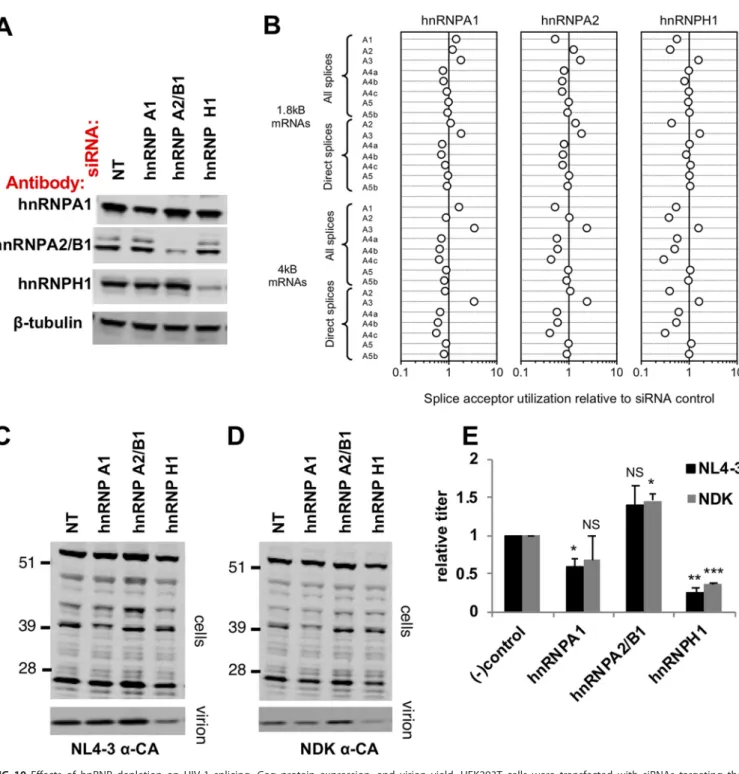
interferingRNA(siRNA)duplexestargetinghnRNPA1,A2/B1,andH1.Asexpected,the levelofeachhnRNPproteinwasreduceduponsiRNAtransfection,althoughinthecase ofhnRNPA1,themagnitudeoftheknockdownwasmodest(⬃2-fold)(Fig.10A).We determinedtheeffectsofhnRNPknockdownonHIV-1alternativesplicingincellsusing anext-generationsequencing-basedassayincorporatingtheprimeridentifier(primer ID)approach(43)andtargetingthe1.8-kbcompletelysplicedclassofmRNAs.Notably, eachhnRNPdepletionincreasedtheuseofspliceacceptorA3(Fig.10B).Additionally, hnRNPA2/B1andhnRNPH1depletionreducedA1utilization,andhnRNPH1depletion alsodecreasedA2usage(Fig.4B).hnRNPH1depletionreducedbothHIV-1NL4-3(Fig.
10C) andHIV-1NDK (Fig. 10D)Gag expression incells, resulting ina commensurate
FIG 9hnRNP H1 exhibits specificity for G-rich sequencesin vitro. (A) Representative calorimetric titration profiles of HqRRM1,2 titrated into model oligomers. The titrations were performed at 298 K and in 20 mM sodium phosphate
infectiousvirionyield,respectively(Fig.10CtoE),withthecaveatthatthemagnitude of hnRNP A1depletionwasmodest.Overall,depletionof eachhnRNP hada distin-guishableoutcomeontheoverallpatternofviralsplicing,particularlyontherelative utilization of A1, A2, and A3, but had relatively modest effects on overall virion production. However, deleterious effects on infectious virion yield were clear and significantinthecaseofhnRNPH1depletion.
EffectofmutationswithinhnRNPH1bindingsitesonhnRNPH1bindingand HIV-1splicing.BecausehnRNPH1boundtodiscretesitesonHIV-1RNA(Fig.7Aand B)anditsdepletionwasdeleteriousfortheinfectious virionyield(Fig.10CtoE),we nextdeterminedwhetherandhowindividualhnRNPH1bindingsitesaffectedHIV-1 alternativemRNAsplicing.Mutationswithintheeightmostfrequentlyboundsiteswere introduced,suchthatnomorethantwoconsecutiveAorGnucleotidesremained(Fig. 11A;Table1).Althoughthemajorityofthesemutationsweresynonymous, conserva-tiveaminoacidsubstitutions(i.e.,lysinetoarginine)wereintroducedwithinhnRNPH1 binding sites when necessary (Table 1).Transfection of HEK293T cells with proviral plasmidsyieldedsimilarlevelsofinfectiousvirusrelativetothewildtype(WT)forthe majorityofthemutants(Fig.11B),withtheexceptionofamutationwithinsite8,within the3=polypurinetract.Mutationsinsite8areexpectedtoreducetheinfectiousnessof virionsfromtransfectedcellsirrespectiveofanypotentialeffectsonsplicing,duetothe requirementforthe3=polypurinetractduringreversetranscription.Finally,mutations introducedwithinalleightoftheprominenthnRNPH1bindingsitesabolishedhnRNP H1bindingtothosesitesanddidnotleadtotheemergenceofotherhigh-frequency bindingsites(Fig.11C).
HEK293T cells were transfected with one of eight HIV-1NL4-3 proviral plasmids
containingmutationsatanindividualprominenthnRNPH1bindingsiteoraplasmid inwhichalleighthnRNPH1bindingsitemutationswererepresented(Fig.11A;Table 1).Thereafter, mRNAsplicing wasanalyzed usingthe primerID/next-generation se-quencingapproach(43).WhilethemajorityofmutationshadmodesteffectsonHIV-1 splicing,mutationofsite5reducedtheuseofspliceacceptorA1toasimilardegreeas didhnRNP H1knockdownbutdidnotaffecttheutilizationof othersplicesites(Fig. 11D).ThisdiscrepancycouldbeduetoindirecteffectsofhnRNPH1knockdownand/or thecomplexcombinatorialeffectsinvolvingmultiplehnRNPH1bindingsites.Notably, site5constitutedthemostfrequentlyboundsiteinallhnRNPH1CLIP-seqexperiments andissituatedproximaltospliceacceptorA1(Fig.7Aand11A).Mutationofalleight prominenthnRNPH1bindingsitesledtoamoredramaticreductionofA1utilization andmodestperturbationsoftheuseofothersplicesites,suggestingacontributionof distalhnRNPH1bindingsitestotheregulationofA1use(Fig.11D).
WhilehnRNPH1depletiondiminishedA2usageandslightlyenhancedA3usage, the hnRNPbindingsitemutationsdidnotrecapitulatetheseeffects(compareFig. 10BversusFig.11D).TheenhancementofA3usagefollowinghnRNPH1depletion was small (⬍2-fold), and because A3 is comparatively infrequently used, small changesin itsutilizationhave acomparativelylarge fold effect.Nevertheless, the inability of the binding site mutations to completely recapitulate the effect of hnRNP H1 knockdown could bedue to residual hnRNP H1 binding at sites other thansites1to8.Alternatively,theeffectsofhnRNPH1depletiononA2utilization might beindirect.
FIG9Legend(Continued)
(pH6.2),20mMNaCl,4mMTCEP.AlltitrationdatawereprocessedandanalyzedusingAffinimetersoftware.The
processedthermogramswerefittoa1:1stoichiometricbindingmodel;therefore,thestoichiometriesreflectthe
concentrationsofactivebindingsites.Thevaluesofthebindingdissociationconstants(KD)andthecorresponding
standarddeviationsarefromduplicateexperiments.Thegoodnessoffit(x2)oftheexperimentaldatatothe1:1
binding modelis reported foreach titration. (B) Overlay of 1H-15N HSQC spectra of freeHqRRM1,2 (red)and
AGGGC-bound HqRRM1,2(black) at a 4:1 molar ratio. Residues that completelydisappear in thepresence of
saturatingamountsofAGGGCarelabeled.(C)SurfacerepresentationsofHqRRM1,2colorcodedbyresiduesthat
FIG 10Effects of hnRNP depletion on HIV-1 splicing, Gag protein expression, and virion yield. HEK293T cells were transfected with siRNAs targeting the
indicated hnRNPs and infected with HIVNL4-3/VSV-G or HIVNDK/VSV-G at 1 day posttransfection, and then the cells and viruses were harvested at 2 days
postinfection for further analysis. (A) Expression of targeted hnRNPs was determined by immunoblotting against the indicated hnRNPs. (B) Analysis of the direct and all splicing events that occur at acceptors A1 to A5b in the 1.8-kb (completely spliced) class of viral RNAs. The fold change for unmanipulated controls in independent experiments and the fold change in hnRNP-depleted cells versus unmanipulated cells in a representative experiment are shown. (C, D) Western blot analysis of cell lysates and virions using an anti-CA antibody for HIVNL4-3(C)- or HIVNDK(D)-infected cells. Numbers to the left of the gels are molecular masses (in kilodaltons). (E) Virus titers in cell culture supernatants was determined on MT4-GFP indicator cells. Data are normalized to these for nontargeting
siRNA-transfected cells (NT) and show the average⫾SEM from three independent experiments. A pairedttest was performed to assign statistical significance.
NS, not significant;*,P⬍0.05;**,P⬍0.01;***,P⬍0.001.
levels were determined 2 days after infection. Mutations within the majority of sites did not have statistically significant effects on protein expression, but a mutation within site 5 (mut5) caused a specific decrease in Vif expression (Fig. 12A and B). This finding is concordant with the observed reduction in the use of A1, which controls Vif expression (Fig. 11D). Curiously, the mutation within site 8, within the 3= polypurine tract, led to a significant decrease in Env and Nef expression (Fig. 12A and B). It is possible that reductions in Nef protein levels are a consequence of nonsynonymous substitutions in the underlying coding sequence (two Lys-Arg substitutions). Moreover, the mutations at site 8 resulted in the inadvertent intro-duction of a cluster of 5 CG dinucleotides within a 13-nucleotide stretch. This is
FIG 11Mutation of hnRNP H1 binding sites alters HIV-1 alternative splicing. (A) Schematic diagram of the splice acceptors, donors, and hnRNP H1 binding sites (red asterisks) (not to scale). (B) Infectious virion yield for VSV-G-pseudotyped hnRNP H1 binding site mutants using TZM-bl target cells. (C) Frequency
distribution of nucleotide occurrence (read density) of reads mapping to the HIV-1NL4-3genome derived from CLIP-seq experiments conducted in hnRNP
H1-expressing cells transfected with WT versus hnRNP H1 binding site mutant proviral clones. (D) Splice acceptor use for the 1.8-kb and 4-kb classes of RNAs is shown for viruses in which all eight hnRNP H1 binding sites were mutated (mut1-8) or viruses in which individual hnRNP H1 binding sites were mutated (mut1 to mut8).
TABLE 1Mutations of the hnRNP H1 binding sites assigned based on CLIP-seq experimentsa
aThemutations(inred)arederivedfromFig.7.
highlyunusual inmammalian or viralmRNAsand couldpotentially resultin their depletion (53). Note that control experiments conducted in the presence of the reverse transcriptase inhibitor nevirapine indicated that the viral proteins were synthesized de novoand donotrepresent input virusproteins(Fig.12A).
Because themut5viruscontainedonly synonymousmutations(Table1)andthe mutationsinthemut5virusinducedaspecificsplicingperturbationataproximalsplice site(A1)andalowerlevelofVifexpressionthatcouldbeascribedtothelossofhnRNP binding, we tested whether the mut5 virus had reduced fitness in a competitive spreading replication assay. The mut5 virus replicated indistinguishably from WT HIV-1NL4-3intheabsenceofcompetition,indicatingthatanyfitnessimpactresulting
frommutationsatthissiteweremodest(Fig.12C).However,independentcompetition experiments in which H9 and CEMx174 cells, which express APOBEC3G (55), were infectedwithWTandmut5virusrevealedthatthepercentageofWTvirusincreased (Fig.12DandE)overtime.Overall,theseexperimentsrevealthatmutationofanovel
DISCUSSION
FIG 12Mutation of hnRNP H1 binding sites alters HIV-1 gene expression and replication. (A, B) MT4 T cells were infected with the
indicated VSV-G-pseudotyped hnRNP H1 mutant viruses at an MOI of 0.5 IU/cell in the absence and presence of 5M nevirapine (Nev).
(A) Gag, Vif, Nef, Env, and actin protein levels in cell lysates were analyzed by immunoblotting 2 days later. (B) Mean values⫾SEM
from quantitation of Western blots from 4 independent experiments are shown. A pairedttest was performed to assign statistical
significance.*,P⬍0.05;**,P⬍0.01;***,P⬍0.001;****,P⬍0.0001. (C) MT4 cells were infected with WT and mut5 viruses at an MOI of 0.001 IU/cell, and virus spread was monitored using a quantitative PCR-based reverse transcriptase (RT) activity assay over 7 days. Data are representative of those from 4 independent replication experiments. (D) CEMx174 cells were infected with hnRNP H1 site 5
mutant virus. WT HIV-1NL4-3was added to the established infection. Culture supernatant was harvested daily to sequence viral RNA
and infect fresh cells. (E) H9 cells were infected as described in the legend to panel D. Supernatant was harvested every 4 days, and viral RNA was sequenced.
AlternativesplicingofHIV-1mRNAshastraditionallybeenstudiedusingindividual
topreviousstudies, CLIP-seqexperiments revealedthatmembers ofthehnRNP A/B family bind broadlythroughout viralRNA, inpartby targeting frequently occurring AGGmotifs.Incontrast,hnRNPH1boundtodiscreteG-richsequenceelements,often consistingoftwoormorecopiesofaGGGGsequence.Assuch,itwouldbeexpected thattheviralgenomecontainsfarmorenumeroushnRNPA/BbindingsitesthanhnRNP H1bindingsites,whichisindeedwhatweobserved.
BindingofhnRNPH1atthemostfrequentlyboundsite(site5),nearA1,enhanced splicingatthissite.Indeed,mutationsatthissiteledtoasignificantdecreaseintheuse of A1andVifexpression. WhilehnRNPsaregenerallythought torepresssplicingat nearbysites,manyactinacontext-dependentmannerandcanexhibitspliceenhancer orsilenceractivities(56).Whilewecannotexcludethepossibilitythatthemutations employedhereininadvertentlyintroducedaninhibitorelementatsite5,thefactthat themutationsphenocopiedtheeffectofhnRNPH1depletion,atleastintermsofA1 usage,arguesagainstthispossibility.
OurfindingthatthehnRNPA1andA2/B1proteinsboundtomanysitesonHIV-1 seemsatoddswiththenotionthatspecificbindingoftheseproteinstoESSandISS elementscontrolssplicing.However,hnRNPscanrepresstheassemblyofspliceosomes through multimerization along exons (57). Therefore, the broadbinding pattern of hnRNP A1 andA2/B1 proteinson viralRNA may, inpart,be theresultof an initial interaction with high-affinity binding sites (e.g., ESS or ISS elements), followed by oligomerization atlower-affinitybindingsites.Itisalsopossiblethatnot allbinding eventsidentifiedbyCLIP-seqarerelevanttosplicingregulationbutreflectotherroles forhnRNPs.Indeed, hnRNPproteinshaveknownregulatoryrolesintheretention of unspliced viralgenomicRNA in thenucleus(12, 13); inthenuclear exportof viral/ cellularRNAs(14);inmRNAtranslation,storage,degradation;andinstressresponses (14,15,17,18,58).WhileatsteadystatethemajorityofhnRNP/SRproteinsarelocalized inthenucleus,manyhnRNP/SRproteinsshuttlebetweenthenucleusandthecytosol (16, 59). Because theCLIP-seq experiments weredone usingwhole-cell lysates,itis possiblethatsomeofthebindingevents documentedhereinmayserverolesother thansplicingregulation.
existsinaconformationalequilibriumbetweencompactandextendedstructures(54). The compact structure has both qRRMs juxtaposed, generating acontinuous RNA-binding surface that would accommodate only a single isolated G-tract element. ConverselytheextendedconformermaybindtranscriptswithmultipleGtracts sepa-ratedbyshortlinkersequences.Inparticular,site5,whichshowsarobustcontribution tosplicing,containstandem6-merGtractsconnectedbya5=-ATT-3=linker.Similarly, othershaveshownthathnRNPH1bindstranscriptscontainingbipartiteG-tractcores separatedbyaspacerof0to4nucleotides(61).
Together,ourstudiesrevealthepreciselocationsofelementsonHIV-1RNAsthatare boundbyhnRNPsandhowthesebindingeventsregulateHIV-1splicing.Indoingso, we have revealed an unexpected splicing enhancer activity for hnRNP H1 and its
cis-actingregulatorytargetelementthatmodulatesVifexpression.Finally,thesestudies provideaframeworktofurtherinvestigatehownumeroustrans-actingproteinsand
cis-actingRNA elementsregulateHIV-1alternativemRNAsplicingbothina compre-hensivemannerandingreaterdetail.
MATERIALSANDMETHODS
Cellculture,transfection,andinfections.HeLacell-derivedTZM-blMT4,H9,andCEMx174cells
(NIHAIDSReagentProgram)andHEK293Tcells(ATCCCRL-11268)cellsweremaintainedunderstandard
conditions.Full-lengthHIV-1infectiousDNAplasmidclonesandderivativesthereofweretransfectedinto
HEK293TcellseitheraloneortogetherwithaVSV-G-expressionvectorataratioof4:1using
polyeth-ylenimine(PolySciences).TogenerateHEK293Tcellsstablyexpressing3⫻HA-taggedhnRNPs,cellswere
transducedwithVSV-G-pseudotypedretroviralvectors.Followingselectioninmediumsupplemented
with50g/mlhygromycin,single-cellclonesweresubsequentlyisolated.ForCLIPexperiments,HEK293T
cellsstablyexpressing3⫻HA-taggedhnRNPsweregrownin15-cmdishesandtransfectedwith30g of
proviralplasmidsusingpolyethylenimine(PolySciences).Inotherexperiments,HEK293Tcellsgrownin
24-wellcellculturedishesweretransfectedwithsiRNAduplexesagainsthnRNPsusingtheLipofectamine
RNAimaxreagent(LifeTechnologies).At1daypost-siRNAtransfection,cellswereinfectedwith
VSV-G-pseudotypedHIVNL4-3orHIV-1NDK,andviralgeneexpressionwasanalyzed2dayslater.
Antibodies.Antibodieswereasfollows:mousemonoclonalanti-HA.11(catalognumberMMS-101R;
Covance),mousemonoclonalanti-hnRNPA1(catalognumberSC-32301;SantaCruz),mousemonoclonal
anti-hnRNP A2/B1(catalognumberSC-374053;Santa Cruz),goatpolyclonalanti-hnRNP H1(catalog
numberSC-10042;SantaCruz),mousemonoclonalhnRNPK(catalognumberSC-28380;SantaCruz),and
mousemonoclonalanti-HIV-1p24CA(catalognumber183-H12-5C;NIHAIDSReagentProgram).
Plasmids.Full-lengthviralDNAplasmidspHIV-1NL4-3(NIHAIDSReagentsProgram)andpHIV-1NDK
weredescribedpreviously(62,63).N-andC-terminally3⫻HA-taggedhnRNPs wereclonedintothe
pCR3.1andpLHCX(Clontech)vectorbackbones.hnRNPH1bindingsitemutationsweregeneratedon
thepHIV-1NL4-3viralDNAbackbonebyoverlap-extensionPCR(Table1).
CLIP-seqexperiments.CLIP-seqexperimentswereconductedasdescribedpreviously(44).Briefly,
HEK293Tcellsexpressing3⫻HA-taggedhnRNPsweretransfectedwithviralDNAplasmidsandgrownin
the presence of 4-thiouridine. Cells were washed and UV cross-linked at 365nm.Following lysis,
hnRNP-RNAcomplexeswereimmunoprecipitatedusingantihemagglutinin(anti-HA)monoclonal
anti-bodies.Cross-linkedRNAwasendlabeledwith[␥-32P]ATPandT4polynucleotidekinase.Then,
protein-RNAadductswereseparatedbySDS-PAGE,transferredtonitrocellulosemembranes,exposedtofilm,and
excisedfromthemembranes,andtheRNAwaspurifiedfollowingproteinaseKdigestion.TheRNAwas
sequentiallyligatedto3=and5=adapters,reversetranscribed,andPCRamplified,andtheresultingDNA
librarywassubjectedtosequencingusingIlluminaplatforms.Theremainderofthedataanalysiswas
followedasdetailedbefore(44),usingtheFASTXtoolkit(http://hannonlab.cshl.edu/fastx_toolkit),the
Bowtiealgorithm(64),andthePARalyzertool(65).Theresultingreadsweremappedtothehuman
genome(hg19)orviralgenome(pHIV-1NL4-3orpHIV-1NDK)containingasinglerepeat(R)regionusingthe
Bowtiealgorithmbyallowingtwomismatches(-v2-m10–beststrata).Readsthatmappedtothe
human genomewerefurtherclusteredbyPARalyzerusingdefaultsettingsandannotatedusingan
in-housescript.MotifanalysiswithinbindingsiteswasassessedusingthecERMITalgorithm(46).
Competition assays. Onemillion CEMx174cells wereinfected withthemut5 virus,and after
infectionwasestablished,WTHIV-1NL4-3wasaddedtoconstitute⬍1%ofthetotalviruses.Everydaythe
cellswerewashedandresuspendedin10mlmediumforanadditional 2 h to harvestnewlyreleased
virus.Fivemillilitersofthissupernatantwasfrozen,whiletheremaining5mlwasusedtoinfect1million
freshCEMx174cells.Thecellswereincubatedfor4h,washed,resuspendedin10mlofmedium,and
incubatedfor24h.Thisprocedurewasrepeateddaily.Attheconclusionoftheexperiment,collected
sampleswereconcentratedusingaLenti-Xconcentrator(TaKaRa),resuspendedin220lAVLbuffer
fromtheQIAampviralRNAminikit,andRNAextracted.Illuminasequencinglibrarypreparationwasas
describedpreviously(44),exceptthatthereverseprimerGTGACTGGAGTTCAGACGTGTGCTCTTCCGATC
TNNNNNNNNNNNNNNATTACTACTGCCCCTTCACCwasusedforthecDNAstepandtheprimerGCCTCC
CTCGCGCCATCAGAGATGTGTATAAGAGACAGNNNNATTTCACCAGTACTACAGTTAAGGCwas usedasthe
forwardprimerinthefirstPCRamplificationstep.TenmicrolitersofsamplefromamplificationPCR1was
1. Karn J, Stoltzfus CM. 2012. Transcriptional and posttranscriptional reg-ulation of HIV-1 gene expression. Cold Spring Harb Perspect Med
2:a006916.https://doi.org/10.1101/cshperspect.a006916.
2. Stoltzfus CM. 2009. Chapter 1. Regulation of HIV-1 alternative RNA splicing and its role in virus replication. Adv Virus Res 74:1– 40.https:// doi.org/10.1016/S0065-3527(09)74001-1.
3. Purcell DF, Martin MA. 1993. Alternative splicing of human immunode-ficiency virus type 1 mRNA modulates viral protein expression, replica-tion, and infectivity. J Virol 67:6365– 6378.
4. Ocwieja KE, Sherrill-Mix S, Mukherjee R, Custers-Allen R, David P, Brown M, Wang S, Link DR, Olson J, Travers K, Schadt E, Bushman FD. 2012. Dynamic regulation of HIV-1 mRNA populations analyzed by single-molecule enrichment and long-read sequencing. Nucleic Acids Res 40:
10345–10355.https://doi.org/10.1093/nar/gks753.
5. Cullen BR. 2003. Nuclear mRNA export: insights from virology. Trends Biochem Sci 28:419 – 424.https://doi.org/10.1016/S0968-0004(03)00142-7. 6. Malim MH, Hauber J, Le SY, Maizel JV, Cullen BR. 1989. The HIV-1 rev
trans-activator acts through a structured target sequence to activate
nuclear export of unspliced viral mRNA. Nature 338:254 –257.https://doi
.org/10.1038/338254a0.
7. Holmes M, Zhang F, Bieniasz PD. 2015. Single-cell and single-cycle
analysis of HIV-1 replication. PLoS Pathog 11:e1004961.https://doi.org/
10.1371/journal.ppat.1004961.
8. Krummheuer J, Lenz C, Kammler S, Scheid A, Schaal H. 2001. Influence of the small leader exons 2 and 3 on human immunodeficiency virus type
1 gene expression. Virology 286:276 –289.https://doi.org/10.1006/viro
.2001.0974.
9. Schwartz S, Felber BK, Benko DM, Fenyo EM, Pavlakis GN. 1990. Cloning and functional analysis of multiply spliced mRNA species of human immunodeficiency virus type 1. J Virol 64:2519 –2529.
10. Madsen JM, Stoltzfus CM. 2005. An exonic splicing silencer downstream
of the 3=splice site A2 is required for efficient human immunodeficiency
virus type 1 replication. J Virol 79:10478 –10486.https://doi.org/10.1128/ JVI.79.16.10478-10486.2005.
11. Fu XD, Ares M, Jr. 2014. Context-dependent control of alternative
splic-ing by RNA-bindsplic-ing proteins. Nat Rev Genet 15:689 –701.https://doi.org/
10.1038/nrg3778.
12. Gordon H, Ajamian L, Valiente-Echeverria F, Levesque K, Rigby WF, Mouland AJ. 2013. Depletion of hnRNP A2/B1 overrides the nuclear
retention of the HIV-1 genomic RNA. RNA Biol 10:1714 –1725.https://
doi.org/10.4161/rna.26542.
13. Olsen HS, Cochrane AW, Rosen C. 1992. Interaction of cellular factors with intragenic cis-acting repressive sequences within the HIV genome.
Virology 191:709 –715.https://doi.org/10.1016/0042-6822(92)90246-l.
14. Roy R, Durie D, Li H, Liu BQ, Skehel JM, Mauri F, Cuorvo LV, Barbareschi M, Guo L, Holcik M, Seckl MJ, Pardo OE. 2014. hnRNPA1 couples nuclear export and translation of specific mRNAs downstream of FGF-2/S6K2
signalling. Nucleic Acids Res 42:12483–12497.https://doi.org/10.1093/
nar/gku953.
15. Vincendeau M, Nagel D, Brenke JK, Brack-Werner R, Hadian K. 2013. Heterogenous nuclear ribonucleoprotein Q increases protein expression
from HIV-1 Rev-dependent transcripts. Virol J 10:151.https://doi.org/10
.1186/1743-422X-10-151.
16. Pinol-Roma S, Dreyfuss G. 1993. hnRNP proteins: localization and trans-port between the nucleus and the cytoplasm. Trends Cell Biol 3:151–155.
https://doi.org/10.1016/0962-8924(93)90135-N.
17. Han TW, Kato M, Xie S, Wu LC, Mirzaei H, Pei J, Chen M, Xie Y, Allen J, Xiao G, McKnight SL. 2012. Cell-free formation of RNA granules: bound RNAs identify features and components of cellular assemblies. Cell 149:768 –779.https://doi.org/10.1016/j.cell.2012.04.016.
18. Kato M, Han TW, Xie S, Shi K, Du X, Wu LC, Mirzaei H, Goldsmith EJ, Longgood J, Pei J, Grishin NV, Frantz DE, Schneider JW, Chen S, Li L, Sawaya MR, Eisenberg D, Tycko R, McKnight SL. 2012. Cell-free formation of RNA granules: low complexity sequence domains form dynamic fibers
(SageScience)inarangeoffrom300to500bp.ElutedampliconswereconcentratedusingAMPureXP
beads(BeckmanCoulter),sequencedusing15%phiX,andoverloadedataclusterdensityof1,475/mm.
Alternatively,1millionH9cellswereinfectedfirstwiththemut5virusfollowedbyWTHIV-1NL4-3, as
describedabove.At4daysaftertheHIV-1NL4-3inoculationandthenevery4days,cellswerespundown,
thesupernatantwasharvested,andinfectedcellswereresuspendedin10mlmedium.Attheconclusion
ofthecompetition,viralRNAwasisolatedasdescribedaboveandpreparedforsequencingasinthe
secondcompetition,withtheBluePippinsystemsizeselectionrangebeing400to700bp.
Proteinexpressionandpurification.His6-taggedqRRM1,qRRM2,qRRM3,andqRRM12domains
wereoverexpressedinEscherichiacolistrainBL21(DE3).Cellswereharvestedinlysisbuffercontaining
20mMNa2HPO4,20mMimidazole,500mMNaCl, 4mMTris(2-carboxyethyl)phosphinehydrochloride
(TCEP)atpH8.0andlysedbysonicationat4°C.Recombinantproteinsintheclearedlysatewerepurified
usingNi-nitrilotriaceticacidagarose,theHis6tagwasremoved,andtheproteinswerefurtherpurifiedby
sizeexclusionchromatographywithNMRbuffercontaining20mM sodiumphosphate,20mM NaCl,
4mMTCEPatpH6.2.
Isothermaltitrationcalorimetry.ThebindingaffinitiesofqRRM1,qRRM2,qRRM3,andqRRM12with
theG-tractRNAoligonucleotidesweremeasuredusingaMicrocalVP-ITCcalorimeter.Theproteinand
RNAbuffersolutionswereexchangedto20mMsodiumphosphate,20mMNaCl,4mMTCEPatpH6.2
beforeuse.Alltitrationswereperformedat25°C.
NMRexperiments.TheNMRexperimentswereperformedonaBruker800-MHzspectrometerat
32°Cequippedwithacryoprobe.The15N-labeledand15N/13C-labeledsamplesforNMRexperiments
werepreparedinabuffercontaining20mMsodiumphosphate,20mMNaCl,4mMTCEP,and10%D2O
atpH6.2.BackboneassignmentsofqRRM12wereobtainedfromHNCA,HNCACB,HNCO,andHN(CA)CO.
ForNMRtitrations,theuniformed15N-labeledHqRRM1,2sampleswerepreparedataconcentrationof
90Min20mMsodiumphosphate,20mMNaCl,4mMTCEP,and10%D2OatpH6.2.Theunlabeled
5=-AGGGC-3=oligonucleotidewasaddedtouniformly15N-labeledHqRRM1,2atmolarratiosof1:0:33,
1:0:66,1:1,and1:2.
ACKNOWLEDGMENTS
This work wassupported by NIHgrants U54GM103297 (theCenter forHIVRNA Studies, toP.D.B.,S.B.K., andR.I.S.),K22 AI116258(toS.B.K.), R01AI50111(toP.D.B.), GM101979(toB.S.T.),andF31AI116406(toA.E.).Theworkwasalsosupportedbythe UNC Center for AIDS Research (NIH award P30 AI50410) and the UNC Lineberger ComprehensiveCancerCenter(NIHawardP30CA16068).
within hydrogels. Cell 149:753–767.https://doi.org/10.1016/j.cell.2012 .04.017.
19. Abrahamyan LG, Chatel-Chaix L, Ajamian L, Milev MP, Monette A, Clem-ent JF, Song R, Lehmann M, DesGroseillers L, Laughrea M, Boccaccio G, Mouland AJ. 2010. Novel Staufen1 ribonucleoproteins prevent formation of stress granules but favour encapsidation of HIV-1 genomic RNA. J Cell Sci 123:369 –383.https://doi.org/10.1242/jcs.055897.
20. Valiente-Echeverria F, Melnychuk L, Vyboh K, Ajamian L, Gallouzi IE, Bernard N, Mouland AJ. 2014. eEF2 and Ras-GAP SH3 domain-binding protein (G3BP1) modulate stress granule assembly during HIV-1
infec-tion. Nat Commun 5:4819.https://doi.org/10.1038/ncomms5819.
21. Han SP, Tang YH, Smith R. 2010. Functional diversity of the hnRNPs: past,
present and perspectives. Biochem J 430:379 –392.https://doi.org/10
.1042/BJ20100396.
22. Smith SA, Ray D, Cook KB, Mallory MJ, Hughes TR, Lynch KW. 2013. Paralogs hnRNP L and hnRNP LL exhibit overlapping but distinct RNA
binding constraints. PLoS One 8:e80701.https://doi.org/10.1371/journal
.pone.0080701.
23. Ray D, Kazan H, Cook KB, Weirauch MT, Najafabadi HS, Li X, Gueroussov S, Albu M, Zheng H, Yang A, Na H, Irimia M, Matzat LH, Dale RK, Smith SA, Yarosh CA, Kelly SM, Nabet B, Mecenas D, Li W, Laishram RS, Qiao M, Lipshitz HD, Piano F, Corbett AH, Carstens RP, Frey BJ, Anderson RA, Lynch KW, Penalva LO, Lei EP, Fraser AG, Blencowe BJ, Morris QD, Hughes TR. 2013. A compendium of RNA-binding motifs for decoding gene regulation. Nature 499:172–177.https://doi.org/10.1038/nature12311.
24. Jain N, Lin HC, Morgan CE, Harris ME, Tolbert BS. 2017. Rules of RNA specificity of hnRNP A1 revealed by global and quantitative analysis of its affinity distribution. Proc Natl Acad Sci U S A 114:2206 –2211.https:// doi.org/10.1073/pnas.1616371114.
25. Caputi M, Mayeda A, Krainer AR, Zahler AM. 1999. hnRNP A/B proteins are required for inhibition of HIV-1 pre-mRNA splicing. EMBO J 18:
4060 – 4067.https://doi.org/10.1093/emboj/18.14.4060.
26. Del Gatto-Konczak F, Olive M, Gesnel MC, Breathnach R. 1999. hnRNP A1 recruited to an exon in vivo can function as an exon splicing silencer.
Mol Cell Biol 19:251–260.https://doi.org/10.1128/mcb.19.1.251.
27. Si ZH, Rauch D, Stoltzfus CM. 1998. The exon splicing silencer in human immunodeficiency virus type 1 Tat exon 3 is bipartite and acts early in
spliceosome assembly. Mol Cell Biol 18:5404 –5413.https://doi.org/10
.1128/mcb.18.9.5404.
28. Damgaard CK, Tange TO, Kjems J. 2002. hnRNP A1 controls HIV-1 mRNA splicing through cooperative binding to intron and exon splicing silenc-ers in the context of a conserved secondary structure. RNA 8:1401–1415.
https://doi.org/10.1017/s1355838202023075.
29. Bilodeau PS, Domsic JK, Mayeda A, Krainer AR, Stoltzfus CM. 2001. RNA
splicing at human immunodeficiency virus type 1 3=splice site A2 is
regulated by binding of hnRNP A/B proteins to an exonic splicing silencer element. J Virol 75:8487– 8497.https://doi.org/10.1128/JVI.75.18 .8487-8497.2001.
30. Tange TO, Damgaard CK, Guth S, Valcarcel J, Kjems J. 2001. The hnRNP A1 protein regulates HIV-1 tat splicing via a novel intron silencer
ele-ment. EMBO J 20:5748 –5758.https://doi.org/10.1093/emboj/20.20.5748.
31. Asai K, Platt C, Cochrane A. 2003. Control of HIV-1 env RNA splicing and transport: investigating the role of hnRNP A1 in exon splicing silencer
(ESS3a) function. Virology 314:229 –242.https://doi.org/10.1016/s0042
-6822(03)00400-8.
32. Jacquenet S, Mereau A, Bilodeau PS, Damier L, Stoltzfus CM, Branlant C. 2001. A second exon splicing silencer within human immunodeficiency virus type 1 tat exon 2 represses splicing of Tat mRNA and binds protein
hnRNP H. J Biol Chem 276:40464 – 40475.https://doi.org/10.1074/jbc
.M104070200.
33. Caputi M, Zahler AM. 2002. SR proteins and hnRNP H regulate the
splicing of the HIV-1 tev-specific exon 6D. EMBO J 21:845– 855.https://
doi.org/10.1093/emboj/21.4.845.
34. Jablonski JA, Buratti E, Stuani C, Caputi M. 2008. The secondary structure of the human immunodeficiency virus type 1 transcript modulates viral splicing and infectivity. J Virol 82:8038 – 8050.https://doi.org/10.1128/ JVI.00721-08.
35. Schaub MC, Lopez SR, Caputi M. 2007. Members of the heterogeneous nuclear ribonucleoprotein H family activate splicing of an HIV-1 splicing substrate by promoting formation of ATP-dependent spliceosomal
complexes. J Biol Chem 282:13617–13626.https://doi.org/10.1074/jbc
.M700774200.
36. Widera M, Hillebrand F, Erkelenz S, Vasudevan AA, Munk C, Schaal H. 2014. A functional conserved intronic G run in HIV-1 intron 3 is critical to
counteract APOBEC3G-mediated host restriction. Retrovirology 11:72.
https://doi.org/10.1186/PREACCEPT-1252941606128392.
37. Lund N, Milev MP, Wong R, Sanmuganantham T, Woolaway K, Chabot B, Abou Elela S, Mouland AJ, Cochrane A. 2012. Differential effects of hnRNP D/AUF1 isoforms on HIV-1 gene expression. Nucleic Acids Res
40:3663–3675.https://doi.org/10.1093/nar/gkr1238.
38. Woolaway K, Asai K, Emili A, Cochrane A. 2007. hnRNP E1 and E2 have distinct roles in modulating HIV-1 gene expression. Retrovirology 4:28.
https://doi.org/10.1186/1742-4690-4-28.
39. Marchand V, Santerre M, Aigueperse C, Fouillen L, Saliou J-M, Van Dorsselaer A, Sanglier-Cianférani S, Branlant C, Motorin Y. 2011. Identi-fication of protein partners of the human immunodeficiency virus 1 tat/rev exon 3 leads to the discovery of a new HIV-1 splicing regulator,
protein hnRNP K. RNA Biol 8:325–342.https://doi.org/10.4161/rna.8.2
.13984.
40. Bieniasz PD, Kutluay SB. 2018. CLIP-related methodologies and their
application to retrovirology. Retrovirology 15:35.https://doi.org/10
.1186/s12977-018-0417-2.
41. Lee FCY, Ule J. 2018. Advances in CLIP technologies for studies of
protein-RNA interactions. Mol Cell 69:354 –369.https://doi.org/10.1016/
j.molcel.2018.01.005.
42. Hafner M, Landthaler M, Burger L, Khorshid M, Hausser J, Berninger P, Rothballer A, Ascano M, Jr, Jungkamp AC, Munschauer M, Ulrich A, Wardle GS, Dewell S, Zavolan M, Tuschl T. 2010. Transcriptome-wide identification of RNA-binding protein and microRNA target sites by PAR-CLIP. Cell 141:129 –141.https://doi.org/10.1016/j.cell.2010.03.009. 43. Emery A, Zhou S, Pollom E, Swanstrom R. 2017. Characterizing HIV-1
splicing by using next-generation sequencing. J Virol 91:e02515-16.
https://doi.org/10.1128/JVI.02515-16.
44. Kutluay SB, Zang T, Blanco-Melo D, Powell C, Jannain D, Errando M, Bieniasz PD. 2014. Global changes in the RNA binding specificity of HIV-1
gag regulate virion genesis. Cell 159:1096 –1109. https://doi.org/10
.1016/j.cell.2014.09.057.
45. Huelga SC, Vu AQ, Arnold JD, Liang TY, Liu PP, Yan BY, Donohue JP, Shiue L, Hoon S, Brenner S, Ares M, Jr, Yeo GW. 2012. Integrative genome-wide analysis reveals cooperative regulation of alternative
splicing by hnRNP proteins. Cell Rep 1:167–178.https://doi.org/10.1016/
j.celrep.2012.02.001.
46. Georgiev S, Boyle AP, Jayasurya K, Ding X, Mukherjee S, Ohler U. 2010.
Evidence-ranked motif identification. Genome Biol 11:R19.https://doi
.org/10.1186/gb-2010-11-2-r19.
47. Hutchison S, LeBel C, Blanchette M, Chabot B. 2002. Distinct sets of adjacent heterogeneous nuclear ribonucleoprotein (hnRNP) A1/A2 bind-ing sites control 5=splice site selection in the hnRNP A1 mRNA precursor.
J Biol Chem 277:29745–29752.https://doi.org/10.1074/jbc.M203633200.
48. Bruun GH, Doktor TK, Borch-Jensen J, Masuda A, Krainer AR, Ohno K, Andresen BS. 2016. Global identification of hnRNP A1 binding sites for
SSO-based splicing modulation. BMC Biol 14:54.https://doi.org/10.1186/
s12915-016-0279-9.
49. Caputi M, Zahler AM. 2001. Determination of the RNA binding
spec-ificity of the heterogeneous nuclear ribonucleoprotein (hnRNP) H/H=/
F/2H9 family. J Biol Chem 276:43850 – 43859.https://doi.org/10.1074/
jbc.M102861200.
50. Thisted T, Lyakhov DL, Liebhaber SA. 2001. Optimized RNA targets of two closely related triple KH domain proteins, heterogeneous nuclear ribonucleoprotein K and alphaCP-2KL, suggest distinct modes of RNA
recognition. J Biol Chem 276:17484 –17496.https://doi.org/10.1074/jbc
.M010594200.
51. Okunola HL, Krainer AR. 2009. Cooperative-binding and
splicing-repressive properties of hnRNP A1. Mol Cell Biol 29:5620 –5631.https://
doi.org/10.1128/MCB.01678-08.
52. van der Kuyl AC, Berkhout B. 2012. The biased nucleotide composition of the HIV genome: a constant factor in a highly variable virus.
Retrovi-rology 9:92.https://doi.org/10.1186/1742-4690-9-92.
53. Takata MA, Goncalves-Carneiro D, Zang TM, Soll SJ, York A, Blanco-Melo D, Bieniasz PD. 2017. CG dinucleotide suppression enables antiviral
defence targeting non-self RNA. Nature 550:124 –127.https://doi.org/10
.1038/nature24039.
54. Penumutchu SR, Chiu LY, Meagher JL, Hansen AL, Stuckey JA, Tolbert BS. 2018. Differential conformational dynamics encoded by the linker be-tween quasi RNA recognition motifs of heterogeneous nuclear
ribonu-cleoprotein H. J Am Chem Soc 140:11661–11673. https://doi.org/10
.1021/jacs.8b05366.
gene that inhibits HIV-1 infection and is suppressed by the viral Vif
protein. Nature 418:646 – 650.https://doi.org/10.1038/nature00939.
56. Busch A, Hertel KJ. 2012. Evolution of SR protein and hnRNP splicing
regulatory factors. Wiley Interdiscip Rev RNA 3:1–12.https://doi.org/10
.1002/wrna.100.
57. Zhu J, Mayeda A, Krainer AR. 2001. Exon identity established through differential antagonism between exonic splicing silencer-bound hnRNP
A1 and enhancer-bound SR proteins. Mol Cell 8:1351–1361.https://doi
.org/10.1016/S1097-2765(01)00409-9.
58. Swanson CM, Sherer NM, Malim MH. 2010. SRp40 and SRp55 promote the translation of unspliced human immunodeficiency virus type 1 RNA. J Virol 84:6748 – 6759.https://doi.org/10.1128/JVI.02526-09.
59. Caceres JF, Screaton GR, Krainer AR. 1998. A specific subset of SR proteins shuttles continuously between the nucleus and the cytoplasm.
Genes Dev 12:55– 66.https://doi.org/10.1101/gad.12.1.55.
60. Martinez-Contreras R, Fisette JF, Nasim FU, Madden R, Cordeau M, Chabot B. 2006. Intronic binding sites for hnRNP A/B and hnRNP F/H
proteins stimulate pre-mRNA splicing. PLoS Biol 4:e21.https://doi.org/
10.1371/journal.pbio.0040021.
61. Dominguez D, Freese P, Alexis MS, Su A, Hochman M, Palden T, Bazile
C, Lambert NJ, Van Nostrand EL, Pratt GA, Yeo GW, Graveley BR, Burge CB. 2018. Sequence, structure, and context preferences of human
RNA binding proteins. Mol Cell 70:854 – 867.e9. https://doi.org/10
.1016/j.molcel.2018.05.001.
62. Spire B, Sire J, Zachar V, Rey F, Barre-Sinoussi F, Galibert F, Hampe A, Chermann JC. 1989. Nucleotide sequence of HIV1-NDK: a highly cyto-pathic strain of the human immunodeficiency virus. Gene 81:275–284.
https://doi.org/10.1016/0378-1119(89)90188-1.
63. Adachi A, Gendelman HE, Koenig S, Folks T, Willey R, Rabson A, Martin MA. 1986. Production of acquired immunodeficiency syndrome-associated retrovirus in human and nonhuman cells transfected with an infectious molecular clone. J Virol 59:284 –291.
64. Langmead B, Trapnell C, Pop M, Salzberg SL. 2009. Ultrafast and memory-efficient alignment of short DNA sequences to the human
genome. Genome Biol 10:R25.https://doi.org/10.1186/gb-2009-10-3-r25.
65. Corcoran DL, Georgiev S, Mukherjee N, Gottwein E, Skalsky RL, Keene JD, Ohler U. 2011. PARalyzer: definition of RNA binding sites from PAR-CLIP
short-read sequence data. Genome Biol 12:R79.https://doi.org/10.1186/